
TL;DR – Buddy Punch Results at a Glance
- Client: Buddy Punch – Time tracking & workforce management SaaS
- Project: Turn an 800+ post, underperforming blog into a focused, AI-ready growth engine.
What we did?
- Audited ~800 existing posts and shortlisted 85 high-potential articles for full rewrites.
- Created 48 net-new, product-led, high-intent posts targeting time-tracking and workforce queries.
- Shifted from a “10 new posts per month” volume model to a quality-first, semantic SEO + CRO approach.
What happened?
- Monthly organic traffic grew from ~28,000 to 93,000+ (around 240% increase).
- For the 85 revised posts:
- Impressions: 1.59M → 5.49M (+245%)
- Clicks: 4,400 → 27,846 (+532%)
- Ranking keywords: 12,765 → 29,268 (+129%)
- For the 48 new posts:
- 457,852 impressions
- 2,981 clicks
- 4,129 new ranking keywords
- Site-wide, total ranking keywords grew from 33,000+ to 74,000+.
Bottom line: Instead of publishing more, we fixed and focused Buddy Punch’s existing content and added only strategic new pieces.
The result: A lean, semantic, product-led blog that tripled organic traffic and massively increased qualified clicks in the age of AI search.
"I've worked with The Rank Masters, particularly Waqas and Faisal, for a year, and it's been exceptional. Their dedication to creating high-quality website content has greatly contributed to my SaaS's success. They understand my needs, show remarkable attention to detail, and incorporate feedback effectively."
Want to run this exact playbook for your own time-tracking or workforce SaaS?
👉 Book a strategy call with The Rank Masters and we’ll show you how we’d approach your product.
Table of Contents
Client Snapshot & Core Challenge
Client: Buddy Punch – a US-based time tracking & workforce management SaaS.
Niche: Employee time clock, scheduling, and payroll-focused time tracking.
ICP: SMBs and mid-market businesses that need clean time tracking, scheduling, and payroll integrations.
Before working with our team at TRM, Buddy Punch had:
- 800+ blog posts on their site
- A publishing cadence of 8–10 new posts per month
- A big paid ads budget alongside organic efforts
Yet:
- Organic traffic was basically stuck at ~28,000 monthly visitors
- Competitors with just 300–400 posts and fewer new articles each month were still beating them in organic traffic and rankings
Buddy Punch’s question:
“We’re doing more content and spending more than competitors. Why are we still being outrun in search?”
Diagnosis: A Quantity-Heavy, Underperforming Blog
From our audit (SEMrush + GSC + content review):
- Many of the 800 posts had low impressions and near-zero clicks
- Even “winner” posts weren’t driving sign-ups — traffic wasn’t turning into trials
- The strategy was volume-first: thin or repetitive articles, overlapping topics, and broad content that didn’t map cleanly to time tracking + workforce management use cases
In contrast, competitors with fewer posts:
- Had more focused, topical clusters
- Hit clear search intent for time-tracking, scheduling, and payroll queries
- Were quietly building topical authority, just as semantic SEO frameworks describe.
The problem wasn’t “not enough content.”
It was: too much unfocused content, not enough strategic, product-led content.
Strategic Shift: From 10 New Posts/Month to High-Impact Revisions
Instead of recommending “even more articles,” we proposed a reset:
“Pause the new-content treadmill. Let’s fix the highest-potential posts you already have, then add new content only where it actually fills a gap.”
This is the same idea we use in our SaaS content audit & fix sprint: fix the foundation before scaling.
Core Idea
- Stop: publishing 8–10 new posts every month
- Start: revising underperforming but promising posts, beginning with 4 deep revisions per month (≈1 per week)
- Later: increase revision frequency once results kick in
This shift aligns directly with Google’s own guidance to prioritize helpful, reliable, people-first content instead of scaled, low-value output.
Execution: What TRM Actually Did
We split the work into two tracks:
- Content Revision Program – upgrade the best ~10% of the existing 800 posts
- New Content Program – add net-new, product-led, high-intent posts
Shortlisting the Right Posts
Using SEMrush + Google Search Console, we shortlisted posts that:
- Already had some impressions/traffic, but sat on pages 2–3
- Were close to valuable queries in the time tracking & workforce niche
- Mapped cleanly to Buddy Punch’s core features (time clock, scheduling, payroll, etc.)
From the ~800-post library we:
- Selected 85 posts as “revision candidates”
- Tagged them by search intent (informational / problem-aware / purchase-intent)
- Prioritized those with commercial or high-value problem intent
Semantic, People-First Content Briefs
For each of the 85 posts, we created a structured brief:
- Semantic SEO mapping
- Primary + secondary keywords
- LSI / related terms, entities and topical relationships
- Questions and subtopics that needed coverage
- Search intent clarity
- What job is the user trying to get done? (e.g. “compare time clock tools,” “fix payroll errors from bad timesheets”)
- E-E-A-T alignment
- Pull in real workflows, examples, and opinions — not generic filler text
- Reflect Google’s emphasis on helpful, expert-driven content and E-E-A-T signals.
We rooted this in the same methodology we outline in our blog on keyword research best practices for SaaS, with an emphasis on intent, not just volume.
SaaS Writers + CRO-Driven Rewrites
Our SaaS-native writers then:
- Conducted competitor gap analysis on each topic (what are other time-tracking tools missing?)
- Rewrote posts as deeper, clearer, more actionable guides with:
- Practical checklists and workflows
- Side-by-side comparisons (manual vs tool-based time tracking, spreadsheets vs SaaS, etc.)
- Wove in product-led moments showing how Buddy Punch handles:
- Employee time clock and attendance
- Shift scheduling
- Overtime & compliance
- Payroll exports
On top of that, we injected CRO and product-led SEO, using the same principles we describe on our CRO + product-led content page:
- Contextual CTAs (“See how Buddy Punch tracks this automatically”)
- Inline links from informational posts → higher-intent pages (pricing, feature pages, comparison pages)
- Clear end-of-post CTAs driving users to start a trial or book a demo
Editing, SEO Review & AI-Era Compliance
Every revised article went through:
- Editorial QA – clarity, tone, structure
- SEO QA – headings, internal linking, metadata, schema, and cannibalization checks
- AI-era quality checks, aligned with Google’s guidance on using generative AI content in a way that still meets Search Essentials:
- No spammy scaled content
- Content must add real value
- Must comply with spam policies and quality standards
Parallel Track: Smart New Content, Not “More of the Same”
While we were revising existing posts, we also created 48 net-new articles aimed at:
- High-intent, high-relevance keywords in the time tracking niche
- Decision-makers at SMBs and mid-market companies looking for:
- Time clock software
- Workforce management tools
- Scheduling and payroll automation
Each piece followed the playbook we share in our SaaS content marketing service:
- Long-form, semantic clusters instead of one-keyword posts
- Explicitly product-led and use-case-driven
- Supporting both demand capture (ranking for “time clock software” queries) and demand generation (educating buyers earlier in the journey)
Results: What Actually Changed for Buddy Punch
All of the numbers below come from the client’s internal SEMrush + GSC snapshots you shared.
Sitewide Organic Growth
Within about 12 months of implementing the new strategy:
Monthly organic traffic grew from ~28,000 to 93,000+ visitors
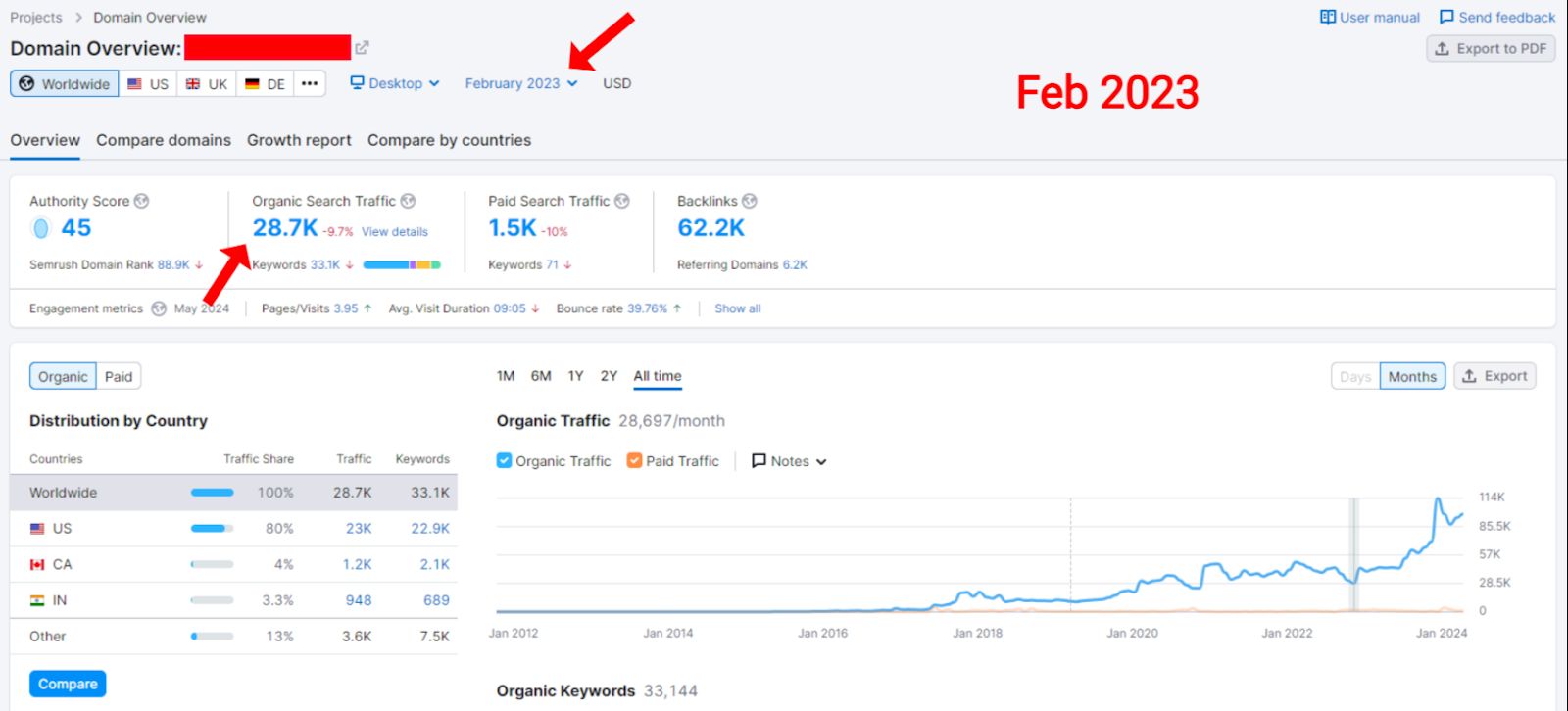
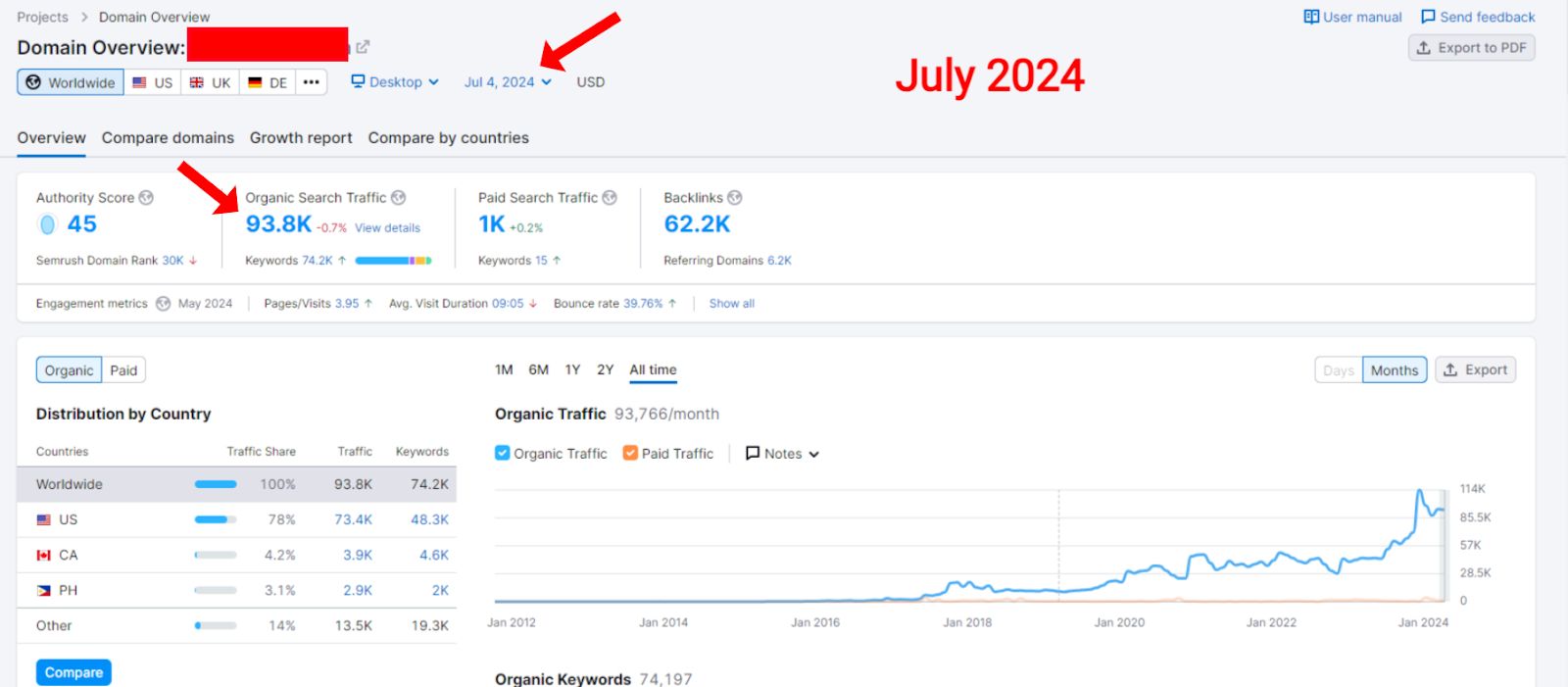
That’s roughly a 240% increase in monthly organic traffic
The site’s keyword universe grew from 33,000+ to 74,000+ total ranking keywords (a net gain of 41,000+)
From Google Search Console:
Daily clicks climbed from ~1,200 to 3,000+
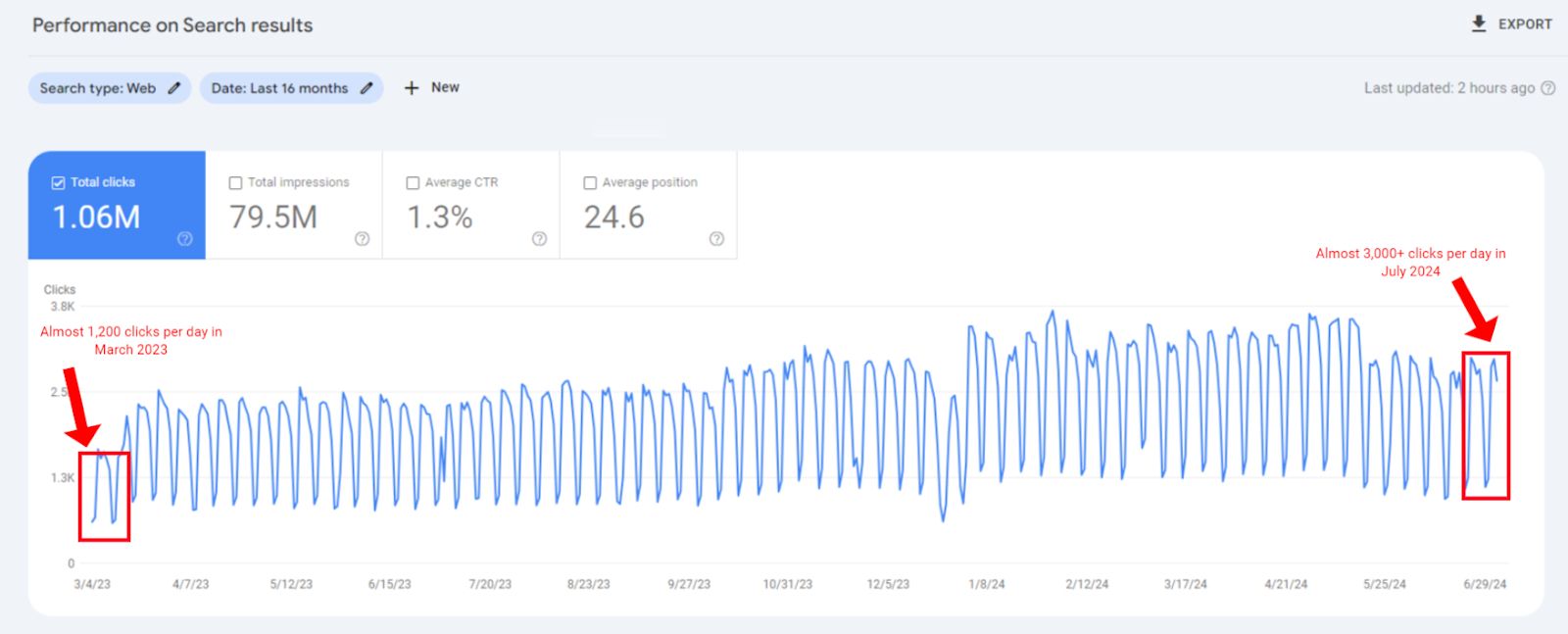
Daily impressions rose from 90,000+ to 200,000+
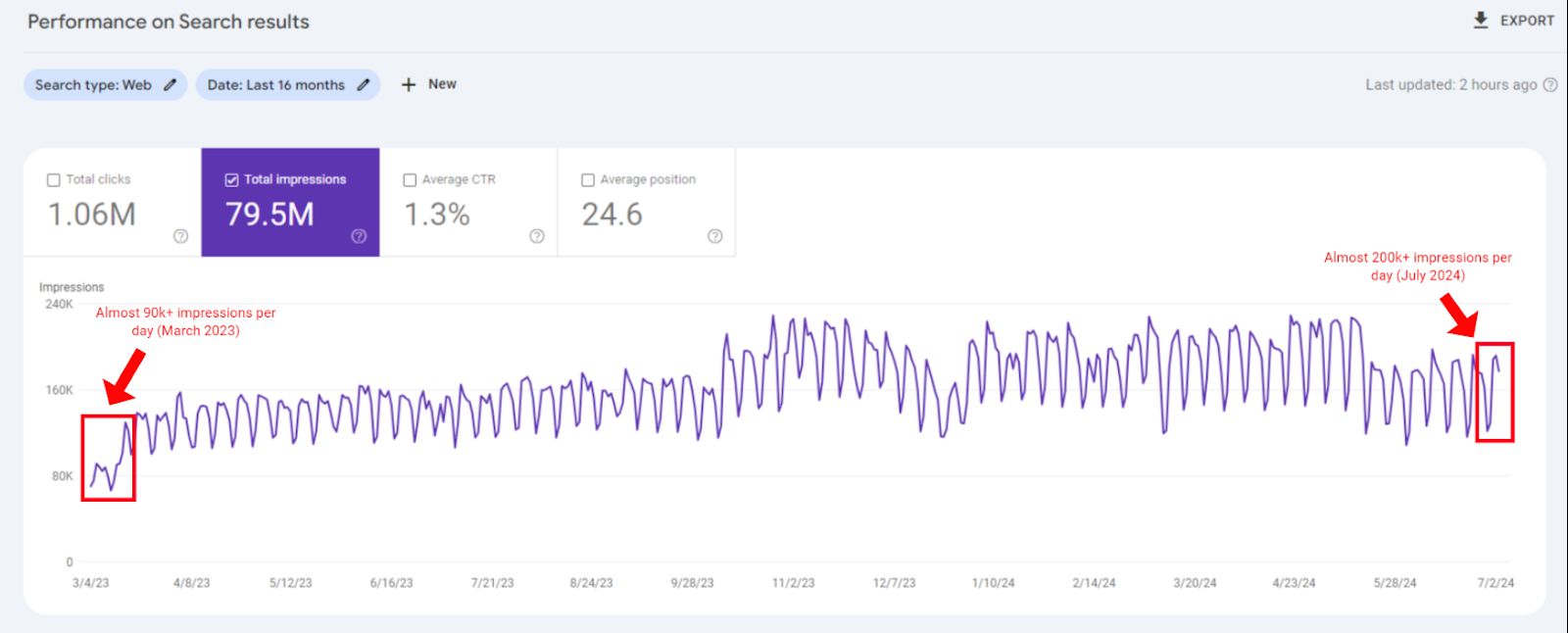
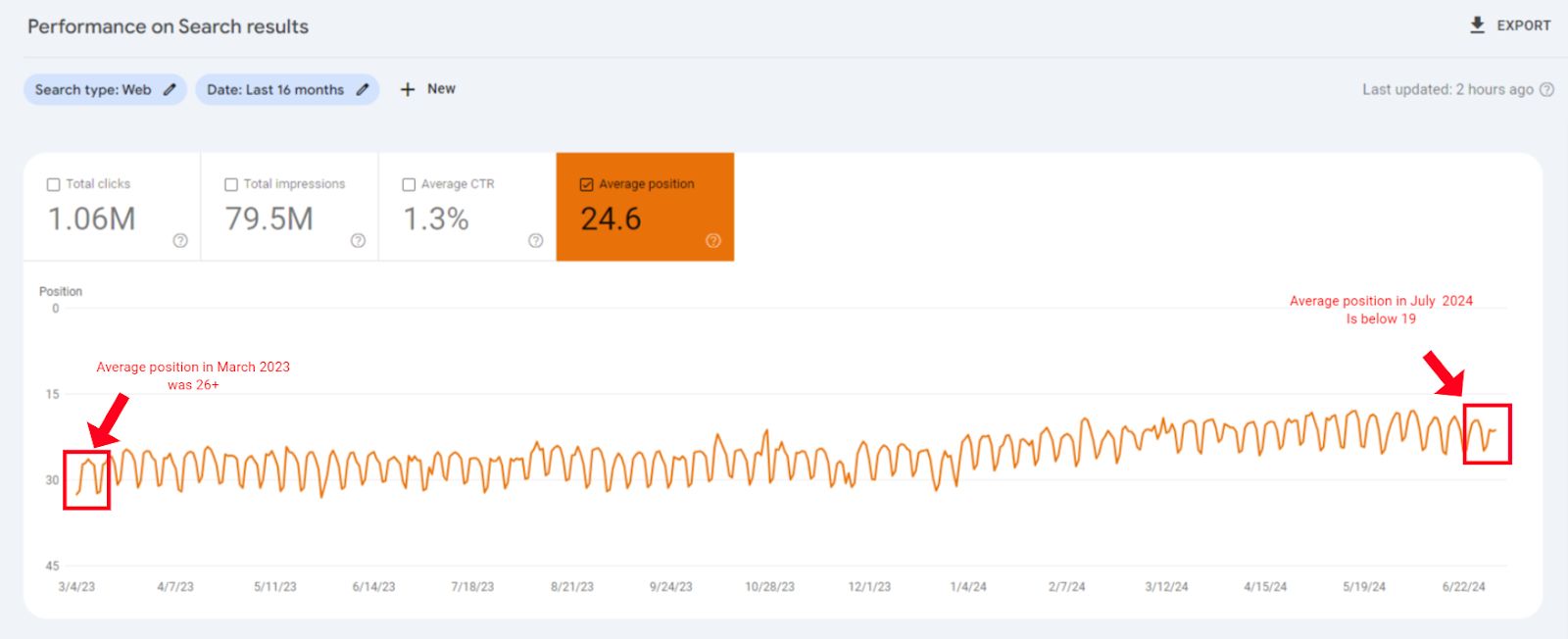
Average position for revised blog pages improved significantly, moving from the mid-20s closer to the teens
Impact of Revising 85 Existing Posts
Comparing before vs. after for the 85 revised posts:
- Impressions
- Before: 1,591,027
- After: 5,489,369
- +245% increase
- Clicks
- Before: 4,400
- After: 27,846
- +532% increase
- Keyword volume
- Before: 12,765
- After: 29,268
- +129% increase
💡 Put simply: Upgrading 85 posts unlocked over 3.8M new impressions and 23,000+ extra clicks — without adding hundreds of new, low-quality URLs.
Performance of the 48 New Posts
The 48 new posts delivered:
- 457,852 impressions
- 2,981 clicks
- 4,129 new ranking keywords
They also expanded Buddy Punch’s topical footprint around:
- Time tracking
- Workforce management
- Scheduling & payroll integrations
Why This Worked (Especially in the AI/LLM Era)
Perfect Fit with Google’s Helpful Content & Search Essentials
Google’s ranking systems now lean heavily on helpful, reliable, people-first content, as outlined in:
Buddy Punch’s revised content:
- Answered real user problems in depth
- Demonstrated experience and trustworthiness (E-E-A-T)
- Removed or consolidated thin, overlapping posts that hurt overall site quality
That’s exactly what Google’s Helpful Content System and related guidance reward.
Semantic SEO & Topical Authority
By restructuring posts using semantic SEO (entities, topics, intent), Buddy Punch:
- Became a stronger authority around time tracking and workforce topics
- Earned more visibility across long-tail and related queries — not just the head term
This mirrors what guides like Search Engine Land’s Semantic SEO: how to optimize for meaning over keywords describe: building richer, entity-driven content that ranks higher and supports AI and GEO use cases.
We describe a similar approach in our own posts on structuring AI-era AEO content and our AEO SEO playbook for AI answers & citation.
AI Search Changed Discovery — It Didn’t Kill SEO
Generative AI search (ChatGPT, Gemini, AI Overviews, etc.) has changed how people discover content, but research shows that top organic results are still heavily reused inside AI answers — SEO and AI visibility are now intertwined.
Search Engine Journal’s piece on how AI will impact SEO and later research on AI answers and rankings both point to the same conclusion: strong traditional SEO directly supports AI visibility.
Because Buddy Punch’s content now:
- Is structured clearly
- Answers questions directly
- Shows expertise and product context
…it’s far better positioned to be surfaced both in classic SERPs and inside AI-generated answers and summaries.
We expand on this “SEO + AI visibility” intersection in our own guide to SEO strategies for AI visibility.
CRO + Product-Led SEO Made the Traffic Count
Because we treated every article like a mini landing page:
- Traffic from both revised and new posts wasn’t just “pageviews.”
- It fed users into trials, demos, and pricing pages for Buddy Punch.
That mix of SEO + CRO, which we also outline on our CRO + product-led content page, is why Buddy Punch’s content is now tied directly to revenue, not just rankings.
Key Takeaways for Time-Tracking & Workforce SaaS
From Buddy Punch’s experience, a few clear lessons emerge:
- You can’t out-publish a misaligned strategy. 800+ posts and 8–10 new articles/month didn’t fix stagnation; targeted revisions did.
- Semantic, people-first content beats keyword dumping. Deep, well-structured posts that map to real jobs-to-be-done outperformed thin, generic content.
- AI search raises the bar but doesn’t replace SEO. The same structure and quality that help in Google now help in AI answer engines too.
- Blogs must convert, not just educate. Product-led, CRO-aware content is why this traffic turned into actual sign-ups and revenue, not just sessions.
Want Buddy Punch-Level Results for Your SaaS?
If you’re running a time tracking, workforce, PSA, or adjacent B2B SaaS and:
- Your blog is huge but flat in traffic
- Competitors outrank you with fewer posts
- Organic visits don’t turn into trials or MRR
…you don’t need more chaos. You need a focused, AI-ready, product-led content strategy like Buddy Punch’s.
👉 Start with a quick audit or strategy session: Book a call with The Rank Masters and we’ll show you how this framework would look for your SaaS — from content audit & fix sprint to ongoing SaaS content marketing and Answer Engine Optimization.