

AI search visibility is now a revenue problem.
Your buyers aren’t just Googling, they’re asking ChatGPT, Perplexity, and Google’s AI experiences to shortlist vendors, recommend tools, and summarize “best options.”
If your brand doesn’t show up (or shows up inaccurately), you lose pipeline before anyone clicks your site.
That’s why AI Visibility Optimization Platforms (also called AEO/GEO platforms) are exploding: they help you see where you’re mentioned, what sources the AI cites, and what to change to earn more inclusion and better positioning.
What you’ll get in this comparison (buyer-focused):
- A side-by-side table of leading platforms
- Honest tradeoffs across coverage, accuracy/defensibility, UX/workflows, and pricing bands
- A clear “best for” shortlist (startup vs agency vs enterprise)
- A 30-day evaluation plan so you don’t get trapped in demos
Need help picking the right platform for your use case? Book a call.
What “AI Search Visibility” Actually Means
How often—and how—your brand appears inside AI-powered search experiences (e.g., AI Overviews and chatbots like ChatGPT, Gemini, Perplexity), including the language used and the sources cited.
👉 GEO / AEO (Generative / Answer Engine Optimization)
The practices that increase the chance AI systems choose and cite your brand as an answer (similar spirit to SEO, but focused on generated answers rather than blue-link rankings). Learn more about TRM’s Answer Engine Optimization.
👉 AI Visibility Tools / Platforms
Software that monitors and analyzes where and how your brand appears across AI search experiences—often across multiple engines/models.
👉 Why these definitions matter (buyer clarity):
They tell you what you’re actually buying:
- A measurement layer (tracking mentions/citations/share-of-answer)
- An optimization workflow (turning changes into weekly actions)
- Sometimes, an infrastructure layer (changing how agents/LLMs access or interpret your site)
If you’re evaluating platforms right now, you can also review TRM Pricing or Book a call to get a shortlist recommendation for your budget and team setup.
The 5 leading AI Visibility Optimization Platforms (2026 Shortlist)
We picked five contenders that appear repeatedly in real buyer shortlists:
💡 Key takeaways
- Profound is an enterprise-first platform with broad module depth (visibility + agent analytics + prompt volumes + shopping).
- Scrunch is differentiated by AXP, a parallel AI-ready site layer—powerful if you want more than dashboards.
- BrightEdge AI Catalyst is best for enterprises consolidating AI visibility inside an existing SEO platform.
- Authoritas stands out for defensible hybrid capture (API + UI crawl tiers) and transparent credit-based pricing.
- Peec is the best “fast start” option for startups/SMEs thanks to clear pricing and a simple weekly workflow.
1. Profound
What it does?
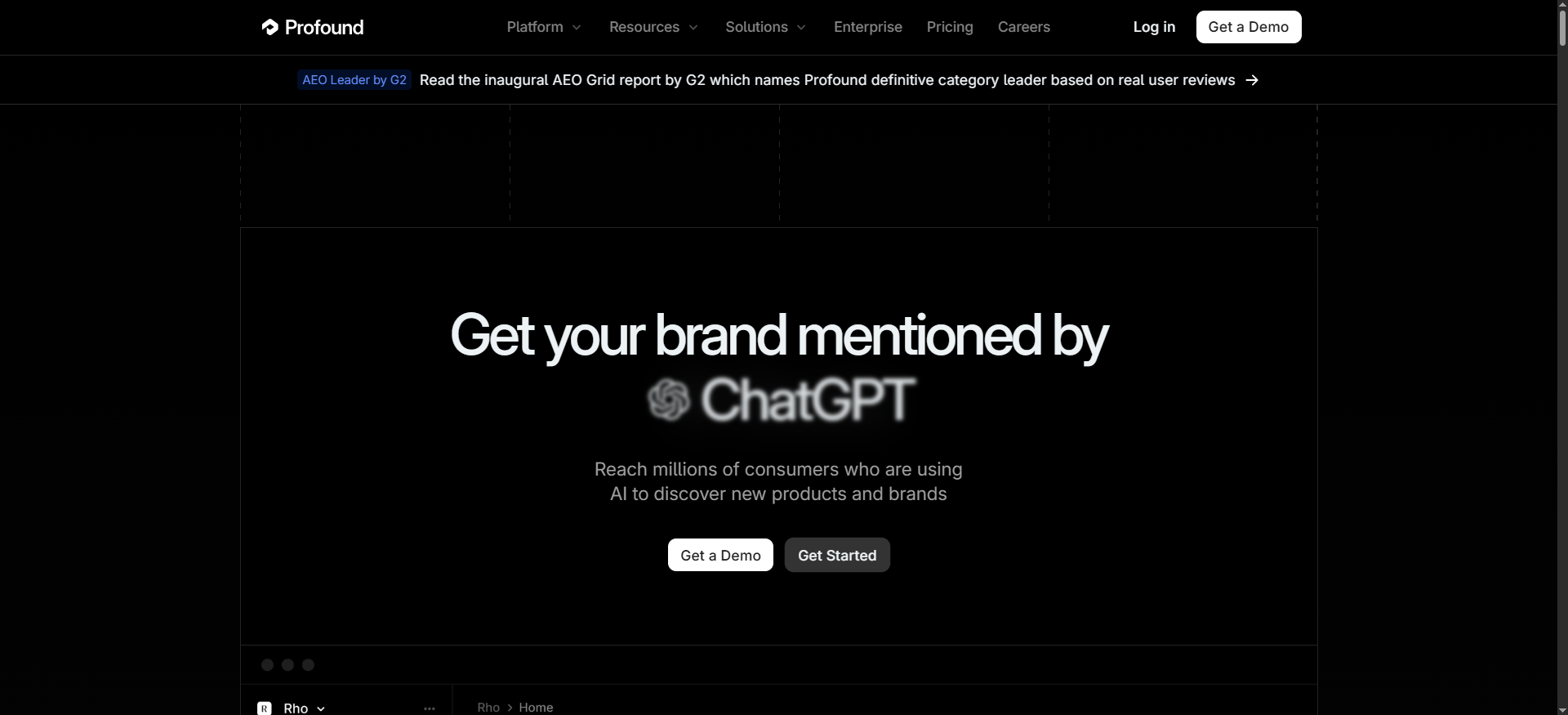
Profound is an enterprise AI visibility platform that tracks how your brand appears in AI answers and what sources/citations drive that visibility. It’s built for measuring share-of-answer across engines and turning insights into repeatable reporting and workflows.
Why teams use it?
Teams use Profound when AI visibility is a strategic channel and leadership wants defensible, consistent measurement. It’s commonly shortlisted by orgs that need more than “mentions”—they want source-level clarity and enterprise-grade governance.
Who is this tool for (ICP)?
Best when you need enterprise rigor, cross-team reporting, and scale.
- Enterprise SEO/AEO teams
- Brand/Comms teams managing narrative risk
- Large sites with multiple products/regions
How this tool fits in this AI-first era?
AI answers compress the funnel, so “being cited” matters as much as ranking. Profound supports this shift by measuring visibility at the answer/citation layer. It also fits teams that treat AI visibility as an ongoing program with governance and reporting.
- Track share-of-answer
- Focus on citations/sources
- Operationalize weekly reporting
How does Profound work?
You define topics/prompts → Profound captures answers/citations → you identify gaps vs competitors → you execute content/PR/tech actions and track movement over time.
Free tier? No.
Strengths?
- Strong enterprise posture & workflows
- Source/citation-driven visibility insights
- Built for scale (teams, markets, reporting)
Weaknesses?
- Often sales-led / not “lightweight”
- Higher price band vs SMB tools
- Overkill for small prompt sets
Key Capabilities?
Core features most buyers care about.
- AI visibility tracking (mentions/citations)
- Competitive visibility benchmarking
- Stakeholder-ready reporting
Pricing snapshot?
- Lite — from $499/mo
- Agency Growth — $1,499/mo
- Enterprise — custom
Best for?
Enterprises that need defensible AI visibility measurement and governance, and have the resources to act on insights across SEO, content, and PR.
2. Scrunch
What it does?
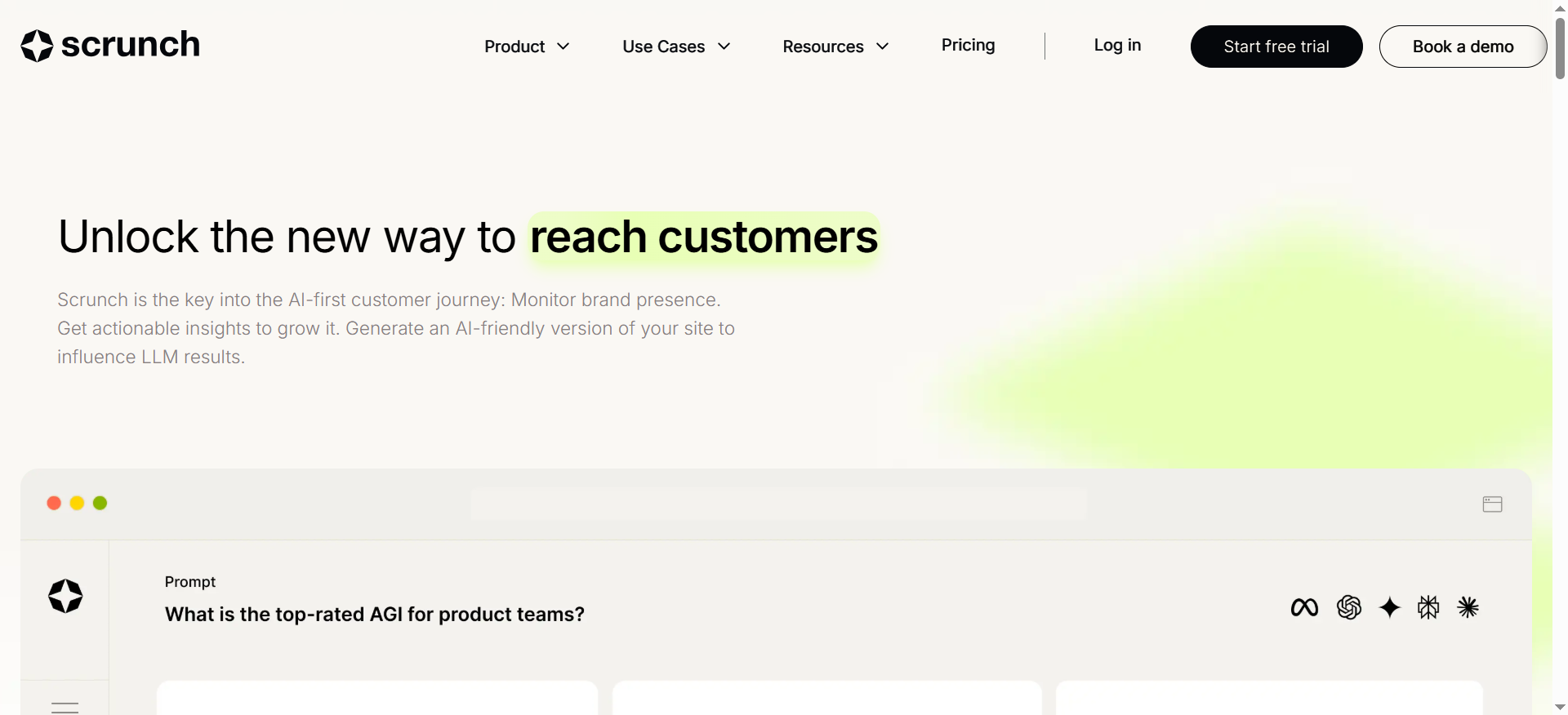
Scrunch tracks brand visibility across major AI engines and helps teams monitor prompts, sources, and performance over time. It’s positioned as both measurement + operational workflow for AEO/GEO programs.
Why teams use it?
Teams choose Scrunch for broad engine coverage and a clear workflow (prompts, personas, audits, reporting). It’s also popular because pricing and packaging are easier to understand than many enterprise-only options.
Who is this tool for (ICP)?
Great for teams building a repeatable cadence.
- Growth-stage marketing/SEO teams
- Content teams running buyer-journey prompt sets
- Agencies needing client reporting
How this tool fits in this AI-first era?
AI discovery happens across multiple engines, so you need cross-platform prompt monitoring—not just Google features. Scrunch supports this with structured prompt/persona tracking and reporting that teams can run weekly.
- Prompt-first visibility tracking
- Persona/journey segmentation
- Source-led optimization
How does Scrunch work?
Set prompts/personas → Scrunch monitors engines → you review gaps/sources → run audits and ship fixes → track visibility changes.
Free tier? No.
Strengths?
- 7-platform coverage list
- Clear tiered pricing
- Built-in reporting + audits
Weaknesses?
- Needs disciplined prompt libraries
- Enterprise features gated at higher tiers
- Not a full SEO suite replacement
Key Capabilities?
Practical AEO operating features.
- Prompt monitoring + personas
- Source visibility & reporting
- Page audits
Pricing snapshot?
- Starter — $300/mo
- Growth — $500/mo
- Pro — $1,000/mo
- Enterprise — custom
Best for?
Teams that want broad AI engine monitoring plus a structured workflow (prompts → insights → audits → reporting) without jumping straight to heavy enterprise procurement.
3. BrightEdge AI Catalyst
What it does?
BrightEdge AI Catalyst brings AI search visibility into the BrightEdge enterprise SEO platform—tracking presence and enabling prompt research and optimization workflows. It’s designed for large org governance and reporting.
Why teams use it?
Teams use it when they want AI visibility inside an established enterprise SEO operating system. It reduces tool sprawl and supports executive-friendly reporting in one place.
Who is this tool for (ICP)?
Best for enterprise SEO environments.
- Enterprises already using BrightEdge
- Global teams needing centralized reporting
- Orgs standardizing on one SEO platform
How this tool fits in this AI-first era?
AI visibility is becoming part of enterprise organic performance reporting. AI Catalyst fits by embedding AI-engine tracking and prompt research into existing governance workflows, so AI search isn’t managed as a side project.
- Centralize AI visibility reporting
- Connect to enterprise SEO operations
- Standardize processes globally
How does AI Catalyst work?
Use BrightEdge for prompt research → track visibility across supported engines → apply recommendations via SEO workflows → report through enterprise dashboards.
Free tier? No (enterprise).
Strengths?
- Integrated with BrightEdge platform
- Prompt research + unified visibility
- Stakeholder-ready governance
Weaknesses?
- Sales-led pricing
- Overkill for SMBs
- Best value if you’re already a BrightEdge org
Key Capabilities?
Enterprise AI search workflow features.
- Prompt research (Copilot-led)
- Visibility across key AI engines
- Reporting & governance
Pricing snapshot?
- BrightEdge platform (incl. AI Catalyst) — Custom / contact sales
Best for?
Enterprises that want AI visibility integrated into their existing BrightEdge SEO stack and need governance, reporting, and scale more than a lightweight prompt tracker.
4. Authoritas
What it does?
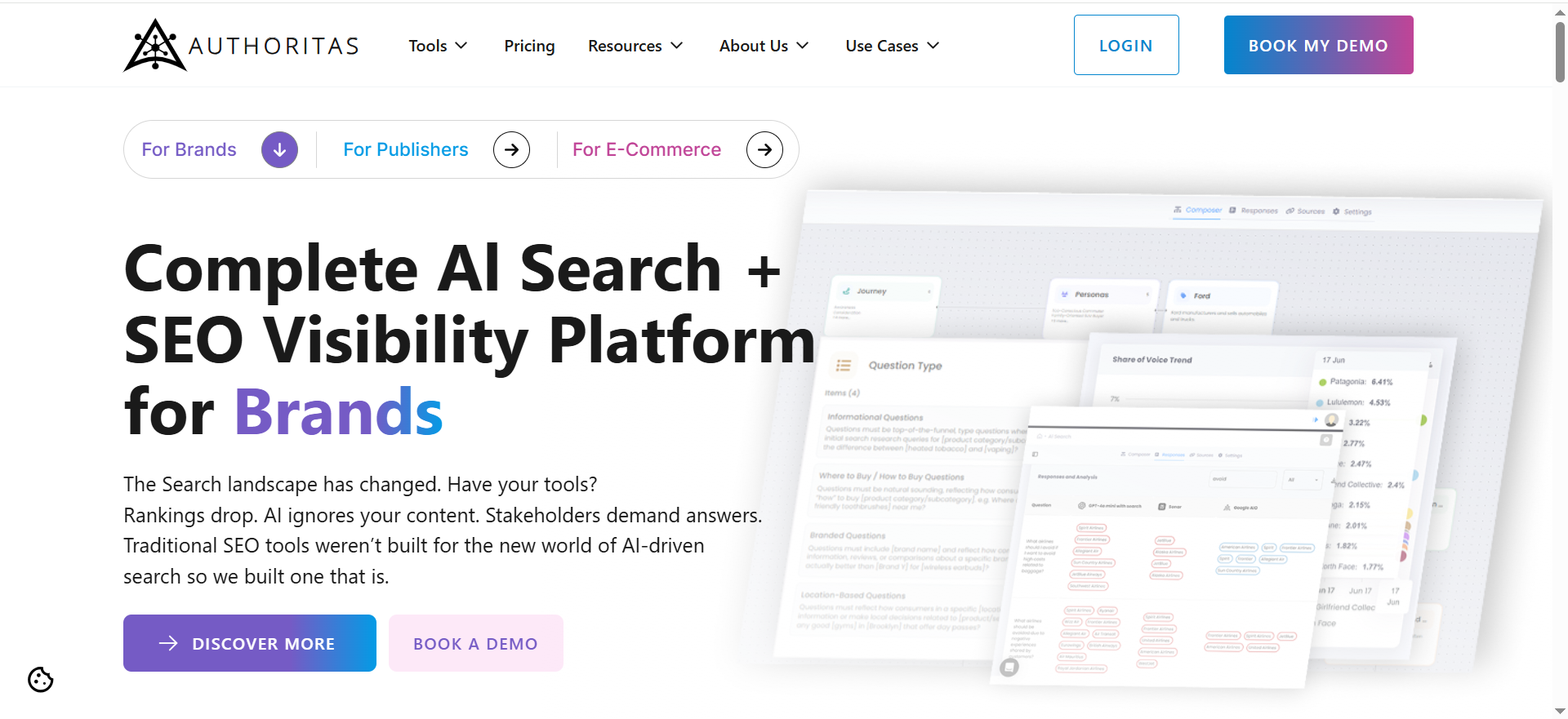
Authoritas tracks AI search visibility across multiple engines and supports structured prompt testing with competitive comparisons. It’s notable for clearly distinguishing API-based vs UI-crawled tracking tiers for more defensible “what users see” measurement.
Why teams use it?
Teams use Authoritas when they want configurable testing, transparent usage-based pricing (credits), and a credible measurement method across engines. It’s a strong fit for teams that want to start small, prove value, and scale coverage predictably.
Who is this tool for (ICP)?
Built for teams that like structured measurement and cost control.
- Growth SaaS SEO/content teams
- Agencies and analysts
- Teams needing UI crawl evidence for stakeholders
How this tool fits in this AI-first era?
AI answers vary and stakeholders demand proof. Authoritas fits by offering UI-crawl tiers for real-interface visibility, plus a credit model that makes experimentation budgetable.
- Defensible reporting (UI crawl options)
- Prompt libraries as the new “keyword set”
- Scalable measurement without enterprise lock-in
How does Authoritas work?
Build prompt sets → choose models/tiers → run tracking via API/UI crawl → compare SOV and sources → iterate and measure movement.
Free tier? Yes.
Strengths?
- Free plan available
- UI crawl tier listing (ChatGPT, Google AI Mode/AIO, Perplexity, etc.)
- Clear credit-based pricing
Weaknesses?
- Prompt sprawl can increase cost
- Some capabilities gated at higher tiers
- Requires thoughtful prompt design
Key Capabilities?
Core measurement and comparison features.
- Multi-engine prompt tracking
- Competitive visibility/SOV views
- Flexible scheduling + model selection
Pricing snapshot?
- Free — 50 credits — £0
- P1 — 2,000 credits — £89/mo
- P2 — 6,000 credits — £229/mo
- P3 — 15,000 credits — £379/mo
Best for?
Teams that want measurable AI visibility with transparent scaling and the option to use UI-crawled evidence for stakeholder trust—especially agencies and growth-stage SaaS orgs.
5. Peec
What it does?
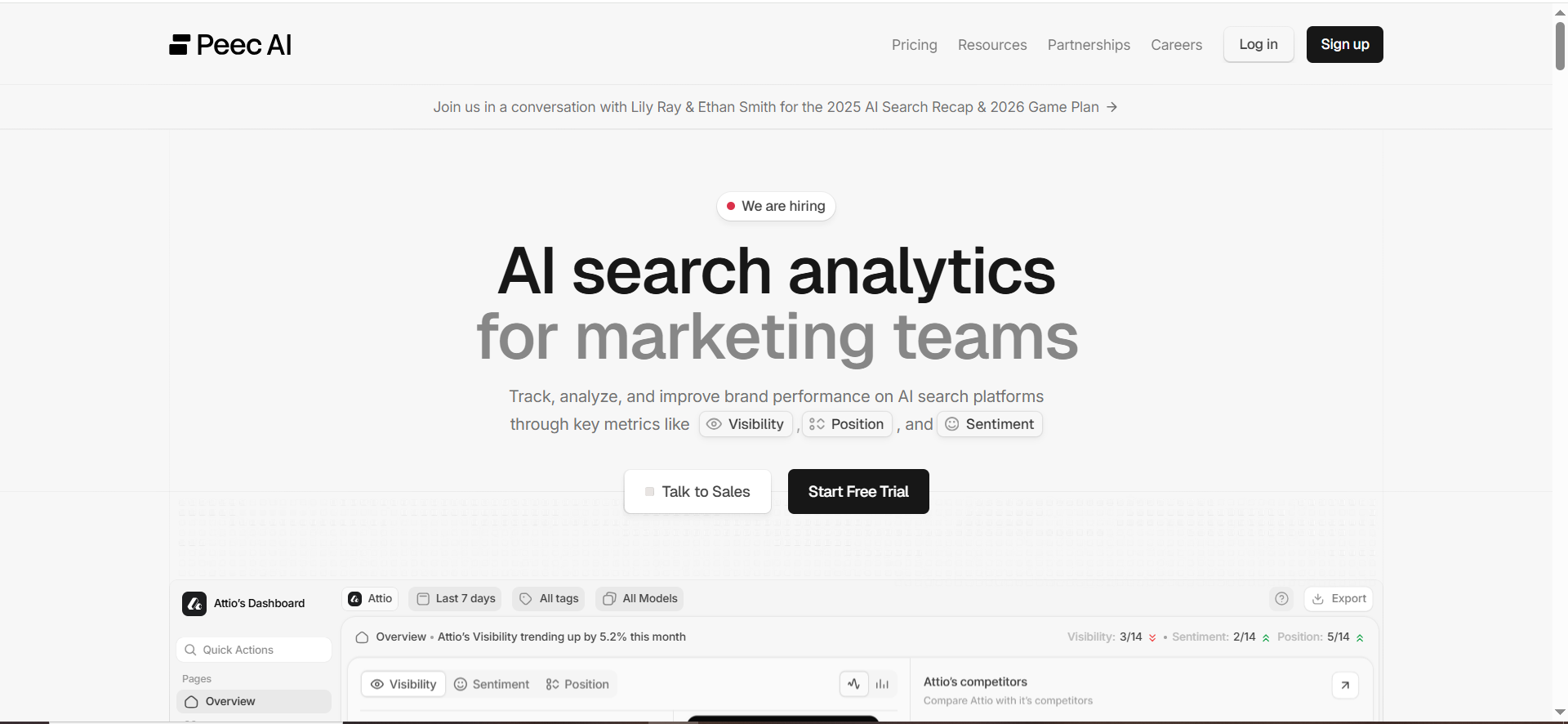
Peec is a prompt-based AI search analytics tool that tracks visibility across key AI engines on a recurring cadence (daily runs). It’s designed to be simple: prompts → answers analyzed → visibility insights and progress tracking.
Why teams use it?
Teams use Peec because it’s fast to adopt and pricing is clear. It works well for building a weekly operating rhythm without buying a full enterprise SEO suite.
Who is this tool for (ICP)?
Best for teams that want speed + clarity.
- Startups/SMBs and lean marketing teams
- Content/SEO teams starting AEO tracking
- Teams wanting predictable monthly pricing
How this tool fits in this AI-first era?
AI visibility needs a simple baseline and frequent monitoring. Peec fits by making prompt-based tracking easy to run daily, so teams can detect movement and tie it to changes they ship.
- Fast baseline creation
- Daily monitoring habit
- Expand coverage as ROI proves out
How does Peec work?
Add prompts → Peec runs them daily on supported engines → it analyzes answers → you track visibility changes and iterate.
Free tier? No (paid plans; “start free” may indicate trial).
Strengths?
- Transparent tiers and limits
- Daily runs + answer analysis
- Collaboration-friendly packaging
Weaknesses?
May be lighter than enterprise suites.
- Advanced governance/integrations may be limited
- Broader engine coverage is more enterprise/add-on
- Requires your own action playbook
Key Capabilities?
Core prompt-monitoring stack.
- Prompt libraries + recurring runs
- Visibility tracking across core engines
- Reporting suitable for weekly ops
Pricing snapshot?
- Starter — €89/mo
- Pro — €199/mo
- Enterprise — €499+/mo
Best for?
Startups and SMBs that want a clean, prompt-based AI visibility tracker with transparent pricing and a simple workflow they can run weekly—without enterprise procurement friction.
Why Buyers Are Now Searching “AI Visibility Platform” (and not Just “SEO Tool”)
Traditional SEO tools answer questions like:
- “Where do we rank for keywords?”
- “How much organic traffic did we earn?”
- “Which pages need on-page improvements?”
AI visibility platforms answer a different set of questions:
- “Do AI engines mention us for high-intent prompts?”
- “What do they say about us (positioning + sentiment)?”
- “Which sources do they cite—and are we one of them?”
- “How does visibility differ by engine (ChatGPT vs Google AIO vs Perplexity)?”
- “What should we change to increase inclusion and citations?”
The key shift: you’re no longer competing for clicks—you’re competing for inclusion in the answer.
▶️ If you’re building this capability in-house, start with an Answer Engine Optimization operating model (prompt library → citations → actions → weekly reporting).
The KPI That Matters Most: AI Share of Voice
If you track only one KPI, make it AI Share of Voice (SoV):
The percent of your tracked prompts where your brand is mentioned/cited compared with your competitors.
Under the hood, serious teams break this into supporting metrics:
- Presence: are you included at all?
- Position / prominence: are you first, or buried?
- Citation share: which domains are cited—and how often?
- Sentiment / framing: are you described correctly and favorably?
The best platforms let you segment these by persona, journey stage, topic cluster, and engine—because “visibility” is meaningless unless it maps to pipeline reality (pricing prompts, alternatives prompts, integration prompts, category definition prompts, etc.).
👉 Want TRM to benchmark your SoV + citation gaps and hand you a prioritized fix plan? See the SaaS Content Audit Fix Sprint or Book a call.
How we Evaluated Platforms (so the Comparison is Fair)
TRM’s tool coverage rule is simple: evaluate on criteria, not vibes.
▶️ Our Evaluation Criteria
We compared platforms across four categories buyers care about most:
- Coverage Which AI engines are supported (ChatGPT, Google AI Overviews/AI Mode, Perplexity, Gemini, Claude, Bing/ Copilot, etc.) and whether tracking is prompt-level.
- Accuracy & defensibilityHow the platform captures answers:
- API-based (faster, cheaper, sometimes less “real-world”)
- UI crawling (more realistic to what users see, more expensive/complex)
- Hybrid (often best for decision-grade reporting)
Authoritas, for example, explicitly distinguishes API models vs UI Crawl models (including ChatGPT and Google AIO/AI Mode).
- UX & workflow depthCan your team actually operate this weekly?
- prompt libraries
- competitor sets
- segmentation
- exports/integrations
- collaboration & reporting
- Pricing bandsNot “exact price” (these change constantly), but realistic entry points and how pricing scales with prompts/answers/teams.
▶️ Independence Note
This is an evaluator-style guide: structured, transparent, and designed to build trust with both SaaS buyers and vendors.
🤙 If we ever have partnerships with tools, we still apply the same rubric and disclose relationships where relevant. If you want help shortlisting without sales pressure, Book a call.
Which Platform Should you Choose? (Decision Guide)
Instead of “best overall,” choose based on your operating model.
If you’re an Enterprise SEO / Growth Org
You need:
- defensible data (often UI crawl or hybrid)
- governance + reporting
- security (SSO/SOC2)
- cross-functional workflow support
Shortlist: Profound (enterprise posture), BrightEdge AI Catalyst (suite integration), Authoritas (explicit UI Crawl + credits)
If you’re a Growth-Stage SaaS Team
You need:
- speed (fast onboarding)
- clear pricing
- prompt libraries aligned to pipeline (alternatives, pricing, integrations, category prompts)
Shortlist: Peec (fast workflow + transparent pricing), Authoritas (transparent scaling + hybrid capture), Scrunch (if you want to go beyond dashboards)
If you’re an Agency
You need:
- multi-client reporting
- exports
- clean narratives (“here’s what moved, here’s why, here’s what we’ll do next”)
Shortlist: Authoritas (credits + scheduling + citations), Peec (agency pitch workspaces), Profound (for enterprise accounts)
A 30-day Evaluation Plan (so you Don’t Get Trapped in Demos)
Most teams fail tool selection because they test the wrong thing. Here’s the simplest evaluation flow:
Week 1: Build the Prompt Library (your “AEO Keyword Set”)
Create 50–150 prompts split into:
- Category definition prompts (“What is X? Best X tools?”)
- Alternatives prompts (“X alternatives”, “X vs Y”)
- Pricing prompts (“X pricing”, “cost of X”)
- Integration prompts (“X integrates with Y?”)
- Use-case prompts (“Best X for mid-market”, “Best X for agencies”)
Output at end of Week 1: a prompt spreadsheet + naming convention + owners.
👉 If you need a working system for prompt libraries + citations, follow the TRM AEO playbook.
Week 2: Benchmark and Tag
For each prompt, tag:
- persona (CIO vs CMO vs RevOps vs SEO lead)
- journey stage (awareness vs consideration vs decision)
- competitor set (3–8 key vendors)
Week 3: Validate Accuracy
Ask each vendor:
- Is this API-based or UI-crawled?
- Can I re-run prompts and see volatility over time?
- Can I inspect citations/source URLs?
- Can I export raw answers for auditability?
Non-negotiable: If you’re considering tools where UI crawl vs API is tiered, confirm your must-have engines are included in the tier you’re buying.
👉 If you want TRM to build the prompt library + benchmark + citation gap analysis for you, see the SaaS Content Audit Fix Sprint.
Week 4: Run the “Weekly Workflow” Test
The tool is only “good” if your team can do this weekly:
- Spot 5–10 prompt drops
- Identify why (citations changed? competitor gained sources? your page lost retrieval?)
- Turn it into actions (content updates, digital PR, structured data, internal linking, page improvements)
Demo Questions that Cut Through Vendor Fluff
Use these questions in every demo (and don’t accept vague answers):
- Coverage: Which engines are supported today, and which are “coming soon”? (Scrunch, for example, lists its current seven platforms publicly.)
- Data capture: Is this UI crawl, API, or hybrid? Show me which engines are UI crawled. (Authoritas makes this explicit.)
- Citations: Can I see exact source URLs per answer and aggregate citation share?
- Segmentation: Can I slice reporting by persona, stage, market, and competitor set?
- Governance: How do you prevent prompt sprawl (and cost sprawl)?
- Exports: Can I export raw answers + metadata for auditing or BI?
- Actionability: What does the platform recommend, and how does it tie to pages/entities/sources?
👉 (If you’re setting up the program end-to-end, start with TRM’s Answer Engine Optimization framework.)
Frequently Asked Questions
What’s the Difference Between GEO/AEO and SEO?
Why Does “UI Crawling” Matter?
Which Platform has the Most Transparent Pricing?
What’s a Realistic “Starter” Budget?
How Many Prompts Should we Track?
Can These Tools Guarantee we’ll “Rank” in AI Answers?
What’s the Fastest Way to Make Progress if we don’t Have Bandwidth?
Final Thoughts
AI visibility is quickly becoming a category-defining channel: buyers are getting recommendations and shortlists from answer engines before they ever hit your site. That means the goal isn’t just rankings anymore—it’s consistent inclusion, accurate positioning, and citation share across the AI surfaces your market actually uses.
If you’re choosing between the five tools in this comparison, use a simple rule:
- Need enterprise-grade governance and deep reporting? Start with Profound or BrightEdge AI Catalyst.
- Want broad engine coverage and an operator-friendly workflow? Look at Scrunch.
- Care most about defensible measurement and a transparent cost model? Authoritas is a strong contender.
- Want the fastest, simplest path to a weekly AEO rhythm? Peec is a clean starting point.
The most important takeaway: the tool only works if the workflow works. Build a prompt library tied to your buyer journey (category, alternatives, pricing, integrations), track weekly, and turn visibility shifts into specific actions—content improvements, authority building, and technical accessibility for AI crawlers.
▶️ If you want TRM to run the evaluation with you (prompt library → competitor benchmark → citation gaps → shortlist), start with an AI visibility audit or Book a call.