

Content auditing software refers to platforms that systematically assess your site’s written assets (typically blog posts, landing pages, product pages, or help docs) for performance, quality, and strategic alignment.
These tools are not like your common static analytics dashboards. These tools use algorithms to evaluate semantic depth, SEO structure, engagement signals, and increasingly, AI readability.
Modern content auditing tools perform tasks such as:
- Crawling and indexing your content library
- Scoring each page for factors like topic coverage, keyword intent, freshness, and NLP clarity
- Recommending actions like update, combine, redirect, or delete
- Visualizing opportunities for improving internal linking, authority flow, or topical clusters
There are generally two types:
- Crawler-based tools (e.g., Screaming Frog, Sitebulb) that focus on technical and metadata aspects
- NLP-based platforms (e.g., MarketMuse, Clearscope) that assess semantic coverage, topical gaps, and quality signals optimized for AI/LLM parsing
SaaS teams often choose content audit platforms that integrate with CMS, support bulk exports, and prioritize content scoring frameworks relevant to AI-first content strategies.
▶️ Best AI Search Visibility Tools: Compare & Track
What’s the best content auditing software for SaaS in 2025?
Choosing a content audit tool for a SaaS business means finding a platform that can handle content at scale, leverage AI-driven insights, and deliver measurable SEO improvements.
Based on expert reviews and user ratings, here are the top five content auditing tools in 2025 (with a focus on SaaS content needs):
| Tool | G2 Rating | Strengths | Drawbacks | Pricing |
|---|---|---|---|---|
| MarketMuse | 4.6/5 ★ (83 reviews) | AI-driven content strategy (content inventory, topic modeling) and deep content briefs; identifies content gaps and decay | High cost for full features; uses a credit system for queries | $600+ per month (Standard) |
| Surfer SEO | 4.8/5 ★ (537 reviews) | Excellent on-page optimization with real-time content scoring; intuitive UI with “gamified” feedback; includes an Audit tool for existing pages. | Pricing can be steep for small teams; focuses mainly on SEO text content (less on visuals/other formats). | $59+ per month (Basic) |
| Clearscope | 4.9/5 ★ (90+ reviews) | Easy for writers – Google Docs/WordPress integrations; powerful NLP term suggestions; content grading with readability metrics | Premium pricing (geared to mid-large companies); limited keyword research (focuses on optimization). | $170+ per month (Essentials) |
| Content Harmony | 4.9/5 ★ (Capterra) | Best-in-class for content briefs & outlines; pulls SERP data to build detailed briefs quickly (huge time saver for agencies) | Narrow scope – primarily a brief builder (not a full SEO suite); lacks its own writing or analytics engine | $10 trial for 10 briefs (then usage-based plans) – targeted at agencies (custom pricing). |
| Frase | 4.6/5 ★ (G2), 4.8/5 ★ (Capterra) | All-in-one content research, briefs, and AI writing assistant; great for answering user questions (FAQ generation) and optimizing content for snippets | Content scoring is not as advanced as Surfer/Clearscope; UI can feel less polished | $45+ per month (Individual) |
| AirOps | 4.8/5 ★ (G2) | AI Search/AEO visibility insights; end-to-end workflows for research, briefs, creation & refresh; templates, integrations, API access; supports team orchestration | Learning curve noted by reviewers; credit/task usage needs monitoring; some navigation/UX niggles reported | Starter (Free, $0); paid plans are custom (Scale/Agency). 14-day free trial of Scale |
1. MarketMuse
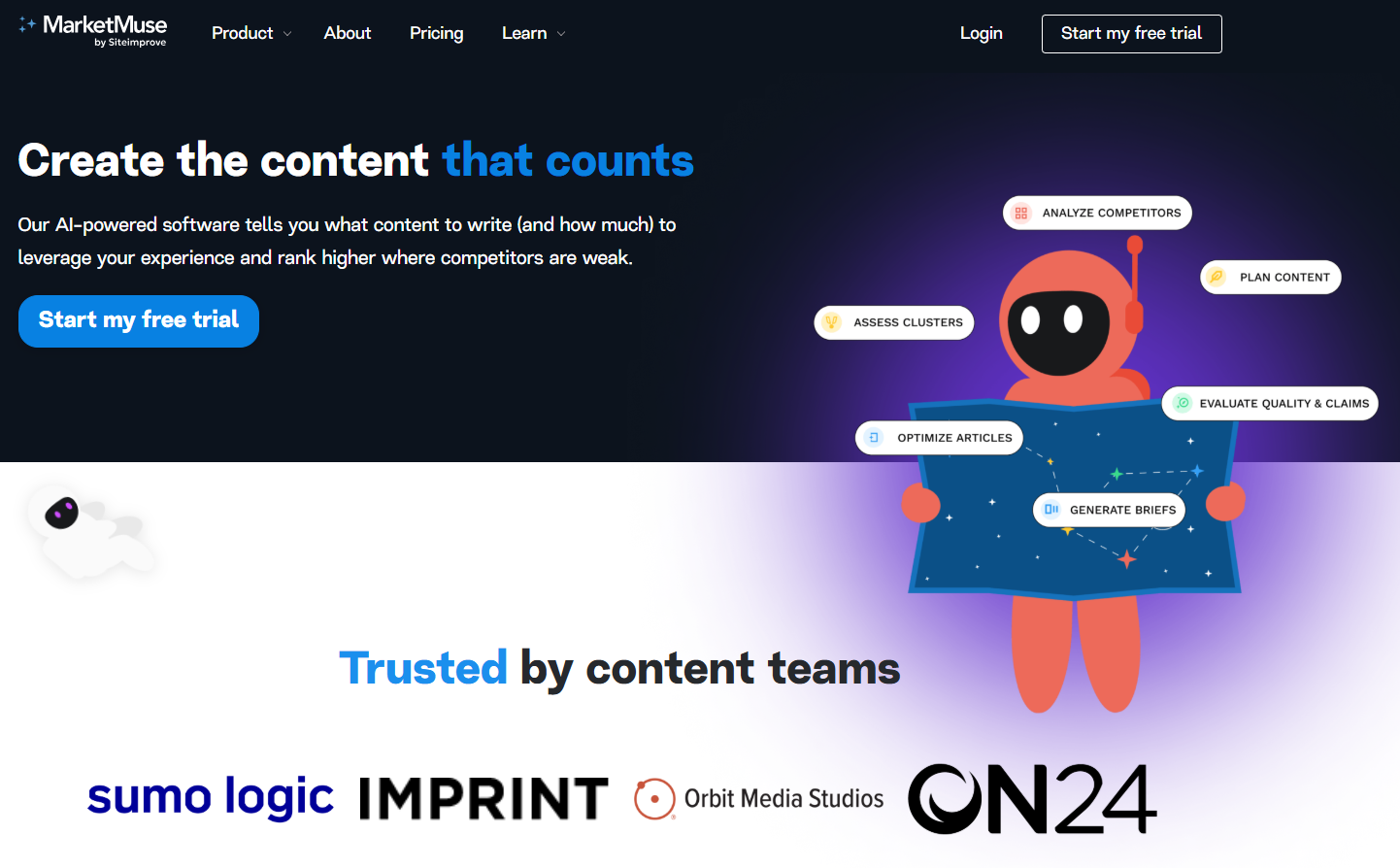
What it does?
Audits your content inventory and identifies topic gaps and optimization opportunities across a site. It’s built for prioritization and strategy, not just single-page tweaks.
Why teams use it?
Teams use it to decide what to refresh vs. create next and to build topic authority. It helps align resources to the highest-impact updates.
Who is this tool for (ICP)?
For teams managing lots of content and needing strategic direction.
- Content strategists / SEO leads
- Mid-market + enterprise content teams
- Agencies managing multiple sites
How this tool fits in this AI-first era?
AI-driven discovery rewards depth and coverage. MarketMuse helps you find missing subtopics and strengthen clusters so your site reads as more authoritative. It’s also useful to prevent “AI-scaled thin content” by guiding what deserves expansion.
- Supports topic depth + cluster planning
- Helps prioritize refresh vs. new content
How does the MarketMuse works?
Import inventory → analyze coverage/competition → follow prioritized recommendations.
Free tier? Yes
Strengths?
- Inventory-level insights
- Strong prioritization signals
Weaknesses?
- Premium/enterprise-leaning cost
Key Capabilities?
Strategy + coverage intelligence.
- Topic gap analysis
- Refresh prioritization
Pricing snapshot?
- Free: $0
- Optimize: $99/mo
- Research: $249/mo
- Strategy: $499/mo
Best for?
Large content libraries where choosing what to improve next matters as much as the edits themselves.
In short, MarketMuse is ideal for enterprise SaaS content teams that need a “command center” for content planning and audits.
2. Surfer SEO
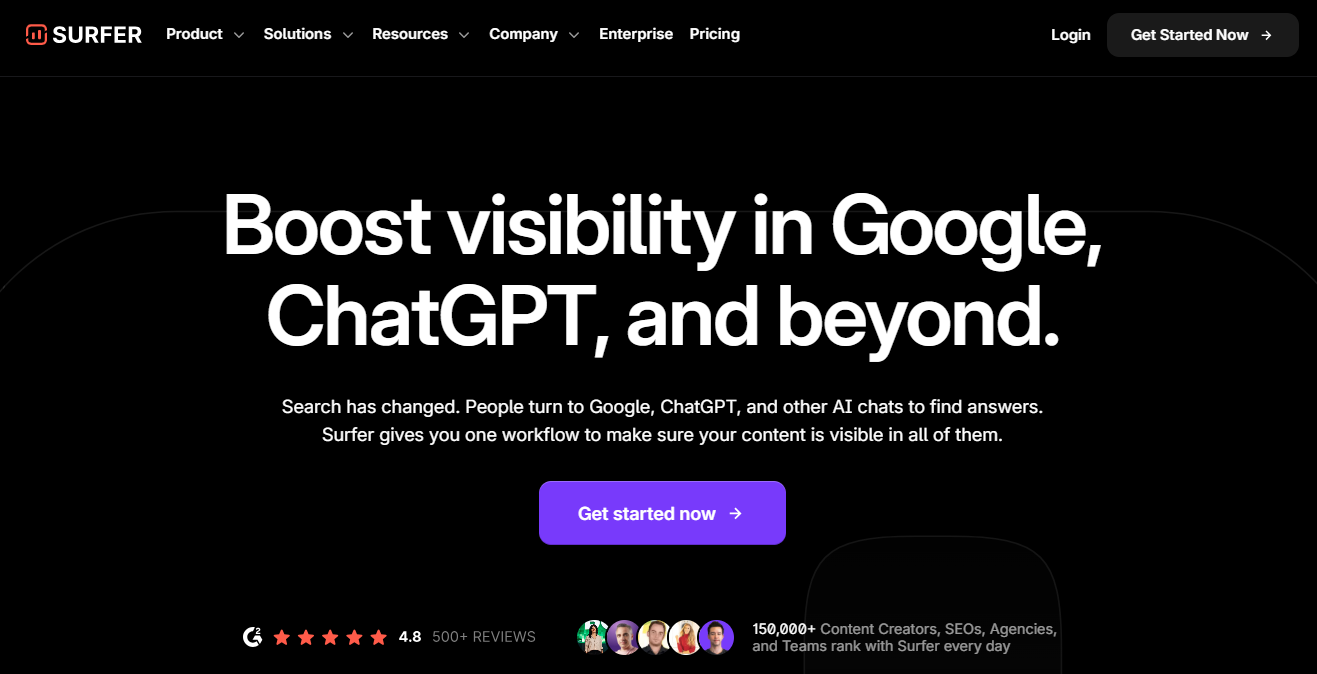
What it does?
Gives page-level audits and a real-time editor with SERP-based recommendations. It’s an execution tool for on-page optimization.
Why teams use it?
Teams use it to refresh pages quickly with clear, step-by-step guidance writers can follow.
Who is this tool for (ICP)?
For teams optimizing content frequently.
- SEO practitioners and content ops
- Writers/editors needing clear checklists
- Agencies shipping many updates
How this tool fits in this AI-first era?
AI answers reward pages that are well-structured and cover the right subtopics. Surfer helps ensure your content matches what top results include and is easier to “extract” from.
- Good QA layer on AI drafts
- Helps enforce consistent on-page standards
How does the Surfer SEO works?
Enter a keyword/URL → Surfer compares SERP leaders → edit until recommendations are met.
Free tier? No
Strengths?
- Real-time content editor
- Clear URL audit actions
Weaknesses?
- Costs can rise at scale.
Key Capabilities?
On-page execution toolkit.
- Content Editor + scoring
- Audit for existing URLs
Pricing snapshot?
- Essential: $99/mo (or $79/mo annual)
- Scale: $219/mo (or $175/mo annual)
- Enterprise: from $999/mo (annual)
Best for?
Teams doing frequent refreshes who want strong guidance per page without heavy strategy layers.
3. Clearscope
What it does?
Content optimization editor that grades content and recommends key terms and targets. Also supports refresh workflows by flagging content decay signals.
Why teams use it?
Easy for writers to adopt and standardize quality across a team. Useful for keeping content competitive over time.
Who is this tool for (ICP)?
For teams that want a clean, writer-first optimizer.
- Editorial + content marketing teams
- SEO teams running refresh programs
- Agencies with many writers
How this tool fits in this AI-first era?
AI search favors clear, complete coverage. Clearscope helps ensure pages include important concepts and remain readable—good for extraction/summaries.
- Standardizes quality even with AI drafts
- Helpful for refresh cadence
How does the Clearscope works?
Pick keyword → write in editor → follow term/grade targets.
Free tier? No
Strengths?
- Easy adoption
- Grading + term guidance
Weaknesses?
- Can be pricey for smaller teams.
Key Capabilities?
Optimization + refresh readiness.
- Content grading + term recommendations
- Content decay indicators
Pricing snapshot?
- Essentials: $129/mo
- Business: $399/mo
- Enterprise: Custom
Best for?
Teams that want a premium, writer-friendly optimization standard and are okay paying for simplicity + consistency.
4. Content Harmony
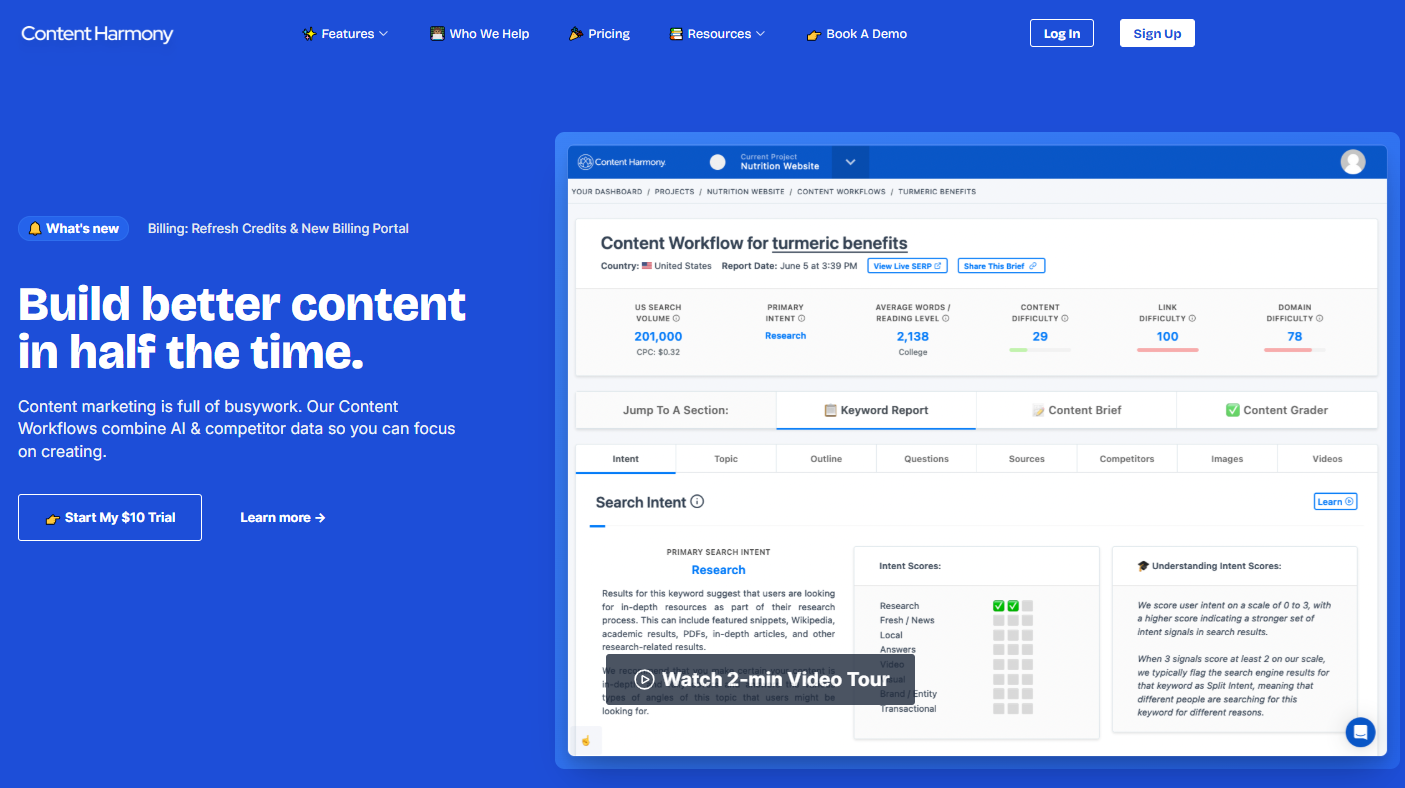
What it does?
Creates research-backed content briefs by pulling SERP headings, questions, and intent signals. It’s a brief builder, not a full SEO suite.
Why teams use it?
Saves hours on outlining and keeps briefs consistent across writers. Great when briefing is the bottleneck.
Who is this tool for (ICP)?
For teams producing lots of content and needing repeatable briefs.
- Content leads / editors
- Agencies
- SEO + content ops teams
How this tool fits in this AI-first era?
AI drafting is only as good as the brief. Content Harmony improves inputs so AI (and humans) stay aligned to intent and key questions.
- Better briefs → better AI drafts
- Reduces rework and drift
How does the Content Harmony works?
Run topic research → generate standardized brief → draft against it.
Free tier? No (trial-style entry)
Strengths?
- SERP-informed briefs
- Time savings for teams
Weaknesses?
- Not a complete auditing/analytics platform.
Key Capabilities?
Brief + research engine.
- Intent + headings/questions extraction
- Brief workflow organization
Pricing snapshot?
- Standard – 5: $50/mo
- Standard – 12: $99/mo
Best for?
Teams who want better content outcomes by fixing the briefing step and standardizing research across writers.
5. Frase
What it does?
All-in-one research + brief + AI drafting + optimization platform. Often used for question-led content and refresh insights.
Why teams use it?
Convenient “one tool” workflow for lean teams that don’t want a big stack. Often seen as more affordable than premium-only options.
Who is this tool for (ICP)?
For teams that want research-to-draft in one place.
- Lean SaaS teams / solo marketers
- FAQ + long-tail content creators
- Agencies needing flexibility
How this tool fits in this AI-first era?
AI-first discovery rewards direct answers and structured coverage. Frase supports question research and guided drafting, helping teams ship faster without losing intent alignment.
- Good for Q&A-driven visibility
- Useful guardrails for AI drafts
How does the Frase works?
Research topic → build outline/brief → draft (AI or human) → optimize + refresh.
Free tier? No (free trial-style entry)
Strengths?
- Research + drafting + optimization in one
Weaknesses?
- May be less “best-in-class” for pure on-page scoring vs. specialists.
Key Capabilities?
End-to-end content workflow.
- Briefing + SERP/question research
- AI-assisted drafting
Pricing snapshot?
- Starter: $38/mo
- Professional: $98/mo
- Scale: $195/mo
- Advanced: $297/mo
- Enterprise: Custom
Best for?
Lean teams that want one platform to research, draft, and optimize—especially for question-based content.
6. AirOps
What it does?
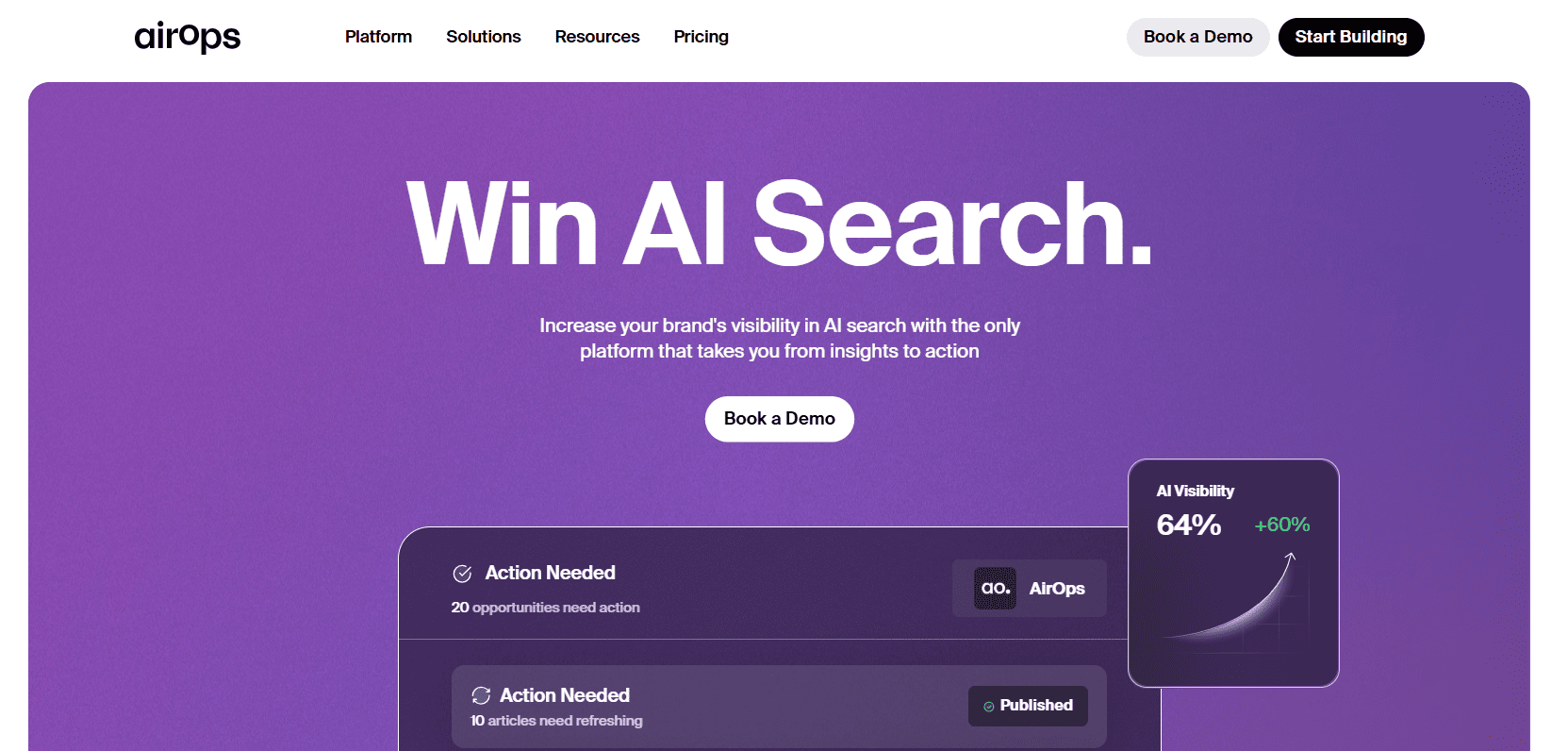
Focuses on AI search visibility and “answer engine” optimization with monitoring + workflows. Built for the shift beyond classic SEO.
Why teams use it?
Used by teams preparing for AI-first discovery who want visibility insights tied to repeatable actions.
Who is this tool for (ICP)?
For teams treating AI visibility as a KPI.
- SaaS SEO + content leaders
- Teams running refresh programs
- Agencies offering AI-visibility services
How this tool fits in this AI-first era?
It’s explicitly designed around AI discovery: track visibility across AI engines, spot gaps, and operationalize refresh/creation workflows. This matches the “visibility everywhere” reality (not just Google rankings).
- AI visibility monitoring focus
- Workflow execution layer
How does the AirOps works?
Monitor AI visibility → identify opportunities → run workflows to fix/expand content.
Free tier? Yes
Strengths?
- AI search visibility focus
- Monitoring + workflows
Weaknesses?
- More setup/learning than simple content editors.
Key Capabilities?
AI visibility + content workflows.
- Cross-engine monitoring
- Orchestration + integrations
Pricing snapshot?
- Insights: from $0/mo
- Pages: Custom
- Enterprise: Custom
Best for?
Teams optimizing for AI-first discovery who want monitoring + repeatable workflows—not just on-page scoring.
How To Know Which Content Auditing Tool Do You Need For Your SaaS Website’s Content?
Overall, the “best” content auditing software depends on your specific needs:
- If you need a high-level audit of your entire SaaS content library (and have a bigger budget), MarketMuse offers a comprehensive solution for content strategy and gap analysis.
- If your priority is on-page SEO refinement and quick fixes, Surfer SEO or Clearscope will be more directly actionable, helping writers tweak content in real-time for better rankings.
- If you want to streamline content briefing and ensure quality at the planning stage, Content Harmony stands out as the specialist tool to standardize and speed up your briefing process.
- And if you’re looking for a cost-effective mix of content research, optimization, and even some AI writing help, Frase can be the handy all-rounder in your toolkit.
Each of these top tools has proven itself with SaaS marketers and content experts (evidenced by their strong user reviews).
For instance, Surfer and Clearscope consistently come up as favorites in SEO communities (one reviewer exclaimed, “It works... knowing Surfer made me who I am and got me where I am”), while MarketMuse is often recommended by content strategists tackling large sites who need that AI-driven direction on what to do next.
If you are a SaaS founder or a content lead, you should consider the scale of your current content operations, your team’s skillset, and your budget when picking a platform.
💡 Often the winning approach is blending a couple of these tools, for example, using MarketMuse to decide your overall content priorities, and Surfer or Clearscope to execute optimizations on each article.
How does MarketMuse compare to Surfer SEO for audits?
MarketMuse vs. Surfer SEO is a common comparison, as they represent two different approaches to content auditing:
- MarketMuse is like a content strategist’s AI assistant. It analyzes your site’s content inventory and helps plan what to create or update, providing deep insights into topics and coverage.
- Surfer SEO is more of an SEO specialist’s power tool. It focuses on optimizing content one page at a time, excelling at giving step-by-step improvements for on-page factors.
When it comes specifically to content audits (evaluating existing content and finding improvements), here’s how they stack up:
| Criteria | MarketMuse | Surfer SEO |
|---|---|---|
| Content Inventory & Monitoring | Maintains a site-wide content inventory with topic authority, content scores, and backlink data. Ideal for auditing 500+ pages. | No full-site inventory. Audits are URL-based and performed on-demand per keyword or page. |
| Audit Depth vs. Simplicity | Offers granular insights (subtopic gaps, personalized difficulty scores, topic coverage). Strategic and deep. | Highly actionable. Outputs simple, clear to-do lists like “add 2-3 paragraphs” or “increase density.” |
| Content Optimization Approach | Uses its own topic model and knowledge graph; focuses on long-term content planning and semantic depth. | Reverse-engineers top 20 SERP competitors to provide practical, keyword-based optimizations. |
| Strategic vs. Tactical | Helps plan what to write/update next via topic modeling and intent coverage. Great for clusters. | Focused on how to improve a page now. Tactical SEO gains per piece. |
| Ease of Use | Rich in features but steeper learning curve; ideal for strategists and SEO leads. | Very user-friendly, especially for beginners and content writers. Easy to get started. |
| AI & Additional Features | Offers First Draft (AI writing assistant), but mainly focused on audits, strategy, and brief generation. | Includes AI writer (Surfy) and Grow Flow for weekly suggestions. All-in-one SEO content suite. |
| Pricing & Scalability | Starts at $600/month (Standard); premium tiers run higher. Built for large sites, deep strategy. | Starts at $59/month. Modular pricing. Great for lean teams or optimizing selected pages. |
Summary:
MarketMuse and Surfer SEO serve different categories of professionals when it comes to audits.
MarketMuse is ideal if you need strategy-oriented audits (identifying content gaps, assessing your entire content program’s strengths and weaknesses, and getting AI-driven roadmaps).
Surfer SEO is ideal for rapid content-specific audits (getting actionable fixes to boost individual pages in the SERPs).
In practice, some companies even use both. For instance, they might use MarketMuse to decide what pages or topics to tackle, and Surfer to execute the on-page improvements. As one detailed comparison noted, MarketMuse’s broader data and personalized insights give it an edge in planning clusters and covering intent, while Surfer’s straightforward audit tool is better for quick wins on underperforming content.
For a SaaS founder deciding between them, choose MarketMuse if you have hundreds of pages and need an AI strategist to prioritize and guide your content updates OR choose Surfer if you have a lean team that needs an easy checklist to make your blog posts and pages SEO-friendly and you’ll be auditing content on a rolling basis.
Both will undoubtedly improve your content (just in very different ways).
Are AI content scanners better than manual audits?
Nowadays, it’s tempting to rely entirely on automated content audit tools (or “AI content scanners”) to evaluate your SaaS site’s content. These tools can crawl pages, calculate scores, and flag issues in a fraction of the time a human would take. But does that mean they’re better than a manual, human-led content audit?
The consensus among experts is that a hybrid approach works best, meaning, use AI-driven tools for speed and data, and human insight for context and decision-making.
Here’s why:
What AI Content Scanners Excel At?
AI content scanners excel at scale and consistency.
Automated audit tools can scan hundreds of pages overnight, compiling metrics on each (traffic, word count, keyword usage, readability, etc.). They don’t get tired or overlook things, meaning, if a title tag is missing or a keyword density is low, they will catch it uniformly across the site.
For example, an AI scanner can quickly list all pages with thin content or duplicate meta descriptions. This kind of quantitative analysis is invaluable as a starting point.
AI tools are also great for surface-level SEO checks i.e., broken links, missing alt text, slow page speed, and so on (the kind of stuff that would bore a human auditor to tears but a bot can highlight in seconds).
In short, AI scanners “provide a general overview of site health” and ensure obvious issues aren’t missed.
What Human Content Auditors Excel At?
Human content auditors excel at nuance and strategic thinking.
A skilled content strategist or editor can judge content quality, relevance, and tone in a way a machine still can’t. They can ask, “Is this blog post actually valuable to our target SaaS buyers?” A question that involves understanding the audience and business goals, not just ticking SEO boxes.
Human content auditors spot things like content that’s off-brand, messaging that’s outdated or contradictory, or opportunities to consolidate content that an automated tool wouldn’t recognize.
As an example, an AI might flag a page with low word count as “too short,” but a human might realize that the page is a concise FAQ answering exactly what users need and thus it’s fine.
Also, stakeholder insight is critical. One agency notes that involving sales/marketing teams and looking at actual customer pain points is crucial in an audit, which pure software cannot do.
Human-led audits bring qualitative evaluation, understanding if content is accurate, persuasive, and aligns with strategy, not just whether it has the right keywords.
Speed vs. Depth
AI tools clearly win on speed. They can generate an audit report in minutes, whereas a manual content audit of a large SaaS blog might take days or weeks. But with that speed comes a trade-off i.e., automated audits often lack depth in analysis.
They might say “Page X has low engagement,” but they can’t fully explain why or what to do about it in a business context. A human can dig into the analytics and say “Oh, that article is getting traffic but not conversions because the content is attracting the wrong audience. Perhaps we should repurpose it for a different use case.”
AI might flag the symptom; a human diagnoses the cause.
Consistency vs. Creativity
Tools apply the same checklist to every page, thus, making sure consistency. Humans might have biases or simply vary in thoroughness from page to page.
However, humans can be creative and strategic. How? Well, they can invent new solutions, whereas an AI audit tool can typically only recommend known best practices.
For instance, a human content auditor could suggest a completely new content angle or combining two mediocre posts into one great resource (content consolidation), something an algorithm might not propose.
As one experienced SEO put it, “critical thinking by experts is what makes manual audits superior. They can spot false positives or negatives that software would misinterpret” (source).
On the flip side, software will never “get bored” and skip a section. It will check everything it’s programmed to, every time.
Data-Driven vs. Empathy-Driven
AI scanners are fantastic at being data-driven. They can correlate things like “pages with higher content scores correlate to higher rankings” and thus push you toward those improvements. They also remove some of the human guesswork. But humans bring empathy and intuition. They can read a piece of content and feel if it truly answers the user’s query or if it’s fluff.
They can consider external factors like maybe a blog post is underperforming not because the content is bad, but because it’s published in the wrong section of the site or isn’t promoted (context an AI wouldn’t know).
The Hybrid Recommendation
Nearly every authoritative source suggests using both in combination.
Start with automated content auditing tools to gather the raw data, get that inventory of all pages, basic SEO metrics, and maybe an initial scoring. Then involve humans to interpret the data and make judgments.
For example, your AI tool might flag 50 blog posts as “low word count” or “low traffic.” A human content lead can then review that list and categorize:
- Which of those are actually important pages that need rewriting?
- Which are low traffic because they’re very niche but still valuable to the few readers they get (so we keep them)?
- Which align with upcoming product launches (maybe a post has low traffic but is about a new feature, perhaps marketing will promote it later)?
These nuances require human decision-making that takes into account business strategy and audience understanding.
Notably, AI cannot (yet) measure brand voice or storytelling effectiveness. A manual audit will consider if content is on-message and high-quality from a brand perspective.
AI also can’t easily assess content accuracy or up-to-dateness beyond checking the date, whereas, a human can verify if the advice in an article is still valid in 2025, or if it references old screenshots or versions.
That’s why our content audit guide emphasized combining quantitative and qualitative steps and said: tools are invaluable, but their value pales in comparison to actual customer data and insight.
▶️ Request your Custom Content Audit Today!
What are the pros and cons of using a human-led vs software-led audit?
Both human-led and software-led content audits have distinct advantages and disadvantages. Here’s a side-by-side comparison to illustrate the trade-offs:
| Element | Human-Led Audit (Manual) | Software-Led Audit (Automated) |
|---|---|---|
| Depth & Nuance | Pro: Can evaluate content quality, relevance, tone, and strategic fit. Humans catch context and subtleties (e.g., whether content truly addresses customer pain points or how it aligns with brand voice) that tools might miss. Con: Might overlook certain technical issues or minor pages, especially on very large sites (humans can get fatigued or make errors by accident). | Pro: Scans every page systematically for defined criteria. Ensures no page is skipped and flags issues consistently (broken links, missing meta tags, etc.). Great at surface-level checks and maintaining a broad view of site content. Con: Lacks the ability to judge qualitative aspects – an automated audit can’t tell if a blog post is well-written or if the messaging resonates. It may also mislabel nuanced situations (false positives/negatives) because it doesn’t understand context. |
| Speed & Efficiency | Con: Time-consuming; a content strategist manually auditing 100 pages might take days or weeks. Slower especially for very large SaaS websites or when auditing multiple content types (blogs, help docs, videos, etc.). Con: Not easily repeatable at high frequency (doing a manual audit every month is usually impractical). | Pro: Very fast; can audit hundreds of pages in minutes to hours. Tools like Screaming Frog or an SEO audit software can crawl a whole site overnight and produce a report. Ideal for quick health checks and ongoing monitoring (some tools schedule regular scans for continuous auditing). Pro: Scalable; no matter how large the site (thousands of pages), automated audits handle it with minimal additional effort. |
| Consistency | Con: Human analysis can be inconsistent. Different auditors might have different opinions or criteria. Even the same person might not apply the exact checklist uniformly to each page, potentially leading to oversights or bias. Pro: However, humans can adjust criteria on the fly if something unexpected comes up (they are adaptable, albeit not perfectly consistent). | Pro: Standardized criteria; the software uses the same rules for every page, ensuring uniformity. If your audit needs to adhere to a strict checklist (e.g., all pages must have “x” keyword density, “y” readability score), a tool will apply that evenly. Con: One-size-fits-all approach can be a downside; tools can’t easily adapt the criteria for different sections of your site or understand unique business priorities without custom configuration. |
| Insights & Recommendations | Pro: Humans provide custom, prioritized recommendations. They can synthesize findings into an action plan tied to business goals (e.g., “Updating these 5 product pages will likely yield the best ROI because…”). They can also integrate external knowledge (seasonal trends, upcoming product launches, customer feedback) into the audit insights. Pro: Able to perform cross-disciplinary analysis; e.g., looking at SEO, UX, and conversion elements together, and offer holistic fixes. Con: The quality of insights depends on the auditor’s expertise. A less experienced person might miss opportunities or misprioritize. | Pro: Data-driven suggestions; automated tools often come with built-in recommendations or scores (like “Content score 78: needs improvement” or “Add 3 backlinks to this page”). They take guesswork out of technical improvements and can suggest optimizations based on best practices. Con: Generic advice; because it’s standardized, it might say “increase word count” or “add keyword X,” which may not always align with your content strategy or might be too simplistic. Tools lack strategic prioritization as they’ll give you a laundry list of issues, but not necessarily tell you which ones matter most for your business. This can lead to a false sense of security or spending time on minor fixes that don’t move the needle. |
| Cost | Con: Expensive in manpower; you might need to hire a content audit specialist or agency. Manual audits at scale can be costly, especially if you bring in experts (some agencies charge significant fees for a comprehensive content audit report). Pro: If done, the “cost” is mainly the time, which might be justified for the depth of insight gained. | Pro: Cost-effective for basic auditing; many tools have free versions or affordable subscriptions. For example, using Google Analytics and Search Console is free for gathering data; or a tool like Semrush can audit content as part of its package. Automated audits save on labor costs (one team member can run the tool instead of a whole team manually reviewing). Con: Some enterprise-grade audit tools themselves have significant subscription costs. But generally, running an automated audit is cheaper than paying for many hours of manual work. |
As you can see, it’s not that one method is universally better, they complement each other. A human-led audit delivers “personalized recommendations” and ensures nothing important to your business context is missed, while a software-led audit offers “speed, scalability, and consistency” to cover all the basics.
For a practical SaaS scenario, consider this example:
A manual audit might reveal that your product feature pages aren’t effectively communicating value (a human notices the copy isn’t resonating), while an automated audit might reveal those pages also lack H2 tags and have slow load times.
The best outcome comes when you address both the human-identified issues and the tool-identified issues. As one Reddit user aptly summarized, a content inventory from a tool gives a great overview, but it “doesn't give you insights into its quality or how to improve it”, that part requires human interpretation.
How do free content audit tools stack up against paid platforms?
Not every team has the budget for high-end content audit software. Free or freemium tools (like Google Analytics, Google Search Console, or limited versions of SEO tools) can certainly help you audit content but how do they compare to the solid & strong capabilities of paid platforms?
The answer is simple.
Free tools are useful for basic insights, but paid platforms offer far more in-depth analysis and guidance.
Here’s the breakdown:
1. Capabilities
Free tools often tackle one slice of the content audit puzzle.
For example, Google Search Console (GSC) can show you which pages’ clicks dropped or which queries you’re losing rankings on. Google Analytics (GA) can tell you user metrics like time on page or bounce rate. Animalz Revive (a free tool by Animalz) will list blog posts that are decaying in traffic over time.
These are extremely handy data points.
In fact, Animalz Revive is loved by content marketers for quick wins, as one review states that, “if you simply want to identify which content to prioritize for refreshes, Revive might be perfect for you, and it’s completely free”. The limitation, as that same review notes, is that free tools usually stop at identification.
Animalz Revive will tell you “these 5 posts lost the most traffic this past year”, but then you have to figure out why and how to refresh them.
In contrast, a paid platform like MarketMuse or Surfer will not only identify a declining post, but also provide recommendations to improve it (e.g., keywords to add, sections to expand, competitive gaps to fill).
Paid platforms integrate multiple data sources and use advanced algorithms (like NLP for content relevance) to give you a fuller picture.
For instance, Surfer SEO’s paid Content Audit will automatically analyze an underperforming page and suggest very specific changes (add 2 backlinks, increase keyword frequency, improve readability, etc.) and even allow one-click optimizations in some cases.
A free tool might tell you the page isn’t ranking; Surfer will tell you what to do about it.
2. Data Freshness and Scope
Free tools sometimes have limitations in data freshness or scope.
GSC data is reliable but focused on Google search impressions and clicks. It won’t tell you about content quality or competitor comparison.
Some free audit tools rely on cached data or limited crawls.
Freemium SEO audit tools (like a free version of Semrush’s content audit, or HubSpot’s website grader) usually only scan a certain number of pages or provide a very high-level score unless you upgrade.
Paid platforms often use live crawling and up-to-date algorithms. They also tend to cover a broader array of factors (semantic analysis, competitor benchmarking, etc.) which free tools might skip.
For example, a free site auditor might flag broken links and duplicate content, but a paid content audit tool could analyze the semantics of your content using NLP i.e., highlighting that your article on “SaaS onboarding” is missing topics that top-ranking articles cover (something a basic free tool wouldn’t know, as it requires comparison and an AI model).
3. False Confidence
One danger with free tools is false confidence.
You might run a free audit that gives you a pass/fail style report. Let’s say it scores your content 85/100 and highlights a few minor issues. It’s easy to think, “Great, our content is fine.” But that free audit might not check deeper aspects like content relevancy or alignment with user intent.
A paid platform like Clearscope or MarketMuse might reveal that, despite looking “fine” technically, your content is missing breadth or depth compared to competitors.
In other words, free tools often focus on quantity metrics (word count, keywords used, etc.) while paid tools evaluate quality and competitiveness (does this content comprehensively answer the query? Is it as authoritative as others?).
4. Advanced Features
Paid tools come with advanced bells and whistles that free tools lack.
For example, MarketMuse’s AI-powered content briefs and content scoring or Clearscope’s integration into Google Docs for real-time suggestions are things you won’t get for free.
Surfer’s content planner that helps build topic clusters is another paid feature.
Free tools also typically don’t include any form of AI content generation. In contrast, some paid suites will actually generate draft improvements or suggest outlines for new content based on audit findings.
That can accelerate your content refresh process dramatically (something a free approach would require you to do manually).
5. When Free Tools Suffice?
If you’re a very small SaaS startup with a tight budget or just a handful of pages, free tools can get you pretty far.
You can manually pull data from GSC and GA, use a free crawling tool (like Screaming Frog’s free mode, which crawls up to 500 URLs), and maybe use a free content analysis tool like Yoast (if on WordPress) or Ubersuggest for some basic content ideas. This will allow you to identify glaring issues and perhaps do a basic clean-up.
Many content marketers start this way. In fact, it’s a recommended first step to use free content audit checklists and spreadsheets to inventory content.
However, as your content library grows, the effort to piece together insights from multiple free sources grows exponentially. You might find yourself maintaining a giant spreadsheet and manually cross-referencing data (search clicks here, bounce rate there, keyword rankings from another tool).
Paid platforms justify themselves by centralizing all this info and analyzing it for you. As an analogy, free tools are like individual ingredients, while a paid platform is like a ready-made meal i.e., more expensive, but it saves you cooking time and likely tastes more refined due to expert “chefs” (algorithms and developers) preparing it.
Examples to illustrate:
- Animalz Revive (Free) vs MarketMuse Content Audit (Paid): Revive will show you posts with traffic drop. MarketMuse will show you those plus why they dropped (e.g., competitors published newer content) and how to refresh them (which subtopics to add). Revive is great for quick triage, but MarketMuse guides you to the solution.
- Google Search Console (Free) vs SurferSEO Audit (Paid): GSC might highlight that your “SaaS onboarding tips” page lost rankings for certain keywords. Surfer’s audit would analyze that page against the current top results and give you a specific action plan to win back those rankings (maybe your page needs to mention “user activation metrics” which others now cover). GSC provides data, Surfer provides data + actionable recommendations.
- UpCity SEO Report Card (Free) vs Clearscope Optimize (Paid): A free SEO report might give your page an overall grade and note, for example, “10 images missing alt text” and “readability needs improvement.” Clearscope’s optimize mode will assign a content grade based on competitive analysis and explicitly list the terms and topics you should include to be comprehensive. The free report gives generic advice; Clearscope tells you, concretely, “mention X, Y, Z topics and aim for 2,000 words” backed by its analysis of competing content.
6. Caveats of Free Tools
They often use simpler algorithms.
For instance, a free keyword density tool might just check if you used a keyword enough, whereas a paid tool uses NLP to gauge content relevance beyond exact keywords (looking at entities and semantically related terms).
Free content audit tools also typically don’t integrate with each other, that’s why you end up doing a lot of copy-pasting and interpreting on your own. And as noted, some free tools use outdated or limited datasets.
An SEO expert warning on Search Engine Land noted that some “website graders” give misleading results because they don’t reflect Google’s latest algorithm nuances (for example, they might not account for mobile-first indexing or Core Web Vitals properly).
7. When to Upgrade
If you find that the free route leaves you with unanswered questions (“I see page X has high bounce rate, but what do I do about it?”) or if it’s eating too much of your time to manually analyze, that’s when a paid platform shows its value.
Paid tools can surface non-obvious insights.
For example, a tool like Content Harmony (paid) might reveal content gaps or questions people ask that your content doesn’t answer (something you wouldn’t glean from GA/GSC alone). Or paid tools can alert you automatically when content performance changes (Surfer’s Grow Flow sends weekly suggestions).
These proactive features help ensure you’re not flying blind between manual audits.
Why do SaaS companies need AI-ready content audits?
SaaS companies are no longer just optimizing content for search engines, they’re optimizing for large language models (LLMs) and AI summarization systems that decide what gets surfaced in tools like Google’s AI Overviews or Perplexity AI.
An AI-ready content audit ensures your pages are:
- Structured for machine parsing (headings, clarity, semantic markup)
- Scored for topical depth, authority, and recency
- Clear enough to be excerpted and cited in AI-generated answers
Legacy audits focused on metadata, backlinks, and keyword gaps. But today’s systems weigh semantic coherence, token density, and trust signals. That means your “good enough” blog post from 2024 might be ignored if it lacks structured clarity or freshness.
Without AI-aligned auditing, SaaS teams risk:
- Publishing at scale with diminishing visibility
- Losing zero-click discovery opportunities to better-structured competitors
- Failing to appear in SGE-style summaries or AI search feeds
Explore ▶️ Content Audit Checklist for B2B SaaS Blogs
What does “AI-readiness” mean in content marketing?
“AI-readiness” in content marketing refers to how well your content is structured, formatted, and written to be parsed, summarized, and cited by large language models (LLMs) like ChatGPT, Gemini, and Claude.
It’s not just about keywords anymore. AI-ready content exhibits:
- Semantic clarity: Straightforward language, clear intent signals, low ambiguity
- Structured formatting: Logical H1-H3 hierarchies, schema markup, tables, lists
- Freshness and recency: Updated timestamps, current data points, relevance for SGE inclusion
- Authority markers: Brand mentions, expert quotes, references to trusted sources
- Machine-extractable chunks: Paragraphs that answer a question in ≤150 words (ideal for SGE/Perplexity)
Traditional SEO optimization relies heavily on backlink profiles and keyword density, whereas, AI-readiness focuses on whether your content can be turned into a citable, zero-click answer block by an LLM.
How to Audit Content with AI-First Tools?
Here’s a five step by step process you can follow to run a content audit for your SaaS website with AI-first content auditing tools.
Step 1: Crawl and Inventory Your Existing Content
Use tools like Screaming Frog, Sitebulb, or ContentKing to generate a full URL map. Make sure that each asset has metadata, last modified date, and basic crawlability info.
Step 2: Score Each Asset Using NLP-Powered Tools
Platforms like Clearscope or Surfer SEO evaluate readability, keyword coverage, and semantic depth. Score content on relevance, structure, and on-page SEO.
Step 3: Identify Gaps and Overlaps
Use MarketMuse or Frase to find missing topics, overlapping articles, or cannibalization. Cross-reference with GSC data (clicks, impressions) for performance signals.
Step 4: Classify for Actionability
Group pages into:
- Keep (performing well)
- Improve (update title, enhance content)
- Merge (duplicate intent)
- Remove (outdated or thin)
Step 5: Create an Optimization Plan
Export your findings into a centralized Notion or Airtable sheet. Include priority, assigned owner, and deadline per URL.
💡 Pro Tip: Combine GSC export + Surfer score + URL notes for a hybrid view of technical + semantic performance.
Explore ▶️ How To Perform Content Audit For SaaS?
Which content audit tools automate content gap detection?
Modern content gap tools use NLP, SERP analysis, and competitor modeling to identify what your site is missing. Here are leading options:
- MarketMuse – Best for enterprise SaaS.
- It creates a content cluster map and shows which topics competitors cover that you don’t. It also offers a content score vs. ideal score.
- Frase – Ideal for lean teams.
- It scans top SERP results, extracts common questions, headers, and entities, and suggests what your draft lacks.
- Clearscope – Focused on real-time term suggestions.
- It benchmarks your content draft against top-ranking pages and highlights semantic keyword gaps.
- Outranking – Offers an automated research assistant that builds outline briefs from competitor content and helps you fill gaps with AI-assisted copy.
- Dashword – Lightweight, great for high-volume content.
- It auto-identifies under-covered terms and missing sections based on real-time SERP changes.
⚠️ Avoid relying solely on keyword gaps. True gap detection considers intent, semantic relevance, and freshness (not just keyword density).
What’s the best workflow for auditing a 500+ page SaaS blog?
In order to audit a large SaaS blog, your basic requirements should be prioritization, automation, and clarity. Here's a scalable workflow built for teams managing 500+ URLs:
1. Generate a Full URL Inventory
Use Screaming Frog or Sitebulb to crawl your domain. Export page titles, last modified dates, response codes, canonical tags, and word counts.
2. Filter Pages for Audit Worthiness
Exclude low-impact pages (privacy policy, legal, dev/test pages). Focus on content that can drive traffic or conversions, e.g., blog, knowledge base, feature pages.
3. Tier Pages by Traffic or Business Value
Use GA4 or GSC to categorize content:
- Tier 1: High traffic + business impact
- Tier 2: Medium performance or strategic intent
- Tier 3: Old, low-traffic or misaligned content
4. Batch Score With SEO Tools
Import Tier 1 and Tier 2 pages into Surfer or Clearscope for bulk content scoring. Add qualitative labels (e.g., “thin,” “duplicated,” “outdated”) via a Notion table.
5. Assign Actions Using a Sprint Model
Each content owner gets a slice of the backlog. Use status tags like:
- Needs Rewrite
- Needs Merge
- Needs Redirect
- Evergreen (no action)
⚠️ Watch for hidden risks like SEO cannibalization or orphaned content, especially in older blogs that grew without strategy.
What’s a good content quality score for B2B SaaS pages?
For B2B SaaS, a high-quality content page isn’t just grammatically clean, it aligns semantically with intent, is topically complete, and optimized for both search engines and AI systems. Audit platforms like Clearscope, Surfer SEO, and MarketMuse quantify this through content scores.
Here’s what “good” typically looks like:
- Clearscope: Aim for an A or A+ score. Anything below B may signal thin coverage or poor semantic alignment.
- Surfer SEO: Pages should hit a Content Score of 70+ for informational pieces and 80+ for competitive keywords.
- MarketMuse: Look for Coverage and Optimization scores above 40, especially in clustered topics or long-form guides.
In addition to tool scores, watch for:
- Topical completeness (did you answer the full query scope?)
- Token density and variation (helps with LLM surfacing)
- Absence of filler/fluff, which can trigger low engagement or AI devaluation
💡 Tip from experience: Even high-scoring pages underperform if they lack conversion alignment or have poor internal linking.
How do audit tools calculate authority, freshness, and semantic depth?
Modern audit tools use a mix of SEO metrics, semantic models, and crawl data to calculate scores for authority, freshness, and semantic depth, all of which influence how content performs in traditional search and AI-powered results.
Here’s how they generally break it down:
1. Authority: Calculated from domain-level signals like backlinks (from Ahrefs or Moz), internal link strength, and historical traffic.
Some tools use simplified formulas like:
Authority Score = (Referring Domains x Page Engagement) ÷ Content Age
2. Freshness: Determined by last modified date, topical updates (e.g., new stats), and crawl recency. Tools may penalize content that hasn’t changed in 12+ months. Watch for “stale” flags in platforms like Content Harmony.
3. Semantic Depth: NLP-based systems like Clearscope and MarketMuse use embeddings to check if your content addresses all relevant subtopics and terms related to a query.
Example formula:
Depth Score = # of Covered Concepts ÷ # of Recommended Concepts
Together, these metrics tell you not just how optimized a piece is, but how future-proof it is for AI discovery models like Google’s SGE or Perplexity.
What’s the ROI of running a full content audit?
A full content audit often delivers 3–10x ROI when executed correctly, especially for B2B SaaS teams sitting on years of under-optimized or redundant content. Here’s how that ROI typically unfolds:
- Traffic Reclamation: Pruning thin or outdated posts can uncap index bloat, improving crawl efficiency. Teams often see 10–40% traffic lifts after streamlining.
- Lead Quality Improvement: By re-aligning content to ICP pain points and intent stages, audits help move pages from “informational” to “conversion-ready.”
- Funnel Efficiency: Eliminating fluff or cannibalizing posts means more focused CTAs and better user journeys, boosting demo requests or trial signups.
- Ops Cost Savings: Knowing what to kill vs keep means fewer wasted content hours and tighter strategy cycles.