

💡 Quick answer
- Best overall for quick SEO refreshes: QuillBot
- Best for human-sounding rewrites and voice/flow: Wordtune
- Best for brand-consistent rewrites at scale: Jasper AI
- Best for speed + content repurposing workflows: Writesonic
- Best for everyday clarity + tone tweaks inside your workflow: Grammarly Rewrite (Beta)
Every SaaS marketer knows content is the heartbeat of online growth. But when you’re publishing nonstop, content can start to sound repetitive, generic, or “same-y.” The result is a full calendar that doesn’t always translate into traffic, pipeline, or product growth.
That’s where AI paraphrasing tools help — not as “spinners,” but as editing assistants that can refresh wording, improve clarity, tighten messaging, and repurpose existing assets faster (while keeping the original meaning intact).
💡 If you’re searching for the best paraphrasing tools for SaaS marketing teams in 2025, this guide shows the top options, what each is best for, and how to use them safely to improve performance — not just output.
Top AI Paraphrasing Tools for SaaS Teams (2025 Edition)
The market for AI paraphrasing tools has exploded, but not all are built for B2B SaaS content operations. Below are the top performers “tested for accuracy, tone control, and usability” that help content-led and PLG-driven SaaS teams rewrite faster without sacrificing clarity or conversion power.
| Tool | Best For | Key Strength | Ideal SaaS use case |
|---|---|---|---|
| QuillBot | SEO & clarity refreshes | Multiple rewrite modes + compare options | Updating blogs, docs, and refresh cycles |
| Wordtune | Conversational rewrites | Flow + tone control | Thought leadership, customer-facing pages |
| Jasper AI | Brand consistency | Brand voice profiles + team workflows | Landing pages, product messaging at scale |
| Writesonic | SEO optimization | Fast multi-format rewrites | Turning one asset into many channel variants |
| Grammarly Rewrite | Quick tone & clarity | Inline rewrite suggestions | Microcopy, docs, emails, UI text |
1. QuillBot
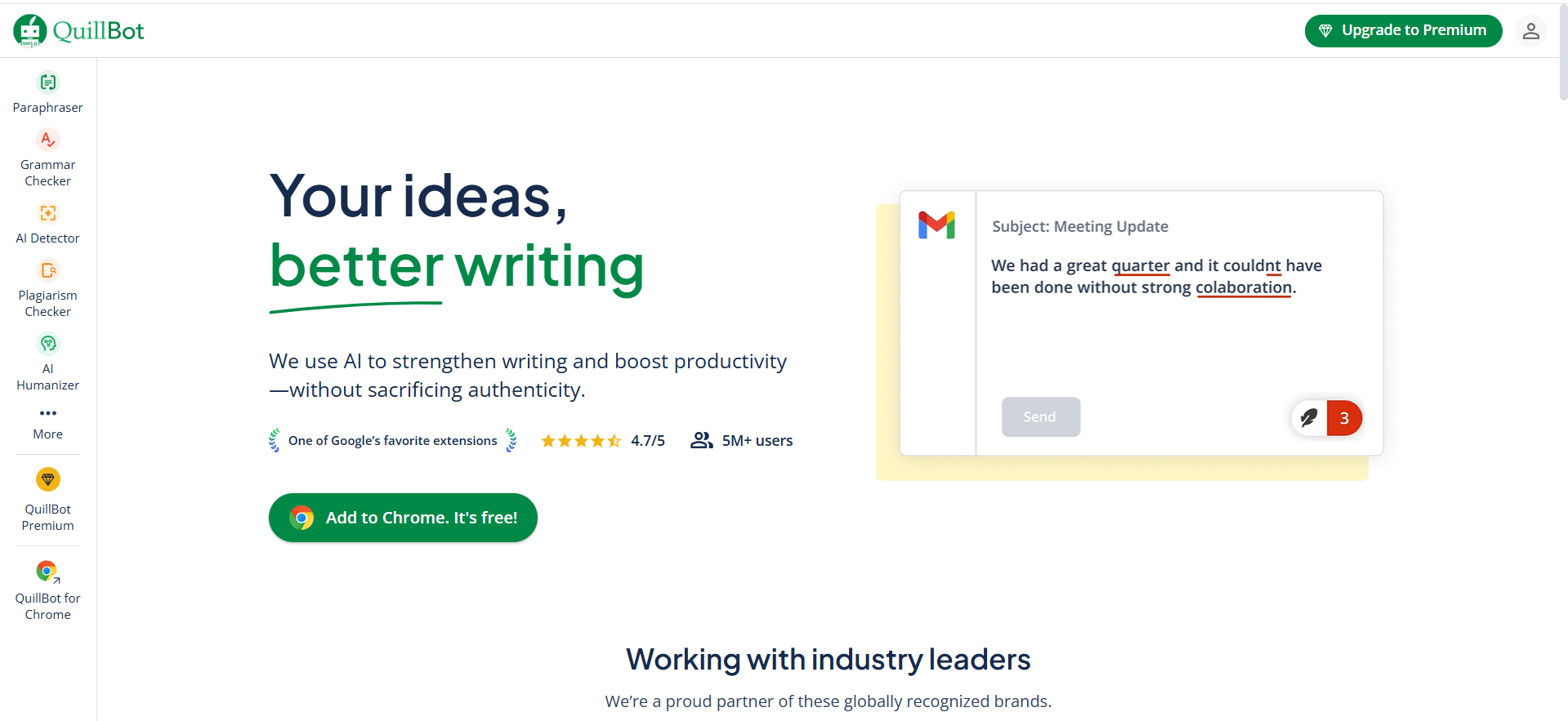
Best For: Fast SEO refreshes, clarity rewrites, and multi-tone experimentation
Why It Works: QuillBot is the most widely used paraphrasing platform, and for good reason. It combines simplicity with control. You can switch between six paraphrasing modes “Standard, Fluency, Formal, Simple, Expand, and Shorten” to adjust tone, sentence length, and complexity in seconds.
Its built-in grammar checker and summarizer also make it a lightweight all-in-one editor for quick optimizations. For SaaS teams refreshing large content libraries, the “Compare Modes” view is particularly useful to A/B test how different rewrites sound before pushing updates live.
SaaS Use Case:
- Refreshing stale TOFU blogs for SEO without rewriting from scratch
- Editing help articles or support docs for clarity and brevity
- Repurposing gated reports into public blog snippets
Key Strengths:
- Browser extensions for Chrome, Docs, and Word
- Built-in plagiarism checker
- Paraphrasing up to 10,000 characters (premium)
Limitations:
- Occasionally rigid on creative tone adjustments
- Doesn’t handle nuanced narrative flow as well as Wordtune or Jasper
2. Wordtune
Best For: Natural, human-like rewrites that preserve voice and flow
Why It Works: Wordtune doesn’t just rephrase sentences, it reimagines phrasing for readability and tone. It’s trained to act like an editor, suggesting rewrites that sound organic, conversational, and context-aware. You can fine-tune tone (Formal / Casual), shorten or expand text, and rewrite line-by-line for high-touch editing.
SaaS Use Case:
- Repurposing founder LinkedIn posts into polished blogs
- Refining case studies, product update posts, and nurture emails
- Editing long-form content into bite-sized social or email copy
Key Strengths:
- Real-time suggestions in Docs, Gmail, and CMS editors
- Chrome extension works across content platforms
- Excellent for customer-facing or narrative-heavy SaaS content
Limitations:
- Limited batch or bulk editing
- Less suitable for long technical rewrites
3. Jasper AI
Best For: Brand-consistent paraphrasing at enterprise scale
Why It Works: Jasper AI goes beyond rewriting, it acts as a brand voice engine. Its “Content Improver” mode allows teams to rephrase copy while maintaining predefined tone, vocabulary, and product positioning. You can set up multiple brand profiles, ideal for multi-product SaaS or agency teams managing different clients.
Integrations with SurferSEO and Chrome, plus API access, make it suitable for high-volume operations or content teams running refresh workflows at scale.
SaaS Use Case:
- Refreshing landing pages or onboarding sequences while preserving brand tone
- Running large-scale refresh cycles for existing blog libraries
- Maintaining voice consistency across multiple GTM teams
Key Strengths:
- Brand voice profiles for tone alignment
- Collaboration tools for multi-seat teams
- Integrates with CMS, Google Docs, and SEO platforms
Limitations:
- Higher cost (geared toward scaling teams)
- Occasional repetition in long-form rewrites
4. Writesonic (Sonic Editor)
Best For: SEO-driven paraphrasing and content optimization
Why It Works: Writesonic’s Sonic Editor is purpose-built for SEO and marketing teams. It leverages real-time SERP insights and integrates with SurferSEO, making it excellent for rewriting pages to improve rankings or match search intent.
Writesonic includes rewriting presets tuned for SEO, readability, and tone. The result is faster refresh cycles where you can improve clarity for readers while still aligning content with search intent.
SaaS Use Case:
- Rewriting comparison pages or feature breakdowns for SEO
- Refreshing product blogs based on changing keyword trends
- Aligning long-form guides with AI-driven search intent
Key Strengths:
- SurferSEO integration for keyword optimization
- Multi-language support (25+ languages)
- Google Docs-style editing interface
Limitations:
- Slightly generic phrasing in creative sections
- Some paraphrased outputs require manual trimming
5. Grammarly Rewrite (Beta)
Best For: Everyday clarity and tone refinement in workflow
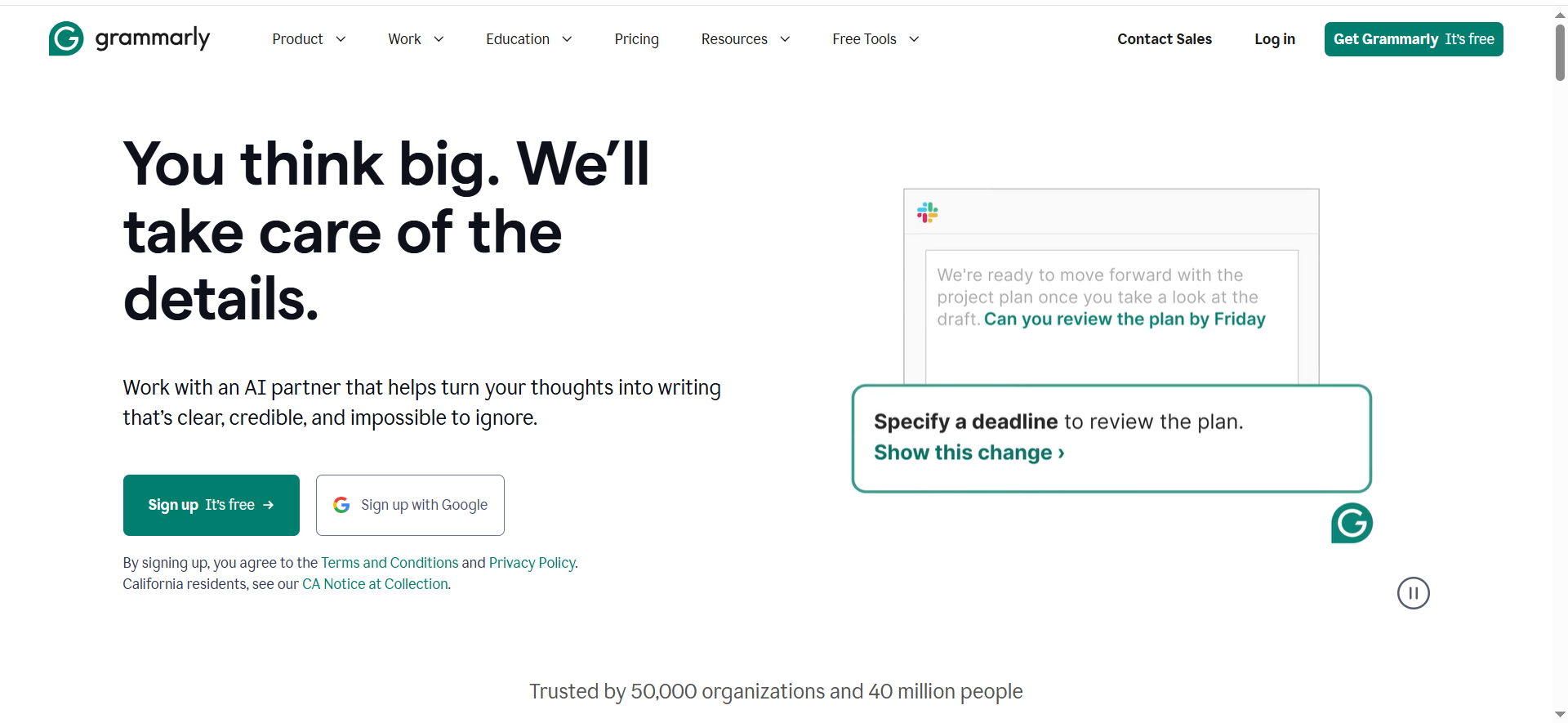
Why It Works: Grammarly Rewrite, currently in beta, extends Grammarly’s trusted grammar engine into smart paraphrasing. Instead of generating new sentences, it suggests contextual rewrites to make phrasing smoother, shorter, or more confident, right where you write.
It’s ideal for teams constantly switching between Docs, Gmail, Notion, or CMS platforms, and ensures brand tone consistency across micro-copy (like UI text or tooltips).
SaaS Use Case:
- Improving clarity in onboarding guides or help center content
- Editing micro-copy in product UIs or release notes
- Maintaining consistent tone across internal and external communication
Key Strengths:
- Seamless workflow integration (Docs, Gmail, CMS)
- Advanced tone detection and rewrite options
- Enterprise-grade privacy and compliance
Limitations:
- Limited to short paragraphs or snippets
- Still in beta (some advanced paraphrasing modes pending)
What Is an AI Paraphrasing Tool (and Why It Matters)
An AI paraphrasing tool helps you say the same thing in a new and improved way — rewriting your content while keeping the original meaning intact. Unlike the old “article spinners” that produced robotic or clumsy text, modern tools use advanced language models like GPT or Claude to understand tone, context, and intent before rephrasing your content — see our guide to safe AI writing for SEO for guardrails that keep quality and compliance intact.
For a marketing or writing team, that means you can:
- Turn a detailed case study into multiple blog posts or LinkedIn updates
- Refresh outdated articles to regain rankings (use this B2B SaaS content audit checklist to prioritize pages)
- Rewrite website copy for different audiences or customer segments
- Simplify complex text for easier readability
Why You Might Need One
If you’re wondering whether it’s worth trying a paraphrasing tool, here are a few situations where it can make a real difference:
- To repurpose top-performing blogs into updated or shorter versions that maintain ranking signals
- To adjust tone and style for different audiences — from formal explainers to conversational posts
- To save editing time, especially on long-form or repetitive content
- To localize or simplify writing for different regions or reader levels
- To improve engagement, by rewriting introductions, meta descriptions, or headlines at scale
When used thoughtfully, AI paraphrasing tools don’t replace creativity, they free it up. You spend less time wrestling with words and more time refining ideas that actually move your business forward.
What Makes an AI Paraphraser “Good”
Here’s what you should evaluate before picking one:
| Criteria | What It Means | Why It Matters |
|---|---|---|
| Output Quality | Natural, fluent sentences | Readers & Google both judge readability |
| Meaning Preservation | Keeps your original intent intact | Critical for SaaS feature or pricing pages |
| Control Options | Adjust tone, length, or structure | Ideal for reusing content across funnel stages |
| Language Support | Multiple tones, formal/informal | Helps repurpose across regions or audiences |
| Speed & Scalability | Handles bulk inputs, APIs | Useful for PLG teams automating refresh cycles |
| Privacy & Security | Doesn’t store or train on your data | Protects confidential product messaging |
| Integration | Chrome/Docs/Word | Fits seamlessly into existing content ops |
| Pricing & Value | Fair free tier or scalable plan | Ensures ROI at scale |
Side-by-side comparison for SaaS content teams
Use this as a practical “which tool should we use for what?” cheat sheet:
| Use case | Best pick | Why |
|---|---|---|
| Refresh old blog posts for SEO | QuillBot / Writesonic | Quick paragraph rewrites, multiple variations, faster refresh cycles |
| Preserve human voice for thought leadership | Wordtune | Editor-like rewrites that keep flow and voice |
| Keep brand positioning consistent across many assets | Jasper AI | Brand controls + scale-friendly workflows |
| Repurpose one asset into many formats | Writesonic | Speed + multi-format output support |
| Tighten clarity in docs, emails, UI copy | Grammarly Rewrite | Small, frequent improvements inside daily writing tools |
How we evaluated these tools
To keep this guide useful for SaaS marketers (not a generic tool list), the evaluation focused on real workflows:
What we tested
- Refreshing SEO paragraphs without changing meaning
- Rewriting intros/hooks to improve readability and clicks
- Repurposing long-form sections into shorter channel-specific versions
- Tone shifts (more confident, more concise, more formal/casual)
- Brand/positioning sensitivity (product claims, differentiators, CTAs)
How we judged outputs
- Does it stay accurate for SaaS product messaging?
- Does it sound natural to a human reader?
- Can a team use it inside a repeatable workflow?
- How much manual editing is still required?
How to Choose the Right Tool (For Your Use Case)
Every AI paraphrasing tool has its own strengths. Some are built for quick SEO edits, while others shine when it comes to maintaining tone or scaling content across teams. Choosing the right one depends on what you’re trying to achieve — not just which tool is most popular.
Here’s a simple guide to help you match your use case with the best fit:
1. Fast SEO Refreshes → QuillBot / Writesonic
If your goal is to update older blog posts or web pages without rewriting them from scratch, QuillBot and Writesonic are great options. They make it easy to rephrase existing paragraphs, tweak structure, and integrate new keywords, all while preserving the original meaning.
Pair these rewrites with a content pruning guide for SaaS to remove low-value sections and focus your refresh on what moves rankings.
💡 Perfect for: quick content updates, meta rewrites, and refreshing articles with declining CTR or traffic.
2. Brand Voice Consistency → Jasper AI
When your brand has a specific tone “whether it’s professional, approachable, or expert-driven, Jasper AI stands out”. It allows you to set up brand voice profiles, ensuring every rewrite sounds like you.
For evaluators comparing tools, scan our Jasper AI competitors roundup to see where it wins (and where it doesn’t).
💡 Perfect for: rewriting landing pages, sales copy, and blog posts while keeping your brand’s unique tone intact.
3. Marketing Email & Customer Communication → Wordtune
For short-form, conversational content like marketing emails, in-app messages, or newsletters Wordtune is your best bet. It produces rewrites that sound natural, human, and emotionally resonant.
To convert that clarity into pipeline, align your messaging with CRO for product-led content so key pages nudge readers toward demos and trials.
💡 Perfect for: refreshing nurture emails, reworking announcements, or refining customer communication.
4. Multi-Language or Global Copy → QuillBot / Grammarly
For larger teams or agencies producing high volumes of content every week, Jasper AI combined with its API is the most efficient choice. You can automate paraphrasing tasks, maintain brand safety, and push updates into your CMS.
If you need hands-on execution bandwidth, our SaaS content marketing services extend your team with a refresh-at-scale program.
💡 Perfect for: localizing product pages, blogs, and help center content for international audiences.
5. Content Velocity at Scale → Jasper AI + API
For larger teams or agencies producing high volumes of content every week, Jasper AI combined with its API is the most efficient choice.
You can automate paraphrasing tasks, create brand-safe rewrites, and push updates directly into your CMS or content pipeline, cutting down hours of manual work.
💡 Perfect for: scaling blog refreshes, automating large content updates, and supporting high-volume publishing operations.
👉 Want your content library audited for refresh ROI?
How to Use AI Paraphrasing Tools Effectively
Using AI paraphrasing tools isn’t just about pressing “Rewrite.”
It’s about building a repeatable workflow that preserves your SaaS brand’s tone, improves SEO performance, and speeds up refresh cycles — all without losing substance or credibility.
Here’s a step-by-step guide, with micro-checks to keep every stage tight, compliant, and conversion-focused.
Step 1: Identify Target Content
Before paraphrasing anything, start with data - not intuition.
What to Do:
Audit your content performance in Google Analytics 4 (GA4) and Search Console (GSC).
Identify posts with:
- Declining clicks or sessions
- High impressions but low CTR (classic “content fatigue” signal)
- Outdated or repetitive sections
Prioritize content that still ranks but underperforms in engagement or conversions; use content audit steps for SaaS to triage pages systematically.
Why It Matters:You don’t need to rewrite your best posts, you need to refresh the ones that are 80% good but under-optimized. Paraphrasing helps you keep ranking equity while improving clarity and relevance.
Micro-Check:✅ Make sure the content isn’t outdated beyond repair (e.g., obsolete product screenshots, old pricing, deprecated features).
Step 2: Choose the Right Tool & Mode
Each tool serves a slightly different purpose — choose the one that aligns with your content goal.
What to Do:
- Use QuillBot for SEO refreshes or readability rewrites.
- Use Wordtune for tone adjustments and conversational polish.
- Use Jasper AI for brand voice consistency at scale.
- Set parameters such as rewrite strength, tone, or formality level before paraphrasing; if you’re evaluating toolsets, skim our Writesonic AI review for an SEO-focused perspective.
Why It Matters:The goal isn’t to make your content sound “different” it’s to make it sound clearer, fresher, and more aligned with current audience and search intent.
Micro-Check:✅ Keep one “control version” that’s close to the original for A/B testing — measure which rewrite improves CTR, time-on-page, or demo clicks.
Step 3: Review and Refine the Output
AI paraphrasers are fast — but not flawless. Treat their output like a first draft.
What to Do:
- Read aloud to spot robotic or awkward phrasing.
- Compare each sentence with the original to ensure meaning and technical accuracy remain intact.
- Ensure SaaS-specific terms (e.g., “user activation,” “ARR,” “API calls”) haven’t been simplified or misinterpreted.
- If your SaaS has a unique tone (e.g., consultative or data-driven), re-inject that manually.
Why It Matters:Even subtle tone inconsistencies can break trust with B2B audiences — especially if your brand positions itself as a growth or technical authority.
Micro-Check:✅ Ensure your brand voice guide is followed — no over-simplified or salesy phrasing.
Step 4: Optimize and Edit for SEO + CRO
Once the paraphrase feels natural, move into optimization mode. Your goal here: make it rank and convert.
What to Do:
- Run grammar and clarity checks with AI grammar and style checkers.
- Use your target keyword and close variants naturally in the places that matter (title, H2s where relevant, intro, image alt text if appropriate). Prioritize clarity and scannability over any “density” target.
- Reinsert internal links to relevant pages (case studies, service pages, demos).
Add mid-post CTAs that align with funnel intent for example:
- TOFU (Awareness): “See our SaaS SEO Guide”
- MOFU (Consideration): “Compare SaaS SEO vs. Paid Ads ROI”
- BOFU (Decision): “Book a SaaS SEO Audit”
If you need a structured, hands-on turnaround, consider our SaaS content audit & fix sprint to accelerate results.
Why It Matters:You’re not rewriting for vanity, you’re optimizing for visibility and conversion. Every refreshed asset should support a measurable business outcome (CTR ↑, demo rate ↑, CAC ↓).
Micro-Check:✅ Verify keyword placement, meta descriptions, and internal links are updated to reflect the new paraphrased copy.
Step 5: QA for SEO + Compliance
Your final step is quality assurance, ensuring that every refreshed post meets TRM’s SOP and Google’s quality guidelines
What to Do:
- Check plagiarism via Copyscape or Grammarly Premium.
- Test originality with AI detection tools like GPTZero or Originality.ai.
- Run the content through including:
- EEAT elements (expert quotes, data, authority links)
- Schema readiness (FAQ / HowTo)
- Internal linking depth
- Funnel alignment and CTA placement
- Validate EEAT signals with frameworks like E-E-A-T after SGE; confirm schema (FAQ/HowTo), internal-linking depth, and CTA placement.
Why It Matters:Compliance isn’t just about avoiding penalties, it’s about ensuring every asset builds authority, ranks in both traditional and AI-first search, and feeds your long-term content ROI.
Micro-Check:✅ Ensure the updated content maintains schema, meta titles, and FAQ blocks that match your SEO plugin or CMS requirements.
▶️ Book a 30-min strategy session
Limitations & Ethical Use
| Risk / Limitation | What It Means | Best Practice |
|---|---|---|
| Distorted Meaning | AI may oversimplify or misinterpret technical SaaS details. | Have a strategist or SME review key sections before publishing. |
| No Strategic Context | Tools don’t understand ICP, funnel stage, or positioning. | Use AI for drafting; apply human judgment for strategy. |
| Detection & Similarity Flags | Rewrites can still trigger AI or plagiarism checks. | Run Copyscape / GPTZero and lightly edit for originality. |
| Over-Reliance | Too much automation erodes brand voice and depth. | Maintain EEAT signals, data, quotes, and real examples. . |
| Data Privacy | Some tools store or train on input data. | Use tools with “no-train” or enterprise-grade security policies. |
💡 Golden Rule:
Use AI paraphrasing tools as assistants, not substitutes.
Always perform a final human review for tone, context, and compliance, especially for regulated SaaS sectors like fintech, healthtech, or security.
Future of Paraphrasing Tools
The next generation of AI paraphrasing tools is set to become far more intelligent, contextual, and workflow-native, turning what was once a convenience into a core part of content operations.
▶️ In the near future, you can expect context-aware tone mapping, where tools automatically detect and match your brand’s voice and writing style. Instead of manually tweaking tone settings, the AI will understand your company’s preferred phrasing, rhythm, and vocabulary, ensuring consistent communication across every touchpoint, from product updates to blog posts. For teams navigating AI-first search, understanding E-E-A-T after SGE will become table stakes for trustworthy rewrites at scale.
▶️ Another big leap will be real-time rewriting combined with SEO optimization. Instead of writing, paraphrasing, and then optimizing separately, future tools will handle all three simultaneously. They’ll paraphrase your content while optimizing for search intent, keywords, and schema, a shift that pairs well with voice search SEO for SaaS as conversational interfaces change how users discover and evaluate content.
▶️ We’ll also see voice-locking technology, AI models that can “learn” your specific brand voice and lock onto it. Whether your tone is authoritative, educational, or playful, every rewrite will automatically reflect it. This ensures brand consistency even across multiple writers, agencies, or freelance contributors and makes auditability easier when you run periodic reviews like the Hubstaff content audit style of teardown.
▶️ And as paraphrasing becomes more integrated into SaaS workflows, expect native CMS integrations for platforms like WordPress, Webflow, and HubSpot. This means you’ll be able to paraphrase, optimize, and publish content directly from your CMS, eliminating copy-paste steps entirely. For ongoing governance, teams may lean on AI content audit software to monitor freshness, internal links, and schema compliance across large libraries.
▶️ Finally, enterprise users will gain access to AI compliance and audit features, tracking what was rewritten, when, and by which model. This kind of version traceability will be essential for regulated industries and large SaaS organizations where accountability and brand consistency are key.
Frequently Asked Questions
Will AI-paraphrased content still rank in Google?
Can AI paraphrasing bypass plagiarism detectors?
Is it safe to paste confidential SaaS messaging into these tools?
How often should SaaS teams refresh old blogs or landing pages?
Can paraphrasing tools replace editors or content strategists?
Final Thoughts
In a world where content velocity defines visibility, AI paraphrasing tools have become essential growth infrastructure for SaaS companies. They don’t just save time “they empower your team to scale content quality, refresh existing assets, and maintain consistent brand voice across every channel”. Use a B2B SaaS content audit checklist to decide which pages to refresh first instead of guessing.
Whether you’re updating blog posts, rewriting website pages, or polishing marketing materials, the right paraphrasing tool can make your content sound clearer, more natural, and true to your brand’s voice.
It’s not about replacing writers, it’s about giving them better tools to work smarter and produce higher-quality results. If you’re comparing platforms, this Writesonic vs Jasper comparison highlights trade-offs for SEO-driven teams.
▶️ Start small:
Pick a few older articles or pages, paraphrase them using tools like QuillBot, Wordtune, or Jasper AI, and see the difference in clarity and engagement after a few weeks. Small updates can often bring big results. When you need hands-on velocity, our SaaS content audit & fix sprint can execute a prioritized refresh quickly, or you can Contact The Rank Masters to outline scope.
If you’d like help identifying which parts of your content could perform better with a refresh, our team at The Rank Masters can help. We’ll analyze your existing library, find high-impact opportunities, and show you how to get more value from what you already have.