

An AI search visibility audit answers a question traditional rank trackers cannot i.e., is your brand appearing (and being recommended) when buyers ask ChatGPT, Perplexity, or Google AI Overviews to solve the problem your product addresses?
Ranking on page one of Google no longer guarantees the click.
The SparkToro/Datos 2024 Zero-Click Search Study found that 58.5% of US Google searches now end without a click to any external website (and with AI Overviews expanding), Ahrefs measured a CTR drop of approximately 58% for queries where AI Overviews appear.
Meanwhile, G2's 2026 Answer Economy report found that 51% of B2B software buyers now begin product research with an AI chatbot rather than Google, up from 29% just eleven months prior.
An AI visibility audit maps the gap between where you rank and where you're actually cited, recommended, or ignored by answer engines, then prioritizes the content, entity-signal, and authority fixes that close it.
This guide evaluates top tools — OtterlyAI, Semrush, Peec AI, Profound, Scrunch AI, and Conductor — on audit-specific capabilities: keyword-to-prompt mapping, citation source tracking, competitive gap detection, crawl accessibility checks, and the speed at which a team can move from "diagnostic" to "fix."
Best AI Search Visibility Checkers (Quick Answer)
If you want the fastest answer: use a checker for quick spot-checks, and use a tracking platform when you need ongoing monitoring across a full keyword set (and reporting for teams or clients).
Quick definitions (so you’re clear on what you’re buying):
| Term | Simple definition |
|---|---|
| AI search visibility | How often (and how prominently) AI systems mention your brand/pages in AI answers |
| AI search visibility checker | A tool that checks whether you show up in AI answers (AIO and/or chat tools) for keywords/prompts |
| AI search visibility audit | A structured process to measure visibility across a keyword set, find gaps, and prioritize fixes |
Best AI Tools for Auditing AI Search Visibility
| Attribute | OtterlyAI | Semrush | Peec AI | Profound | Scrunch |
|---|---|---|---|---|---|
| Best For | GEO audits + quick baseline visibility checks | Integrated SEO + AI visibility audit | Daily AI visibility monitoring + prioritized audit actions | Enterprise-depth AI search audits | Compliance-grade audits with crawler feeds |
| G2 Rating | 4.8/5 (~50 reviews) | 4.5/5 (~2,200 reviews) | 4.7/5 (~30 reviews) | 4.7/5 (~38 reviews) | 4.7/5 (~25 reviews) |
| Audit Capabilities | GEO Audit with SWOT, prompt research, citation tracking | AI site audit + mention quality + 261M+ prompt database | Actions module with source gap scoring + prioritized fix queue | Agent Analytics + content performance tracking + prompt volumes | Bot crawling feed + site audits + hallucination detection |
| Engine Coverage | ChatGPT, Perplexity, AIOs, Copilot (+add-ons) | ChatGPT, Perplexity, Gemini, AI Mode, Copilot | ChatGPT, Perplexity, AIOs (+paid add-ons) | 10+ AI engines (inclusive) | 7+ engines (Enterprise); 4 on Core |
| Starting Price | $29/month | $139/month | ~€95/month | $99/month | $250/month |
Tool #1 — OtterlyAI
Best for: GEO audits + quick baseline AI visibility checks
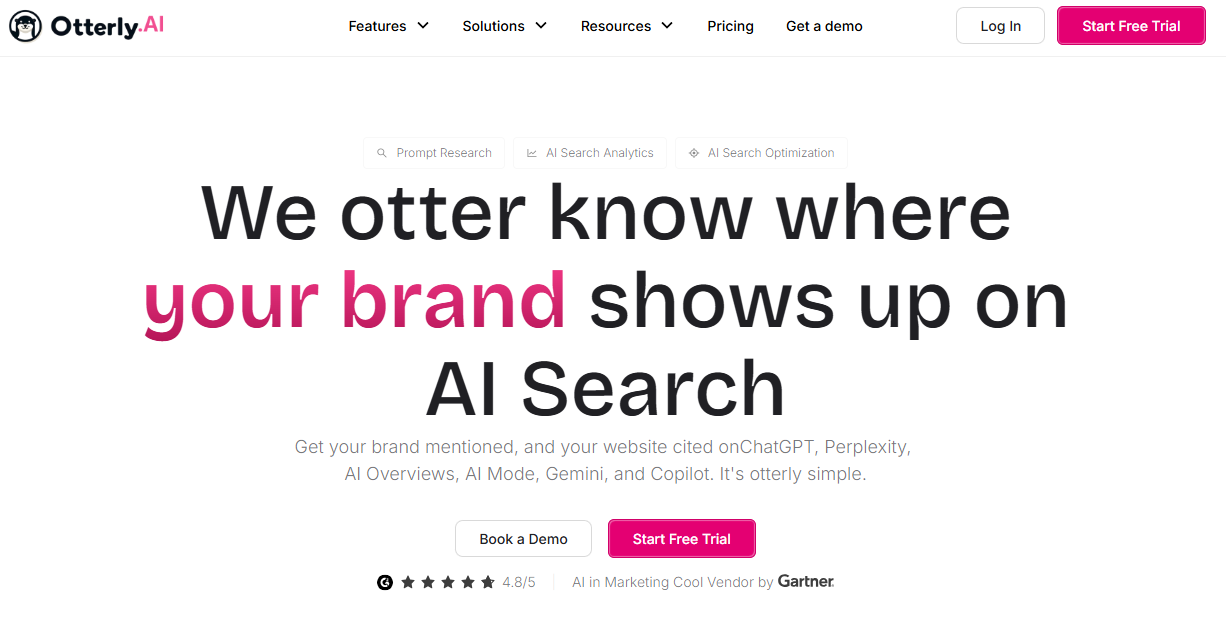
OtterlyAI provides the fastest path from "zero AI visibility data" to "actionable audit baseline" in this category. The platform's GEO Audit module — a dedicated Generative Engine Optimization assessment with SWOT analysis, competitor gap identification, and page-level optimization recommendations — distinguishes it from tools that only monitor what AI says about you without telling you what to fix. At $29/month entry pricing, it is the most accessible audit-grade tool for teams running their first structured AI visibility assessment.
- GEO Audit Module: OtterlyAI delivers a comprehensive Generative Engine Optimization audit that evaluates on-page factors for AI-readiness — structured data integrity, content parsability, entity signal strength, and tactic gaps. The SWOT analysis framework identifies competitive positioning strengths and weaknesses specific to AI search surfaces, giving content teams a prioritized remediation list rather than raw data.
- AI Engine Coverage: OtterlyAI tracks brand mentions and citations across ChatGPT, Perplexity, Google AI Overviews, and Microsoft Copilot on all base plans. Gemini and Google AI Mode are available as add-ons at $9–$149/month per tier, according to independent pricing reviews.
- Prompt Research for Audit Scoping: OtterlyAI's Prompt Research module discovers the conversational queries real users ask on AI platforms for your category, enabling teams to scope audits around actual buyer intent rather than keyword lists translated from traditional SEO.
- Citation & Link Position Tracking: OtterlyAI surfaces all cited URLs and domains weekly and tracks link position changes over time, giving audit teams a direct view of whether their domain is gaining or losing citation authority compared to competitors within AI-generated responses.
- Brand Visibility Index: OtterlyAI aggregates mention frequency, citation positioning, and competitive share into a single Brand Visibility Index KPI — providing the "before" metric that makes audit results measurable and reportable to stakeholders.
- Pricing Structure: OtterlyAI ranges from $29/month (Lite, 100 prompts) to $989/month (Pro), with the GEO Audit available across tiers. G2 reviewers rate the platform 4.8/5 across approximately 50 verified reviews.
When OtterlyAI Is a Good Fit
SEO managers and growth leads who need to run a first AI visibility audit quickly and affordably — establishing a baseline across 25–100 prompts, identifying the biggest citation gaps, and producing a stakeholder-ready "before" snapshot. Agencies benefit from the repeatable GEO Audit deliverable for client engagements.
When OtterlyAI Is Not a Good Fit
Enterprise teams needing compliance-certified infrastructure (SOC 2), hallucination detection, or AI crawler log analysis will require tools with deeper audit layers. Organizations tracking visibility across 7+ engines on base plans will find the add-on pricing model restrictive.
Tool #2 — Semrush
Best for: Integrated SEO + AI visibility audit in a single platform

Semrush turns an AI visibility audit into an action-connected workflow by pairing AI mention tracking — with sentiment classification, citation analysis, and share-of-answer benchmarking — with the SEO, content, and technical site-audit tools needed to execute fixes inside the same platform. Semrush used these capabilities internally and increased its own AI share of voice from 13% to 32% in one month, demonstrating the feedback loop between auditing and action.
- AI Site Audit: Semrush includes a dedicated AI site audit that evaluates technical factors affecting AI crawler accessibility — structured data integrity, content parsability, crawl directives, and schema validation — identifying the infrastructure-level issues that prevent AI engines from ingesting and citing your content.
- Mention Quality Classification: Semrush classifies every audited mention by sentiment (positive / neutral / negative), ensuring audit reports separate genuine recommendations from neutral listings and negative references. This prevents the common audit failure mode of inflating visibility scores with low-quality mentions.
- Citation Source Analysis: Semrush identifies which source domains AI engines cite when your brand is mentioned or when competitors are recommended instead. This citation-source layer is critical for audits because it reveals the authority gap: which third-party sources you need to earn coverage from to improve citation rates.
- 261M+ Prompt Database: Semrush provides access to a 261 million+ prompt database for audit scoping — enabling teams to discover the actual conversational queries triggering AI answers in their category at scale, rather than manually building prompt sets from scratch.
- Share-of-Answer Benchmarking: Semrush supports comparison against up to 9 competitors per tracked prompt, producing audit-grade competitive gap analysis segmented by engine, prompt cluster, and time period.
- Multi-Market Audit Scale: Semrush supports AI visibility audits across 38 countries and 28 languages via Enterprise AIO, making it the widest geographic coverage option for brands auditing global AI visibility.
- Pricing Structure: Plans start at $139/month for core SEO, with bundled SEO + AI visibility tiers available. G2 reviewers rate the platform 4.5/5 across approximately 2,200 verified reviews — the highest review density of any tool in this comparison.
When Semrush Is a Good Fit
Teams that need AI visibility audit data connected directly to the SEO, content, and technical tools required to act on findings — eliminating the audit-in-one-tool, fix-in-another workflow. Multi-market brands auditing across multiple languages and product lines benefit from the Enterprise AIO layer. The 261M+ prompt database makes audit scoping fast for teams entering the category.
When Semrush Is Not a Good Fit
Organizations that need only a lightweight, focused AI audit without SEO workflows. If your budget caps at sub-$50/month or you want a pure-play AI visibility specialist, a narrower tool will be simpler. Teams needing SOC 2-certified audit infrastructure or dedicated crawler log analysis should evaluate compliance-grade alternative
Tool #2 - Peec AI – Best for AI Overviews Tracking + Full LLM Coverage
What it does
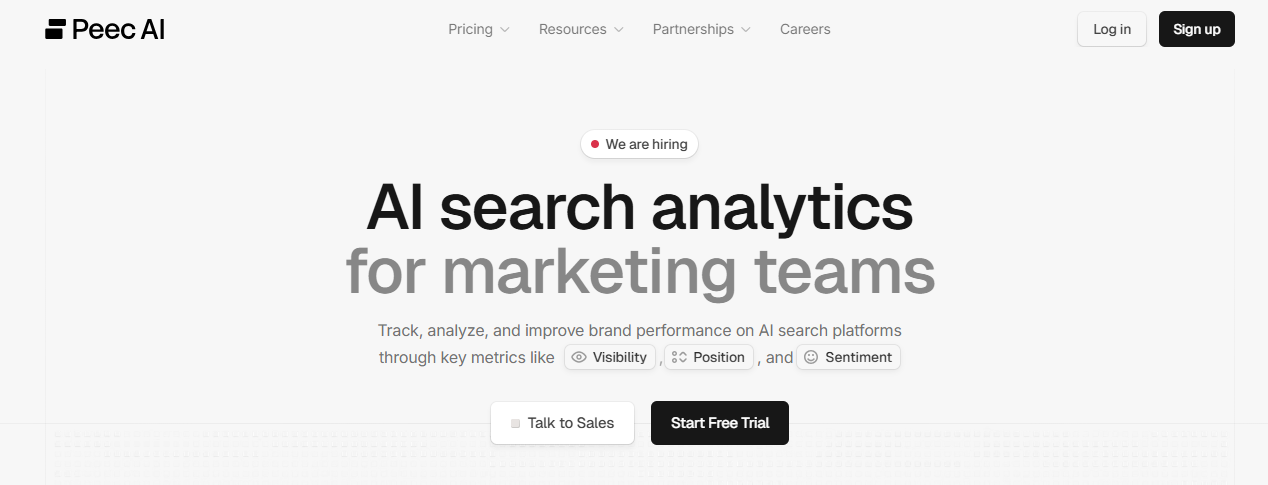
Peec AI is built natively for AI search and goes beyond presence tracking with a dedicated Actions module: instead of leaving you to interpret raw data, Peec clusters source opportunities, scores them by impact, and suggests specific next steps - whether that's earning coverage in the right publications, engaging in relevant communities, or creating content that fills gaps where competitors appear in AI Overviews and you don't.
Why teams use it
SEO and content teams use Peec AI when they need AI Overviews tracking alongside the broader AI search picture - without managing multiple tools. Instead of knowing only whether you appear in AIO, you also see which third-party sources are driving those citations, where competitors have an edge, and crucially, what to do about it. The Actions module turns that data into a prioritized work queue - specific source opportunities and content gaps, scored by impact, ready to act on. Agencies use it for multi-client dashboards, white-label reporting, and free pitch projects for prospects.
Who is this tool for (ICP)?
Peec AI is a good fit for:
- In-house SEO teams that want daily AI Overviews tracking plus a clear picture of what to fix next
- Content and growth teams that need competitor benchmarking and source gap intelligence alongside AIO data
- Agencies managing multiple clients across different markets, models, and reporting needs
- Enterprise teams that need API access, SSO, and BI integrations at scale
How this tool fits in this AI-first era
Unlike tools that bolted AI Overviews onto an existing SEO platform, Peec AI was built from the ground up for AI search - which means every feature reflects how teams actually need to work in this environment, not how they worked in classic SEO.
Peec AI:
- Tracks Google AI Overviews as a core surface, not an add-on
- Covers the full AI search landscape - ChatGPT, Perplexity, AI Mode, Gemini, Microsoft Copilot, and more - in one project setup
- Daily prompt execution across unlimited countries keeps data fresh across all tracked engines simultaneously
- Measures visibility at any level of granularity - full project, topic cluster, tag, or individual prompt
- New models added regularly as the AI search landscape evolves
How Peec AI works
Step 1 - Set up: The prompt generator builds your initial prompt set based on your business context - no blank page, no guesswork. Organize prompts by project, topic, or tag alongside your brand and competitors.
Step 2 - Track and analyze: Peec AI executes prompts daily across Google AI Overviews and supported AI engines, logging mentions, citations, position, and sentiment. Compare your AIO performance directly against ChatGPT, Perplexity, AI Mode, and more in the same view.
Step 3 - Act: The Actions module clusters visibility gaps into prioritized owned and earned media opportunities, scored by impact. Your team knows where to focus next - no manual data interpretation required.
Results sit in the dashboard, connect natively to Looker Studio (Advanced and Enterprise), or flow into any BI tool via API.
Free tier?
A 7-day free trial is available with no credit card required. Agencies get an additional advantage: free 7-day prospect projects that let you run a full AI visibility analysis for any potential client before committing budget - removing the cost risk of new business pitches.
Strengths
- Prompt generator builds your initial prompt set based on business context - no blank page setup
- Covers the full AI search landscape - AI Overviews, ChatGPT, Perplexity, AI Mode, Gemini, Microsoft Copilot, and more - in one project setup
- Actions module clusters those gaps into prioritized owned and earned media opportunities, scored by impact
- Granular visibility measurement - across an entire project, by topic cluster, by tag, or down to a single prompt
- Native Looker Studio integration and open API for custom BI workflows (Enterprise plans)
- Ability to track unlimited number of countries
Weaknesses
- API access is powerful but limited to Enterprise plans
Key capabilities
- Prompt generator - builds your initial prompt set based on business context, so setup takes minutes not hours
- Google AI Overviews tracking with daily prompt execution across unlimited countries
- Full LLM coverage including Google AI Overviews, ChatGPT, Perplexity, AI Mode, Gemini, Microsoft Copilot, and more - with new models added regularly
- Actions module - clusters visibility gaps into prioritized owned and earned media opportunities, each scored by impact
- Granular visibility measurement - across an entire project, by topic cluster, by tag, or down to a single prompt
- Project-level flexibility - independently configure tracking frequency and model selection per client, brand, or market
Pricing snapshot
- Starter: €85/month - 50 prompts, 1 project, 3 models
- Pro: €205/month - 150 prompts, 2 projects, 3 models
- Advanced: €425/month - 350 prompts, 5 projects, multi-country tracking, native Looker Studio integration
- Enterprise: custom pricing - unlimited prompts, unlimited projects, all models including Claude and GPT-5 Search, API access, SSO, dedicated support
Best for
Best for SEO and content teams that want daily Google AI Overviews tracking alongside full LLM coverage - without running separate tools for each. The Actions module makes it particularly useful for teams that don't just want to measure AI visibility but want a clear, prioritized list of what to do about it. If you only need a free AIO spot-checker, look at some other tools included in this comparison. If you need AI Overviews data integrated into a broader multi-engine visibility program with competitor benchmarking, citation intelligence, and actionable next steps, Peec AI is the strongest fit in this guide.
Tool #4 — Profound
Best for: Enterprise-depth AI search audits with content performance tracking
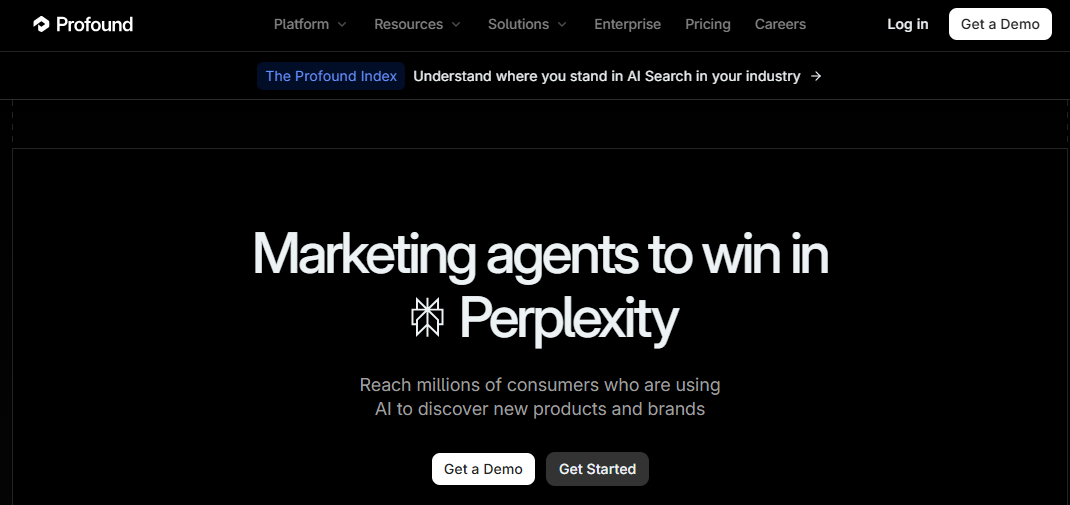
Profound approaches AI visibility audits from the content-performance layer — tracking not just whether your brand appears in AI answers, but which specific pages on your site are being cited, which are being ignored, and why. The platform's Agent Analytics module adds an "input-side" audit dimension by monitoring which AI crawlers and agents are consuming your content — revealing whether your pages are even visible to the systems generating AI answers before auditing the outputs.
- Content Performance Audit: Profound tracks which specific URLs and content assets are referenced in AI-generated responses, enabling audit teams to identify content gaps at the page level — which assets are never cited, which are repeatedly pulled in, and which competitor pages are cited instead of yours.
- Agent Analytics Module: Profound provides a dedicated Agent Analytics dashboard tracking AI crawler and agent activity on your site — measuring which AI systems consume your content, how frequently, and which pages they prioritize. This input-side audit data reveals whether your content is even accessible to AI systems before it can appear in their outputs.
- Prompt Volume Data: Profound offers panel-derived prompt volume estimates — showing how many real users ask specific queries to AI engines. This is a unique audit scoping capability: teams can prioritize audit coverage by actual search demand rather than estimated keyword volume.
- AI Engine Coverage: Profound monitors visibility across 10+ AI engines — including ChatGPT, Perplexity, Google AI Overviews, Gemini, Claude, and Copilot — with inclusive pricing (no per-engine add-ons), providing the broadest audit surface in this comparison.
- Revenue Attribution Workflows: Profound connects AI visibility audit findings to site outcomes including traffic and pipeline, enabling enterprise teams to quantify the business impact of visibility gaps and prioritize audit remediation by revenue potential.
- Pricing Structure: Entry pricing starts at approximately $99/month, with standard plans around $499/month and enterprise tiers at custom pricing. G2 reviewers rate the platform 4.7/5 across approximately 38 verified reviews — a significantly larger review sample than most competitors.
When Profound Is a Good Fit
Enterprise teams with established SEO/content programs that need audit depth beyond "are we mentioned?" — specifically: which content gets cited, which AI crawlers consume your pages, how many real users ask the queries you're auditing, and what's the revenue impact of the gaps you've found. Organizations where AI visibility carries brand/PR stakes requiring accuracy and governance.
When Profound Is Not a Good Fit
Early-stage teams running their first lightweight audit with a small prompt set at budget pricing. The depth of capability comes with a steeper learning curve and higher price floor. Teams that need compliance-grade certifications (SOC 2) or dedicated hallucination detection should evaluate specialized alternatives.
Tool #5 — Scrunch AI
Best for: Compliance-grade audits with real-time crawler analytics
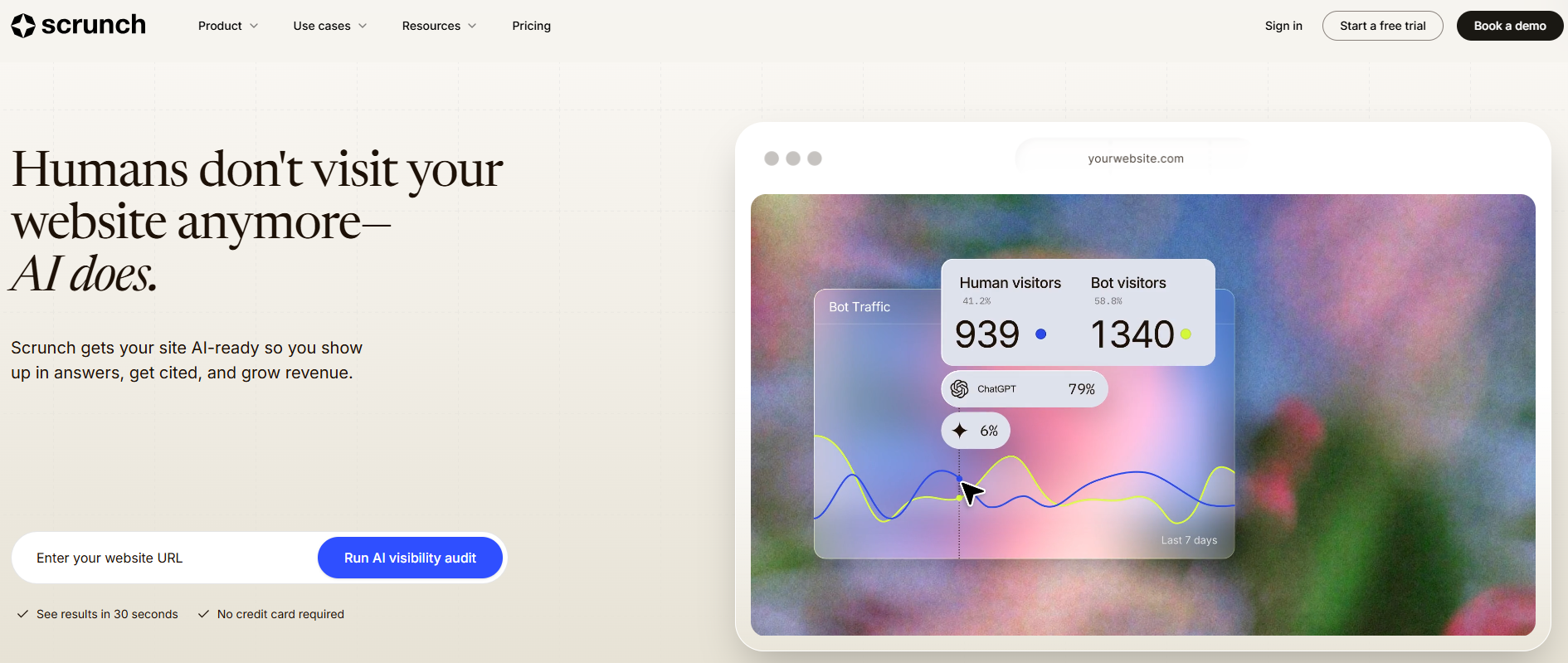
Scrunch AI approaches AI visibility auditing from the compliance and infrastructure layer — combining SOC 2 Type II certification, real-time AI bot crawling feeds, and site audit modules that evaluate technical barriers to AI discoverability. The platform is the only audit-grade tool in this comparison with formal security certification, making it the default option for enterprise procurement processes that mandate auditable, compliant vendor infrastructure.
- Real-Time Bot Crawling Feed: Scrunch AI integrates with GA4 and Cloudflare to provide real-time tracking of AI crawler visits — showing which bots visit your site, crawl frequency, and which pages they consume. This "input-side" audit data is a genuine differentiator: most audit tools only examine what AI engines output, not what they actually read.
- AI Site Audits: Scrunch AI runs 5 site audits per month on the Core plan, evaluating technical and structural barriers that reduce AI visibility — crawlability, structured data gaps, content parsability, and crawler directive issues. These audits identify infrastructure-level problems that content optimization alone cannot solve.
- SOC 2 Type II Certification: Scrunch AI is the only tool in this comparison with SOC 2 Type II compliance — providing the formal security and data-handling certification that enterprise procurement teams require before approving visibility audit vendors.
- Hallucination Detection (Enterprise): Scrunch AI includes dedicated hallucination detection on Enterprise plans — flagging when AI models generate factually incorrect claims about your brand during audit runs. This is currently unique in the market and particularly valuable for brands in regulated industries.
- Agent Experience Platform (AXP): Scrunch AI's AXP framework creates AI-optimized versions of your pages for maximum agent parsability — converting audit findings into actionable content delivery improvements.
- AI Engine Coverage: Scrunch AI Core plan tracks 4 engines (ChatGPT, Perplexity, AIOs, Copilot) at $250/month. Enterprise plans expand to 7+ engines including Claude, Gemini, and AI Mode.
- Pricing Structure: Core starts at $250/month (125 custom prompts), Growth at $500/month, Enterprise at custom pricing. G2 reviewers rate the platform 4.7/5 across approximately 25 reviews.
When Scrunch AI Is a Good Fit
Enterprise organizations with SOC 2 compliance requirements and dedicated AEO teams that need to audit both the "input side" (what AI crawlers read) and "output side" (what AI engines say about you). Regulated industries where hallucination detection carries legal risk mitigation value. Agencies needing workspace management for multi-client audit engagements.
When Scrunch AI Is Not a Good Fit
Budget-conscious teams running first-time audits. Organizations without dedicated SEO/AEO specialists. Teams that primarily need content creation guidance or lightweight monitoring rather than compliance-grade audit infrastructure.
What Is AI Search Visibility?
AI search visibility measures how often — and how prominently — AI systems mention, cite, or recommend your brand in generated answers across engines like ChatGPT, Perplexity, Google AI Overviews, Gemini, and Copilot. It is structurally different from traditional search visibility because AI engines don't rank pages in a list — they synthesize answers from multiple sources, choose which brands to mention, and decide which domains to cite, all within a single generated response.
Traditional rank trackers and Google Search Console cannot show: how frequently your brand appears in AI-generated answers, whether AI engines prefer competitors' sources over yours, or which high-intent queries you're completely absent from in AI summaries. That gap — between where you rank and where you're cited — is what AI visibility auditing exists to close.
What Is an AI Search Visibility Audit?
An AI search visibility audit is a structured diagnostic process that maps your brand's presence, citation rate, competitive positioning, and content gaps across AI answer engines for your most important queries. It answers three questions:
- Where are you visible? Which prompts and engines mention your brand, cite your domain, or recommend your product?
- Where are you missing? Which high-intent queries trigger AI answers that mention competitors but not you?
- Why are you missing? Is the gap caused by content absence, entity signal weakness, technical crawl barriers, or third-party authority deficiency?
The audit produces a prioritized remediation plan: content to create, pages to restructure, entity signals to strengthen, and authority to build — with each fix tied to specific prompts where visibility improvement is measurable.
How to Choose AI Visibility Tools (Evaluation Criteria)
Audit Coverage vs Monitoring Coverage
Not every monitoring tool is an audit tool. Audit-grade tools provide: diagnostic capabilities (what's broken and why), gap identification (where competitors appear and you don't), remediation guidance (what to fix and in what order), and baseline measurement (before/after metrics). Pure monitoring tools tell you what happened; audit tools tell you what to do about it.
Technical Audit Depth
Evaluate whether the tool audits the infrastructure layer — crawl accessibility, structured data, content parsability, AI crawler behavior — or only the output layer (what AI says about you). Tools like Semrush (AI site audit), Scrunch AI (bot crawling feed), and Conductor (24/7 monitoring) assess both layers. Tools like OtterlyAI and Peec AI focus primarily on the output layer.
Competitive Gap Analysis
AI answers are inherently comparative. Audit tools must support competitive benchmarking — ideally tracking 5+ competitors per prompt cluster. Semrush supports up to 9 competitors; Conductor supports up to 50. The depth of competitive gap analysis determines whether your audit can answer "who is beating us and why."
Action-to-Fix Pipeline
The most valuable audit tools close the gap between "here's what's wrong" and "here's what to do." Peec AI's Actions module scores source gaps by impact and suggests specific fixes. Semrush connects audit findings to content and SEO tools for execution. Profound ties visibility data to content performance tracking. Evaluate whether the tool leaves you with a diagnostic or a roadmap.
How to Run an AI Search Visibility Audit for Your Top Keywords
A structured AI search visibility audit gives you a clear, before-and-after picture of how often AI systems actually mention and recommend your brand for the keywords that matter most.
Step 1 – Define and Prioritize Your Top Keywords
Start with keywords that actually move the needle:
- Top revenue-driving keywords from GA4 / CRM
- High-intent queries from Google Search Console
- Strategic category / solution terms (e.g., “project management software for agencies”)
▶️ Export 50–200 priority keywords as your initial audit set. This becomes your control group for every future AI SEO audit for brand visibility.
Step 2 – Map Keywords to AI Surfaces & Choose Tools
For each keyword, ask:
- Does it mostly live on Google (informational/commercial)?
- Is it heavily influenced by ChatGPT/Gemini/Perplexity usage?
- Does shopping or local intent matter?
Then:
- Use a Google-oriented tool (SE Ranking AI Overviews Tracker, SEOmonitor, SEO.com AI Overview Checker) for AI Overview coverage.
- Add answer engine tools (Profound AI, Rankability, Morningscore) if conversational search is important.
▶️ If you’re still shortlisting, it helps to compare AI SEO tools side by side before you commit.
Step 3 – Run a Baseline Audit
Inside your chosen tools:
- Upload your keyword list
- Run scans to collect:
- Presence/absence in AI Overviews / AI answers
- Mentions of your brand vs competitors
- Pages and domains AI is citing
▶️ Export this baseline to Sheets or BigQuery so it becomes your “version 1” for every future SEO strategy using AI visibility tools.
Step 4 – Diagnose Gaps & Opportunities
Look for:
- Keywords where you rank well in classic SEO but don’t appear in AI Overviews
- Topics where AI prefers competitor guides, tools, or marketplaces
- Recurrent third-party domains that AI trusts more than your site (e.g., review sites, niche blogs)
Cluster gaps into themes (by product line, use case, or SERP type).
Step 5 – Build an Optimization Roadmap
Use your audit to create a prioritized roadmap:
- Refresh or create pillar guides for topics where AI leans heavily on competitors
- Strengthen E-E-A-T signals (expert authors, references, case studies)
- Earn more citations & links from domains that currently dominate AI sources
▶️ If you want to operationalize this, plug it into an AI SEO tools agile workflow so optimization work actually ships, not just lives in a spreadsheet.
Step 6 – Monitor and Iterate
AI surfaces update frequently. Make AI visibility:
- A monthly reporting line (presence rate, share of voice, traffic impact)
- Part of your content planning (which topics to write next)
- A QA step after publishing major content (spot-check AI Overviews & chatbots)
▶️ Over time, your brand visibility in AI search should improve steadily across your most valuable topics and markets.
Best Practices to Improve AI Search Visibility
Align with Google’s Guidance for AI Search
Google’s own guidance for succeeding in AI search emphasizes helpful, people-first content, clear sourcing, and strong technical hygiene.
Make sure you:
- Cover topics comprehensively, not just superficially
- Provide clear, verifiable claims (stats, references, examples)
- Maintain solid page experience and technical SEO
👉 This is the foundation for any long-term AI search visibility SEO strategy.
Optimize Entities, Brand Mentions & Topical Depth
AI systems think in entities and relationships:
- Make sure your brand, products, and categories are described consistently
- Create hub-and-spoke topic clusters around your top themes
- Earn mentions from trusted, topic-relevant sites (reviewers, industry blogs)
Use Structured Data & Clear Content Architecture
While AI systems don’t only rely on schema, structured data and clean page architecture still help search engines understand and surface your content:
- Add relevant schema markup (FAQ, Product, HowTo, Organization)
- Use clear headings, bullets, and summaries that are easy to quote
- Ensure internal links reinforce your topical authority
👉 You can see how this plays out in practice in our AI search visibility audit tools guide, which is structured with exactly this in mind.
Treat AI Visibility as an Ongoing Program
AI visibility isn’t a one-and-done project:
- Re-run AI visibility audits quarterly
- Add AI visibility metrics to your SEO dashboards
Keep experimenting with content angles, formats, and sources that AI tends to cite
Frequently Asked Questions
What’s the difference between classic SEO rank tracking and AI visibility tracking?
Do I really need AI visibility tools if my organic SEO is strong?
How many keywords should I audit for AI visibility?
How often should I run an AI search visibility audit?
Can I track traffic from AI Overviews in Google Search Console?
Conclusion
AI search isn’t a side-show anymore. Between Google’s AI Overviews and answer engines like ChatGPT, Gemini, and Perplexity, a growing share of discovery now happens inside AI-generated answers long before anyone clicks a “blue link.”
If you’re only tracking classic rankings and Search Console data, you’re effectively flying blind in a channel your buyers are already using and where your brand visibility in AI search may look very different from traditional SEO.
The tools in this guide exist to close that gap. Some focus on Google AI Overviews, others specialize in LLMs and answer engines, and a few bundle visibility with strategy and execution.
The “right” stack for you depends on your maturity and resources: smaller teams might pair a simple SEO + AI tracker with a free grader, while agencies and enterprises lean into more advanced AI search visibility audit tools that offer multi-AI coverage, APIs, and forecasting.
Whatever you choose, the mindset shift is the same: treat AI search visibility as a measurable, improvable program, not a one-off experiment. Start with your top 50–200 revenue-driving keywords, run a baseline AI visibility audit, and identify where AI is recommending competitors instead of you.
From there, fold AI insights into your SEO strategies using AI visibility tools content roadmap, E-E-A-T initiatives, link building, and reporting cadence.
If you do that consistently “measure, prioritize, ship, and re-measure” you’ll be ahead of most of the market. While others are still arguing about whether AI will “kill SEO,” you’ll already be visible in the answers that matter, with the AI SEO tools and processes in place to keep it that way.
📑 Disclosure!
Some links in this article are affiliate links. If you sign up through them, The Rank Masters may earn a commission at no additional cost to you. This does not influence which tools we recommend or what we say about them.