

AI search is rewriting the rules of SaaS SEO.
At The Rank Masters, B2B SaaS SEO Agency, we see it every day: it’s no longer enough to rank for a few high-volume keywords—you need tightly structured topic clusters that AI Overviews, chatbots, and search assistants trust enough to quote.
That’s where AI-powered keyword clustering and GEO-ready topical maps come in. The right tools turn messy SaaS keyword dumps into clean, GEO-aware topic maps that map directly to pipeline, not just pageviews - exactly what a specialist SaaS SEO agency needs to scale organic growth.
In this guide, you’ll see which AI tools are worth your time, how they work, and who they’re best for, so you can pick the one that fits your stack, your budget, and your growth stage.
Whether you’re a solo founder or leading a multi-market SEO team, use this to shortcut tool research and start building clusters that actually convert.
Table of Contents
Best AI Tools for Clustering SaaS Keywords into GEO-Ready Topic Maps
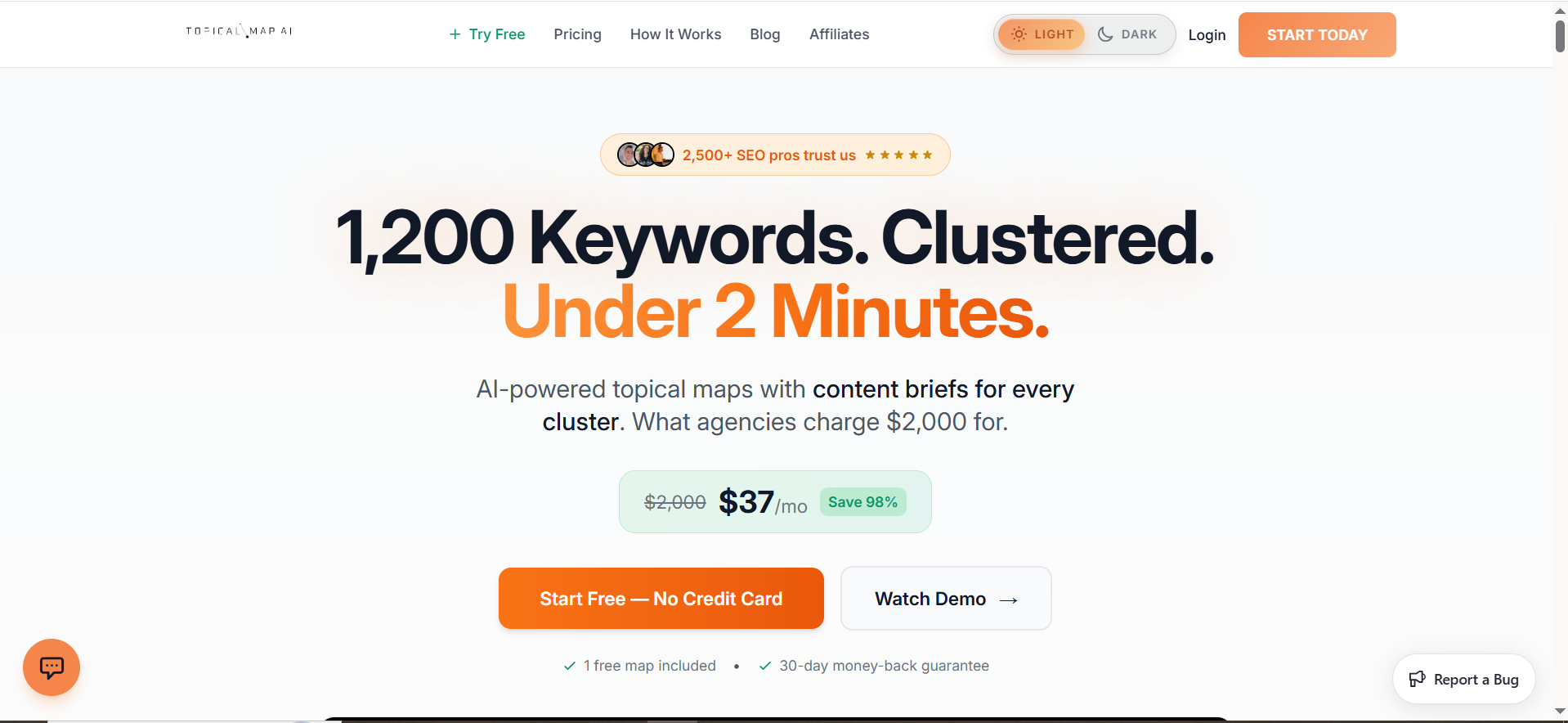
Topical Map AI – Fast, focused topical map and clustering engine; best for SaaS teams and agencies that want a dedicated tool just for building topic maps and briefs.
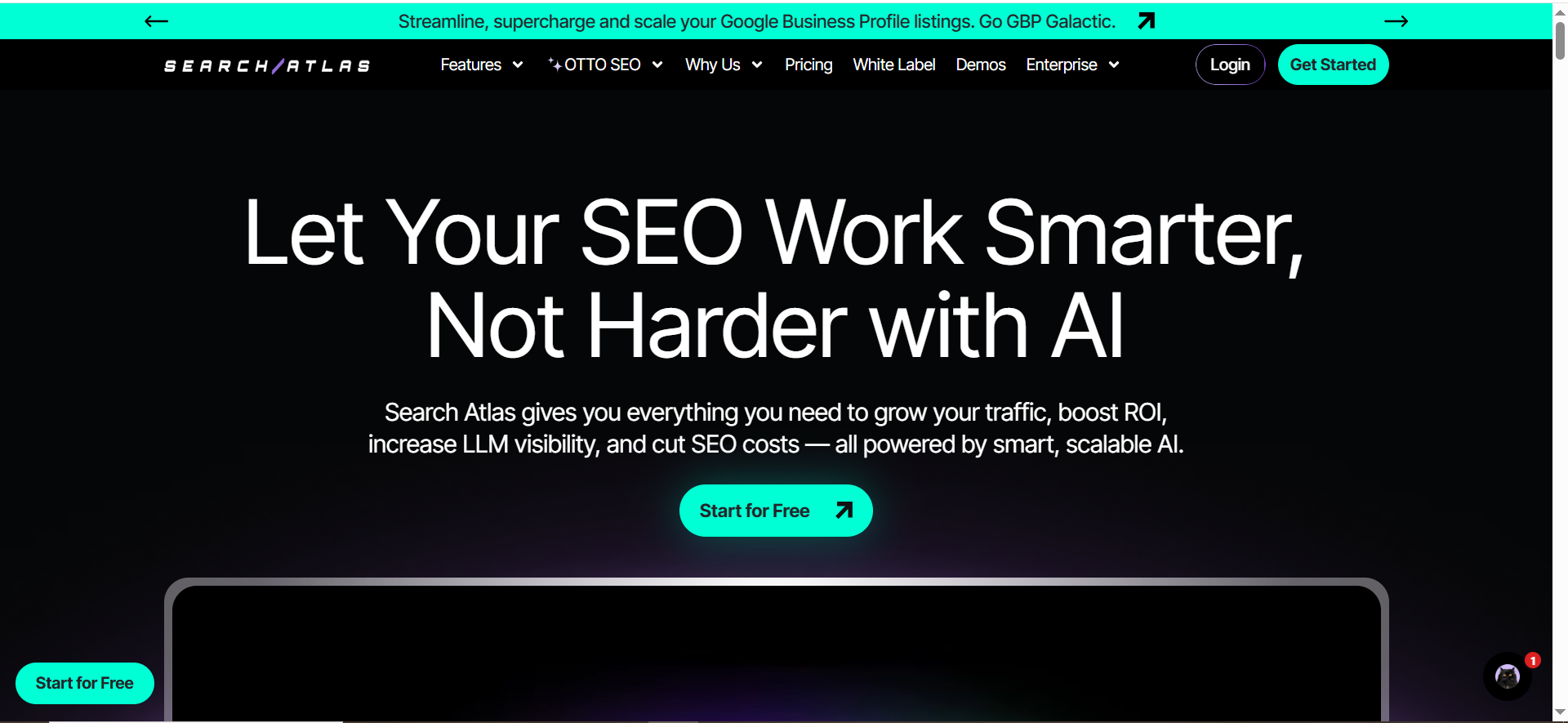
SearchAtlas (Topical Map + OTTO) – Full SEO+AI suite with mapping, content, and reporting in one place; best for mid–large SaaS companies and agencies running serious, multi-site SEO programs.
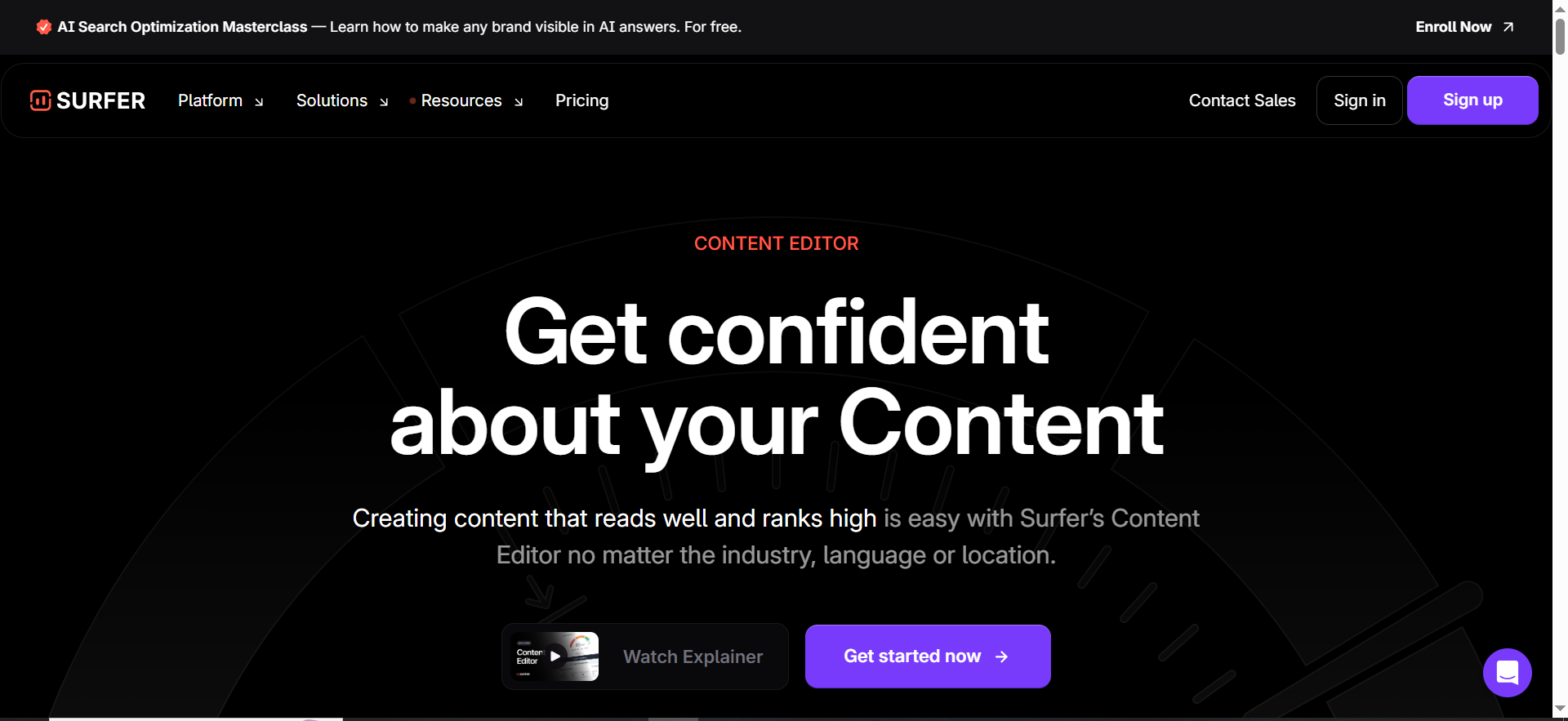
Surfer SEO – Editor-first SEO tool that turns topic ideas into well-optimized articles; best for content-heavy SaaS brands and agencies with active writing teams.
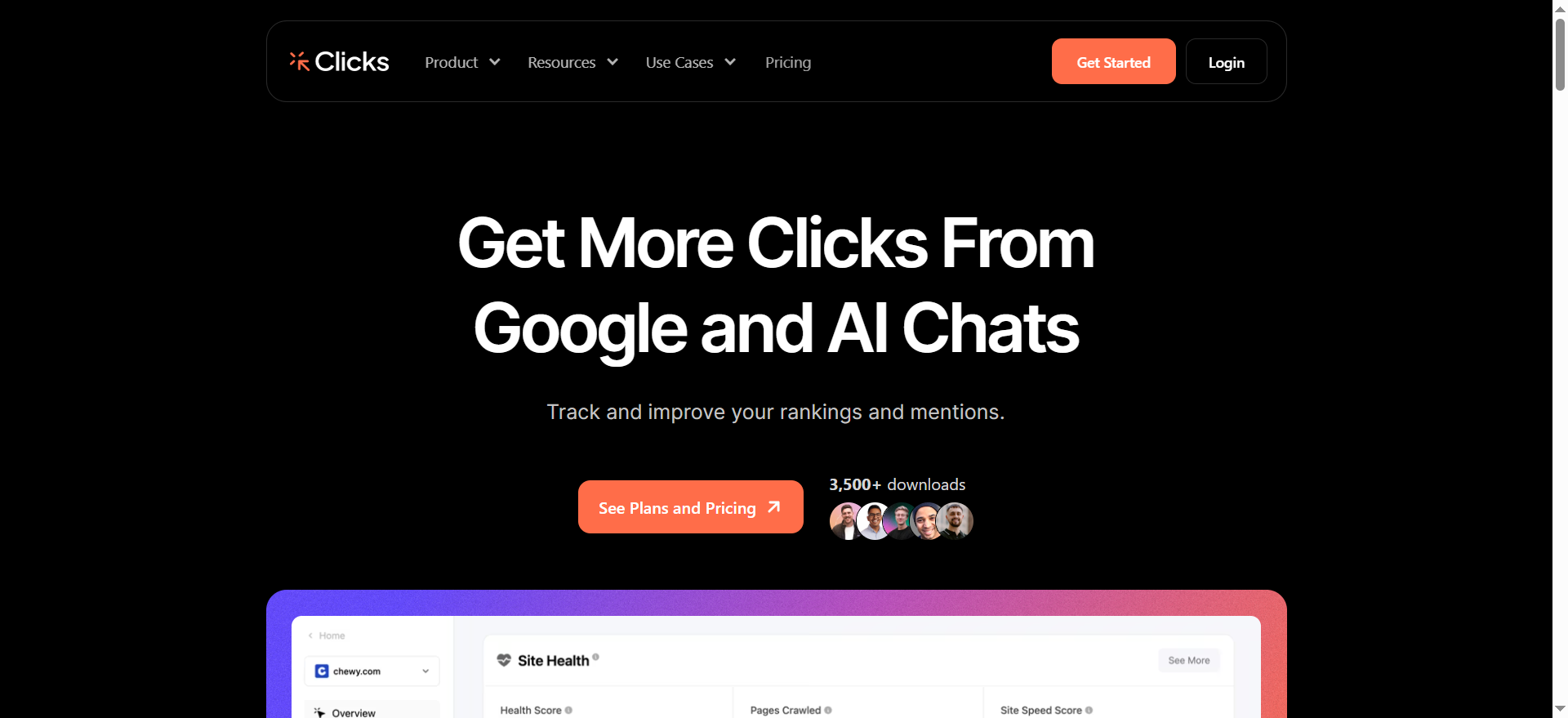
Clicks.so Topical Map & Clustering – Free, lightweight way to get quick topical maps and clusters; best for early-stage SaaS, lean teams, and rapid idea validation.
Optimo Topical Map Generator – Zero-cost topic/subtopic ideation for fast brainstorming; best for solo founders and small SaaS teams needing quick inspiration without a budget.
HackTheSEO Topical Map – AI-forward platform combining mapping, research, and personalization; best for experiment-friendly SaaS teams and innovative SEO agencies.
KeywordInsights & Answer Socrates (Clustering tools) – Heavy-duty SERP-based clustering for huge keyword lists; best for advanced SEOs and agencies managing large-scale SaaS SEO.
Free Lightweight Map Generators (FatJoe, Growthack, Publish7, etc.) – Simple, fast topical maps as a second opinion; best for brainstorming, micro-cluster planning, and cross-checking your main tool’s output.
1. Topical Map AI – Purpose-Built Topical Map Generator
What it does?
Topical Map AI turns a seed topic (or site) into a structured topical map with clusters, pillars, and long-tail ideas. It focuses on fast, clean maps you can export and plug into content briefs, calendars, and AI-writing workflows.
Why teams use it?
Teams use it to replace manual keyword clustering in spreadsheets and get a clear “topic source of truth.” It helps SEO, content, and PMM align on what to publish and in what order, without needing a huge SEO suite.
Who is this tool for (ICP)?
Best for teams that want a focused “map engine” rather than an all-in-one.
- In-house SaaS SEO/content leads
- B2B SaaS agencies building topical authority
- Solo founders / lean growth teams with content as a key channel
How this tool fits in this AI-first era?
Topical Map AI gives you structured, entity-aware topics that LLMs and AI search systems can easily interpret. Instead of guessing what to tell your AI writer, you feed it a map built around real topical coverage and search intent.
- Creates AI-ready topic graphs from seed ideas
- Helps ensure content is cluster-driven and “summarizable”
- Gives a central map that all AI tools can work from
- Surfaces gaps where competitors may be winning AI citations
How does Topical Map AI work?
You enter a topic or domain; it expands and clusters keywords into pillars and subtopics. Then you export the map into Sheets/Notion or directly into AI prompts/briefs.
Free tier?
Typically some form of trial/limited usage; details vary by plan.
Strengths?
- Very fast map generation
- Purpose-built for topical authority
- Easy exports and workflows
Weaknesses?
- No technical SEO or link-building features
- Less useful if you publish very little content
Key Capabilities?
Core features to highlight:
- AI topical map generation
- Automated keyword clustering into pillars/clusters
- Simple exports for briefs and content planning
Pricing snapshot?
- Starter – $X/month
- Pro – $X/month
- Agency – $X/month
Best for?
Best for SaaS teams and agencies that already have analytics and just need a fast, dedicated tool for keyword clustering and map building.
2. SearchAtlas Topical Map Generator (with OTTO)
What it does?
SearchAtlas is a full SEO platform with a topical map generator plus OTTO, its AI engine. It turns seed topics into clusters, then connects them to content creation, optimization, and reporting.
Why teams use it?
Teams choose it when they want maps, audits, rank tracking, and AI content in one place. It reduces the need for multiple tools and gives a single home for strategy and execution.
Who is this tool for (ICP)?
Best when SEO is a big, ongoing growth lever.
- Mid–large B2B SaaS companies
- SEO agencies with many clients
- In-house SEO teams needing reporting + execution
How this tool fits in this AI-first era?
SearchAtlas acts as an AI-driven SEO control center: it helps you define topical clusters, create and optimize content, and see how clusters perform across search and AI surfaces.
- Links strategy (maps) to content production
- Supports continuous optimization as SERPs/AI change
- Centralizes data for multi-market SaaS
- Reduces stack sprawl for larger teams
How does SearchAtlas work?
You generate topical maps, turn cluster ideas into content briefs or drafts via OTTO, and track performance with built-in reports and audits.
Free tier?
Generally paid; expect demo/trial rather than a generous free plan.
Strengths?
- All-in-one mapping + content + reporting
- Good for multi-site/multi-market management
- Built for teams and agencies
Weaknesses?
- Higher learning curve
- Pricing suited more to serious SEO programs
Key Capabilities?
- Topical map generator
- OTTO AI content & optimization
- Technical audits & rank tracking
- Dashboards & reporting
Pricing snapshot?
- Essentials – $X/month
- Growth – $X/month
- Enterprise – custom
Best for?
Best for SaaS companies and agencies wanting a full SEO+AI stack where mapping, creation, and measurement live together.
3. Surfer SEO – Topical Map + On-Page Optimization
What it does?
Surfer combines a Topical Map feature with a well-known SEO writing editor and content audits. It helps you plan topics and optimize each article for semantic coverage and competitive benchmarks.
Why teams use it?
Teams love Surfer because it sits directly in the writing workflow. Writers see in-editor suggestions, SEO scores, and entity hints, making it easy to turn cluster ideas into optimized articles.
Who is this tool for (ICP)?
Ideal where content output is regular and serious.
- SaaS blogs with recurring publishing cadence
- SEO/content agencies and freelancers
- In-house content teams focused on on-page gains
How this tool fits in this AI-first era?
The AI era rewards content that’s clear, structured, and entity-rich; Surfer helps enforce that on every URL. Its Topical Map shows what to cover, and the editor ensures each page is good enough for both search engines and LLMs.
- Ensures cluster pages are semantically rich
- Bridges planning and drafting in one tool
- Works well with AI writers for “guided” drafts
- Supports ongoing refreshes as topics evolve
How does Surfer work?
You generate clusters or pick keywords, open the editor, and follow its recommendations as you write or refine content. Audits then suggest updates for older articles.
Free tier?
Primarily paid; often trial-based, not fully free.
Strengths?
- Editor is writer-friendly
- Clear optimization guidance
- Useful audits and refresh suggestions
Weaknesses?
- Pricing can be high for low-volume publishers
- Not a replacement for analytics or technical tools
Key Capabilities?
- Topical Map & planner
- SEO writing editor (with scoring)
- Content audits/refresh recommendations
- Integrations with docs/AI writers
Pricing snapshot?
- Essential – $X/month
- Advanced – $X/month
- Max/Enterprise – $X/month
Best for?
Best for SaaS teams where multiple writers need consistent, search- and AI-friendly content standards.
4. Clicks.so – Free Topical Map Generator + AI Clustering
What it does?
Clicks offers a free topical map generator and AI keyword clustering, creating industry-specific maps with subtopics and internal link ideas. It’s simple and fast for getting a strategic overview.
Why teams use it?
Teams use Clicks for quick, low-friction topic exploration without committing to heavy software. It’s great for validating ideas, pitching clusters to stakeholders, and getting a first pass at a content map.
Who is this tool for (ICP)?
Best as a light, easy entry point.
- Early-stage SaaS founders/growth marketers
- Freelancers and small agencies
- Content strategists testing niches/verticals
How this tool fits in this AI-first era?
Clicks helps you quickly see the shape of a topic so you can feed better structures into AI writers and GEO strategies. It’s perfect for generating “starter maps” that inform prompts and outlines.
- Rapidly visualizes topic structure
- Helps identify early gaps/opportunities
- Good for generating AI-ready outlines and FAQs
- Pairs well with deeper SEO tools
How does Clicks.so work?
You add a topic, the tool returns a map and possible clusters, and its clustering module deepens them using your keyword lists.
Free tier?
Yes – free topical map generator; advanced limits/features often paid.
Strengths?
- Free or very low-cost entry
- Very fast results
- Easy to share with stakeholders
Weaknesses?
- Less control than specialist clustering tools
- Limited depth for large, complex sites
Key Capabilities?
- Free topical map generator
- AI keyword clustering
- Basic internal linking ideas
Pricing snapshot?
- Free – basic maps
- Pro – $X/month
- Agency – $X/month
Best for?
Best for early mapping, testing new angles, and getting started before investing in heavier platforms.
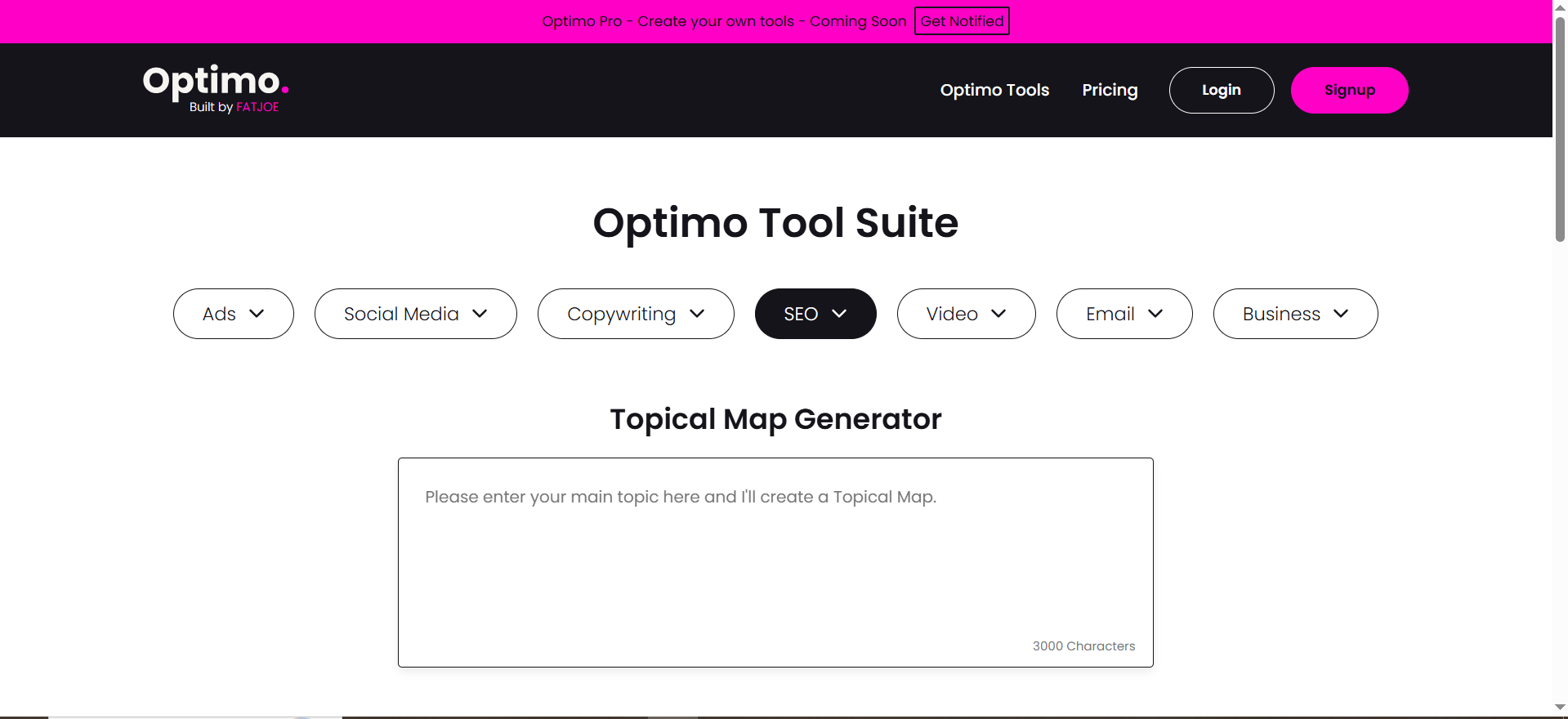
5. Optimo Topical Map Generator (Free)
What it does?
Optimo’s topical map generator is a free ideation tool that turns a main topic into subtopics and content angles. It’s part of a larger free AI marketing toolkit.
Why teams use it?
They use it for rapid brainstorming and first-draft topic structures, especially when budgets are tight. It’s helpful for side projects and quick content calendar ideas.
Who is this tool for (ICP)?
Good for anyone needing fast, no-cost ideation.
- Solo founders and small SaaS teams
- Content marketers planning blog themes
- Agencies doing early exploration for clients
How this tool fits in this AI-first era?
Optimo democratizes topic ideation, giving anyone a quick “AI opinion” on how to structure a subject. Teams can refine these outputs and feed them into more advanced clustering or AI-writing workflows.
- Great for zero-budget experimentation
- Helps generate rough maps for LLM prompts
- Useful for initial GEO/vertical exploration
- Works as a second opinion alongside other tools
How does Optimo work?
Input a topic, get a list/map of subtopics, then copy results into your planning or keyword stack for refinement.
Free tier?
Yes – generally free, sometimes with usage limits.
Strengths?
- No big learning curve
- Ideal for quick “what should we cover?” checks
Weaknesses?
- No SERP-based clustering
- No performance/analytics
Key Capabilities?
- Topical map ideation from seed topics
- Quick subtopic/content idea generation
Pricing snapshot?
- Free – main topical map features
- (If paid tier exists) Paid – $X/month
Best for?
Best for early idea-stage mapping and for teams wanting free support before investing in dedicated clustering tools.
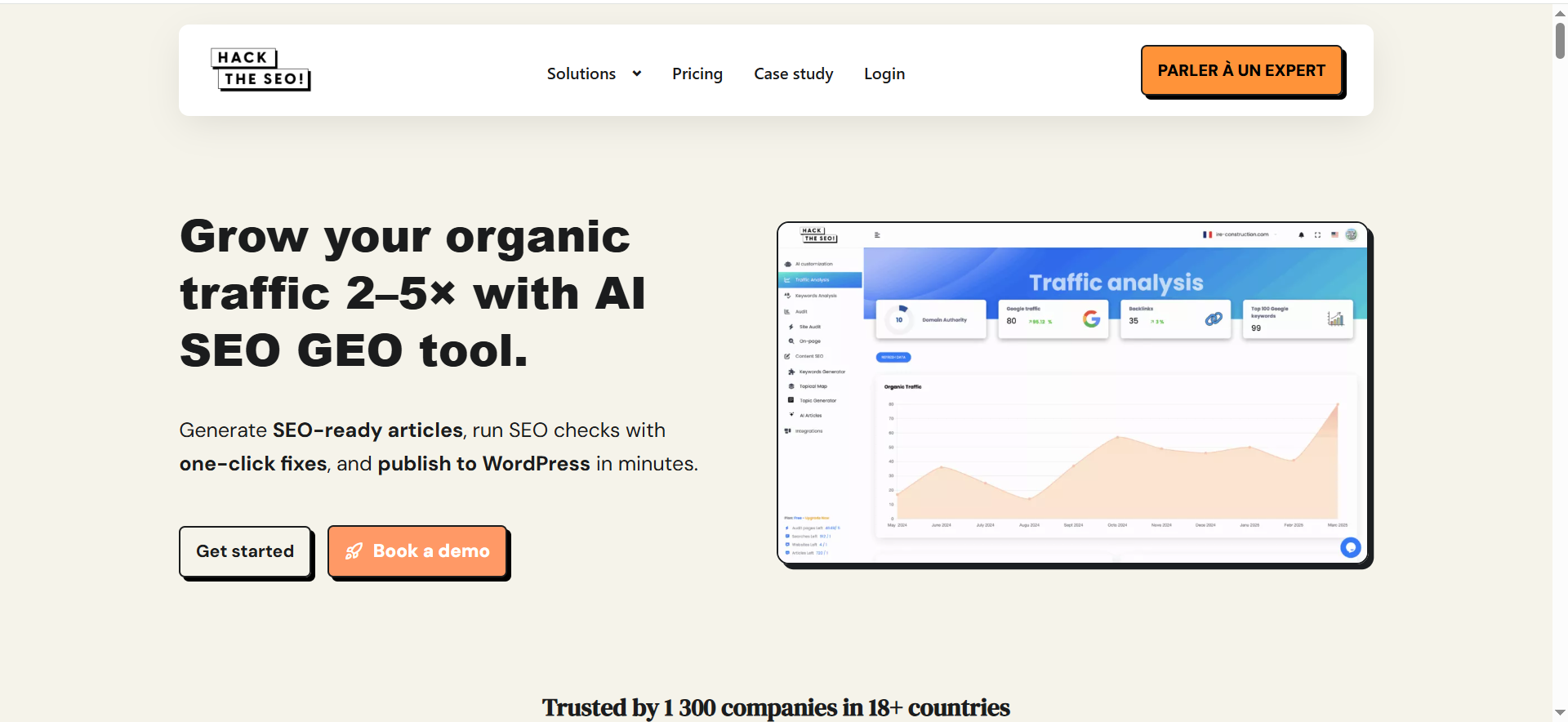
6. HackTheSEO Topical Map Generator
What it does?
HackTheSEO offers a topical map generator plus AI keyword research, on-page optimization, and personalization features. The map module builds semantic clusters around your topic inside a broader AI SEO suite.
Why teams use it?
They use it when they want an AI-forward SEO platform and are happy experimenting with newer tools. It’s attractive for combining mapping, content recommendations, and personalization in one place.
Who is this tool for (ICP)?
Fits teams comfortable with experimentation.
- SaaS growth teams trying AI-heavy workflows
- Agencies wanting a fresher SEO stack
- SEOs who like testing new platforms
How this tool fits in this AI-first era?
HackTheSEO treats SEO as an evolving, AI-driven system: topical maps inform content, and personalization helps optimize for engagement and relevance as AI search changes.
- Connects mapping to keyword research and content
- Encourages continuous testing and iteration
- Supports personalized experiences that can improve signals
- Designed for AI-influenced search behavior
How does HackTheSEO work?
You generate a topical map, then use its other modules to research keywords, create/optimize content, and test personalization variants.
Free tier?
Likely limited trial; main value is on paid plans.
Strengths?
- Modern UI and workflows
- Integrated mapping + content + personalization
Weaknesses?
- Fewer case studies/resources
- Possible fast-changing UX/features
Key Capabilities?
- SEO Topical Map generator
- AI keyword research and clustering
- On-page optimization
- Content personalization tools
Pricing snapshot?
- Starter – $X/month
- Growth – $X/month
- Agency/Enterprise – custom
Best for?
Best for teams that treat SEO as an experimentation playground and want mapping, AI content, and personalization in one tool.
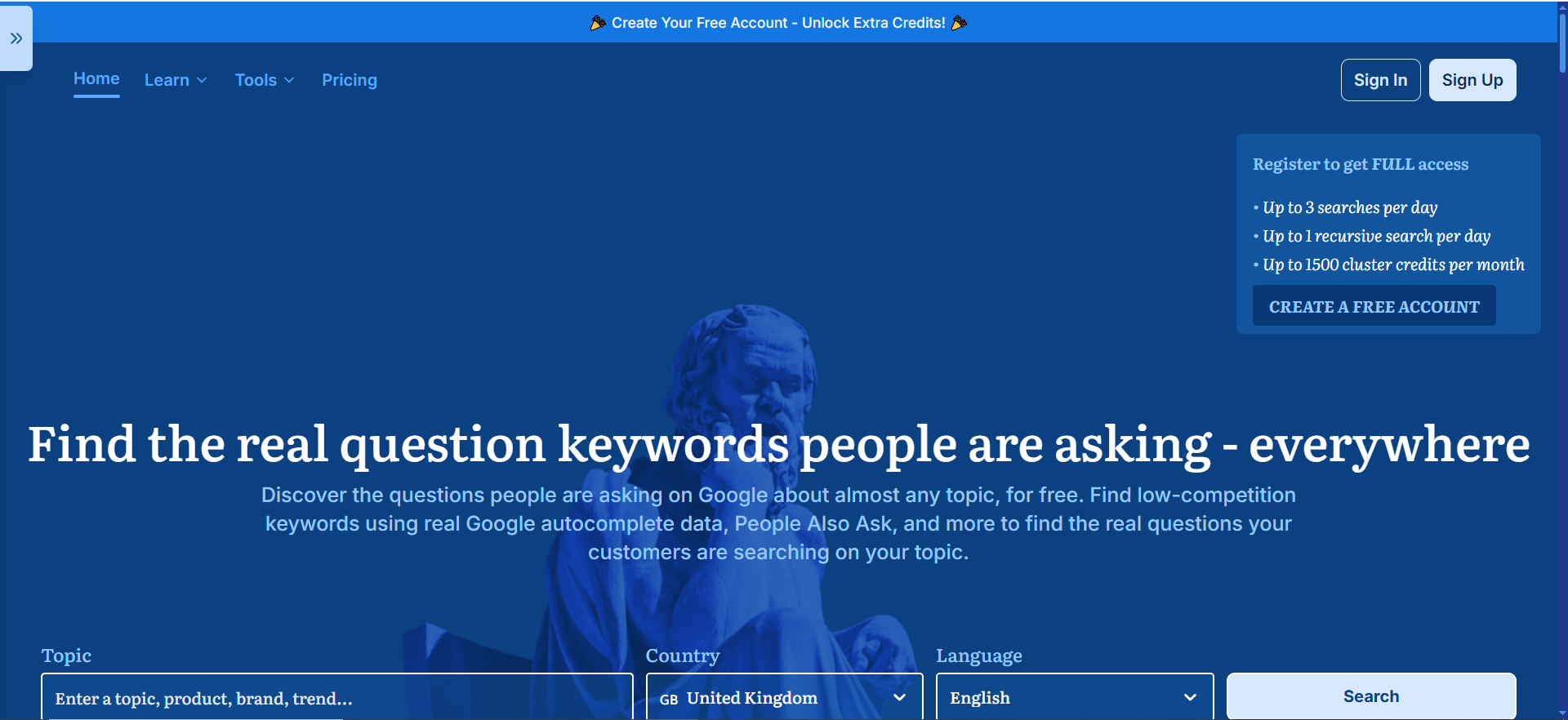
7. Dedicated Keyword Clustering Tools (KeywordInsights, Answer Socrates, etc.)
What it does?
These tools specialize in turning big keyword lists into intent-based clusters using SERP and semantic signals. They’re built to handle large CSVs from Ahrefs/Semrush and output clean cluster spreadsheets.
Why teams use it?
Teams use them for scale and control—especially when working with tens of thousands of keywords. They’re perfect for building custom topic maps and architectures tailored to your strategy.
Who is this tool for (ICP)?
Ideal for advanced practitioners.
- SEO leads at large SaaS companies
- Agencies with many clients and huge keyword sets
- Technical SEOs who live in Sheets/BI tools
How this tool fits in this AI-first era?
Clustered keyword data becomes the foundation for AI-era topic graphs and GEO strategies. These tools help you see every intent variation so you can create deep, comprehensive coverage that AI systems trust.
- Processes very large keyword lists
- Reveals granular intent groupings
- Feeds better prompts and briefs for LLMs
- Supports geo/persona segmentation at scale
How do dedicated clustering tools work?
Upload a CSV, set clustering parameters, run the clustering, and export clusters for mapping, URL planning, and content production.
Free tier?
Often limited trials or small sample runs; full power is paid/usage-based.
Strengths?
- Handle huge keyword volumes
- Fine control over clustering sensitivity
- Great for custom, advanced architectures
Weaknesses?
- Little/no visualization
- No built-in analytics or content editor
Key Capabilities?
- SERP-based clustering at scale
- Intent tagging/labels
- Exportable cluster reports
Pricing snapshot?
- Credit-based/pay-as-you-go – $X for Y keywords
- Monthly tiers – Starter / Pro / Agency
Best for?
Best for seasoned SEOs and agencies who already know how they want to design topic maps and just need a powerful clustering engine.
8. Other Free or Lightweight Topical Map Generators (FatJoe, Growthack, Publish7, etc.)
What it does?
These tools offer simple, often free topical map generation and content idea suggestions. They give quick subtopic lists, basic clusters, and sometimes outline starters.
Why teams use it?
Teams use them for variety and quick checks—sanity-checking maps, exploring micro-niches, and creating pitch visuals. They’re handy when you want multiple “takes” on a topic.
Who is this tool for (ICP)?
Perfect as support tools, not core platforms.
- New SaaS projects testing positioning
- Content marketers brainstorming campaigns
- Freelancers/small agencies with tight budgets
How this tool fits in this AI-first era?
In an AI-first world, having several fast ways to reframe a topic is valuable. These tools give alternative structures you can merge into stronger prompts, topic maps, and FAQ sets for AI and SEO.
- Provide quick alternative topic views
- Useful for generating new prompt/FAQ ideas
- Help non-SEOs contribute structured ideas
- Great for micro-clusters and campaigns
How do these generators work?
Enter a topic, get clusters/subtopics, then copy into your planning docs. Repeat with variations (different seeds, geos, verticals).
Free tier?
Most offer free/freemium access with usage caps.
Strengths?
- Simple, low-friction use
- Free or very affordable
Weaknesses?
- Little SERP/volume rigor
- No analytics or performance layer
Key Capabilities?
- Rapid topical map and subtopic generation
- High-level cluster ideas and angles
Pricing snapshot?
- Free – basic access
- Pro/Plus – $X/month with higher limits
Best for?
Best as secondary tools to spark ideas, cross-check your main map, and support quick campaign or micro-topic planning.
What Are “GEO-Ready Topic Maps” for SaaS?
GEO-ready topic maps are structured content maps built from clustered keywords that are optimized not just for classic SEO, but also for Generative Engine Optimization (GEO)—visibility in AI Overviews and AI search answers from tools like ChatGPT, Perplexity, Gemini, and others.
Instead of just trying to rank a few URLs in Google, a GEO-ready map is designed so your SaaS brand becomes the default answer in AI-generated summaries. It does this by covering a topic with deep, well-structured clusters, clear entities, and smart internal links that make your expertise obvious to both search engines and LLMs.
GEO vs Traditional SEO (in One Minute)
Traditional SEO focuses on ranking URLs in the “10 blue links” using keywords, backlinks, and on-page optimization. GEO, on the other hand, focuses on getting your brand cited or mentioned inside AI-generated answers and overviews across AI search systems—what our AI overview SEO services are built to support.
In practice, you still need solid SEO, but GEO demands tighter topical clusters, clearer entities, schema, and Q&A-style content so generative engines can interpret and quote your site accurately.
Why GEO Topic Maps Matter Specifically for SaaS
SaaS queries are often complex, comparison-driven, and multi-touch (“best CRM for startups in Germany”, “SOC 2 compliant log management tool”, “API monitoring SaaS pricing”). AI systems love answering these with summaries and tool shortlists, not just links.
A strong GEO-ready topic map lets you systematically cover:
- Problems & use cases (jobs-to-be-done)
- Personas & roles (founders, CTOs, RevOps, CS leaders)
- Verticals & geos (countries, regions, industries)
…so that AI systems treat your brand as the safe, comprehensive source to cite when buyers are close to a decision. If you’d rather have an expert do this for you, a specialist SaaS SEO agency can build and maintain these maps for you.
Core Concepts – Keyword Clustering, Topical Maps & GEO for SaaS
What Is Keyword Clustering?
Keyword clustering is the process of grouping related queries that share similar intent and SERP results so they can be targeted with fewer, stronger pages.
AI-powered keyword clustering tools use semantic similarity plus live SERP data to build clusters like:
“saas crm for startups”, “crm software for small business”, “best crm tool for new business”.
What Is a Topical Map?
A topical map is a blueprint of your content universe: pillar topics, supporting clusters, long-tail queries, and internal link relationships. Modern tools can generate topical maps from a seed topic in seconds, grouping clusters and suggesting content ideas, titles, and hierarchy.
For SaaS, your topical map usually includes:
- Product-led topics (features, integrations, use cases)
- Buyer-led topics (problems, alternatives, comparisons)
- GEO and industry variations (by region, by sector)
What Makes a Topic Map “GEO-Ready”?
A GEO-ready map doesn’t just group keywords; it mirrors how AI engines think:
- Clusters aligned with entities & relationships, not only keywords (e.g., your product + use case + industry + geo).
- Coverage of high-value questions AI Overviews are likely to answer.
- Clear hierarchy and internal links, so AI can follow and summarize your content.
That’s why most serious GEO playbooks, and our own GEO case studies, emphasize topic clusters, structured content, and FAQs as non-negotiables.
▶️ Example: A GEO-Ready SaaS Cluster
For a fictional “API monitoring SaaS”:
- Pillar: “API monitoring platform”
- Clusters: uptime monitoring, error tracking, distributed tracing, logs & observability, SLAs
- GEO-ready refinements: “API monitoring for fintech”, “API monitoring for EU banks (PSD2)”, “API monitoring for HIPAA-compliant healthcare”, “API monitoring in Germany/UK/US”.
👉 Each cluster becomes a hub for detailed guides, comparisons, and FAQs—exactly the kind of content AI systems pull from when composing their answers. If you want help mapping your own product like this, you can speak with our SEO strategists about a GEO-focused topic map for your SaaS.
How to Evaluate AI Tools for SaaS Keyword Clustering & Topic Maps
Choosing the right platform isn’t just about shiny AI features—it’s about how well it fits your SaaS growth model, GEO plans, and content workflows. Before you lock into a tool, it helps to Compare AI SEO tools so you know exactly where each one wins or falls short.
Must-Have Features
When comparing tools, look for:
- SERP-based clustering (not just pure embeddings), to reflect real-world search intent.
- Automatic topical maps / content hierarchies from a single seed topic.
- Export to Sheets/CSV and/or integration with your content stack.
These must-haves make it possible to go from a messy keyword dump to a prioritized publishing plan in minutes—not weeks—so your AI SEO tools agile workflow actually stays agile.
GEO-Specific Features
For GEO-ready usage, prioritize tools that:
- Generate questions, subtopics, and long-tail queries inside each cluster.
- Support entity-style groupings (e.g., industries, technologies, compliance frameworks).
- Help with content structure (titles, brief outlines) that AI engines can easily parse.
This is where a “Best AI visibility tool for GEO targeting” mindset pays off—you want software that shows you where you’re already being surfaced in AI answers, and where you’re invisible.
SaaS-Specific Requirements
For SaaS teams, the best tools typically offer:
- Multi-language / multi-geo support for rapidly cloning maps across markets.
- Ability to tag or filter by persona, funnel stage, product line.
- Reasonable cost for multiple workspaces (SEO, PMM, demand gen, agencies).
Workflow & Stack Fit
Ask:
- Can I plug this into Surfer, Jasper, Claude, or my AI writer?
- Can I reuse the topical map in project management (Notion, Asana, ClickUp) easily?
- Does it play nicely with existing rank tracking & analytics tools?
👉 You’re aiming for a smooth, end-to-end AI SEO workflow playbook, not yet another silo.
Step-by-Step – Building GEO-Ready SaaS Topic Maps with AI Tools
Step 1 – Define Your SaaS Growth Goals & ICP
Clarify:
- What revenue or sign-ups you’re targeting.
- Your ideal customer profiles (ICP) by company size, industry, and region.
- Which products or features matter most this quarter.
This will determine which pillars your topic map should revolve around.
Step 2 – Collect a Deep Keyword Set per GEO
Combine:
- Traditional keyword tools (Semrush, Ahrefs, GKP, etc.).
- AI keyword generators for long-tails and question ideas.
Tag each keyword by country/region, persona, and funnel stage so your tool can cluster more intelligently later. This upfront work makes SaaS content optimization for AI search (see Structuring AI-era content) much easier down the line.
Step 3 – Generate Clusters with Your Chosen Tool
- Feed seed topics (e.g., “SOC 2 compliance software”, “SaaS churn prediction tool”) into your topical map generator.
- Or upload a CSV of keywords into a clustering-focused tool (KeywordInsights, Answer Socrates, etc.).
Review clusters manually to ensure they align with true search intent and your SaaS positioning.
Step 4 – Enrich Clusters for GEO (Questions, Entities, Variants)
For each cluster:
- Add FAQs, how-to questions, and comparison queries that AI systems love to answer.
- Layer in entities (frameworks, standards, integrations, industries) connected to your product.
- Mark “must-own” topics where you want to be cited in AI answers, not just rank in SERPs.
Step 5 – Map Clusters to URLs, Content Types & Internal Links
Decide:
- Which clusters become pillars vs supporting pages.
- Where you need product pages, how-to guides, comparison pages, vs docs/blog content.
- Internal linking rules (e.g., all child pages link up to the pillar and across to siblings).
This structure helps both search engines and generative engines understand your topical authority.
Step 6 – Optimize for GEO (Beyond Traditional SEO)
On top of classic SEO, apply GEO practices:
- Structure content for clear sections, headings, and concise answers that AI can quote.
- Use schema & internal links to expose entities and relationships (e.g., Product → Use Case → Industry → GEO).
- Consider GEO-focused metadata approaches (like llms.txt) as they mature.
▶️ If you want a done-for-you approach, TRM’s Answer engine optimisation services can handle the heavy technical and content lift.
Step 7 – Measure SEO and GEO Performance
Track:
- Traditional KPIs (rankings, organic traffic, sign-ups).
- AI visibility metrics where available (e.g., tools or platforms that measure citations in AI answers, GEO dashboards, or topic-cluster based GEO reports).
👉 Use this feedback to refine clusters that rank but aren’t cited, or topics that get cited but don’t convert—and feed those learnings back into your ongoing AI SEO tools agile workflow.
Frequently Asked Questions
A keyword list is a flat collection of queries; a GEO-ready topical map organizes them into pillars, clusters, entities, and geos, aligned with how AI and search engines understand topics. The latter is far more powerful for building both SEO rankings and AI citations.
Most modern SEO platforms are adding GEO-aligned features (topic clusters, FAQ structures, AI visibility dashboards). You don’t always need a standalone GEO tool, but you do need to use your SEO tools in a GEO-aware way (clusters, entities, structured answers).
Dedicated tools (Topical Map AI, Clicks, Growthack, etc.) excel at speed and focus. Full suites (SearchAtlas, Surfer) are better if you want maps plus ongoing optimization & reporting. Many SaaS teams end up using one specialist mapper + one SEO suite.
For a single SaaS product, a typical first pass might include: 5–15 pillars 50–200 clusters 300–1,200 keywords depending on scope Some tools automatically generate maps in this range.
Update at least every 6–12 months, or whenever you: Launch a major feature / new pricing model Enter a new geo or industry See big changes in AI Overviews or SERPs on your core terms
AI tools are excellent at pattern detection and speed, but they still need: Human checks for search intent accuracy Strategic decisions about what to prioritize Think of clustering as AI-assisted, human-directed work.
Useful exports include: Pillars, clusters, and example keywords Suggested titles and FAQ ideas Priority tags (by funnel stage, ICP, and geo) This makes it easier for PMM, sales, and leadership to see the roadmap rather than just a data dump.
Wrap Up
In an AI-first search world, your SaaS doesn’t win by publishing more content “it wins by publishing better-structured content”.
The right clustering and topical map tools give you a single source of truth: which topics you must own, how to localize them for each GEO, and where AI systems should naturally pull you into their answers.
You don’t need every tool on this list; you need the one (or two) that match your stage, volume, and ambitions.
Start with a focused mapper or free generator, ship your first GEO-ready clusters, then layer on more advanced suites as you scale. Do that consistently and you won’t just chase rankings, you’ll train AI to treat your product as the obvious expert in your category.
👉 If you’d rather have specialists build this for you, our SaaS SEO agency and AI overview SEO services can map, implement, and optimize GEO-ready clusters end-to-end, book a strategy call to see what that looks like for your product.