

If you’re not getting cited in AI answers, you usually don’t have a “rank problem”, you have a source problem: AI engines are consistently pulling from a handful of domains for your topic, and your brand isn’t on that short list.
The fastest way to fix that is citation gap analysis: track the prompts that matter, extract the domains/pages AI cites, compare them against your site and your competitors, then close the gaps with targeted content + source outreach.
In this guide, the five tools I’d shortlist for citation gap analysis are PromptMonitor, OtterlyAI, Profound, Semrush, and Conductor (each excels at slightly different parts of the workflow).
📋 Get Listed / Advertisement
We update this guide monthly. Want your tool featured? Contact: [email protected]
Best AI Visibility Tools for Citation Gap Analysis (Quick Comparison)
| Tool | Best for | Citation gap strength | Pricing (public) |
|---|---|---|---|
| Promptmonitor | Fast visibility tracking + source discovery | Strong “what sources cite/mention you” workflow | Public site; pricing varies (check site) |
| OtterlyAI | Affordable multi-engine monitoring | Built-in citation analysis + reporting | From $25/month (Lite) |
| Profound | Enterprise AI search intelligence | Deep, enterprise-grade insights; often used for exec reporting | Customized enterprise pricing |
| Semrush | End-to-end citation gap closure (detect → diagnose → fix) | Citation + source tracking paired with SEO, content, and PR tools to close gaps; backed by 43T-backlink data | From $139/month (SEO); bundled SEO + AI plans at higher tiers; Enterprise AIO custom |
| Conductor | End-to-end enterprise AEO/SEO workflow | Strong mentions/citations tracking + content workflow integration | Tailored plans (site size/needs) |
📋 Get Listed / Advertisement
We update this guide monthly. Want your tool featured? Contact: [email protected]
1. Promptmonitor
What it does
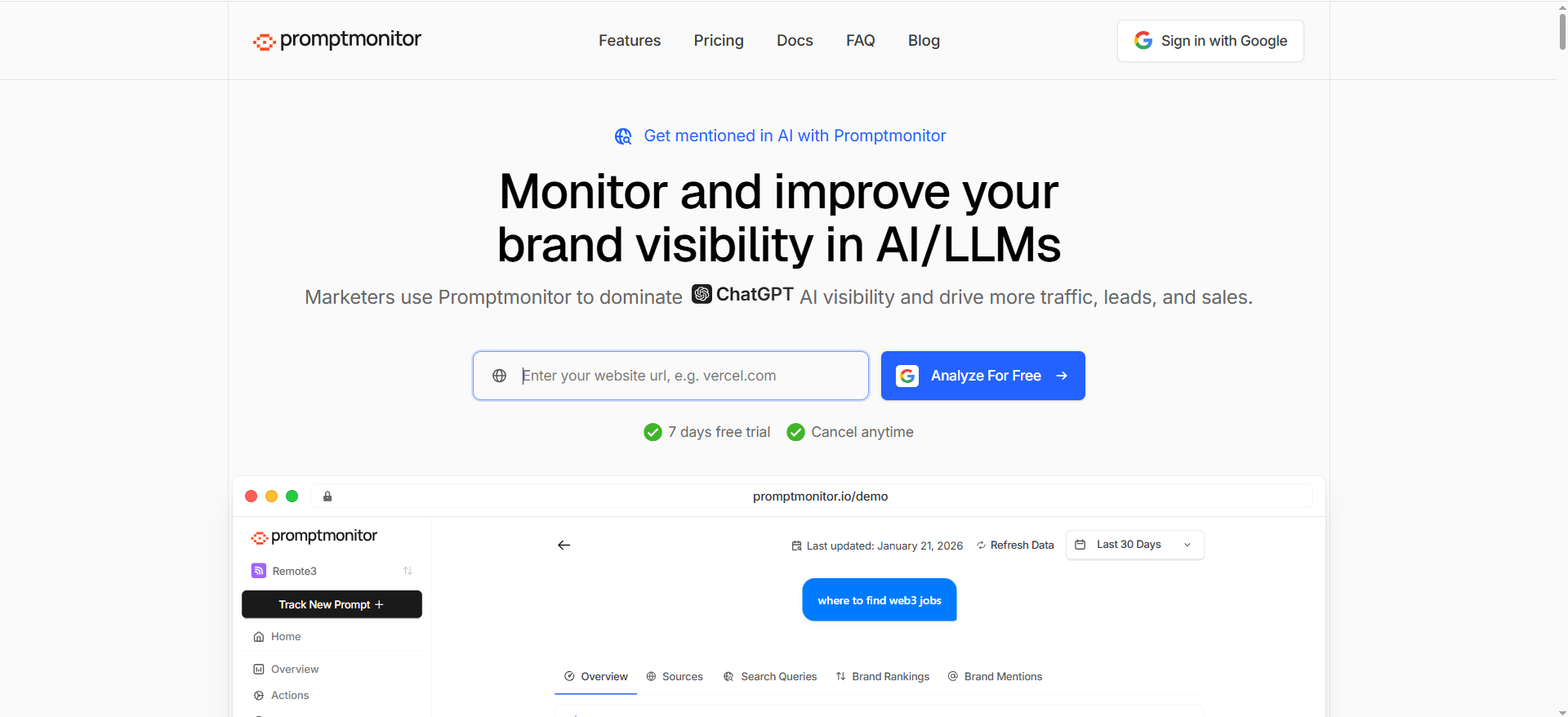
PromptMonitor positions itself as a tool to track and improve AI visibility across major AI/LLM surfaces, focusing on whether your brand gets mentioned and what sources AI uses to form answers.
Why teams use it
Citation gap analysis isn’t just “am I mentioned?” It’s:
- Which prompts matter (buyer-intent prompt clusters)
- Which sources AI trusts for those prompts
- What sources mention competitors but not you
- What you can do next (target sources, publish missing pages, improve authority)
PromptMonitor's positioning is aligned with that: it emphasizes showing what sources AI is using and turning that into outreach or content actions.
What it’s good for
- Getting started with prompt-based monitoring without building your own messy spreadsheet of prompts + screenshots.
- Source-led workflows: “Here are the pages AI is pulling from, go win those.”
- Teams that want a practical bridge between AI visibility insights → actions.
When it’s a good fit
- You’re early in AI visibility and need quick answers to: “Where are we invisible, and what should we do first?”
- You want a workflow that naturally supports the “gap checklist” approach (sources-first, not vanity metrics).
When it’s not a good fit
- You need highly customized enterprise governance, deep integrations, or complex multi-brand governance (that’s usually where enterprise suites stand out).
- You require very specific public pricing transparency, some tools keep pricing lightweight on marketing pages.
How to use it for citation gap analysis
- Build a prompt taxonomy (categories = product use cases, “best X for Y,” integrations, comparisons).
- Track prompts across your priority engines.
- Export/record cited domains (and ideally URLs) for each prompt cluster.
- Identify repeat-cited domains you don’t appear on.
- Choose actions per gap:
- Create a “citation asset” page (definition/table/checklist)
- Update an existing page to match the extractable pattern
- Outreach to a citing source where you truly belong (evidence-based)
Key capabilities to look for
When you evaluate Promptmonitor (or any tool), prioritize these citation-gap capabilities over generic dashboards:
- Prompt clustering & tagging (so you can compare gaps by intent)
- Citation/source extraction (domains + URLs if possible)
- Diffing over time (what sources are rising/declining)
- Competitive comparison (which sources cite competitors)
PromptMonitor's messaging highlights source identification and outreach pathways as a core loop.
Pricing
Promptmonitor’s pricing starts at $29/month.
Free tier?
Promptmonitor doesn’t offer a free tier, but it does offer a 7-day free trial.
Downsides / limitations
- As with any AI visibility tool, data quality depends on:
- prompt definitions
- engine coverage
- consistency of testing conditions (location, model version, personalization)
- If your organization needs strict compliance controls and deep integrations, you may outgrow lightweight platforms.
2. OtterlyAI
What it does
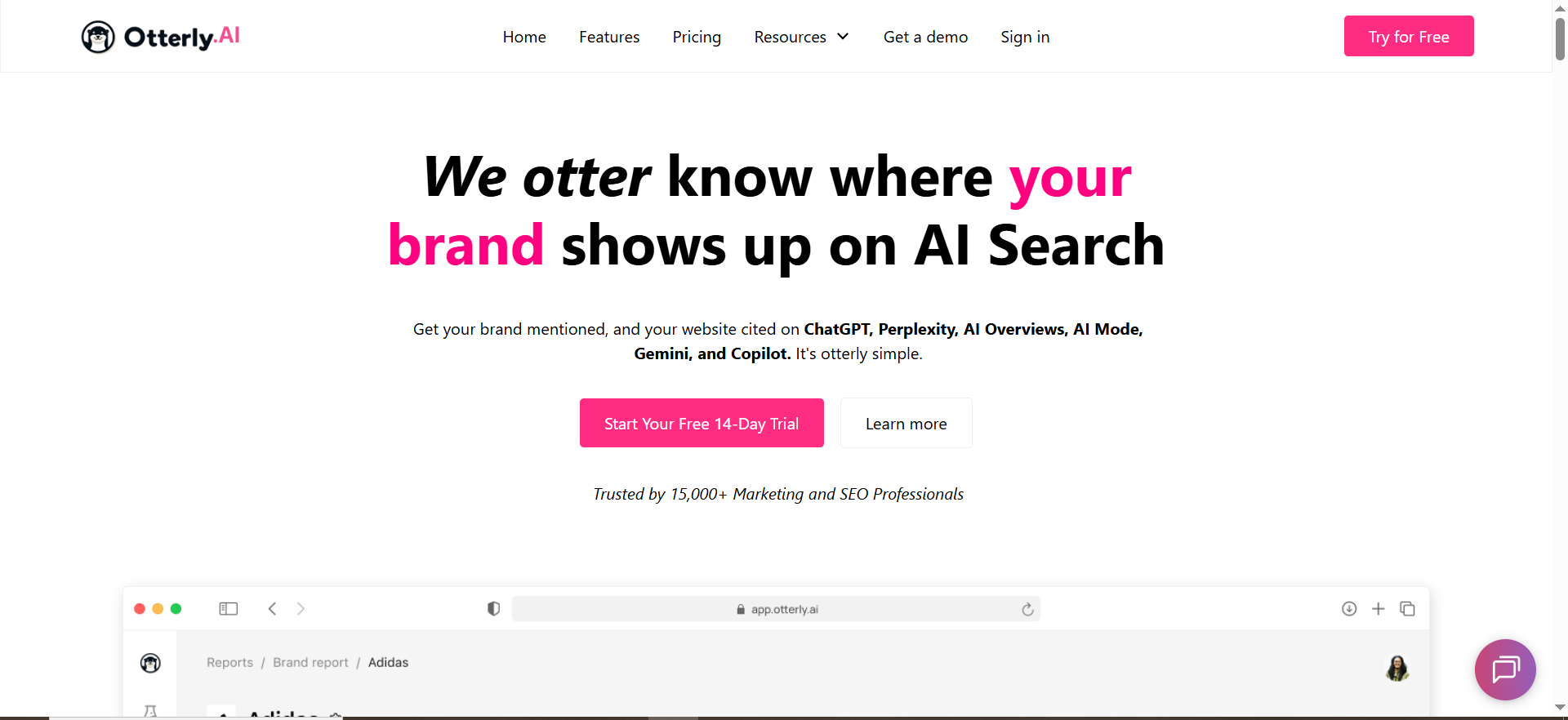
OtterlyAI is an AI search monitoring tool that includes link/citation analysis, reporting, and prompt research features.
Why teams use it
OtterlyAI is popular when teams want multi-platform monitoring with a comparatively approachable entry point, plus explicit citation analysis features you can operationalize into a gap list.
What it’s good for
- Foundational monitoring: establish a baseline for mentions/citations.
- Turning keywords into prompts and tracking them across AI surfaces (helpful if you’re transitioning from SEO keyword lists).
- Lightweight reporting: enough to run monthly “what changed?” reviews.
When it’s a good fit
- Startups / small teams that need a cost-effective monitoring layer.
- Agencies that want a repeatable reporting format across clients.
- Teams that primarily need: “show me citations, show me trends, show me competitors.”
When it’s not a good fit
- You need deep enterprise integrations, advanced governance, or extensive customization beyond what a self-serve tool typically offers.
- Your buying committee expects a full “platform” with content workflow + technical monitoring under one umbrella.
How to use it for citation gap analysis
Step 1: Build prompt clusters (not just prompts).
Example clusters:
- “Best [category] tools”
- “[category] pricing”
- “[competitor] alternatives”
- “How to [job-to-be-done]”
- “Best [category] for [industry/persona]”
Step 2: Track citations by cluster.
Your first deliverable is a simple table:
- Cluster → prompts → cited domains → frequency
Step 3: Create a gap score.
A basic model:
- Citation frequency (how often a domain is cited)
- Buyer intent (how close prompt is to revenue)
- Competitor presence (do your competitors appear there?)
Step 4: Choose the closing tactic.
- If the citing domain is a directory/list: list your product (with proof).
- If it’s editorial: offer data, benchmarks, and a genuinely useful angle.
- If it’s a Wikipedia-style reference: publish a “definition + evidence” page and earn links/citations.
Key capabilities
From OtterlyAI’s pricing page, plans include items like:
- multi-country support,
- brand visibility index,
- domain ranking,
- link citations analysis,
- exports and reporting.
Those are exactly the ingredients you need to run citation gap analysis as a process, not a one-off audit.
Pricing
OtterlyAI’s pricing starts at $29/month (Lite plan).
Free tier?
OtterlyAI doesn’t offer a free tier, but it does offer a free trial.
Downsides / limitations
- Lower-cost tools can be great for baselining, but the main limitation is often depth:
- fewer enterprise controls,
- fewer custom integrations,
- less sophisticated workflow support for turning gaps into production plans.
3. Profound
What it does
Profound is positioned as an AI search visibility platform for brands, and its site indicates it’s available through customized enterprise pricing.
Why teams use it
At enterprise scale, citation gap analysis isn’t just “what sources cite us?” It becomes:
- Exec-level reporting (“are we winning AI mindshare?”)
- Category coverage (“are we the default answer in our segment?”)
- Repeatability across brands, regions, and product lines
Profound is frequently discussed as an enterprise-oriented solution in AI visibility roundups, which aligns with that need profile.
What it’s good for
- Enterprise organizations that want AI visibility to be a measured program (not an experiment).
- Teams that care about strategy-level signals (share, volume proxies, category demand) as well as citations.
When it’s a good fit
- You need a robust program, stakeholder reporting, and a platform approach.
- You’re coordinating across multiple teams (SEO, content, comms, product marketing) and need consistent measurement.
When it’s not a good fit
- You need self-serve onboarding at low cost.
- You’re early-stage and still proving the ROI of AI visibility tracking.
How to use it for citation gap analysis
If you’re paying for a platform like Profound, use it like a program:
- Define your “AI revenue surface”Which prompts are closest to the pipeline? Which engines matter most in your market?
- Set a citation baseline by categoryFor each category:
- your citations/mentions
- competitor citations/mentions
- top cited domains
- Build a Source Target List“These 50 domains shape our category’s AI answers.”
- Map sources to actions
- partnerships (if appropriate)
- editorial placements
- data contributions
- content builds (your owned assets)
- Operate monthly
- new gaps
- lost citations
- new competitor sources
- wins to replicate
Key capabilities to ask about
Because pricing is customized, don’t just ask “what’s included.” Ask:
- Can you export cited URLs (not only domains)?
- Can you tag prompts into clusters and compare clusters?
- Do you support multi-location / multi-language testing?
- Do you have change detection (citation volatility)?
- How do you control for model changes / engine updates?
Pricing
Profound’s pricing starts at $99/month (Starter), and Enterprise pricing is custom/quote-based.
Free tier?
Profound doesn’t publicly list a free tier, but it does offer a demo and requires applying for access.
Downsides / limitations
- Enterprise platforms often have:
- longer onboarding,
- higher minimums,
- stronger value only when you have enough scale to justify them.
4. Semrush
What it does
Semrush is a search visibility platform that tracks which sources AI cites in answers and pairs that data with the SEO, content, and PR tools needed to turn those gaps into citations. Its AI Visibility Toolkit covers citation tracking, mention tracking, and sentiment across ChatGPT, Perplexity, Gemini, Google AI Mode, and Copilot.
Why teams use it
Citation gap analysis is a workflow, not a metric. Teams pick Semrush when they want all four phases in one stack:
- Detect: track which domains AI cites for your priority prompts
- Diagnose: identify whether you're losing on content format, evidence, entity coverage, authority, or accessibility
- Close: act on findings through SEO updates, content production, technical audits, or PR outreach
- Maintain: monitor citation volatility and replace lost wins
What it's good for
- Source extraction: identifies the domains AI cites for tracked prompts, so you know who's shaping your category's answers
- Coverage diagnostics: connects citation gaps to fixes across content updates, on-page SEO, and backlink building
- AI site audit: flags crawler accessibility issues that prevent AI bots from indexing your pages
- Backlink intelligence: 43T-backlink database for finding which domains link to (and likely influence) competitor-cited sources
- Multi-market coverage: 38 countries, 28 languages via Enterprise AIO
When it's a good fit
Choose Semrush when:
- You need citation tracking AND the tools to act on it (PR, content, technical SEO)
- Your team can absorb a broader platform vs a single-purpose monitor
- You want to tie citation gaps to backlink and content workflows in one stack
- You're tracking across multiple markets or product lines
When it's not a good fit
Semrush may be overkill if:
- You only want raw citation extraction on a small prompt set
- You don't have an SEO or content team that will act on the gap analysis
- Your budget tops out at sub-$50/month tooling
How to use it for citation gap analysis
- Build a prompt library mapped to your buyer funnel and tag prompts by cluster (category, comparison, integration, proof prompts).
- Run a baseline across the supported AI platforms (ChatGPT, Perplexity, Gemini, Google AI Mode, Copilot) to capture which domains are cited for each prompt.
- Compare your domain's citation rate against up to 9 competitors for the same prompt clusters.
- Categorize each gap: format (no extractable page), entity (missing coverage), evidence (no data/benchmarks), authority (no third-party trust), or accessibility (AI crawler blockers).
- Run an AI site audit to fix accessibility gaps and close any technical issues.
- Use the backlink and link-building tools to target source acquisition on domains that repeatedly cite competitors.
- For multi-market or multi-brand programs, scale through Enterprise AIO with country- and language-level segmentation.
Key capabilities
- Citation tracking: which domains AI cites for tracked prompts
- Mention and recommendation tracking (presence + sentiment)
- Share-of-answer comparison vs up to 9 competitors
- AI site audit (technical checks for AI crawler accessibility)
- 43T-backlink database for source diagnostics and link-building
- 261M+ prompts database for prompt research
Pricing
Plans start at $139/mo for SEO. Bundled SEO + AI visibility plans are available at higher tiers. Enterprise AIO pricing is custom (via demo). See Semrush's pricing page for current details.
Free tier?
Semrush doesn't offer a free tier, but it does offer a free trial on most plans and a free Enterprise AIO demo.
Downsides / limitations
- Broader platform vs pure-play specialist: if you only need lightweight citation tracking without SEO and content workflows, a $29/month tool is simpler.
- Learning curve: more surface area than single-purpose AI tools.
- Pure-play AI tools (like Profound) can match Semrush on enterprise depth for AI specifically; Semrush's edge is the combined citation tracking + SEO + content + PR scope.
5. Conductor
What it does
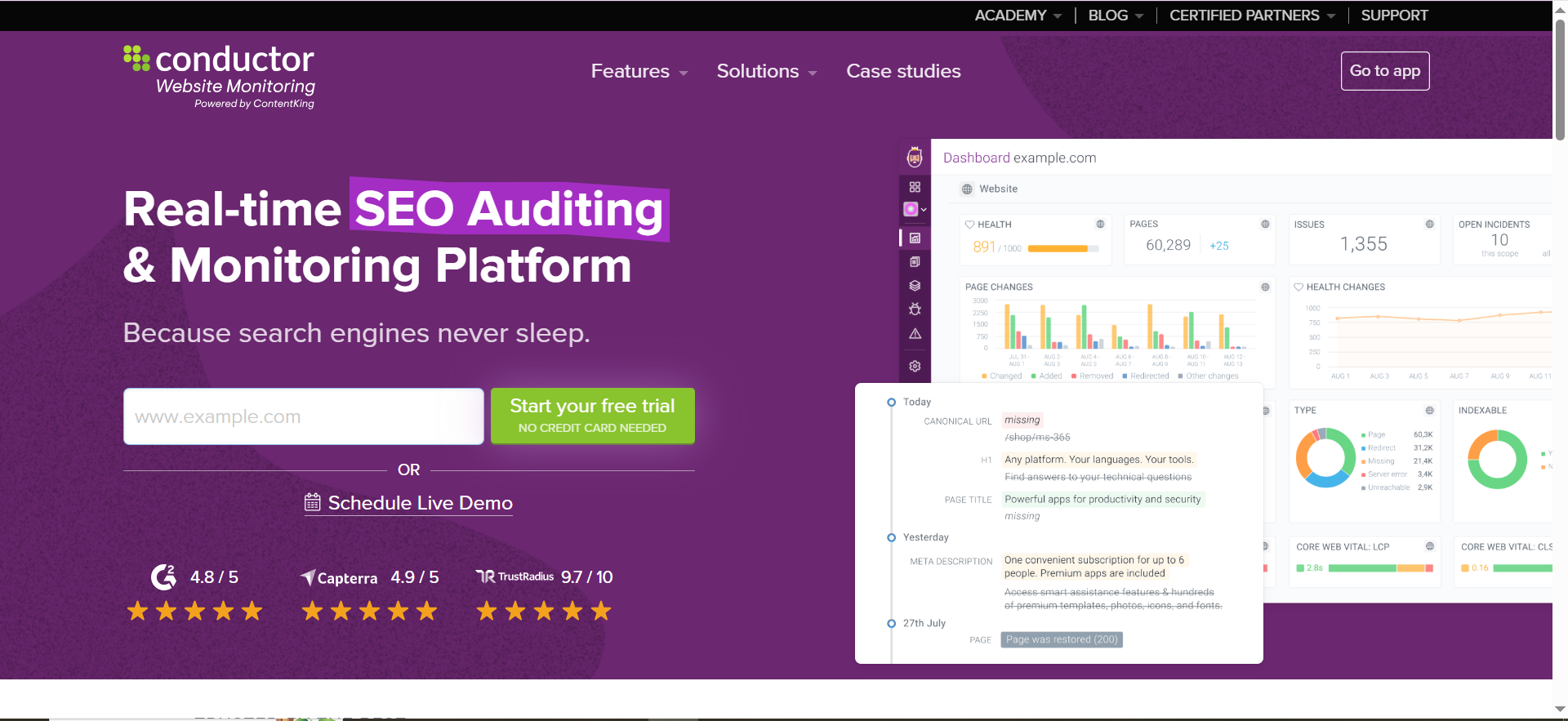
Conductor offers “AI Mention & Citation Tracking” to measure how brands appear in AI search and to find content opportunities.
It also positions AI search performance as part of an enterprise AEO/SEO platform.
Why teams use it
Conductor is compelling when citation gap analysis isn’t a standalone activity, it’s part of a broader system:
- detect gaps (mentions/citations)
- identify opportunities (topics, prompts, competitive share)
- connect to workflows (content creation/optimization, reporting)
That integrated approach is called out in its AI search performance feature positioning.
What it’s good for
- Enterprise teams that want a unified view of SEO + AI search performance.
- Organizations that need repeatable workflows and cross-team reporting.
- Teams that want to link AI visibility back to traffic/conversions and content workflows.
When it’s a good fit
- You need governance and reliability (large sites, many stakeholders).
- You want AI search insights embedded into your broader SEO operating system.
When it’s not a good fit
- You only need lightweight citation tracking and don’t want platform complexity.
- You have a small site with minimal reporting needs.
How to use it for citation gap analysis
Step 1: Establish your baseline Track mentions and citations (separately).
- Track mentions and citations (separately).
- Segment by brand vs product vs category terms.
Step 2: Extract the “citing sources map”
For your target prompts, collect:
- cited domains
- cited URLs (if available)
- frequency and trend
Step 3: Build “gap clusters”
Common gap types:
- Definition gaps: AI needs a clean definition, your site doesn’t provide it.
- Comparison gaps: competitors have “X vs Y” pages, you don’t.
- Evidence gaps: competitor pages have stats, benchmarks, or templates.
- Authority gaps: your content exists but isn’t trusted/referenced.
Step 4: Turn gaps into a production + outreach plan
- create/update pages that AI can extract cleanly (tables, bullets, clear headings)
- pursue inclusion on highly-cited third-party sources (where justified)
Key concept: mentions vs citations
Conductor’s AI search education content emphasizes that mentions and citations are different signals, and that citations can be less visible in some interfaces (though still valuable for credibility and downstream clicks).For citation gap analysis specifically, you care about both:
- Mentions = brand is part of the narrative
- Citations = your site is treated as a reference source
Pricing
Pricing is not publicly listed; it’s available by quote.
Free tier?
Conductor doesn’t offer a free tier, but it does offer a free trial (up to 3 weeks) and a demo.
Downsides / limitations
- Sales-led platforms can be heavier to adopt (implementation + change management).
- If you only need one narrow capability (citation extraction), you may prefer a specialized tool.
What “citation gap analysis” means in AI search
In traditional SEO, a “gap analysis” might mean keyword gaps, content gaps, or backlink gaps.
In AI search, citation gap analysis is more specific:
For a set of prompts that matter, identify which sources AI cites to answer them, then compare those sources against your domain and your competitors, and prioritize the gaps that will most likely increase citations/mentions.
A citation gap analysis answers questions like:
- “Which domains are shaping the AI narrative for our category?”
- “Why does AI trust them more than us?”
- “What exact asset are they citing (and what is it doing right)?”
- “What can we build or change to become the cited source?”
This is exactly why modern AI visibility tools focus on mentions + citations tracking and source opportunity discovery.
The TRM citation gap checklist
Use this checklist every month (or every sprint) to operationalize the “You vs sources that beat you” angle from the brief.
1) Define your prompt universe (taxonomy first)
Don’t track 200 random prompts. Track clusters.
Recommended taxonomy:
- Category prompts: “best [category]”, “top [category] tools”
- Use case prompts: “how to [job]”, “tools for [job]”
- Persona prompts: “[category] for SaaS CMOs”, “for RevOps”
- Comparison prompts: “X vs Y”, “X alternatives”
- Integration prompts: “connect [tool] with [tool]”
- Proof prompts: “pricing”, “security”, “SOC2”, “GDPR”
This is where tools that support prompt tagging and organization really matter.
2) Capture the citation set (domains + URLs)
For each cluster, export:
- top cited domains (frequency)
- cited URLs (if possible)
- “position/prominence” if the tool supports it
Why URL-level matters: sometimes one page is responsible for most competitor citations.
3) Categorize each gap (so you choose the right fix)
Every missing citation typically falls into one of these buckets:
- Content format gap: you don’t have the format AI extracts well (table, definition, checklist).
- Entity coverage gap: you didn’t cover key entities (standards, competitors, integrations).
- Evidence gap: no stats, benchmarks, examples, citations.
- Authority gap: others have links/mentions; you don’t.
- Accessibility gap: AI bots can’t crawl/parse the content cleanly.
4) Prioritize gaps by leverage
A simple prioritization model:
- Frequency: how often a source is cited across your clusters
- Intent: how close the cluster is to revenue
- Replaceability: can you realistically be a better cited source?
Start with “universal sources” that appear across multiple prompt clusters, those are your highest leverage targets.
5) Choose the action per gap
- If gap is format → build a “citation asset” page
- If gap is entity coverage → add missing sections + structured headings
- If gap is evidence → add benchmarks, tables, real examples
- If gap is authority → targeted digital PR / partner listings
- If gap is accessibility → fix crawlability, page structure, and extraction
How to get cited: the playbook for closing citation gaps
Here’s the practical part, how you go from “we’re not cited” to “we get cited consistently.”
Step 1: Build “citation assets” (pages designed to be referenced)
AI systems cite pages that are:
- specific
- structured
- extractable
- credible
High-performing citation asset formats:
- “Definition + why it matters + examples”
- “Step-by-step checklist”
- “Comparison tables”
- “Benchmarks / statistics pages”
- “Templates” (downloadable or copy/paste)
Your goal is to create passages that are easy to quote or summarize:
- short paragraphs
- crisp bullet lists
- clear headings matching questions (helps extraction)
Step 2: Match the citing pattern you see in winning sources
This is the fastest win most teams miss.
If the top cited source for “citation gap analysis” has:
- a glossary-style definition,
- a step-by-step framework,
- and a checklist…
…then your “thought leadership essay” won’t replace it.
Instead:
- mirror the structure
- improve clarity
- add differentiators (templates, decision trees, better examples)
- make it easier to scan
Step 3: Engineer “extractable” sections
AI answers often lift:
- definitions
- lists
- comparisons
- pros/cons
- short “how-to steps”
So build sections like:
- “What is citation gap analysis?”
- “How to run citation gap analysis (7 steps)”
- “What to do when a competitor is cited instead of you”
- “Checklist: closing a citation gap this week”
And format them so they’re clean and unambiguous.
Step 4: Close authority gaps with targeted source wins
In many categories, AI engines cite:
- major industry blogs
- directories
- comparison sites
- standards bodies
- large communities
Your job is to earn inclusion where it’s legitimate.
A clean outreach approach:
- Identify the specific page AI cites.
- Confirm it’s relevant to your category.
- Provide a contribution that improves the page (data, clarification, missing tool/vendor, updated pricing).
- Avoid generic “add us please” pitches, be useful.
Step 5: Track volatility and protect wins
Citations change. Models update. Sources shift.
That’s why monitoring matters:
- detect new sources entering the citation set
- detect when you lose citations (and why)
- detect when competitor sources surge
Tools that provide change tracking and reporting make this operational, not reactive.
What to track and report (KPIs that actually move citations)
If you report the wrong KPIs, you won’t improve.
Core KPIs for citation gap analysis
- Citation share by cluster: % of prompts in a cluster where your domain is cited
- Mention share by cluster: % where your brand is mentioned
- Top cited domains (frequency): the “source set” that defines your category
- New/lost citations: month-over-month change
- URL-level citation winners: which page is responsible for citations
- Competitor citation delta: who is gaining source coverage
Optional (advanced) KPIs
- Prominence weighting (if your tool supports it): being cited as a primary source vs “one of many”
- Sentiment/context (for brand safety, not just SEO)
- Multi-country variance (citations differ by market)
Common failure modes (why you’re still not getting cited)
1) You track random prompts instead of buyer-intent clusters
Fix: taxonomy first. Clusters drive action.
2) You try to “SEO harder” instead of “source harder”
Sometimes you don’t need 50 new blog posts, you need to be included 10 sources AI already trusts.
3) Your content exists but is not extractable
Fix: rewrite key pages with:
- clearer headings
- tables
- bullet lists
- tight definitions
4) You ignore accessibility / crawlability
If AI systems can’t reliably fetch/parse your content, you won’t be cited consistently.
5) You don’t maintain wins
Citations are not “set and forget.”You need monitoring + monthly review.
How do I identify which page should win citations (URL-level mapping)?
URL-level mapping means you don’t just ask “why isn’t my domain cited?”,you ask:
“Which exact page on my site should be the ‘best possible cited source’ for this prompt cluster?”
This is where most teams lose citations: they have content, but it’s scattered across multiple posts, or the “best” page is too broad, too thin, or too hard to extract.
Step 1: Map each prompt cluster to a “primary URL”
Create a spreadsheet with:
- Cluster (e.g., “citation gap analysis”)
- Prompts (10–30 variations)
- Search intent (definition/how-to/comparison)
- Primary URL target (one page you want cited most often)
Rule of thumb: one cluster → one primary URL (and a few supporting URLs).
Step 2: Check how winning sources are structured
For each cluster, look at the URLs that AI engines cite most. You’re looking for patterns such as:
- Is it a glossary/definition page?
- A listicle?
- A “how-to” guide with steps?
- A stats/benchmark page?
This tells you what type of URL tends to “win citations” for that cluster.
Step 3: Score your candidate URLs (pick the winner)
Use a quick scorecard (0–2 points each):
- Intent match: does the page exactly match the question?
- Extractability: headings, bullets, tables, short definitions
- Coverage: does it include key sub-questions AI tends to answer?
- Evidence: examples, stats, citations, screenshots, frameworks
- Trust signals: author, date, references, about page, schema
- Technical access: indexable, fast, not blocked, clean HTML
Whichever page scores highest becomes the primary citation target.
Step 4: Consolidate cannibalization
If multiple pages compete for the same cluster, AI may cite none of them consistently.
Fix options:
- Merge content into one canonical page
- Add a “hub” page + redirect/update older posts
- Use internal links to establish the primary URL as the authority
Step 5: Build “supporting URLs” as feeders
Supporting pages should exist to rank and funnel authority internally:
- “citation gap analysis template”
- “citation gap analysis checklist”
- “mentions vs citations”
- “AEO vs SEO”
Each one should link prominently to the primary URL with consistent anchor text.
Which engines show citations most consistently (Perplexity vs others)?
Different AI engines expose citations differently, and they also source information differently.
What teams typically observe
- Perplexity is generally considered one of the most citation-forward AI answer engines (often showing sources more prominently than many chat-style assistants).
- Chat assistants like ChatGPT can provide sources in certain modes/configurations, but citation visibility can vary depending on the product surface and settings.
- Google AI Overviews may include citations/links, but how often and how prominently they appear can vary by query type and rollout.
Because engines evolve quickly, the best practice is: measure citations across the engines your buyers actually use, with the same prompt set and on a schedule.
The practical implication for citation gap analysis
If you want a consistent “citation dataset” for your program, you usually:
- Use Perplexity-style engines as a strong baseline for citation behavior
- Track the same clusters in other engines to see:
- where citations are hidden
- where only mentions appear
- where the engine behaves more like a “no-click summary”
How to make cross-engine comparisons fair
To reduce noise:
- Run prompts from the same location/locale
- Use clean sessions where possible
- Track the same prompt phrasing over time
- Record engine version changes when available
- Focus on cluster-level trends, not single prompts
What content formats get cited most often (definitions, lists, stats, tables)?
Citations tend to go to content that is:
- easy to extract
- clearly structured
- high-confidence
- specific and reference-like
That typically means formats like:
1) Definition pages (glossary-style)
Best for:
- “What is X?”
- “X vs Y”
- “How does X work?”
Why they get cited:
- they contain a short, quotable definition
- they often include context + examples
2) Step-by-step guides
Best for:
- “How do I do X?”
- “How to fix Y?”
- “Process for Z”
Why they get cited:
- lists of steps are extractable
- they match how AI answers “how-to” prompts
3) Lists and comparisons
Best for:
- “Best tools for X”
- “Top platforms for Y”
- “Alternatives to Z”
Why they get cited:
- easy summarization
- tables reduce ambiguity
4) Stats / benchmarks / data pages
Best for:
- “How big is X?”
- “What’s the adoption rate of Y?”
- “Trends in Z”
Why they get cited:
- AI wants to ground claims in numbers
- data pages often become “source magnets”
5) Templates, checklists, and frameworks
Best for:
- “Template for X”
- “Checklist for Y”
- “Framework for Z”
Why they get cited:
- they are directly useful
- they give AI a clean structure to echo
Key insight: format often beats length. A 1,200-word page with a crisp definition, table, and checklist can outperform a 3,000-word essay for citations.
How do I create “citation-worthy” passages that LLMs can extract?
Think of a citation-worthy passage as a “drop-in answer module.”
It should be:
- short enough to quote/summarize
- precise enough to trust
- structured enough to extract
The ideal structure (copy/paste template)
H3: Definition
One-sentence definition in plain language.
H3: Why it matters
2–3 bullets.
H3: How it works
5–7 steps (numbered list).
H3: Example
A simple example with inputs/outputs.
H3: Common mistakes
3–5 bullets.
H3: Checklist
A checkbox-style list.
This structure maps extremely well to how AI answers.
Writing rules for extractability
- Put the definition in the first 2–3 lines under the heading
- Use headings that match natural questions (“What is…”, “How to…”, “Examples”)
- Use short paragraphs (2–4 lines max)
- Prefer bullets/tables over long narrative blocks
- Avoid “clever” metaphors in the core definition (use them later)
Add credibility hooks
AI engines prefer content that looks like a trustworthy reference:
- include author
- cite sources where relevant
- show last updated date
- include clear examples and constraints
How do I earn citations without “PR spraying” (repeatable outreach)?
“PR spraying” is sending the same pitch to 200 sites and hoping someone bites. It wastes time and often harms reputation.
A repeatable, citations-first outreach system is more like targeted source acquisition.
Step 1: Build your “Cited Sources List”
From your monitoring tool exports, build a list of domains that AI cites most for your prompt clusters.
Then label each domain by type:
- directory/listicle
- editorial blog
- standards / definitions
- community / forum
- data/benchmark publisher
- marketplace/review site
Step 2: Create “source-specific offers”
Different source types want different contributions:
Directory/listicle
- accurate product info
- pricing details
- screenshots
- a strong positioning statement
- proof (awards, reviews, case studies)
Editorial blog
- unique data or benchmarks
- a fresh angle
- expert quotes
- updated information (outdated listicles are everywhere)
Standards/definitions
- precise definitions
- neutral tone
- references
- examples
Step 3: Use “proof-based outreach”
A reliable email formula:
- show you read the page
- explain the gap you can fix (missing vendor, outdated pricing, missing category)
- provide a clean snippet they can paste
- include evidence links
- keep it short
Step 4: Turn wins into a system
Create an internal tracker:
- Source → page → status → outcome → next follow-up
- Contribution type → what worked → what didn’t
This becomes a repeatable “citation pipeline.”
How do I track citation loss and volatility over time?
Citation loss happens when:
- the model updates
- the engine changes retrieval behavior
- competitor sources get fresher/better
- your cited page changes (content, URL, indexing)
- your authority shifts (links, mentions, trust signals)
Build a “citation change log”
Every month (or weekly if you’re aggressive), capture:
- prompts tracked
- citations per prompt
- cited domains
- cited URLs
- wins/losses since last snapshot
Many AI visibility tools do this automatically, but the key is to operationalize it:
- “What changed?”
- “Why?”
- “What action do we take?”
Create volatility alerts (even manually)
Watch for:
- a sudden drop in citations for a whole cluster
- a competitor domain suddenly dominating citations
- a new domain entering the citation set repeatedly
Diagnose citation loss with a quick checklist
When you lose citations:
- Is the page still indexable?
- Did the URL change?
- Did the content change materially?
- Did the competitor publish something fresher?
- Are you still being mentioned but not cited (or vice versa)?
- Is the engine behavior different now?
Protect your “citation assets”
Treat your top cited pages like product pages:
- update regularly
- improve clarity
- add new examples/data
- maintain internal linking
- keep technical health high
What’s the fastest path to first citations for a new brand?
If you’re a new brand with low authority, you can still get cited, but you need to choose battles carefully.
The fastest path is usually “borrowed trust”
Instead of trying to make your site the citation source immediately, aim to get included in sources AI already trusts.
Step 1: Identify “universal sources” in your category
These are domains cited across multiple prompts and engines.
Example targets:
- popular industry listicles
- directories
- “best tools” posts
- comparison sites
- community resources
Step 2: Win 5–10 third-party inclusions
Focus on:
- correct category placement
- strong, specific positioning
- accurate pricing info
- proof points (case studies, reviews)
This can get you mentioned and sometimes cited quickly.
Step 3: Publish one “definitive citation asset” on your site
Pick one cluster you can own (narrow, high intent, underserved):
Examples:
- “Citation gap analysis template”
- “AI visibility metrics glossary”
- “How to track citations across AI engines (step-by-step)”
Make it:
- structured (definition + steps + table + checklist)
- genuinely useful
- updated monthly
Step 4: Use that asset as your outreach hook
When you pitch editorial sources, you’re not pitching your homepage,you’re offering:
- a useful reference page
- a data-backed framework
- a template they can link to
Step 5: Expand cluster by cluster
Don’t try to cover everything. Win one cluster, then replicate the pattern.
FAQs
What’s the difference between a mention and a citation in AI search?
Which AI engine is most “citation-heavy”?
How long does it take to start getting cited?
Do I need backlinks to get cited?
What content formats get cited most often?
What’s the simplest way to run citation gap analysis every month?
📋 Get Listed / Advertisement
We update this guide monthly. Want your tool featured? Contact: [email protected]
📑 Disclosure!
Some links in this article are affiliate links. If you sign up through them, The Rank Masters may earn a commission at no additional cost to you. This does not influence which tools we recommend or what we say about them.