
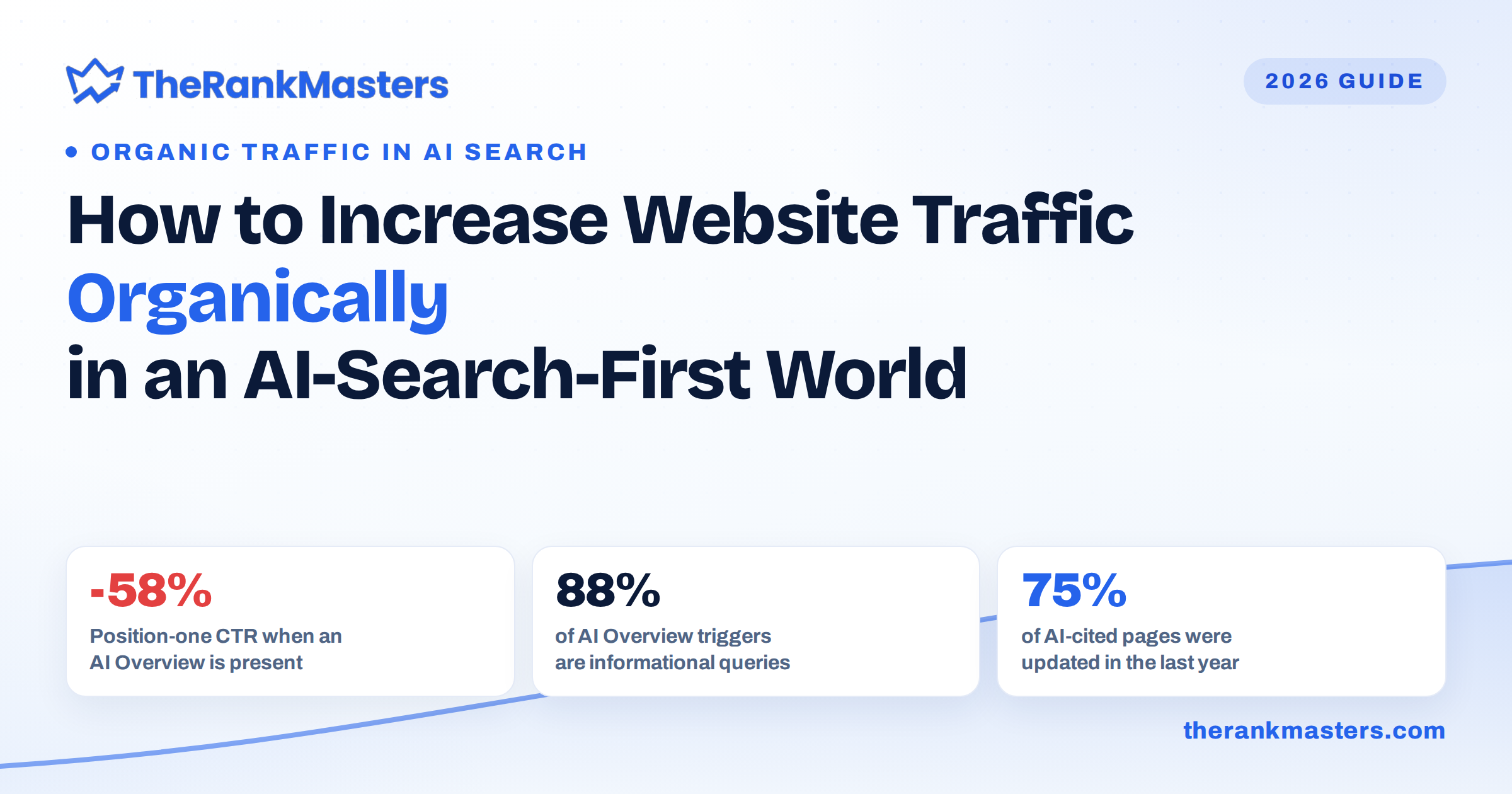
A July 2026 Seer Interactive analysis of 47,097 AI citations across 7,683 pages found that 75% of the pages ChatGPT, Gemini, and Perplexity cite were updated within the previous year, while only 42% were originally published in that window.
If your rankings held all year while your organic website traffic slid, nothing is broken on your site.
The click is being intercepted before it reaches you.
Left unaddressed, that gap compounds quietly. Impressions climb, sessions flatten, content-sourced pipeline thins, and by the time anyone runs the numbers the story leadership hears is that the content programme stopped working.
It did not.
The surface moved underneath it, and the teams that re-derive their strategy from current evidence take the share the ones still publishing on 2021 assumptions are giving up.
Organic website traffic is no longer won by publishing volume. It is won by eligibility, extractability, and maintenance.
The three levers that moved organic traffic between 2015 and 2023 (more pages, more keywords, more backlinks) now produce a fraction of the return they used to, because the click itself has been partially decoupled from the ranking.
A page can hold position one, earn more impressions than ever, and send fewer visitors to your site than it did two years ago. That is not a penalty. It is the architecture of AI-mediated search working exactly as designed.
This guide gives you the operating system for organic growth under that architecture. It covers what organic website traffic actually is in 2026, why it is falling even when rankings hold, which query types still return clicks and which never will again, and a nine-step system for compounding organic traffic across both Google's classic results and the AI answer layer. Every recommendation is tied to a named, dated source and to a metric you can check in your own Search Console.
▶️ Recognise the pattern already? Book a call and we will pull your traffic data live, show you which of your pages are losing clicks to AI answers versus genuinely declining, and tell you what that gap is worth in pipeline before you change anything.
How to Increase Website Traffic Organically: The Nine-Step System
Increase organic website traffic by fixing eligibility first, then intent selection, then extractable structure, then maintenance, then authority, then measurement. Executed in that order, each step compounds the one before it.
Most teams attempt these in the wrong sequence.
They commission twenty new articles before confirming the existing library is crawlable, snippet-eligible, and internally linked, which is the equivalent of buying inventory before checking whether the shop door opens.
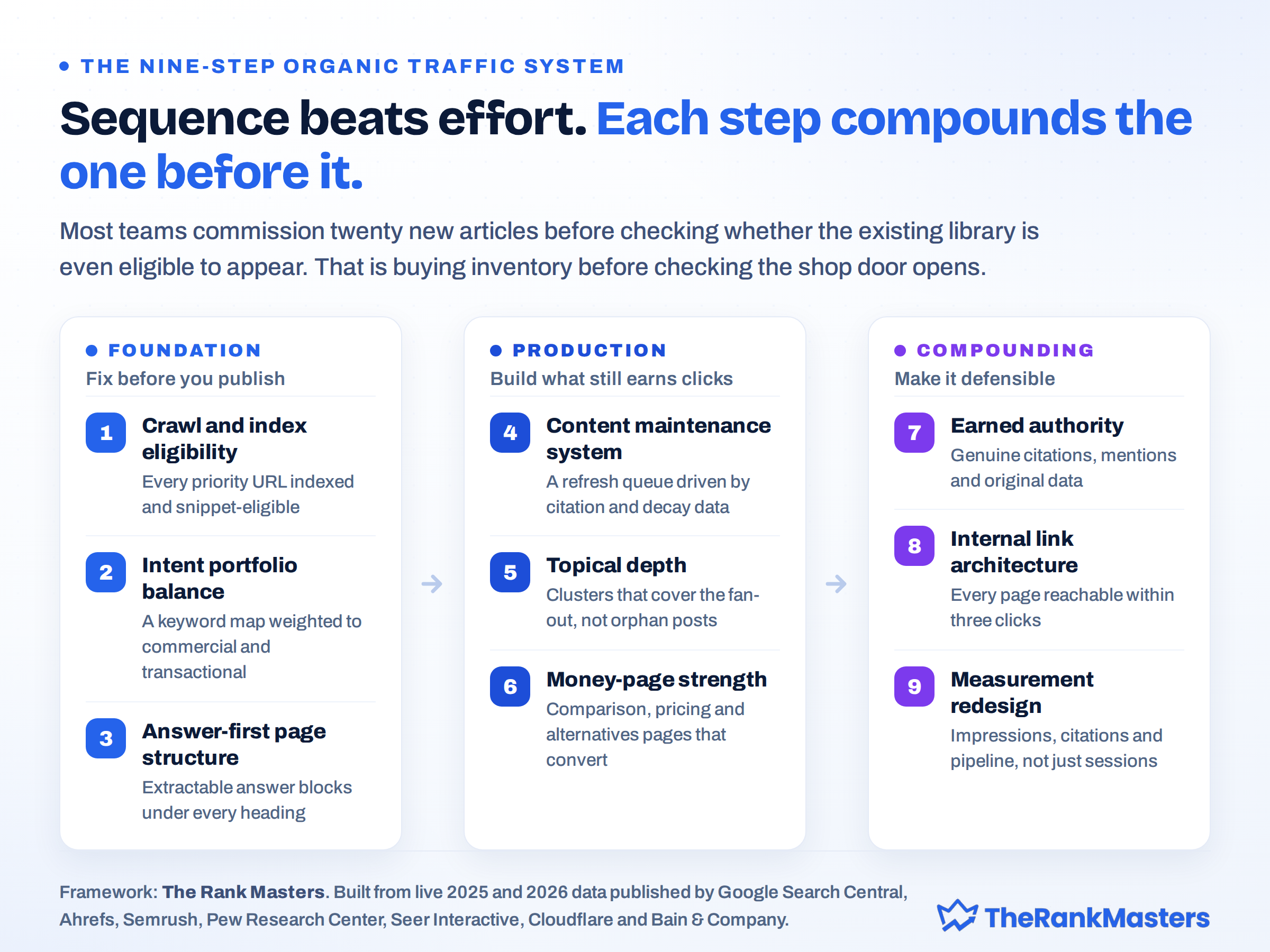
| Step | What You Are Fixing | Primary Output | Leading Indicator to Watch |
|---|---|---|---|
| 1 | Crawl and index eligibility | Every priority URL indexed and snippet-eligible | Indexed page count against submitted count |
| 2 | Intent portfolio balance | A keyword map weighted to commercial and transactional | Share of tracked keywords by intent class |
| 3 | Answer-first page structure | Extractable answer blocks under every heading | Featured snippet and AI Overview citation count |
| 4 | Content maintenance system | A refresh queue driven by citation and decay data | Median last-updated age of cited pages |
| 5 | Topical depth | Clusters, not orphan posts | Number of ranking keywords per cluster |
| 6 | Money-page strength | Comparison, pricing, and alternatives pages that convert | Assisted conversions from organic |
| 7 | Earned authority | Genuine citations, mentions, and coverage | Referring domains from relevant sites |
| 8 | Internal link architecture | Every page reachable within three clicks | Orphan page count |
| 9 | Measurement redesign | Impressions, citations, and pipeline, not just sessions | Citation rate on tracked prompts |
The rest of this guide works through each of those steps in the order they should be executed.
How to Fix Crawl and Index Eligibility Before Anything Else
Fix eligibility first, because a page that is not indexed and snippet-eligible cannot appear in classic results, AI Overviews, or AI Mode, regardless of how good the content is.
Google's guidance on optimizing for generative AI search, last updated in July 2026, is unambiguous on this point. Eligibility for generative AI features requires the page to be indexed and snippet-eligible under the standard Search technical requirements, plus inclusion in Search generative AI features in Search Console. There is no parallel qualification route.
1. Crawl access: Confirm that robots.txt, your CDN, and any bot-management rules allow the crawlers you want. This has become a live risk rather than a theoretical one, because infrastructure providers have shifted their defaults. Blocking a retrieval crawler removes you from the answer layer entirely, and the block is often invisible in robots.txt because it lives in a WAF rule instead.
2. Snippet controls: Any nosnippet, data-nosnippet, or aggressive max-snippet directive that was added to protect content from scraping will also remove the page from AI Overviews and AI Mode. Audit these deliberately rather than inheriting them.
3. Rendering: Google can process JavaScript, but content that only exists after client-side hydration is slower to index and more fragile in retrieval. Important text belongs in the initial HTML response.
4. Duplication: Duplicate and near-duplicate URLs waste crawl budget on pages you do not care about. Canonical consolidation is a traffic tactic, not a hygiene chore.
5. Internal discoverability: Google's own list of worthwhile fundamentals for AI features names internal links explicitly as the mechanism that makes content findable. A page linked from nowhere is a page the retrieval layer is unlikely to reach.
The crawl-side economics have also changed, and it is worth understanding why your logs look different than they did.
Cloudflare's Radar data showed that for the week of 19 to 26 June 2025, crawl-to-refer ratios ranged from Anthropic's roughly 70,900 page requests per referral down to Mistral's 0.1 to 1. Legacy search crawlers scanned your content a couple of times for each visitor they sent. Many AI crawlers scan it thousands of times for the same return.
That asymmetry is real, and it is why blanket blocking is tempting. It is also why blanket blocking is usually the wrong call for a B2B SaaS brand whose category vocabulary is still being established in models, since removing yourself from retrieval removes the citations that produce your highest-value visits.
For the full technical sequence, the technical SEO library covers indexing, rendering, and architecture, and the content audit checklist for B2B SaaS blogs gives you a repeatable pass for finding the pages that are silently ineligible.
✅ Where this stalls without help. Eligibility problems are the cheapest thing on this list to fix and the hardest thing to find, because nothing in your analytics tells you a page is ineligible. It simply never appears. Teams routinely discover, months in, that a WAF rule added by security or a max-snippet directive added by legal had been quietly removing a section of the site from the answer layer the entire time.
This is the one area where a second pair of eyes pays for itself immediately, because the fix takes minutes once the cause is identified and the search for it can take a quarter. The Ops library covers how to make that audit repeatable rather than heroic.
How to Do Keyword Research That Survives AI Overviews
Build the keyword map around intent class and click retention rather than search volume, because 88% of AI Overview triggers are informational and over 68% of them sit at 100 or fewer monthly searches.
Volume-first keyword research systematically routes budget toward the exact terms Google has chosen to answer itself. The correction is to score every candidate keyword on two axes at once, namely commercial proximity and AI Overview exposure.
| Scoring Axis | Signal to Pull | Green Light | Red Light |
|---|---|---|---|
| Intent class | SERP composition and modifier language | Commercial, transactional, comparison, alternatives | Definitional, "what is", "how does" |
| AI Overview presence | Live SERP check or a SERP feature filter | No AI Overview on the current SERP | AI Overview present and stable |
| Query shape | Word count and question form | One to four words, entity-led | Ten or more words, question-led |
| Commercial value | CPC and ad density | CPC above roughly $2, ads present | No ads, negligible CPC |
| Money-page proximity | Clicks from this term reach a page that converts | One click from pricing, demo, or trial | Three or more clicks from any conversion path |
| Category ownership | Does your brand need to be the reference on this topic | Yes, defend regardless of click outlook | No, deprioritise |
1. Keyword difficulty is now a weaker filter than it looks. Semrush found that almost 80% of AI Overview triggering keywords fall in the 0 to 40 keyword difficulty band. The easy keywords got easier to rank for and harder to earn clicks from at the same time. Low difficulty is no longer a proxy for opportunity.
2. The bottom-of-funnel bias is deliberate. For a B2B SaaS company, the terms that still return clicks are the ones your buyer types when they already have a shortlist. Comparison queries, alternatives queries, pricing queries, integration queries, and use-case queries scoped to a segment. These are also the terms where a generic AI answer is least satisfying, because the buyer wants specifics an assistant cannot responsibly invent.
3. Do not abandon the informational tier. Reclassify it. Informational pages are the raw material for citations, and the citation is what earns you the 35% CTR premium Seer measured on the commercial queries that sit alongside them. Fund the informational tier from the authority budget, not the traffic budget, and hold it to a citation KPI rather than a sessions KPI.
Practical sequencing for a quarterly cycle looks like this.
- Weeks 1 to 2: Export every ranking keyword, classify by intent, and tag AI Overview presence. Rank clusters by commercial proximity, not volume.
- Weeks 3 to 4: Identify the money pages each cluster should feed, and confirm each one is genuinely conversion-ready before sending traffic to it.
- Weeks 5 to 8: Produce the commercial and transactional tier first. It is the only tier with a defensible click forecast.
- Weeks 9 to 12: Produce or refresh the informational tier that supports the commercial tier semantically, and instrument citation tracking on it from day one.
Be honest about where that plan usually breaks. Weeks 1 and 2 are the ones teams underestimate. Intent classification at scale is a judgement call on every row, AI Overview presence has to be checked against live SERPs rather than a cached field, and the output only helps if someone senior enough is willing to act on it and kill funded topics. In practice this stage either takes an experienced person two weeks of focused work or it takes an internal team a quarter and produces a spreadsheet nobody trusts enough to reallocate budget against.
The strategy library covers opportunity sizing and roadmap sequencing in more depth, the SEO tools library compares the platforms that expose AI Overview presence at keyword level, and the keyword research collection covers the planning layer around it.
If you would rather start the quarter with the classification already done, book a call and we will run your top ranking terms through the intent and AI Overview filter with you, then hand back the shortlist of terms actually worth producing against this quarter.
How to Increase Website Traffic Using Content Marketing
Increase organic traffic through content marketing by building clusters that map to a money page, not standalone posts, and by holding each asset to a specific job in the buyer journey.
Google's July 2026 guidance is direct about what fails here.
It names "commodity content" explicitly, using the example of a generic tips list built from common knowledge, and contrasts it with non-commodity content that carries a first-hand or expert position.
It also warns that producing separate pages for every possible query variation, including fan-out variations, primarily to influence rankings violates the scaled content abuse policy.
That is a meaningful constraint on the old content-marketing playbook, and it is worth stating plainly.
Producing 200 thin pages to cover 200 long-tail variants is now both ineffective and policy-adjacent.
Producing 20 pages that each carry evidence, a position, and an original data point is the strategy that survives.
| Content Tier | Job in the Funnel | Success Metric | Realistic Click Expectation |
|---|---|---|---|
| Definitional and explainer | Establish topical coverage and earn citations | Citation rate, AI Overview presence | Low and falling |
| Comparison and versus | Enter the buyer's shortlist | Assisted conversions, demo starts | High and stable |
| Alternatives pages | Capture competitor-aware demand | Trial signups, pipeline influenced | High and stable |
| Pricing and cost | Resolve the objection before sales | Direct conversions | High and stable |
| Use-case and segment pages | Prove fit for a named ICP segment | Qualified demo requests | Moderate to high |
| Original research and benchmarks | Earn links, mentions, and repeat citations | Referring domains, citation persistence | Moderate, with long tail |
| Case studies and proof assets | Convert consideration into a call | Booked calls | Moderate, high value |
1. Originality is now a retrieval input, not a nice-to-have. Google's guidance describes a first-hand review as unique perspective and a summary of existing content as restatement, and states that unique, compelling, useful content will influence generative-AI presence more than any other suggestion in the guide. Original data, proprietary benchmarks, and named practitioner experience are the only reliable way to be non-substitutable when an engine is choosing between eight sources that all say the same thing.
2. Format diversification is measurable, not decorative. Ahrefs found that among AI Overview citations that did not rank in Google's top 100 for the same keyword, 18.2% were YouTube URLs. If your category's answers are being partly assembled from video and your brand publishes only text, you are absent from a growing slice of the citation pool.
3. Publishing cadence is the wrong lever. More pages per month does not increase organic traffic when the marginal page is commodity content on a query that triggers an AI Overview. Fewer, denser, better-maintained pages outperform, which is the conclusion the Seer recency data points to as well.
If you are still measuring whether the blog itself earns its place, whether SaaS blogs actually drive organic leads and conversions works through the attribution question directly, and the AI content library covers where AI assistance in production helps and where it introduces commodity risk.
How to Structure a Page So AI Engines Can Extract It
Structure every page so that each heading owns one question and the first sentence beneath it answers that question in under 30 words, because retrieval systems select passages, not whole documents.
This is where answer engine optimisation stops being an abstraction. Retrieval-augmented generation pulls specific spans of text. If your answer is buried in paragraph six behind three sentences of setup, the passage that gets retrieved is somebody else's.
| Page Element | Specification | Why It Changes Retrieval |
|---|---|---|
| H2 headings | One buyer question each, entity front-loaded, under roughly 70 characters | Matches the fanned-out sub-query the engine actually issued |
| Opening sentence per section | Direct answer in 30 words or fewer | Gives the model a clean, liftable span |
| Section length | Roughly 200 to 500 words, self-contained | Sits inside a single retrieval chunk without truncation |
| Pronouns | Name the entity, avoid "this", "it", "the above" | Keeps the passage coherent when lifted out of context |
| Tables | One row per entity, consistent column labels | Parsed as clean entity-attribute-value pairs |
| Lists | Parallel structure, capitalised first word, no orphan fragments | Survives extraction into a bulleted answer |
| Statistics | Number, source name, and reporting year in the same sentence | Groundable, which raises the odds of citation |
| FAQ block | Buyer-phrased questions with answer-first responses | Matches conversational query patterns directly |
⚠️ A caution against over-engineering. Google's July 2026 guidance explicitly lists things you do not need, and the list is worth internalising because a lot of 2025 advice contradicts it. You do not need llms.txt or similar machine-readable files, since Google Search ignores them. You do not need to chunk content into artificially tiny pieces. You do not need to rewrite in a special voice for AI systems. There is no special schema.org markup required for generative AI features, though structured data remains worthwhile for rich results.
Reconcile that with the table above as follows.
Answer-first structure and self-contained sections are not AI-specific hacks. They are readability practices that happen to align with how retrieval works, which is exactly why they survive Google's mythbusting.
The tactics Google dismisses are the ones that serve no human reader.
Schema that still earns its place: Article or BlogPosting with accurate datePublished and dateModified, FAQPage on genuine question blocks, Organization for entity disambiguation, and Product or SoftwareApplication where applicable. Google's own condition is that structured data must match the visible text on the page.
For the full execution pattern, how to write AEO-optimized content covers answer-first structure, self-contained chunks, and schema in sequence, and the on-page SEO collection covers the classic layer underneath it.
How to Refresh Existing Content for Compounding Organic Traffic
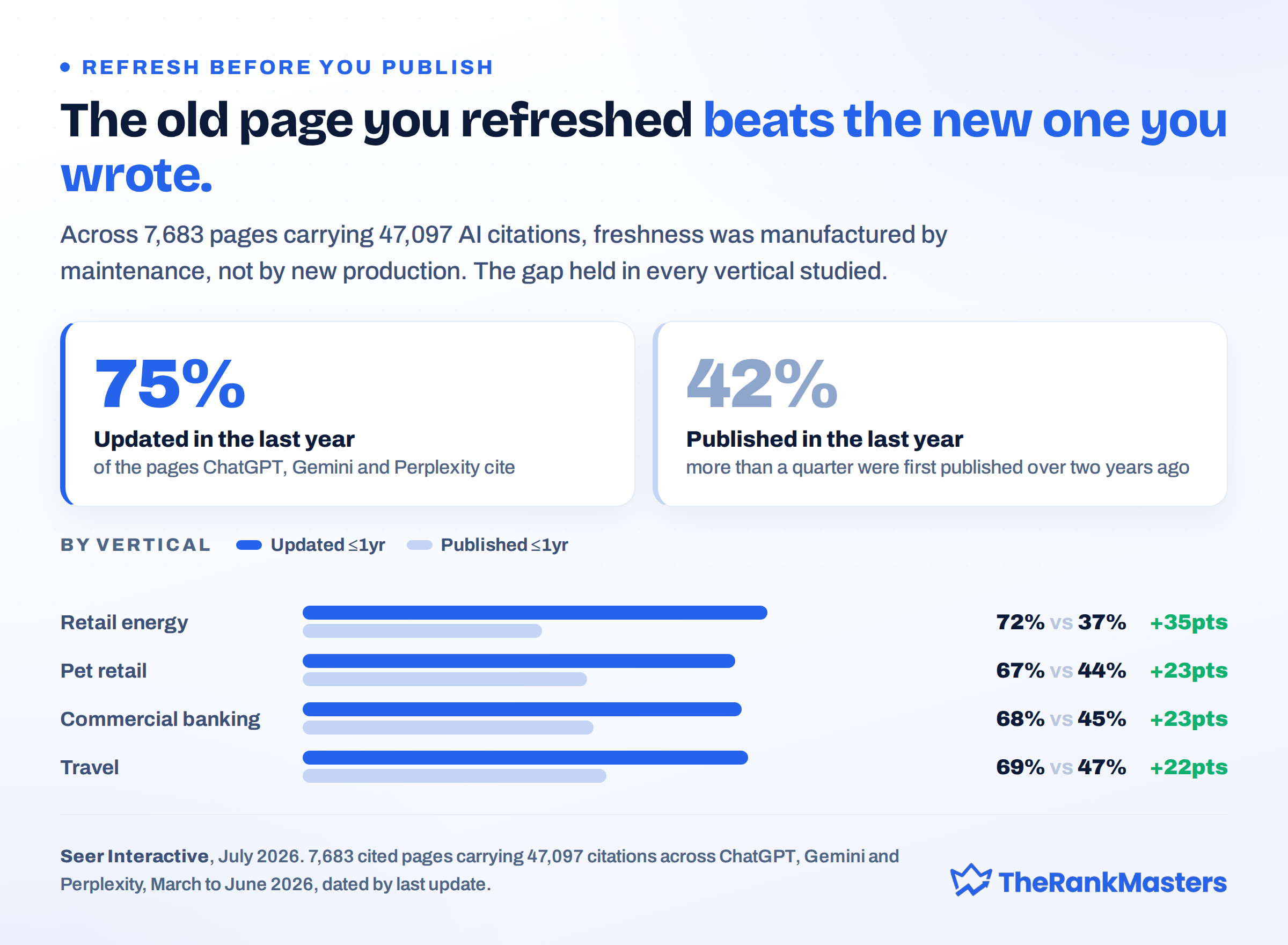
Refresh before you publish, because 75% of the pages LLMs cite were updated in the last year while only 42% were published in that window.
Freshness in AI search is manufactured by maintenance, not by new production.
This is the most under-exploited lever in organic growth right now, and it is the one the Seer Interactive July 2026 dataset quantifies most cleanly. Across 7,683 cited pages carrying 47,097 citations from ChatGPT, Gemini, and Perplexity between March and June 2026, the gap between update recency and publish recency held in every vertical studied.
| Vertical Studied | Cited Pages Updated in Last Year | Cited Pages Published in Last Year | Gap |
|---|---|---|---|
| Retail energy | 72% | 37% | 35 points |
| Pet retail | 67% | 44% | 23 points |
| Commercial banking | 68% | 45% | 23 points |
| Travel | 69% | 47% | 22 points |
The engines also differ in how much they reward recency, which matters if a specific assistant drives most of your referral volume.
| Engine | Cited Pages Updated Within One Year | Within Two Years | Content It Leans On Most |
|---|---|---|---|
| Gemini | 78% | 90% | Marketplaces and comparison content |
| ChatGPT | 73% | 87% | Blogs, guides, and brand pages |
| Perplexity | 65% | 83% | Blogs, guides, and older reference material |
1. The staying-power finding is the strategic one. Seer found that pages cited in only one of the four study months were the freshest of all at 86% updated within a year, while pages cited in all four months were the oldest at 68%, with a median time since update of roughly six months. A very recent update earns the initial pickup. Established pages that are kept reasonably current earn the durable citation. If you want compounding organic traffic rather than a spike, you are playing the maintenance game.
2. Build the refresh trigger from your own data, not from a calendar. A blanket "update everything quarterly" rule burns capacity on pages that do not need it and starves the ones that do. Instead, identify the URLs that appear repeatedly in AI answers and in Search Console impressions, check how stale they are, and let the observed citation pattern set your threshold.
A practical refresh queue, in priority order.
- Tier 1, decaying money pages. Comparison, pricing, and alternatives pages with falling clicks and stable impressions. Highest revenue impact, fastest payback.
- Tier 2, always-on cited pages. Pages appearing in AI answers month after month. Protect the citation by keeping facts, pricing, and product names current.
- Tier 3, high-impression low-click informational pages. These are already being read inside the answer layer. Restructure them for extractability and add original data.
- Tier 4, orphaned or thin legacy posts. Consolidate into stronger clusters or remove. Every one of them costs crawl budget.
- Tier 5, genuinely evergreen reference content. Leave alone unless the facts have moved, the citation rate has dropped, or being outdated would cost you credibility.
3. Update the content, not just the date. Changing a dateModified value without substantive revision is a transparent signal and does nothing for the underlying reason engines prefer fresh pages, which is that the facts inside them are more likely to be correct.
One further point from the Seer analysis that most refresh programmes miss entirely. Your own pages are typically a small minority of what gets cited about you. The comparison sites, marketplaces, and third-party guides that carry most of the citation volume are earned rather than owned, which makes publisher freshness a legitimate criterion when you evaluate partnerships.
A site that lets its articles rot is a worse bet for AI visibility than one that maintains them, even at similar authority.
4. The reason most refresh queues never get built. Nobody objects to the idea. It fails on prioritisation. Without citation data you cannot tell which of your 200 pages are the always-on assets worth protecting and which are dead weight, so the queue defaults to either everything (impossible) or whatever the last stakeholder complained about (random). The prioritisation is the work. The updating is the easy part.
You can also see this executed end to end in how to write AEO-optimized content and in the AI visibility library.
If your library is ageing and you do not yet know which pages are carrying your citations, book a call and we will identify your always-on pages and your decaying money pages from your own data, then show you the refresh order that recovers the most traffic per hour of effort.
How to Increase Traffic on a Website Through Technical SEO
Technical SEO increases organic traffic by removing the constraints that cap it, namely crawl waste, indexation gaps, slow rendering, and broken internal paths. It rarely creates demand on its own.
The framing matters because technical work is frequently oversold as a growth driver and then underfunded as a maintenance cost. Treat it as the ceiling on everything else.
| Technical Lever | What It Actually Fixes | Traffic Mechanism | Check It With |
|---|---|---|---|
| Robots and WAF audit | Crawlers silently blocked at the edge | Restores eligibility for classic and AI surfaces | Server logs against robots.txt |
| Snippet directive audit | nosnippet or tight max-snippet removing AI eligibility | Restores AI Overview and AI Mode inclusion | URL Inspection and page source |
| Indexation coverage | Priority URLs not indexed | Nothing ranks or gets retrieved until it is indexed | Search Console indexing report |
| Internal link architecture | Orphan pages and deep click paths | Distributes authority and aids discovery | Crawl depth report |
| Canonical consolidation | Duplicate and near-duplicate URLs | Reclaims crawl budget for pages that matter | Crawl comparison against sitemap |
| Rendering strategy | Content only present after client-side hydration | Faster, more reliable indexing and retrieval | Rendered HTML in URL Inspection |
| Page experience | Latency and layout instability | Reduces abandonment on the clicks you do earn | Core Web Vitals field data |
| Structured data accuracy | Markup that contradicts visible text | Preserves rich-result eligibility | Rich Results Test |
| Sitemap hygiene | Stale, redirected, or noindexed URLs submitted | Improves crawl efficiency signals | Sitemap versus index status |
1. Crawl budget is a live constraint again. Bot traffic has grown sharply, and a meaningful share of it delivers nothing back. Cloudflare's published ratios make the asymmetry concrete, and for large or frequently updated sites Google's own guidance now points explicitly to crawl budget optimisation as a worthwhile fundamental. If your log files show retrieval crawlers spending most of their requests on faceted URLs, paginated archives, and parameter variants, you are funding your competitors' crawl allowance with your own server capacity.
2. Do not over-rotate. Google's guidance is clear that perfectly semantic HTML is not required and that Google can understand imperfect markup. Semantic HTML is worth doing because it helps screen readers and browser agents parse your page, not because it unlocks a hidden ranking factor.
The Ops library covers the process side of keeping this work repeatable, and the technical SEO tag collects the implementation guides.
How to Build Topical Authority Instead of Chasing Single Keywords
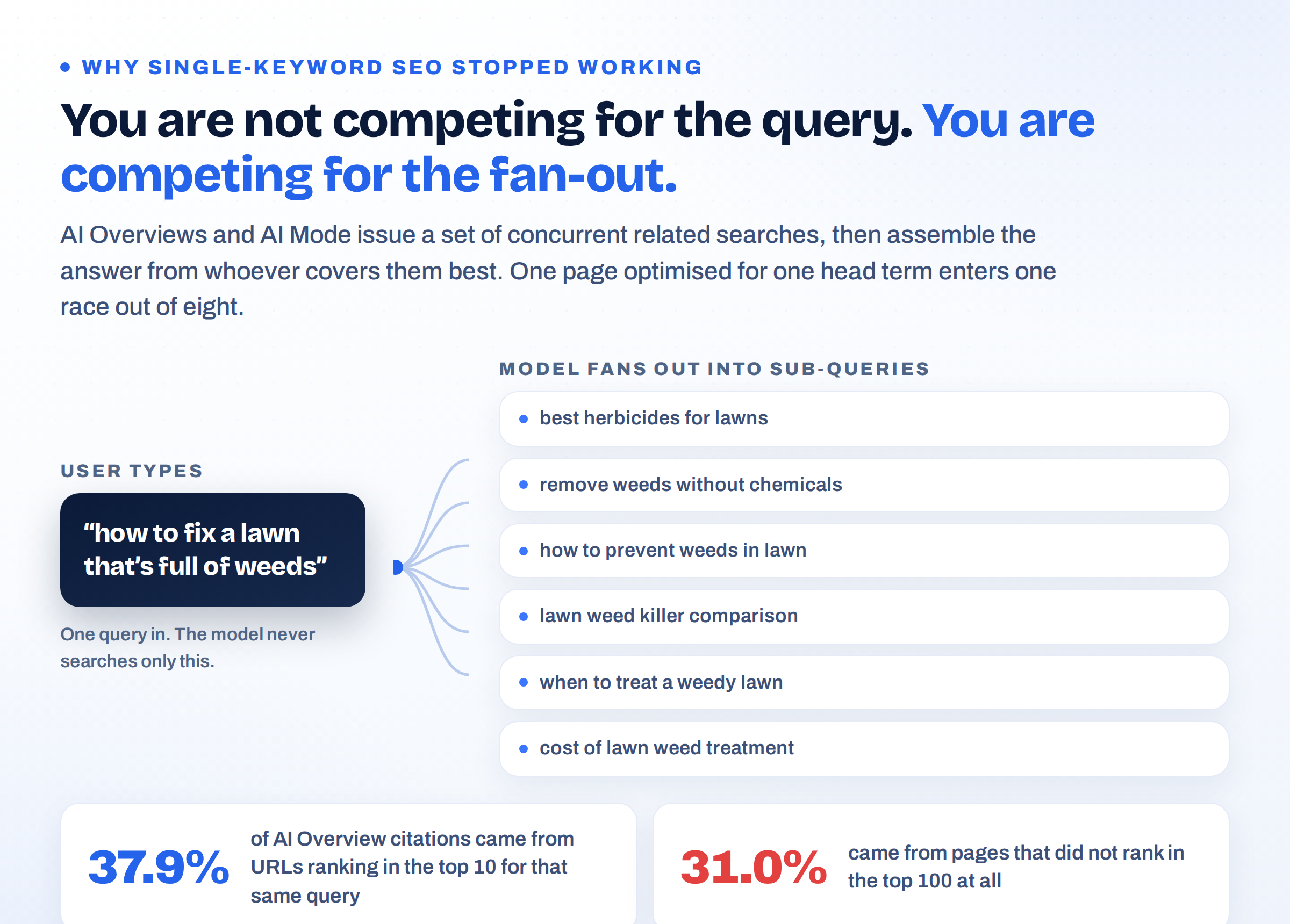
Build authority across a full topic cluster, because ranking in the top 10 for a single query no longer predicts citation. Ahrefs found that only 37.9% of AI Overview citations came from URLs in the first 10 result blocks, down from 76% seven months earlier.
That is the clearest evidence available that single-keyword thinking has stopped working.
The Ahrefs analysis of 863,000 keyword SERPs and roughly 4 million AI Overview URLs found the remaining citations split almost evenly between positions 11 to 100 at 31.2% and beyond position 100 at 31.0%.
| Where the Cited URL Ranked for the Same Query | Share of AI Overview Citations |
|---|---|
| Top 10 result blocks | 37.9% |
| Positions 11 to 100 | 31.2% |
| Not in the top 100 | 31.0% |
The mechanism behind this is query fan-out, and it is documented rather than inferred. Google Search Central describes fan-out as a set of concurrent related queries the model generates to fetch additional relevant results, using the worked example of "how to fix a lawn that's full of weeds" expanding into "best herbicides for lawns", "remove weeds without chemicals", and "how to prevent weeds in lawn."
Read that carefully, because it dictates content architecture.
Your page is not competing for the query the user typed. It is competing for a set of related sub-queries the model generated on the user's behalf, most of which you will never see in a rank tracker. A single page optimised for a single head term is entering one race out of eight.
What a cluster that wins fan-out looks like:
- Coverage across the sub-query set. One pillar page plus supporting pages that each own a distinct sub-question rather than a keyword variant of the same question.
- Consistent entity naming. The same product names, category names, and terminology across every page, so the model can resolve that these pages describe one coherent body of knowledge.
- Dense internal linking within the cluster. Sibling pages linked to each other on topic-named anchors, so retrieval and crawling both reach the whole set.
- Distinct angles, not duplicated substance. Each page answers something the others do not. Google's scaled content abuse policy targets the opposite pattern.
- Evidence at the passage level. Every high-intent section carries a named, dated figure with its source in the same sentence.
The intent-dilution trap. Adding tangential sections to an already focused page can reduce its AI Overview visibility by burying the answer and blurring the intent match. Depth means answering the question completely, not answering adjacent questions in the same document.
Executing this well is exactly the gap The Rank Masters closes for B2B SaaS teams, building an ICP-led content system that maps each topic cluster to a money page and to pipeline, rather than publishing posts that never convert.
The cluster architecture sits inside our SaaS content marketing engagement, and the citation layer on top of it sits inside answer engine optimization. You can see the mechanics in the PSOhub AI visibility case study, which documents page-1 rankings and AI citations built from a cluster architecture, and in the Avaza AI visibility case study, which traces the same system through to conversion events.
How to Earn Links and Mentions Without Buying Fake Referrals
Earn authority through genuine coverage, original data, and product-led assets, because purchased traffic and manufactured mentions do not produce durable organic growth and carry real downside risk.
The search for "increase website traffic without fake referrals" is a real and rational one. Referral spam, bot traffic packages, and paid mention schemes all promise a number that looks like growth in a dashboard and delivers nothing underneath it.
Google's July 2026 guidance addresses the mention side of this explicitly. It states that seeking inauthentic mentions across the web is not as helpful as it might seem, that core ranking systems focus on high-quality content while separate systems block spam, and that generative AI features depend on both.
Manufacturing mentions is therefore not a shortcut into the answer layer. It is an input the systems are specifically built to discount.
| Tactic | What It Actually Produces | Durable Organic Effect | Verdict |
|---|---|---|---|
| Bot or purchased traffic packages | Inflated session counts, distorted analytics | None | Avoid |
| Referral spam in analytics | Phantom referrers, corrupted channel reporting | None, and it hides real signal | Filter out |
| Paid mention or citation schemes | Low-quality placements on low-trust domains | Negligible, discounted by spam systems | Avoid |
| Original research and benchmark data | Journalist and practitioner citations | Strong and compounding | Invest |
| Free tools and calculators | Repeat visits, natural links, AI citations to a utility page | Strong | Invest |
| Practitioner-led case studies with real numbers | Trust signals, sales enablement, citation-worthy specifics | Strong | Invest |
| Podcast, video, and conference appearances | Entity reinforcement across formats | Moderate to strong | Invest |
| Genuine digital PR on a real story | Referring domains from relevant publications | Strong | Invest selectively |
1. Why original data outperforms everything else here. An engine assembling an answer prefers a groundable claim it can attribute. If you publish the benchmark, every article that references that benchmark reinforces your entity, and the engine has a specific reason to reach for your page rather than one of the eight sites paraphrasing you. This is the cheapest durable moat available to a mid-market SaaS brand.
2. Clean your analytics before you judge any channel. Referral spam and bot traffic inflate session counts and depress every quality metric downstream, which makes real channels look worse than they are. Filtering known spam referrers and confirming bot exclusion is a prerequisite for making any traffic decision at all.
3. Watch how third parties describe you. Because most of what gets cited about your brand sits on comparison sites, marketplaces, and review platforms you do not own, narrative accuracy on those pages is an authority input. Correcting an outdated pricing tier on a third-party comparison page can be worth more than publishing another blog post.
If you are evaluating outside help for this layer, the vendors library covers scoping and selection, and how to choose a B2B SaaS SEO agency with a scorecard and RFP gives you the diligence questions that separate genuine authority work from link-buying dressed up as strategy.
How Much Does It Cost to Increase Website Traffic Organically?
Organic traffic is free of media spend but not free of cost. The real inputs are production capacity, engineering time, subject-matter expertise, and a maintenance budget most teams never allocate.
Treating organic as costless is the reason so many programmes stall in month five. The cash cost is low and the capacity cost is high, and capacity is the thing that runs out.
| Cost Input | What It Buys | Typical Underfunding Symptom |
|---|---|---|
| Content production | New commercial and comparison pages | Publishing volume with no cluster logic |
| Content maintenance | Refreshes on decaying and cited pages | Library ages out of the citation pool |
| Subject-matter expert time | Non-commodity insight and first-hand experience | Generic content that no engine has a reason to prefer |
| Original research | Benchmarks and datasets that earn citations | No linkable asset, permanent reliance on other people's data |
| Engineering time | Indexation, rendering, schema, site speed | Technical ceiling capped below the content's potential |
| Tooling | Rank tracking plus AI citation tracking | Invisible to the channel that carries your highest-value visits |
| Analytics and attribution | Correct channel classification, conversion tracking | AI referrals misfiled as direct, ROI understated |
1. The maintenance line is the one that gets cut first and costs the most. Given that three in four cited pages were updated within the previous year, a programme with no refresh budget is a programme that ages out of the answer layer by default, regardless of how good the original writing was.
2. Where paid still earns its place. Seer's data showed paid click-through rate on informational queries with AI Overviews falling 68% from June 2024 to September 2025, which is a strong argument for pulling budget off high-funnel paid search. That budget is usually better redeployed into the maintenance and original-research lines above, both of which improve organic and AI visibility at once.
3. A realistic split for a growth-stage B2B SaaS team. Roughly 40% of content capacity on new commercial and comparison assets, 30% on refreshing existing pages, 20% on original research and proof assets, and 10% on technical and measurement work. The exact numbers vary. The principle that refresh is a first-class line item rather than a leftover does not.
How Long Does It Take to Increase Organic Website Traffic?
Expect leading indicators within 30 to 60 days, meaningful ranking and citation movement between 90 and 180 days, and compounding traffic growth from month six onward. Fixes to eligibility move fastest, and authority moves slowest.
Anyone promising faster than this on a competitive B2B SaaS term is selling either a technical fix you already needed or a metric that does not connect to revenue.
| Phase | Window | What Moves | What Does Not Yet |
|---|---|---|---|
| Eligibility repair | Days 0 to 45 | Indexed page count, snippet eligibility, crawl efficiency | Rankings on competitive terms |
| Structural rework | Days 30 to 90 | Featured snippets, AI Overview citations, impressions | Total session count |
| Cluster build-out | Days 60 to 180 | Ranking keywords per cluster, long-tail coverage | Head-term positions |
| Authority accumulation | Days 90 to 365 | Referring domains, citation persistence, brand queries | Anything, if the earlier phases were skipped |
| Compounding phase | Month 6 onward | Qualified sessions, assisted conversions, pipeline | Nothing, this is where the return lands |
1. Why refreshes are the fastest legitimate lever. A page that is already indexed, already has link equity, and already earns impressions needs no discovery period. Improving its structure and updating its facts can move it inside a single crawl cycle. This is why the refresh queue outranks the publishing calendar when you need results inside a quarter.
2. Why crawl timing sets a floor. Google's own documentation notes that recrawling can take anywhere from several days to several months depending on how often its systems determine a page needs refreshing. On a low-authority domain with a shallow internal link graph, that floor is the binding constraint, which is another reason internal architecture is a traffic tactic rather than a housekeeping task.
If you want to sanity-check these windows against documented programmes rather than against averages, the SaaS SEO case studies show what movement looked like at each phase, and the benchmarks library gives you the comparison set for your own baseline.
How to Measure Organic Traffic Growth When Clicks Undercount Demand
Measure impressions, citation rate, engaged sessions, and assisted pipeline alongside clicks, because a session count alone now understates demand by the size of the zero-click gap.
If sessions are your only KPI, a team that grew impressions 40% and citation rate 60% while sessions stayed flat will read as a failure. That is a measurement defect, not a performance one.
| Metric | What It Tells You | Where to Get It | Why It Matters More Now |
|---|---|---|---|
| Impressions by intent class | Whether demand for your topics is growing | Search Console, segmented | Separates surface change from demand change |
| Generative AI performance | How your content performs inside Google's AI features | Search Console generative AI report | The only first-party view of the AI layer |
| AI citation rate | Share of tracked prompts where you are cited | AI visibility tracking tools | Predicts the 35% CTR premium on adjacent queries |
| Narrative accuracy | Whether AI answers describe you correctly | Prompt monitoring | A wrong description costs pipeline silently |
| Engaged sessions | Quality of the clicks you still earn | Analytics platform | Volume fell, so quality per visit must be tracked |
| Assisted conversions | Organic's role in closed pipeline | CRM plus analytics | Connects content to revenue rather than to traffic |
| Median last-updated age | Freshness of your cited library | Site crawl plus citation export | Leading indicator of citation decay |
| Branded search volume | Whether AI exposure is building demand | Search Console, branded segment | Captures the value of impressions that never clicked |
1. Use Search Console as the source of truth for the AI layer. Google confirms that sites appearing in AI Overviews and AI Mode are included in overall search traffic in the Search Console Performance report under the "Web" search type, and it now provides a dedicated Generative AI performance report. It also warns against third-party tools claiming access to internal Google ranking or AI metrics, since no third-party tool has that access.
2. Instrument the AI referral channel manually. Because native app traffic frequently arrives without a referrer, build a segment that captures known assistant hostnames and accept that some portion will remain in direct. Reporting the segment as a floor rather than a total is more honest than pretending precision you do not have.
3. Set the goal on the right denominator. Against a documented 40% to 58% CTR headwind, "grow organic sessions 20%" and "grow organic impressions 20%" are wildly different asks. Agree which one you are being measured on before the quarter starts.
The analytics library covers tracking setups and dashboards, how to audit your brand's visibility on LLMs covers the manual and tool-assisted audit, GEO prompt monitoring tools compares the platforms that track citation rate across markets, and the attribution collection covers connecting all of it back to pipeline.
4. The measurement gap is the expensive one. Every other problem in this guide costs you traffic. This one costs you budget, because a programme that cannot show its contribution gets cut regardless of whether it was working. Teams that rebuild reporting around impressions, citation rate, and assisted pipeline routinely discover the content channel was performing the whole time and the dashboard was measuring the wrong thing.
If you are heading into a planning cycle and cannot currently prove what organic is contributing, book a call and we will review your traffic and conversion data together, show you what your organic and AI-referred visitors are actually worth, and give you the reporting frame to defend the budget with.
What Is Organic Website Traffic in 2026?
Organic website traffic is any unpaid visit that arrives because a discovery system surfaced your page, which now includes classic search results, AI Overviews, AI Mode, and assistant referrals from ChatGPT, Gemini, Perplexity, and Copilot.
The definition matters because most analytics setups still use a 2019 taxonomy. Under that taxonomy, a visit from a Google blue link is "organic search" and a visit from an AI assistant is "referral" or, worse, "direct." Both were earned by the same content asset, using the same editorial and technical inputs, with no media spend attached.
Treating them as separate channels causes teams to under-report the return on the exact work that is now driving qualified demand.
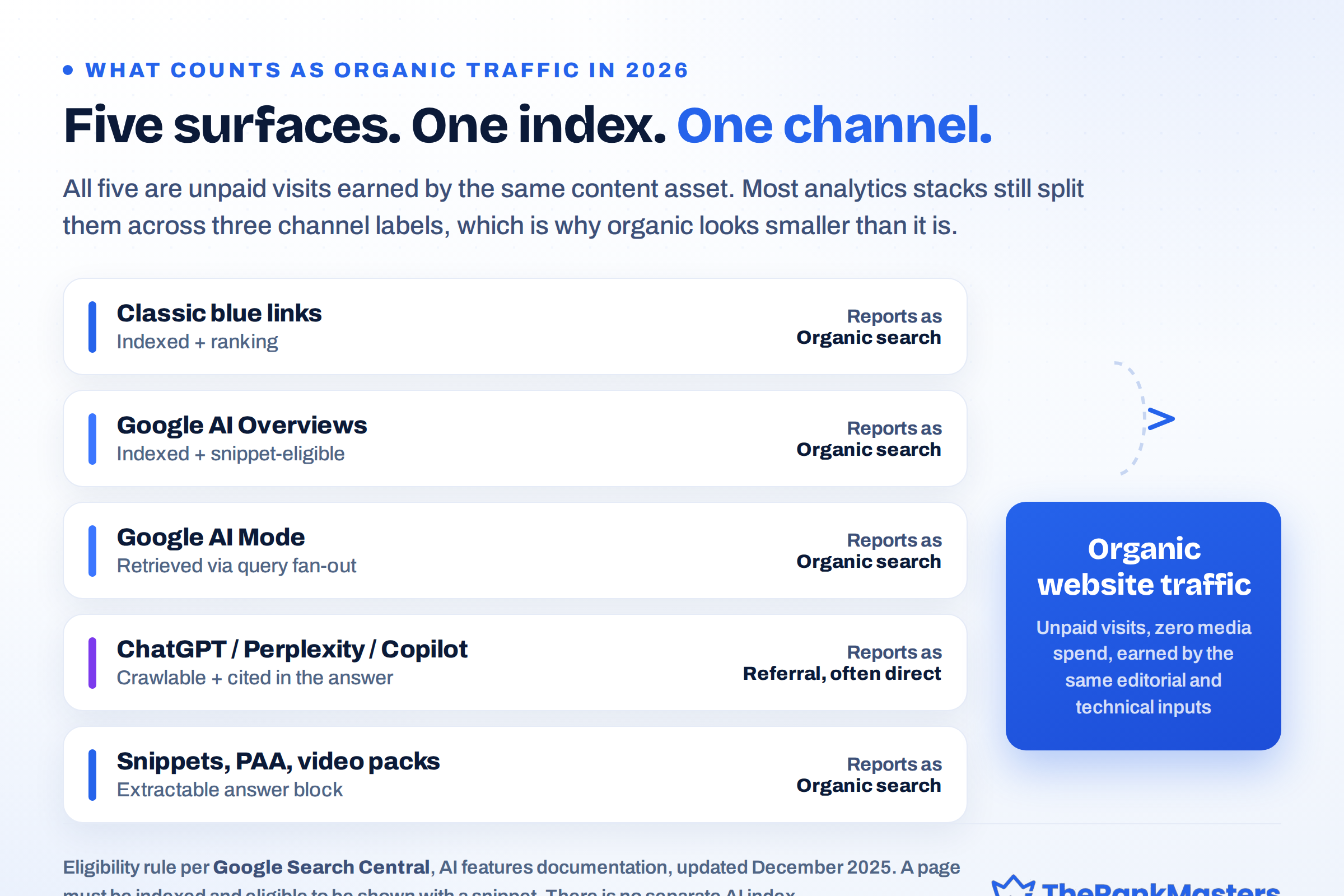
Here is how the modern organic surface actually breaks down.
| Discovery Surface | How Your Page Qualifies | How It Usually Appears in Analytics | Why It Counts as Organic |
|---|---|---|---|
| Classic Google blue links | Indexed, snippet-eligible, ranking for the query | Organic search | Unpaid placement earned by ranking systems |
| Google AI Overviews | Indexed and snippet-eligible, selected as a supporting link | Organic search (reported inside Search Console) | Unpaid citation drawn from the same index |
| Google AI Mode | Indexed and snippet-eligible, retrieved through query fan-out | Organic search (Search Console "Web" type) | Unpaid citation drawn from the same index |
| ChatGPT, Perplexity, Copilot referrals | Crawlable, retrievable, cited in the generated answer | Referral, or direct when no referrer header is sent | Unpaid citation earned by content quality |
| Featured snippets, People Also Ask, video packs | Indexed with an extractable answer block | Organic search | Unpaid SERP feature placement |
1️⃣ Eligibility baseline: Google Search Central states that to be shown as a supporting link in AI Overviews or AI Mode, a page must be indexed and eligible to be shown with a snippet, with no additional technical requirements beyond the standard Search technical requirements. That single sentence collapses a large amount of 2025 speculation. There is no separate AI index to get into. There is one index, and your eligibility to appear in an AI answer is downstream of your eligibility to appear in a normal result.
2️⃣ Attribution blind spot: Assistant referrals frequently arrive without a Referer: header, particularly from native desktop and mobile apps. Cloudflare flagged this explicitly when it published its crawl-to-refer data, noting that referral counts based only on web-based tools may overstate the imbalance. In practice this means a share of what your dashboard labels "direct" is unattributed AI referral traffic, and the true organic number is higher than reported.
If your team is still deciding how to classify these surfaces internally, the breakdown in traditional SEO vs AI SEO maps each metric to the strategy layer it belongs to.
Why Organic Website Traffic Falls While Rankings Hold
Rankings and clicks have decoupled.
Ahrefs measured a 58% drop in position-one click-through rate on keywords that trigger an AI Overview, comparing December 2023 with December 2025 across 300,000 keywords.
This is the single most important number for anyone trying to increase website traffic organically, because it reframes the problem. You are not losing traffic because your page got worse. You are losing traffic because the answer is being delivered above your listing, and the reader's need is satisfied before the click.
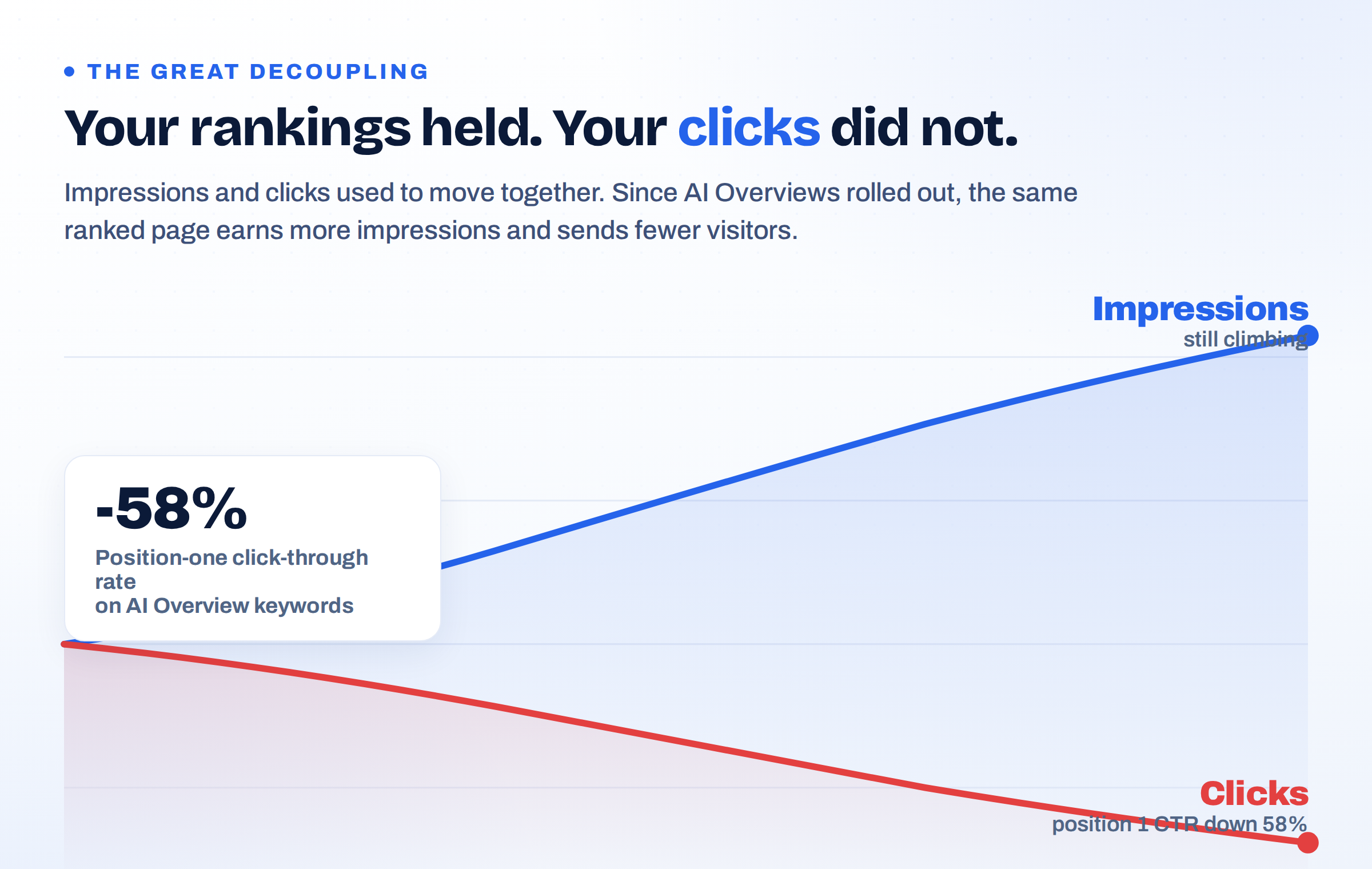
The Ahrefs analysis of AI Overview click-through impact also shows that the damage is not uniform across the page. It concentrates at the top.
| Organic Position | Click-Through Rate Impact When an AI Overview Is Present |
|---|---|
| 1 | -58.0% |
| 2 | -50.8% |
| 3 | -46.4% |
| 4 | -38.8% |
| 5 | -32.6% |
| 6 | -30.5% |
| 7 | -29.7% |
| 8 | -28.8% |
| 9 | -29.7% |
| 10 | -19.4% |
Read that table as a strategy document rather than a scoreboard.
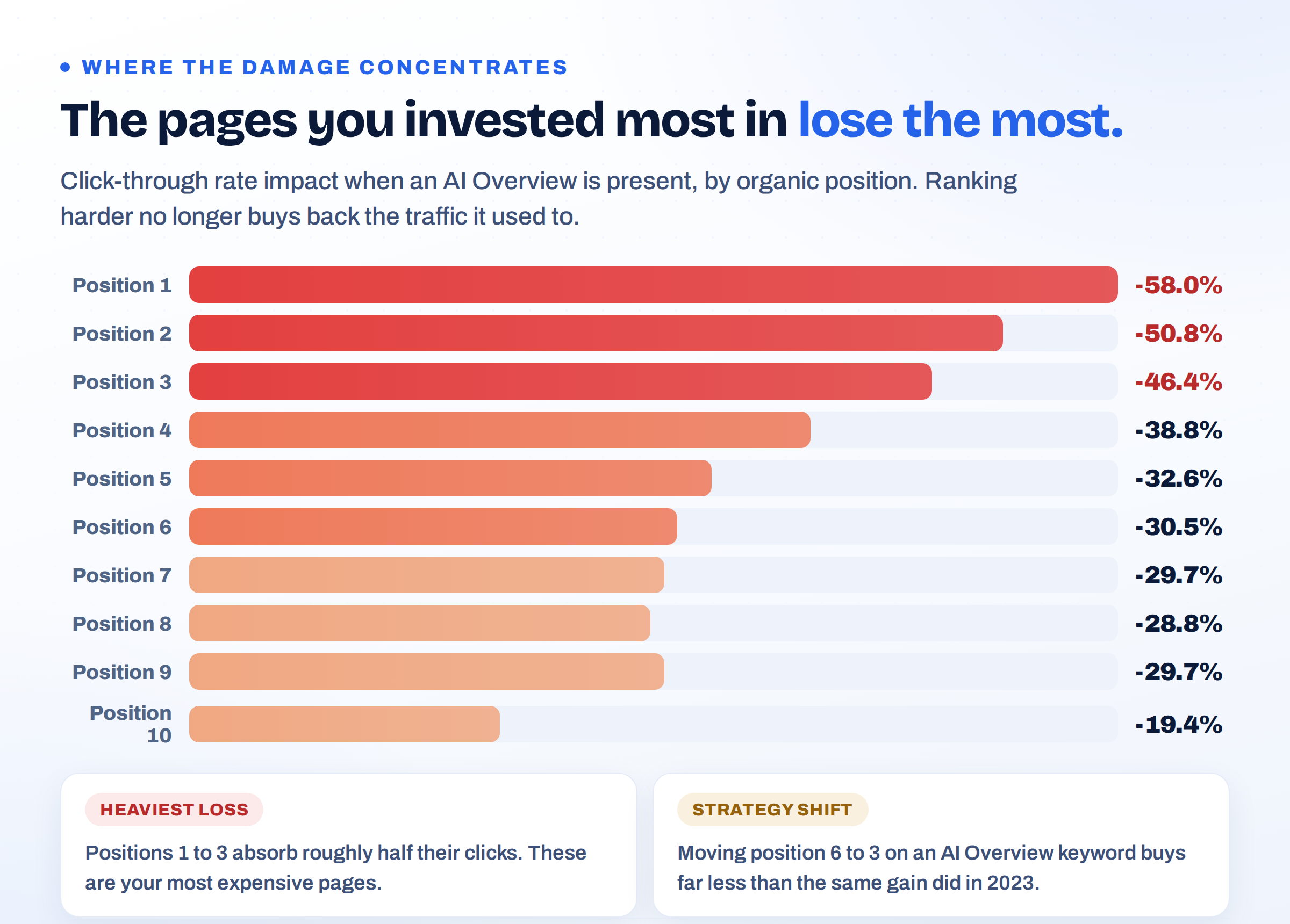
The pages you invested the most in, the ones that fought their way to position one, absorb the largest proportional loss.
Ranking improvements from position 6 to position 3 on an AI Overview keyword now buy you materially less incremental traffic than the same improvement did in 2023.
Behavioural data from outside the SEO industry confirms the mechanism.
Pew Research Center tracked the March 2025 browsing behaviour of 900 US adults across 68,879 Google searches and found that users who encountered an AI summary clicked a traditional result link in 8% of visits, against 15% for searches without one. Clicks on links inside the AI summary itself occurred in just 1% of visits, and 26% of sessions on pages with an AI summary ended entirely, against 16% without.
The pattern is corroborated at the consumer-survey level.
Bain & Company's December 2024 survey of 1,117 consumers found that about 80% of search users rely on zero-click results in at least 40% of their searches, an effect Bain estimated as reducing organic web traffic by 15% to 25%.
Three independent methodologies, three different populations, one direction.
The click discount is structural, not cyclical, and any plan to increase organic website traffic that assumes a rebound is planning against the evidence.
✅ What this changes about goal-setting. A flat year-over-year organic session count in 2026 is not stagnation. Against a 40% to 58% CTR headwind on informational queries, holding sessions flat means you materially grew impressions, coverage, or both. Teams that reset their baseline correctly stop firing good strategists for losing a race that the surface itself moved.
The B2B SaaS content benchmarks dataset is a useful reference point when you need to re-baseline with a leadership team, and the benchmarks library covers what good looks like across rankings, traffic, and conversion.
✅The part you cannot see from a dashboard. These three datasets tell you the industry-level effect. They cannot tell you your split, and that split is the whole decision. Some of your decline is AI interception on queries you were never going to keep. Some of it is genuine ranking loss you can reverse this quarter. Some of it is AI referral traffic misfiled as direct, meaning you are already winning in the answer layer and under-reporting it. Those three causes look identical in a sessions chart and require three different responses.
If your traffic chart looks like the one described above and you want the split rather than the average, book a call and we will walk your Search Console and analytics data with you, separate the intercepted clicks from the real losses, and tell you which bucket your decline actually sits in.
Organic Traffic vs AI Referral Traffic: What Is the Difference?
Organic traffic arrives from a ranked link the user chose from a list. AI referral traffic arrives from a citation the user followed after an answer had already been generated, which makes it lower in volume and later in the buying journey.
The two behave differently enough that averaging them together hides the story. AI referral visitors have usually had the definitional layer of their question resolved before they arrive, so they skip the top of your funnel and land on comparison pages, pricing, product tours, and free tools.
| Attribute | Classic Organic Traffic | AI Referral Traffic |
|---|---|---|
| Typical entry point | Blog posts and informational guides | Homepage, product, pricing, comparison, free tools |
| Journey stage on arrival | Early to middle, often exploratory | Middle to late, often pre-qualified |
| Volume relative to total sessions | Majority of unpaid sessions for most sites | Low single-digit percentage for most sites |
| Per-visitor value | Baseline | Semrush estimates an AI search visitor is worth 4.4x a traditional organic visitor |
| Attribution reliability | High, referrer header present | Low, native apps frequently omit the referrer |
| What earns the placement | Ranking position for the head query | Citation selection across fanned-out sub-queries |
Semrush's traffic modelling puts the average AI search visitor at 4.4 times the value of a traditional organic search visitor, and projects AI-sourced website visits overtaking traditional search visits by 2028. The volume today is small. The trajectory and the per-visit economics are not.
The operational conclusion is uncomfortable but clean. You should expect to grow organic traffic in 2026 by simultaneously defending a declining-CTR channel and building a small, high-value channel that will not replace it for several years. Optimising exclusively for either one loses.
For the mechanics of engineering that second channel deliberately, how to create an AEO strategy for B2B SaaS walks through prompt mapping and citation tracking, and AI search engine optimization compared with classic SEO, AEO, and GEO disambiguates the acronyms your team will encounter.
Which Queries Still Send Organic Clicks and Which Never Will
Informational queries are where AI Overviews concentrate, and commercial and transactional queries are where clicks survive.
Semrush found that 88% of AI Overview triggers are informational, against 8.69% commercial and 1.76% transactional.
This is the highest-leverage filter available to anyone doing keyword research right now, and most keyword tools do not surface it by default. Before you commit a quarter of production capacity to a topic cluster, you can predict with reasonable confidence whether that cluster will return clicks or only impressions.
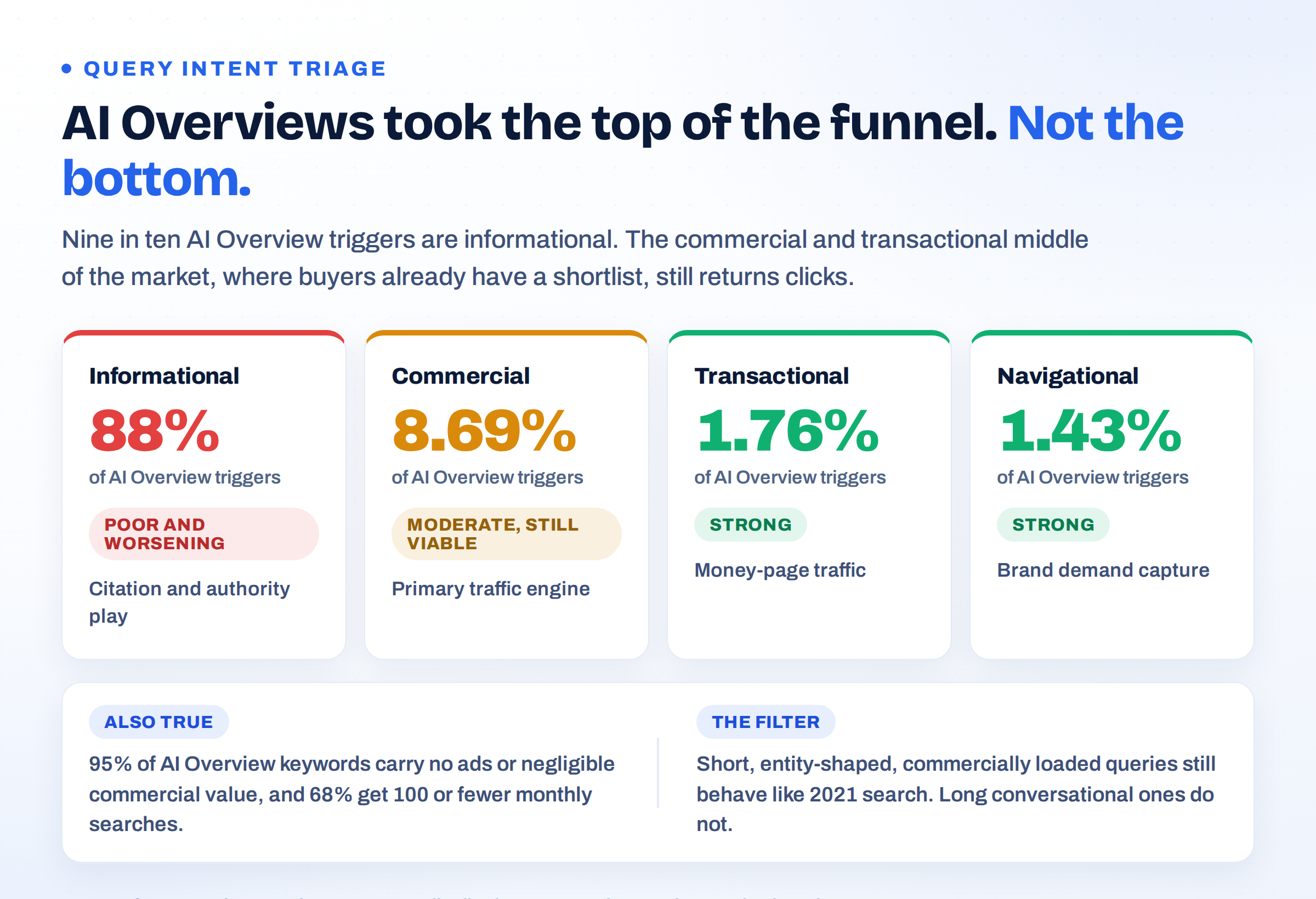
| Query Intent | Share of AI Overview Triggers (Semrush, 2025) | Click Outlook | Strategic Role |
|---|---|---|---|
| Informational | 88% | Poor and worsening | Citation and authority play, not a traffic play |
| Commercial | 8.69% | Moderate, still viable | Primary organic traffic engine |
| Transactional | 1.76% | Strong | Money-page traffic, defend aggressively |
| Navigational | 1.43% | Strong | Brand demand capture, downstream of everything else |
Two further findings from the Semrush AI Overviews dataset sharpen the filter. Roughly 95% of keywords triggering AI Overviews either display no paid ads or carry minimal commercial value, and over 68% of AI Overview terms receive 100 or fewer monthly searches. Google is, in effect, absorbing the low-commercial-value long tail and leaving the revenue-adjacent middle of the market comparatively intact.
Query length and phrasing predict the trigger just as reliably. The Pew dataset shows the pattern precisely.
| Query Characteristic | Share Producing an AI Summary |
|---|---|
| One or two word searches | 8% |
| Searches of ten words or more | 53% |
| Searches beginning with who, what, when, or why | 60% |
| Searches containing both a noun and a verb | 36% |
| All Google searches in the study | 18% |
✅ The practical filter. Short, entity-shaped, commercially loaded queries ("psa software pricing", "time tracking software for agencies") still behave like 2021 search. Long, conversational, question-shaped queries ("what is the best way to track billable hours across a distributed team") are AI Overview territory and should be planned as citation assets with a low click assumption.
That does not mean abandoning informational content. It means changing what you expect informational content to return.
Informational pages are how you become the source an engine reaches for, and Seer Interactive's Q3 2025 study found that brands cited inside an AI Overview earned 35% higher organic click-through rate and 91% higher paid click-through rate than brands appearing on the same query without a citation.
The informational layer is not a traffic channel any more. It is the qualification round for the traffic channels that still work.
A caution from the same Seer dataset, because it corrects a comfortable assumption. Organic click-through rate on queries where no AI Overview appeared still fell 41% year over year. Avoiding AI Overview keywords is not a safe harbour. Broader behaviour has shifted, and the only durable response is to widen where you are discoverable rather than to hunt for untouched SERPs.
✅ What this usually means in practice. Most B2B SaaS keyword maps we look at are 70% or more informational, which is a portfolio built for the 2021 SERP. The correction is not complicated to describe. It is uncomfortable to execute, because it means telling a content team that a large share of the library they are proud of is now an authority asset rather than a traffic asset, and rebuilding the plan around commercial terms that have lower volume and higher difficulty.
If you want to know your own split before you have that conversation internally, book a call and we will classify your ranking keywords by intent and AI Overview exposure with you on the call, then show you which of your existing terms still have a defensible click forecast and roughly what the misallocated share is costing you.
Organic Traffic Strategy for a 40-Person B2B SaaS Team
A 40-person SaaS team should run a narrow, ICP-scoped programme, namely one vertical, one core cluster, ten commercial pages, and a standing refresh queue, rather than broad category coverage it cannot maintain.
Breadth is the failure mode at this size. A team with one content lead and a fractional SEO cannot maintain 300 pages to the freshness bar the citation data implies, and an unmaintained library actively decays.
| Constraint at 40 People | Wrong Response | Right Response |
|---|---|---|
| One or two content producers | Publish more, faster, thinner | Publish less, deeper, with SME input |
| No dedicated SEO engineer | Defer all technical work indefinitely | Batch technical fixes into two engineering sprints per year |
| Limited SME availability | Write around the expert | Book 45 minutes per asset and build the page from that interview |
| Small existing library | Chase head terms immediately | Own one narrow segment completely before widening |
| No research budget | Cite everyone else's data | Publish one original benchmark per year from your own product data |
| Thin conversion path | Send traffic to the blog | Ensure every cluster terminates at a money page |
1. Pick the segment where you can be the definitive source. Not the largest addressable market, the one where ten excellent pages make you unambiguously the reference. Category ownership in a narrow vertical produces citations. Partial coverage of a broad category produces neither rankings nor citations.
2. Terminate every cluster at a page that converts. The most common failure in mid-market SaaS content is a well-ranked informational library with no path into a pricing, comparison, or demo page. That structure loses twice, once to the AI Overview taking the informational click and once to the absence of a conversion route for the clicks that survive.
3. Protect the refresh queue from the publishing calendar. When capacity is tight, new production always feels more urgent. The citation data says otherwise. Ring-fence maintenance capacity in the plan rather than hoping it survives contact with the quarter.
This is the shape of programme documented in the generative engine optimization case study covering 8,337% ChatGPT referral growth in 90 days, which was built on a small number of core pages plus a deliberately clustered long-tail layer rather than on volume. The PSOhub case study shows the same architecture producing page-1 rankings and AI citations inside 90 days on a comparably sized team.
4. The honest constraint at this headcount. None of the above is intellectually difficult. It is a sequencing and capacity problem. One content lead cannot simultaneously run intent classification, maintain a refresh queue, brief SMEs, produce commercial pages, and instrument citation tracking, and the first thing that gets dropped is always the measurement layer that would have proved the rest was working. That is why programmes at this size tend to look fine for two quarters and then quietly stall.
Top SEO and AEO services for AI search visibility sets out what a real scope looks like if you are comparing options, and the service playbooks library documents the systems themselves.
If you recognise your team in the constraints table above, book a call and we will look at your current site, traffic, and team capacity together, then tell you honestly which parts of this you should keep in-house and which parts are worth handing over.
Organic Website Traffic Mistakes That Cap Growth
The mistakes that cap organic growth in 2026 are mostly inherited habits, namely volume-first publishing, session-only measurement, informational-heavy keyword maps, and treating maintenance as optional.
| Mistake | Why It Made Sense Before | Why It Fails Now | The Correction |
|---|---|---|---|
| Publishing volume as the growth lever | More pages meant more ranking keywords | Commodity pages on AI Overview queries return impressions, not clicks | Fewer, denser, maintained assets |
| Keyword maps weighted to informational terms | Informational terms were high-volume and easy | 88% of AI Overview triggers are informational | Weight toward commercial and transactional |
| Measuring only sessions | Sessions tracked demand closely | A 58% CTR discount breaks the link | Add impressions, citations, and pipeline |
| Skipping refresh work | Evergreen content stayed evergreen | Three in four cited pages were updated in the last year | Fund a standing refresh queue |
| Chasing single-keyword rankings | Top 10 predicted visibility | Only 37.9% of AI Overview citations rank in the top 10 | Build clusters that cover the fan-out |
| Adding tangential sections for coverage | Longer pages ranked | Intent dilution buries the extractable answer | Keep pages focused, split the sub-topic out |
| Building llms.txt and AI-specific markup | Felt like an early-mover advantage | Google Search ignores these files entirely | Spend that time on content and structure |
| Blocking all AI crawlers by default | Protects content from extraction | Removes you from the citation pool that drives your best visits | Decide per crawler purpose, not as one policy |
| Buying traffic or mentions | Moved a dashboard number | Discounted by spam systems, corrupts your analytics | Invest in original data and genuine coverage |
| Sending all organic traffic to the blog | Blog was the top of a working funnel | No conversion route for the clicks that survive | Terminate clusters at money pages |
1. The meta-mistake behind all of them. Each of these was a correct answer to the search environment that existed when it was adopted. None of them were wrong at the time. The failure is not having re-derived the strategy from current evidence, which is why grounding every decision in a dated, named source matters more than any individual tactic in this guide.
2. What this article cannot do for you. Everything above is the general case, and the general case is where advice stops being useful. Whether you should reallocate away from informational content depends on how much of your pipeline currently originates there. Whether your traffic decline is AI interception or genuine ranking loss depends on which of your keywords now trigger an overview. Whether your refresh queue should start with money pages or cited pages depends on what your citation data says. Four companies reading this paragraph should do four different things first, and none of them can tell which from a blog post.
That is the specific gap worth a conversation.
On a call we will pull up your site and your traffic data while you are on it, and work through three things.
First, where your organic website traffic is genuinely going, separating clicks intercepted by AI answers from real ranking losses and from AI referrals your analytics is misfiling as direct.
Second, what the traffic you still have is actually worth, mapped to the pages that convert rather than the pages that get sessions.
Third, which single change in this guide would move your number fastest given your library, your team size, and your category.
You will leave with that read whether or not you ever work with us.
If it turns out the fix is straightforward and internal, we will say so. If it turns out your library needs the kind of ICP-led content system that maps every cluster to a money page and to pipeline, that is the work The Rank Masters does, and we will show you what it looks like on your domain rather than in the abstract.
Book a call and we will analyse your site's traffic with you and tell you what that traffic is worth before you spend another quarter guessing.