AI search visitors made up just 0.5% of total traffic but drove 12.1% of all product signups, according to Ahrefs' June 2025 first-party analysis of its own conversion data. That is a 23x conversion premium, and it is exactly the channel most SaaS brands still cannot see in their reporting.
📓 Quick note!
This is Part 2 of the Avaza story.
Part 1 breaks down the “AI-ready posts” experiment and how we proved SEO + AI search conversion potential early.
To read Part 1, open this: Avaza SEO Case Study: 6.4% AI Assisted Conversions
Then Part 2 (this case study) shows what happened when we went deeper i.e., winning repeatable AI answers visibility (mentions + citations) and turning that visibility into measurable discovery + key events.
This case study shows what happens when a mature PSA software brand deliberately engineers that channel instead of waiting for it.
Over a 90-day measurement window (April 16 to July 14, 2026), the 58 pages The Rank Masters wrote for Avaza became the pages AI engines cite, the pages Google surfaces, and the pages new signups start on.
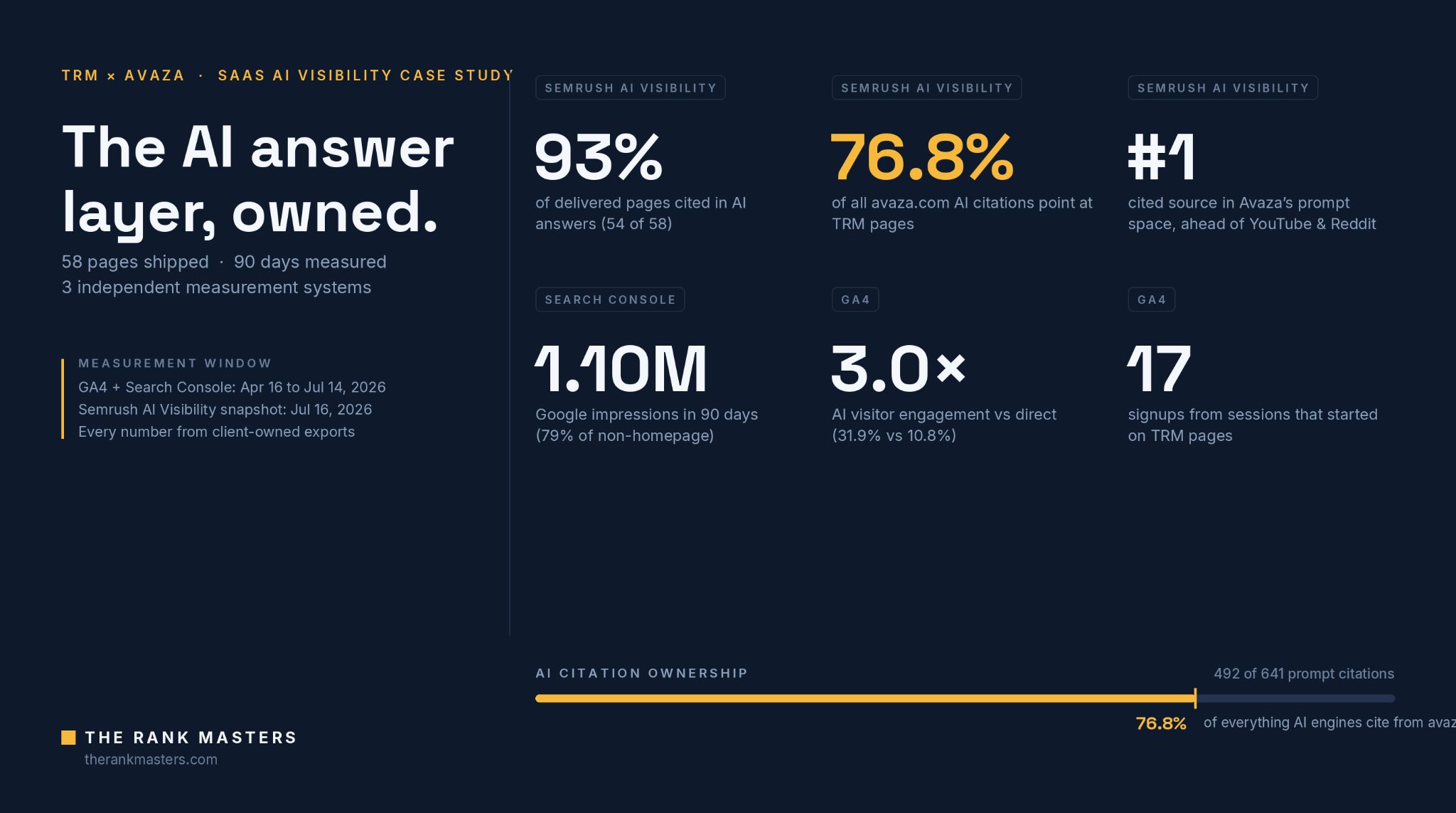
The headline results, all pulled from Avaza's own Semrush AI Visibility, Google Search Console, and GA4 exports:
| Result | Number | Data Source |
|---|---|---|
| TRM-written pages cited inside AI answers | 54 of 58 pages (93%) | Semrush AI Visibility, Jul 16, 2026 |
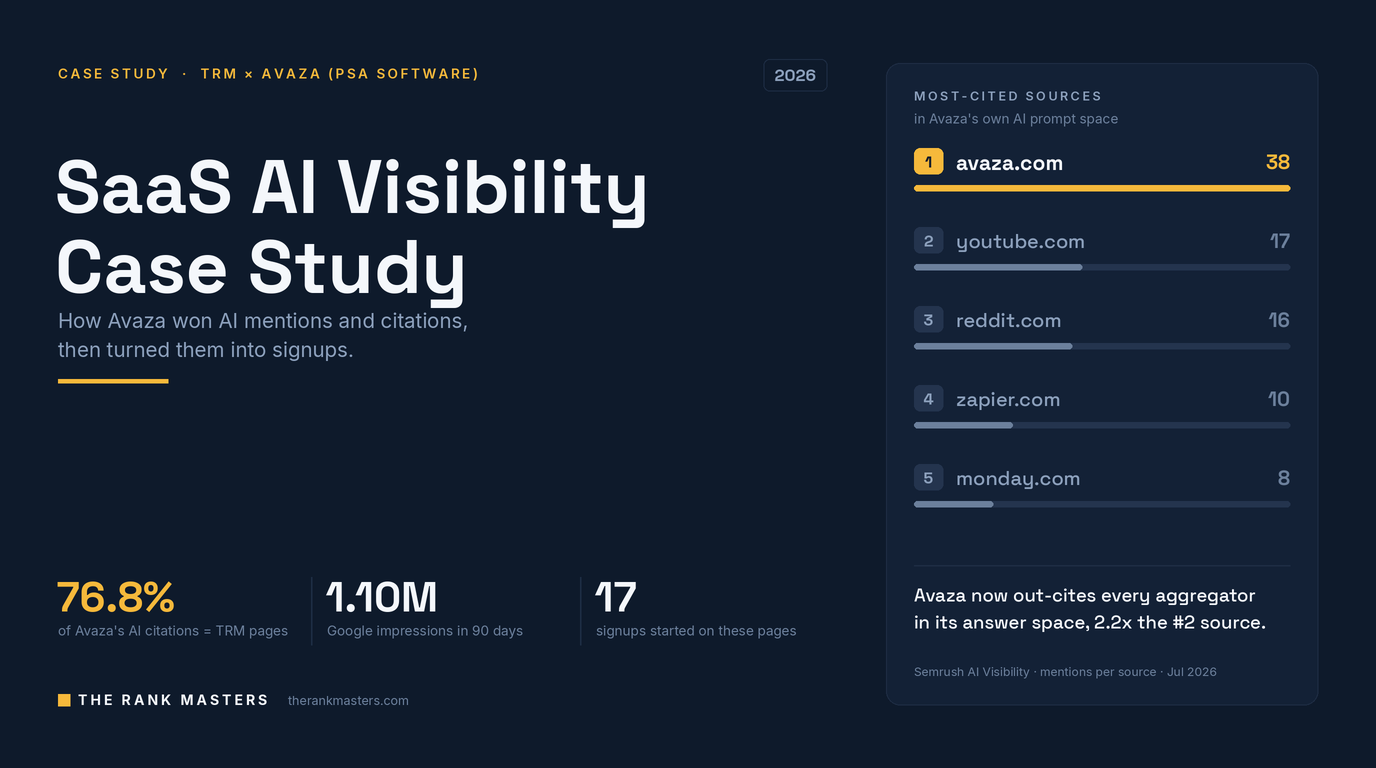
| Share of ALL avaza.com AI prompt citations pointing at TRM pages | 492 of 641 (76.8%) | Semrush cited-pages export |
| Avaza.com's rank among cited sources in its own AI prompt space | #1, ahead of YouTube, Reddit, and Zapier | Semrush cited-sources report |
| Google impressions earned by the 58 pages in 90 days | 1.10M (79.2% of all non-homepage impressions) | Google Search Console |
| Engagement rate of AI Assistant traffic vs direct traffic | 31.9% vs 10.8% (roughly 3x) | GA4 traffic acquisition |
| Free-account signups from sessions that started on a TRM page | 17 NewSignup events in 90 days | GA4 events by landing page |
▶️ If your ranked pages are not showing up in AI answers and you want a content system that fixes that, book a SaaS content strategy call.
A note on the measurement stack. Every citation number in this study came out of Semrush's AI Visibility toolkit, which tracks which prompts cite which URLs across ChatGPT, Google AI Overviews, AI Mode, and Gemini. We use it because it reports at page level rather than brand level, which is the only granularity that lets you say this specific URL earned this specific citation. If you want to run the same audit on your own domain, that is where we would start.
Part 2, the study you are reading now, shows what happened when we went deeper, i.e., winning repeatable AI answers visibility (mentions plus citations) at page level and turning that visibility into measurable discovery and key events. Both studies live alongside our other measurement work in the benchmarks category on TRM Insights.
The Scope: 58 Pages TRM Shipped Into Avaza's Buyer Question Space
TRM delivered 58 pages engineered across four corridor types, each mapped to a distinct stage of the PSA buyer's question space. The delivery mix:
| Corridor Type | Example Pages (avaza.com paths) | Buyer Question It Owns |
|---|---|---|
| Operational how-to | /work-breakdown-structure/, /calculating-hours-worked/, /responsibility-assignment-matrix-raci/ | "How do I run this process correctly?" |
| Decision and planning | /project-cost-estimation/, /resource-constraints/, /consulting-business-plan-template/ | "How do I plan and decide before buying?" |
| Category and comparison | /best-team-task-management-app/, /best-project-management-software-australia/, /collaboration-project-management-tools/ | "Which tools should be on my shortlist?" |
| Billing and monetization | /payrate-vs-billrate/, /billable-vs-non-billable-hours/, /freelance-time-tracking-and-invoicing/ | "How do I bill accurately and profitably?" |
Every page followed the same production standard, namely question-shaped H2s, a direct answer in the first sentence of every section, Decision Blocks at each high-intent moment, structured data throughout, and internal links wiring the corridor together.
The list was not chosen by editorial instinct. It was chosen from converting-term intelligence and fan-out mapping, so each page corresponds to a question that sits on the line between learning and shopping.
That completes the setup.
Everything from here forward is measurement, drawn from three independent systems, namely Semrush AI Visibility (the citation layer), Google Search Console (the search coverage layer), and GA4 (the behavior and conversion layer).
Three systems, one consistent story, in the tradition of every study in the TRM case studies library.
Proof Layer 1: TRM Pages Drive 77% of Avaza's AI Citations
The Semrush AI Visibility snapshot of July 16, 2026 shows that pages TRM wrote account for 492 of the 641 prompt citations pointing at avaza.com, i.e., 76.8% of everything AI engines cite from the entire domain. The claim ladder, each rung verifiable in the platform:
- 93% citation coverage: 54 of the 58 delivered pages are actively cited inside AI answers across ChatGPT, Google AI Overviews, Google AI Mode, and Gemini. The four not yet cited are the queue, not the ceiling.
- 41.7% of unique cited URLs: Of the 132 unique avaza.com URLs that AI platforms cite, 55 are TRM-written pages.
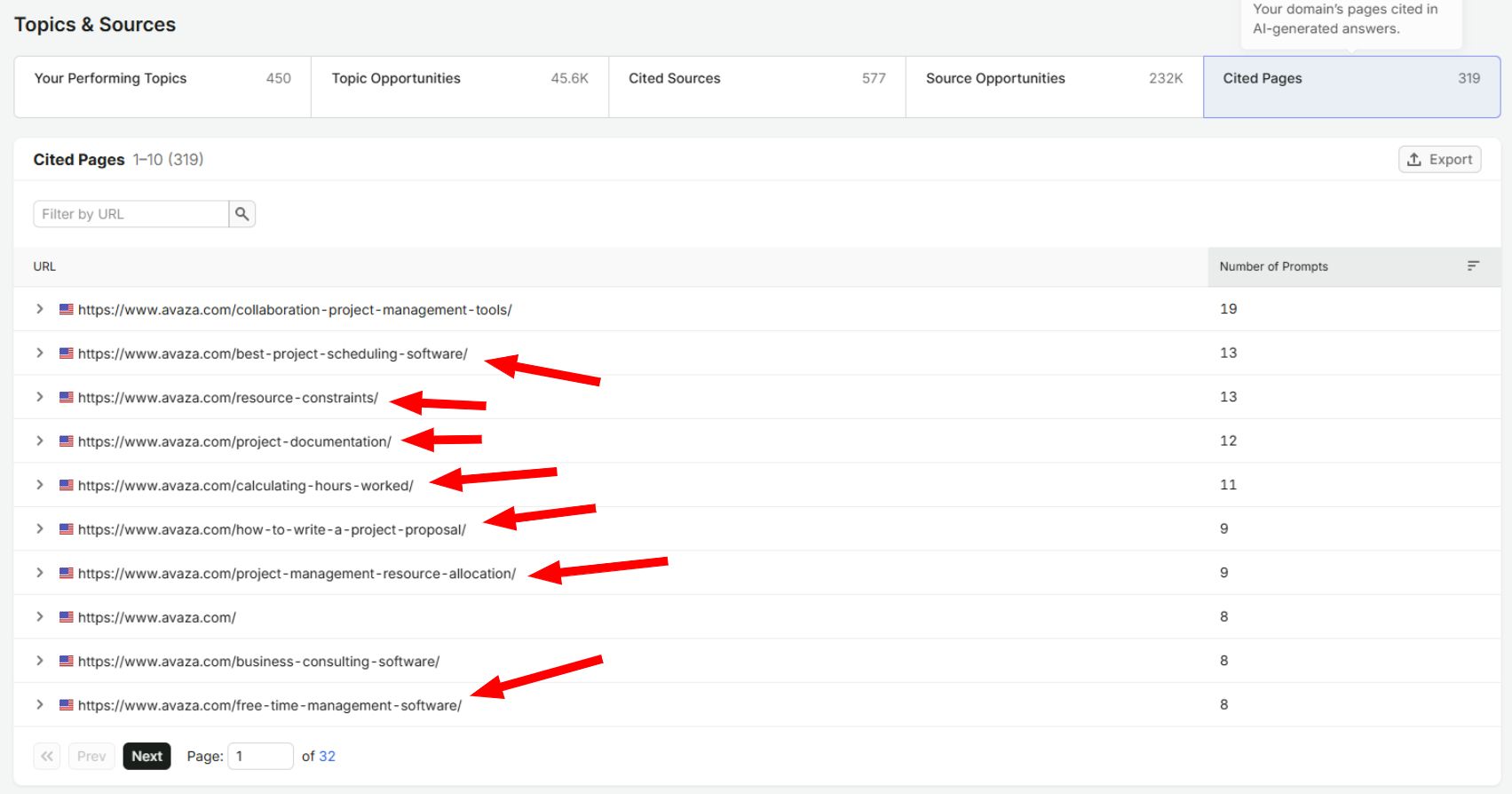
- The domain's #1 cited page is ours: /collaboration-project-management-tools/ leads all avaza.com URLs with 19 U.S. prompt citations (39 worldwide), ahead of every product and support page on the site.
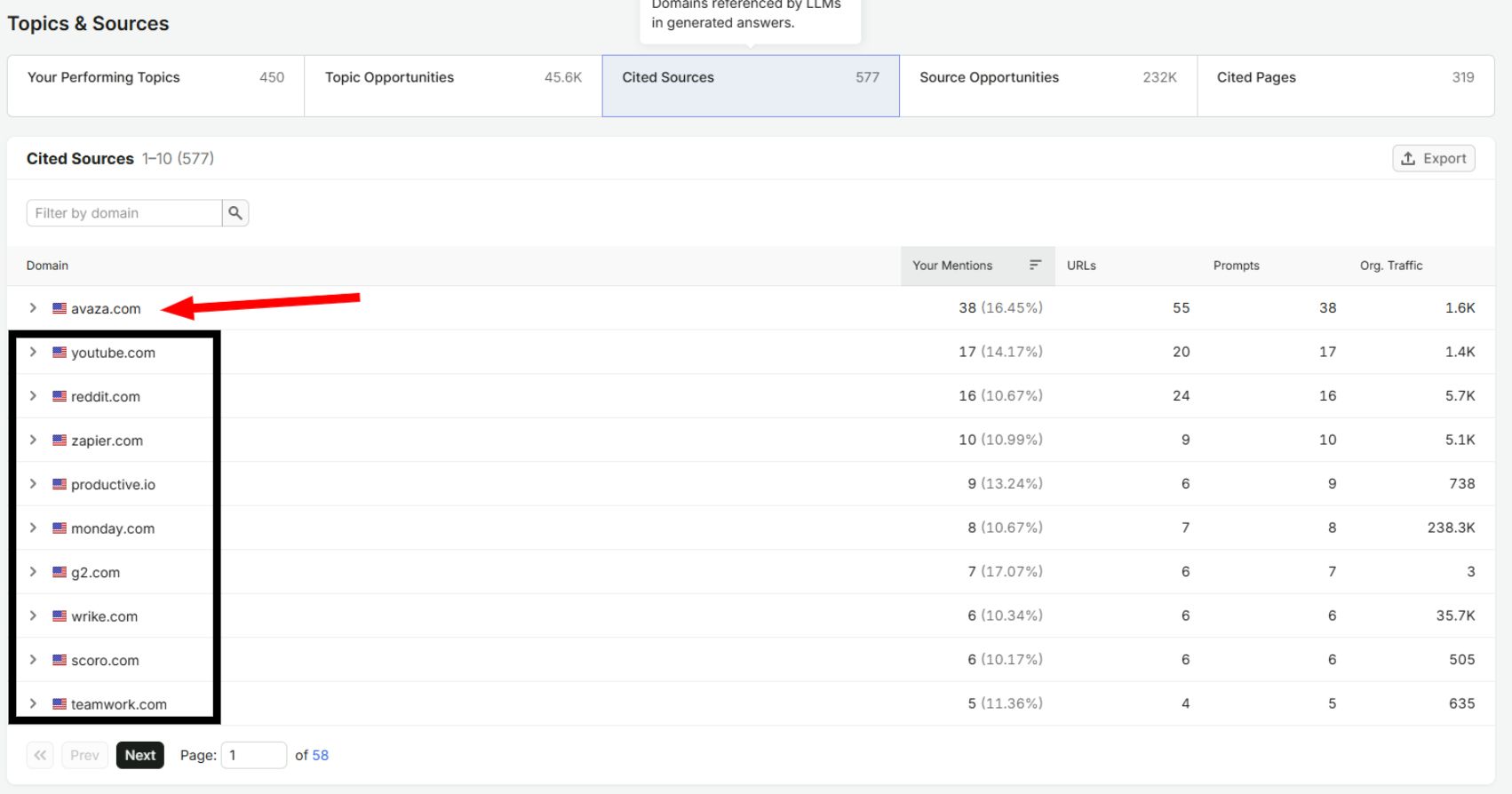
- Avaza outranks the aggregators in its own answer space: In the cited-sources report for Avaza's tracked prompts, avaza.com is the most-cited source at 38 mentions across 55 URLs, ahead of youtube.com (17), reddit.com (16), zapier.com (10), and monday.com (8).
That last rung deserves a pause. The default state of AI answers in most SaaS categories is that review sites, forums, and video platforms speak for the brand.
The goal of a GEO program is to invert that, so the brand becomes its own best source instead of renting visibility on Reddit threads. Avaza now holds that position in its prompt space.
Platform distribution of Avaza's 319 cited pages confirms the visibility is broad rather than platform-lucky:
| AI Platform | Cited Pages | Share of Cited Pages |
|---|---|---|
| Google AI Mode | 151 | 47.3% |
| Google AI Overviews | 135 | 42.3% |
| ChatGPT | 123 | 38.6% |
| Gemini | 11 | 3.4% |
That platform split is the kind of read most teams cannot produce, because brand-mention monitoring collapses four very different retrieval systems into one number. Semrush's cited-pages export is what separates them, and the separation matters commercially: a brand strong in AI Overviews and absent from ChatGPT has a very different problem from one that is weak everywhere. Pull the export before you decide which gap to fund.
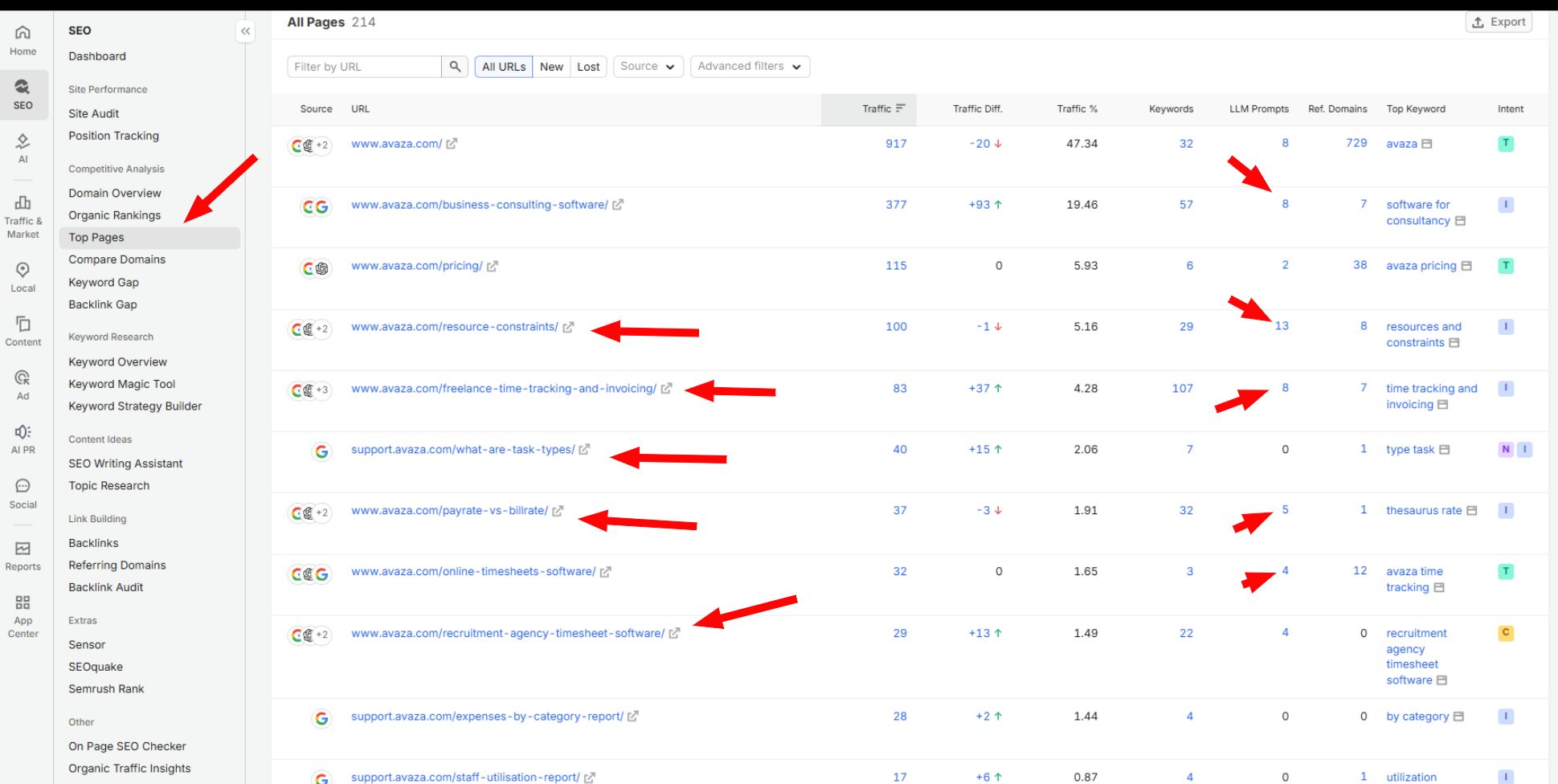
The most-cited individual pages, from the Semrush cited-pages export with worldwide prompt counts summed, are /collaboration-project-management-tools/ (39), /project-documentation/ (29), /time-management-in-project-management/ (27), /work-breakdown-structure/ (26), /calculating-hours-worked/ (22), and /freelance-time-tracking-and-invoicing/ (21).
Every one is a TRM-delivered page, and every one is a Decision Block-built, corridor-connected asset of the type described above. Geographically, 70% of mentions originate in the United States, with Australia (7.8%) and Canada (4.4%) following, which matches Avaza's target markets.
One honesty note, because credible measurement demands it. Domain-level citation counts in any tracking tool fluctuate as prompt panels evolve, so this study anchors on share and depth (77% ownership, 54 of 58 pages cited) rather than on raw count trends. Share of a moving total is the durable claim.
On the platform trend that is measurable, Avaza's ChatGPT visibility score moved up 2 points and AI Overviews up 1 point in the current period.
Proof Layer 2: 1.1M Google Impressions in 90 Days
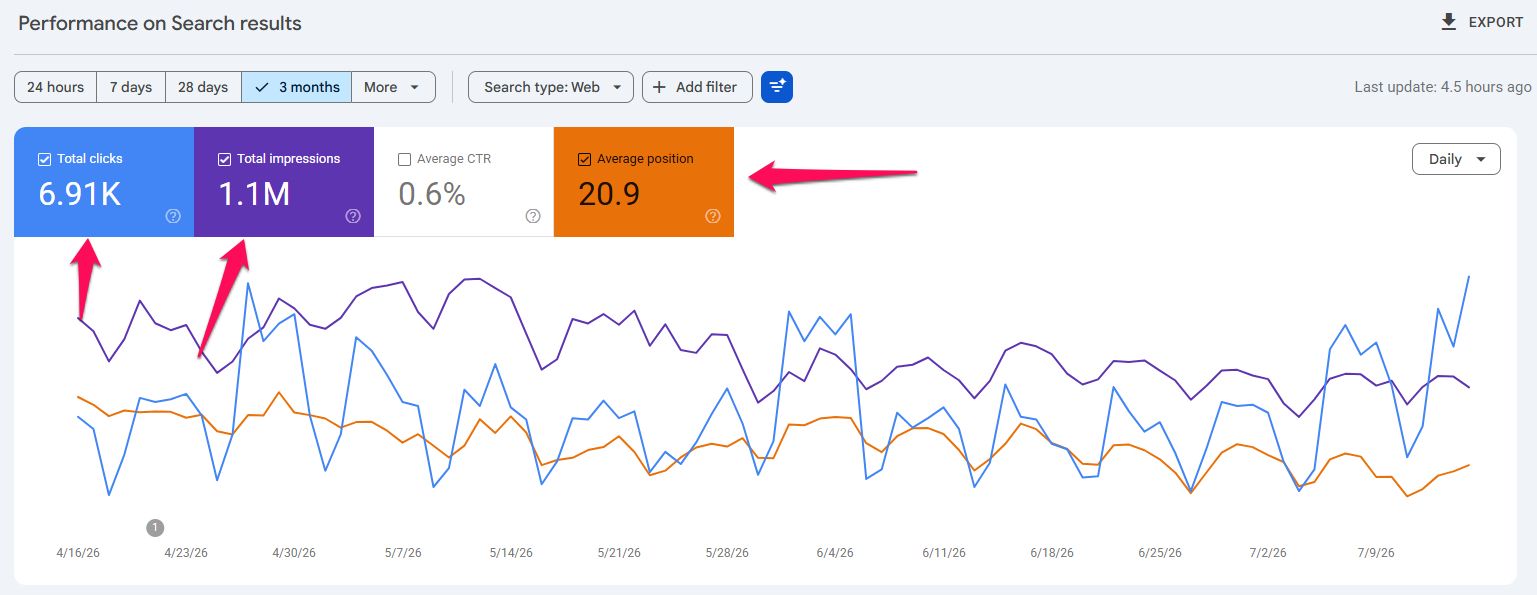
Google Search Console for the last three months shows the 58 TRM pages earned 1,516 clicks and 1,104,434 impressions, i.e., 79.2% of the domain's non-homepage impressions. Coverage is the corridor thesis made visible in Google's own reporting:
| GSC Metric (Last 3 Months, Web) | TRM's 58 Pages | Context |
|---|---|---|
| Impressions | 1,104,434 | 76.5% of all site impressions, 79.2% excluding the homepage |
| Clicks | 1,516 | 57.9% of all non-homepage clicks |
| Pages appearing in GSC | 58 of 58 | Full delivery footprint is search-visible |
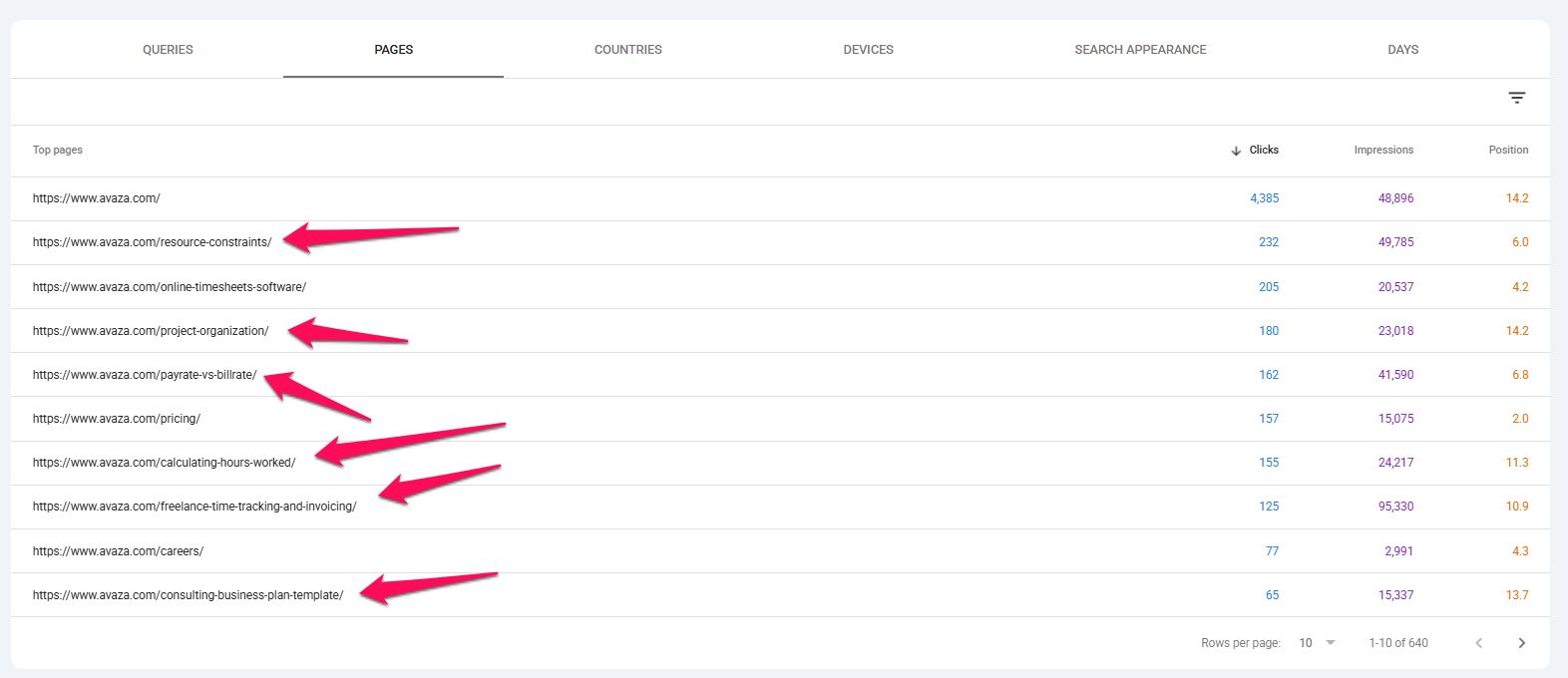
The click leaders are the same pages the AI engines cite. /resource-constraints/ earned 240 clicks on 107,763 impressions, /project-organization/ 185 clicks, /payrate-vs-billrate/ 174, /calculating-hours-worked/ 155, and /freelance-time-tracking-and-invoicing/ 130 clicks on a category-leading 134,583 impressions.
That overlap between the GSC leaderboard and the citation leaderboard is not a coincidence. It is the same structural quality being rewarded by two different retrieval systems.
The non-branded query positions show the pages winning question-shaped searches, which are precisely the searches answer engines expand from:
| Non-Branded Query | Average Position | Owning Page |
|---|---|---|
| "resource constraints" | 2.3 | /resource-constraints/ |
| "what is bill rate and pay rate" | 1.3 | /payrate-vs-billrate/ |
| "project organization" | 4.6 | /project-organization/ |
| "best time tracking and invoicing software for freelancers" | 3.3 | /freelance-time-tracking-and-invoicing/ |
Semrush's U.S. organic data adds the fusion view. The 52 TRM pages in the U.S. export hold 1,270 of the domain's 1,773 tracked organic keyword positions (72%), and 50 of those 52 pages also surface inside answer engines (Google AI, SearchGPT, Gemini), carrying 233 of the domain's 298 U.S. LLM prompts (78%).
One content system, two discovery layers, the same pages winning both, which is the operating premise of the analytics work we publish on TRM Insights.
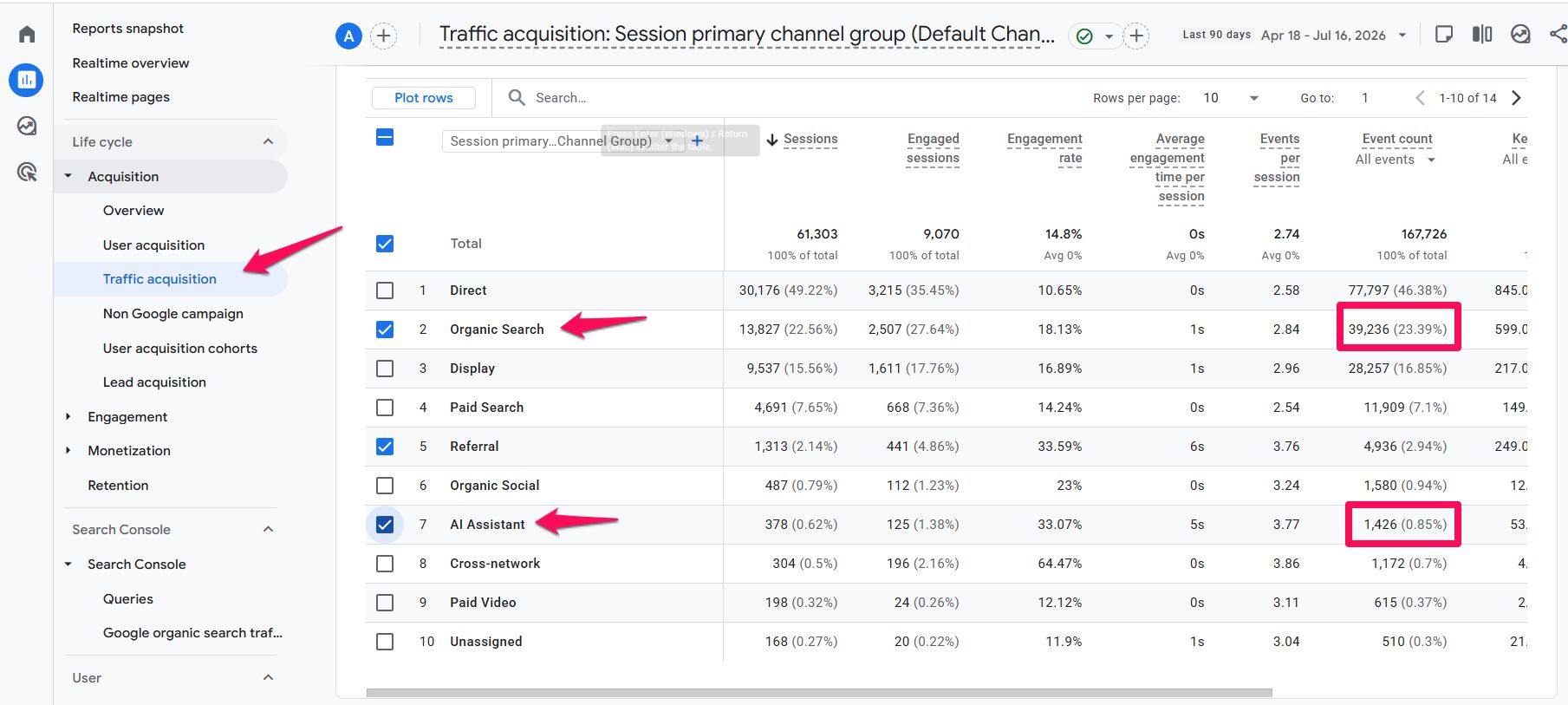
Proof Layer 3: AI Visitors Engaged 3x Harder Than Direct Traffic
GA4's channel data for April 16 to July 14, 2026 shows Avaza's AI Assistant channel engaging at 31.9%, versus 10.8% for direct and 17.8% for organic search.
The quality signal in full:
| GA4 Channel (Apr 16 to Jul 14, 2026) | Sessions | Engagement Rate |
|---|---|---|
| AI Assistant | 342 | 31.9% |
| Organic Search | 13,827 | 17.8% |
| Direct | 29,502 | 10.8% |
| Paid Search | 4,705 | 14.1% |
Transparency note, stated up front: Avaza's single largest AI landing page in this window was a careers listing that job applicants researched through ChatGPT. Every buyer-behavior claim in this section excludes careers-page sessions, because a case study that quietly counts job seekers as demand is not a case study worth reading.
With that exclusion applied, the buyer-side pattern holds. In the source-level view, ChatGPT drove 426 of 477 AI-referred sessions (89%), with Gemini, Copilot, Perplexity, and Claude splitting the remainder, a concentration profile that mirrors the Conductor benchmark cited earlier.
And the AI sessions that reached TRM pages landed deep in decision-formation content rather than on the homepage, led by /work-breakdown-structure/ (13 sessions), /freelance-time-tracking-and-invoicing/, /consulting-business-plan-template/, /risk-identification-techniques/, and /project-cost-estimation/.
Those are the pages a buyer reads immediately before shortlisting tools, which is exactly where a PSA brand wants its AI-referred visitors to start.
Across all channels, the 58 pages generated 3,667 sessions and 4,038 pageviews in the window, with organic search contributing 1,901 of those sessions.
The AI slice is the smallest of the three proof layers by volume and the most concentrated by intent, which matches every external benchmark in this study.
Executing this well, i.e., building pages that hold up simultaneously in Google rankings, AI citations, and buyer engagement, is exactly the gap The Rank Masters closes for B2B SaaS teams, through an ICP-led content system that maps each topic cluster to a money page and to pipeline rather than publishing posts that never convert.
Proof Layer 4: Signups That Started on a TRM-Written Page
GA4's landing-page-attributed events show 17 new free-account signups in 90 days from sessions that began on a TRM-written page, alongside 17 create_a_free_account events and 36 signup-page views.
The attribution framing matters and deserves precision. Conversion events fire on Avaza's signup flow, not on blog URLs, so the honest lens is landing-page attribution, namely "which page started the session that ended in a signup."
By that lens, the funnel from delivered content reads:
| Conversion Signal (Sessions Landing on TRM Pages, 90 Days) | Count |
|---|---|
| view_signup_page events | 36 |
| create_a_free_account events | 17 |
| NewSignup events (completed free accounts) | 17 |
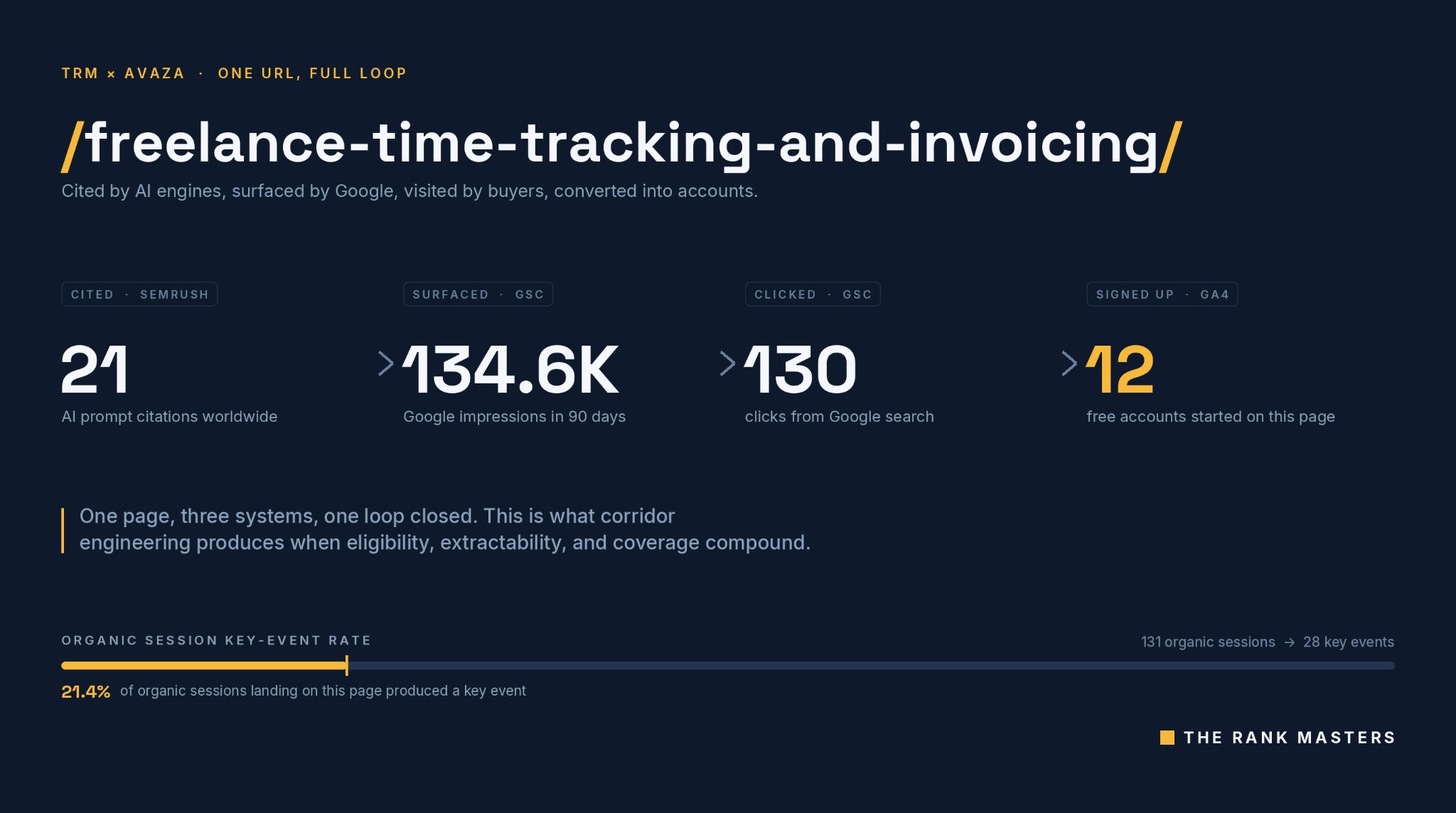
One page closes the entire loop of this case study by itself. /freelance-time-tracking-and-invoicing/ is simultaneously a top AI-cited page (21 worldwide prompt citations), a top search performer (130 clicks on 134,583 impressions), and the top converter, producing 12 of the 17 signups.
On organic traffic alone it recorded 131 sessions and 28 key events, a 21.4% session key-event rate. Cited by the engines, surfaced by Google, visited by pre-qualified buyers, converted into accounts, all through a single URL built on the framework described above.
For a program measured in 90-day windows, 17 attributed signups from content-started sessions is a directional pipeline signal rather than a victory lap, and we present it as exactly that. The pattern it confirms is the one that matters, i.e., AI-era discovery enters through problem-solving pages and exits through the product funnel, so the pages TRM shipped are now the front door of Avaza's organic acquisition.
Teams that want the scope conversation before a call can review the full TRM case studies library or reach us through the contact page.
The Repeatable AI Visibility Playbook for SaaS Teams
The Avaza playbook is a five-step system any B2B SaaS team can copy, and each step exists to produce a measurable condition rather than a deliverable. The operating sequence:
| Step | Action | Condition It Produces |
|---|---|---|
| 1 | Mine converting-term intelligence to pick money corridors | Topics chosen by revenue signal, not editorial instinct |
| 2 | Build ownership pages engineered for rankings and prompts together | One asset eligible in both discovery layers |
| 3 | Install Decision Blocks at every high-intent moment | Citation-ready chunks engines can safely borrow |
| 4 | Expand each page into a connected corridor | Repeatable retrieval across fan-out sub-questions |
| 5 | Measure citations, coverage, engagement, and attributed signups | Proof at every layer of the funnel, not just traffic |
Step 1 prevents the most expensive content mistake, namely writing what feels interesting instead of what sells. Steps 2 and 3 are where the craft lives, and the get-cited framework documents both in depth. Step 4 converts single wins into durable presence. Step 5 is the discipline that makes the other four accountable, and it gets its own section next because most teams measure the wrong things.
Two cadence notes from the Avaza engagement worth stealing. First, ship corridors, not calendar posts, because a half-built corridor is retrievable at half the fan-out points. Second, requalify the four uncited pages each quarter rather than rewriting them on instinct, since citation lag is normal for newer corridor members and premature rewrites destroy accumulating signals.
Which KPIs Prove AI Visibility Is Actually Working?
Four KPI families prove an AI visibility program is working, and together they cover the funnel from retrieval to revenue. The measurement standard this case study itself follows:
| KPI Family | Primary Metrics | Avaza Benchmark From This Study |
|---|---|---|
| Citation ownership | Share of domain citations from program pages, % of delivered pages cited | 76.8% ownership, 93% of pages cited |
| Search coverage | Impression share, non-branded positions, keyword footprint | 79.2% of non-homepage impressions, 72% of U.S. keyword positions |
| Visitor quality | AI channel engagement rate vs direct and organic | 31.9% vs 10.8% direct |
| Attributed conversion | Landing-page-attributed signups and key events | 17 signups from content-started sessions |
Two anti-metrics deserve equal attention. Raw domain citation counts fluctuate with tracking-panel changes, so trend claims built on them collapse under scrutiny, which is why share and depth anchor this study. And unsegmented AI session counts mislead in both directions, because they hide non-buyer traffic (like the careers sessions excluded above) while undercounting AI influence that arrives untagged as direct. A reporting stack built on the four families in the table survives a skeptical CFO. One built on "our mentions went up" does not.
The reporting-focused work on TRM Insights expands on building that stack, and our AI visibility tracking tools SEO and GEO services page covers the tooling layer beneath it.
What Is AI Visibility for a SaaS Brand?
AI visibility is how often and how prominently a SaaS brand appears inside AI-generated answers, measured through two distinct units, namely mentions of the brand and citations of specific URLs.
The distinction matters because the two units behave differently and reward different work:
| Visibility Unit | What It Measures | What Earns It |
|---|---|---|
| Mention | The brand name appearing in an AI answer's text | Brand authority, consistent positioning, presence in training and retrieval sources |
| Citation | A specific URL linked or referenced as a source | Page-level extractability, clean structure, quotable chunks |
| Cited page | A unique URL that has earned at least one citation | Coverage across the buyer's full question space |
Most SaaS teams track mentions because mentions flatter the brand. Citations are the harder currency, because a citation means the answer engine retrieved a specific page, judged the chunk trustworthy, and attached it to the response a buyer reads.
Our guide to getting cited in AI answers covers the full mention-versus-citation mechanics, and the TRM SEO glossary defines the surrounding terminology.
This case study is deliberately citation-first. Anyone can claim their client "gets mentioned by ChatGPT." We are going to show, page by page, that the specific URLs we wrote are the URLs the engines cite.
Why the SaaS Buyer Journey Moved Into Answer Engines
SaaS buyers now form shortlists inside AI answers before they ever click a website, which makes citation presence the new gatekeeper for discovery. The behavioral data behind that shift is stark.
The Benchmark: According to a July 2025 Pew Research Center analysis of 900 U.S. adults' real browsing behavior, users clicked a traditional result link in only 8% of visits when an AI summary appeared, versus 15% without one.
Operational Impact: Day to day, informational clicks that used to reach your blog are being absorbed by the answer layer. Strategically, the brands named and cited inside that layer inherit the trust the click used to build.
The referral side of the equation is small but concentrated.
Conductor's 2026 AEO/GEO Benchmarks Report, which analyzed 13,770 domains across 10 industries, found AI referral traffic averaging 1.08% of total website traffic, with the IT sector already at 2.8% and ChatGPT driving 87.4% of all AI referrals.
For a B2B SaaS content strategy, those two numbers say the same thing from two directions. The volume is early, the concentration is real, and the shortlist is being written right now.
The consequence for a PSA software brand like Avaza is binary. Either your pages are the retrieved sources when a buyer asks "what are the best tools for project budget management," or a competitor's pages are.
There is no neutral outcome in an answer-first funnel, a dynamic we unpack across the AI visibility category on TRM Insights.
The Growth Plateau Mature SaaS Companies Quietly Hit
Avaza's starting point was not failure but the plateau that hits most mature SaaS products, i.e., healthy retention and branded traffic paired with weak new-question discovery. That profile shows up constantly in PSA and project management SaaS:
- Retention looks strong: Existing users keep logging in, so branded and direct traffic stay healthy.
- Paid fills the gaps: Acquisition targets get hit by buying demand, which quietly turns growth into a rental agreement.
- Organic discovery stalls: The brand is not the default answer for the new questions its next customers are asking.
- The answer layer compounds the problem: As AI summaries absorb informational clicks, a brand absent from citations loses even the impression it used to get.
The math of that trap has changed in the AI era. In the old model, weak organic discovery could be papered over with ad spend. In the new model, absence from AI answers means absence from the shortlist itself, so paid has to carry discovery, consideration, and conversion alone, forever, at rising CPCs.
Avaza's leadership recognized the pattern early, which is why the engagement brief was never "publish more blog posts." It was to make Avaza retrievable, quotable, and repeatedly cited across the exact question space its buyers occupy.
Does AI Search Traffic Convert Better Than Organic Search?
Yes, across every major 2025 and 2026 dataset, AI-referred visitors convert at a multiple of organic search visitors because the answer engine pre-qualifies intent before the click. The external evidence:
| Study (Year) | Finding | Scope |
|---|---|---|
| Semrush AI search study (July 2025) | Average LLM visitor is 4.4x as valuable as the average traditional organic visitor, based on conversion rate | 500+ high-value topics translated into search terms and prompts |
| Seer Interactive case study (June 2025) | ChatGPT referrals converted at 15.9% versus 1.76% for Google organic | One B2B client, Oct 2024 to Apr 2025 |
| WebFX generative AI traffic study (updated March 2026) | Generative AI traffic grew 796% across 2024 to 2025 and converted at a higher rate than any other free channel | 2.3 billion sessions, Jan 2024 to Dec 2025 |
The mechanism is consistent across all three datasets. By the time an AI-referred visitor lands, the comparison work already happened inside the conversation, so the click is a decision signal rather than a research signal.
That is precisely why this case study measures engagement rate and landing-page-attributed signups rather than raw session counts, and it is why Avaza's own GA4 numbers, covered in Proof Layer 3 below, mirror the external benchmarks.
How Do AI Engines Choose Which Pages to Cite?
AI engines cite pages that are retrievable, chunkable, and scoped tightly to the sub-question being answered, which is a different selection logic than classic ranking algorithms. Four properties dominate:
- Retrievability: The crawler must fetch clean HTML fast. Pages that hide their core answer behind JavaScript rendering or bloated markup get skipped before evaluation even starts.
- Chunk quality: Engines lift 200-to-500-token passages, so a self-contained block that names the entity, states the answer, and carries a concrete figure wins over an elegant essay.
- Question scope: A page mapped to one specific buyer sub-question outperforms a broad page that gestures at ten.
- Corroboration: Claims anchored in named data and consistent entity descriptions are safer for the engine to reuse, so they get reused.
Notice what is absent from that list, namely a strict dependence on top-3 Google rankings. Ranking helps retrieval, and Avaza's pages do rank, but citation selection happens at chunk level.
This is the core thesis of our AI answers visibility framework, and it is why the build described next optimizes pages as answer inventory rather than as ranking assets alone.
The TRM Framework: Eligibility, Extractability, Authority, Coverage
TRM's framework wins citations by engineering four conditions in sequence, because each condition is a prerequisite for the one after it. This is the system we ran for Avaza:
| Framework Stage | The Condition It Creates | Failure Mode It Prevents |
|---|---|---|
| Eligibility | Pages are crawlable, indexable, and structurally clean for retrieval systems | Content that is functionally invisible to answer engines |
| Extractability | Every page carries quotable, self-contained answer chunks | Pages that get retrieved but never quoted |
| Authority | Claims are grounded, consistent, and safe for an engine to repeat | Chunks that engines skip as risky or unverifiable |
| Coverage | A connected corridor of pages spans the buyer's full question space | One-off wins that never become repeatable presence |
Eligibility is the harshest layer because it is binary. A brilliant article the retrieval system cannot cleanly fetch and parse does not exist to the answer engine.
So the Avaza build started unglamorously, with question-shaped headings, front-loaded answers, and content segmented into blocks a parser can isolate without guesswork.
Extractability is where most competitors fail, because they optimize for readers who scroll while engines reward chunks that stand alone.
Authority and coverage then convert isolated wins into a durable position, which the next two sections break down in practice. For teams comparing approaches, our answer engine optimization service page describes how the four stages map to deliverables.
How Decision Blocks Turn Blog Posts Into Citation Assets
A Decision Block is an on-page module that packages one buyer decision into a bounded, structured, attributable chunk, which is exactly the shape answer engines prefer to borrow. Think about what an assistant is doing when it composes an answer. It is reducing risk. It wants sources that are unambiguous, scoped to the question, and easy to attribute. Decision Blocks deliver that by combining:
- A tight direct answer: One or two sentences that resolve the sub-question without preamble.
- Decision criteria or a matrix: The factors a buyer actually weighs, laid out as structured data.
- Best-for and not-for context: Explicit fit statements that let the engine match the chunk to a specific asker.
- Sequenced steps or checklist logic: Procedures the engine can compress without distortion.
- Grounded specifics: Named figures and defined terms that signal the chunk is safe to repeat.
Across Avaza's 58 pages, every high-intent section got this treatment.
The result reads "boring" to a traditional marketer and irresistible to a retrieval system, and the citation data in Proof Layer 1 shows which instinct the engines rewarded.
The deeper pattern library behind this module lives in our framework for getting cited across AI Overviews, AI Mode, and ChatGPT-style engines.
Why Keyword Corridors Beat One-Off Money Pages in AI Search
Keyword corridors win because answer engines expand a single prompt into a fan of related sub-questions, and a connected set of pages can be retrieved across that entire fan. One isolated page might earn one citation once. A corridor earns citations repeatedly, across dozens of adjacent prompts, in multiple countries, on multiple platforms.
A corridor in the Avaza build looks like this in miniature:
- The operational anchor: /project-budget-management/ answers the core discipline question.
- The adjacent mechanics: /project-cost-estimation/, /project-cost-tracking-software/, and /how-to-measure-project-profitability/ each own one neighboring sub-question.
- The connective tissue: Internal links tie the cluster together so topical authority reinforces every member.
When a buyer asks an assistant "how do you choose between different project scheduling tools for a software project," the engine fans out into budgeting, resourcing, scheduling, and tracking sub-questions.
A brand with corridor coverage gets retrieved at several points in that fan-out, which is how a single answer ends up citing the same domain more than once.
This is distribution engineering, not content marketing, and it is the structural reason the coverage numbers in Proof Layers 1 and 2 concentrate so heavily on the delivered pages.
Related corridor economics for adjacent verticals are covered in our time tracking SaaS SEO services breakdown.
Frequently Asked Questions
How Much AI Referral Traffic Can a SaaS Website Realistically Expect?
How Do You Track AI Traffic in GA4?
Do You Need to Rank Number One in Google to Get Cited by ChatGPT?
What Is the Difference Between an AI Mention and an AI Citation?
How Long Does It Take for New Pages to Get Cited in AI Answers?
Why Do AI Search Visitors Convert Better Than Organic Visitors?
Is AI Referral Traffic Too Small to Matter for SaaS Pipeline?
What the Avaza Case Study Means for Your SaaS Brand in 2026
The lesson of this case study is that AI visibility is engineered at page level, and the brands that engineer it early become the default sources answer engines keep reusing. Avaza did not win 77% citation ownership by publishing more. It won by making 58 specific pages the safest possible sources for the exact questions its buyers ask, then letting three independent measurement systems verify the result.
The land-grab framing is not rhetoric, it is retrieval mechanics. Once an engine repeatedly resolves a question space through a given set of sources, displacing those sources requires beating them on every property that earned the position, i.e., eligibility, extractability, authority, and coverage, simultaneously. Every quarter a SaaS brand waits, its competitors' pages accumulate exactly the reuse signals that make displacement harder. The window where citation slots in most B2B software niches remain winnable is open now and will not stay open.
In 2026, you do not win by publishing. You win by becoming the source.
Before you can engineer citations, you have to be able to see them. The 76.8% ownership figure in this study only exists because the citation layer was instrumented from day one. If you are starting from zero visibility into which prompts name your pages, set up AI visibility tracking in Semrush and take a baseline this month — you cannot prove a lift against a number you never captured.
If thin AI visibility is costing you shortlist presence and pipeline, book a SaaS content strategy call and we will map your highest-intent question space to the pages that can own it.
📑 Disclosure!
Some links in this article are affiliate links. If you sign up through them, The Rank Masters may earn a commission at no additional cost to you. This does not influence which tools we recommend or what we say about them.