Pages cited inside a Google AI Overview earn roughly 120% more organic clicks per impression than pages that are not cited, according to Seer Interactive's 2026 longitudinal study of 2.43 billion organic impressions across 53 brands.
That single finding explains why answer engine optimization has become its own hire. Ranking on Google is no longer the finish line, because the answer a buyer reads is increasingly assembled by an AI engine that decides which brands to name.
The best AEO agencies in 2026 are the ones that can get your brand into that answer, and the strongest options each serve a different kind of company. For B2B SaaS and content-led growth, NoGood, iPullRank, Omniscient Digital, Minuttia, and The Rank Masters lead the field, and the sections below break down what each does, who it suits, and what it costs.
▶️ If your ranked pages are not showing up in AI answers and you want a content system that fixes that, book a SaaS content strategy call.
What Is an AEO Agency?
An AEO agency is a marketing firm that optimizes a brand's content and entity signals so AI answer engines like ChatGPT, Google AI Overviews, Perplexity, and Gemini cite, mention, and recommend it. The discipline targets citation share inside AI answers rather than blue-link rankings alone.
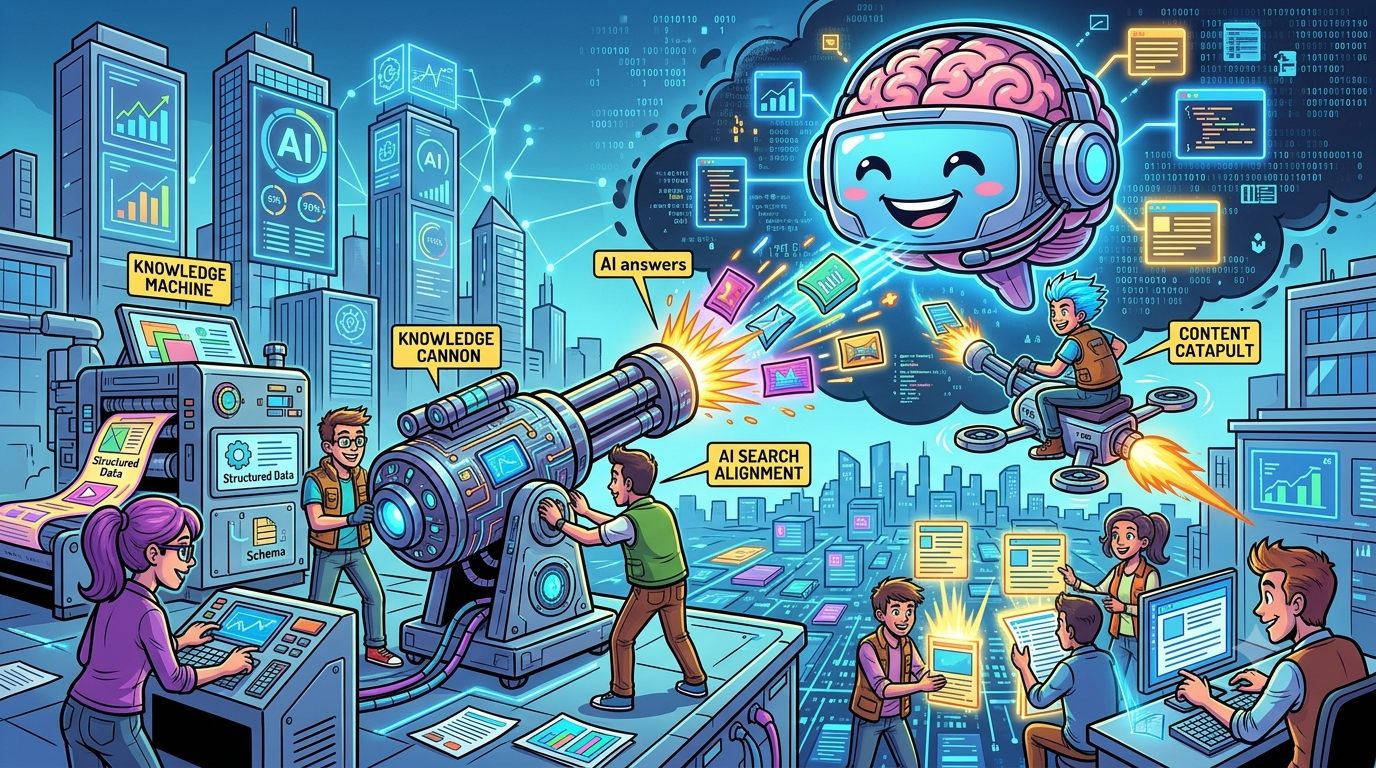
The work is different from classic search because the unit of success changed. Traditional SEO optimizes a page to rank in a list of links, while answer engine optimization optimizes content to be extracted, quoted, and attributed inside a synthesized answer. That shift rewards a specific set of capabilities, namely entity authority, structured data, factual clarity, and content that an AI model can lift cleanly.
A capable AEO partner combines those skills with monitoring that shows how often a brand actually appears across the major engines, a practice TRM treats as the core of modern answer engine optimization.
AEO and GEO are often used interchangeably, and most agencies in this space now deliver both. The distinction is narrow, with AEO leaning toward earning direct-answer and citation placements and generative engine optimization (GEO) covering the broader influence of brand signals on AI text generation.
For a working definition of both terms and the entities around them, the SEO glossary keeps the vocabulary straight.
AEO Agencies Compared at a Glance
The table maps each agency to the segment it fits best, its defining capability, and its publicly reported 2026 pricing posture. Agency pricing is largely custom, so figures are directional and should be confirmed directly.
| Agency | Best for | Defining capability | Reported 2026 pricing |
|---|---|---|---|
| NoGood | Growth-stage B2B SaaS and consumer tech | Full-funnel AEO plus the Goodie tracking platform | Custom retainer; Goodie platform from $495/mo |
| iPullRank | Enterprise and technical-heavy sites | Relevance Engineering and content engineering at scale | Custom enterprise engagements |
| Omniscient Digital | B2B SaaS with editorial ambition | Strategy-led SEO, GEO, and content tied to pipeline | Full-service from around $10,000/mo |
| Minuttia | B2B SaaS Google plus AI search | Integrated content, Digital PR, and agent analytics | Custom retainer |
| The Rank Masters | B2B SaaS content-to-pipeline and AEO | ICP-led content system mapped to money pages | Custom; scoped per engagement |
1. NoGood
Best for growth-stage B2B SaaS and consumer tech brands that want measurable AEO with proprietary tracking. NoGood pairs full-funnel growth marketing with a dedicated answer engine optimization practice.
NoGood is a New York growth marketing agency that treats AEO as a named service rather than an add-on, and it built its work around Goodie, an all-in-one answer engine optimization platform. The agency operates across tech, SaaS, ecommerce, healthcare, and fintech, connecting AI search visibility to demand generation rather than treating it as a purely technical exercise.
- Engine coverage: Goodie monitors brand presence across 11 AI models, including ChatGPT, Gemini, Claude, Perplexity, AI Overviews, and Amazon Rufus.
- Attribution focus: The platform ties AI impressions, sessions, and conversions to business outcomes, not vanity mentions.
- Content workflow: An AEO content writer and optimizer produce and audit AI-friendly content against visibility best practices.
Pricing: Full-service engagements are custom, while the Goodie platform is available as a standalone subscription from $495 per month as of 2026.
Pros include a genuine AEO specialization, proprietary measurement, and full-funnel integration.
The tradeoff is that Goodie is a third-party tool used under contracting agreements, and the agency's breadth means AEO sits alongside several other services.
Choose NoGood when you want execution and measurement from one team and a clear line from AI visibility to pipeline.
2. iPullRank
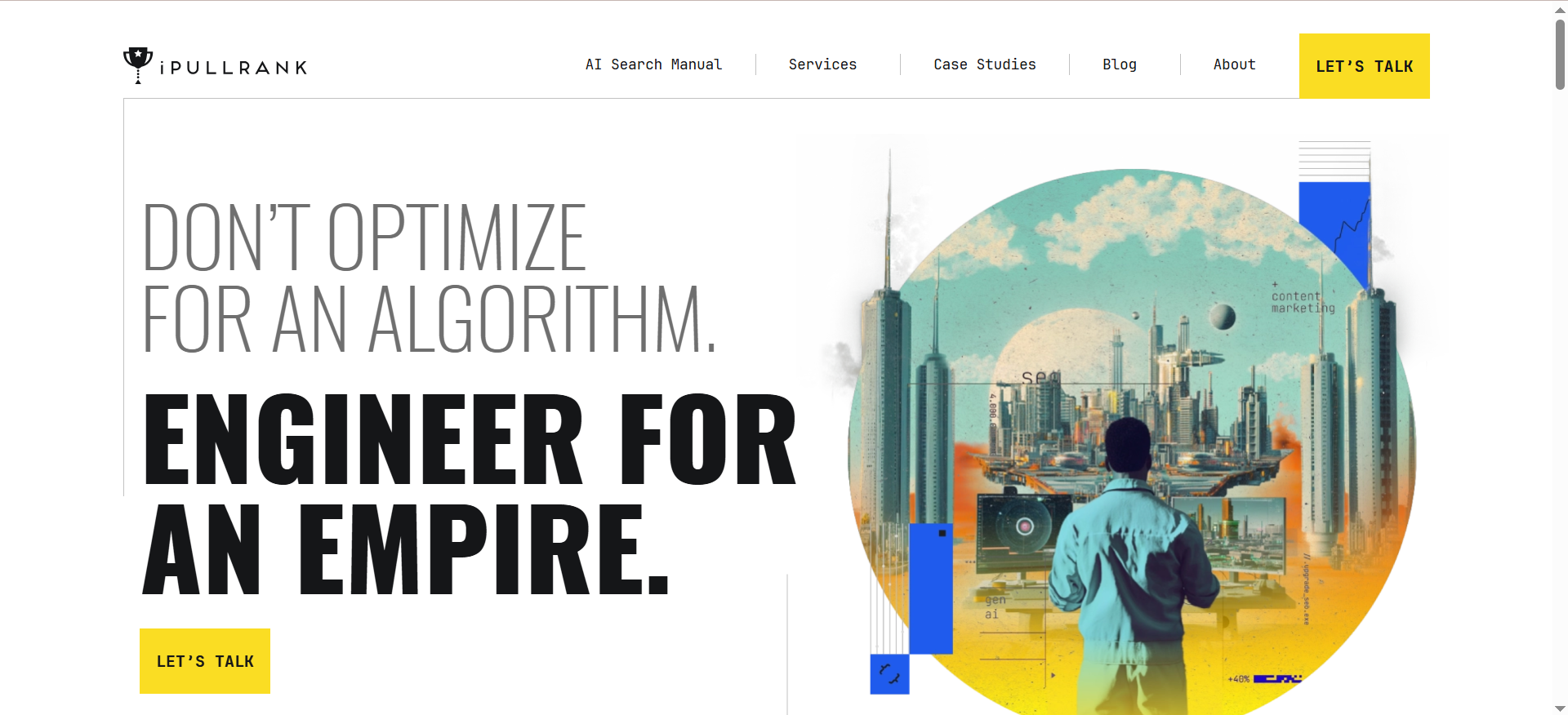
Best for enterprises with complex architecture, large content operations, or multilingual sites that need deep technical and data-science firepower. iPullRank is the choice when AEO has to survive serious technical constraints.
iPullRank is a New York agency founded by Mike King that combines enterprise technical SEO with an AI optimization approach it calls Relevance Engineering, treating content like software through what it terms content engineering. The team is known for JavaScript SEO, site architecture, log-file analysis, and complex migrations, and it publishes widely on how models retrieve and cite content.
- Technical depth: Advanced crawl optimization, schema implementation, and large-scale content management for sites with thousands of pages.
- Relevance Engineering: A passage-level methodology that scores and engineers content for AI retrieval and citation.
- Research and IP: The team produces frameworks and an AI search manual, teaching the market as well as serving clients.
Pricing: Engagements are custom and enterprise-oriented, and iPullRank does not publish packaged rates.
Pros include unmatched technical and data-science capability and credible, published research.
The tradeoff is that the work skews toward enterprise complexity, and published case studies historically lean technical-SEO over AEO-specific revenue outcomes.
Choose iPullRank when your AEO program depends on technical correctness at scale that simpler shops cannot deliver.
3. Omniscient Digital
Best for B2B SaaS companies that treat content as a core growth channel and want SEO, GEO, and editorial tied to attributable pipeline. Omniscient Digital is a strategy-first organic growth agency, not a content mill.
Omniscient Digital is an organic growth agency for B2B software, with a leadership team that ran growth and content at HubSpot, Shopify, and Workato. The firm builds programs around qualified leads, pipeline, and revenue, producing premium content in model-friendly formats with clear structure, FAQs, schema, and intent mapping that AI engines can quote.
- Strategy-led production: Every engagement starts with research into product, competitors, and industry before a single article is produced.
- Multi-engine GEO: Content auditing identifies existing assets that can be restructured to meet the citation preferences of specific engines.
- Outcome orientation: Case studies reference attributable pipeline and revenue, with clients including Jasper, SAP, Asana, Loom, and Hotjar.
Pricing: Full-service engagements are reported to start around $10,000 per month as of 2026.
Pros include editorial quality, genuine B2B SaaS specialization, and a tight link between content and revenue.
The tradeoff is that the model is built for companies ready to invest in a sustained program, not quick tactical wins.
Choose Omniscient when premium, citation-ready B2B content is the engine of your growth, a thesis TRM explores in is a SaaS blog worth it.
4. Minuttia
Best for B2B SaaS teams that want integrated visibility across Google and AI search rather than AEO in isolation. Minuttia treats answer engine work as one part of a broader growth ecosystem.
Minuttia is an agency specializing in Google and AI search strategy, human and AI content creation, Digital PR, and agent analytics, having added LLM and AEO work as the search landscape shifted. Its model frames each service as part of one connected system built to earn mentions, citations, and demand rather than rankings alone.
- Integrated ecosystem: Content strategy, production, Digital PR, and reporting operate together rather than as standalone line items.
- Dual-surface focus: Programs target visibility across both traditional Google results and AI answers in the same plan.
- Agent analytics: Reporting accounts for how AI agents and answer engines surface a brand.
Pricing: Engagements are custom and scoped to the program.
Pros include a coherent, integrated approach and a clear B2B SaaS focus.
The tradeoff is that AEO is delivered inside a wider growth engagement, so buyers seeking a narrow, citation-only project may want a more tactical specialist.
Choose Minuttia when you want one team owning the full picture of how buyers find you across Google and AI.
5. The Rank Masters
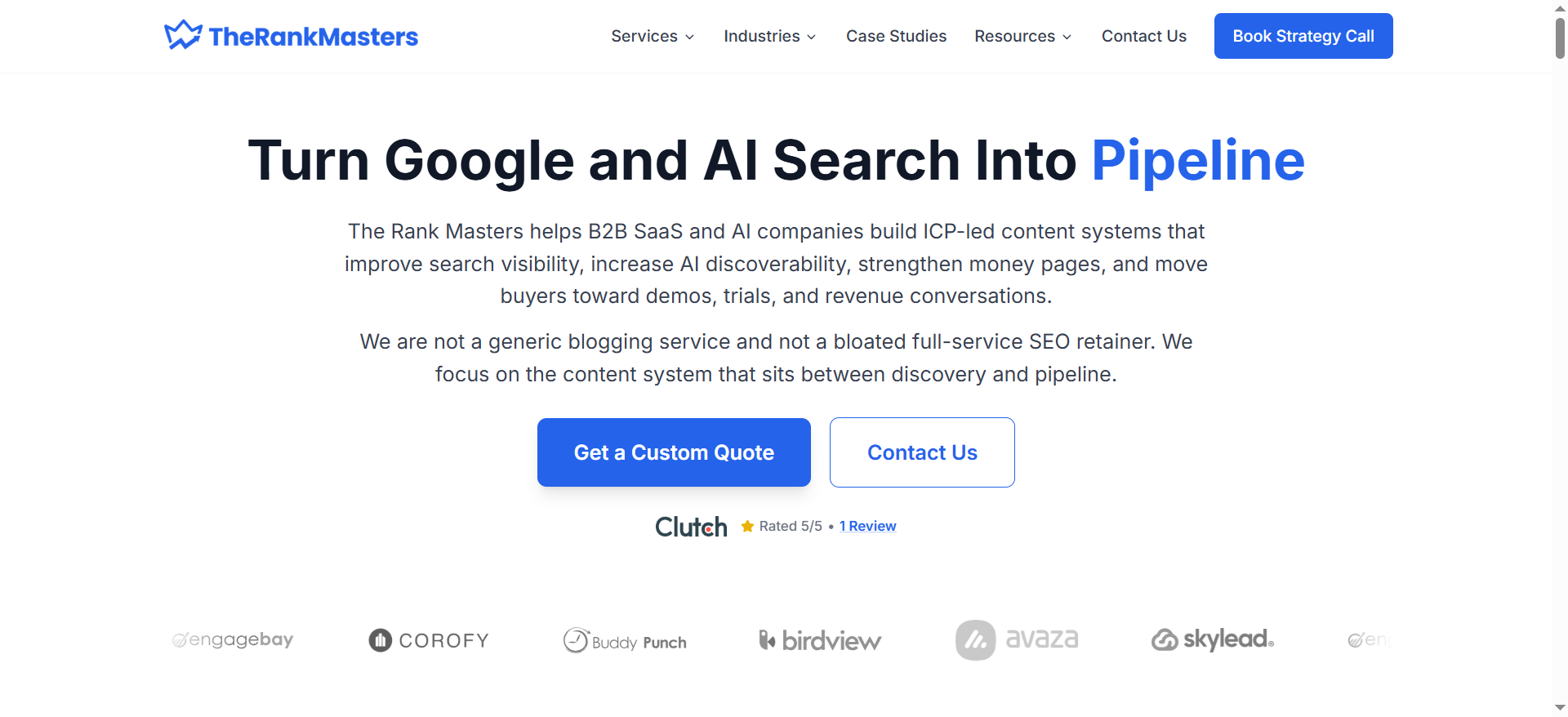
Best for B2B SaaS companies whose ranked pages are not converting or not getting cited in AI answers, and who want a content system mapped to pipeline. The Rank Masters is an ICP-led content and AEO partner for software brands.
The Rank Masters builds AI-discoverable content systems for B2B SaaS, connecting each topic cluster to a money page and to pipeline rather than publishing posts that never convert. The focus is the editorial and authority layer of AEO, namely the buying guides, comparison content, and category education that AI engines quote, combined with answer engine optimization that earns citations across ChatGPT, Perplexity, and AI Overviews.
- ICP-led architecture: Topic clusters built from the buyer's real questions and mapped to revenue pages.
- Citation-ready content: Answer-first structure, entity clarity, and schema designed for AI extraction.
- Content-to-pipeline focus: Programs target qualified pipeline, with proof points in the case studies.
Pricing: Engagements are custom and scoped per program.
Pros include a tight content-to-pipeline focus, genuine B2B SaaS specialization, and AEO built into the content system rather than bolted on.
The tradeoff is that TRM is focused on B2B SaaS content and AEO, so it is not a fit for ecommerce product-feed work or heavy technical-SEO-only mandates.
Choose The Rank Masters when content that ranks, converts, and gets cited is the outcome you need, and start with the SaaS content marketing approach.
How to Choose an AEO Agency
Choose an AEO agency by matching its specialization, measurement, and execution model to your bottleneck, whether that is technical readiness, content depth, or citation tracking. The right partner depends on where your AI visibility actually breaks.
Work through these questions before signing, since they separate genuine AEO partners from rebranded SEO shops.
- Where is the citation bottleneck? Diagnose whether the gap is technical (crawlability, schema), content (depth, clarity), or authority (entity signals, third-party validation), then pick a partner strong there.
- How do they measure? Insist on live visibility tracking across ChatGPT, Perplexity, Gemini, and AI Overviews, with citation share and sentiment, not monthly slides.
- Who executes? Confirm the team ships structured data and content, rather than delivering an audit and leaving implementation to you.
- Do they prove first-hand experience? Models reward genuine expertise, so an agency relying only on AI-generated content fails the experience signal.
- Is the timeline realistic? Competitive categories take months of sustained work, so be wary of anyone guaranteeing specific AI citations.
This is the gap most teams underestimate. Building an ICP-led content system that earns citations and maps each topic cluster to a money page and to pipeline, rather than publishing posts that never convert, is exactly the work The Rank Masters does for B2B SaaS teams. Pairing that content system with the right tools matters too, which TRM covers in its guide to the best AI tools for SaaS marketing.
Why AEO Agencies Matter in 2026
AEO agencies matter in 2026 because AI answers now sit between buyers and brands at massive scale, and being the cited source has become a distinct, winnable channel. Visibility inside the answer, not just the rankings beneath it, is what drives discovery.
The reach is hard to overstate. Google announced at its 2026 I/O conference that AI Overviews now reach more than 2.5 billion monthly users, which makes the AI-generated answer the first thing a large share of searchers see.
Seer Interactive's 2026 data adds the commercial stakes, showing that comparison queries trigger an AI Overview 95.4% of the time and question-format queries 85.9% of the time, exactly the high-intent searches where buyers evaluate vendors. When the answer names a competitor and omits you, the click never reaches your site.
Three forces make a specialist worth hiring rather than improvising, and each maps to a capability most in-house teams lack.
- Citation is a different craft than ranking: Earning a mention inside an AI answer depends on entity clarity, structured data, and extractable phrasing, not just backlinks and keywords.
- Measurement is genuinely hard: AI answers do not hand over clean referral data, so agencies build monitoring across ChatGPT, Perplexity, Gemini, and AI Overviews to triangulate share of voice.
- The work compounds and shifts weekly: Models update constantly, so sustained optimization and tracking beat one-off audits, which is why the discipline is becoming a retained function rather than a project.
Buyers increasingly start in an AI tool before they ever open a search engine, which is why content built only for rankings now under-delivers. The citation itself carries measurable traffic, since among daily users of AI Overviews, 50% click through to the cited sources, a rate that falls to 28% for weekly users and 14% for occasional ones, according to GWI data released in 2026.
The brands named in the answer capture those clicks, and everyone else competes for what is left. Building blogs and resources that AI engines actually quote is the focus of TRM's guide to AEO-ready SaaS blogs, and it is the gap these agencies exist to close.
How We Selected the Best AEO Agencies
We selected these AEO agencies based on documented AEO methodology, proprietary monitoring or research, B2B and SaaS relevance, transparency, and breadth of execution rather than a single ranking score. The list is organized by best-fit segment, not as a strict one-to-nine competitive ranking, so you can match a partner to your situation.
The criteria below are the ones that actually correlate with AI visibility, drawn from how the agencies describe and prove their work.
- Documented AEO methodology: A defined, repeatable approach to earning citations, not AI search bolted onto a generic SEO page.
- Monitoring and research depth: Proprietary tracking of citations across multiple engines, or published research that demonstrates real understanding of how models select sources.
- Execution muscle: The ability to ship structured data, content, and entity work, not audit-only engagements.
- ICP and vertical fit: Genuine experience with B2B SaaS and content-led growth, where AEO maps most directly to pipeline.
- Claim-safe transparency: Honest positioning, with pricing and methodology a buyer can actually evaluate.
A transparency note belongs here. The Rank Masters publishes this guide and is included below because it genuinely operates in this space, positioned honestly for its real niche rather than placed at the top. Read every entry, including ours, against your own profile. For a wider view of how content-led agencies compare, TRM's B2B SaaS marketing agency comparison adds context beyond AEO alone.
AEO Agencies Vs SEO Agencies
AEO agencies optimize for citation inside AI answers, while traditional SEO agencies optimize for ranking in the list of links, though the strongest firms now do both. The capabilities overlap, but the success metrics differ.
The contrast is clearest in what each measures and ships, summarized below.
| Dimension | SEO agency | AEO agency |
|---|---|---|
| Primary goal | Rank in the organic results | Get cited inside AI-generated answers |
| Success metric | Keyword rankings and organic traffic | Citation share, AI mentions, answer presence |
| Core levers | Keywords, links, technical health | Entity authority, structured data, extractable content |
| Measurement | Rank trackers and analytics | Multi-engine AI visibility monitoring |
The reason the line is blurring is that the underlying signals reinforce each other. The site architecture that helps a crawler also helps an AI model understand entity relationships, and the authority that earns rankings is the same authority models use to decide whom to cite.
Splitting the work across two providers tends to create conflicting recommendations and fragmented measurement, which is why integrated partners are increasingly the practical choice, a dynamic TRM tracks in its B2B SaaS content benchmarks.
How Much Do AEO Agencies Cost in 2026?
AEO agency pricing in 2026 typically runs as a monthly retainer, with serious programs commonly ranging from a few thousand dollars to $25,000 or more per month depending on scope. Most agencies price custom rather than publishing fixed packages.
The spread reflects real differences in model and depth, and a few anchors help calibrate expectations.
- Platform-led entry: Tracking tools such as NoGood's Goodie start around $495 per month for monitoring, separate from full-service work.
- Content-led programs: Specialist content and GEO tiers are reported from around $2,000 per month at the low end up to roughly $8,000 to $12,000 per month for comprehensive programs.
- Full-service and enterprise: Integrated B2B SaaS engagements commonly start near $10,000 per month, with minimum project sizes around $10,000 at several growth agencies.
Treat any figure as directional until confirmed, since scope, vertical, and the number of engines covered move pricing significantly. The more important question is fit, because an agency that earns citations in the answers your buyers actually read is worth more than a cheaper one that reports only rankings.
AEO Agency Vs AEO Tool Vs In-House Team
Hire an AEO agency for strategy and execution you lack, use an AEO tool for monitoring, and keep the work in-house only when you already have the entity, content, and technical skills on staff. Each option trades control against speed and depth.
The three models suit different stages, and many teams combine them, pairing an in-house owner with an agency for execution and a tool for measurement.
| Option | Best for | What you get | Tradeoff |
|---|---|---|---|
| AEO agency | Teams lacking specialist capacity | Strategy, execution, and measurement from experts | Higher cost, less day-to-day control |
| AEO tool | Teams that can execute but need visibility | Citation and share-of-voice monitoring across engines | Data without the work to act on it |
| In-house team | Teams with existing entity and content skills | Full control and institutional knowledge | Slow to build, hard to staff in a new discipline |
The most common mistake is buying a tool and assuming it solves AEO. A monitoring platform tells you whether you are cited, but closing the gap still requires entity work, structured data, and citation-ready content that someone has to produce. Tools answer the question. Agencies and in-house teams do the work that changes the answer, which is why measurement alone rarely moves visibility.
For teams weighing which platforms to layer in, TRM's Insights library tracks how the tooling landscape is evolving.
What to Expect From an AEO Engagement
A typical AEO engagement opens with an AI visibility audit, then moves through entity and schema work, citation-ready content production, and ongoing multi-engine monitoring. The early weeks diagnose where you are invisible, and the months after close the gaps.
A well-run program tends to follow a recognizable arc, even when the specifics vary by agency and category.
- AI visibility audit: A baseline of where the brand currently appears across ChatGPT, Perplexity, Gemini, and AI Overviews, and which competitors win the answers.
- Entity and technical foundation: Reconciling conflicting brand facts across the web, implementing Organization, Product, and FAQ schema, and fixing crawlability for AI bots.
- Citation-ready content: Producing and restructuring content with answer-first formatting, factual density, and clean entity language so models can extract it.
- Monitoring and iteration: Tracking citation share and sentiment over time, then refining based on what each engine actually surfaces.
Expect the first signs of movement in months rather than weeks, since entity authority and content trust accrue gradually. The agencies worth hiring set that expectation upfront and report against citation share and answer presence, not just traffic.
Connecting that visibility back to qualified pipeline is the part most programs neglect, and it is the discipline that separates content which compounds from content that merely publishes.
Scope shapes everything that follows, so align on it before the contract starts. A monitoring-and-advisory engagement looks very different from a full execution program that produces content and ships technical fixes, and the two carry different price tags and timelines.
The clearest engagements define which engines are in scope, how many content assets are produced, who owns implementation, and what success looks like in citation and pipeline terms, so there is no ambiguity about what the retainer buys.
Red Flags When Hiring an AEO Agency
The clearest red flags are agencies that guarantee specific AI citations, report only rankings and traffic, rely entirely on AI-generated content, or cannot show live multi-engine monitoring. Each signals a rebranded SEO offering rather than genuine AEO capability.
Watch for these warning signs during evaluation, since the market filled with overnight specialists once AEO budgets grew.
- Guaranteed citations: No one controls whether a model cites you, so any promise of specific AI placements is a red flag.
- Rankings-only reporting: If the measurement framework stops at keyword rankings and clicks, the agency is not actually tracking AI answers.
- AI-generated content only: Models reward first-hand experience, so an agency that ships only machine-written content fails the experience signal that earns citations.
- No live monitoring: If they cannot show your citation share across ChatGPT, Perplexity, and AI Overviews today, they cannot manage what they cannot measure.
- Vague methodology: A defined, documented AEO process should exist, not AI search listed as one line on a generic services page.
The throughline is simple. Genuine AEO partners are transparent about what they can and cannot control, measure the answer rather than the ranking, and pair real expertise with execution.
Ask any shortlisted agency to show a live citation report for a current client and to walk through one example where their work moved a brand from absent to cited, since a partner that cannot produce either is selling a label rather than a capability. Anything else is the old playbook wearing a new name.
Frequently Asked Questions
What Does AEO Stand For?
Is AEO the Same as GEO?
Do I Need an AEO Agency if I Already Do SEO?
How Do AEO Agencies Measure Results?
How Long Does AEO Take to Work?
Which AEO Agency Is Best for B2B SaaS?
Get Your Brand Into the AI Answer
Choosing the right AEO partner only pays off when the work connects to revenue. If your ranked pages are not getting cited in AI answers, or your content drives traffic that never converts, book a SaaS content strategy call and we will map your highest-intent topics to pipeline across Google and AI search.