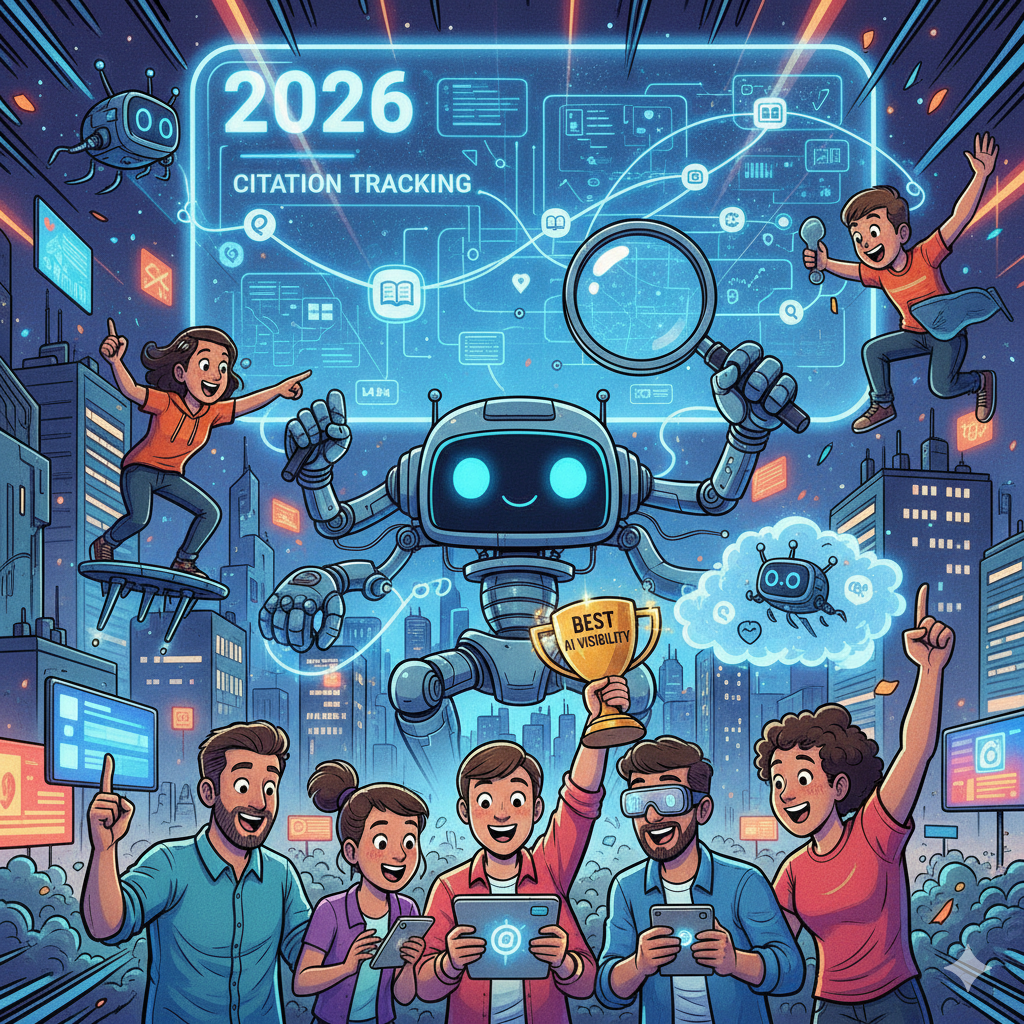

A 2025 Pew Research Center analysis of 900 US adults found that when an AI summary appeared in Google results, people clicked a traditional link just 8% of the time versus 15% without one, and clicked a citation inside the summary only 1% of the time.
The best enterprise GEO agencies do not chase AI mentions as a vanity metric. They engineer the entity signals, citation-ready structure, and original evidence that make answer engines such as ChatGPT, Google AI Overviews, Perplexity, and Gemini retrieve, cite, and recommend a brand to in-market buyers, then tie that visibility to pipeline.
Generative engine optimization, or GEO, is the discipline of shaping content and digital signals so AI systems surface your brand inside generated answers rather than ten blue links. For enterprises this is now a board-level concern, because the clicks that once flowed from informational search are being absorbed by AI summaries, and the question has shifted from where you rank to whether you are the source the model cites.
This guide ranks the agencies built to win that surface at enterprise scale, explains how to evaluate them, and shows where each one fits.
▶️ If your ranked pages are not showing up in AI answers and you want a content system that fixes that, book a SaaS content strategy call.
The Best Enterprise GEO Agencies at a Glance
The strongest enterprise GEO providers in 2026 are Conductor and BrightEdge for platform-led visibility at scale, iPullRank and Intero Digital for technical and relevance engineering, and First Page Sage, Omnius, and The Rank Masters for authority-led and SaaS-native GEO. The fuller shortlist below adds growth-integrated and editorial specialists.
- The Rank Masters: Best for B2B SaaS and AI companies that want a GEO-led content system mapped to pipeline.
- Conductor: Best for large enterprises that want GEO inside a mature content intelligence platform.
- iPullRank: Best for technically complex sites that must win classic rankings and AI citations together.
- BrightEdge: Best for enterprises that want AI visibility tracking and content optimization in one platform.
- Single Grain: Best for growth-stage and mid-market teams wanting GEO folded into integrated demand generation.
This list is organized by use case rather than ranked one through ten, because the right enterprise GEO partner depends on whether your constraint is platform tooling, technical depth, content authority, or pipeline attribution. The selection logic and full comparison table follow.
How We Selected and Ranked These GEO Agencies
These GEO providers were selected on four criteria, namely practical GEO execution, entity and technical depth, authority and content capability, and measurement maturity for AI-driven retrieval. Self-declared rankings were ignored in favor of demonstrable approach and fit.
The GEO market is noisy, and many roundups place the publishing agency at the top of its own list, so credibility had to be earned through method rather than claims.
The agencies here show real capability across the levers that determine AI citation, namely entity optimization, structured data, authoritative evidence-backed content, and performance measurement built for retrieval and synthesis rather than rankings alone.
Source quality and the queries an engine actually runs matter more than raw output, which is why content engineered for extraction outperforms volume. The vocabulary that recurs across these engagements, from entity to retrieval-augmented generation, is mapped in the SEO glossary for teams aligning stakeholders on terms.
| Selection Criterion | What It Measures | Why It Matters for Enterprise GEO |
|---|---|---|
| GEO execution | Real citation wins, not theory | AI visibility requires applied entity and content work, not slideware |
| Entity and technical depth | Schema, crawlability, retrieval readiness | LLMs cannot cite a site they cannot cleanly parse |
| Authority and content | Evidence-backed, expert-led content | Models favor credible, specific, well-sourced sources |
| Measurement maturity | Share of voice, citation rate, accuracy | Enterprise GEO must be tracked and tied to outcomes |
The remaining criteria were transparency of methodology, vertical fit, and source-able reputation through reviews and published case studies rather than self-anointed leadership.
For a side-by-side evaluation scoped to software companies, the comparison of B2B SaaS marketing agencies goes deeper on how to score AI capability against content depth and pipeline focus.
Enterprise GEO Agencies Compared
The table below maps all ten providers across their best-fit use case, GEO approach, 2026 pricing posture, and delivery model, so the trade-offs are extractable at a glance. GEO pricing is almost always custom, so the column reflects how each firm tends to price rather than a fixed rate.
| Provider | Best For | GEO Approach | Pricing (2026) | Model |
|---|---|---|---|---|
| The Rank Masters | B2B SaaS pipeline GEO | Citation-first content system | Custom, scoped to gaps | Boutique, senior-led |
| Conductor | Platform-led enterprise GEO | Content intelligence plus AI visibility | Custom enterprise | Platform plus services |
| iPullRank | Technical plus AI citations | Relevance engineering, entity structure | Custom enterprise | Consultancy |
| BrightEdge | AI tracking plus optimization | Platform-tracked AI citations | Custom enterprise | Platform plus services |
| Single Grain | Integrated growth GEO | GEO inside demand generation | Custom retainer | Full-service agency |
Each provider now gets a dedicated profile covering who it suits, what it is, its key capabilities in specification form, how it prices, and a balanced read on strengths and trade-offs.
1. The Rank Masters
Best for B2B SaaS and AI companies that want a GEO-led content system that structures content for citation from the planning stage and ties AI visibility to pipeline.
The Rank Masters builds the content system that sits between discovery and pipeline for B2B SaaS and AI brands, with AI readiness native rather than bolted on. Rather than adding an AI service to a legacy menu, it structures content for citation from the start and tracks directional AI visibility as a first-class metric.
- Citation-first content: The team designs decision-grade content, comparisons, and proof so the brand is mentioned, cited, and accurately represented inside AI summaries and shortlists, the core of answer engine optimization.
- Pipeline mapping: Each topic cluster is mapped to a money page and to pipeline, so SaaS content marketing reports content-attributed pipeline rather than pageviews.
- Senior, boutique delivery: The strategist who scopes the system also executes it, and the agency publishes its own work openly, including a generative engine optimization case study documenting a large jump in ChatGPT referral growth.
- Pricing (2026): Pricing is custom and scoped to gaps, with B2B SaaS programs commonly landing in the mid four to five figures monthly per TRM's B2B SaaS agency comparison.
Pros include AI-search nativity, senior attention, and commercial measurement.
The trade-off is deliberate focus, since the model fits B2B SaaS and AI companies rather than broad consumer brands or very large technical estates.
Choose The Rank Masters when AI discoverability and pipeline are the goal and you want a specialist. Proof points are published in the case studies.
2. Conductor
Best for large enterprises that want generative engine optimization built into a mature content intelligence platform with deep search data behind it.
Conductor is a long-standing enterprise SEO and content intelligence platform now positioned at the front of GEO. Its Conductor AI suite is purpose-built to help brands stay discoverable in generative answer engines, layered on more than a decade of search data and content workflow tooling.
- AI visibility tracking: Conductor AI provides end-to-end visibility into where and how content appears in AI-driven results, including tracking LLM crawler activity and identifying content gaps for AI queries.
- Content intelligence: The platform pairs GEO with established content strategy and optimization workflows, which suits enterprises that want one system for traditional and AI search.
- Analyst recognition: Conductor has been positioned as a leader in enterprise SEO platform evaluations and rates highly with enterprise users on independent review sites.
- Pricing (2026): Pricing is custom at the enterprise level and reflects platform access plus services.
Pros include platform maturity, deep data, and unified tracking across search and AI.
The trade-off is that a platform-led model assumes internal capacity to act on its insights, so enterprises without execution bandwidth should budget for managed support.
Choose Conductor when you want GEO inside an enterprise content platform you will operate at scale.
3. iPullRank
Best for large, technically complex websites that must win classic rankings and AI citations together, where engineering-grade SEO is table stakes.
iPullRank, the New York firm led by Mike King, pairs deep technical SEO with some of the most cited thinking in generative engine optimization. It built its reputation on engineering for very large sites, the kind where crawl efficiency, rendering, and indexation directly shape revenue, and it now treats GEO as a first-class discipline.
- Technical depth: iPullRank handles million-plus-page architectures where crawlability and rendering determine whether content is even eligible for AI citation.
- Relevance engineering: The team structures content and entities for extraction by answer engines, applying patent-informed thinking about how AI retrieval works.
- Thought leadership: iPullRank is a prominent voice on how search is shifting toward AI answers, which signals genuine depth rather than rebranded SEO.
- Pricing (2026): Pricing is custom at the enterprise level, consistent with a senior technical consultancy.
Pros include rare technical rigor, AI-retrieval expertise, and credibility on complex estates. The consideration is that an engineering-led consultancy is a heavier engagement than a content-only program, so fit is best when technical SEO is a real constraint.
Choose iPullRank when rankings and AI citations have to be won together on a large site. The guide to enterprise SEO agencies covers this technical tier in more depth.
4. BrightEdge
Best for enterprises that want to track AI citations and optimize content in one platform that already underpins large SEO programs.
BrightEdge is an enterprise SEO and content performance platform that has extended into GEO through AI-focused modules. Its proprietary engines analyze search trends and content at scale, while newer capabilities give marketers a unified view of brand visibility across generative search platforms.
- AI citation tracking: BrightEdge clients can track how content appears in Google AI Overviews, ChatGPT, Perplexity, and other emerging engines from one dashboard.
- Sentiment and attribute analysis: The platform analyzes what models appear to value about a brand, informing content strategy rather than only reporting presence.
- Enterprise scale: BrightEdge is built for large content operations, with automation and content recommendations that support portfolio-level optimization.
- Pricing (2026): Pricing is custom at the enterprise level and reflects platform plus services.
Pros include unified AI visibility tracking, scale, and a strong data foundation.
The trade-off, as with any platform, is that insight only converts to outcomes if the team executes, so confirm execution support.
Choose BrightEdge when you want AI visibility measurement and content optimization inside one enterprise platform.
5. Single Grain
Best for growth-stage and mid-market teams that want GEO folded into an integrated growth program across SEO, content, and paid channels.
Single Grain is a full-service growth marketing agency, led by Eric Siu, that helps companies scale revenue through integrated strategies. It takes a marketing-forward approach to GEO, emphasizing brand building and lead generation alongside AI optimization, which makes GEO accessible to teams new to it.
- Integrated growth: Single Grain ties GEO to SEO, content, and paid acquisition, so AI visibility feeds a broader funnel rather than sitting in isolation.
- Accessibility: The team's educational approach makes GEO concepts approachable for marketing teams beginning AI optimization, reducing onboarding friction.
- Full-funnel framing: GEO is connected to lead generation and pipeline goals, not treated as a standalone visibility experiment.
- Pricing (2026): Pricing is a custom retainer scaled to scope across channels.
Pros include integration, accessibility, and growth orientation. The consideration is that a generalist growth agency may not match the technical depth of a GEO-native specialist for the most complex retrieval problems.
Choose Single Grain when you want GEO inside a broader, integrated growth engine.
What Is a GEO Agency
A GEO agency is a partner that optimizes a brand's content and digital signals so AI engines retrieve, cite, and recommend it inside generated answers. It targets the synthesis layer of AI search rather than the ranked list of links.
The discipline goes by several names, including answer engine optimization, AI SEO, and large language model optimization, but the goal is consistent, namely getting a brand surfaced accurately inside conversational and generative answers. A GEO agency works at the intersection of technical SEO, entity authority, content engineering, and AI-retrieval behavior.
The difference from a traditional SEO agency is one of target and measurement, since success is judged by answer inclusion, citation frequency, and brand mentions inside AI outputs rather than rankings and organic traffic alone. Teams new to the space can ground the concepts in the walkthrough of AI search visibility strategy for B2B SaaS.
What a GEO Agency Actually Does
A GEO agency runs a recognizable set of functions, namely AI visibility auditing, entity and knowledge-graph optimization, citation-ready content engineering, technical readiness for AI crawlers, and digital PR that influences the sources models trust. The output is a system, not a single deliverable.
In practice the work maps to the levers that determine whether an answer engine can find, parse, and trust a brand, and an enterprise buyer should expect each in a proposal.
| Function | What It Involves | Why It Drives AI Citation |
|---|---|---|
| AI visibility audit | Baseline of citations across ChatGPT, Gemini, Perplexity | You cannot manage share of voice you have not measured |
| Entity optimization | Knowledge-graph alignment, consistent brand signals | Models resolve and trust well-defined entities |
| Content engineering | Answer-first structure, evidence, schema | Extractable, well-sourced passages get cited |
| AI crawler readiness | Crawlability, rendering, clean semantic HTML | A site the model cannot read cannot be cited |
| Digital PR and mentions | Third-party citations and brand mentions | Branded mentions correlate strongly with AI visibility |
| Measurement | Citation rate, share of voice, narrative accuracy | Enterprise GEO must report outcomes, not activity |
The mix a given enterprise needs depends on whether its constraint is technical readiness, entity clarity, or content authority. A clean way to test a proposal is to ask which AI engines the agency tracks and how it measures citation, because a partner that cannot answer precisely is selling rebranded SEO.
Why GEO Matters Now for Enterprise
GEO matters now because AI answers are absorbing the clicks that once flowed to websites, so being cited inside the answer has become the new visibility. The data shows both the suppression of traditional clicks and the lift that citation provides.
The suppression is well documented.
The Pew analysis above showed click-through falling by roughly half when an AI summary is present, and Seer Interactive's September 2025 study of 3,119 queries found organic click-through dropping 61% on queries where an AI Overview appeared.
At the same time, demand is migrating into AI tools rather than disappearing.
Adobe Analytics reported AI-driven traffic to US retail sites rising roughly twelvefold between July 2024 and February 2025, with AI referrals showing stronger engagement than traditional traffic, and during the 2025 holiday season Salesforce estimated that AI agents and generative tools influenced more than 20% of global online retail sales.
For an enterprise, the implication is direct, namely that visibility is shifting from the ranked list into the generated answer, and the brands engineered to be cited there capture the buyers who never scroll to a blue link.
This is the exact problem covered in the B2B SaaS content benchmarks on how AI overviews reshape click behavior.
What Gets Your Brand Cited in AI Answers
Brands get cited in AI answers through clean entity signals, strong off-site brand mentions, answer-first structure, original evidence, and topical completeness, not through keyword repetition. Citation is engineerable, and the signals are increasingly measurable.
Recent meta-analysis of the field puts numbers on the levers. Synthesizing studies across millions of citations, research compiled by Digital Applied found branded web mentions correlating roughly three times more strongly with AI Overview visibility than backlinks, and AI-cited content running about 25.7% fresher than the organic top ten, with the large majority of citations still coming from pages that already rank in the top results.
The practical lesson is that traditional SEO remains the foundation for AI citation, while the differentiators are off-site authority, freshness, and structure. Seer Interactive's data reinforces the payoff, since brands cited inside an AI Overview earned 35% more organic clicks than uncited brands on the same queries.
| Citation Signal | What It Means | How a GEO Agency Builds It |
|---|---|---|
| Branded mentions | Off-site references to your brand | Digital PR and earned mentions across trusted sources |
| Entity clarity | Machine-resolvable brand and product entities | Knowledge-graph alignment and consistent structured data |
| Answer-first structure | Direct answers in the first 50 to 70 words | Content engineering and format discipline |
| Original evidence | Proprietary data, statistics, expert sourcing | Research-backed content with named, dated sources |
| Topical completeness | Full coverage of the question neighborhood | Entity-led topic clusters and query fan-out |
The agencies that win citations treat these as a system rather than a checklist. The set of tools that measure progress against them is compared in the roundup of AI tools that monitor brand visibility across ChatGPT and Perplexity.
GEO vs SEO for Enterprise Buyers
GEO and SEO are layers of the same discipline, not competitors, where SEO earns clicks on the results page and GEO earns inclusion inside AI-generated answers. The strongest enterprise programs run them as one workstream.
The difference is target and KPI rather than philosophy. SEO optimizes keywords, pages, technical health, and links to rank and capture clicks, while GEO optimizes entities, structure, evidence, and authority to be retrieved and cited by models. They compound, since technical health, credible content, and brand mentions raise both ranking potential and answer eligibility
| Dimension | Traditional SEO | Generative Engine Optimization |
|---|---|---|
| Target | Ranked links on the results page | Inclusion inside the AI-generated answer |
| Primary KPI | Rankings, organic traffic | Citation rate, answer share of voice |
| Core levers | Keywords, links, technical health | Entities, structure, evidence, mentions |
| Unit of success | The click | The citation |
| Measurement | Search Console, rank tracking | AI visibility tracking, citation audits |
Treating GEO as separate from SEO is a common and costly mistake, because the two share the same content and technical foundation. An enterprise should expect a capable agency to run AEO, GEO, and SEO as a single program rather than three line items.
GEO vs AEO vs LLMO and AI SEO
GEO, AEO, LLMO, and AI SEO are overlapping labels for optimizing toward AI search, separated mostly by scope. The differences are useful for scoping work, not for treating them as rival disciplines.
The cleanest way to hold the terms is by what each targets. Answer engine optimization, or AEO, targets direct-answer features and assistants. Generative engine optimization, or GEO, targets the generative synthesis layer across engines such as ChatGPT and Perplexity.
Large language model optimization, or LLMO, and AI SEO are broader umbrella terms for the same goal, namely being surfaced and represented accurately by AI systems. A capable agency treats them as one workstream, since the underlying levers of entity clarity, citation-ready structure, and authority are shared.
For most enterprise buyers, the label matters far less than whether the partner can measure citations and improve them.
How Much Do Enterprise GEO Agencies Cost
Enterprise GEO engagements in 2026 are almost always custom, with mid-market to enterprise retainers commonly running from roughly $8,000 to $25,000 per month and boutique entry points lower. Pricing tracks implementation depth, not a fixed rate card.
A useful frame is that GEO pricing follows the same logic as content and SEO pricing, namely scope and depth rather than a published tier. Industry comparisons place most enterprise GEO partners on custom retainers, with platform-plus-services models at the higher end and focused boutiques more accessible.
| Engagement Tier | Typical Monthly Range (2026) | What It Buys |
|---|---|---|
| Boutique or productized | Roughly $1,500 to $8,000 | Focused GEO content and citation work |
| Mid-market to enterprise | Roughly $8,000 to $25,000 | Entity work, content engineering, tracking |
| Platform plus services | $25,000 and up | Enterprise tooling, governance, managed delivery |
These ranges are directional and align with TRM's published comparison, which notes that B2B SaaS marketing agencies in 2026 generally charge between $6,500 and $45,000 per month, with growth-stage retainers commonly landing between $8,000 and $25,000.
Because the market is immature, some agencies offer shorter AI-visibility programs rather than long contracts, which can be a lower-risk way to start. When comparing quotes, normalize them to scope, the AI engines tracked, and the measurement provided rather than headline price.
How to Choose an Enterprise GEO Agency
Choose an enterprise GEO agency by testing four things, namely whether it can prove citation wins, whether it has technical and entity depth, whether it engineers credible content, and whether it measures AI visibility precisely. Marketing claims are not evidence.
GEO is an emerging discipline, so not every SEO agency is equipped for its technical, strategic, and engineering demands. The following checklist turns the evaluation into something you can run against any shortlist.
- Demand proof of citation. Ask for examples where the agency moved a brand into AI answers, not just rankings, since AI visibility is the actual goal.
- Check technical and entity depth. Confirm the agency can handle schema, crawlability, and entity optimization, because a site models cannot parse will not be cited.
- Inspect content quality. Verify that content is evidence-backed and expert-led, since models favor credible, specific sources over generic posts.
- Require precise measurement. Ask which engines the agency tracks and how it reports citation rate, share of voice, and narrative accuracy, not vague visibility claims.
- Confirm SEO and GEO are unified. Make sure the partner runs AEO, GEO, and SEO as one workstream rather than bolting an AI service onto a legacy menu.
Executing this well is exactly the gap The Rank Masters closes for B2B SaaS teams, building an ICP-led content system that maps each topic cluster to a money page and to pipeline, rather than publishing posts that never get cited.
For verticals where AI visibility tooling is the priority, the AI visibility tracking services page covers measurement-led GEO in more depth.
GEO Agency for B2B SaaS Companies
B2B SaaS companies should favor GEO partners that understand subscription buyers and own the evaluation moments, namely the comparison, alternatives, and best-of queries that shape vendor shortlists. Generic GEO misses where SaaS pipeline is actually decided.
The reason is that B2B SaaS does not win by publishing hundreds of informational posts. It wins by being cited and recommended when buyers ask AI engines to compare options, evaluate alternatives, and reduce risk during procurement.
That demands content engineered for the prompts that drive pipeline, clean entity signals so the product is resolved correctly, and proof that survives AI synthesis. Specialists such as Omnius, First Page Sage for thought leadership, and The Rank Masters for pipeline-mapped systems fit this profile better than broad generalists. The full evaluation lens for software companies runs across the B2B SaaS marketing agencies comparison.
How GEO Agencies Measure Success
The best GEO agencies measure success through AI answer share of voice, citation rate, narrative accuracy, and the pipeline that visibility influences, rather than rankings or traffic alone. Measurement maturity is the clearest signal of a serious partner.
GEO requires reporting that standard SEO toolsets do not provide, which is why credible agencies have built or integrated AI visibility tracking. The metrics below are the ones enterprise buyers should expect to see on a regular cadence.
| Metric | What It Tracks | Why It Matters |
|---|---|---|
| AI answer share of voice | Percent of tracked prompts where you appear | Measures presence in the generated answer |
| Citation rate | Percent of tracked prompts where you are cited | Captures whether you are the trusted source |
| Narrative accuracy | Whether AI describes your brand correctly | Protects representation in AI research |
| Branded search lift | Searches for your brand after AI exposure | Signals downstream demand from AI visibility |
| Influenced pipeline | Opportunities tied to AI-visible content | Connects GEO to revenue, not vanity metrics |
The agencies worth retaining will agree to these metrics up front and report against them transparently. If a partner can only show rankings or AI mentions without tying them to share of voice and pipeline, that gap is the answer. The broader operating model runs across the full Insights library.
Frequently Asked Questions
What is the difference between a GEO agency and a GEO tool?
Is GEO worth it for enterprise brands?
How long does GEO take to show results?
Can you do GEO in-house?
Do GEO agencies also do traditional SEO?
Which AI engines do GEO agencies optimize for?
What is the difference between GEO, AEO, LLMO, and AI SEO?
Turn AI Search Visibility Into Pipeline
The enterprise GEO agencies above solve different problems, namely platform tooling, technical depth, content authority, growth integration, and pipeline attribution, and the right one depends on which constraint is binding for your team.
If your ranked pages are absent from AI answers and that gap is costing you pipeline, book a SaaS content strategy call and we will map your highest-intent topics to revenue.