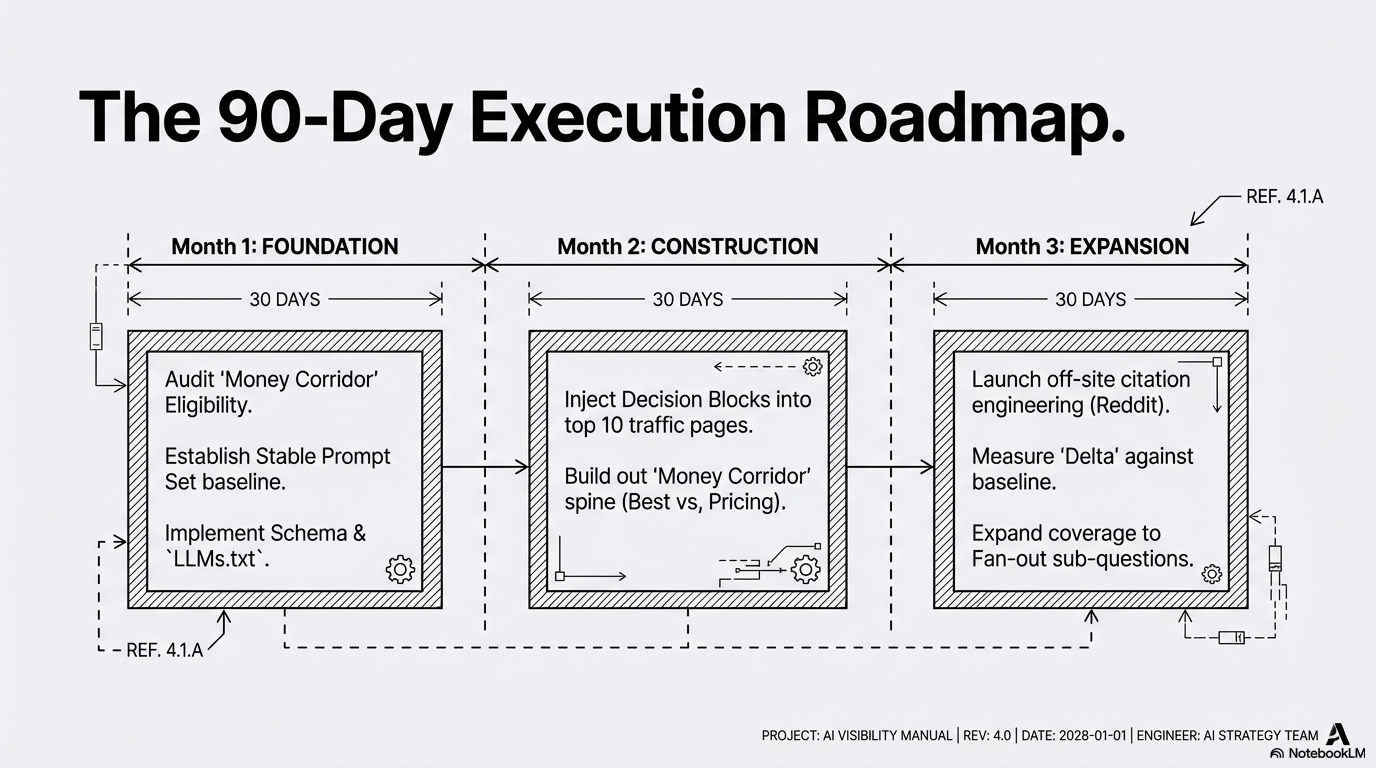
TL;DR
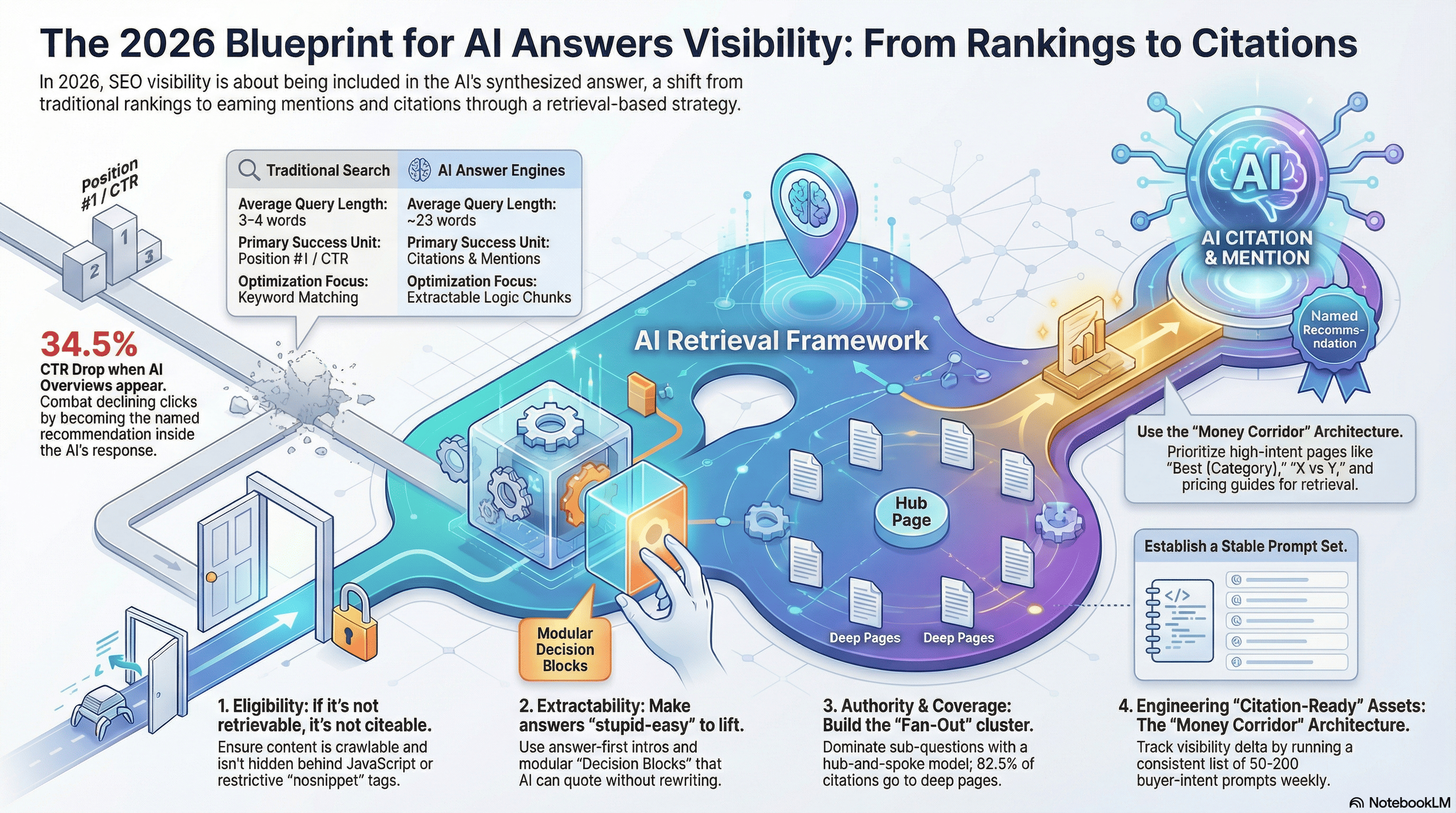
To win AI Answers Visibility in 2026, you need a system that makes your pages retrievable, extractable, and reference-worthy across the fan-out cluster (not just one keyword). That means 👉 Eligibility (crawlable/indexable/snippet-safe) → Extractability (answer-first sections, question headings, tables/decision blocks) → Authority (proof + corroboration across the ecosystem) → Coverage (hub + supporting pages for the fan-out). Then you track progress with a stable prompt set and iterate baseline → delta.
Alright, let’s get into it.
If you’re still thinking “visibility” means ranking #1 and getting the click, 2026 is going to feel… weird. Because for a huge chunk of informational (and even comparison-style) queries, the click isn’t the main event anymore.
The main event is the answer.
And the new visibility unit is simple:
- Did the AI include you inside the response?
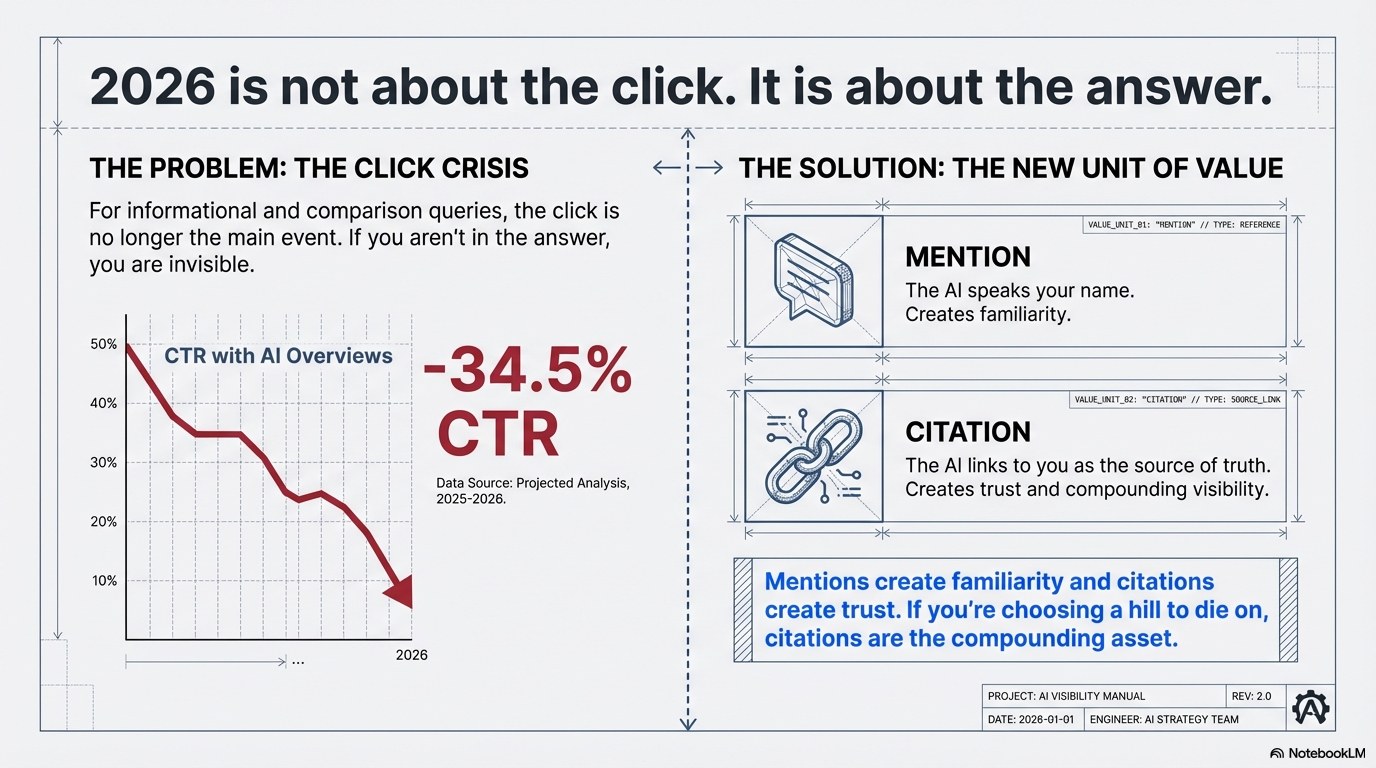
Recent click data backs this up as one Ahrefs dataset summarized by eMarketer found that when Google’s AI Overviews appear, average CTR drops by about 34.5%.
It has links in it, so it’s not like something that just goes on top alone. (Source)
That’s what we mean by AI Answers Visibility i.e., how often your brand shows up as a named recommendation (mention) or a linked source (citation) inside things like AI Overviews / AI Mode and the citation-first answer engines people are using instead of scrolling. For context, Google says AI Overviews will reach 1B+ global users monthly and has rolled out to 100+ countries and territories.
AI Overviews… [are] designed… helping with more complex questions… while prominently including links to learn more. — (Source)
Helping people discover content… remains central to our approach with AI Overviews. — (Source)
And yes, mentions and citations are different when it comes to AI-generated answers in LLM search engines.
- A mention is the AI saying your name.
- A citation is the AI backing its claim by linking to your page as a source.
Each answer includes numbered citations linking to the original sources… — (Source)
You can find all the cited sources… by clicking on the Sources button. — (Source)
We always cite our sources. — (Source)
In short, mentions create familiarity and citations create trust.
In 2026, you want both, but, if you’re choosing a hill to die on, citations are the compounding asset.
Now here’s the part most people miss 👉 getting cited is mostly a retrieval game.
These systems don’t “read your whole website.” They expand a query into a bunch of sub-questions (fan-out), retrieve chunks from multiple pages, then stitch a response together. Your job isn’t to “write longer.” Your job is to be the cleanest, most quotable chunk for the questions they actually expand into.
So if your best insight is buried in paragraph seven, inside a story, behind a pop-up, or locked in an image… you’re basically asking the model to ignore you.
⚙️ The real shift? Ranking pages → engineering extractable answers
In the old world, we obsessed over three things:
- Keywords
- Rankings
- CTR
In this world, the obsession shifts to:
- Selection → Citation → Accurate Description.
And that’s exactly why at TRM, a system exists to make AI visibility operational and measurable, not buzzwordy.
Because the way we win isn’t by “publishing more content.”
We win by taking demand that already exists (especially high-intent PPC demand) and turning it into owned assets that:
- Rank organically, and
- Show up inside AI answers (over and over again).
That’s the whole Stop Renting Clicks idea where you’re already paying to learn what converts. We use that signal to decide what to build so you stop renting the same demand forever and start owning it across search and AI surfaces.
What this post gives you (a repeatable system)?
This isn’t a “tips” post. It’s a blueprint you can actually run.
You’ll learn how we:
- Pick buyer-intent prompts (AI-first + BOFU),
- Structure quotable / citable decision blocks (tables, checklists, summaries),
- Build comparison assets that AI engines summarize into shortlists,
- And measure AI answers visibility baseline → delta using a stable prompt set.
And we’re going to do it in a way that matches how answer engines work in reality, meaning, we’ll explicitly build for query fan-out (the “one question becomes 20 sub-questions” phenomenon).
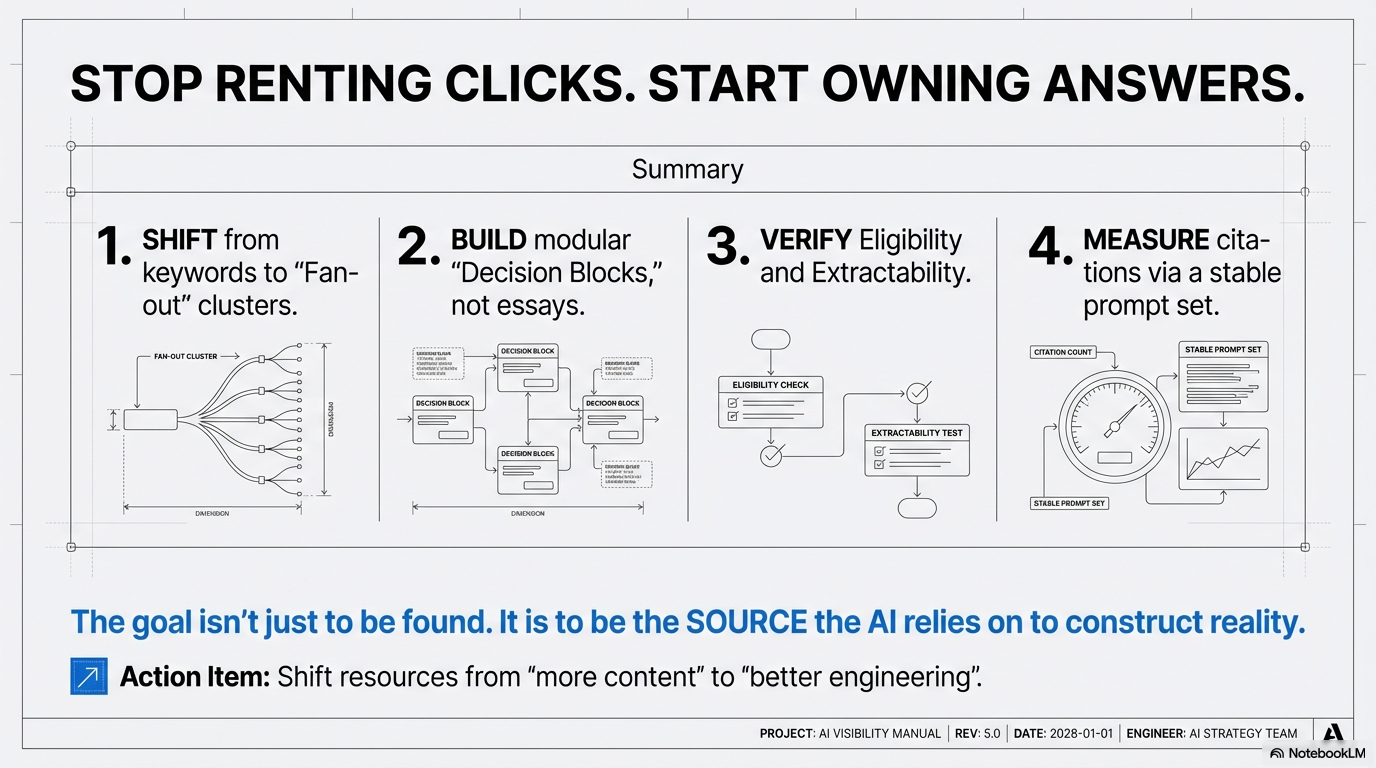
Let’s break down exactly how answer engines pick sources (the retrieval + citation pipeline), and how to engineer your site so you become the obvious chunk they grab, whether the user is asking through Google, OpenAI, Microsoft’s answer surfaces, or Perplexity and why ecosystems like Reddit can quietly decide whether you get cited at all.
How Answer Engines Pick Sources (The Retrieval + Citation Pipeline)
Alright! This is the part that flips the whole game on its head.
When someone asks an AI engine a question, it doesn’t “read your page” like a human. It doesn’t even treat the user’s prompt as the query.
In an AI-first answer engine, the prompt is basically a starter pistol. It kicks off a much bigger exploration where the system decomposes the question, rewrites it multiple ways, generates follow-ups, and routes each variant to different sources.
ChatGPT search rewrites your query into one or more targeted queries… — (Source)
So if you’ve been optimizing like “I just need to rank for this one keyword”… yeah. That’s not what’s happening anymore.
The “citation machine” in 5 steps
Most AI search flows follow a pipeline like this:
- Expansion → Routing → Retrieval → Selection → Synthesis.
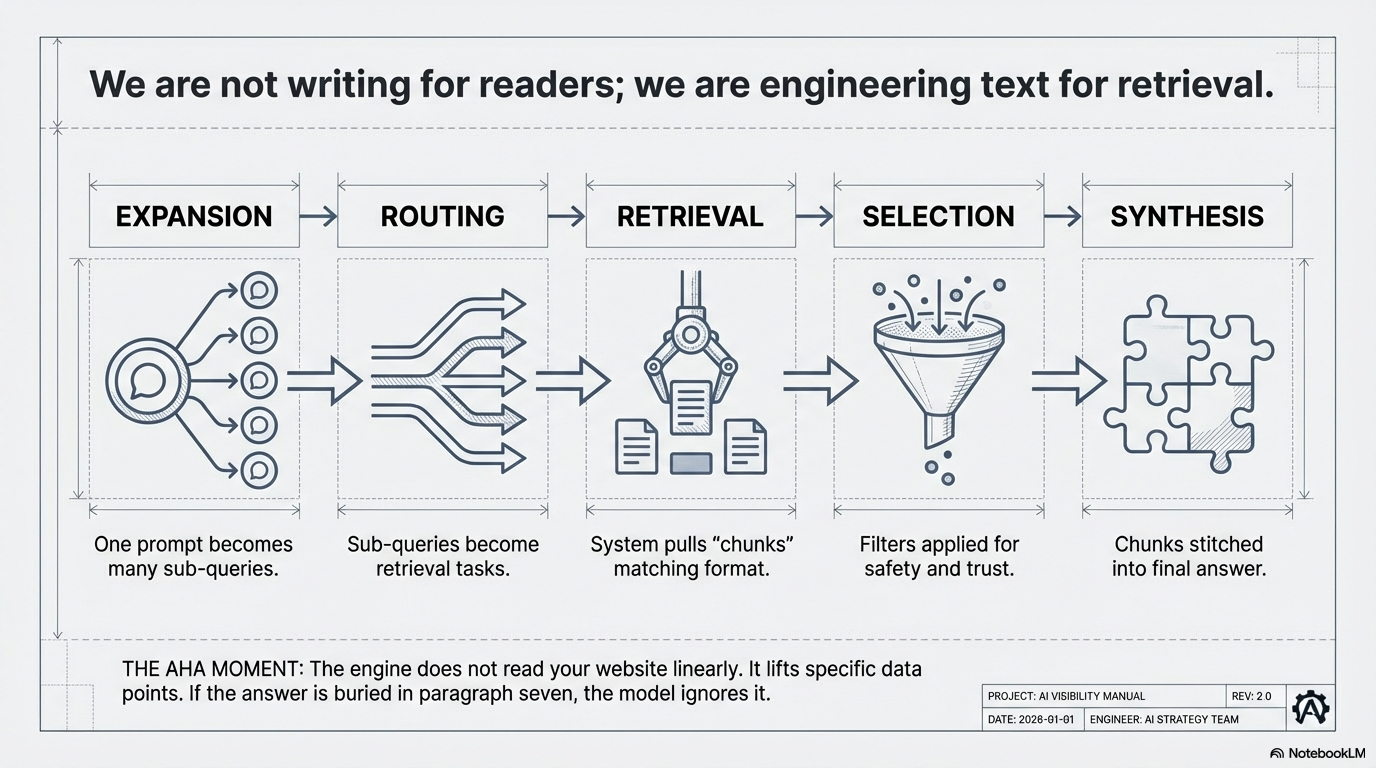
And it sits on top of RAG (retrieval-augmented generation), meaning, the model tries to ground its answer in externally retrieved data to reduce hallucinations and knowledge cutoffs.
Let’s break down the pipeline in plain English and what it means for you if you want citations.
1) Expansion: “One query becomes many”
This is where the system broadens the scope to cover both the explicit question and the implied questions behind it.
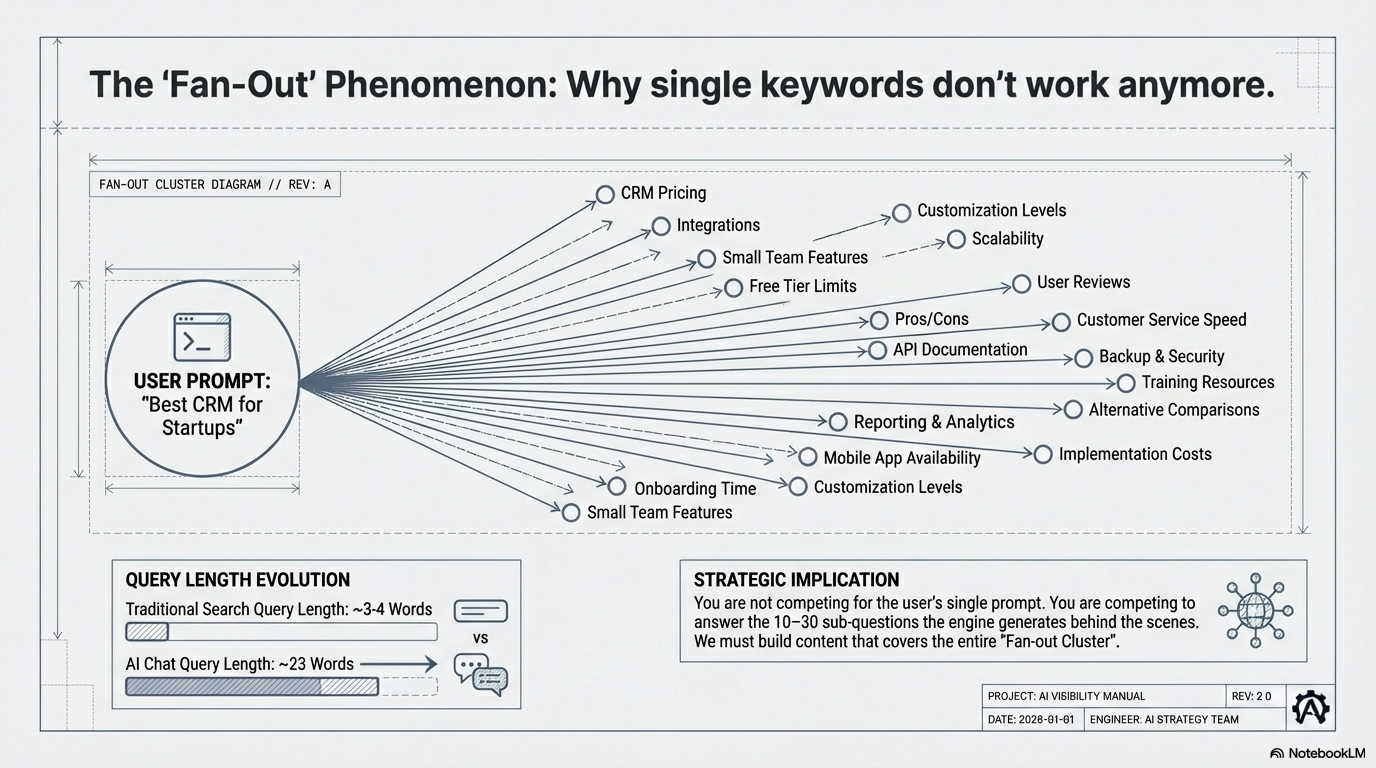
❓ Why this matters? One analysis found AI Overviews showed up on ~8% of 1–2 word searches, but ~53% of searches with 10+ words.
That ‘long question’ behavior is also normal in chat-first engines. Aravind Srinivas says Perplexity’s median query is ~10–11 words vs ~2–3 words on Google Search.
💡 What it means for you? You’re not competing on one query. You’re competing across the fan-out cluster i.e., the 10–30 sub-questions the engine spins up behind the scenes.
2) Routing: “The fan-out becomes tasks”
Routing is where the fan-out becomes operational where each sub-query becomes a task, and the engine decides which source, which modality (text vs video transcript vs structured data), and which retrieval strategy to use.
▶️ Concrete example: Perplexity says its Deep Research mode performs dozens of searches and reads hundreds of sources to build an answer.
Deep Research performs dozens of searches… [and] reads hundreds of sources… — (Source)
💡 What it means for you? If your best insight exists only in a format the routing logic doesn’t pull (or can’t parse), you don’t get a seat at the table, no matter how good your content is.
3) Retrieval: “If it doesn’t match the expected format, it doesn’t get pulled”
This is the brutally simple part where the content must match the expected modality or it won’t be retrieved. The guidance is explicit 👉 ensure multi-modal parity (text, structured data, transcripts) and put content where the system is likely to look.
💡 What it means for you? Being “right” isn’t enough. You need your answer in clean, extractable text, plus the formats engines like to pull (tables, lists, FAQs, transcripts).
4) Selection: “Filters + trust checks”
Selection is where systems apply filtering, often including safety/harm filters and learned patterns.
Google has also publicly described how strict these guardrails can be. It said policy violations in AI Overviews occurred on “less than one in every 7 million unique queries” where AI Overviews appeared.
💡 What it means for you? This is where credibility and clarity start to matter more than ever. Vague claims, unclear sourcing, or weird framing can get your page deprioritized even if it’s relevant.
5) Synthesis: “Only the easiest chunks make it into the final answer”
The painful truth is even high-quality content can get excluded if it isn’t easy to extract. Interactive designs that aren’t crawlable, or long narratives that bury key facts, can get skipped in favor of denser, more accessible material.
💡 What it means for you? This is why “answer-first” wins. If your page doesn’t hand the model a clean chunk it can quote, it will go find someone else who does.
✔️ Quick Reality Check: Some systems don’t crawl the way you think
Some LLM experiences don’t crawl/index like traditional search; they can “request” information in real time rather than caching it like classic engines.
To put it simply, “your content has to be accessible, fetchable, and instantly usable.”
Where this shows up in the real world?
For example, AI answer surfaces can generate an answer and then look for documents that corroborate what was said—meaning being a clean, verifiable reference page can be a huge advantage.
And when fan-out gets more aggressive (AI Mode-style behaviors), the pipeline gets longer and considers more passages/pages across more queries.
What engines reward (aka “how to become the chunk they grab”)
If you want to consistently win citations, you build content that fits this pipeline:
- Answer-first intros (give the model a clean chunk immediately)
- Question-based headings (match fan-out tasks)
- Fact-first paragraphs (clear, quotable statements)
- Tables & lists (dense, structured, easy to lift)
And now that you understand the machine… we can finally talk about the fun part. The 4 levers we use to win citations (Eligibility, Extractability, Authority, Coverage) and how to turn them into an execution plan.
The 4-Lever Framework For Winning Citations (Eligibility → Extractability → Authority → Coverage)
Now that you understand the pipeline, here’s the part that actually moves the needle.
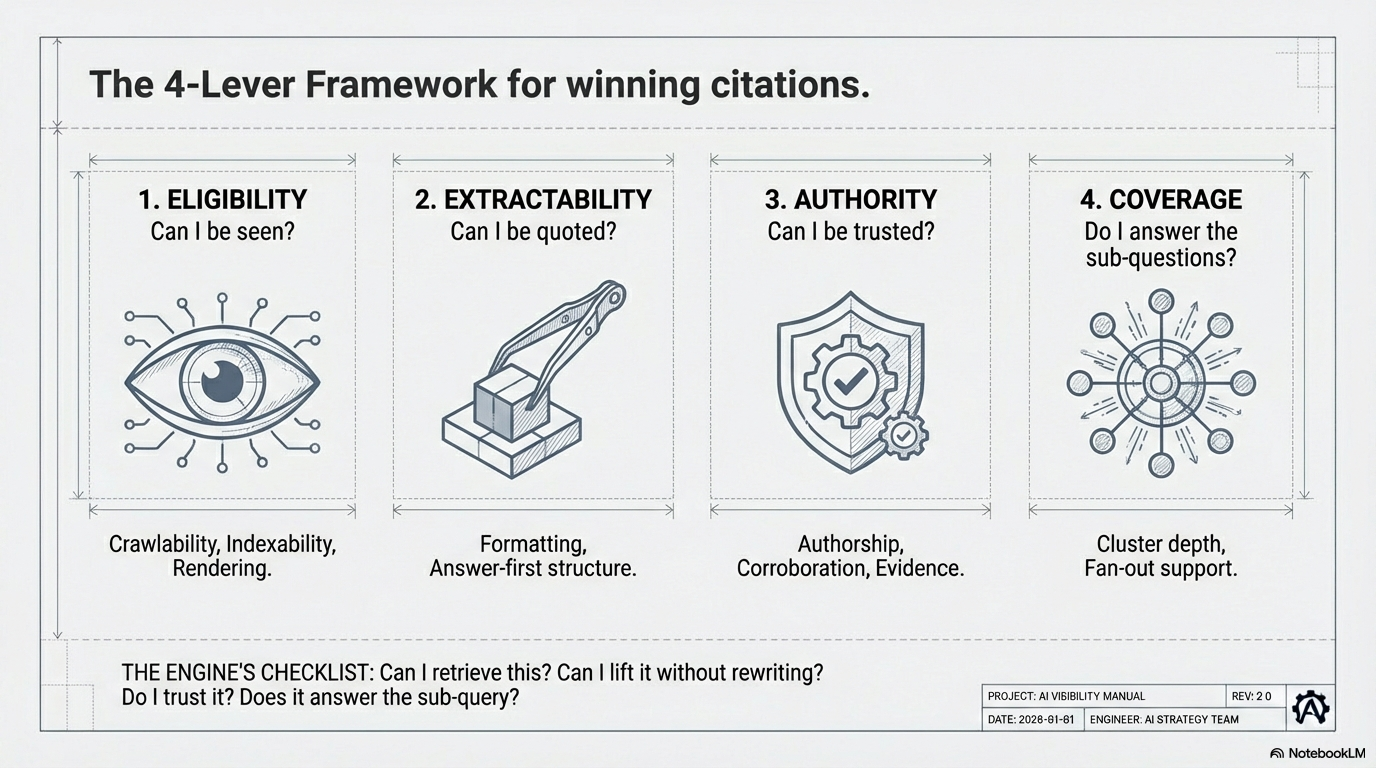
In 2026, “getting cited” isn’t magic and it’s not luck. It’s engineering. And it comes down to four levers you can control:
- Eligibility
- Extractability
- Authority
- Coverage.
Think of these like a checklist the engine implicitly runs:
- Can I retrieve this page at all? (Eligibility)
- Can I lift a clean answer without rewriting it? (Extractability)
- Do I trust this source enough to cite it? (Authority)
- Does this site cover the fan-out questions I’m trying to answer? (Coverage)
Let’s break each one down into “what to do” (and what kills citations).
Lever #1: Eligibility — “If you’re not retrievable, you’re not citable"
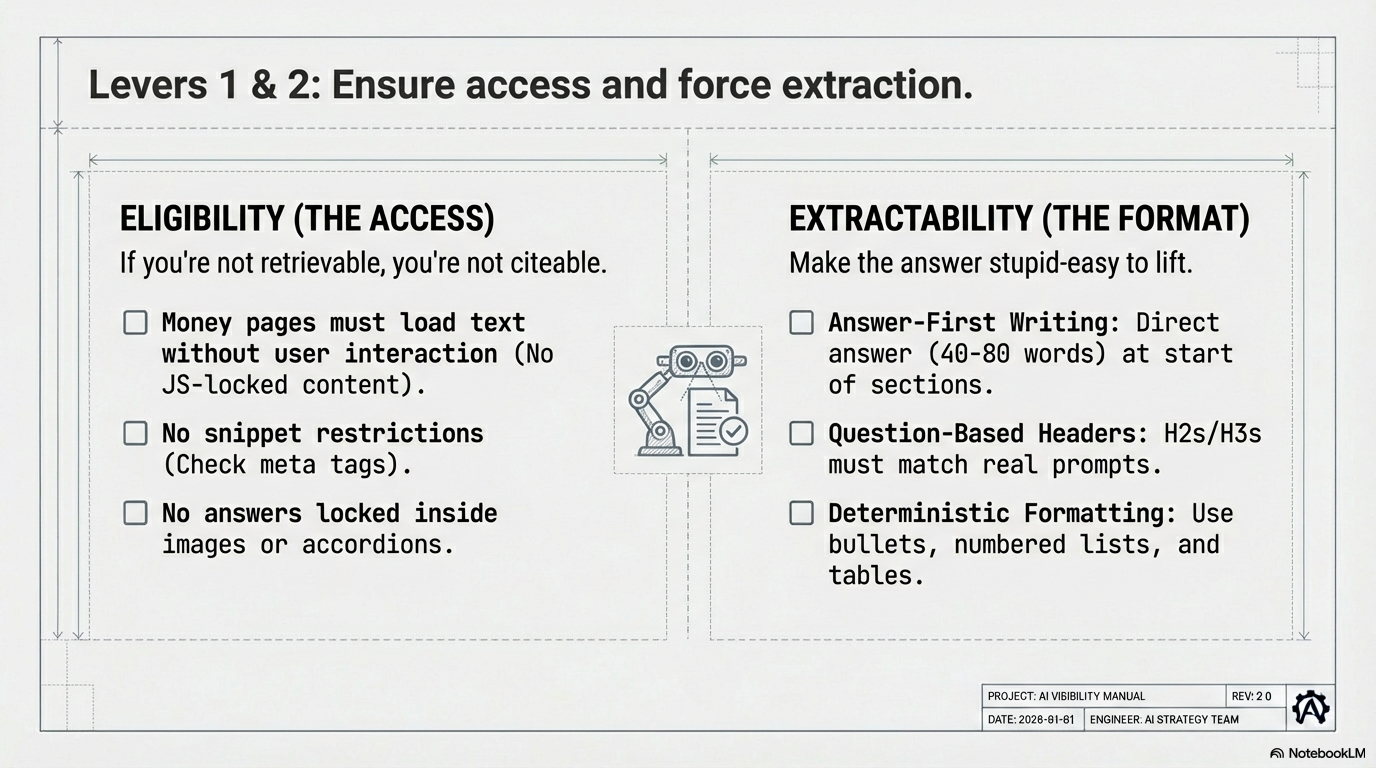
This is the most boring lever… and the one that quietly nukes visibility for a ton of brands.
Eligibility means your content is:
- Crawlable
- Indexable
- Snippet-eligible
- And actually visible to bots (not hidden behind heavy client-side rendering or blocked previews)
Because the engine can’t cite what it can’t access. This is the foundation layer in the “retrieval game” you’re playing.
Eligibility checklist (practical):
- Your “money” pages load meaningful text without requiring user interaction.
- The primary answer isn’t locked inside tabs/accordions that don’t render in HTML.
- You haven’t accidentally blocked extraction with snippet restrictions.
If you want a clean “on/off switch” for snippets, Google’s docs are blunt:
To prevent Google from displaying a snippet… use the nosnippet meta tag. — (Source)
Common citation killers:
- The answer exists only in an image
- The answer loads only after JS
- Interstitials or UX layers obscure the main content for bots
Lever #2: Extractability — “Make the answer stupid-easy to lift”
This is where most SEO content fails because it’s written for humans only.
Answer engines want pages that are modular. And by modular we mean, “content that can be lifted as a clean “chunk” and dropped into an answer without editing.”
So your job is to build answer-ready sections:
Extractability rules that win citations:
- Answer-first writing: Start each section with the direct answer (2–4 sentences), then explain.
- Question-based H2/H3s: Write headings that match real prompts (“How do I…”, “What is…”, “Best way to…”) so the engine can map fan-out tasks to your page.
- Deterministic formatting: Bullets, numbered steps, and small tables, because they’re dense, scannable, and easy to cite.
Extractability checklist (what we deliver to out clients on purpose):
- A 40–80 word “answer capsule” near the top
- “Key takeaways” box (3–7 bullets)
- At least one table or structured list per major section
- Short paragraphs that don’t bury the claim
🤙 Want the same for your business? Book a call with TRM experts.
Common citation killers:
- Long intros that “warm up” before answering
- Clever headers (“Let’s dive in!”) that don’t match a query
- Vague marketing language (engines avoid citing fluff)
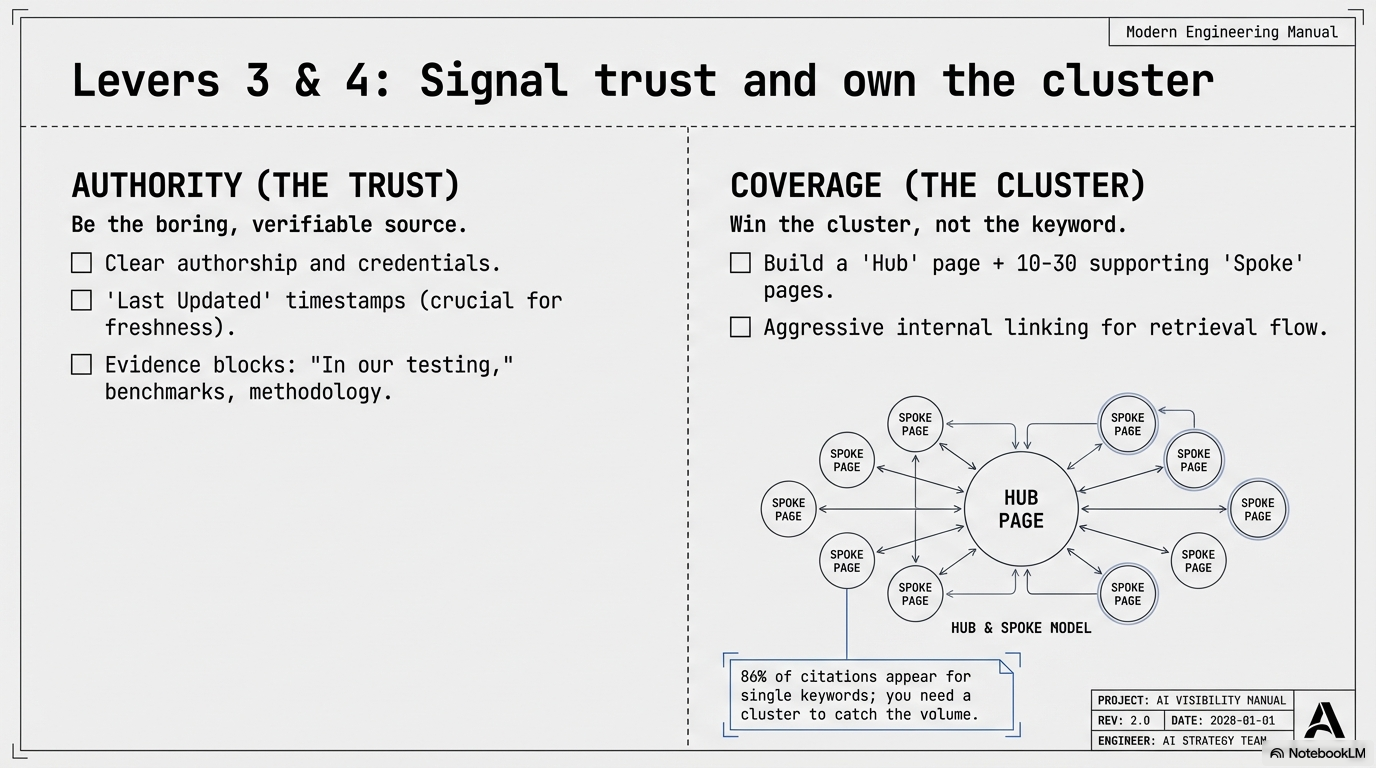
Lever #3: Authority — “Be the boring, verifiable source engines like to reference”
This is where citations separate from mentions.
Engines don’t just want a relevant answer, they want an answer that looks safe to stand behind. So authority is about being reference-worthy.
What authority looks like in practice:
- Clear authorship and credentials (who wrote this, why should I trust them?)
- “Last updated” signals (especially for fast-changing topics)
- Evidence:
- Numbers
- Constraints
- Dates
- Sources
- Methodology
This is also where off-site corroboration matters because the ecosystem has to “agree you exist” and agree on what you are.
That’s not just theory as major answer surfaces emphasize source visibility as part of a healthy web ecosystem:
Cited sources are easily accessible in-line… highlighted prominently… so you’re a click away from the publisher. — (Source)
Authority checklist:
- Author bio + real editorial stance
- Clean attribution (links to sources, not vibes)
- Proof blocks (“in our testing…”, benchmarks, mini-studies)
- Consistent brand/entity info across the web (no mixed signals)
Common citation killers:
- Anonymous content
- No timestamps for fast-changing topics
- Claims without proof (“best”, “leading”, “#1”) that can’t be grounded
Lever #4: Coverage — “Win the fan-out cluster, not the single keyword”
This is the lever that compounds.
Because answer engines expand one query into many sub-queries (fan-out), you don’t win by having one “perfect” page. (build for AI search visibility instead).
You win by owning the cluster:on rate is flat, the root cause might not be “
- The hub page (pillar)
- Plus supporting pages that answer the sub-questions the engine will inevitably generate
Data from BrightEdge’s analysis of AI Overview citations supports this structure: 82.5% of citations went to deep pages (not homepages), and only ~0.5% cited homepages.
Same study dictates that 86% of citations showed up for only a single keyword — another reason you need a ‘cluster’ of pages instead of one ‘hero’ URL.
This is why TRM pushes the “corridor” approach (comparisons, alternatives, pricing, implementation, best-for-use-case pages) and why we treat it like an asset system, not a one-off post.
Coverage checklist:
- Build a hub + 10–30 spokes tied to buyer-intent prompts
- Publish comparison + alternatives pages (these get pulled constantly)
- Interlink aggressively so retrieval flows discover your cluster
Common citation killers:
- One giant page that tries to do everything but answers nothing cleanly
- No supporting pages for subtopics
- Weak internal linking (engines find you less often during fan-out)
▶️ Read our Case Study: Avaza PSA SEO Case Study: 6.4% AI Assisted Conversions
The simplest way to use this: AI citation scorecard
If you want a quick internal scoring system for your content’s AI visibility matters, rate any “source page” 1–5 on each lever:
- Eligibility (can bots access it?)
- Extractability (can it be quoted in 10 seconds?)
- Authority (does it look safe to cite?)
- Coverage (does it link into a cluster?)
Your goal is not perfection. Your goal is to get consistently “good enough” across all four, because that’s what wins repeated retrieval.
Explore ▶️ Use the AI visibility metrics as your scoring backbone.
Next up, we turn this framework into something concrete i.e., decision blocks—the on-page module we use to manufacture citations (because it gives the engine a clean, structured answer every time).
The “Decision Block” system (your on-page citation magnet)
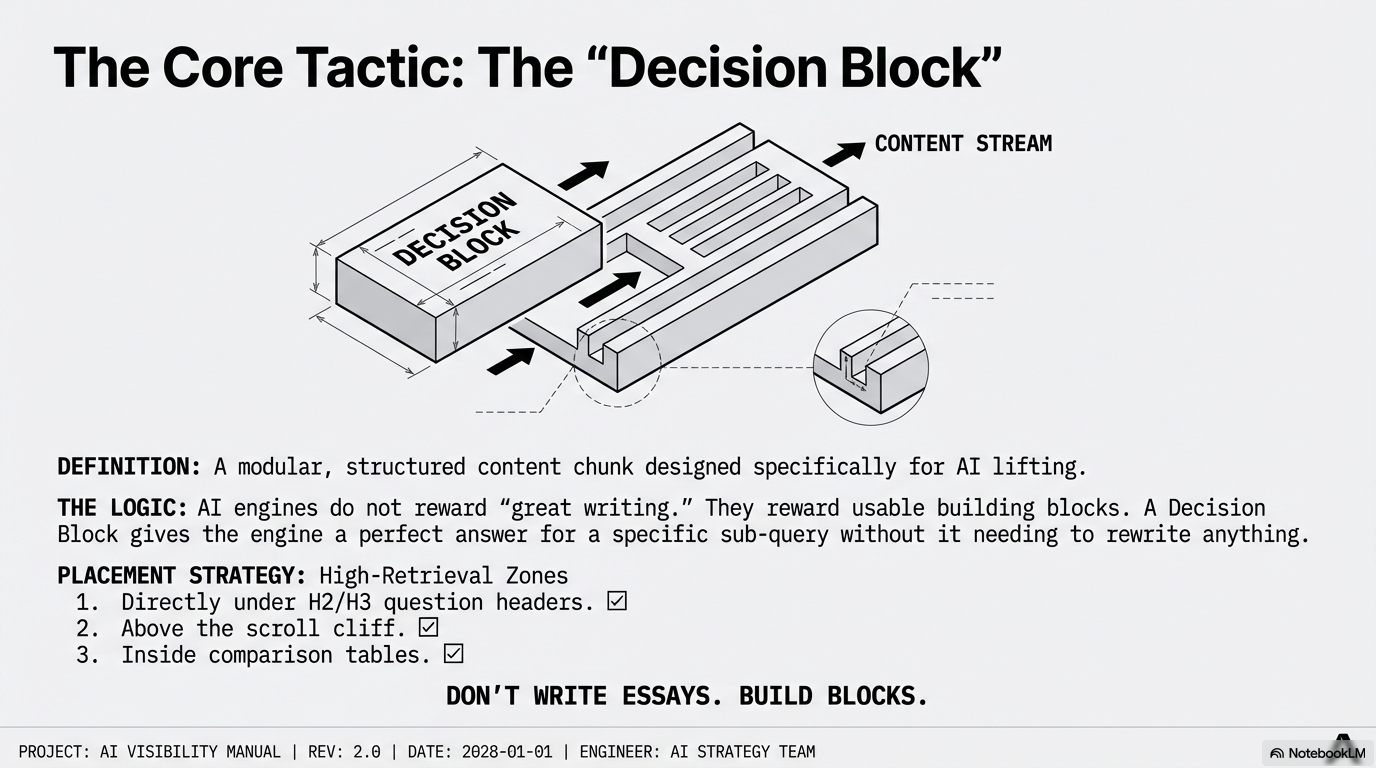
This is where the strategy stops being theoretical and starts printing citations.
Because once you understand how answer engines work, you realize something kind of hilarious:
- They don’t “reward great writing.” They reward usable building blocks.
So we build Decision Blocks! Repeatable, structured sections designed to be the exact chunk an AI can lift when it’s trying to answer a buyer-intent question.
And yes, this is a core part of your finalized plan i.e., building structure decision blocks, then measuring “baseline → delta” with a stable prompt set.
What is a Decision Block?
A Decision Block is a self-contained mini-answer that helps a buyer decide:
- What to do
- When to do it
- Who it’s for
- What the tradeoffs are
- What to do next
It’s basically an “AI-ready decision module” that works for humans and machines because it’s clean, factual, and easy to quote.
And it maps perfectly to what answer engines want i.e., modular chunks that can be extracted and dropped into a response without rewriting.
Why Decision Blocks get cited (the unfair advantage)
Here’s what happens behind the scenes:
A user asks:
- “How do I win citations in AI answers in 2026?”
The engine fans out into sub-questions like:
- “What should I build first?”
- “What’s the fastest path to visibility?”
- “What makes content citeable?”
- “How do I track results?”
Decision Blocks win because they give the engine a perfect chunk for each sub-question right after a heading that matches the prompt.
The Decision Block template
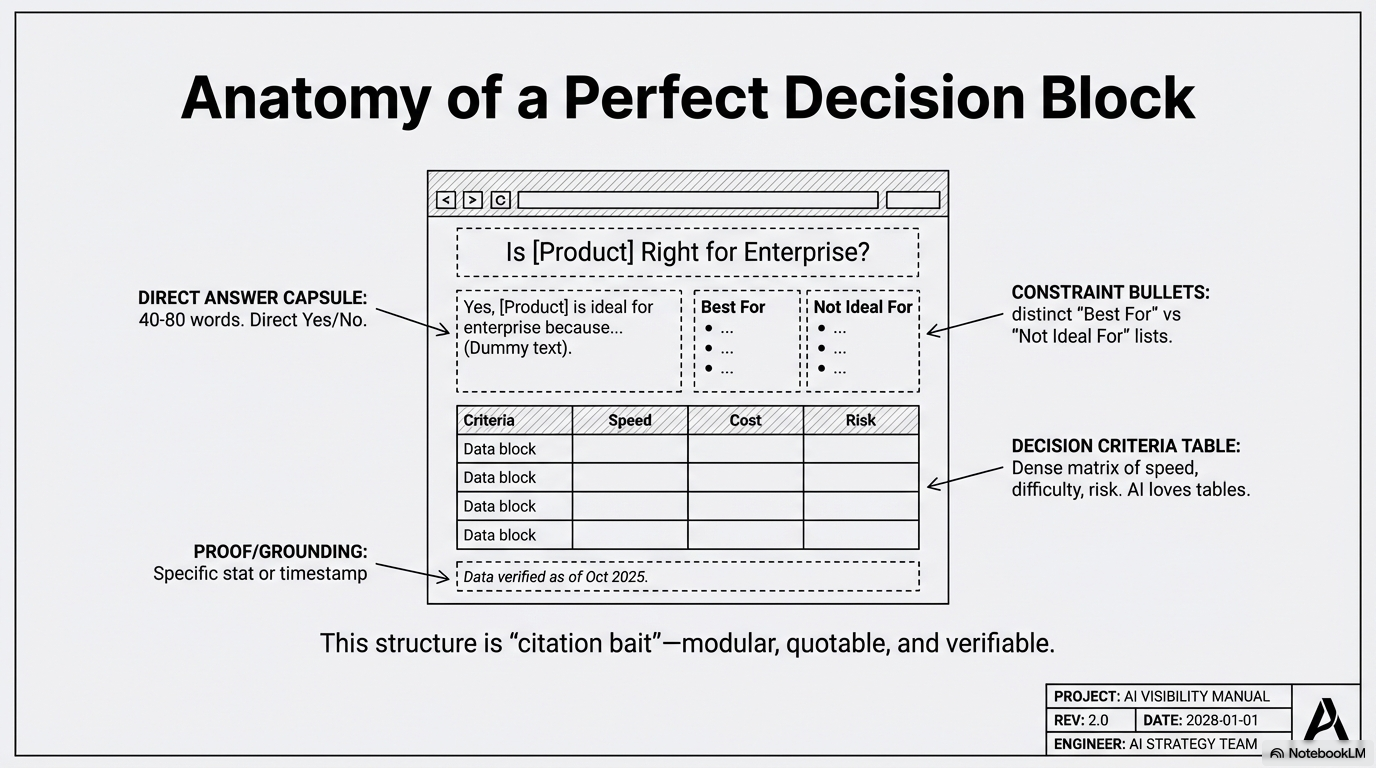
Use this exact structure repeatedly across the post (and across your supporting pages). Consistency helps engines “learn” how to extract from you.
1) Direct answer (40–80 words)
- 2–4 sentences that answer the question immediately.
- No scene-setting. No fluff. Just the decision.
2) Best for / Not ideal for (2 bullets)
- Best for: Who should do this
- Not ideal for: Who shouldn’t
3) Decision criteria (mini-table or bullet grid)
- Speed to implement
- Difficulty
- Risk level
- Expected payoff
- Time to measurable results
4) Steps (3–7 numbered steps)
Short and deterministic.
5) Proof / grounding
One of:
- a stat (“X% lift”)
- a mini-case (“we tested this on…”)
- a constraint (“works best when…”)
- an “as-of” timestamp for freshness
This combination is basically “citation bait” because it’s structured, quotable, and verifiable (and exactly what AI answer engines prefer).
Where Decision Blocks go (so they actually get used)
This part matters more than people think.
Put Decision Blocks in these high-retrieval zones:
- Directly under question-style H2/H3 headings
- Because engines map the heading → the following chunk.
- Near the top of the page (above the scroll cliff)
- Remember: You’re fighting for inclusion in the first synthesized answer, not for time-on-page.
- Inside comparison and alternatives sections
- Those prompts (“X vs Y”, “best X”, “alternatives to X”) are where citations stack up.
- In your supporting pages (spokes)
- Decision Blocks aren’t just for the pillar. They’re for each spoke page in the corridor so you win fan-out coverage.
Here’s the move 👉 Don’t write one Decision Block. Write a library of them.
Comparison Assets That Get Pulled Into AI Answers (the “money corridor”)
Now we’re in the part of the playbook that actually turns AI visibility into a pipeline.
Because informational prompts are nice… but the real commercial gravity is in decision prompts:
- “Best ___ for ___”
- “___ vs ___”
- “Alternatives to ___”
- “Is ___ worth it?”
- “Pricing for ___”
- “How to implement ___”
These are the prompts where buyers are basically saying, “I’m ready to choose. Please help me shortlist.”
And your finalized system already nails the strategy here as you already have built a money keyword corridor made of comparison, best, vs, alternatives, pricing, and implementation pages. The only thing remaining is then connecting them as a cluster.
Why does that corridor matter so much in 2026?
Because when answer engines do query fan-out, they actively look for pages that already contain structured comparisons and tradeoffs and they love citing them because it’s safer than inventing pros/cons from scratch.
What is the “money corridor”?
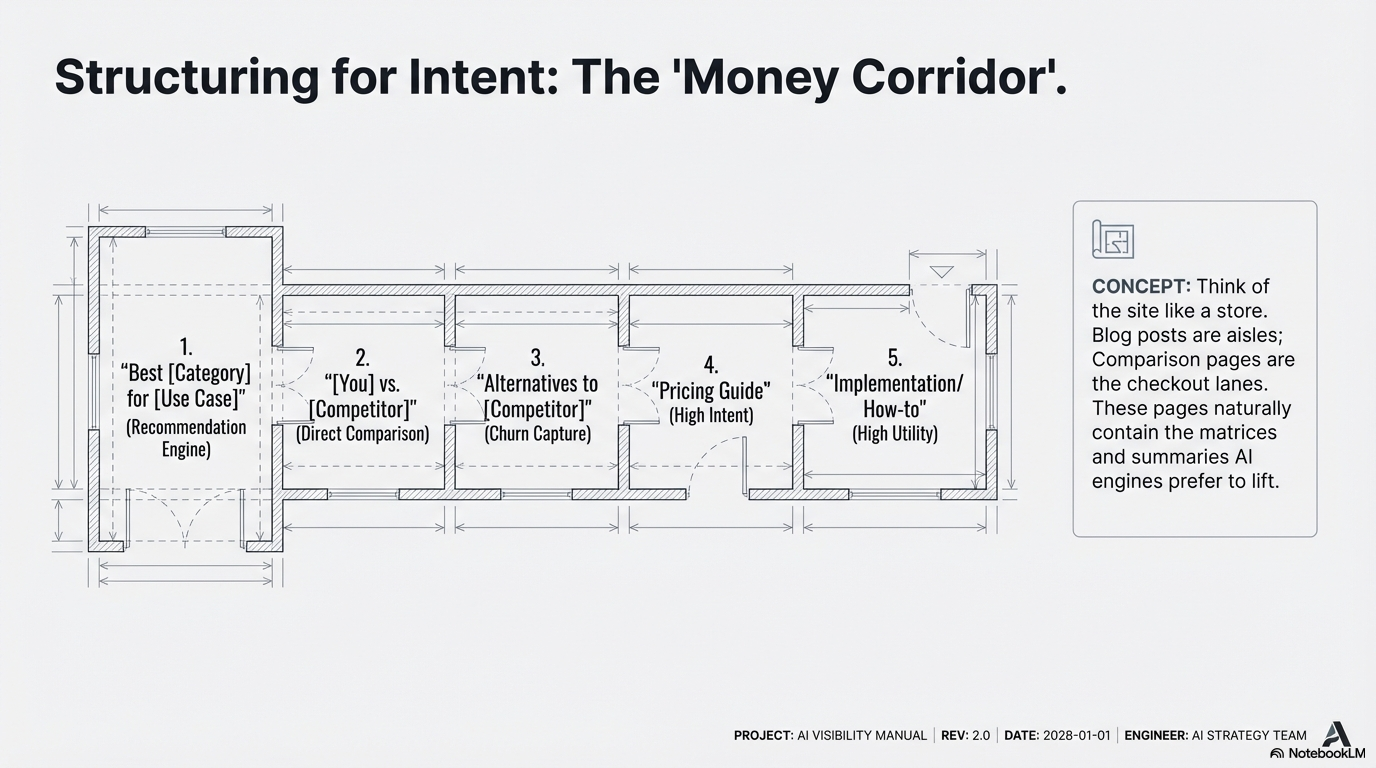
Think of your site like a store.
- Blog posts are the aisles.
- Product pages are the shelf.
- And comparison pages are the checkout lane.
The “money corridor” is the set of pages that sit closest to purchase intent and get retrieved constantly because they align with how people now ask AI systems for recommendations.
A corridor map includes:
- Your money keyword
- Best ___
- ___ vs ___
- Alternatives to ___
- Pricing / cost
- Implementation / setup
- Templates + workflows
- “What is ___?” (definition / primer)
- Feature pages (use-case proof)
That’s not “just content.” That’s a retrieval architecture.
Why comparison pages get cited more than “normal blog posts”
Answer engines don’t just want “information.” They want decision-ready structure.
Comparison pages naturally contain the exact things engines like to lift:
- Feature matrices
- Pros/cons
- “Best for / not for”
- Pricing summaries
- Implementation constraints
- Alternatives and edge cases
Basically, they’re pre-packaged synthesis.
And because fan-out creates multiple sub-questions, a corridor gives the engine multiple high-quality landing spots as it searches and corroborates across the cluster.
The corridor blueprint (what to build, in what order)
If you want this to be executable, here’s the exact “build order” we use:
Step 1: Pick one BOFU topic (the “trial corridor”)
Pick a category where:
- People actively comparison-shop
- There’s clear differentiation
- You can speak with proof
Step 2: Build the corridor spine (5 core pages)
Create these 5 pages first:
- Best [category] for [ICP/use case]
- [Your solution] vs [Top competitor]
- Alternatives to [Top competitor]
- [Category] pricing / cost guide
- How to implement [solution] (checklist + timeline)
Then link them all together like a loop.
Step 3: Add the corridor boosters (support pages that win fan-out)
These pages feed the engine during query expansion:
- “What is [category]?” (definition)
- “How does [category] work?”
- “[Category] features checklist”
- “Mistakes to avoid / implementation pitfalls”
- “Templates / calculators / scorecards”
These are the pages engines retrieve when they’re gathering evidence and explaining “why,” not just “what.”
The “AI-ready comparison page” structure (so it actually gets cited)
Here’s the exact structure we use at TRM to make comparison assets extractable:
1) Answer capsule at the top (40–80 words)
- Who wins for which situation
- No hype, just a clean decision statement
2) “Best for / Not ideal for” blocks (2–4 bullets each)
This is where citations happen because it’s quotable and constraint-based.
3) Feature matrix (table)
A simple table with:
- Features
- Pricing notes
- Complexity
- Ideal user
- Limitations
Tables are “AI-friendly” because they’re dense and easy to parse. (And engines love lifting them.)
4) Decision Blocks inside the comparison
Drop 3–5 Decision Blocks under questions like:
- “Which is better for small teams?”
- “Which is better if you need X integration?”
- “Which is cheaper at 10 users?”
- “Which is easier to implement?”
This is how you win multiple fan-out sub-queries inside one URL.
5) Alternatives section (with mini-comparisons)
Engines frequently fetch alternatives lists during routing because it helps them diversify recommendations.
6) Freshness + trust markers
- Updated date
- Author
- Proof sources
- Change notes (even tiny)
This makes the page safer to cite.
The corridor internal-link system (the part most people forget)
Your corridor only compounds if the engine can discover it easily.
So every corridor page should link to:
- The pillar page
- The “best” page
- 1–2 comparisons
- The pricing page
- The implementation checklist
And the pillar page links back to all of them.
That creates a tight cluster where fan-out retrieval keeps bouncing inside your ecosystem, meaning, you show up more often, and your pages reinforce each other’s authority.
✔️ Mini Decision Block: “What corridor page should I publish first?”
Start with “Best [category] for [use case]” if you want max surface area, then publish “[You] vs [top competitor]” to capture high-intent comparison prompts, then “alternatives” and “pricing” to win objection-based fan-out. This matches the corridor logic we’ve already outlined i.e., build the pages closest to purchase intent first, then expand outward into definitions and implementation support.
Technical GEO foundations (make your content machine-readable)
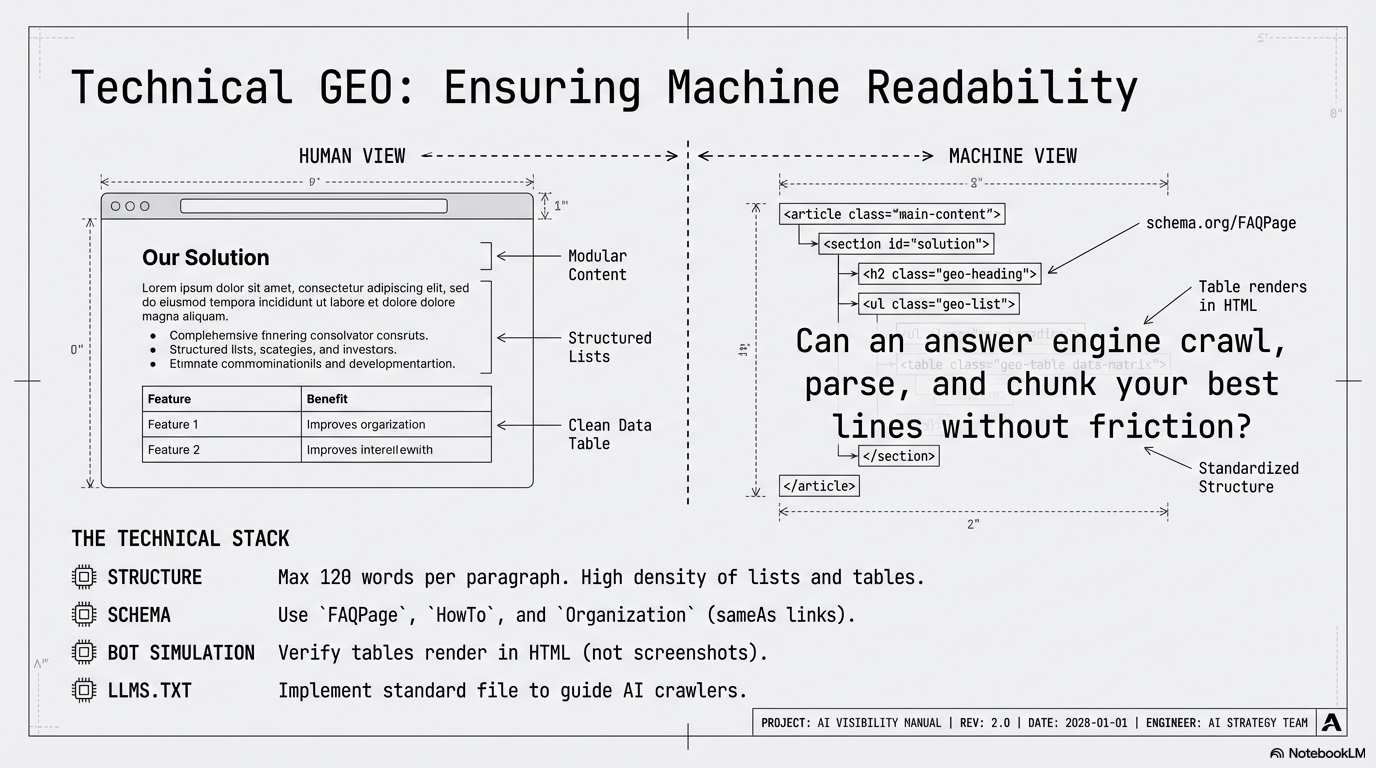
This is the part everyone thinks they have covered… and then you look under the hood and realize the AI can’t actually see the answers you worked so hard to write.
Because in 2026, “technical SEO” isn’t just about rankings. It’s about machine readability. And by machine readability, we mean that, “Can an answer engine reliably crawl, parse, chunk, and lift your best lines without friction?”
Here are the three technical GEO foundations we treat as non-negotiables.
1) Structure rules (non-negotiables)
Think of structure like a “machine interface” for your content. If your page is cleanly chunked, engines can retrieve a single section and cite it confidently.
Machine readability required structure rules are dead simple (and insanely effective):
- Question-based H2/H3 headings
- Answer-first paragraphs
- Lists + tables for deterministic extraction
- Table of contents with anchors
Also, keep paragraphs under ~120 words and break concepts into bullets, numbered steps, mini-tables, and callouts, because AI crawlers favor clean, logically arranged text that’s easy to extract and cite.
💡 Quick gut-check: If I screenshot just one H2 section, does it contain a complete answer right there or do I have to scroll to “find the point”? If you have to scroll, the model will scroll right past you.
2) Schema plan (but only where it matches visible content)
Schema isn’t “SEO seasoning.” It’s disambiguation.
Multiple expert resources agree on the same core stack:
- FAQPage for Q&A pairs
- HowTo for step-by-step processes
- Article + author info for attribution/trust
- Organization + sameAs links to reinforce entity identity
And here’s the important why? Structured data helps models interpret relationships (not just words) so they can understand who you are, what the page covers, and how it connects across the web.
There’s evidence out there that when LLMs are powered by structured data/knowledge graphs, response quality improves by 300% (via a referenced study).
Practical schema rules we follow:
- Only mark up what is visible on the page (no “schema fantasy”)
- Use schema to label structure, not to “game relevance”
- Connect entity identity with sameAs to verified profiles like LinkedIn, Crunchbase, and Wikipedia when appropriate
That last part matters because entity consistency is how you stop AI from treating “your brand,” “your tool,” and “your company” like three different things.
3) Bot access + verification loop (because assumptions get you killed)
This is the sneaky one.
You can write the cleanest answer on earth… but if the bots can’t preview it, it doesn’t exist.
TRM recommends testing pages with AI bot previews/simulations to catch the most common citation-killers:
- Critical sentences hidden inside images/graphics
- Inconsistent headings and structure
- Key facts embedded in long paragraphs
The verification loop we run (simple but ruthless):
- Open the page like a bot (no cookies, no personalization)
- Confirm the “answer capsule” and key Decision Blocks render in plain text
- Check that tables/lists are HTML (not screenshots)
- Confirm schema matches what’s visible
- Re-run after publishing to ensure nothing broke
💰 Bonus: LLMs.txt
This is not mandatory everywhere, but it’s one of those “why wouldn’t you?” additions.
LLMs.txt is a proposed structured file to help LLMs understand a website, and that major AI players (including Perplexity) have incorporated it into their own site architecture (as of August 2025).
Off-site “Citation Engineering” (mentions that turn into citations)
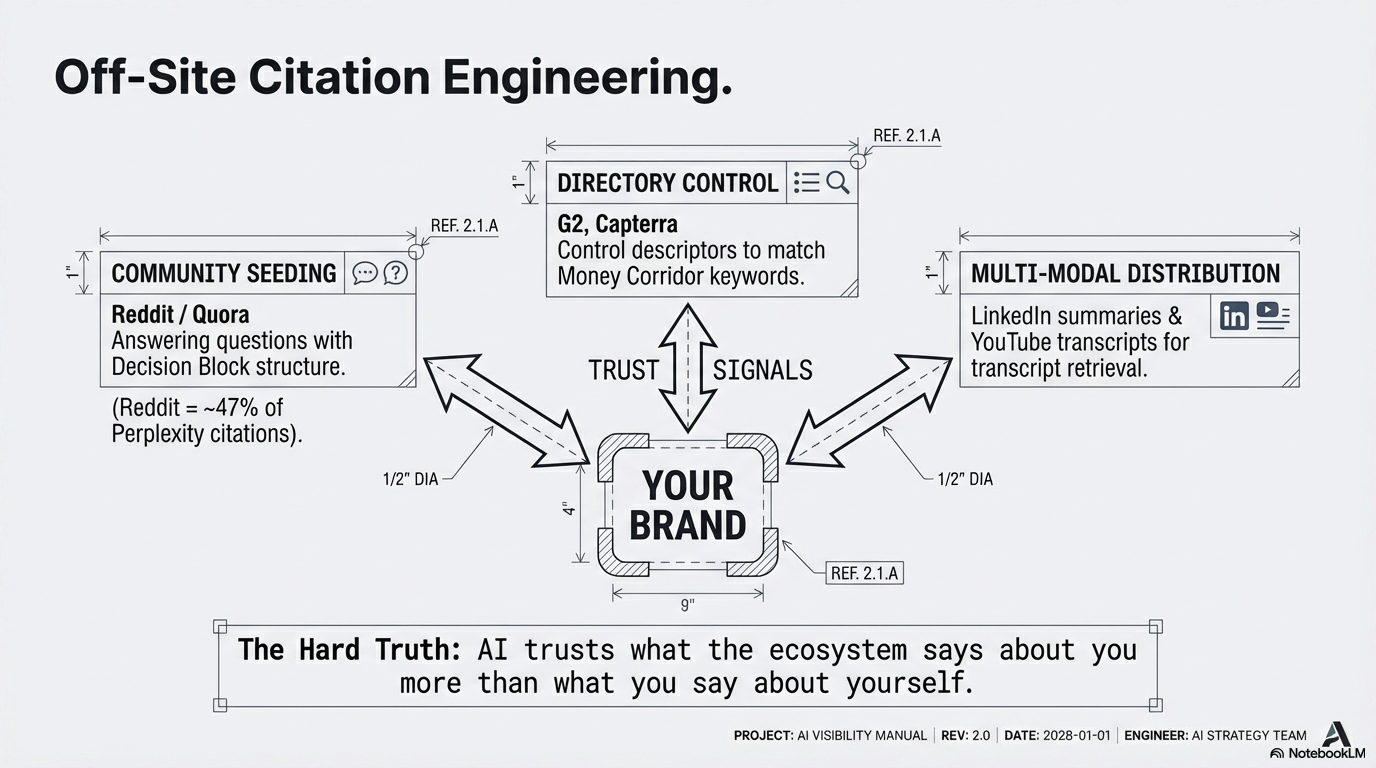
This is where most people get uncomfortable, because it means admitting a hard truth 👉 AI engines don’t just trust what you publish about yourself. They trust what the internet says about you.
So if your plan is “we’ll just write great content on our site,” you’ll get some visibility… but you’ll lose the citation war to brands that are backed by third-party corroboration.
And here’s the kicker! A huge portion of AI citations come from places SEOs used to ignore.
Reddit accounts for 46.7% of Perplexity’s top citations. That’s not a “nice to have.” That’s a distribution surface that decides who exists.
The goal of Citation Engineering
Not “link building.” Not “brand awareness.”
Your goal is to engineer a reality where, when an answer engine tries to corroborate facts, it repeatedly finds:
- Your brand mentioned in the right contexts,
- On the right third-party domains,
- With consistent descriptors,
- And (ideally) linked back to your “source pages.”
That’s what turns “mentions” into “citations.”
The 3 off-site pillars we run
1) Community credibility (the “human-vetted moat”)
Communities matter because they’re messy but they’re real. AI systems lean on them as an antidote to generic content.
How we do it (without spamming):
- Find 10–20 threads per month where people are already asking the problem your corridor targets.
- Contribute one truly useful answer (framework, checklist, tradeoffs).
- Then link to a single source page only when it genuinely helps (not as a pitch).
What wins citations here:
- Concrete constraints (“if you have X, do Y”)
- Step-by-step answers
- Comparisons and tradeoffs
- “Best for / not ideal for” framing (your Decision Block format)
This is also why your content needs to be modular i.e., a good off-site answer + a clean on-site source page creates a loop that answer engines can follow.
2) Directory + review ecosystems (entity reinforcement)
These are boring. They’re also some of the strongest “who is this brand?” signals on the web.
Your job here is not “set up a profile.” It’s descriptor control:
- What category you’re in,
- What use-cases you’re known for,
- What competitors you’re compared against,
- And what language users repeat about you.
Priority targets (because they show up constantly in recommendation prompts):
- G2
- Capterra
- TrustRadius
💡 The trick? Steer reviews toward specific use cases (the same ones your corridor covers). That way, when the engine asks, “best X for Y,” it finds consistent third-party phrasing that matches your BOFU prompts.
3) Repurposing for multi-surface retrieval (distribution that compounds)
Most teams publish one blog post and call it done. That’s not how AI discovery works anymore.
You need to repurpose content across formats because visibility is fragmented across AI-powered surfaces.
So for every “source page,” create a small distribution kit:
- 1 short post on LinkedIn summarizing the Decision Block
- 1 community answer (Reddit/Quora-style) using the same structure
- 1 visual (simple table screenshot plus the HTML table on-site)
- Optional: A short video + transcript on YouTube (because transcript retrieval is real)
The point isn’t “omnipresence.” The point is corroboration density. When engines fan out and cross-check, they keep encountering the same clean narrative.
How to measure AI visibility (new KPI stack)
Now, this is the part where most teams accidentally gaslight themselves.
Because if you’re still measuring “success” with rankings + clicks, you’re basically using a 2018 dashboard to judge a 2026 game.
In AI answer surfaces, position #1 doesn’t even exist the way it used to. You’re either in the answer (mentioned/cited)… or you’re not.
So we need a KPI stack that matches how answer engines behave i.e., non-deterministic, prompt-driven, and heavily influenced by how you’re described (not just whether you show up!).
First: The 3-layer model (Visibility → Sentiment → Citation)
AI visibility isn’t one metric. It’s three separate realities you have to track in parallel.
- Visibility: Are you showing up for the prompts that matter?
- Sentiment: How is the engine describing you (premium vs cheap, advanced vs beginner, etc.)?
- Citation: Are you getting linked as a source (stronger trust signal than a mention)?
And yes! Your readers need the distinction clearly:
- Mention = Your brand name appears
- Citation = Your URL is referenced as a source (that’s the “trust win”)
The stable prompt set method (the only way to track this without losing your mind)
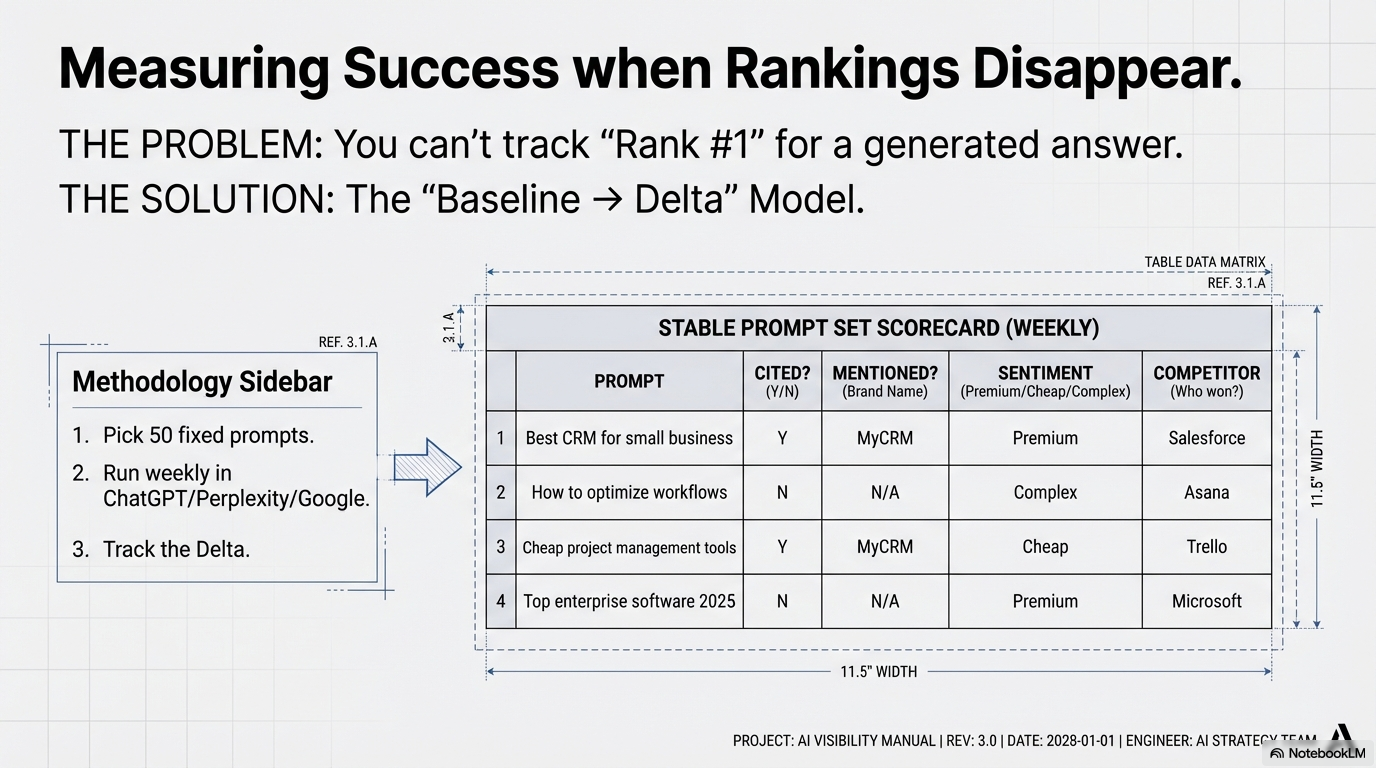
Here’s your measurement loop, that you can use as an actual operating system. Explicitly plan a “baseline → delta” using a stable prompt set. Because if you change prompts every time, you can’t tell whether visibility improved… or you just asked a different question.
Build a list of 50–200 prompts (seriously! This is your new “keyword list”) and run daily prompt runs:
- Awareness: “What is X?”
- Comparison: “X vs Y”
- Decision: “Best X for Y”
- Objection: “Is X worth it if…?”
Weekly run (same prompts, same order):
Track:
- Cited? (Y/N)
- Citation position
- Sentiment descriptors used
- Competing domains that got cited instead
That “competing domains” field is huge because it tells you who the engine trusts for each prompt, which becomes your off-site outreach target list.
Don’t ignore crawl + retrieval signals (because that’s upstream of citations)
In AI search, you also track crawl activity and crawl patterns i.e., are AI engines even visiting your site regularly? Because if your citation rate is flat, the root cause might not be “content quality.” It might be 👉 the systems aren’t retrieving you in the first place.
Explore ▶️ Start with an audit of brand visibility on LLMs.
Track AI referrals in analytics (so this connects to revenue, not vibes)
Track AI referrals in Google Analytics 4 & Add an “AI assisted conversions” view
That’s how you’ll be able to connect: prompt coverage → citations → sessions → conversions
And it stops the classic executive question: “Cool, we got cited… but did it do anything?”
Why measurement has to change (the “3–4 words vs 23 words” reality)
This is the behavioral shift that breaks old reporting.
Traditional search queries are short, about 3–4 words on average. But in ChatGPT or other answer engines, the average prompt is ~23 words (full questions with context).
So if your measurement system is built around, “we rank for 200 keywords”…you’re missing the actual game, which is, “we show up for 200 decision prompts,” and that’s why teams invest in AI visibility tracking.