Citation tracking is the highest-signal metric in AI visibility because it measures the authority layer, not just whether your brand name appears in an AI answer, but whether the AI engine attributes its information to your domain as a source.
A Princeton and Georgia Tech GEO study demonstrated that incorporating authoritative citations into web content increases an asset's probability of being extracted into AI search responses by 30% to 40%. In practical terms: brands that AI engines cite get clicks and trust; brands that are merely mentioned get awareness at best, confusion at worst.
The distinction matters because Perplexity provides numbered inline citations, ChatGPT Search links to source URLs, and Google AI Overviews reference pages within the generated summary — each with different citation behavior, different source selection logic, and different traffic attribution patterns.
This guide evaluates top tools — OtterlyAI, Peec AI, Profound, Semrush, Scrunch AI, SE Ranking, and CrunchJunkie — specifically on citation tracking depth: URL-level citation capture, citation source analysis, "used vs cited" source distinction, citation gap detection, citation trend tracking, and the ability to connect citation data to actionable content and PR remediation.
📋 Get Listed / Advertisement
We update this guide monthly. Want your tool featured? Contact: [email protected].
Best AI Visibility Tools with Citation Tracking (Quick Comparison)
| Tool | Best for | Citation Tracking Depth | Engine Coverage | Starting Price |
|---|---|---|---|---|
| OtterlyAI | Budget-friendly citation + link tracking | Weekly URL-level citation + link position tracking | ChatGPT, Perplexity, AIOs, Copilot (+add-ons) | $29/month |
| Peec AI | URL-level citation analysis & "used vs cited" distinction | "Used" vs "Cited" source distinction at URL level | ChatGPT, Perplexity, AIOs (+paid add-ons) | ~€95/month |
| Profound | Enterprise citation depth + revenue attribution | Page-level citation tracking + prompt volume data | 10+ engines (inclusive) | $499/month |
| Semrush | Citation tracking with a built-in execution stack | Cited pages report with sentiment + SOV integration | ChatGPT, Perplexity, Gemini, AI Mode, Copilot | $139/month |
| Scrunch AI | Citation segmentation + crawler feed intelligence | Domain + URL citation analysis with persona/topic filtering | 4 engines Core; 7+ Enterprise | $250/month |
| CrunchJunkie | Agencies: citation sources on ten engines plus white-label client reports | Retrieved vs cited per tracking answer, citation gaps to briefs, citations vs Google rank, time-to-citation | 10 engines on every plan: ChatGPT, Gemini, Claude, Perplexity, Grok, DeepSeek, Copilot, AI Overviews, AI Mode, Meta AI | €14/month |
*Starting price = lowest public plan at time of writing (Jan 2026); enterprise plans vary.
Tool #1 — OtterlyAI
Best for: Budget-friendly citation + link tracking
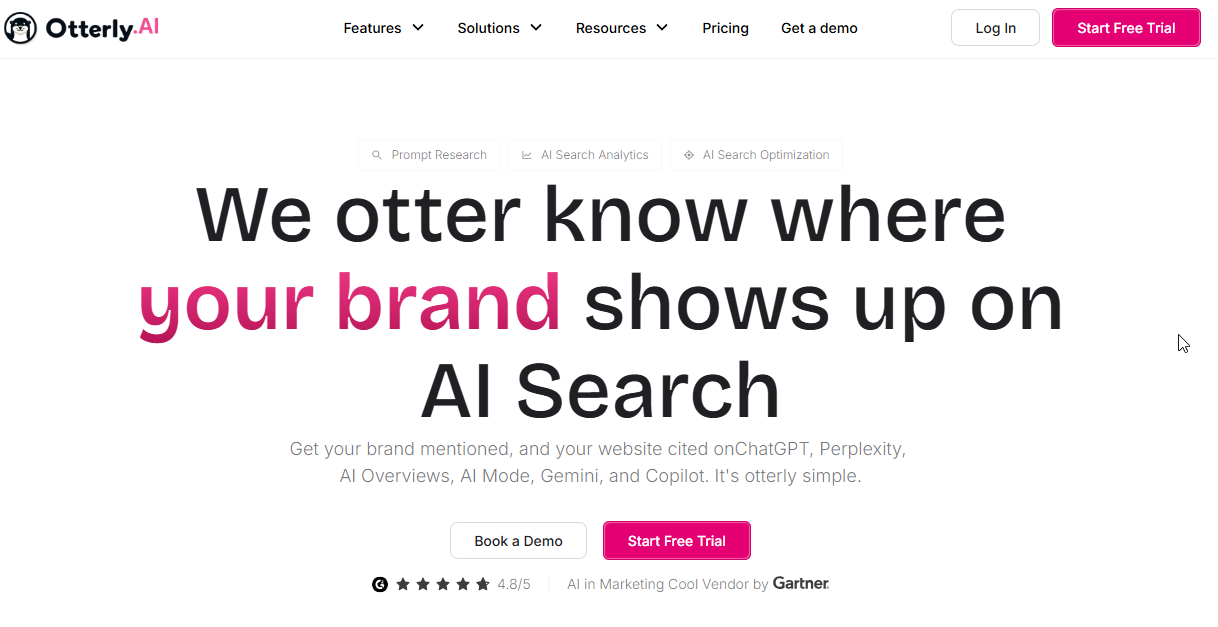
OtterlyAI provides the most accessible entry point for citation tracking, with weekly URL-level citation analysis and link position monitoring starting at $29/month. The platform's citation layer surfaces every domain and URL cited in AI-generated responses for your tracked prompts, displays link position movement over time, and connects citation data to its Brand Visibility Index — enabling teams to measure whether content updates actually improve citation authority without enterprise-tier pricing.
- Citation & Link Tracking: OtterlyAI automatically captures all cited URLs and source domains in AI-generated responses for tracked prompts, logging link position changes weekly. This enables citation trend analysis: teams can identify whether their domain is gaining or losing citation share compared to competitors across ChatGPT, Perplexity, Google AI Overviews, and Copilot.
- AI Engine Coverage: OtterlyAI tracks citations across 4 base engines — ChatGPT, Perplexity, Google AI Overviews, and Microsoft Copilot. Gemini and Google AI Mode are available as add-ons at $9–$149/month per tier, according to independent review data.
- Brand Visibility Index + Citation Correlation: OtterlyAI aggregates mention frequency, citation positioning, and competitive share into a Brand Visibility Index KPI — providing a single metric that reflects both mention and citation performance, making it easier to report citation impact to stakeholders.
- GEO Audit for Citation Optimization: OtterlyAI's GEO Audit evaluates on-page factors that affect citation likelihood — structured data, content parsability, entity signal strength — and provides page-level recommendations for improving AI citation rates.
- Pricing Structure: Plans range from $29/month (Lite, 100 prompts) to $989/month (Pro). G2 reviewers rate the platform 4.8/5 across approximately 50 verified reviews.
When OtterlyAI Is a Good Fit
Teams that need citation tracking at a budget entry point — particularly SEO managers and content leads running their first citation baseline across 25–100 prompts. The weekly citation data refresh and link position tracking provide sufficient granularity for teams iterating on content updates monthly.
When OtterlyAI Is Not a Good Fit
Organizations needing real-time citation analysis, "used vs cited" source distinction, or compliance-grade citation auditing. Teams tracking across 7+ engines on base plans will find the add-on model limiting for comprehensive citation intelligence.
Tool #2 — Peec AI
Best for: URL-level citation analysis & "used vs cited" source distinction
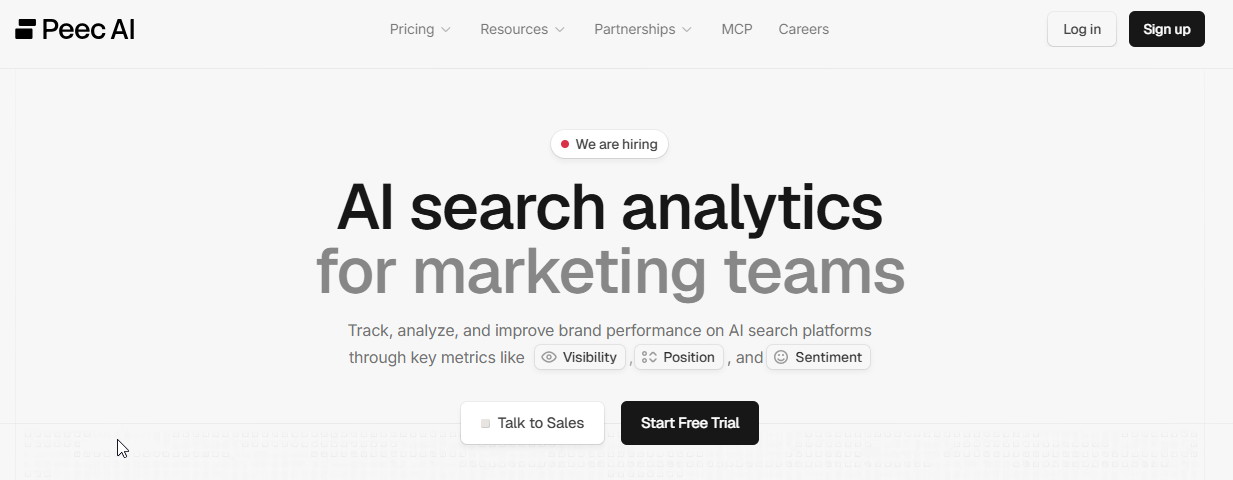
Peec AI differentiates on citation tracking through its "used vs cited" source analysis — distinguishing between domains the AI model consumed to construct the answer (used sources) and domains explicitly linked in the response (cited sources). This distinction is critical for citation strategy because it reveals the gap between influence and attribution: your domain may be heavily "used" by the model but never explicitly "cited," meaning your content shapes answers but receives no traffic credit.
- "Used" vs "Cited" Source Analysis: Peec AI provides URL-level analysis separating "used" sources (domains consumed by the model to build the answer) from "cited" sources (domains explicitly linked as attributions). This distinction reveals the influence-attribution gap and directs citation optimization efforts toward earning explicit attribution, not just content consumption.
- Source Gap Identification: Peec AI's Actions module identifies source gaps — domains and URLs that competitors are cited from but you are not — and scores each gap by estimated impact, producing a prioritized list of citation-building opportunities.
- Citation Tracking by Prompt Cluster: Peec AI enables citation analysis segmented by topic, prompt cluster, and competitive set, showing which citation sources dominate for specific buyer-intent categories and where your domain has the highest citation opportunity.
- AI Engine Coverage: Peec AI tracks citations across ChatGPT, Perplexity, and Google AI Overviews on all paid plans, with additional engines (Claude, Gemini, DeepSeek, Grok, Copilot, AI Mode) as paid add-ons at €20–30 per engine/month.
- Multi-Language Citation Tracking: Peec AI supports citation tracking across multiple languages and countries on all plans — important because citation sources vary significantly by geographic and language context.
- Pricing Structure: Plans start at approximately €95/month (Starter) and scale to €675/month (Scale), with unlimited seats. G2 reviewers rate the platform 4.7/5 across approximately 30 verified reviews.
When Peec AI Is a Good Fit
Marketing and content teams that need to understand not just where they're cited, but where they're "used" (influencing answers) without being explicitly cited — and want a prioritized action queue for closing that gap. The "used vs cited" distinction is unique in this comparison and is the most actionable citation intelligence layer for content strategists.
When Peec AI Is Not a Good Fit
Teams needing crawler-level citation infrastructure (bot crawling feeds, SOC 2 compliance) or revenue attribution from citation data. Organizations requiring 7+ engine coverage without per-engine surcharges.
Tool #3 — Profound
Best for: Enterprise citation depth + revenue attribution
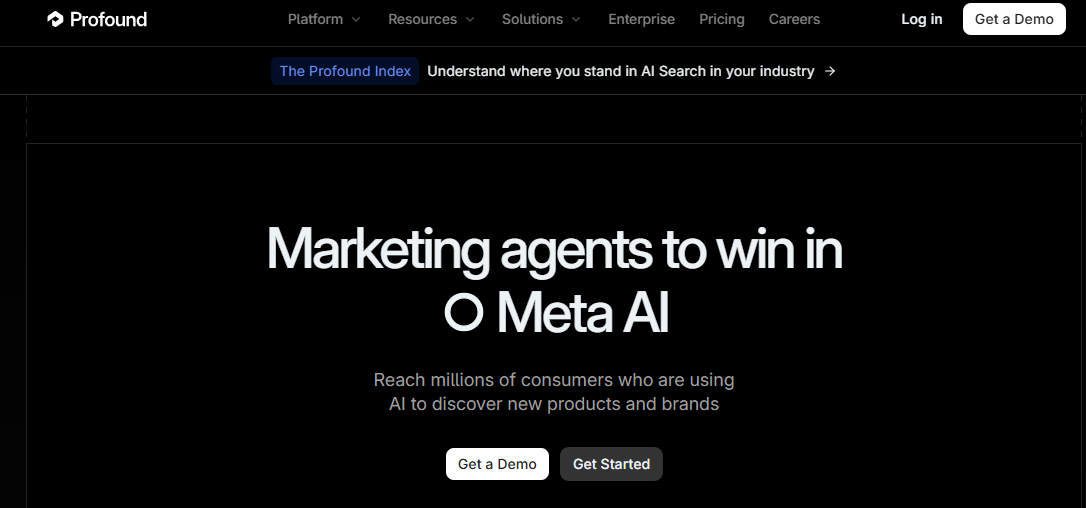
Profound provides the deepest citation intelligence in this comparison through page-level citation tracking tied to revenue outcomes, panel-derived prompt volume data for prioritizing citation efforts by search demand, and Agent Analytics that reveal which AI crawlers consume your content before deciding whether to cite it. Profound has raised significant funding including a $96M Series C announced in 2026, according to Rankability's competitive analysis, pushing it further into the enterprise citation intelligence category.
- Page-Level Citation Tracking: Profound tracks which specific URLs on your site are cited in AI-generated responses — not just domain-level mentions, but the exact pages AI engines reference. This enables citation gap analysis at the content-asset level: which pages are never cited, which are repeatedly pulled in, and which competitor pages are cited instead.
- Prompt Volume Data for Citation Prioritization: Profound offers panel-derived prompt volume estimates showing how many real users ask specific queries to AI engines. This enables teams to prioritize citation-building efforts on prompts with the highest actual search demand — not estimated keyword volume.
- Agent Analytics (Citation Input Layer): Profound's Agent Analytics dashboard tracks which AI crawlers and agents consume your content and how frequently — revealing whether your pages are even accessible to AI systems before they decide whether to cite you. Citation problems often originate at the crawl layer, not the content layer.
- Revenue Attribution from Citations: Profound connects citation data to site outcomes including traffic and pipeline, enabling enterprise teams to quantify the revenue impact of citation gains and prioritize citation optimization by business value.
- AI Engine Coverage: Profound monitors citations across 10+ AI engines — inclusive pricing, no per-engine add-ons — providing the broadest citation tracking surface in this comparison.
- Pricing Structure: Entry pricing starts at approximately $499/month, with enterprise tiers at custom pricing. G2 reviewers rate the platform 4.7/5 across approximately 38 verified reviews.
When Profound Is a Good Fit
Enterprise teams that need to connect citation data to revenue outcomes and prioritize citation-building by real prompt demand. Organizations where citation tracking carries brand/PR stakes and requires page-level granularity, Agent Analytics for crawl-layer diagnosis, and prompt volume data unavailable elsewhere.
When Profound Is Not a Good Fit
Budget-conscious teams running first-time citation tracking programs. The $499/month entry price and enterprise learning curve make it impractical for organizations without dedicated AEO specialists.
Tool #4 — Semrush
What it does
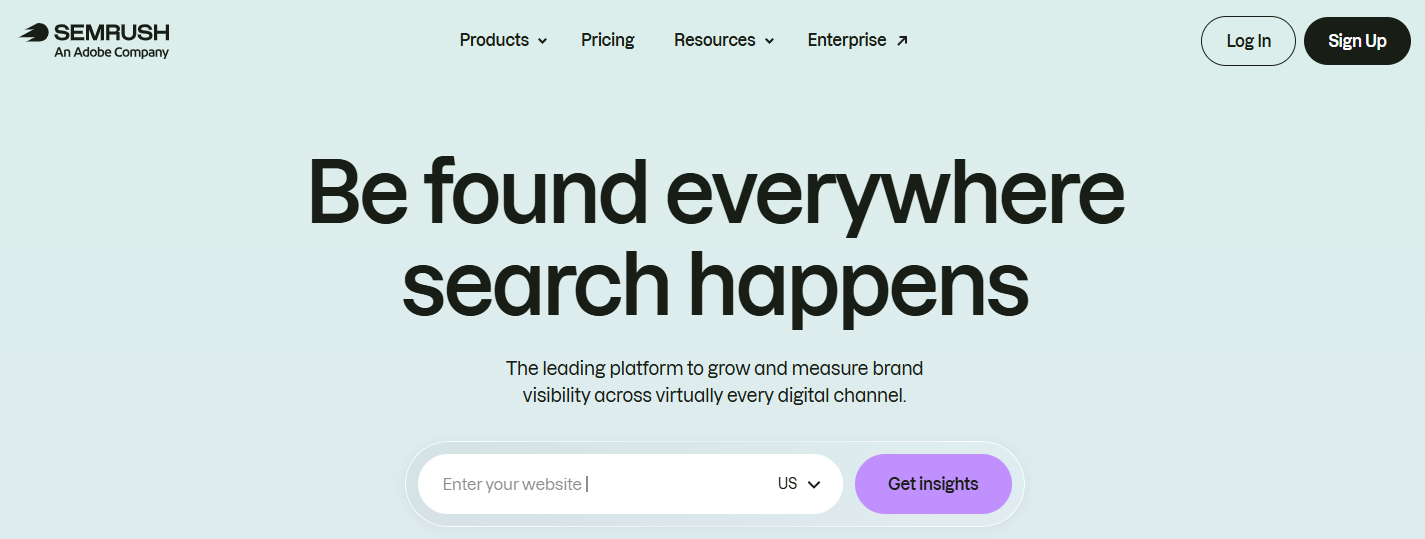
Semrush is a search visibility platform that tracks which sources AI cites in answers — alongside mentions and sentiment — and pairs that data with the SEO, content, and PR tools needed to close the gaps you find. Its AI Visibility Toolkit covers ChatGPT, Perplexity, Gemini, Google AI Mode, and Copilot, with Enterprise AIO extending coverage to Claude, DeepSeek, and Grok.
Why teams use it
Most citation trackers stop at the dashboard. Teams pick Semrush when they want all four pieces of the citation tracking loop in one stack:
- Track: capture citation share, prominence, and stability across the major AI engines
- Compare: benchmark citation share against up to 9 competitors per prompt
- Diagnose: identify whether you're losing on content format, evidence, authority, or technical accessibility
- Act: execute fixes through content updates, backlink-building, AI site audits, or PR outreach — all within the platform
What it's good for
- Citation share measurement vs up to 9 competitors per prompt
- Retrieval readiness: AI site audit flags technical issues that block AI bots from indexing your pages
- Source intelligence: 43T-backlink database for identifying which domains link to (and likely influence) competitor-cited sources
- Multi-market tracking: 38 countries and 28 languages via Enterprise AIO
- Action stack: connect citation gaps to content, technical SEO, and link-building workflows in one platform
When it's a good fit
Choose Semrush when:
- you need citation tracking AND the tools to fix what's broken (PR, content, technical SEO)
- you want a single platform across SEO and AI visibility, not two parallel stacks
- you're tracking across multiple markets, languages, or product lines
- your team will act on the data, not just report on it
When it's not a good fit
Semrush may be overkill if:
- you only want lightweight citation tracking on a small prompt set
- you don't have SEO or content workflows to consolidate with citation data
- your budget tops out at sub-$50/month tooling
How to use it for citation tracking
- Build a prompt library of 50–150 prompts split across money, problem, and proof buckets (matching the article's recommended portfolio).
- Add up to 9 competitors so each prompt returns comparative citation share data.
- Run a baseline across the supported AI platforms (ChatGPT, Perplexity, Gemini, Google AI Mode, Copilot) to capture cited domains, mentions, and sentiment per prompt.
- Tag each result by citation status: cited (your domain), mentioned only, or absent.
- Pull the cited-domain list to build a "source target list" — publishers AI cites for your category but doesn't link to you.
- Run an AI site audit to surface and fix retrieval gaps (crawler access, structured data, indexability).
- Use the backlink and link-building tools to target inclusion on competitor-cited domains.
- For multi-market programs, scale through Enterprise AIO with country- and language-level segmentation.
Key capabilities
- Citation tracking: which domains AI cites for tracked prompts
- Mention and sentiment tracking (positive / neutral / negative)
- Citation share comparison vs up to 9 competitors
- AI site audit for retrieval readiness (technical checks for AI crawler accessibility)
- 43T-backlink database for source diagnostics and link-building
- 261M+ prompts database for prompt research
- Multi-market scale: 38 countries, 28 languages via Enterprise AIO
Pricing
Plans start at $139/mo for SEO. Bundled SEO + AI visibility plans are available at higher tiers. Enterprise AIO pricing is custom (via demo). See Semrush's pricing page for current details.
Free tier?
Semrush doesn't offer a free tier, but it does offer a free trial on most plans and a free Enterprise AIO demo.
Downsides / limitations
- Broader platform vs pure-play specialist: if you only need lightweight citation tracking without SEO workflows, a $29/month tool is simpler.
- Learning curve: more surface area than single-purpose AI trackers.
- Pure-play AI tools (like Profound) can match Semrush on enterprise depth for AI specifically; Semrush's edge is the combined citation tracking + action stack, not citation tracking alone.
Tool #5 — Scrunch AI
Best for: Citation segmentation + AI crawler feed intelligence
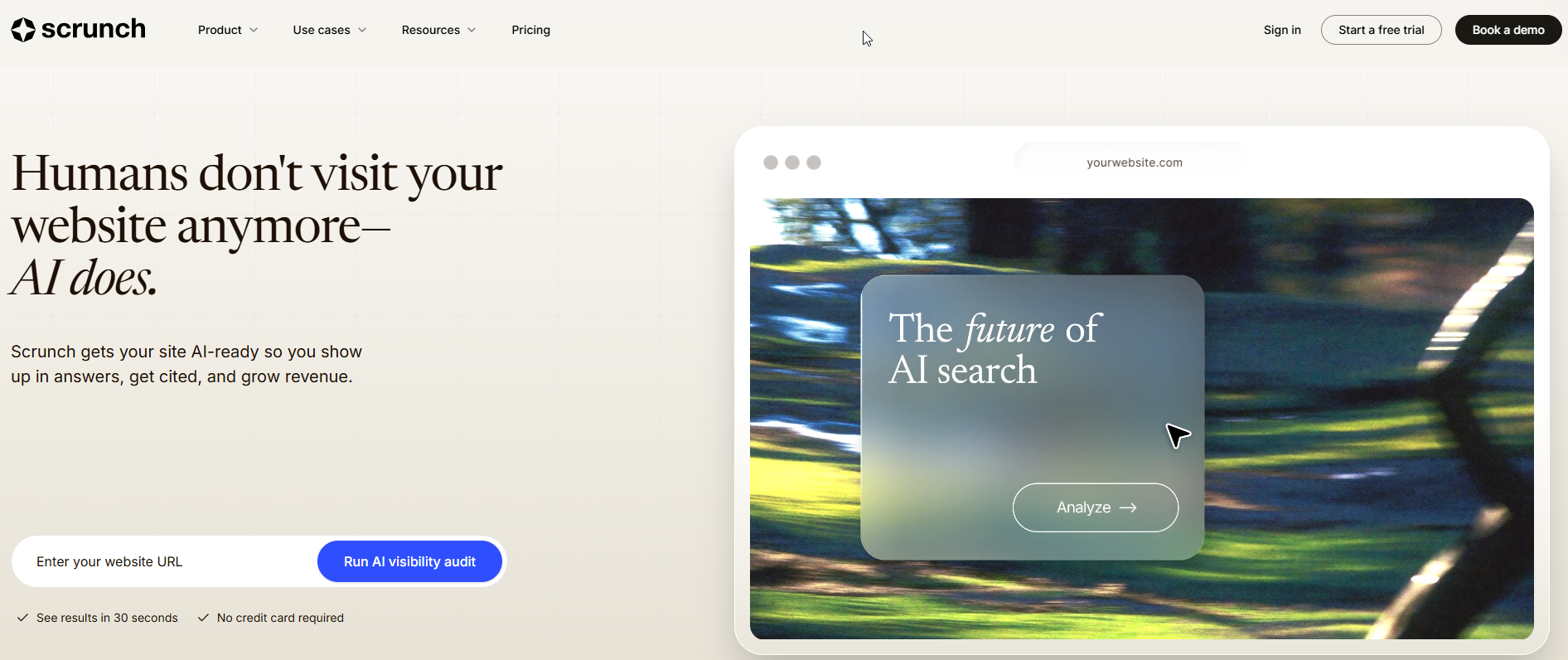
Scrunch AI provides the most technically sophisticated citation analysis in this comparison through its domain and URL-level citation intelligence with persona, topic, and geography filtering — combined with real-time AI bot crawling feeds that show which AI systems are consuming your pages before deciding whether to cite them. The platform's citation analysis reveals not just where you're cited, but which citation trends are emerging, declining, or disappearing — enabling proactive rather than reactive citation strategy.
- Citation Trend Analysis: Scrunch AI tracks citation trends over time — showing which citations are rising, declining, disappearing, or newly emerging. This temporal dimension reveals when a competitor has dropped off a source (overtake opportunity) or when your own URL has lost a citation (investigation trigger), according to Firebrand's Scrunch analysis.
- Citation Filtering by Persona & Topic: Scrunch AI enables citation analysis filtered by persona, topic, geography, and competitor — segmenting citation data to show which domains dominate citation share for specific buyer segments and subject areas, rather than providing only aggregate citation counts.
- Real-Time Bot Crawling Feed (Citation Input Layer): Scrunch AI integrates with GA4 and Cloudflare to provide real-time tracking of AI crawler visits, categorized into segments like "Citations," "Training," and "Indexing." This reveals whether AI systems are actually consuming your pages before making citation decisions.
- Content Gap Detection for Citations: Scrunch AI's Content Gaps feature auto-detects missing content for tracked prompts where competitors are cited but you are not — converting citation gap data into specific content creation briefs.
- SOC 2 Type II Certification: Scrunch AI is the only citation tracking tool in this comparison with SOC 2 Type II compliance — mandatory for enterprise procurement processes requiring auditable data handling.
- AI Engine Coverage: Core plan covers 4 engines (ChatGPT, Perplexity, AIOs, Copilot) at $250/month; Enterprise expands to 7+ engines including Claude, Gemini, and AI Mode.
- Pricing Structure: Core at $250/month (125 custom prompts), Growth at $500/month, Enterprise at custom pricing. G2 reviewers rate the platform 4.7/5 across approximately 25 reviews.
When Scrunch AI Is a Good Fit
Enterprise and mid-market teams that need citation intelligence with temporal trend analysis, persona-level segmentation, and crawler-side visibility into what AI systems actually consume. Organizations with SOC 2 compliance requirements for citation data handling. PR and content teams that need citation gap-to-brief automation.
When Scrunch AI Is Not a Good Fit
Budget-conscious teams running first-time citation tracking programs. Organizations without dedicated AEO specialists who need simpler citation monitoring. Teams that need "used vs cited" source distinction (Peec AI's differentiation).
Tool #6 — CrunchJunkie
Best for: Agencies that need citation tracking across all major AI engines and white-label client reporting at a low entry price
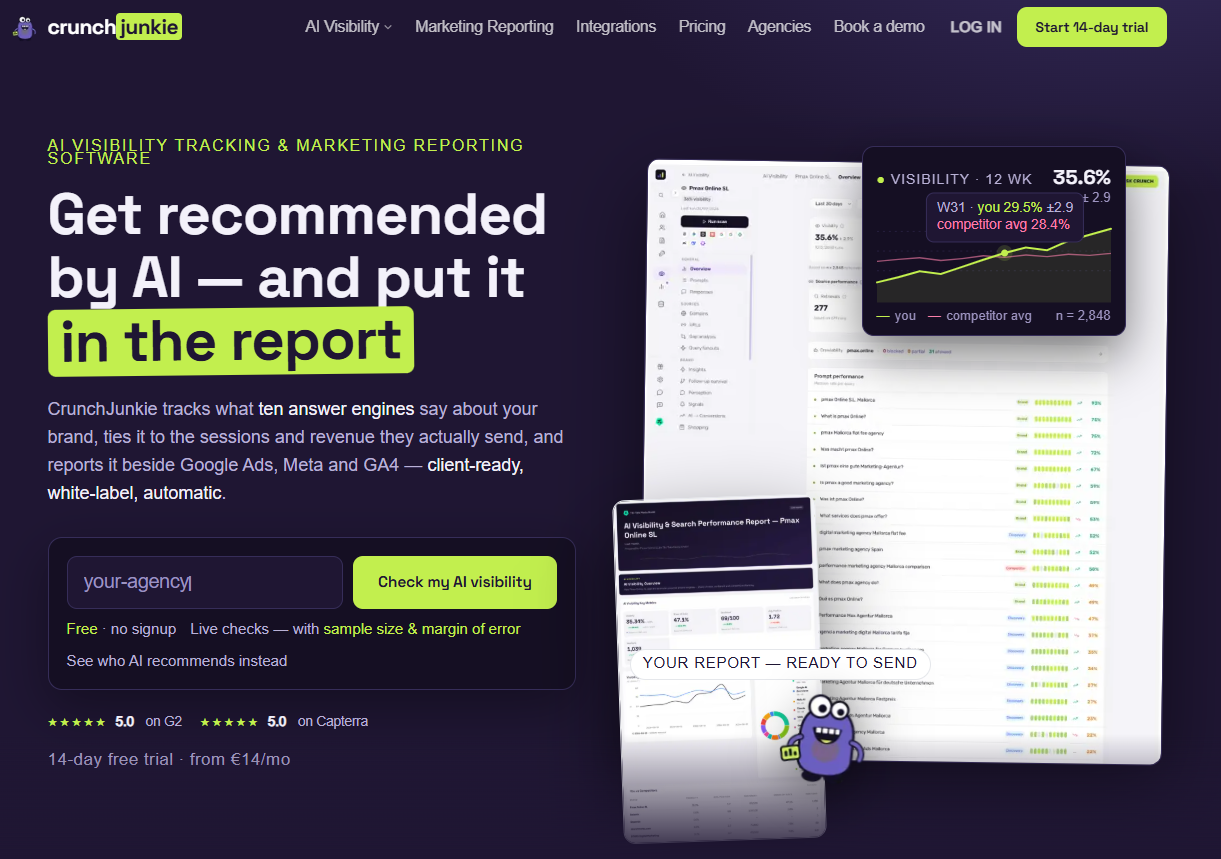
CrunchJunkie is an AI visibility tool with marketing reporting built in, made by Tiki-Taka Media GmbH in Hamburg. It tracks brand mentions and source citations across ten AI engines: ChatGPT, Gemini, Claude, Perplexity, Grok, DeepSeek, Microsoft Copilot, Google AI Overviews, Google AI Mode and Meta AI. All ten are included on every plan, including the €14 plan. Each AI answer is stored in full, together with the sources the engine retrieved while researching and the sources it cited in the answer. Visibility rates show their sample size and margin of error. The same citation data goes into white-label client reports next to Google Ads, GA4 and Search Console.
- Retrieved vs cited sources: for every answer CrunchJunkie stores which pages the engine retrieved and which it cited, and reports Retrieval Rate and Citation Rate for your domain separately. The crawl view shows, per page, how many answers read it and how many cited it. A page that is read often and cited rarely is shaping answers without getting credit.
- Cited vs named: a per-engine breakdown of how often your brand is named in answers against how often your domain is cited as a source. The two numbers often differ and mean different things for traffic.
- Citation gaps to content briefs: the Gap analysis lists the prompts where competitors are cited and you are not, with the domains the engines cited instead. Each gap can be turned into a content brief that quotes the actual answers and sources behind it.
- Citations ahead of Google rank: with Search Console connected, CrunchJunkie lists your pages that AI engines cite while they rank low or not at all in Google.
- Crawl layer: AI crawler visits verified against the providers' published IP ranges, the median time from a page's first AI crawl to its first citation per engine, and a GEO audit that detects firewall and WAF blocks and compares your crawler access with your competitors' domains.
- Source health: cited pages are checked for dead links and retracted sources.
- Sources and URLs views: cited domains and pages across all prompts, filtered by engine, topic, brand and a custom date range, with a citation trend chart, tags for competitor research, and a market and language setting per prompt.
- Sampling: two passes per prompt by default, weekly or daily, with Wilson confidence intervals on visibility rates. A change inside the margin is marked as such.
- Reporting: scheduled white-label reports, share links and PDFs that combine AI citation metrics with Google Ads, GA4, Search Console, Meta and LinkedIn data. Existing Peec AI projects can be imported.
- Integrations: a public MCP connector with 33 tools, so Claude or another MCP client can read citations, gaps and metrics and add prompts. Data is hosted in Frankfurt, Germany.
- Pricing: €14/month (Solo, one brand), €59 (Starter, five brands), €149 (Pro, 20 brands), €224 (Agency, 40 brands), all excluding VAT, with unlimited prompts per brand and all ten engines on every plan. Scans run on your own API keys at no extra charge, or on Managed AI scan packages from 645 checks a month at €0.039 per check, overage €0.05 per check. Rated 5.0/5 on G2 (4 reviews) and Capterra (6 reviews).
When CrunchJunkie Is a Good Fit
Agencies that report AI visibility and citations to clients and want the report, the white-label and the ten engines in one subscription. Teams that want a lower entry price than Peec AI or Profound without giving up engine coverage. Anyone who wants a sample size next to the numbers.
When CrunchJunkie Is Not a Good Fit
Enterprise programmes that need panel-based prompt volume data or SOC 2 Type II documentation; CrunchJunkie has neither. Teams that only want a monitoring dashboard and no reporting.
What “citation tracking” means in AI search (and why it’s different from backlinks)
Citation tracking in AI search measures which source URLs are explicitly referenced — as clickable links or named attributions — within AI-generated answers across engines like ChatGPT Search, Perplexity, Google AI Overviews, and Copilot. A citation is fundamentally different from a backlink because backlinks are static, page-to-page references that persist until removed. AI citations are dynamic, probabilistic, and regenerated every time a user asks a prompt — meaning your citation status can change from query to query, engine to engine, and day to day.
The Three Layers of AI Source Behavior
AI engines process sources at three layers, and most citation tracking failures happen because teams conflate them:
- Consumed sources (training/retrieval input): Pages the model ingested during training or retrieved during real-time search. Your content may heavily influence the answer without ever being cited. This is the "invisible influence" layer.
- Referenced sources (model attribution): Pages the model explicitly attributes its information to — appearing as inline citations (Perplexity), source links (ChatGPT Search), or cited URLs (Google AI Overviews). This is what citation tracking tools measure.
- Displayed citations (user-facing links): The subset of referenced sources that appear as clickable links visible to the end user. Not all referenced sources produce clickable links — some engines attribute without linking.
Why Citation Tracking Matters More Than Mention Tracking
A brand mention in an AI answer is an awareness signal. A citation is an authority signal. The Princeton/Georgia Tech GEO study showed that content with explicit, authoritative citations is 30–40% more likely to be extracted by AI systems. Brands that earn citations get two outcomes that mentions alone don't provide: traffic attribution (clickable citations drive visits) and compounding authority (cited sources are more likely to be cited again in future queries by the same and other AI engines).
The metrics that actually move AI visibility
Citation Share
The percentage of tracked prompts where your domain is explicitly cited as a source in AI-generated responses. This is the primary output metric for citation tracking programs.
Citation Source Diversity
Which types of sources AI engines cite when answering queries in your category: your own domain, competitor domains, third-party publications, review sites, documentation sites, forums. Understanding source diversity reveals whether your citation strategy should target owned content, earned media, or both.
Citation Quality (Recommendation vs Attribution)
Not all citations carry equal value. A citation in a recommendation context ("the top tool for this is X, according to [your domain]") drives more pipeline than a citation in a neutral data reference. Semrush's sentiment + citation integration and Peec AI's source-type analysis provide this quality layer.
Citation Velocity
The rate at which your citation share changes over time. Scrunch AI's citation trend analysis tracks rising, declining, and emerging citations — enabling teams to detect citation gains or losses before they fully materialize in aggregate metrics.
📋 Get Listed / Advertisement
We update this guide monthly. Want your tool featured? Contact: [email protected].
What are the best AI visibility tools for citation tracking in 2026?
As of January 2026, the strongest “AI citation tracking” tools (i.e., tools that capture links/sources used by AI answers and trend them over time) generally fall into two buckets: (1) self-serve monitoring for marketing/SEO teams and (2) enterprise visibility ops.
Top picks to shortlist:
- OtterlyAI; solid self-serve AI visibility monitoring; explicitly highlights analyzing link citations in AI responses.
- Peec AI; “AI search analytics for marketing teams,” with prompt tracking as a foundation.
- Profound; enterprise AI search visibility/optimization focus (often custom pricing and governance-oriented).
- Promptmonitor; often used by SMBs/agencies for multi-model monitoring; worth a look if you want broad coverage at lower cost.
- CrunchJunkie; AI visibility tool for agencies with retrieved-vs-cited source tracking on ten engines and white-label client reports, from €14/month.
How to pick quickly
- Choose OtterlyAI if you want to get started fast and specifically care about URL/link citation analysis.
- Choose Peec if your priority is prompt monitoring + marketing-friendly dashboards.
- Consider Profound if you need enterprise controls + deeper program management.
Reality check: “Best” depends on your prompt volume, engines you must support (ChatGPT/Perplexity/AIO), and whether you need team governance vs exports into Looker/PowerBI.
How do I track which sources ChatGPT uses?
The practical answer: you track ChatGPT outputs with web search enabled and extract the linked sources it provides.
What to do (reliable workflow):
- Run ChatGPT Search prompts consistently (same prompts, same cadence). ChatGPT Search is designed to provide “timely answers with links to relevant web sources.”
- Capture the sources (links shown in the response/Sources view) and store:
- prompt text + tags (intent/category/geo)
- date/time run
- response text
- source URLs/domains
- Normalize URLs (strip tracking params, canonicalize http/https, collapse subdomains if needed).
- Trend the source set week over week:
- new sources appearing
- sources disappearing
- “top cited domains” by prompt cluster
Two ways teams track it
- Manual (early stage): spreadsheet + weekly runs (good for 20–50 prompts).
- Tool-based (scales): AI visibility trackers that run prompts automatically and store citations/links over time (fewer human hours, better consistency). (For example, Otterly’s positioning includes “Analyze Link Citations.”)
How do I track citations/links in Google AI Overviews?
Google AI Overviews: Google positions AI Overviews as summaries that help users explore via links (source links are a core part of the experience).
Option A (simplest): use a tracker tool
- Use an AI visibility tool that claims coverage for Google AI Overviews, then track:
- whether you are linked/cited
- which competitor sources appear
- changes over time(OtterlyAI and other AI monitoring tools publicly mention tracking AI Overviews; validate exact coverage and location support in your demo.)
Option B (SEO/analyst workflow): capture the SERP blockIf you have an engineering/analytics workflow:
- Build a fixed query set (your “prompt portfolio” but for Google queries).
- Run them in a controlled environment (country/language/device).
- Extract:
- AI Overview text
- AI Overview links
- linked domains and URLs
- Store daily/weekly snapshots to measure volatility.
Some teams use SERP APIs that offer “AI Overview” extraction to systematize capture (useful if you need scale and geo coverage).
Important nuance: AI Overviews can vary by country/language and by time; so your tracking must be geo + language aware, not just “global averages.” Google also maintains site-owner guidance for AI features through Search Central.
What’s the difference between an AI citation and a backlink?
Backlink: a hyperlink from one website to another (a web graph signal).
AI citation: a source reference included inside an AI-generated answer (often a link card or “Sources” list). In other words, it’s the AI saying “this claim comes from here,” which changes the discovery path.
Why that matters operationally:
- Backlinks are about authority transfer and ranking systems.
- AI citations are about answer inclusion and “who gets referenced” when the user never clicks to page 2 of Google.
In AI surfaces, you’re competing to be retrieved and referenced, not only to rank #1 in classic SERPs.
What metrics should I report: citation share, prominence, source diversity?
If you want metrics that drive decisions (not vanity), report these as a weekly/monthly scorecard:
1) Citation rate (baseline KPI)
% of tracked prompts where your domain is cited/linked.
2) Citation share (competitive KPI)
Of all citations in your prompt set, what % go to you vs competitors?
3) Citation prominence (impact KPI)
Was your citation:
- early/top-of-answer (high impact)
- mid-answer (medium)
- only in sources/footer (lower)
4) Source gap list (action KPI)
Top 10–50 domains that are cited instead of you (your “hit list” for content, PR, partnerships).
5) Source diversity (risk KPI)
If a model heavily cites only a few domains, you have fragility risk:
- one publisher update can tank your visibility
- one competitor partnership can displace you
6) Volatility (confidence KPI)
How much do citations change week-to-week for the same prompt set?
These metrics map cleanly to actions: publish “citeable” pages, win inclusion on frequently cited publishers, and prevent regressions by watching volatility.
Why does AI cite competitors even if you outrank them in Google?
Because “ranking #1” and “being cited by an AI” are related but not identical.
Common reasons you see competitor citations:
- The competitor’s page is easier to quote (clear definitions, tables, concise explanations).
- The competitor is present on a highly cited third-party source (directory, review site, analyst roundup).
- Entity ambiguity: the model associates your category terms more strongly with competitors.
- Freshness / update cadence: AI may favor recently updated sources for time-sensitive topics.
- Different retrieval sources: the AI’s retrieval and citation logic doesn’t mirror classic SERP ordering.
Your fix is not “rank harder.” It’s “be more citable" and “be present on the sources AI already trusts.”
How do I find “citation gaps” (sources AI uses that don’t mention me)?
A “citation gap” is simply: domains that show up in AI sources for your prompts, but don’t reference your brand/product.
Process (repeatable):
- Export the top cited domains/URLs for your category prompt clusters.
- Classify each source into one of three buckets:
- Outrankable content (you can build a better page and compete directly)
- Inclusion targets (directories, communities, comparison sites, review platforms)
- Authority anchors (standards bodies, universities, government—hard to replace, but you can align with them)
- For the Inclusion bucket, run an “inclusion audit”:
- Do they list your category?
- Do they list competitors?
- Is there a submission/edit process?
- Create a backlog:
- Content backlog (pages to publish/update)
PR/partnership backlog (sites to get included on)
This is where citation tracking becomes a growth lever: you stop guessing and start working on the exact sources models already cite.
How many prompts do I need for reliable tracking?
Use a tiered approach:
- 20–50 prompts = directional learning (great to start; enough to find obvious gaps).
- 50–150 prompts = reliable category coverage for a single product line.
- 150–300+ prompts = stable reporting across ICPs, use cases, and competitor sets.
- 300–1,000+ = enterprise, multiple product lines, multi-geo, “always-on” visibility ops.
Rule of thumb: if your answers are volatile, you need more prompts and more frequent runs (daily/weekly) to separate signal from noise.
Can citations drive traffic, or is this only brand visibility?
It can do both, but you should set expectations:
When citations drive traffic
- AI surfaces show clickable links (e.g., AI Overviews “with links” to explore more).
- The answer creates “next-step curiosity” (comparison, pricing, templates, calculators).
- Your cited page matches the user intent exactly (reduces bounce).
When it’s mostly brand visibility
- You’re mentioned but not linked.
- The AI answer fully satisfies the query (no need to click).
- The cited source is a third-party site, not your domain.
Best practice: treat citations as top-of-funnel distribution and measure impact via:
- referral traffic from AI surfaces (where available)
- branded search lift
- assisted conversions (multi-touch)
How do I track citations by country/language?
You need two controls:
- Geo control: run the same prompt/query from specific countries (or simulate through tooling).
- Language control: run prompts in the target language and keep the prompt set consistent.
Operationally:
- Create prompt sets per market: US-English, UK-English, DE-German, etc.
- Track per-set metrics: citation share, top cited domains, volatility.
- Expect different “default sources” by market (local publishers often dominate citations).
Google itself states AI Overviews availability varies by countries and languages, which is another reason geo/language segmentation matters.
FAQs
What is an “AI citation”?
Which AI platform is easiest to track citations in?
Does ChatGPT always show sources/links?
Do Google AI Overviews include source links?
How many prompts do I need for reliable tracking?
What’s the biggest mistake teams make with citation tracking?
Which citation tracking tool includes every AI engine on its cheapest plan?
📋 Get Listed / Advertisement
We update this guide monthly. Want your tool featured? Contact: [email protected].
📑 Disclosure!
Some links in this article are affiliate links. If you sign up through them, The Rank Masters may earn a commission at no additional cost to you. This does not influence which tools we recommend or what we say about them.