
Half of B2B software buyers (51%) now start their research with an AI chatbot rather than Google, according to G2's April 2026 Answer Economy research, nearly double the 29% recorded one year earlier.
That single number explains why PSOhub, a professional services automation (PSA) platform built for service teams that run projects, contracts, and invoicing in one place, did not commission a traditional SEO retainer in 2026.
Instead, PSOhub and The Rank Masters (TRM) ran a time-bound, 90-day-measured proof of concept (POC) with one job, namely to prove that a single ICP-led content system could win Google rankings, AI-answer citations, real engaged visitors, and early buying signals at the same time, and to prove it fast enough to justify a scale decision.
This case study documents exactly what happened.
Every number below comes from Google Search Console, Google Analytics 4, and Semrush's AI visibility layer, measured across the 18 pages TRM delivered, over a fixed trailing 90-day window (16 April to 14 July 2026).
Why that stack, specifically. GSC and GA4 cover discovery and behaviour, but neither can tell you whether an AI engine named your page as a source. That third layer came from Semrush's AI visibility tracking, which samples real prompts across ChatGPT, AI Overviews, AI Mode, and Gemini and counts the distinct prompts citing each URL. It is the only one of the three that answers Question 2, and it ran inside PSOhub's own tooling rather than an agency dashboard.
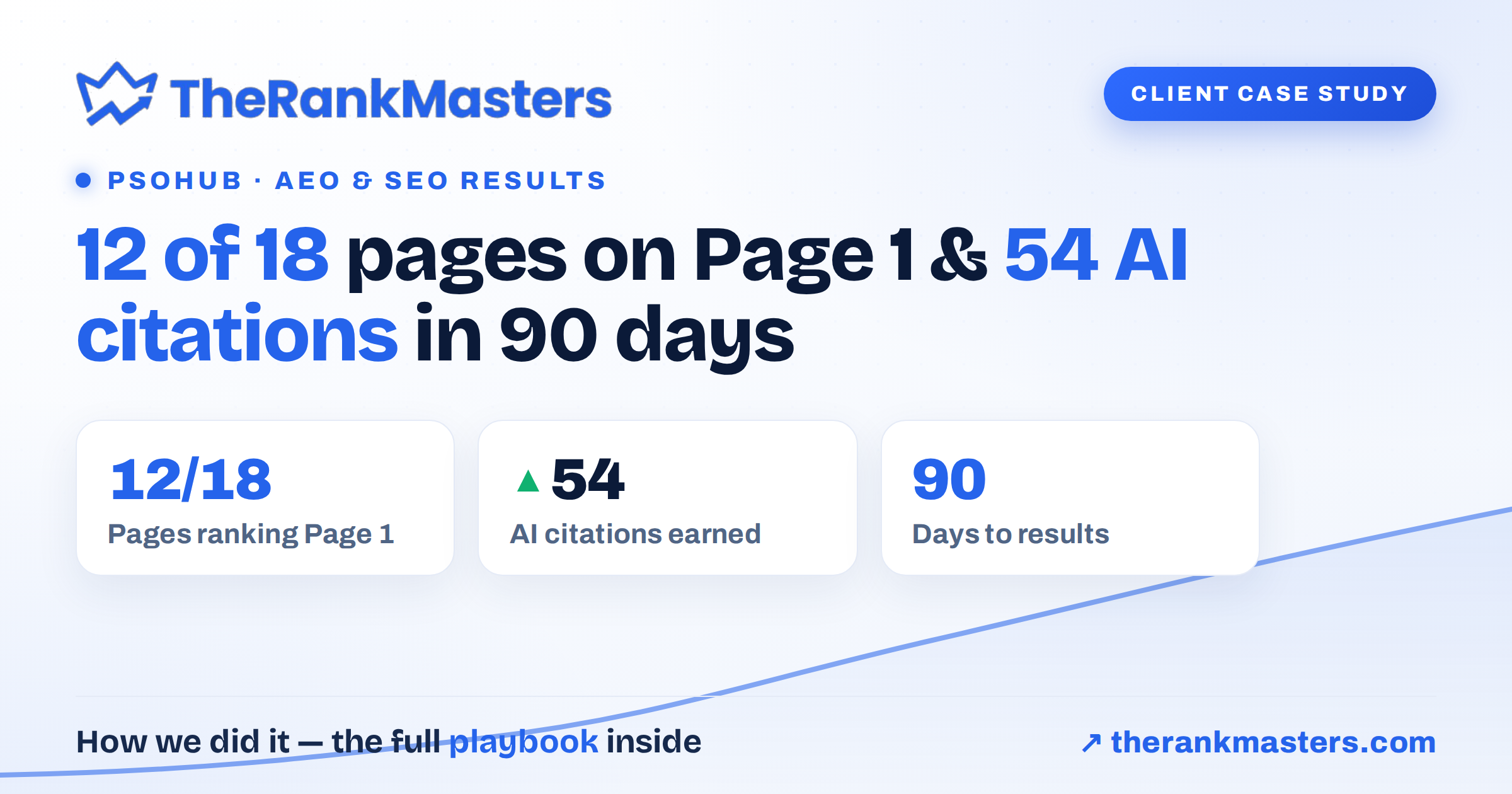
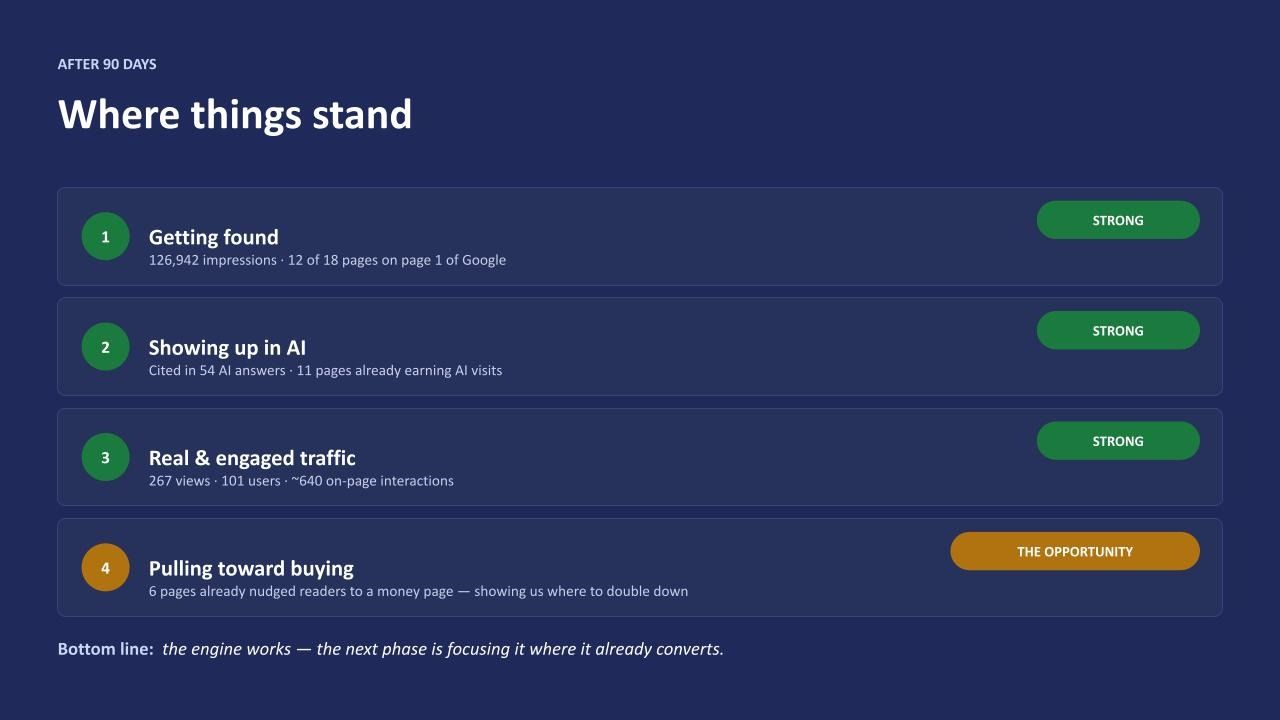
The short version 👉 12 of 18 pages reached page 1 of Google inside the window, the content earned 133,000 search impressions, 12 pages were cited across 54 AI-answer prompts worldwide, AI engines sent 50 real human visits (roughly 1 in 5 of all page views), and 6 pages had already pushed readers to a PSOhub money page before most of the content was even eight weeks old.
▶️ If your ranked pages are not showing up in AI answers and you want a content system that fixes that, book a SaaS content strategy call.
TL;DR: PSOhub's 90-Day Proof of Concept Results at a Glance
Client: PSOhub., a Netherlands-based PSA platform for professional services teams (project management, contract management, time tracking, and invoicing on top of HubSpot).
Engagement: A structured proof of concept (POC). A planning phase (18 February to mid March 2026) locked one primary ICP persona, one core topic cluster, and a four-month execution roadmap mapped to money pages. An execution phase (mid March to mid July 2026) shipped a fixed cadence of four content deliverables per month plus one commercial lever per month. TRM delivered finalized content; PSOhub published in its own CMS.
Measurement window: Trailing 90 days, 16 April to 14 July 2026, across all 18 delivered pages (12 new, 6 refreshed).
| Metric | 90-Day Result | Source |
|---|---|---|
| Search impressions | 133,000 | Google Search Console |
| Pages on page 1 of Google | 12 of 18 | Google Search Console |
| Organic clicks | 58 | Google Search Console |
| Pages cited in AI answers | 12 of 18 | Semrush |
| AI-answer citations (worldwide prompts) | 54 | Semrush |
| Real visits from ChatGPT + Google AI | 50 | GA4 |
| Page views / active users | 267 / 101 | GA4 |
| On-page interaction events | ~640 | GA4 |
| Pages that drove a content-to-money-page click | 6 of 18 | GA4 |
| Demo clicks / sign-ups | 3 / 1 | GA4 |
Bottom line ▶️ The engine works. Discovery (Google), eligibility (AI answers), engagement (real interactions), and early commercial movement (money-page clicks) all fired inside one 90-day window, on content that was mostly 3 to 9 weeks old. The scale decision now has data behind it instead of opinions.
About PSOhub and Why a PSA SaaS Company Bet on AI-Era Content
PSOhub is a professional services automation platform that gives agencies, consultancies, and service teams one system for project management, contract management, time tracking, resource planning, and invoicing, with deep native HubSpot integration. Its buyers are operations and delivery leaders at service businesses, exactly the kind of research-heavy, multi-stakeholder purchase where discovery now happens across both Google and AI assistants.
That buying shift is measurable.
In G2's March 2026 survey of 1,076 B2B software buyers, AI chatbots ranked as the top source influencing vendor shortlists, and Tim Sanders, G2's Chief Innovation Officer, described the change as buyers moving "from reference to inference."
For a PSA vendor, the practical consequence is blunt. When a consultancy COO asks ChatGPT to "compare the best invoicing software for a professional services firm," PSOhub is either inside that answer or invisible to that buyer.
PSOhub's leadership understood this and wanted proof, not promises.
So the mandate handed to TRM was not "publish blogs."
It was closer to a controlled experiment, and it mirrors the pattern we documented in our Birdview PSA BOFU SEO case study, where a small, high-intent cluster outperformed a 350-post legacy library.
Serious PSA vendors are no longer asking whether content works. They are asking which specific content system produces buyers, and how quickly the data can prove it.
The Challenge: Prove Google Rankings, AI Citations, and Buying Signals in One Window
The challenge was compression.
A proof of concept has to demonstrate in roughly one quarter what SEO programs normally get six to twelve months to show, and it has to do it across two discovery layers (classic search and AI answers) simultaneously.
Three constraints made this genuinely hard:
- Rankings mature slowly by default. In Ahrefs' 2025 ranking-age study, only 1.74% of newly published pages reached Google's top 10 within a full year, and the average number-one ranking page is now about five years old. A 90-day window is brutally short against that baseline.
- AI citations have no guaranteed on-ramp. AI engines cite pages they can retrieve, parse, and trust. New pages start with none of that history, so citation velocity had to be engineered into the content itself rather than hoped for.
- Conversion tracking had to attribute correctly. PSOhub did not want vanity sessions. It wanted to know which specific page moved a reader toward a money page, a demo, or a sign-up, which meant every conversion event had to be credited to the page it actually fired on.
The proof of concept also had a fourth, quieter constraint. PSOhub publishes in its own CMS and owns its analytics stack, so the system had to work inside the client's real operating environment (HubSpot CMS, GA4, Google Search Console, Semrush), not inside an agency-controlled sandbox.
How the 90-Day Proof of Concept Was Structured
The engagement was deliberately phased, because the fastest way to waste a content budget is to start writing before the ICP, the cluster, and the measurement stack are locked.
Phase 1, Planning (18 February to mid March 2026). TRM reviewed PSOhub's existing inputs, ICP documentation, and market context, then locked three artifacts before a single article was drafted:
- One primary ICP persona: A single, documented buyer persona with rationale, instead of writing for everyone in professional services at once.
- One core topic cluster: The connected question space that persona actually researches, spanning PSA evaluation, project accounting, retainers, rates, capacity, and AI in project delivery.
- A four-month execution roadmap: Every planned piece mapped to a commercial (money) page, sequenced by priority, with new content and refresh opportunities identified up front.
The planning phase also defined the measurement contract, namely which metrics from Google Search Console, GA4, and the AI visibility layer would count as proof, plus the baseline prompt sets used to track LLM citations.
This is the same eligibility-first logic we unpack in our guide on how to get cited in AI answers.
Phase 2, Execution (mid March to mid July 2026). A fixed monthly cadence, held for four months:
| Monthly Deliverable | Volume | Purpose |
|---|---|---|
| Content deliverables (new or refreshed) | 4 per month | Build the topic cluster and AI-answer eligibility |
| Commercial lever (money page update or BOFU asset) | 1 per month | Ensure discovery traffic has somewhere commercial to land |
TRM delivered every piece as a finalized document; PSOhub's team published in its CMS and implemented technical changes. That division of labor matters for anyone evaluating this model, because it shows the results below were achieved through content architecture and strategy, not through privileged access to the client's website infrastructure.
By 14 July 2026, 18 pages were live: 12 net-new articles and 6 strategic refreshes of existing posts (refreshes are marked in the scoreboard below, and they turned out to matter enormously).
The Four-Question Framework Every Page Was Judged Against
Every one of the 18 pages was measured against the same four questions, three that prove the content is working and a fourth that sets the strategy. This framework is what turned the proof of concept from a content project into an experiment with a readable verdict.
| # | Question | What It Measures | Data Source |
|---|---|---|---|
| 1 | Is it getting found? | Impressions, clicks, and ranking position in Google | Google Search Console |
| 2 | Is it showing up where buyers now look? | Citations inside AI answers (ChatGPT, Google AI Overviews, AI Mode, Gemini) and real visits those engines send | Semrush + GA4 |
| 3 | Is the traffic real and engaged? | Page views, active users, engagement time, on-page events, exact traffic sources | GA4 |
| 4 | Is it pulling people toward buying? | Content-to-money-page clicks, demo clicks, sign-ups and trials, credited to the page they fired on | GA4 |
Two design choices in this framework are worth stealing.
- AI visibility is a first-class metric, not a footnote. Question 2 exists because the answer layer is now a discovery channel with its own physics. Conductor's 2026 AEO/GEO Benchmarks Report, built on 13,770 enterprise domains and 3.3 billion sessions, found that ChatGPT alone drives 87.4% of all AI referral traffic and that Google AI Overviews now appear on roughly 25% of analyzed searches. A measurement framework that ignores that layer measures yesterday's funnel.
- Conversion events are page-attributed. Question 4 credits each money-page click, demo click, and sign-up to the exact page it fired on. Without page-level attribution, a proof of concept cannot tell you which topics attract buyers, which is the entire point of running one.
If you are building your own version of this, our playbook on creating an AEO strategy for B2B SaaS walks through the prompt-mapping and measurement setup in detail.
The Content Strategy: One Persona, One Cluster, Fan-Out to Money Pages
The strategy rested on the same architecture TRM used in its own 8,337% ChatGPT referral growth case study, adapted to PSOhub's PSA vertical.
- ICP-led topic selection: Every topic came from the locked persona's real question space, so the cluster covered PSA evaluation ("PSA vs. ERP," "PSA buyer scorecard"), service-business finance ("project accounting," "pay rate vs. bill rate," "retainer management"), comparison and software queries ("best project management software," "best invoicing and billing software," "CRM tools for consulting"), and AI in delivery ("AI project management").
- Query fan-out per page: Each article was architected around the sub-questions an AI engine expands the head query into, with one sub-query per section and an answer-first opening line, the structure we teach in how to write AEO-optimized content. This is what makes a page quotable to a model, not just readable to a human.
- Refresh where equity already existed: Six pages were refreshed and re-slugged rather than written from scratch, deliberately targeting URLs where PSOhub already had indexation history. The two refreshed comparison posts (best project management software and best invoicing and billing software) became the two most AI-cited pages in the entire program, with 16 and 17 prompt citations respectively.
- Money-page mapping: Every content page had a defined commercial destination, and one commercial lever per month (a money page update or BOFU asset) kept the destinations themselves strong. Content that ranks but routes nowhere is a brand asset; content mapped to money pages is a pipeline asset.
- Extractable structure: Tables, scannable criteria blocks, answer-first sections, and consistent entity naming across the cluster, so both Google's systems and LLM retrieval could lift clean chunks.
Nothing in this list is exotic. The differentiation is that all five ran together, on one persona, inside one measured window.
Question 1: Is the PSOhub Content Getting Found in Google?
Verdict: Strong.
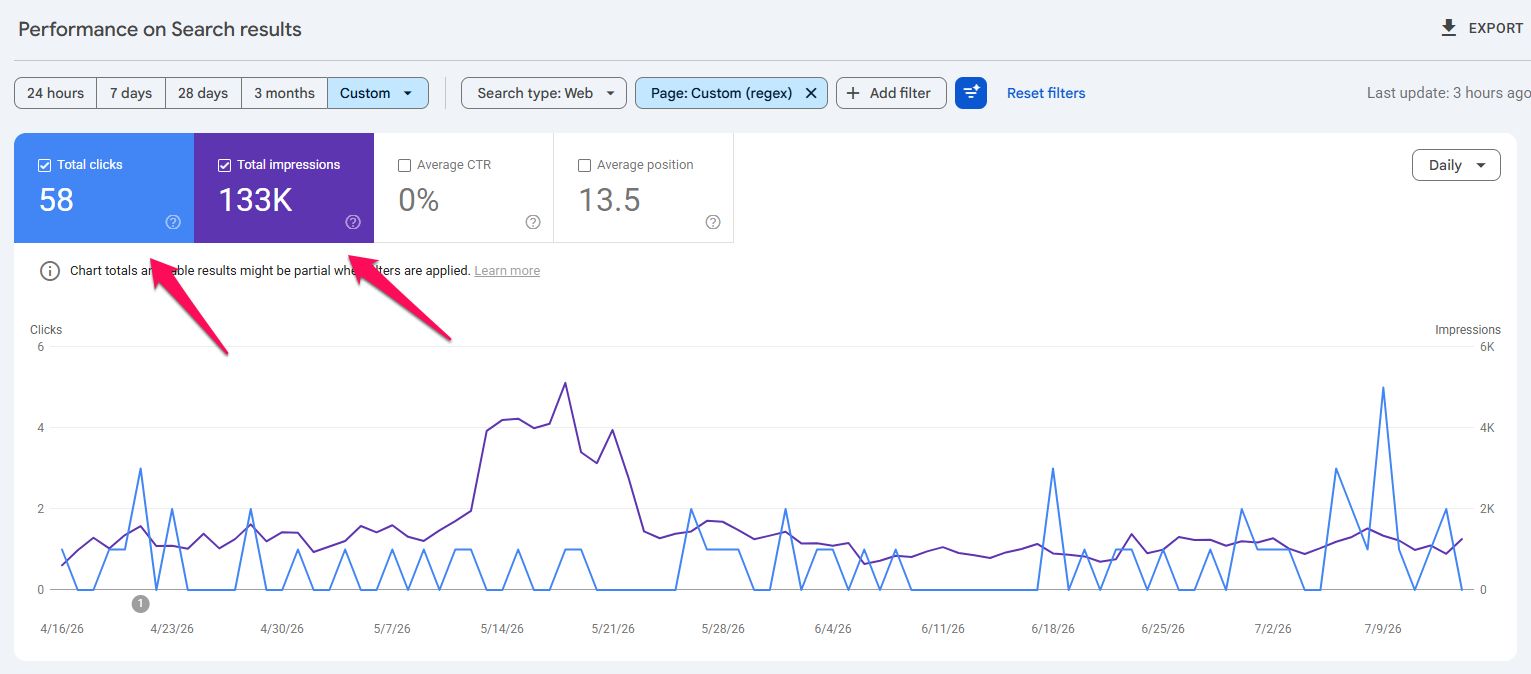
The 18 pages earned 133,000 search impressions in 90 days, 12 of 18 reached page 1 of Google, and 58 organic clicks arrived while most pages were still weeks old.
| Metric | 90-Day Result | What It Tells Us |
|---|---|---|
| Search impressions | 133,000 | Strong query visibility across all 18 delivered pages |
| Pages ranking on page 1 | 12 of 18 | Exceptionally fast against typical 3-to-6-month maturity curves |
| Organic clicks | 58 | Early by design; click-through compounds as positions climb |
Context makes this result readable.
Against the Ahrefs finding that fewer than 2% of new pages crack the top 10 within a year, PSOhub put two-thirds of a brand-new cluster on page 1 inside 90 days, including pages that were live for only four weeks.
The retainer setup kit page, published 17 June, was averaging position 7.1 within four weeks.
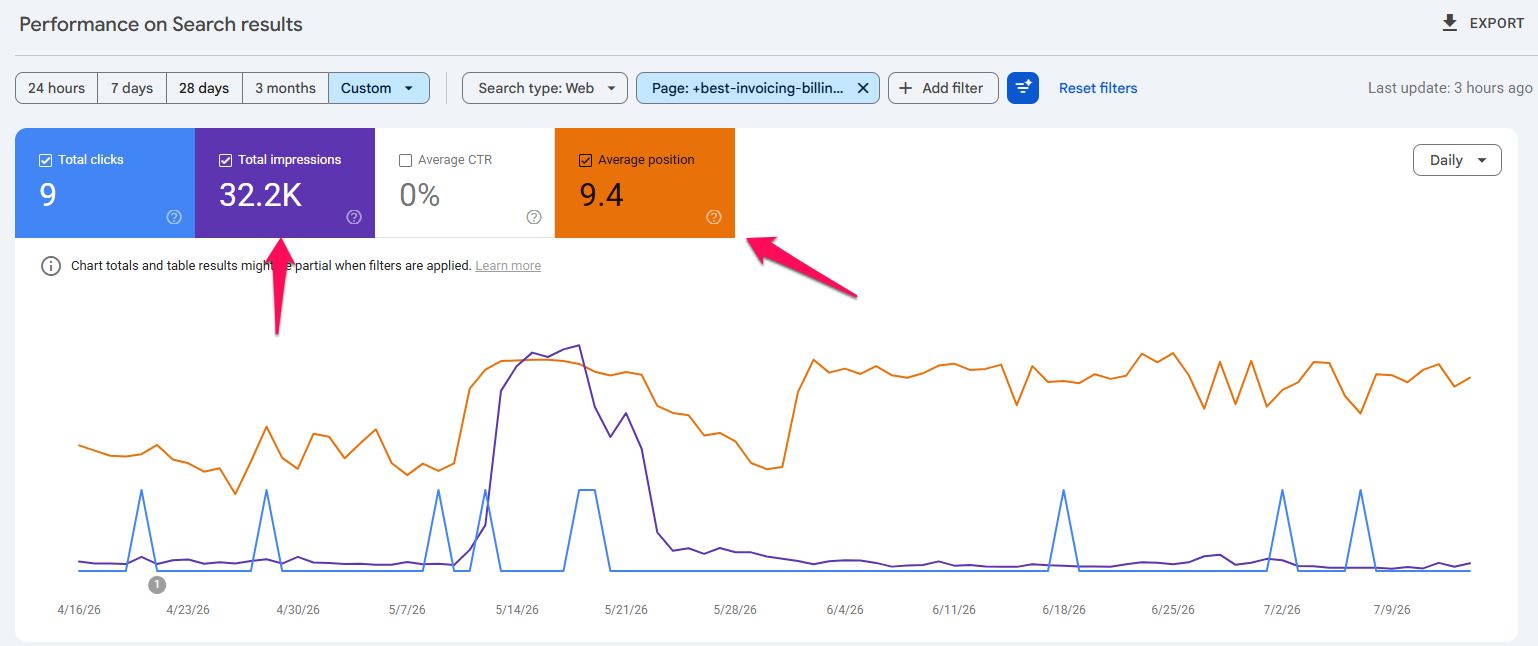
The profitability and utilization benchmark calculator, published 28 May, sat at position 6.8. Speed like that comes from topic selection discipline (queries the domain can credibly win), cluster architecture (internal semantic linking), and refresh leverage (existing URL equity), not from volume.
Clicks were intentionally the smallest number on the board.
Most pages only reached page 1 in May and June, and click-through rises as positions consolidate in the top half of page 1.
The proof of concept's job for Question 1 was trajectory, and the trajectory is unambiguous.
Question 2: Is PSOhub Showing Up Where Buyers Now Look?
Verdict: Strong, and this is the differentiator.
12 of the 18 pages were cited as sources inside AI answers, across 54 distinct answer prompts worldwide, and those citations produced 50 real human visits from ChatGPT and Google's AI surfaces.
| What We Measured | Result | Source |
|---|---|---|
| Pages cited as a source in AI answers | 12 of 18 | Semrush |
| Total AI-answer prompt citations (worldwide) | 54 | Semrush |
| Real visits from ChatGPT + Google AI | 50 | GA4 |
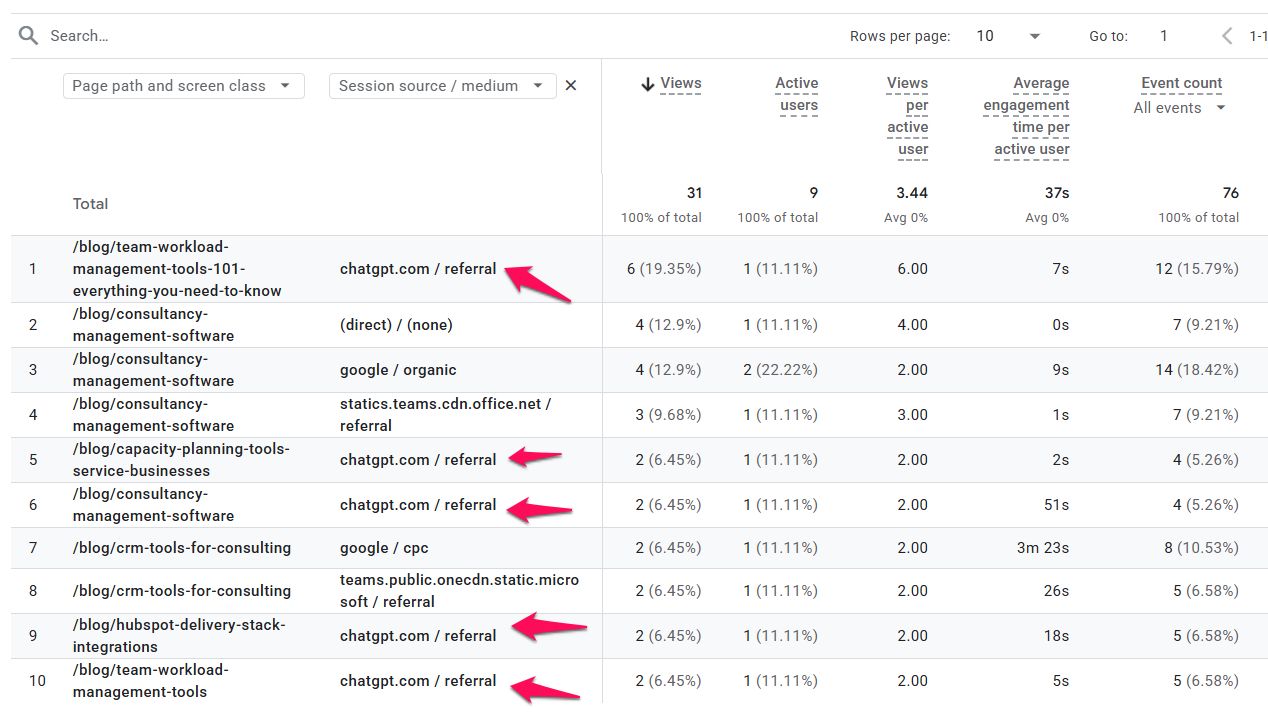
| Pages receiving AI-engine referral visits | 10 of 18 | GA4 |
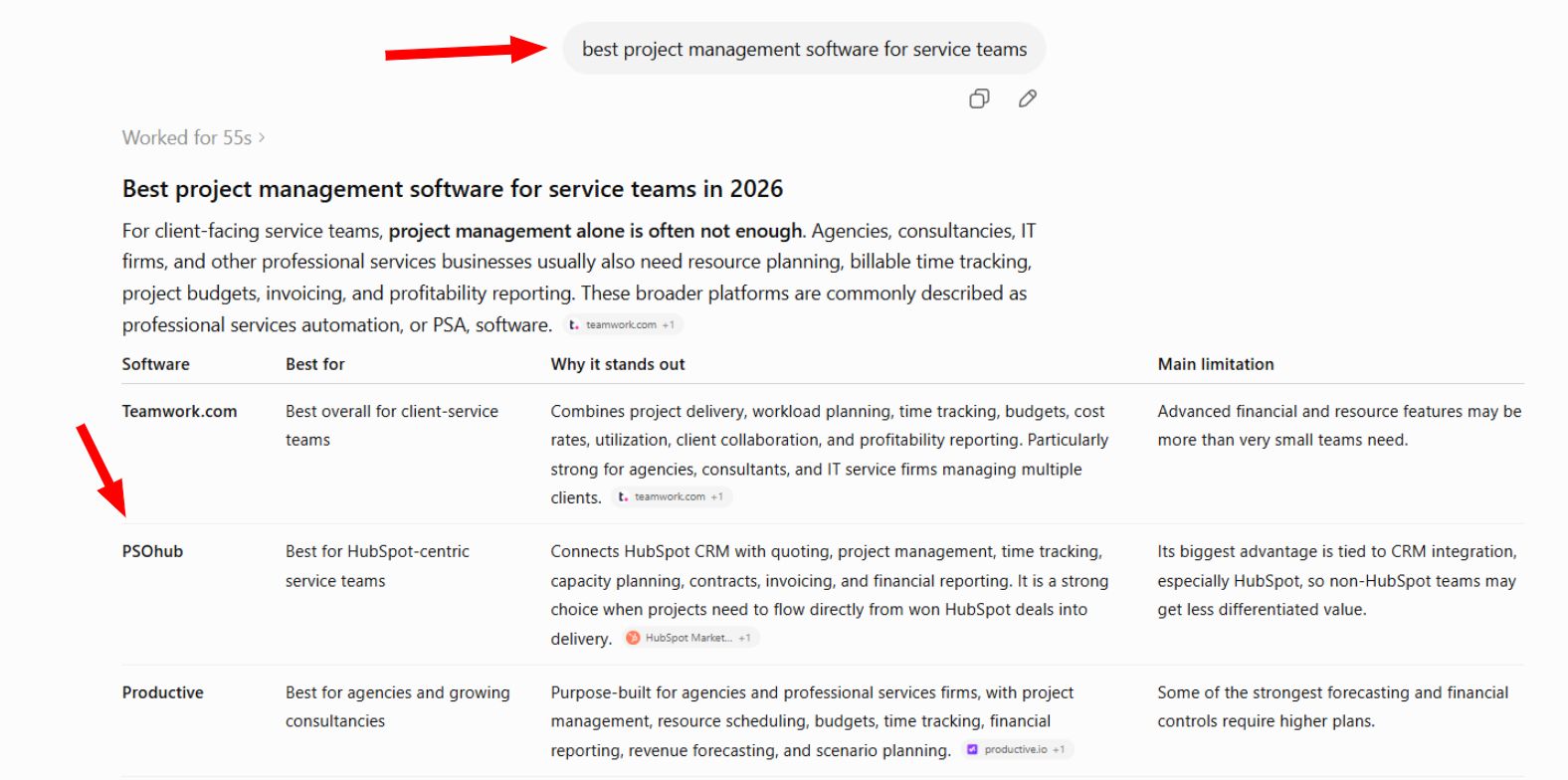
The mechanics matter here, because "AI visibility" is often reported sloppily.
Semrush samples real prompts across the AI engines (ChatGPT, Google AI Overviews, AI Mode, Gemini) and reports how many distinct answer prompts name each page as a source. A page marked cited x17 was named as a source in 17 separate AI-answer prompts.
This is the measurement worth copying. A page marked cited x17 is a falsifiable claim, not a vibe, which is exactly why the citation leaderboard below is readable at all. If you want the same per-page counts for your cluster, Semrush's AI visibility reports are where the x17 comes from — and running them before you publish gives you the baseline that makes a 90-day readout mean something.
That is the strongest visibility signal available, because it means the models are not just crawling the content, they are reusing it as evidence.
The citation leaderboard inside the cluster:
| Page | AI Citations | Citation Geography |
|---|---|---|
| Best invoicing & billing software (refreshed) | 17 | US, CA, UK, IN, AU, DE |
| Best project management software (refreshed) | 16 | US, CA, AU, BR, DE, IL |
| Agency management software | 4 | US |
| PSA buyer scorecard | 4 | AU, BR, TW, US |
| PSA vs. ERP for professional services | 3 | US, NL |
| Pay rate vs. bill rate | 3 | US |
| AI project management (refreshed) | 2 | DE, US |
| Five further pages | 1 each | US, UK, AU |
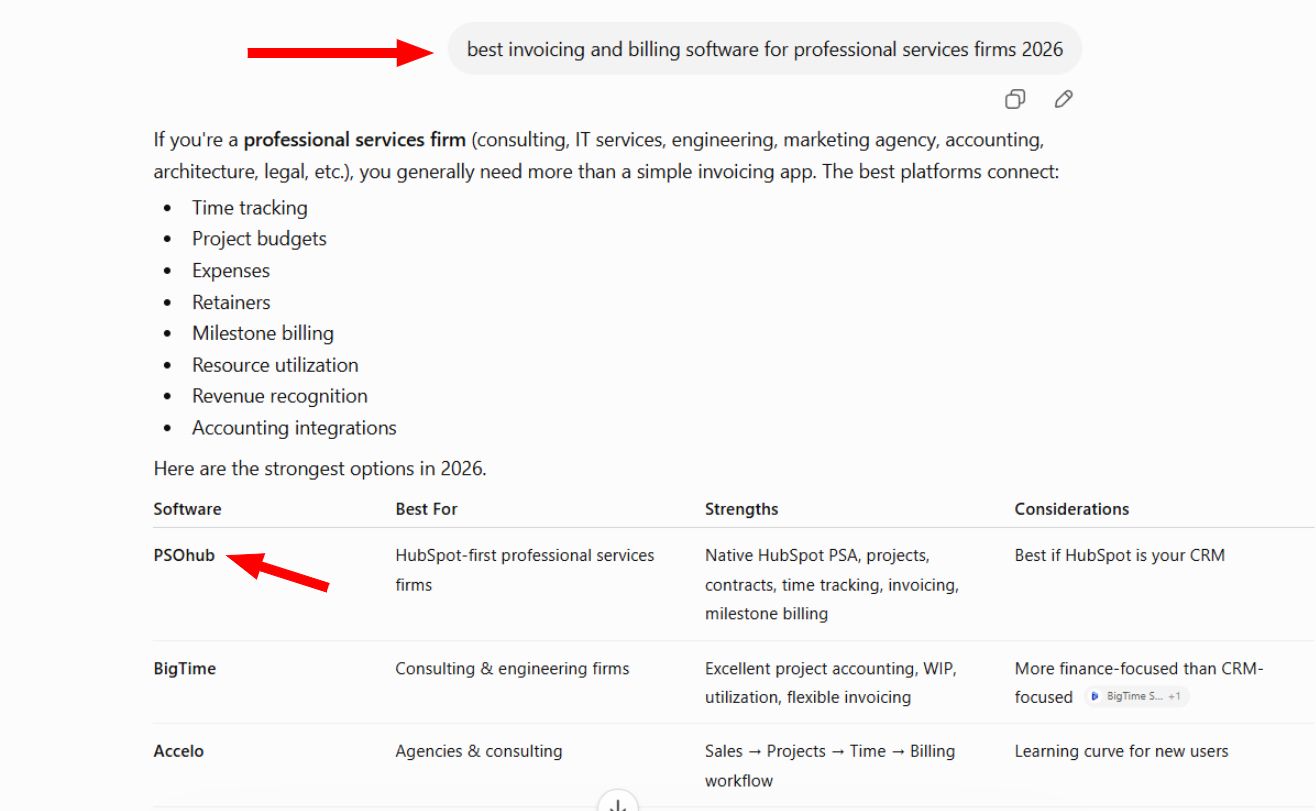
Two findings deserve emphasis.
- Citations converted into humans. GA4 recorded chatgpt.com referrals on 9 of the 18 pages and Google AI (search.google.com) referrals on 5, meaning 10 pages were already receiving real AI-driven visits. Several pages (project cost tracking, consultancy management software) were pulling ChatGPT referral visits before Semrush had even registered a formal citation, which is exactly the leading-indicator pattern you want.
- Geography confirms genuine answer inclusion. Citations landed across the US, Canada, the UK, Germany, Australia, India, Brazil, Israel, Taiwan, and the Netherlands. Distributed geography is a strong signal the pages sit in the models' retrieval layer broadly, rather than appearing in one localized answer variant.
Why does this layer matter commercially?
Because AI referral volume is small but growing violently.
WebFX's analysis of 2.3 billion sessions (January 2024 to December 2025) found generative AI traffic grew 796% in two years while its conversions grew 6,432%, with SaaS among the industries where AI referrals convert at more than 50%.
PSOhub's 50 AI visits in 90 days are not the prize. They are the entry ticket to a channel that compounds.
Question 3: Is the Traffic Real and Engaged?
Verdict: Strong.
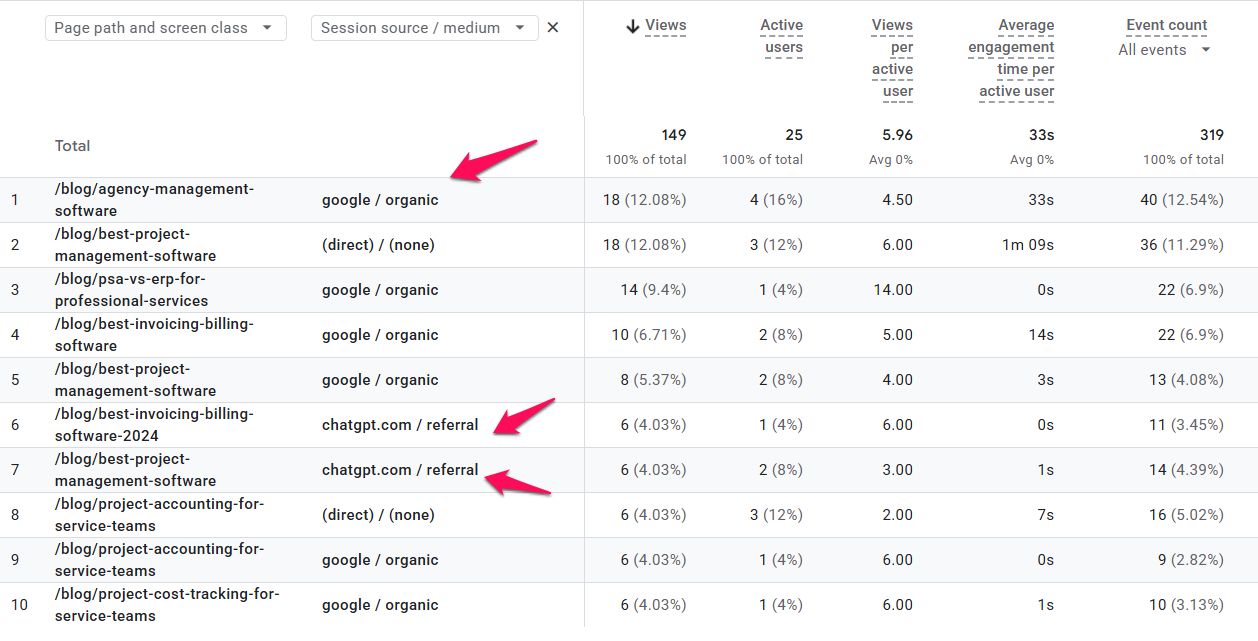
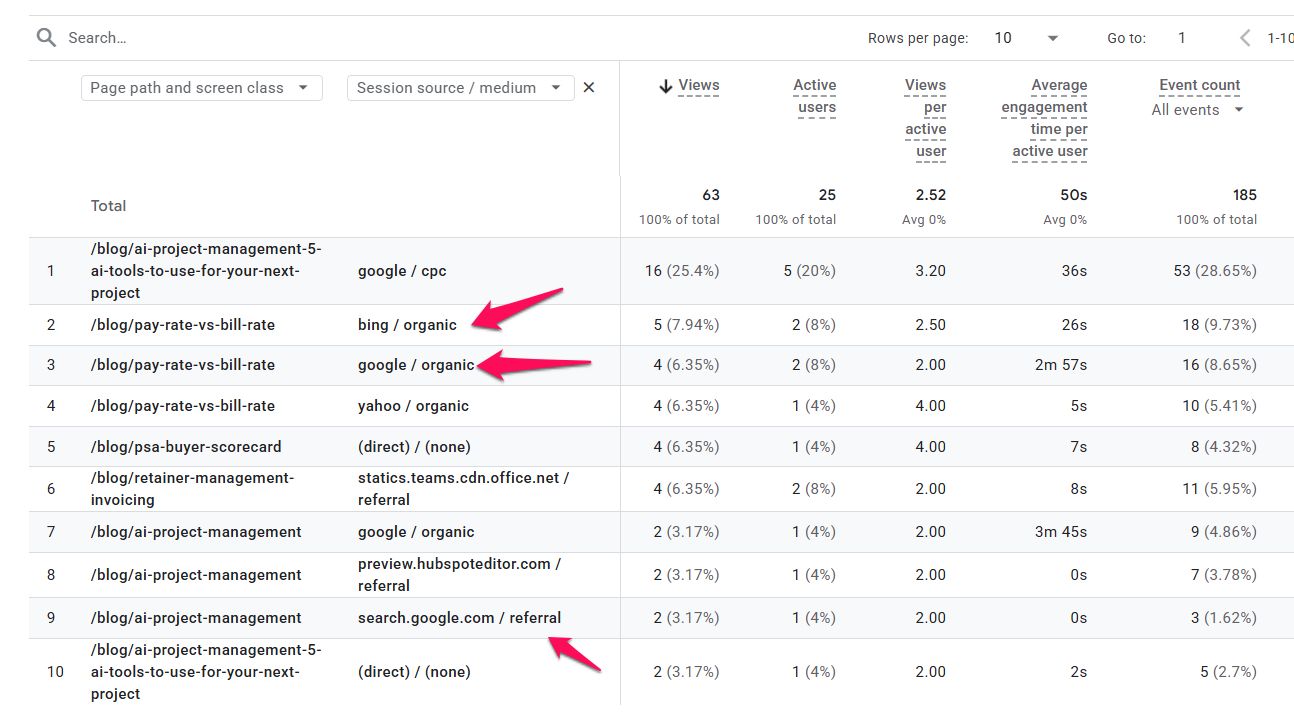
The 18 pages drew 267 page views from 101 active users who fired roughly 640 on-page events, and about 1 in 5 of those views arrived from AI engines.
| Metric | 90-Day Result |
|---|---|
| Page views | 267 |
| Active users | 101 |
| On-page interaction events | ~640 |
| Share of views from AI engines | ~19% (50 of 267) |
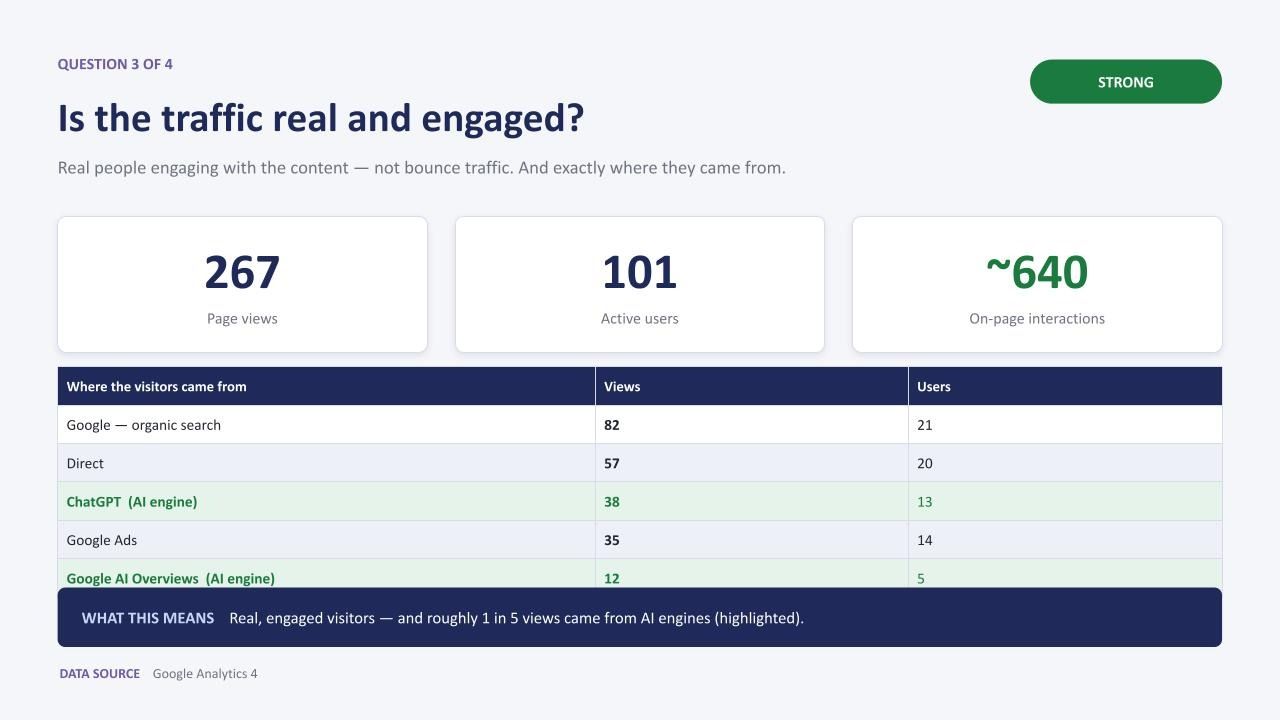
Where the visitors came from, across the whole cluster:
| Source / Medium | Views | Users |
|---|---|---|
| Google, organic search | 82 | 21 |
| Direct | 57 | 20 |
| ChatGPT (AI engine) | 38 | 13 |
| Google Ads | 35 | 14 |
| Google AI Overviews (AI engine) | 12 | 5 |
Read the third and fifth rows again.
An AI assistant outranked the client's own paid channel as a traffic source to this content, one quarter into the program, on pages mostly under nine weeks old.
The number worth stressing most, though, is interaction density.
Around 640 events (scrolls, clicks, element interactions) from 101 users is a ratio of roughly 6.3 events per user, which is engaged-reading behavior, not bounce behavior. The strongest performers on this axis were best project management software (105 events), AI project management (86), best invoicing and billing software (71), PSA vs. ERP (64), and agency management software (54). Several pages also posted long average engagement times for their age, including CRM tools for consulting at 114.5 seconds and the profitability calculator at 96.5 seconds.
This engagement profile is what the research now predicts for AI-era traffic.
Semrush's June 2025 study of AI search impact, built on 500+ high-value topics, found the average AI search visitor is worth 4.4 times the average traditional organic visitor on conversion rate, precisely because the model has pre-qualified them before the click.
PSOhub's on-page data matches the theory: small audiences, unusually dense interaction, and a visible tilt toward decision-stage behavior.
Question 4: Is the Content Pulling Readers Toward Buying?
Verdict: This was the opportunity finder.
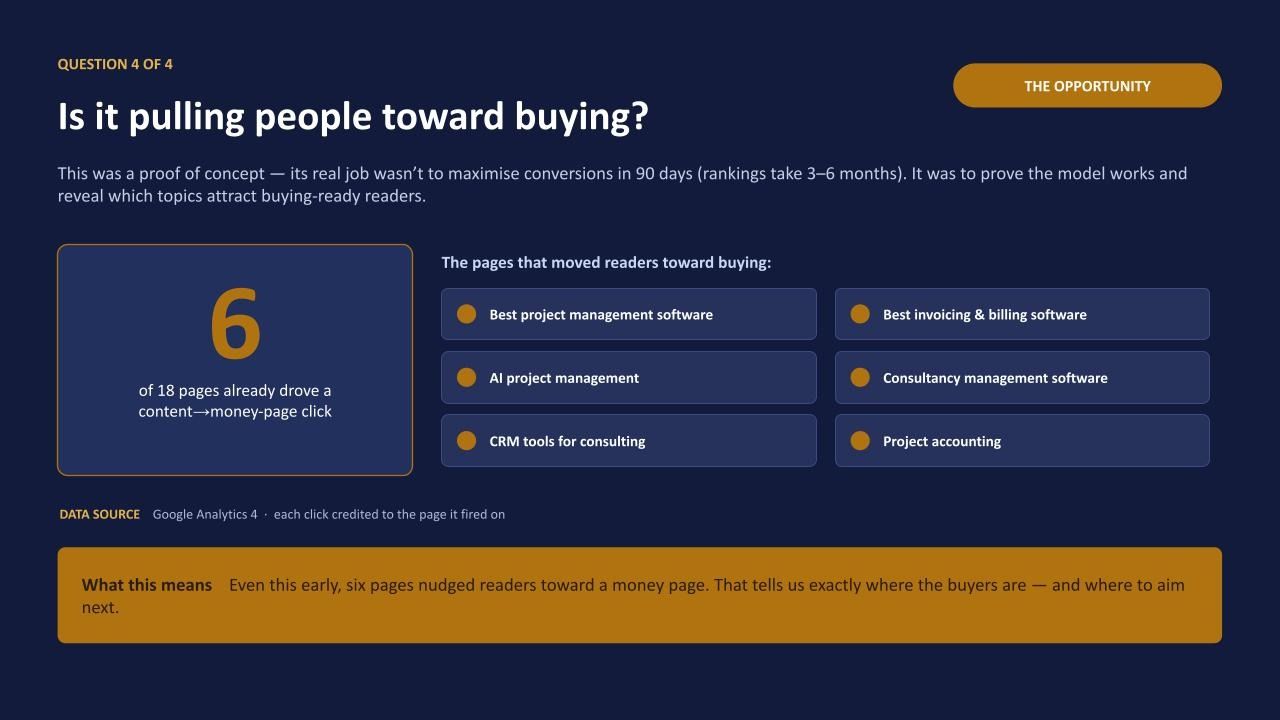
Six of the 18 pages drove a content-to-money-page click inside the window, alongside 3 demo clicks and 1 sign-up, each credited to the page it fired on.
A proof of concept's real job on conversion is not to maximize conversions in 90 days. Rankings and citations take 3 to 6 months to fully mature, so most of these pages had only just started receiving qualified traffic when the window closed.
The job was to prove the attribution model works and to reveal which topics attract buying-ready readers. It did both.
The six pages that moved readers toward a money page:
| Converting Page | Money-Page Clicks | Demo Clicks | Sign-Ups |
|---|---|---|---|
| AI project management (refreshed) | 1 | 1 | 1 |
| Project accounting for service teams | 1 | 1 | 0 |
| CRM tools for consulting | 1 | 1 | 0 |
| Best project management software (refreshed) | 1 | 0 | 0 |
| Best invoicing & billing software (refreshed) | 1 | 0 | 0 |
| Consultancy management software | 1 | 0 | 0 |
Notice what is on that list.
The CRM tools for consulting page was four weeks old and had exactly 4 page views, and it still produced a money-page click and a demo click, because the two readers it attracted were the right readers. The AI project management refresh produced the fullest funnel of the whole program (money-page click, demo click, and a sign-up) while still climbing at position 31.6, meaning its conversions came almost entirely from AI referrals and paid-assisted visits before organic even arrived.
That is the signature of correctly targeted BOFU-adjacent content, and it echoes what we measured in the Avaza AI-ready posts case study, where conversion efficiency, not raw traffic, was the early tell that a cluster was aimed at buyers.
The Per-Page Scoreboard: All 18 PSOhub Pages at a Glance
The full scoreboard below is the honest version of this case study. Every page, including the ones that have not converted yet, measured on the same axes.
| # | Page | Live | Avg. Position | Impressions | AI Citations | GA4 Events | Converted? |
|---|---|---|---|---|---|---|---|
| 1 | PSA vs. ERP for professional services | 15 Apr | 7.6 (page 1) | 14,545 | x3 | 64 | Not yet |
| 2 | Agency management software | 16 Apr | 9.6 (page 1) | 18,887 | x4 | 54 | Not yet |
| 3 | Project cost tracking for service teams | 24 Apr | 9.0 (page 1) | 604 | Not yet | 29 | Not yet |
| 4 | Project accounting for service teams | 28 Apr | 9.1 (page 1) | 3,271 | Not yet | 26 | Yes (money + demo) |
| 5 | Best project management software (R) | 11 May | 12.6 | 11,552 | x16 | 105 | Yes (money) |
| 6 | Best invoicing & billing software (R) | 11 May | 9.5 (page 1) | 32,251 | x17 | 71 | Yes (money) |
| 7 | PSA buyer scorecard | 20 May | 12.3 | 252 | x4 | 15 | Not yet |
| 8 | Retainer management & invoicing | 21 May | 7.1 (page 1) | 4,141 | x1 | 20 | Not yet |
| 9 | Pay rate vs. bill rate | 22 May | 7.6 (page 1) | 5,401 | x3 | 46 | Not yet |
| 10 | AI project management (R) | 26 May | 31.6 | 4,530 | x2 | 86 | Yes (money + demo + sign-up) |
| 11 | How to use AI for project management (R) | 27 May | 48.2 | 4,174 | x1 | 29 | Not yet |
| 12 | Profitability & utilization calculator | 28 May | 6.8 (page 1) | 1,158 | Not yet | 8 | Not yet |
| 13 | Consultancy management software | 10 Jun | 10.4 | 814 | Not yet | 32 | Yes (money) |
| 14 | Retainer setup kit for professional services | 17 Jun | 7.1 (page 1) | 198 | Not yet | 0 | Not yet |
| 15 | CRM tools for consulting | 17 Jun | 9.4 (page 1) | 85 | x1 | 13 | Yes (money + demo) |
| 16 | Team workload management tools (R) | 23 Jun | 17.1 | 18,259 | x1 | 22 | Not yet |
| 17 | Capacity planning tools for service businesses (R) | 24 Jun | 19.3 | 6,820 | x1 | 20 | Not yet |
| 18 | HubSpot delivery stack integrations | 14 Jul | Indexing | n/a | Not yet | 0 | Too new |
(R) marks a refreshed and re-slugged existing page. Positions are 90-day averages from Google Search Console; positions 1 to 10 are page 1. AI citations are distinct AI-answer prompts naming the page as a source (Semrush, worldwide). Events are total GA4 interactions on the page.
The final page went live one day before the data pull, so its only job in this window was to index.
A few patterns jump out of the raw table:
- Age predicts almost everything except conversion. Impressions and citations scale with weeks live, but conversions did not wait for scale. Four of the six converters were five weeks old or younger.
- Refreshes punched hardest on AI citations. The six refreshed pages account for 38 of the 54 citations (70%), because they inherited crawl history and indexation trust that brand-new URLs spend months earning.
- High impressions with a page 2 position is stored energy. Team workload management tools earned 18,259 impressions at position 17.1 in three weeks. Every position it climbs converts existing impression volume into clicks at a steeper rate.
What the Six Converting Pages Have in Common
The converting pages are not random. They cluster into three commercial themes, and that clustering is the single most valuable strategic output of the entire proof of concept.
| Converting Cluster | Pages | Why It Converts |
|---|---|---|
| Comparison & software evaluation | Best PM software, Best invoicing & billing, CRM tools for consulting, Consultancy management software | Readers are actively shortlisting tools; the page meets them mid-decision |
| Practical service-ops & finance | Project accounting for service teams | Operational problem-solving for the people who run the business, one step from evaluating software that fixes the problem |
| AI in project delivery | AI project management | Rides genuine AI-adoption urgency and pairs it with buying intent |
Four of the six converters are comparison and software pages. That aligns with everything the buyer research now shows, because when the buyer research above shows AI chatbots building the shortlist and buyers running head-to-head vendor comparisons inside the chat, the pages that answer comparison intent are the pages standing where the money is.
It also matches the pattern from our Buddy Punch SEO case study, where intent-matched pages outperformed volume plays on every commercial metric.
Executing this well, meaning finding the converting clusters fast and then concentrating production on them, is exactly the gap The Rank Masters closes for B2B SaaS teams.
TRM builds an ICP-led content system that maps each topic cluster to a money page and to pipeline, measures every page against the four questions above, and reallocates the roadmap toward what the data says converts, rather than publishing posts that never get audited again. For PSA vendors specifically, that system is packaged in our PSA SaaS SEO services.
Why the Results Arrived This Fast
Five mechanisms explain how a 90-day-old cluster reached page 1, earned 54 AI citations, and produced buying signals simultaneously. None of them is luck.
- Refresh leverage: Rebuilding six existing URLs converted dormant domain equity into immediate rankings and citations. The two most-cited pages in the program were both refreshes. If your site has aging posts with indexation history, they are your fastest route into AI answers, a dynamic we break down in traditional SEO vs. AI SEO.
- One persona, one cluster: Concentrating 18 pages on a single buyer's question space builds topical completeness that both Google's systems and LLM retrieval reward. Scattered topics dilute; corridors compound.
- Answer-first, extractable structure: Every page led its sections with direct answers and structured data blocks, so AI engines could lift clean chunks. Citation velocity follows extractability, which is the core argument of our Google AI Overviews visibility playbook.
- Commercial levers shipped in parallel: One money page update or BOFU asset per month meant discovery traffic always had a strong commercial destination, which is why content-to-money-page clicks could be observed at all.
- Attribution designed before publishing: Money-page click, demo click, and sign-up events were defined during the planning phase and credited to the page they fired on. Most content programs bolt measurement on afterward and then cannot prove anything.
One more mechanism sits underneath all five, namely dual-surface intent. Because the answer layer and the SERP now share a retrieval foundation, content engineered for extractability tends to win both.
PSOhub's cluster did not run a Google strategy and a separate AI strategy. It ran one architecture that both surfaces rewarded.
The Scale Blueprint: What Happens After a Successful Proof of Concept
The proof of concept closes with two deliverables, a Proof Pack (the evidence you have just read) and a Scale Blueprint. The blueprint's logic is simple to state and hard to fake, because it requires the page-level data above.
- Double down where it converts: Scale production in the comparison, software-evaluation, and service-ops clusters that already drove money-page clicks. The six converters define the demand corridors; the next content wave deepens them with adjacent comparison, alternatives, and use-case pages.
- Let the maturing pages compound: Questions 1 through 3 strengthen on their own as pages age through the 3-to-6-month maturity curve. The 18,259-impression workload page at position 17 and the 6,820-impression capacity page at position 19 are the nearest-term ranking wins; they need consolidation, not replacement.
- Make conversion the scoreboard: With attribution proven, the operating metric shifts from impressions to content-to-money-page clicks per cluster, and production follows the winners. This is the discipline that separates a content system from a publishing habit.
- Track the whole engine mix, not one engine: ChatGPT dominates AI referrals today, but the mix is moving. Goodie's May 2026 AI search traffic report measured ChatGPT's share of B2B AI referrals falling to 62.6% as Claude, Gemini, and Perplexity grew. A citation footprint spread across engines, which PSOhub's Semrush data already shows, is insurance against that reshuffle. PSOhub could see that engine spread because its citations were tracked per platform from the start. If your current reporting cannot tell you whether a citation came from ChatGPT or Gemini, start tracking the engine mix in Semrush before the next reshuffle makes the question urgent.
For readers running their own version of this decision, the glossary definitions behind these metrics (citations, prompt visibility, AI referrals) live in our SEO glossary, and the full library of measured engagements is on our case studies hub.
Frequently Asked Questions
How fast can new B2B SaaS content rank on page 1 of Google?
What counts as an AI citation, and how is it measured?
Do refreshed pages or brand-new pages earn AI citations faster?
How much traffic should a 90-day content proof of concept produce?
What conversion signals can content realistically show inside 90 days?
Is ChatGPT referral traffic actually worth optimizing for at this volume?
What should a SaaS team lock before starting a content proof of concept?
Want This Four-Question Proof on Your Own Domain?
If your SaaS content ranks but never appears inside AI answers, or publishes on schedule but cannot name a single page that moved a reader toward a money page, the PSOhub playbook is directly transferable, including the persona lock, the fan-out cluster, the monthly commercial lever, and the four-question measurement contract that makes the scale decision obvious.
If thin AI-answer visibility and unmeasured content are costing you pipeline, book a SaaS content strategy call and we will map your highest-intent topics to revenue.
▶️ Explore our services:
📑 Disclosure!
Some links in this article are affiliate links. If you sign up through them, The Rank Masters may earn a commission at no additional cost to you. This does not influence which tools we recommend or what we say about them.