
Across 6.77 million AI-driven sessions tracked from November 2024 to May 2026, Search Engine Land reported that ChatGPT alone drives 92.4 percent of trackable LLM referral traffic, which means the pages AI answers choose to cite now decide who gets discovered.
Writing AEO-optimized content means writing so an AI answer engine can lift a clean answer from your page and cite you as the source. That is a different job from ranking a blue link, and it changes how you structure a sentence, a section, and a whole article.
This guide walks the exact process we use on our own domain, and it shows you where to look inside Semrush to find the questions to answer and to prove your content is getting cited.
You will notice a pattern here. We teach the concept first so it stands on its own, then we show you how to execute it on your site. The goal is content that earns a citation even from a reader who never buys anything, because that is precisely the content AI engines quote.
What Is AEO-Optimized Content?
AEO-optimized content is writing deliberately structured so an answer engine can extract a self-contained answer and cite your page, rather than merely rank it in a list of links. It leads with the answer, names its entities cleanly, and backs claims with sourced evidence an AI can trust.
The mental shift is from "how do I get this page to position one" to "how do I get this passage quoted in the answer." Those are related but not identical. A page can rank well and still never get cited, usually because the answer is buried three paragraphs down or wrapped in vague prose an engine cannot isolate.
Think of each section as a standalone unit of meaning. If an answer engine grabbed only that block and showed it to a user with no surrounding context, would it still be correct, complete, and clearly about your entity? When the answer is yes, you have written AEO-optimized content.
✅ Answer-first structure: The page opens each section with a direct response, so the extractable answer sits in the highest-weighted position.
✅ Self-contained chunks: Every passage names its subject and stands alone, which lets a retriever lift it without dragging in context.
✅ Evidence density: Named statistics, primary-source links, and attributed quotes give the engine something concrete to ground and attribute.
What Is Answer Engine Optimization (AEO)?
Answer engine optimization is the practice of shaping content so AI answer engines such as ChatGPT, Perplexity, Google AI Overviews, and Gemini quote and cite it inside the answers they generate. It optimizes for being the source of the answer, not just a candidate link beneath it.
The behavior driving this is already mainstream.
At Google I/O in May 2025, the company reported that AI Overviews are driving over a 10 percent increase in usage of Google for the kinds of queries that show them, in its biggest markets like the US and India. When usage of AI answers climbs, the question of whether your brand appears inside those answers stops being academic.
AEO is less a new channel than a new surface for the content you already publish. The same article can rank in classic search and get cited in an AI answer, but only if it is written so both a crawler and a language model can pull a clean answer from it.
How Do AI Answer Engines Decide What to Cite?
Answer engines retrieve candidate passages by semantic relevance, then favor the sources that are cleanly structured, factually grounded, current, and reference-grade. They lift the passage that most directly and completely answers the prompt, and they attribute it.
Retrieval happens at the passage level, not the page level, which is the single most important thing to internalize.
Aleyda Solis, the international SEO consultant behind Orainti, describes the mechanism directly. "With AI search this happens at a passage or chunk level of relevance," explains Aleyda Solis, meaning the engine is scoring individual blocks of your page, not the page as a whole.
The kind of source matters as much as the structure.
Profound's analysis of 680 million citations found platforms lean toward reference-grade and community-trusted domains, with ChatGPT drawing 80.41 percent of its citations from .com domains and 11.29 percent from .org, a preference for established, well-organized information over thin promotional pages.
So the citation decision rewards four things you can control in the writing itself.
✅ Semantic relevance of the passage: The chunk closely matches a real user intent in vector space, so it surfaces as a candidate in the first place.
✅ Structural clarity: The answer is isolated and unambiguous, so the engine can extract it without guessing where it begins or ends.
✅ Factual grounding: Named, dated statistics and primary-source links give the model something verifiable to attribute.
✅ Freshness and authority: Current data and recognized expertise push your passage ahead of stale or unsupported alternatives.
How Do You Write AEO-Optimized Content? Step by Step
Writing AEO-optimized content follows a repeatable seven-step loop, from finding the real questions to measuring the citations. Each step below carries three things, namely the method itself, the evidence that it works (industry research plus results from our own case studies), and a live rewrite showing how the same content reads when written the standard SEO way versus the AEO way.
The rewrite demos all use one running example from a niche we work in daily, that is time tracking and PSA software for agencies.
Watch how the same information changes shape at every step.
Here is the whole loop at a glance before we work through each step.
- Find the real questions and prompts buyers ask AI about your category.
- Answer each question first, in the opening sentence beneath a question-shaped heading.
- Write self-contained chunks a retriever can lift without losing meaning.
- Add reference-grade evidence, namely sourced statistics, primary links, and attributed quotes.
- Mark the content up with schema, knowing exactly what schema can and cannot do.
- Build topical depth across the full cluster, not a single keyword.
- Measure citations and mentions, refresh on a cadence, and iterate.
The order matters.
Skipping straight to writing without step one is why so much "AEO content" answers questions nobody actually asks an AI. Let us start where the engines start, with the questions.
Step 1: Find the Real Questions Buyers Ask AI
Start by harvesting the exact prompts buyers type into AI tools about your category, then turn each qualifying prompt into one section heading, so every block answers proven demand.
This step decides whether the rest of the work compounds or evaporates, because the question now gets resolved inside the answer itself.
Similarweb keyword data from December 2025 through February 2026 puts the zero-click rate for the query "answer engine optimization" at 78 percent, meaning nearly eight in ten searchers got their answer without clicking any website. If your page is not the source of that answer, the demand it targeted never reaches you.
We proved the payoff of prompt-led question research on our own pages.
By building content around the exact tool-selection prompts buyers ask, our tool-based search pages drove 20,192 events, 4,863 users, 546 page-one keyword rankings, and 2.6K AI citations, turning research-stage questions into a working AEO lead generation funnel.
| The Standard SEO Version | The AEO Rewrite |
|---|---|
| Open a keyword tool, sort by volume, and pick the head term. "Target keyword: time tracking software (33K searches per month). Working title: Time Tracking Software: The Ultimate Guide." One broad page chases one broad phrase, and the buyer’s actual situation never appears on the page. | Harvest the prompts buyers actually type into ChatGPT and Perplexity, then map one prompt to one heading. "Best time tracking software for a 20-person agency that bills hourly." "Does PSA software replace separate time tracking and invoicing tools?" Each prompt becomes an H2, phrased exactly the way the question is asked, so the answer can match it in vector space. |
⚠️ The rule to remember: One real prompt, one heading. If nobody asks it, do not write it.
Step 2: Answer Each Question First, in the Opening Sentence
Under every question heading, state the complete answer in the first sentence, in 30 words or fewer, then expand beneath it, because engines lift the first clean answer they find.
Retrieval happens at the passage level, as covered earlier in this guide, so the first sentence under a heading is the highest-weighted text on the page.
A first line that warms up, sets context, or hedges gives the engine nothing to extract, and it moves on to a competitor who answered immediately.
This is the single fastest-moving lever we have tested.
When we restructured our own bottom-of-funnel pages to lead with the answer, our blogs earned citations in Google AI Overviews for high-conversion BOFU long-tail queries in under 7 days, without relying on backlinks. Nothing about the underlying information changed. Only the position of the answer did.
| The Standard SEO Version | The AEO Rewrite |
|---|---|
| H2: "Why Time Tracking Matters for Agencies" "In today’s fast-paced agency environment, managing time effectively has never been more important. Before we get into the best approaches, let’s look at how agencies have historically handled timesheets…" Two sentences in, the question is still unanswered. An engine has nothing to lift. | H2: "What Is the Best Way to Track Billable Hours in a Marketing Agency?" "The best way to track billable hours in a marketing agency is automatic, timer-based tracking inside the project tool the team already uses, reviewed weekly against utilization targets." 29 words, self-contained, and correct even if it is the only sentence quoted. The nuance and evidence follow underneath. |
⚠️ The rule to remember: Cover everything except the first sentence of each section. If that sentence alone answers the heading, the section is extractable.
Step 3: Write Self-Contained Chunks a Retriever Can Lift
Write passages of roughly 200 to 500 tokens that name their subject, carry one idea, and need no neighboring paragraph, so any single block reads correctly when quoted alone.
A chunk that opens with "it" or "this approach" breaks the moment it leaves the page, because the retriever scores and lifts blocks, not full articles. The liberating flip side is that one strong chunk can win a citation even on a page that ranks modestly overall.
Chunk-first rewriting is the core of the modular, LLM-first structure behind our Generative Engine Optimization case study, where restructured content grew ChatGPT referrals by 8,337 percent in 90 days. The engines did not suddenly discover the site. They could finally lift complete answers from it.
| The Standard SEO Version | The AEO Rewrite |
|---|---|
| "It also integrates with most invoicing tools, which makes this approach even more attractive. On top of that, the reports mentioned above give managers everything they need to keep projects on budget." Three dependencies on earlier text ("it," "this approach," "the reports mentioned above") mean the chunk is meaningless in isolation. | "Timer-based time tracking software integrates with invoicing tools such as QuickBooks and Xero, so agencies convert tracked billable hours into client invoices without re-entering data. Utilization reports then show managers which projects are running over budget." Every entity is named. Lifted alone, the block is still complete, correct, and clearly about its subject. |
⚠️ The rule to remember: Run the copy-paste test. Drop any section into a blank document, and if it needs its neighbors to make sense, rewrite it until it does not.
Step 4: Back Every Claim with Reference-Grade Evidence
Give each key section a named, dated statistic linked to its primary source, plus an attributed expert quote where one exists, because engines quote grounded claims and skip vague ones.
This is where extraction actually happens, because the grounded statistic is the payload an engine lifts and attributes.
Data-rich websites earn 4.31 times more citation occurrences per URL than thin directory-style listings, according to a Q4 2025 Yext analysis reported in ZipTie’s research review. Evidence is not decoration for AEO content. It is the extractable payload.
We hold our own pages to that standard, and the 28-day numbers show why.
Evidence-dense, answer-first pages on our own domain grew Google clicks by 36.9 percent and earned 2.6K AI citations in a 28-day comparison, with the most-cited passages being exactly the ones carrying named, linked data.
| The Standard SEO Version | The AEO Rewrite |
|---|---|
| "Many agencies lose significant revenue every year to untracked hours, and studies show that time tracking is essential for profitability." No name, no date, no source. There is nothing here an engine can verify, ground, or attribute, so the claim gets skipped. | Billable utilization across professional services firms averaged 68.9 percent in 2024, below the commonly cited 75 percent optimal threshold, according to SPI Research’s 2025 Professional Services Maturity Benchmark, which means roughly a third of team capacity goes unbilled. Named organization, stated year, linked source on the entity, and an interpretation the reader can act on. This is a citable unit. |
⚠️ The rule to remember: Name it, date it, and link it on the entity, never on generic words. Replace every "studies show" with the organization and the year.
Step 5: Mark It Up with Schema, and Know What Schema Cannot Do
Add FAQPage, Article, and HowTo schema so answers parse as machine-readable pairs, but treat markup as friction removal, not a citation lever, because structure wins and markup alone does not.
The honest version of this step matters, because schema is the most oversold tactic in AEO.
Ahrefs tracked 1,885 pages that added schema and found AI citations barely moved, even though pages with schema do correlate with more citations overall.
Leigh McKenzie at Backlinko reads the two findings the same way, writing "Schema is a marker of a well-built site. Well-built sites get cited." Add the markup, keep it in perfect agreement with the visible content, and expect it to remove parsing friction, not to manufacture citations on its own.
Markup is one layer of what we call answer eligibility, the combination of structure, entity clarity, and machine-readable formatting that makes a page quotable in the first place.
Engineering that eligibility for a PSA software client is how we helped Avaza win repeatable AI mentions and citations and turn that visibility into measurable conversions.
| The Standard SEO Version | The AEO Rewrite |
|---|---|
| "People often wonder how much time tracking costs, and generally speaking, prices vary depending on the provider, the features, and the size of your team…" The question and answer are fused into flowing prose with no markup, so the engine must guess where the answer begins and ends. | Visible on page: "What is billable utilization?" followed by a direct 40-word answer. In the code: the same pair wrapped in FAQPage markup: { "@type": "Question", "name": "What is billable utilization?", "acceptedAnswer": { "@type": "Answer", "text": "Billable utilization is the share of available hours spent on client-billable work…" } } The question-answer pair is now an explicit, labeled unit, and it mirrors the visible content word for word. |
⚠️ The rule to remember: Mark up only what is actually on the page. Schema that describes invisible content is a policy risk, not an optimization.
Step 6: Build the Full Topic Cluster, Not One Post
Give every sub-question in the cluster its own answer-first page or section, interlinked on topic-named anchors, because engines synthesize across a body of coverage, not one isolated URL.
Depth of coverage, not repetition of a head term, is what reads as authority. The two largest content programs we have documented both won this way.
For Buddy Punch, a semantic rebuild of the existing library, namely 85 rewrites plus 48 net-new high-intent articles, lifted monthly organic traffic from roughly 28,000 to more than 93,000 and grew ranking keywords from 33K to 74K.
Neither result came from a single hero page. Both came from covering the cluster.
| The Standard SEO Version | The AEO Rewrite |
|---|---|
| One 4,000-word page: "The Ultimate Guide to Time Tracking", targeting the head keyword and trying to say everything in one URL. Every sub-question competes for space inside one page, and none of them gets a clean, dedicated answer the engine can retrieve. | Pillar: "Time Tracking Software for Agencies" Cluster pages, each answer-first and interlinked: "Billable vs Non-Billable Hours Explained," "Time Tracking and Invoicing Integrations," "PSA Software vs Standalone Time Tracking," "Time Tracking Software for Consultants." Each sub-question owns a home, each page links to its neighbors on topic-named anchors, and the site reads as an authority on the whole subject. |
⚠️ The rule to remember: One sub-question, one home. If a real buyer question has no dedicated answer anywhere on your site, the cluster is not finished.
Step 7: Measure Citations, Refresh on a Cadence, and Iterate
Track mentions, cited pages, and share of voice rather than rankings alone, then refresh cited assets quarterly, because engines favor fresh content and citation share decays on untouched pages.
Freshness is not a soft signal.
Ahrefs analyzed 17 million AI citations and found cited URLs average 1,064 days old versus 1,432 days for traditional organic results, a 25.7 percent freshness advantage. A page that earned citations last year and has not been updated since is aging out of the consideration set right now.
Just as important is measuring the right outcome.
When we ran a 13-post BOFU sprint for Birdview PSA, we judged it on conversion efficiency instead of raw traffic, and those 13 AI-ready posts beat a legacy library of roughly 350 posts on every efficiency metric, including a 247 percent higher conversion rate per pageview.
Citations and mentions are the visibility layer. Conversions from AI-referred and answer-primed visitors are the proof the loop is working.
| The Standard SEO Version | The AEO Rewrite |
|---|---|
| The dashboard: keyword rankings, organic sessions, bounce rate. All three can look healthy while the brand is completely absent from the AI answers where the buying decision now starts. | The dashboard: AI citations and cited pages by engine, brand mentions and share of voice, AI-referred sessions and their conversion rate, plus a last-refreshed date on every money page. This scorecard shows whether the engines are quoting you, which pages are doing the work, and which cited assets are due for a refresh before their citation share decays. |
⚠️ The rule to remember: What gets cited gets counted, and what gets refreshed keeps getting cited. Put your cited pages on a quarterly review, minimum.
That is the full loop.
The sections that follow show how to execute the research, auditing, and measurement steps inside Semrush, using our own domain as the working example.
How Do You Find the Questions to Answer for AEO?
Start by harvesting the exact prompts buyers ask AI about your category, because every strong AEO section answers a real question rather than a guessed one. You want the live language of your market, not a keyword tool's rounded-off phrasing.
Semrush surfaces the real prompts people ask AI about your industry, brand, and competitors, which is the fastest way to build a question list grounded in actual demand. On our own domain, here is the exact path we use.
- Open Semrush and go to the AI section in the left navigation.
- Click Brand Performance, then open the Questions report (or Prompt Monitoring).
- Enter therankmasters.com and your topic area to load the prompts tied to your space.
- Sort by relevance and export the questions that match buyer intent.
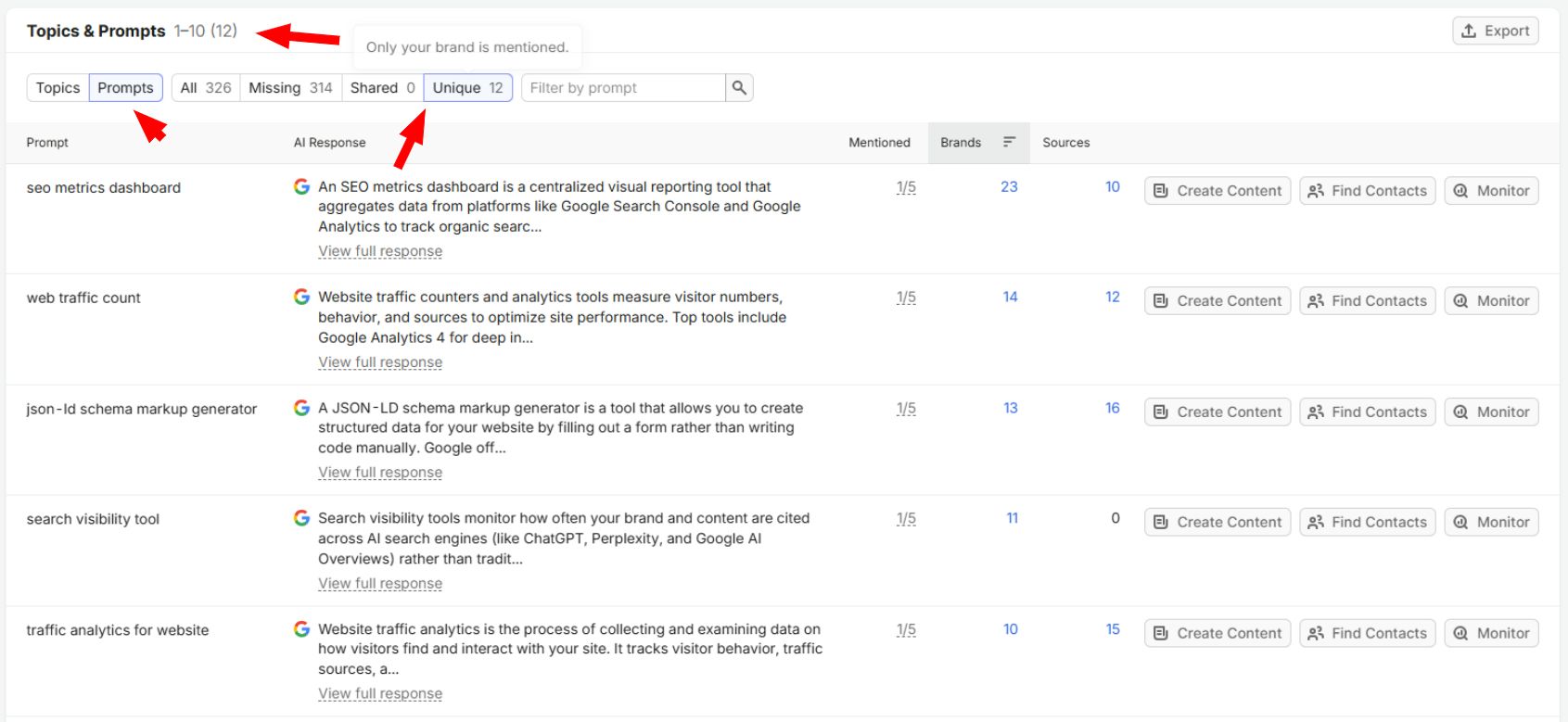
Read the list looking for buying-intent language, not just volume.
A prompt like "best way to structure content for AI Overviews" tells you both the section to write and the exact phrasing to lead with, so your answer matches how the question is actually asked.
Turn each qualifying prompt into one heading, and you have a fan-out map built from demand instead of imagination.
Want your own list? Start a 14-day Semrush One trial and open the AI Visibility Toolkit before you outline your next article, so every section answers a prompt someone is really asking.
How Do You Structure Content Answer-First for AEO?
Lead every section with a direct answer in the first sentence, in 30 words or fewer, beneath a heading phrased the way a buyer asks the question. Front-load the entity, state the answer, then expand underneath.
Answer engines weight early text heavily, so the first sentence beneath a heading is prime real estate. If your opening line hedges, sets context, or warms up, the engine has nothing clean to lift and moves to a competitor who answered immediately. This is the same reason featured snippets have always favored the crisp definition over the meandering intro.
The pattern is simple to apply and easy to audit.
✅ Question-shaped heading: Phrase the H2 the way the buyer types it, with the primary entity first and the heading under about 70 characters.
✅ Answer in sentence one: State the complete answer immediately, self-contained, so it reads correctly even if it is the only sentence quoted.
✅ Expansion after: Use the following two to four sentences to add nuance, evidence, and the "why" that earns depth without burying the answer.
Read your draft the way an engine would. Cover everything except the first sentence of each section, and check whether that first sentence alone answers the heading. When it does, you have written for extraction.
How Do You Write Chunks AI Can Extract?
Write self-contained passages of roughly 200 to 500 tokens, each naming its own entity with no orphan pronouns, so a retriever can lift one chunk and have it still make sense. A chunk that starts with "it" or "this approach" breaks the moment it leaves the page.
Because retrieval scores blocks rather than pages, a single strong chunk can win a citation even on a page that ranks modestly overall. That is liberating. You do not need the whole article to be perfect, you need each section to be independently quotable and correct.
The practical rules for extractable chunks are short and strict.
✅ Name the entity every time: Repeat the subject rather than leaning on pronouns, so the block identifies what it is about on its own.
✅ One idea per chunk: Keep each passage focused on a single question or claim, which matches how a retriever isolates relevance.
✅ Hold the size band: Aim for roughly 200 to 500 tokens per block, dense enough to be complete and short enough to lift cleanly.
✅ No dependency on neighbors: Assume the reader, human or machine, sees only this block, and make sure it still stands.
A useful test is the copy-paste check. Drop any one section into a blank document and ask whether it answers its question with no help from the paragraphs around it. If it needs its neighbors, rewrite until it does not.
How Do You Use Schema and Structured Data for AEO?
Add FAQPage, Article, and HowTo schema so engines parse your entities and answers without ambiguity. Structured data does not force a citation, but it removes the parsing friction that quietly suppresses one.
Schema is the difference between handing an engine a labeled dataset and asking it to infer structure from prose. When you wrap your FAQ in FAQPage markup, each question and answer becomes an explicit, machine-readable pair rather than a run of text the model has to segment on its own.
Prioritize the schema types that map to how answers get built.
| Schema Type | What It Clarifies | Best Used On |
|---|---|---|
| FAQPage | Discrete question and answer pairs | FAQ sections, support content |
| Article / BlogPosting | Author, publish date, and topic entity | Every editorial page, with datePublished and dateModified |
| HowTo | Ordered steps and required inputs | Procedural and tutorial content |
| Organization | Brand identity and sameAs entity links | Your homepage and about page |
| Product / Review | Specs, ratings, and pricing entities | Comparison and evaluation pages |
Keep the visible content and the markup in perfect agreement, because schema that describes content the reader cannot see is a policy risk, not an optimization.
Mark up what is actually on the page, then let the clean structure do its quiet work of making extraction effortless.
How Do You Build Topical Authority and Entity Coverage for AEO?
Build topical authority by covering the full topic cluster, not a single keyword, so every related entity and sub-question has a home and the engines read your site as a genuine authority.
Depth of coverage, not repetition of a head term, is what signals expertise.
Solis is emphatic on this point. "It is even more important than ever to have comprehensive coverage, ideally through topic clusters for each one of the relevant topics that our brands are about," says Aleyda Solis, because answer engines synthesize across a cluster rather than rewarding one isolated post.
The construction pattern is straightforward.
Pick a pillar topic, map every entity and question that co-occurs with it in authoritative sources, give each its own answer-first page or section, then interlink them with anchors named for the destination topic.
That web of internal links tells both Google and the AI engines that you have covered the subject, not just mentioned it.
This is exactly where interpretation beats raw output. A tool can hand you a list of a hundred related prompts, but deciding which cluster to build first, which sub-topics map to a buying decision, and which existing page should own each answer is strategy work.
Executing this well is exactly the gap The Rank Masters closes for B2B SaaS teams, building an ICP-led content system that maps each topic cluster to a money page and to pipeline, rather than publishing posts that never convert.
How Do You Earn Citations, Quotes, and E-E-A-T for AEO?
Earn citations with named, dated statistics, primary-source links, attributed expert quotes, and first-hand data, because reference-grade evidence is precisely what answer engines lift and attribute. Vague claims get skipped, grounded claims get quoted.
The strongest sections stack three assets in the same passage, namely a specific statistic, its primary-source citation, and a supporting expert quote.
When those three co-occur, the engine has a number to report, a source to attribute, and a human authority to reinforce it, which is a far more citable unit than an unsupported assertion.
Follow a simple evidence hierarchy as you write.
✅ Lead with a named, dated figure: Replace "studies show" with the organization and the year, so the claim is groundable and current.
✅ Link the source on the entity: Anchor the hyperlink on the study or organization name, never on generic words, so the citation reads as authoritative.
✅ Add an attributed quote where one exists: Bring in a credible expert by name, and link the quote to where it was said, which both strengthens trust and keeps you claim-safe.
✅ Show first-hand data: Original numbers from your own account or research are the hardest thing for a competitor to copy and the easiest thing for an engine to treat as a primary source.
First-party proof, like the results we document in our case studies, is the highest-value asset here, which is why we run every demonstration in this guide on our own domain. Avoid the shortcut of spammy, over-optimized filler, because engines increasingly discount thin AI-bait pages and readers dislike them just as much.
The most citable thing you can publish is a genuinely better answer than anyone else has written, then structured so it is easy to lift.
How Do You Optimize for ChatGPT vs Perplexity vs AI Overviews?
Cover the AEO fundamentals first, then tune per engine, because each answer engine cites differently. ChatGPT leans encyclopedic and commercial domains, Perplexity leans community and forum sources, and Google AI Overviews blends both with its own index.
Profound's citation study makes the split concrete. Perplexity drew 6.6 percent of its citations from Reddit, far more than ChatGPT did, while ChatGPT concentrated on reference domains like Wikipedia.
That tells you a community-visible presence helps on Perplexity, while clean, reference-grade structure helps everywhere.
Before you pick an engine to chase, find out where you already show up. Semrush's Distribution by LLM view breaks your mentions down by platform, so you can see which engine cites you today and which one is ignoring you.
- Open Semrush and select AI in the left navigation.
- Click Visibility Overview and enter your domain.
- Scroll to the Distribution by LLM module.
- Set your date range to see the trend, not just a snapshot.
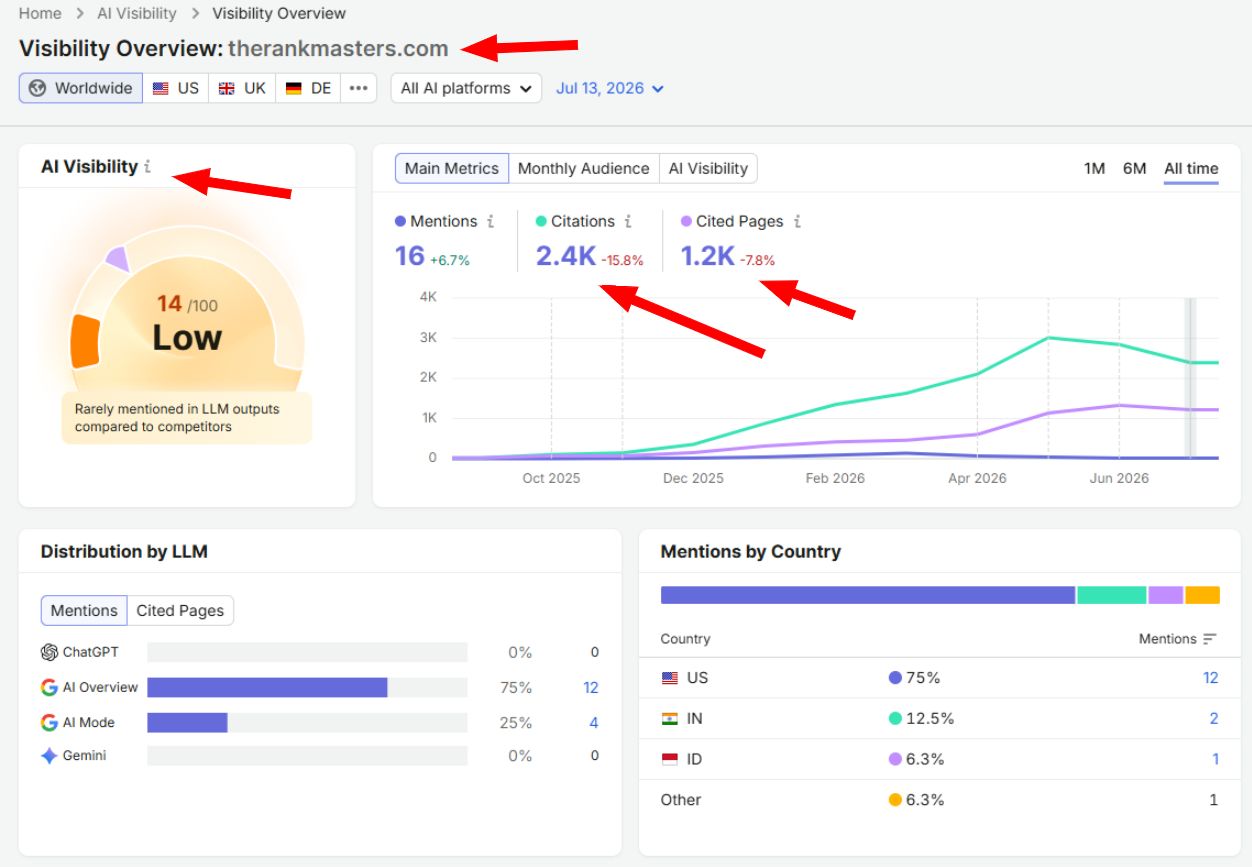
Read it as a priority map.
If you are strong on ChatGPT but invisible on Perplexity, the interpretation is that your reference-grade structure is landing, but your community footprint is thin, so a round of forum-visible, expert-answer content is the next move. The data names the gap, your strategy decides the response.
☑️ Open Semrush One on a 14-day trial and compare your score to a competitor across each engine before you commit a quarter of content to one platform.
How Do You Find Competitor AEO Gaps?
Find competitor AEO gaps by comparing your AI visibility directly against rival brands to see the prompts and topics they get cited for and you do not. Then prioritize the gaps that sit on buying-intent queries, not just high-volume ones.
Competitor Research in Semrush puts your visibility side by side with named rivals, which turns a vague sense that "they show up more in AI" into a specific list of topics to win. Here is how we run it on our own domain.
- Open Semrush and go to AI in the left navigation.
- Click Competitor Research.
- Add your domain and two or three competitor domains.
- Sort the shared prompts to find where a competitor is cited and you are absent.
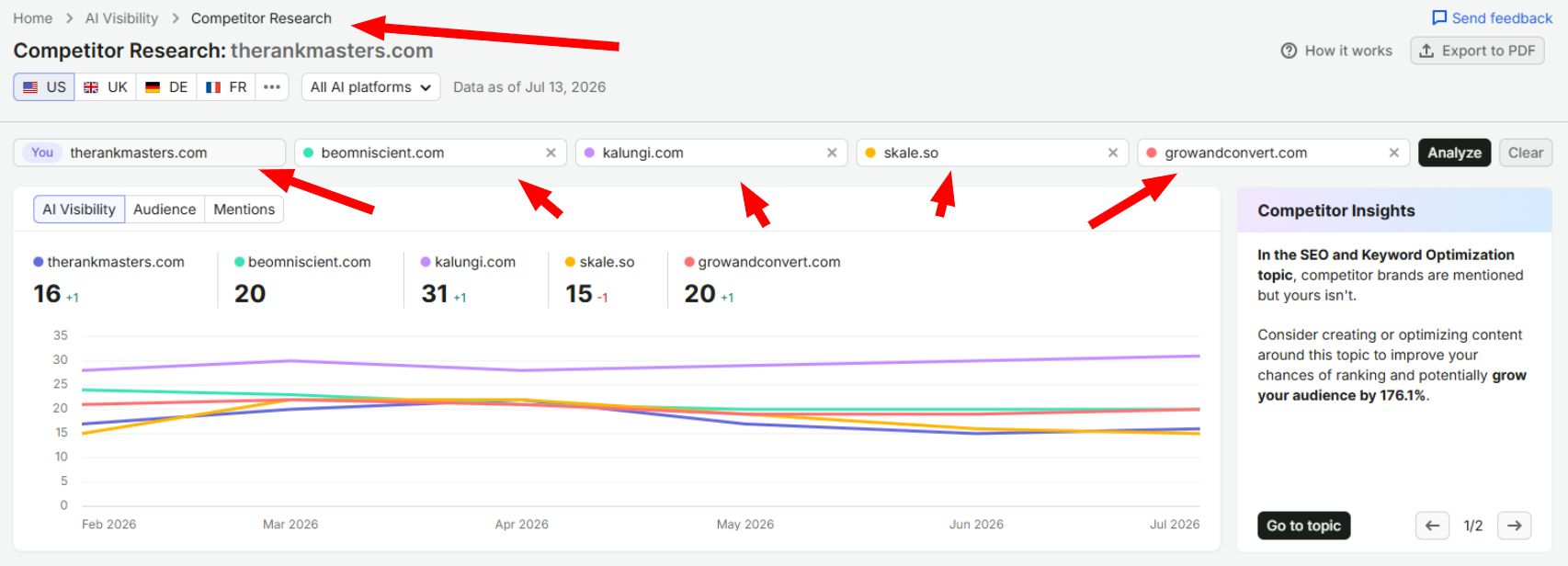
Do not treat every gap as equal.
A competitor being cited for a low-intent definitional prompt matters far less than one owning a "best tool for a 40-person SaaS team" prompt, because the second sits on a buying decision. Rank the gaps by revenue proximity, then write the answer-first sections that close the ones nearest the sale.
See this on your own site 👉 Start your 14-day Semrush One trial and pull the same competitor report to build a prioritized gap list this week.
How Do You Audit a Site's AI Readiness?
Audit AI readiness by checking whether your pages can actually be crawled, rendered, parsed, and cited, then fixing what blocks extraction. Beautiful answer-first content still fails if a render-blocking script or a crawl error hides it from the engines.
Semrush Site Audit adds AI-readiness checks on top of classic site health, flagging the technical issues that stop AI crawlers from reaching and understanding your pages. Run it before you invest heavily in new AEO content, so you are not writing citable answers onto uncitable pages.
- Open Semrush and go to Site Audit.
- Set up or open the project for your domain.
- Review the overall Site Health score on the overview.
- Open the AI-readiness checks and note any crawl or render flags.
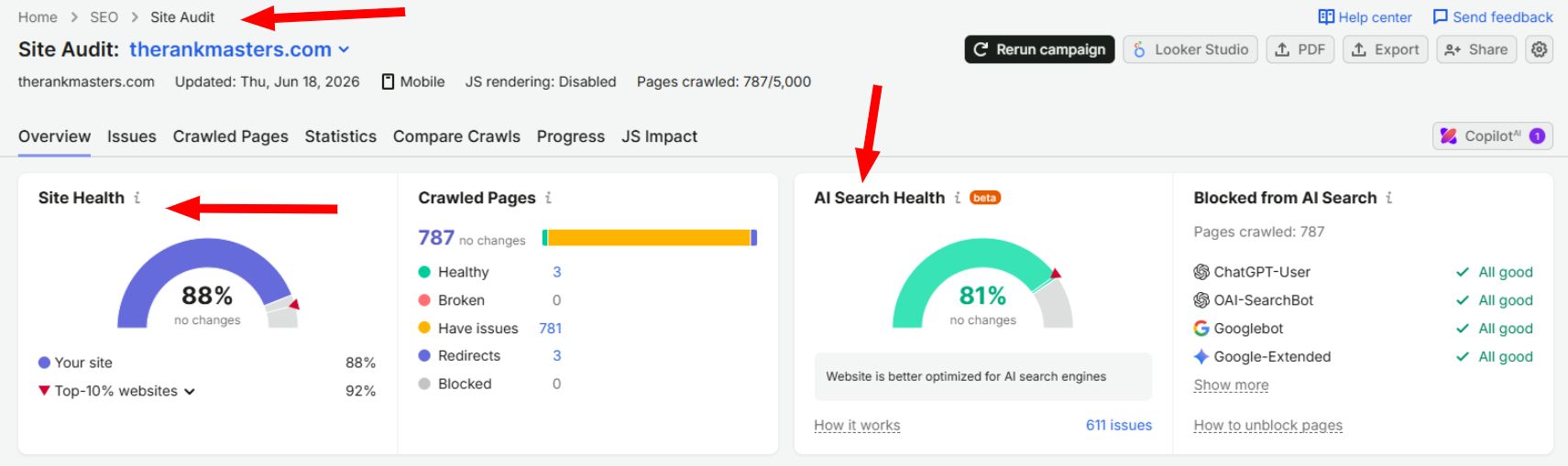
Prioritize anything that blocks access first, namely crawl errors, blocked resources, and content that only appears after heavy JavaScript, because those issues make even your best passages invisible to a retriever. Once access is clean, the structural work from the earlier sections can actually pay off.
Ready to check your own pages? Try the AI Visibility Toolkit free for 14 days and run this audit on your domain before your next content sprint.
How Do You Measure Whether AEO Content Is Working?
Measure AEO with an AI Visibility Score, your mentions, and your cited pages, so you are tracking whether engines are actually quoting you rather than guessing from rankings alone. The score gives you a single trend line, and the cited-pages list tells you which content is doing the work. This is the heart of ongoing AI visibility tracking, and it is what turns AEO from a hunch into a measured program.
Semrush Visibility Overview reports an AI Visibility Score from 0 to 100 alongside your Mentions, Cited Pages, and Citations, which is the baseline you check before and after each content push. Here is the path.
- Open Semrush and choose AI in the left navigation.
- Click Visibility Overview and enter your domain.
- Read the AI Visibility Score gauge and the Mentions figure.
- Open Cited Pages to see exactly which URLs the engines are quoting.
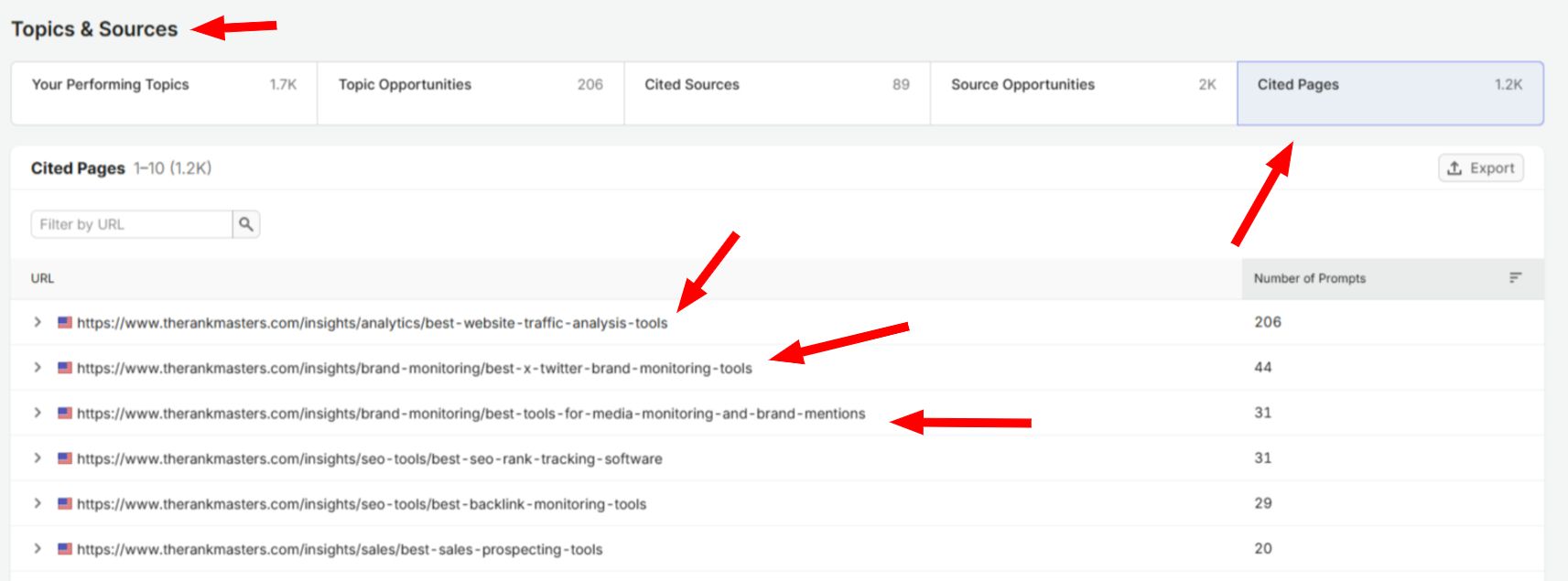
Use the Cited Pages list as a template, not just a scoreboard. The pages already earning citations show you the structure, depth, and evidence pattern the engines reward on your domain, so you can reverse-engineer what works and apply it to the pages that are not yet cited. A rising score with a growing cited-pages list is the clearest signal your AEO writing is landing.
Want the baseline before your next sprint? Start your 14-day Semrush One Starter Trial and check which of your pages are already cited so you can measure the lift afterward.
How Do You Track AEO Performance Across Google and AI Platforms?
Track AEO performance with Position Tracking, which follows your keywords and prompts across Google, AI Overviews, and AI platforms like ChatGPT side by side. That multitargeting view shows whether a page wins the classic ranking, the AI answer, both, or neither.
Watching the same term across surfaces is what separates a real AEO win from a vanity ranking. A page can hold position three on Google and still be absent from the AI Overview for the same query, and only a side-by-side view makes that visible.
- Open Semrush and go to Position Tracking.
- Add or open the project for your domain.
- Add the keywords and prompts you are targeting.
- Enable multitargeting to compare Google, AI Overviews, and ChatGPT together.
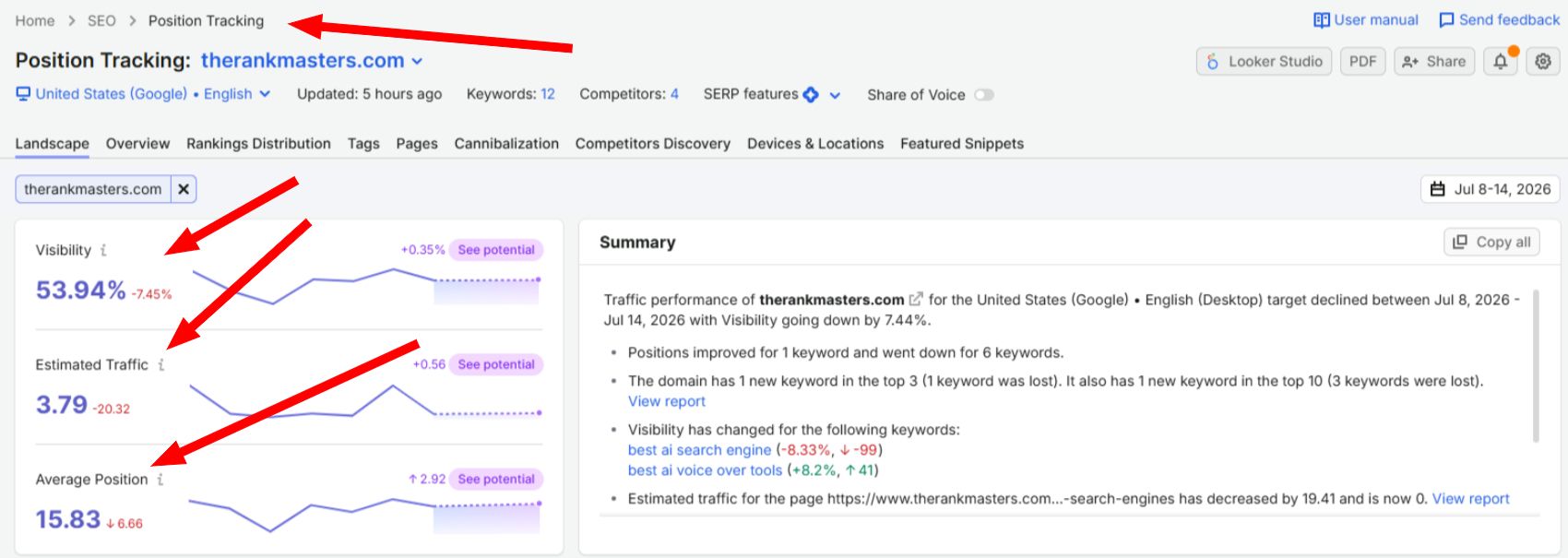
Let the gaps set your rewrite queue. Where you rank on Google but lose the AI answer, the fix is almost always structural, namely a buried answer, a weak first sentence, or a chunk that is not self-contained, all of which you now know how to fix. Re-tracking the same terms after the edit tells you whether the change earned the citation.
Spin up a 14-day Semrush One trial and track your prompts on Google and ChatGPT side by side to see exactly where your content wins or loses the answer.
How Do You Track Brand Mentions and Sentiment in AI Answers?
Track how often AI answers mention your brand, your share of voice against competitors, and whether the sentiment and narrative around you are accurate. Then correct the record with content when the engines describe you wrongly.
Semrush Brand Performance reports Share of Voice against Sentiment, plus Narrative Drivers that surface the top cited domains and the questions shaping your story. It answers a question rankings never could, namely not just whether you appear, but how you are being described.
- Open Semrush and select AI in the left navigation.
- Click Brand Performance.
- Open the Share of Voice versus Sentiment chart.
- Review Narrative Drivers to see the top cited domains shaping your story.
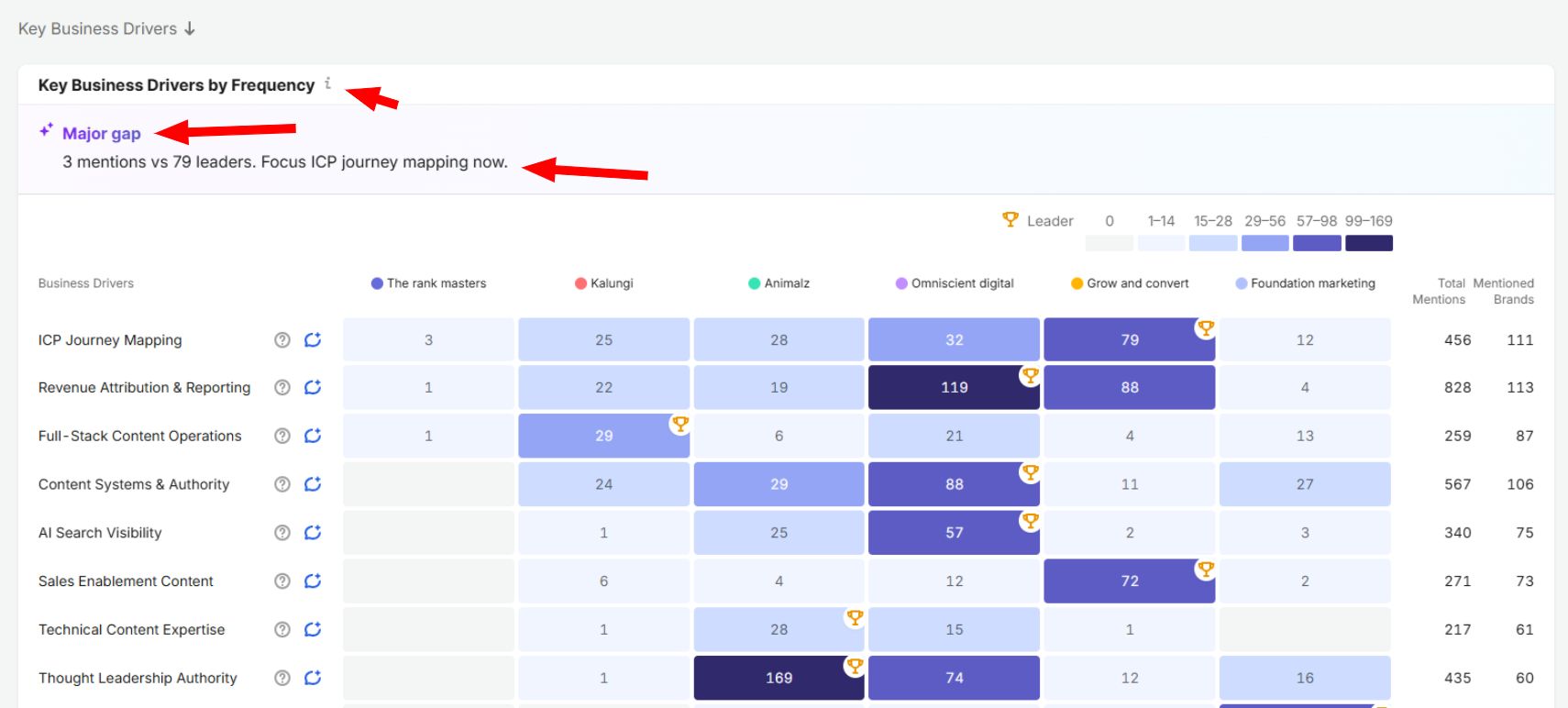
Read sentiment and narrative together with share of voice. A high share with negative or inaccurate sentiment is a content problem, namely the engines are synthesizing an outdated or wrong story about you, and the fix is publishing clear, current, well-sourced pages that give them a better source to cite. The Narrative Drivers list even tells you which domains are shaping that story, so you know whom to out-publish.
Want to watch your own narrative? Grab your 14-day Semrush One trial and watch your share of voice in AI answers shift as your content improves.
A dashboard like this one will hand you the numbers, namely your score, your cited pages, your competitor gaps, and your sentiment. It will not tell you which of them to act on first, or how to turn them into a plan.
That interpretation layer, reading the metrics and mapping your ICP's buying journey to the SEO and AEO content that wins it, is the work The Rank Masters does for B2B SaaS teams, prioritizing the findings that map to revenue and connecting each topic cluster to a money page and to pipeline.
If you would rather see proof before a conversation, our answer engine optimization service page and our case studies show how we do it.
What AEO Mistakes Should You Avoid?
The most damaging AEO mistake is burying the answer, because an engine cannot cite a response it has to dig for. Close behind it sit walls of text, unsourced claims, keyword stuffing, thin coverage, and AI-bait spam, each of which blocks extraction or gets your passage skipped.
Every one of these has a direct fix you have already seen in this guide. The point of listing them together is to give you a fast pre-publish checklist you can run against any draft.
| Common Mistake | Why It Hurts AEO | The Fix |
|---|---|---|
| Burying the answer | The extractable answer is not in the high-weight first sentence | Lead each section with a 30-word direct answer |
| Walls of text | Long paragraphs blur the chunk boundary a retriever needs | Keep paragraphs to 2 to 4 sentences, break out lists |
| Unsourced claims | The engine has nothing to ground or attribute | Add a named, dated statistic with a primary-source link |
| Keyword stuffing | Repetition signals thin content and can suppress visibility | Replace density with topical depth and entity coverage |
| Orphan pronouns | A chunk starting with "it" breaks when lifted alone | Name the entity in every self-contained passage |
| Thin coverage | A single shallow post loses to a full cluster | Build the topic cluster and interlink it |
| AI-bait spam | Over-optimized filler gets discounted by engines and disliked by readers | Write the genuinely best answer, then structure it |
Run this list before you hit publish. If a draft trips even two of these, it will underperform in AI answers no matter how good the underlying research is, because the structure, not the substance, is what the engine sees first.
AEO vs SEO: What Is the Difference?
The difference is the unit of victory. SEO earns a ranked link a human chooses to click, while AEO earns a citation inside an AI-generated answer the human may never click past. SEO optimizes for position on a results page, AEO optimizes for being quoted in the response.
The two are not rivals.
Classic SEO fundamentals, crawlability, relevance, authority, and internal linking, are what make your page eligible to be retrieved in the first place.
AEO adds the layer on top, namely answer-first structure, clean entities, schema, and sourced evidence, that turns an eligible page into a cited one.
Here is the practical contrast, attribute by attribute.
| Dimension | SEO (Classic Search) | AEO (Answer Engines) |
|---|---|---|
| Unit of success | A ranked link in the SERP | A cited passage inside an AI answer |
| Primary optimization | Keywords, backlinks, ranking position | Answer-first passages, entities, evidence, schema |
| How the user arrives | Clicks a link to your page | Reads your answer in the AI response, may click the citation |
| Content shape | Comprehensive page targeting a keyword | Self-contained chunks each answering one question |
| Core metric | Rankings, organic traffic | Mentions, cited pages, AI Visibility Score |
| Time to move | Weeks to months | Days to weeks as engines re-embed content |
None of this means traffic is gone.
It means some of the value now shows up as a citation and a brand impression inside the answer, which is why measuring mentions and cited pages matters as much as measuring clicks.
AEO vs GEO: Are They the Same Thing?
AEO and GEO overlap so much in practice that most teams run them as one workflow. Answer engine optimization emphasizes direct-answer surfaces like AI Overviews and featured-answer boxes, while generative engine optimization emphasizes being synthesized into a generated response. The writing tactics are nearly identical.
Here is the distinction laid out attribute by attribute, so you can see how much they share.
| Dimension | AEO (Answer Engine Optimization) | GEO (Generative Engine Optimization) |
|---|---|---|
| Primary focus | Being the direct, cited answer to a question | Being synthesized into a longer generated response |
| Typical surfaces | AI Overviews, featured answers, voice answers | ChatGPT, Perplexity, Gemini, Copilot answers |
| Core unit of success | A clean, extractable answer passage | A citable claim woven into synthesis |
| What it rewards most | Answer-first structure, schema, clarity | Depth, evidence, entity coverage, authority |
| Writing tactics | Answer-first, chunked, sourced, structured | Answer-first, chunked, sourced, structured |
| How you measure it | Cited pages and answer appearances | Mentions, share of voice, and citations |
Both reward the same things, namely clean structure, self-contained passages, named entities, sourced statistics, and first-hand expertise.
Jakob Nielsen, the usability expert who co-founded Nielsen Norman Group, puts the underlying principle plainly. "What's good for AIs may largely be what's good for human readers," writes Jakob Nielsen, which is why the same content architecture serves both AEO and GEO.
Do not get lost in the acronym debate. Whether a colleague calls it AEO, GEO, or AI search optimization, you are doing the same core job, that is writing content an AI engine can confidently quote and attribute to you.
Why Does AEO Matter Now?
AEO matters because the answer engine increasingly intercepts the query before the click ever happens. When an AI summary resolves the question, the brands cited inside it win the shortlist, and the brands absent from it disappear from consideration entirely.
The scale of the shift is measurable.
Semrush's study of more than 10 million keywords found that AI Overviews appeared on 15.69 percent of queries by November 2025, after peaking near 24.61 percent in July, according to analysis led by Semrush's Jana Garanko.
On the AI-native side, Semrush's clickstream research recorded 206 percent year-over-year growth in outbound referral traffic from ChatGPT between January 2025 and January 2026.
Nielsen frames the stakes for brands in stark terms. "Being ignored by AI is like being on page 5 of a Google SERP in the old days," says Jakob Nielsen, which captures why visibility inside answers is now a survival metric, not a vanity one.
There is a quality upside too, not just a defensive one. AI referral visitors tend to arrive later in their decision, already briefed by the answer, so the traffic that does click through is often more qualified than a cold search click. Getting cited is how you enter that consideration set in the first place.
Frequently Asked Questions
How much does AEO cost and what tools do you need?
Does AEO-optimized content still rank in Google?
How long does AEO take to work?
Does AEO replace SEO?
What word count works best for AEO content?
How do you measure whether AEO is working?
Can you do AEO without a paid tool?
Turn Your AEO Findings Into a Content-to-Pipeline System
You now have the full loop, from finding real prompts to structuring answer-first chunks, adding reference-grade evidence, marking up schema, building the cluster, and measuring citations inside Semrush.
That is the writing.
The harder part is deciding which of those findings actually map to revenue and building the system that turns citations into pipeline.
If thin BOFU coverage is costing you pipeline, book a SaaS content strategy call and we will map your highest-intent topics to revenue.
Prefer to gather your own numbers first? You can always follow along on your own domain with a 14-day Semrush One trial, then bring the data to the call.
📑 Disclosure!
Some links in this article are affiliate links. If you sign up through them, The Rank Masters may earn a commission at no additional cost to you. This does not influence which tools we recommend or what we say about them.