TL;DR
We used The Rank Masters website as our own AEO testing ground.
The goal was simple, i.e., to prove that our strategy could help a B2B SaaS SEO and AEO agency grow organic visibility, rank on page one for service-aligned topics, get cited by AI search engines for non-brand queries our ICP actively searches, and turn that discovery into a service-led funnel.
The strategy worked.
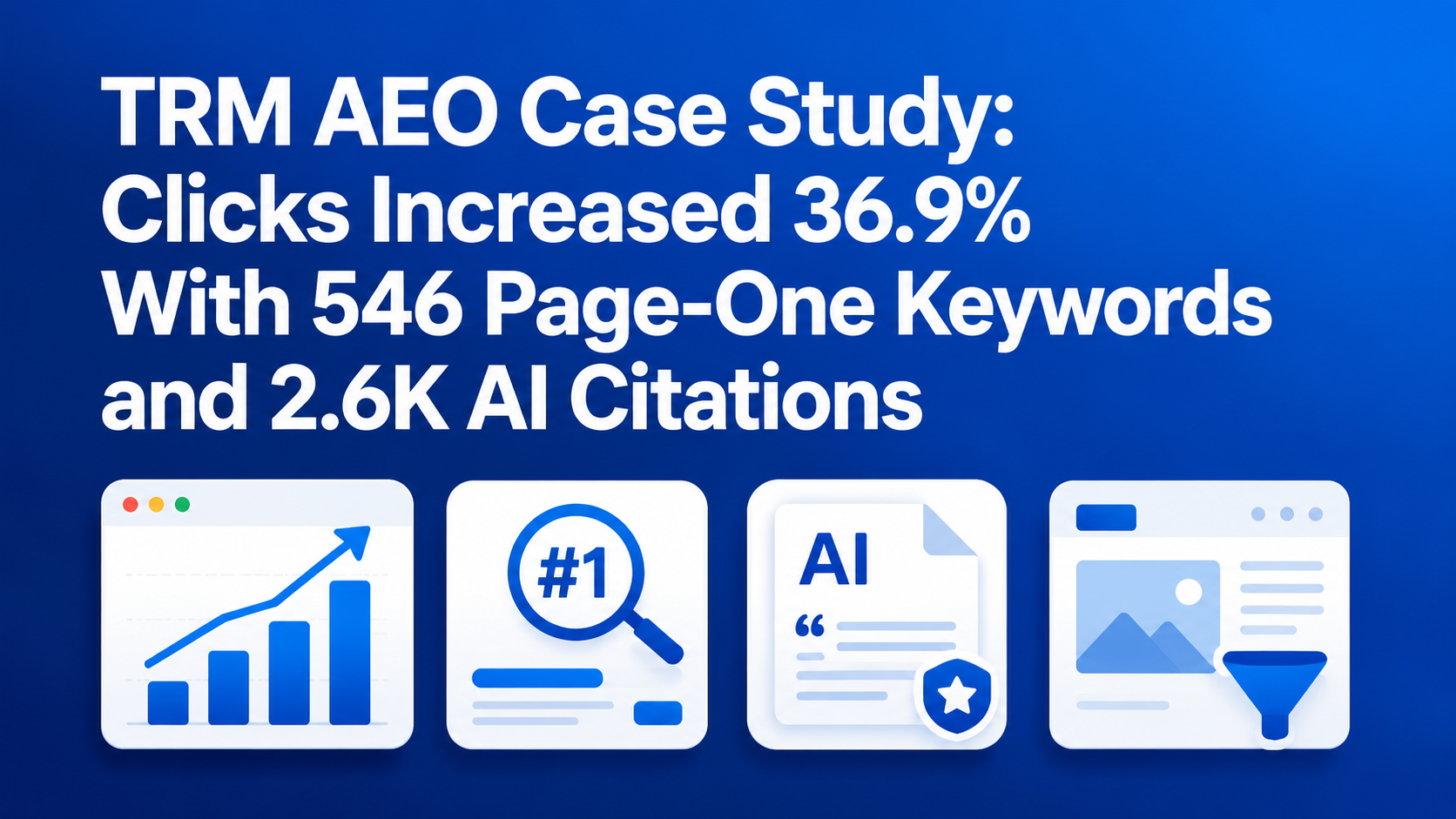
In the latest analysis window, TRM achieved:
| Result area | Outcome |
|---|---|
| Google organic clicks | 1.5K clicks in 28 days, up 36.9% vs the prior 28 days |
| Google organic impressions | 3.19M impressions in 28 days, up 30.7% vs the prior 28 days |
| First-page Google rankings from Semrush export | 546 keywords ranking in positions 1-10 |
| Top 3 rankings from Semrush export | 92 keywords ranking in positions 1-3 |
| GA4 Organic Search sessions | 1,420 sessions, up 295.54% vs the prior 28 days |
| GA4 Organic Search engaged sessions | 532 engaged sessions, up 421.57% vs the prior 28 days |
| GA4 Organic Search engagement rate | 37.46%, up 31.86% vs the prior 28 days |
| GA4 Organic Search key events | 36 key events, up 300% vs the prior 28 days |
| Semrush AI visibility | 2.6K AI citations from 888 cited pages |
But the real win was not just the numbers.
The bigger win was proving that our AEO strategy could create visibility across both Google and AI search while supporting a real buyer journey.
We did not chase vanity brand mentions.
We focused on getting TRM pages cited for the right, service-relevant non-brand queries. We did not treat listicles and tools pages as random top-of-funnel traffic.
Instead, we built them as strategic entry points into an AEO funnel.
This case study explains how we did it.
Background: Why we used our own site as the test case
AEO is still a confusing category for many SaaS founders, CMOs, and growth teams.
- Some people think it is just SEO with a new name.
- Some think it is only about ChatGPT.
- Some think it means tracking brand mentions in AI tools.
- Others are still only looking at Google rankings and backlinks.
We see it differently.
For us at TRM, AEO is the next layer of search visibility. It sits on top of strong SEO, topical authority, technical clarity, helpful content, trust signals, and buyer-intent mapping.
So before asking SaaS and AI companies to trust our AEO process, we wanted to prove it on our own site.
TRM’s website became the testing ground.
The question was:
Can we build a search system that ranks on Google, gets cited by AI search engines, earns visibility for non-brand ICP queries, and routes that attention toward our SEO and AEO services?
That was the challenge.
The core insight: Modern buyers do not start on service pages
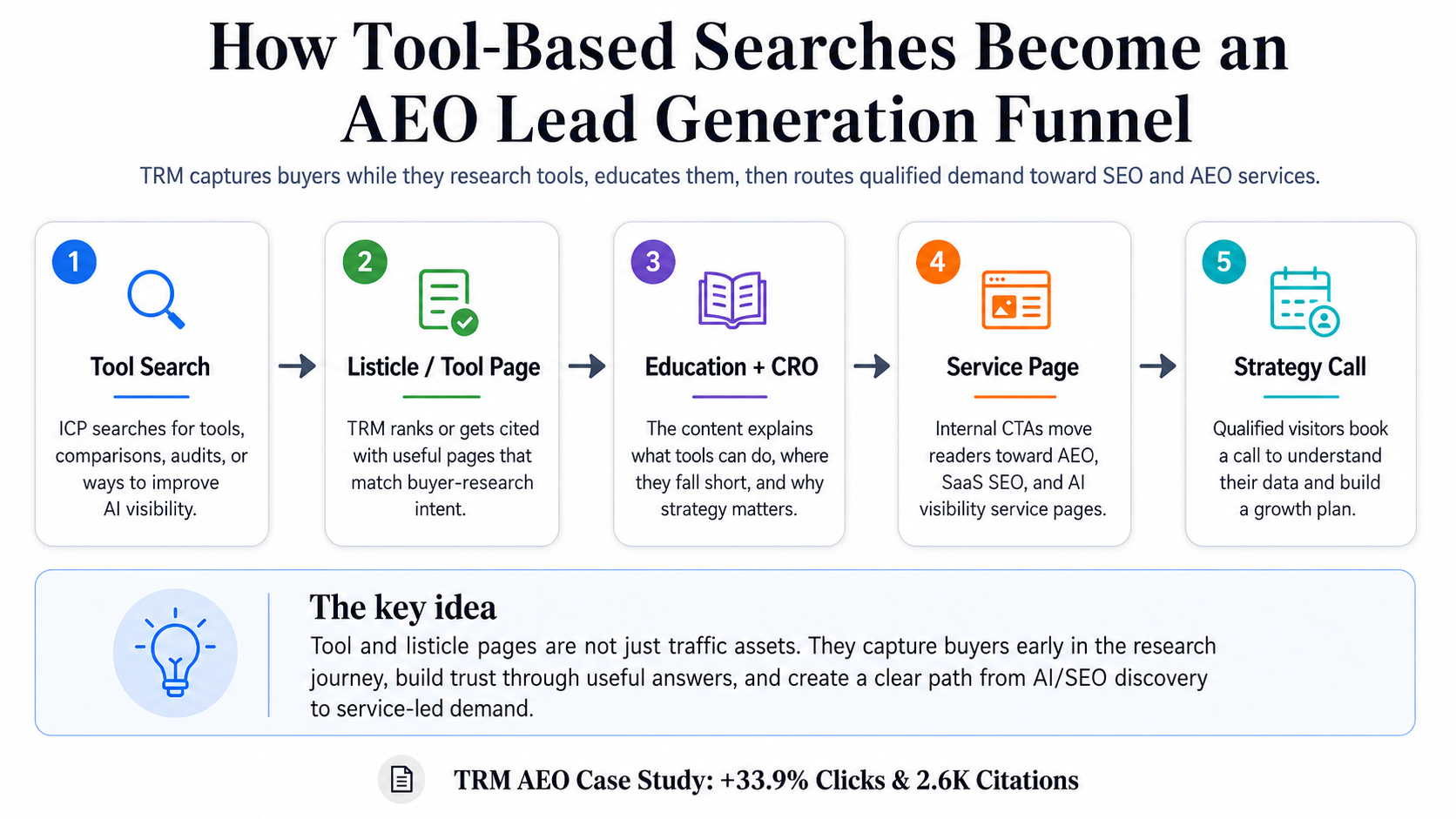
One of the biggest lessons from this project is that service pages are not always the first touchpoint.
A SaaS founder or marketing leader may not start with:
“AEO agency for SaaS”
They may start with:
“best AI visibility tools”“how to track brand mentions in AI search”“best SEO site audit tools”“best rank tracking software”“tools to monitor AI citations”
Those searches look informational on the surface, but they are not low-value.
They often happen when a buyer is already aware of a problem and looking for a way to solve it.
That is why we built content around tool-based and listicle-style queries. The goal was not just to collect clicks. The goal was to show up where modern buyers begin their research.
Then we used CRO inside the content to move readers toward service pages, strategy calls, and deeper AEO education.
That is the difference between publishing listicles for traffic and building listicles as part of a search-led demand system.
The goals
We were not trying to win generic traffic for the sake of traffic.
The goal was to build a modern search visibility system that could support how B2B buyers now discover solutions i.e., through Google, AI Overviews, ChatGPT-style answers, AI search engines, comparison searches, tools searches, and problem-aware research.
We had four main goals.
1. Increase organic traffic
We wanted more organic visibility from Google without relying on paid acquisition.
This meant expanding impressions, clicks, and rankings across topics tied to SEO, AEO, AI visibility, SEO tools, analytics, brand monitoring, and SaaS growth.
2. Rank on page one for service-aligned topics
We wanted to build a footprint across topics connected to what we sell.
That included terms around:
- AI visibility
- AEO
- AI search visibility tracking
- Brand visibility in AI search
- SEO tools
- Site audit tools
- Rank tracking tools
- Backlink monitoring tools
- SaaS SEO
- B2B SaaS SEO agencies
3. Get cited by AI search engines for non-brand ICP queries
This was the most important AEO goal.
We were not trying to get generic brand mentions.
We wanted TRM pages to be cited as sources when our ICP searched for tools, strategies, and solutions related to AI visibility and SEO.
That distinction matters.
A brand mention is useful, but a page citation is stronger because it gives the user a path back to your website. It turns AI visibility into a discoverable source of traffic, trust, and demand.
4. Turn informational and tool-based searches into service-led demand
A lot of our highest-visibility pages are listicles, tool pages, and comparison-style articles.
That was intentional.
Our ICP often starts by searching for tools.
They search for things like AI visibility tools, SEO audit tools, backlink monitoring tools, rank trackers, and brand mention tracking tools.
But tools are not always enough.
The role of our content is to meet them at the tool-search stage, educate them, show them the limits of tooling alone, and move them toward a strategist-led AEO or SEO engagement when that is the right next step.
Results
1. Organic visibility grew in Google
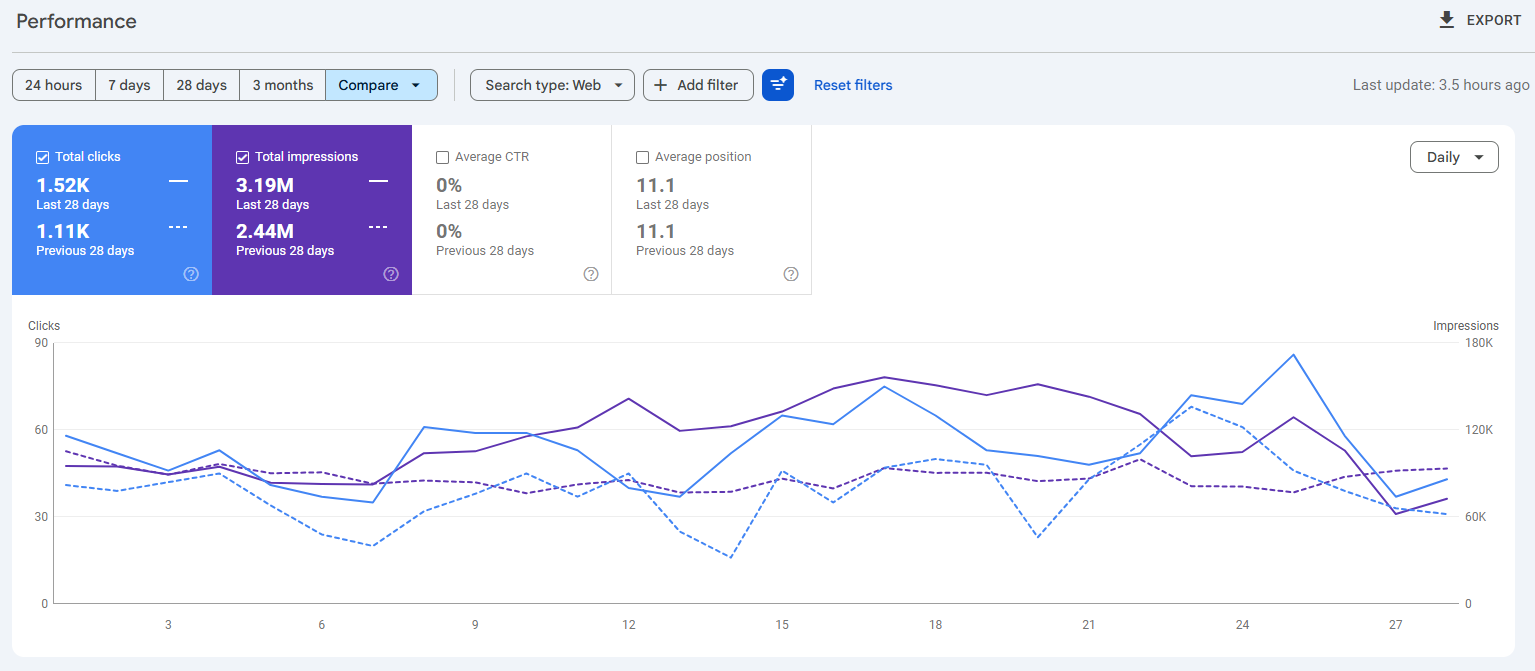
In the latest 28-day GSC analysis window, TRM generated:
- 1.5K organic clicks
- 3.19M organic impressions
- 36.9% more clicks than the prior 28 days
- 30.7% more impressions than the prior 28 days
This showed that the strategy was expanding visibility and increasing organic traffic at the same time.
The impression growth is especially important in an AI-first search environment because visibility now happens across more surfaces than traditional blue-link clicks. Google says AI Overviews and AI Mode can surface supporting links from a wider and more diverse set of helpful pages than classic web search, using techniques like query fan-out to explore related subtopics and data sources. (Source: Google Search Central)
2. TRM ranked on page one for 500+ keywords
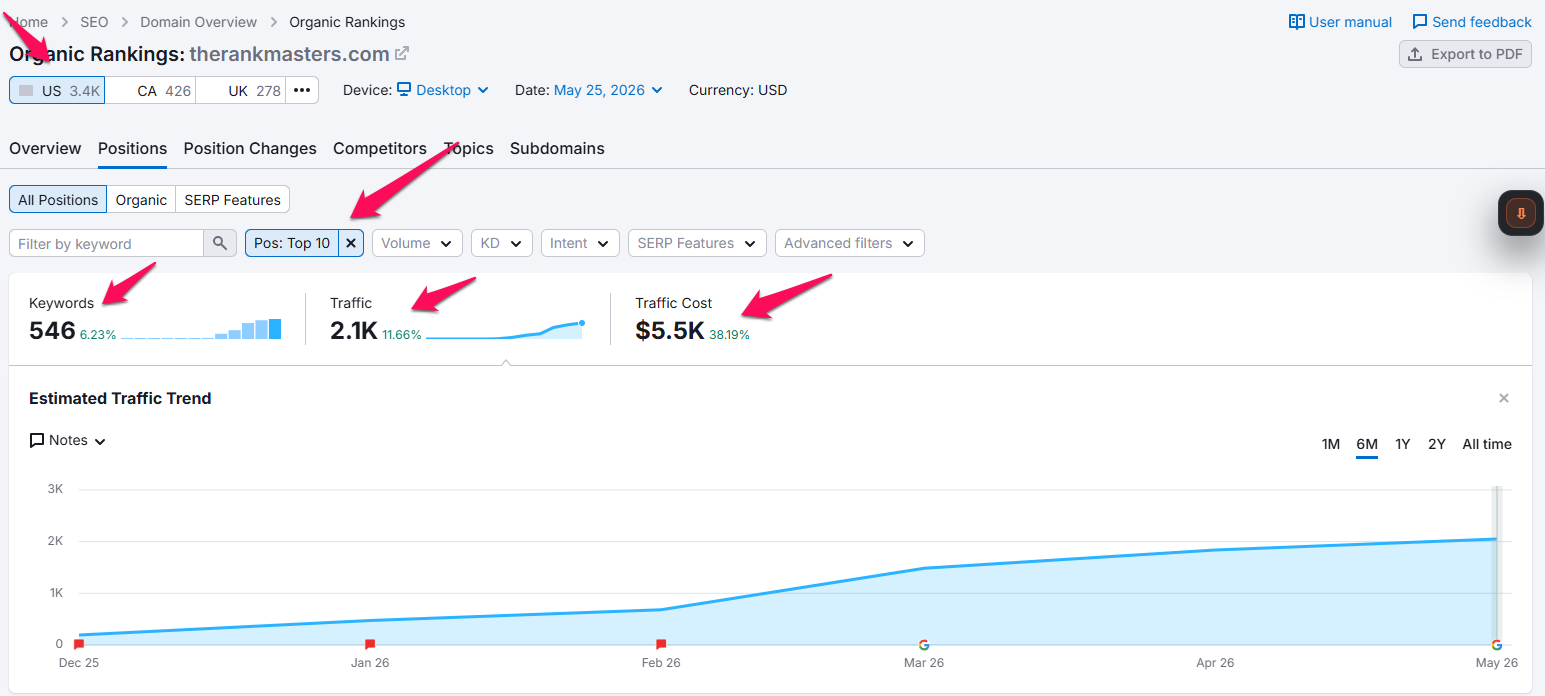
The Semrush first-page keyword export showed:
- 546 keywords ranking in positions 1-10
- 92 keywords ranking in positions 1-3
In other words, the site already has meaningful page-one visibility. The next opportunity is to push more of those rankings into the top 3.
3. Tool and listicle pages became the visibility engines
Some of the strongest ranking assets were exactly the kind of pages we intentionally built for the funnel.
Examples from the Semrush export included:
| Page type | Example page | First-page keyword signal |
|---|---|---|
| AI visibility tools/listicle | AI brand mention tracking tools | 71 first-page keywords |
| AI visibility tools/listicle | AI search visibility audit tools | 61 first-page keywords |
| SEO tools/listicle | Backlink monitoring tools | 12 first-page keywords |
| SEO tools/listicle | Cheap SEO tools | 37 first-page keywords |
| Analytics tools/listicle | Website traffic analysis tools | 58 first-page keywords |
| SEO tools/listicle | Similarweb alternatives | 20 first-page keywords |
This confirmed that tool-based content was not a side project.
It was the growth engine.
These pages helped TRM appear in the exact type of research journeys our ICP goes through before they understand they need a strategist, not just a tool.
4. AI visibility and citation signals grew
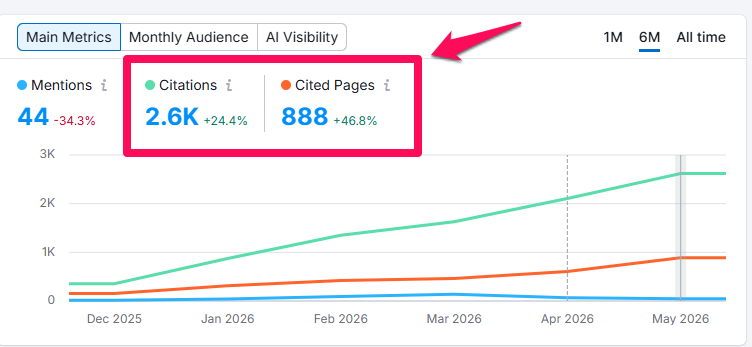
The Semrush AI visibility snapshot showed:
- 2.6K citations
- 888 cited pages
The most important part is not the raw number of citations.
The important part is that the citations were aligned with the types of prompts we wanted to win, i.e., non-brand, service-relevant, ICP-searchable queries connected to AI visibility, SEO tools, tracking, and optimization.
That matters because our AEO funnel does not depend on people already knowing TRM.
It depends on TRM showing up as a cited source when the buyer is researching the problem.
5. Organic Search produced meaningful engagement and key events
GA4 showed that Organic Search generated:
- 1,420 sessions
- 532 engaged sessions
- 37.5% engagement rate
- 36 key events
Organic Search was not just producing awareness. It was producing engaged visitors and conversion activity.
This is important because a lot of informational content gets dismissed as “traffic that does not convert.”
Our data showed something different.
When informational content is connected to a service-led funnel, it can contribute to qualified demand.
6. GA4 showed Organic Search was not just growing, it was engaging
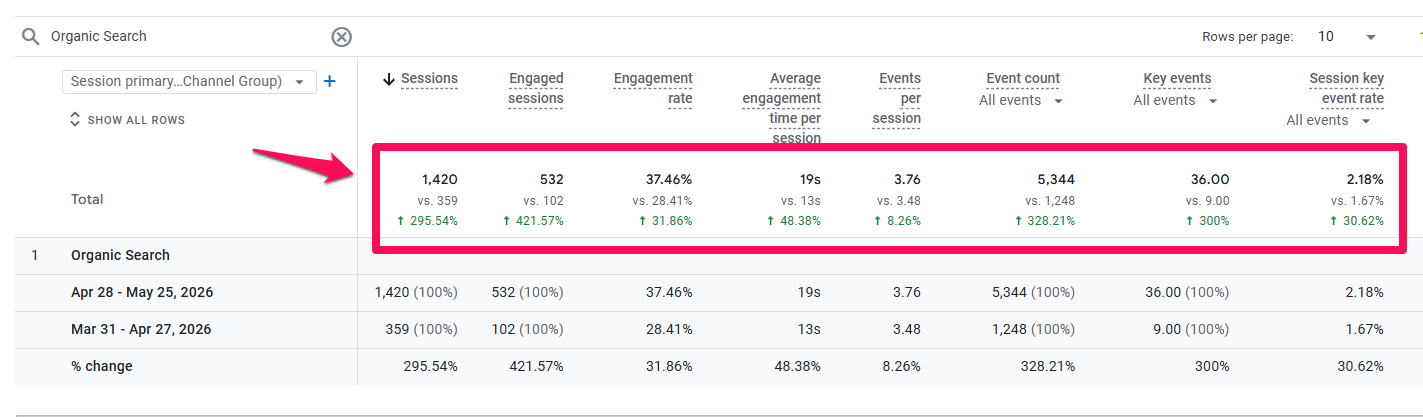
The 28-day GA4 comparison showed a major lift in Organic Search quality and activity, not just traffic volume.
Organic Search generated:
- 1,420 sessions, up 295.54% vs the prior 28 days
- 532 engaged sessions, up 421.57% vs the prior 28 days
- 37.46% engagement rate, up 31.86% vs the prior 28 days
- 19s average engagement time per session, up 48.38% vs the prior 28 days
- 3.76 events per session, up 8.26% vs the prior 28 days
- 5,344 total events, up 328.21% vs the prior 28 days
- 36 key events, up 300% vs the prior 28 days
- 2.18% session key event rate, up 30.62% vs the prior 28 days
This matters because it shows the organic growth was not empty visibility.
More people came through Organic Search, more of them engaged, they triggered more events, and key events increased by 300% compared with the previous 28-day period.
That supports the core thesis of this case study: tool and listicle pages can drive meaningful business activity when they are connected to a service-led funnel.
Organic Search was not just helping TRM get found. It was helping move visitors deeper into the buyer journey.
7. Low CTR did not mean the strategy was failing
The GSC data showed very high impressions and low CTR on several pages.
In a traditional SEO report, that could appear to be a weakness.
But in a zero-click and AI-assisted search environment, CTR needs to be interpreted differently.
Some queries are answered directly on the SERP. Some visibility happens inside AI-generated experiences. Some users discover a brand through repeated appearances before clicking later. Some pages influence AI citations even when the click does not happen immediately.
So we treated low CTR as a signal to improve titles, snippets, and intent matching, but not as proof that the strategy was failing.
The stronger read was this:
TRM’s visibility was expanding. The next job was to convert more of that visibility into clicks, assisted journeys, and service-led demand.
The strategy
We built the site around a combined SEO and AEO strategy.
The strategy had six layers.
1. Topic authority before isolated keywords
We did not treat each keyword as a standalone target.
Instead, we mapped the topics we wanted TRM to be recognized for and built clusters around them.
The main clusters included:
- AI visibility
- Answer Engine Optimization
- AI search monitoring
- Brand visibility in AI search
- SEO tools
- Analytics and traffic analysis
- Backlink monitoring
- Rank tracking
- SaaS SEO
- Content marketing for SaaS
This gave both Google and AI search engines more connected evidence that TRM had depth around these topics.
2. Tool and listicle pages as demand capture assets
A lot of SEO teams treat BOFU listicles as commodity content.
We treated them as strategic entry points.
For example, a page about the best SEO site audit tools can attract marketers who know they need better SEO diagnostics. A page on AI visibility tools can attract SaaS teams seeking to understand how their brand appears in AI responses.
Those people may not be ready to hire an agency immediately, but they are close enough to the problem for us to educate them.
The job of the page is to:
- Help them compare options.
- Explain what tools can and cannot solve.
- Show why strategy, content architecture, technical execution, and CRO still matter.
- Route them toward a relevant TRM service page or strategy call.
3. AI-citable page structure
We wanted our pages to be useful for humans and easy for AI systems to parse.
So we used a structure built around:
- Clear definitions
- Direct answers
- TL;DR sections
- Comparison tables
- Short explanatory blocks
- FAQs
- Strong headings
- Consistent terminology
- Evidence-led claims
- Semantic SEO approach
- Query fan-out techniques
- Modular content approach
- Internal links to supporting pages
This made the content easier to understand, extract, and cite.
4. Internal links from informational pages to service pages
The funnel only works if the user has a clear next step.
So we added service-led CRO pathways inside the content.
The goal was to move users from:
- Tool research to AEO strategy
- SEO software comparisons to SEO execution
- AI visibility tracking to AI visibility growth
- Informational searches to service-led demand
This is where the strategy became commercial.
We were not just publishing content for rankings.
We were building a path from discovery to conversion.
5. Measurement across Google, GA4, and Semrush
We used multiple data sources because no single tool can capture the full search journey anymore.
Google Search Console helped us understand:
- Clicks
- Impressions
- CTR
- Average position
- Query and page-level visibility
GA4 helped us understand:
- Sessions
- Engagement
- Key events
- Landing page behavior
- Channel quality
Semrush helped us understand:
- Page-one rankings
- Ranking distribution
- Competitive visibility
- Top pages
- Keyword opportunities
- AI visibility signals
- Mentions, citations, and cited pages
Even though Semrush did not create the strategy, it helped us research, validate, monitor, and report the strategy.
That distinction is important.
The tool gave us visibility.
The win came from how we used the data.
If you want to apply the same approach to your own business, start by taking a 14-day free Semrush trial and gathering data on your site’s current SEO and AI visibility performance.
Once you have that data, schedule a call with us.
We’ll help you understand what the numbers actually mean, where your biggest search and AEO opportunities are, and what it would take to reach the same kind of success we created for our own agency website.
6. Reporting success beyond CTR
CTR still matters, but it is no longer enough.
Google is increasingly a zero-click environment.
AI Overviews and AI search experiences can answer more of the query directly on the results page.
That means impressions, citations, cited pages, brand evidence, assisted journeys, and engagement quality need to be considered alongside clicks.
So we did not judge the strategy only by CTR.
We judged it by whether TRM was becoming visible where our buyers research.
Execution: What we actually did?
Here is the execution framework we used.
Step 1: Built the topic map
We started with the topics TRM needed to own.
The focus was not just “SEO.” That category is too broad.
We narrowed the content universe around topics that connect directly to our services and ICP:
- AI visibility for SaaS companies
- AEO strategy
- AI search visibility tracking
- SEO tool evaluation
- SEO audits
- Rank tracking
- Backlink monitoring
- SaaS SEO
- Content-led demand generation
From there, we mapped content types to buyer intent.
| Buyer stage | Search behavior | Content type we built |
|---|---|---|
| Problem-aware | “How do I improve AI visibility?” | Educational guides and frameworks |
| Tool-aware | “Best AI visibility tools” | Listicles and comparison pages |
| Solution-aware | “AEO agency” or “SaaS SEO agency” | Service pages and case studies |
| Validation stage | “Does this strategy work?” | Case studies, benchmarks, proof-led articles |
Step 2: Prioritized tool-based and comparison searches
We saw a major opportunity around tool-based searches because these queries sit at the intersection of awareness and commercial intent.
Examples included topics around:
- Website traffic analysis tools
- SEO rank tracking software
- Site audit tools
- Backlink monitoring tools
- AI visibility tools
- Brand mention tracking tools
- AI search visibility audit tools
These pages gave us a way to reach buyers before they were searching directly for an agency.
Step 3: Built pages that were useful enough to rank and structured enough to be cited
Every important page needed to serve two audiences:
- The human buyer who wants a clear answer.
- The AI system that needs clean, extractable, source-worthy information.
So the pages were built with:
- Clear search intent matching
- Direct answers above the fold
- Tables and comparison sections
- Practical evaluation criteria
- Use-case-driven recommendations
- Semantic SEO approach
- Query fan-out techniques
- Modular content approach
- FAQs
- Internal links
- Service-led CTAs
- Author and brand trust signals
Step 4: Added CRO paths from informational content to service pages
This is where the strategy became more than SEO.
Inside tool and listicle pages, we added conversion bridges that helped readers understand when they needed more than a tool.
For example:
- A tool can track AI visibility, but it cannot build the strategy for you.
- A site audit tool can find issues, but it cannot prioritize fixes based on revenue impact.
- A rank tracker can show movement, but it cannot create topic authority.
- An AI visibility platform can surface citations, but it cannot make your content more citable by itself.
That message created a natural bridge to TRM’s AEO and SEO services.
Step 5: Measured the system, not just isolated pages
We did not only ask:
Did this page get clicks?
We also asked:
Did this page create visibility?Did it rank for relevant queries?Did it get cited by AI search engines?Did it support the buyer journey?Did it assist service demand?Did it strengthen topical authority?
That broader measurement model is what made this an AEO case study, not just an SEO traffic report.
That is also why we used Semrush alongside Google Search Console and GA4. GSC showed us how the site was performing inside Google Search, and GA4 showed us what happened after visitors landed on the site.
But those two tools were not enough to understand the full SEO and AEO picture. GSC does not show competitor ranking movement, full page-one keyword distribution, AI visibility signals, cited pages, or how our content compares against other domains in the market.
GA4 does not show which external topics, prompts, or competitive content formats are creating search visibility.
Semrush helped close that gap by giving us keyword intelligence, competitive research, ranking validation, top-page analysis, and AI visibility data that we could connect back to our GSC and GA4 performance.
If you want to run the same type of audit for your own business, start with a free 14-day Semrush trial.
Use it to gather your keyword, competitor, ranking, and AI visibility data, then schedule a call with us so we can help you understand what the data means and where your biggest opportunities are.
Why the strategy worked
1. We built for how buyers actually search
Our buyers do not always start by searching for an agency.
They start with tools, comparisons, problems, workflows, and questions.
By building content around those searches, we entered the journey earlier.
That gave us a better chance to shape how buyers think about AI visibility and why they may need expert help.
2. We connected SEO and AEO instead of treating them separately
Traditional SEO helped us build the foundation: rankings, topic authority, internal links, and crawlable content.
AEO helped us optimize for the next layer: AI citations, answerability, extractability, and source-worthiness.
The two worked together.
That is the point most companies miss.
AEO is not a replacement for SEO. It is what strong SEO evolves into when buyers start using AI search to make decisions.
3. We focused on cited pages, not just brand mentions
Brand mentions matter, but they are not the full goal.
A cited page gives the user a direct path to your site.
That is why we focused on making TRM pages useful enough to be cited for non-brand prompts.
That is a more commercially useful goal than simply trying to appear in AI-generated text.
4. We used listicles and tools pages as funnel assets
The content that drove visibility was not random.
It was designed to attract people who were already researching solutions.
Then the pages explained the limits of tools and routed readers toward strategy-led support.
That is how informational traffic becomes service-led demand.
5. We measured the full journey
We did not rely on one metric.
We looked at:
- Google rankings
- Organic clicks
- Impressions
- GA4 sessions
- Engagement
- Key events
- Semrush keyword visibility
- AI mentions
- AI citations
- Cited pages
- Page types driving discovery
That gave us a clearer picture than a clicks-only report.
The Semrush role in this workflow
Semrush was part of the intelligence and reporting layer.
We used it to support:
- Keyword research
- Competitive research
- Reverse engineering page-one opportunities
- Ranking validation
- Top page analysis
- AI visibility checks
- Citation and cited-page monitoring
- Reporting around SEO and AEO progress
But the important point is this:
Semrush helped us find, validate, and monitor the opportunity. TRM’s strategy turned that opportunity into results.
That is also how we recommend SaaS and AI companies use tools.
A platform can show you where the opportunity is. It can tell you what is ranking. It can help you monitor citations and visibility.
But the tool alone will not build topic authority, write citation-worthy content, improve CRO, or create a service-led search funnel.
That is where strategy and execution matter.
What this means for SaaS and AI companies
If you are a SaaS or AI company, this case study has a simple takeaway:
Your buyers are already searching in more places than Google.
They are using AI search engines. They are reading AI Overviews. They are comparing tools. They are asking ChatGPT-style questions. They are searching for workflows before vendors.
That means your search strategy needs to do more than rank a few service pages.
You need a system that helps your brand show up across the full buyer journey:
- When buyers search for tools
- When they compare solutions
- When they ask AI engines for recommendations
- When they research how to solve a problem
- When they move from education to vendor selection
That system needs SEO, AEO, content architecture, CRO, measurement, and iteration.
That is what we built for our own site.
And that is what we build for clients.
Explore ▶️ Related Case Studies
- How TRM grew ChatGPT referral traffic by 8,337% in 90 days
- How AI visibility turned mentions, citations, and conversions into a measurable SaaS growth channel
- How BOFU SEO lifted conversions by 247% for a PSA SaaS brand
- How SEO drove a 240% traffic lift for Buddy Punch
- How Avaza built AI-ready posts for PSA SaaS search visibility
- How BOFU SEO helped win visibility inside Google AI Overviews
Lessons learned
Lesson 1: Page-one rankings still matter
AI search is changing discovery, but Google rankings are not irrelevant.
Strong organic visibility still creates authority, traffic, and discoverability. It can also support AI citations because well-structured, authoritative pages are easier for AI systems to use as sources.
Lesson 2: AI citations are more useful when they are tied to buyer prompts
A citation is only valuable if it appears in the right context.
For us, the goal was not to be mentioned by AI search engines in random conversations.
The goal was to be cited when our ICP searched for topics connected to AI visibility, SEO tools, and AEO strategy.
Lesson 3: Tool searches can be high-intent
A person searching for a tool is not always a low-intent visitor.
Often, they are trying to solve a business problem.
If your content helps them understand the problem better and shows where tools stop being enough, that search can become the start of a service conversation.
Lesson 4: Low CTR needs context
Low CTR is not always a failure anymore.
In zero-click and AI-assisted search, visibility can influence discovery before the click. That does not mean CTR should be ignored. It means CTR should be interpreted alongside impressions, citations, engagement, key events, and assisted demand.
Lesson 5: Tools support strategy, but they do not replace it
Semrush, GSC, and GA4 helped us understand what was happening.
But the results came from the strategy:
- Choosing the right topics
- Building the right pages
- Structuring content for humans and AI systems
- Connecting informational pages to service journeys
- Measuring beyond clicks
- Improving what already had traction
Final takeaway
We proved our AEO strategy on our own agency website first.
The result was not just more rankings or more traffic.
The result was a modern search visibility system:
- Google organic visibility grew.
- TRM ranked on page one for 500+ keywords.
- Tool and listicle pages became strategic demand-capture assets.
- AI citations appeared for the right non-brand ICP queries.
- Organic Search generated engaged sessions and key events.
- The site became a proof point for the same AEO strategy we recommend to SaaS and AI companies.
That is the real win.
We did not just talk about AEO.
We used it on our own website, measured it, proved it, and turned it into a repeatable strategy.
Want the same type of AI search visibility for your SaaS or AI company?
If your buyers are searching on Google, asking AI engines for recommendations, comparing tools, and researching solutions before they ever speak to sales, your content needs to show up in those moments.
TRM helps SaaS and AI companies build SEO and AEO systems that rank, get cited, and convert visibility into qualified demand.
Book a free 30-minute free strategy call and we’ll show you where your biggest SEO and AI visibility opportunities are.
FAQs
What is AEO?
Is AEO replacing SEO?
Why did TRM focus on tool and listicle pages?
Why are AI citations more useful than brand mentions?
How did Semrush fit into the workflow?
Can SaaS companies use the same strategy?
📑 Disclosure!
Some links in this article are affiliate links. If you sign up through them, The Rank Masters may earn a commission at no additional cost to you. This does not influence which tools we recommend or what we say about them.