

Outbound referral traffic from ChatGPT to the rest of the web grew 206% in 2025, according to Semrush's 17-month clickstream study of more than one billion lines of US data through February 2026. The buying conversation is moving into the answer, and an AEO strategy is how you get named inside it.
An AEO strategy is a documented plan for getting your brand cited as the answer inside AI engines like ChatGPT, Perplexity, Google AI Overviews, and Gemini, then measuring and defending that visibility over time.
It is not a single tactic.
It is a system that maps the questions your buyers ask, structures content those engines can extract, and tracks whether you are actually being cited.
This guide walks the full build, step by step, and shows each measurement step live in Semrush using our own domain as the worked example.
What Is an AEO Strategy?
An AEO strategy is a repeatable plan that makes your brand the cited source inside AI answer engines, covering question mapping, content structure, technical readability, and citation measurement. AEO stands for Answer Engine Optimization, and the "engine" is any system that returns a synthesized answer instead of a list of blue links.
Think of it as three commitments working together. You commit to covering the exact questions buyers ask, to formatting answers so a model can lift them cleanly, and to measuring citations the way you once measured rankings. Drop any one of the three and the other two underperform.
The discipline sits next to SEO, not on top of it. Traditional SEO earns a ranked position on a results page. AEO earns a mention inside a generated answer, where there may be no page-two, no scroll, and often just three or four cited sources.
That scarcity is exactly why a written strategy beats scattered tactics.
Core deliverables of an AEO strategy:
- A buyer-question map: The full set of prompts your ICP asks an answer engine across their journey, from category education to vendor comparison.
- A content architecture: Answer-first pages built around entities and self-contained passages a model can extract without ambiguity.
- A technical readiness baseline: Confirmation that your pages can be crawled, parsed, and cited by AI systems.
- A citation measurement loop: Ongoing tracking of your AI Visibility Score, mentions, cited pages, and competitor gaps.
Why AEO Matters Now for B2B SaaS
AEO matters now because AI answers are absorbing the clicks that used to reach your site, and the brands cited inside those answers win the shortlist before a buyer ever visits a page. The shift is measurable, recent, and steep.
When an AI Overview appears, the top organic result now sees a 58% lower average clickthrough rate, based on Ahrefs' December 2025 analysis of 300,000 keywords against a 2023 baseline. A ranked page is no longer the same as a visited page. The answer is intercepting the visit.
A separate randomized field experiment run through a Chrome extension found the same direction of travel.
Economists Saharsh Agarwal and Ananya Sen documented a 38% drop in organic clicks on queries where AI Overviews appeared, across 1,065 US participants in early 2026. Two different methods, two different samples, one consistent conclusion.
For B2B SaaS the stakes are higher than for consumer search, because your buyers research in the answer and validate with a human.
A Gartner Sales survey of 645 B2B buyers run from August to September 2025 found that 69% turn to sales reps to validate AI-generated insights. If the engine never surfaces you, you are not in the set the buyer brings to that validation call.
The upside is that the traffic which does come through converts on high intent. Because buyers arrive after the answer has pre-qualified you, they land closer to a decision. Our own read on how this plays out across formats is covered in our guide to AI visibility tools for content formats.
AEO vs SEO: How They Differ and Why You Need Both
AEO and SEO share a foundation of quality content and crawlability, but they optimize for different outcomes, namely a cited mention inside an answer versus a ranked link on a results page. You need both because the same page can win a Google position and an AI citation at once.
The clearest way to see the difference is side by side.
| Dimension | Traditional SEO | Answer Engine Optimization |
|---|---|---|
| Goal | Rank a page in the top positions | Get cited as a source inside a generated answer |
| Unit of victory | A ranked URL | A named mention, often 1 of 3 to 5 sources |
| Primary surface | Google and Bing results pages | ChatGPT, Perplexity, Google AI Overviews, Gemini |
| Content shape | Keyword-relevant, depth-rewarded | Answer-first, entity-clear, extractable passages |
| Core metric | Position, clicks, impressions | Citations, mentions, AI Visibility Score, share of voice |
| Failure mode | Page two | Absent from the answer entirely |
They are not rivals.
Most of the on-page work that earns a citation also strengthens a ranking, so the smart move is one content system serving both. What changes is the measurement layer and the way you shape each answer.
One practical warning.
Optimizing for a generic notion of AI without picking your surfaces is a mistake.
As enterprise SEO consultant David Bell of Previsible put it, "optimizing for 'AI visibility' without prioritizing ChatGPT means optimizing for an abstraction." His firm's July 2026 analysis of 6.77 million sessions found ChatGPT drove 92.4% of trackable LLM referral traffic, so your strategy needs named targets, not a vague aspiration.
For a deeper comparison of the platforms, see our roundup of AI search visibility audit tools.
How Answer Engines Decide Which Sources to Cite
Answer engines cite sources they can retrieve, trust, and extract cleanly, favoring pages with clear entities, direct answers, and topical authority over pages that merely repeat a keyword. The selection happens in a retrieval layer before the model writes a word.
Three signals do most of the work. The engine has to find your page in its retrieval index, judge it authoritative enough to ground a claim, and parse a passage it can quote without distortion. Miss any one and you are filtered out before synthesis.
This is why answer-first writing wins.
A model rewards a passage that states the answer in the first sentence, names the entity explicitly, and stands alone without surrounding context. Bury the answer three paragraphs down and the retriever may never isolate it.
Semantic clarity beats keyword density here.
Repeating "AEO strategy" twenty times does nothing, because the engine is matching meaning in vector space, not counting terms. Cover the full neighborhood of related concepts instead, and name each entity with its defining attributes.
Our breakdown of the best AI visibility tool for GEO shows how different tools score this readiness.
The Five Building Blocks of an AEO Strategy
Every durable AEO strategy rests on five building blocks, namely audience mapping, content architecture, technical readiness, measurement, and interpretation.
Skip a block and the system leaks.
| Building block | What it produces | Primary Semrush feature |
|---|---|---|
| Audience and question mapping | The prompts your ICP asks across the journey | Prompt Monitoring |
| Content architecture | Answer-first, entity-clear pages | Site Audit readiness checks |
| Technical AI readiness | Pages that can be crawled and cited | Site Audit / AI readiness |
| Citation measurement | Your visibility, mentions, and cited pages | Visibility Overview |
| Competitive interpretation | The decisions that turn data into pipeline | Competitor Research plus a strategist |
The first four blocks are executable with a tool.
The fifth is the one a dashboard cannot do for you, and it is where most programs stall.
The rest of this guide builds each block in order, and demonstrates the measurement work live in Semrush.
If you want to see how these map to real service work, we detail it in our overview of AEO services for AI search visibility.
Step 1: Map Your ICP and Their Buying-Journey Questions
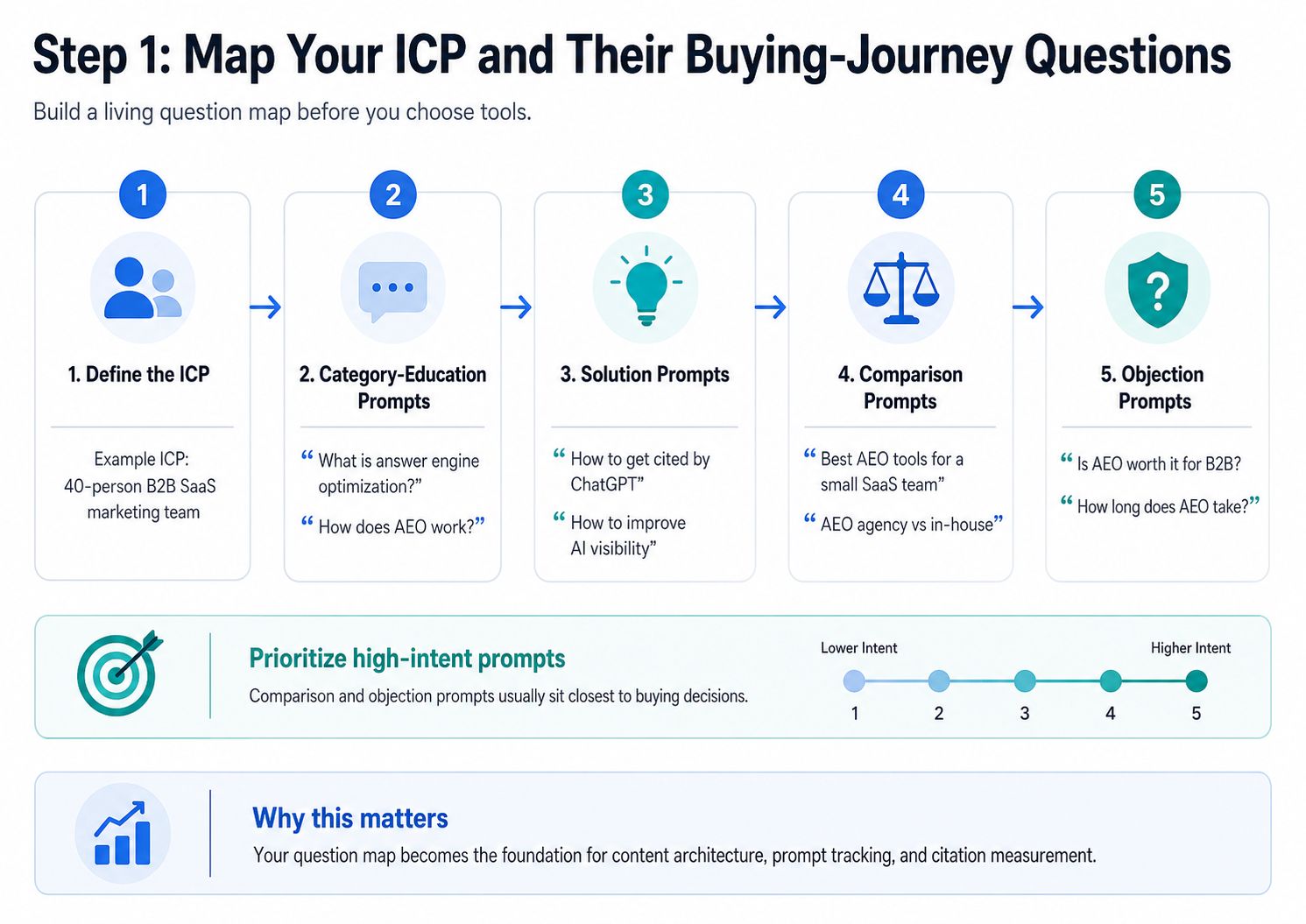
Start by writing down exactly who you serve and every question they ask an answer engine from first awareness to final comparison. Your AEO strategy is only as good as the question map underneath it, so this step comes before any tooling.
Work the journey in stages and list the real prompts for each. A buyer moves from category education to solution research to vendor comparison, and the language changes at every stage. Build the map like this:
- Name the ICP segment precisely, for example a 40-person B2B SaaS marketing team.
- List their category-education prompts, such as "what is answer engine optimization".
- List their solution prompts, such as "how to get cited by ChatGPT".
- List their comparison prompts, such as "best AEO tools for a small SaaS team".
- List their objection prompts, such as "is AEO worth it for B2B".
Prioritize the prompts that sit closest to a buying decision, because a citation on a comparison prompt is worth far more than one on a broad definition. Not every question deserves equal weight, and the mistake is spreading effort evenly across all of them.
This map becomes the spine of your content architecture and your measurement set. Keep it in a living document, because buyer language shifts fast in AI search. Our notes on GEO prompt monitoring tools cover how to keep that map current once you start tracking.
Step 2: Run an AI Visibility Audit to Set Your Baseline
Run an AI visibility audit first so you have a real starting score to improve against, namely your AI Visibility Score, mentions, cited pages, and citations in one view. You cannot manage what you have not measured, and this is the baseline every later step is judged against.
Here is the exact path inside Semrush, run on our own domain.
- Open Semrush One and go to the AI section in the left navigation.
- Click Visibility Overview.
- Enter your domain, for example therankmasters.com.
- Set the date range you want to baseline.
- Read the AI Visibility Score gauge and the Mentions figure at the top.
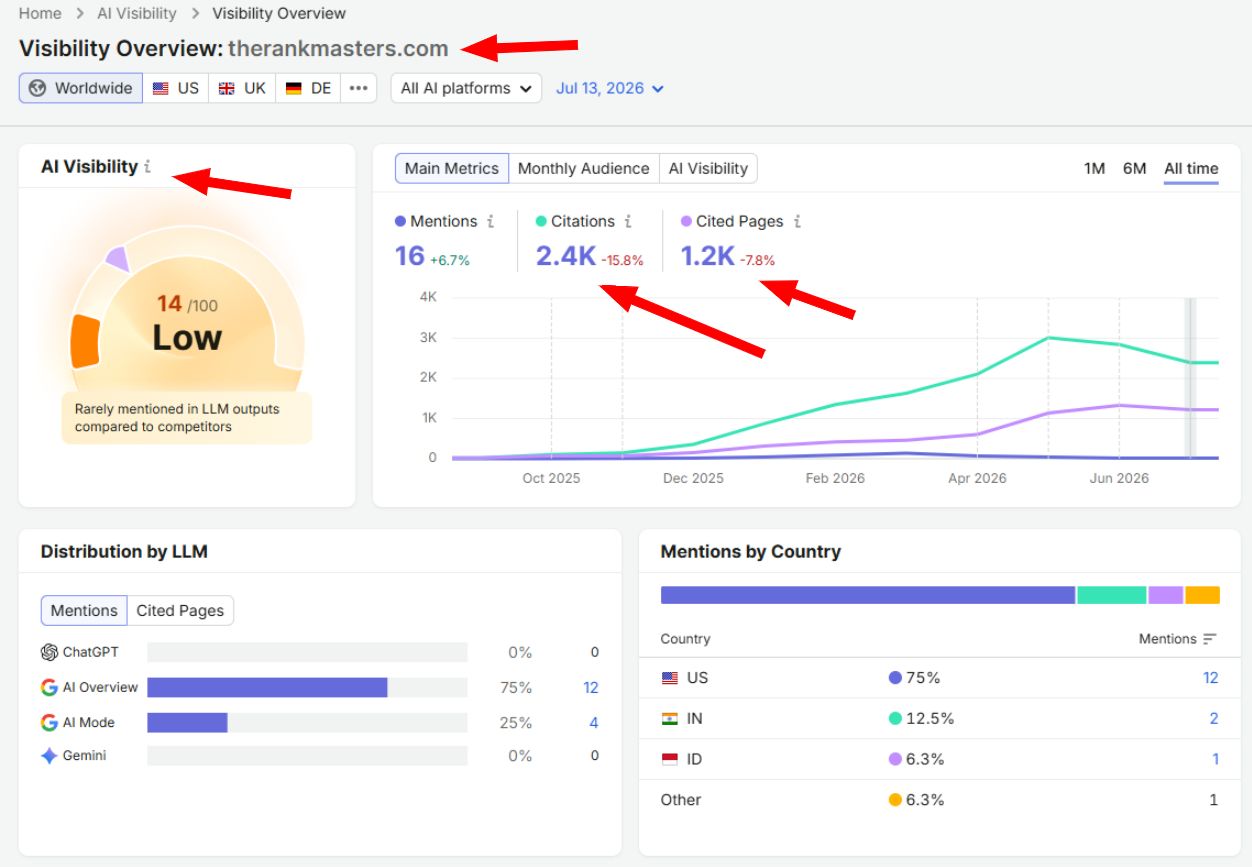
Now read it the way a strategist would. The score is an index from 0 to 100, so a mid-range reading is normal for a brand early in its AEO work, and the number matters far less than its trend. If mentions are climbing month over month, your architecture is working. If the score is flat while you publish, your content is not being retrieved, and that points you straight at Step 6.
Want to reproduce this baseline for your brand? Start a 14-day Semrush One trial and open the AI Visibility Toolkit before the next step.
Step 3: Find Your Competitor Gaps in AI Search
Compare your AI visibility directly against your rivals so you can see which brands the engines cite instead of you, and on which topics. Your baseline only means something next to the competitive set, because AI answers are a scarce, winner-take-few surface.
The competitor view lives one click from the audit.
- In the AI section, open Competitor Research.
- Add two or three rival domains you lose deals to.
- Compare AI Visibility Scores side by side.
- Sort to find topics where a competitor is cited and you are not.
- Note the gaps that map to your highest-intent prompts from Step 1.
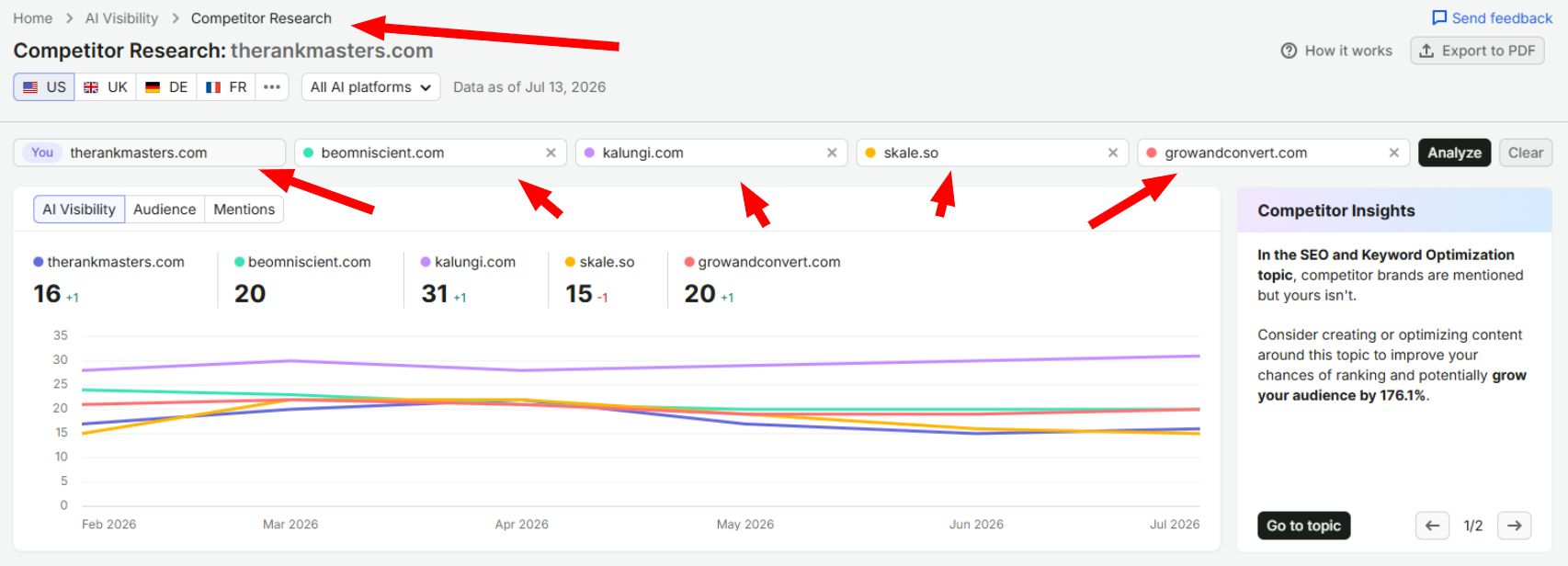
The gaps are your roadmap, but only some of them are worth chasing. A competitor beating you on a low-intent definition prompt is noise. A competitor owning the answer to "best AEO tools for B2B SaaS" is a pipeline threat, and that is the gap you close first. Prioritizing by revenue, not by volume, is the difference between a busy content calendar and a strategy.
To see your own gaps, open Semrush One on a 14-day trial and compare your score to a competitor.
A dashboard like this one will hand you the numbers, namely your score, your cited pages, and your competitor gaps. It will not tell you which of them to act on first, or how to turn them into a plan.
That interpretation layer, reading the metrics and mapping your ICP's buying journey to the SEO and AEO content that wins it, is the work The Rank Masters does for B2B SaaS teams.
Step 4: Discover the Prompts Your Buyers Actually Ask
Surface the real prompts people ask AI about your category, brand, and competitors, so your content targets language buyers actually use rather than language you assume. This step turns the hand-built map from Step 1 into an evidence-based one.
Semrush exposes these prompts directly.
- In the AI section, open Brand Performance and go to the Questions report, or open Prompt Monitoring.
- Review the prompts triggering mentions in your category.
- Filter to prompts where competitors appear and you do not.
- Tag the high-intent, comparison, and objection prompts.
- Feed the winners back into your content architecture.
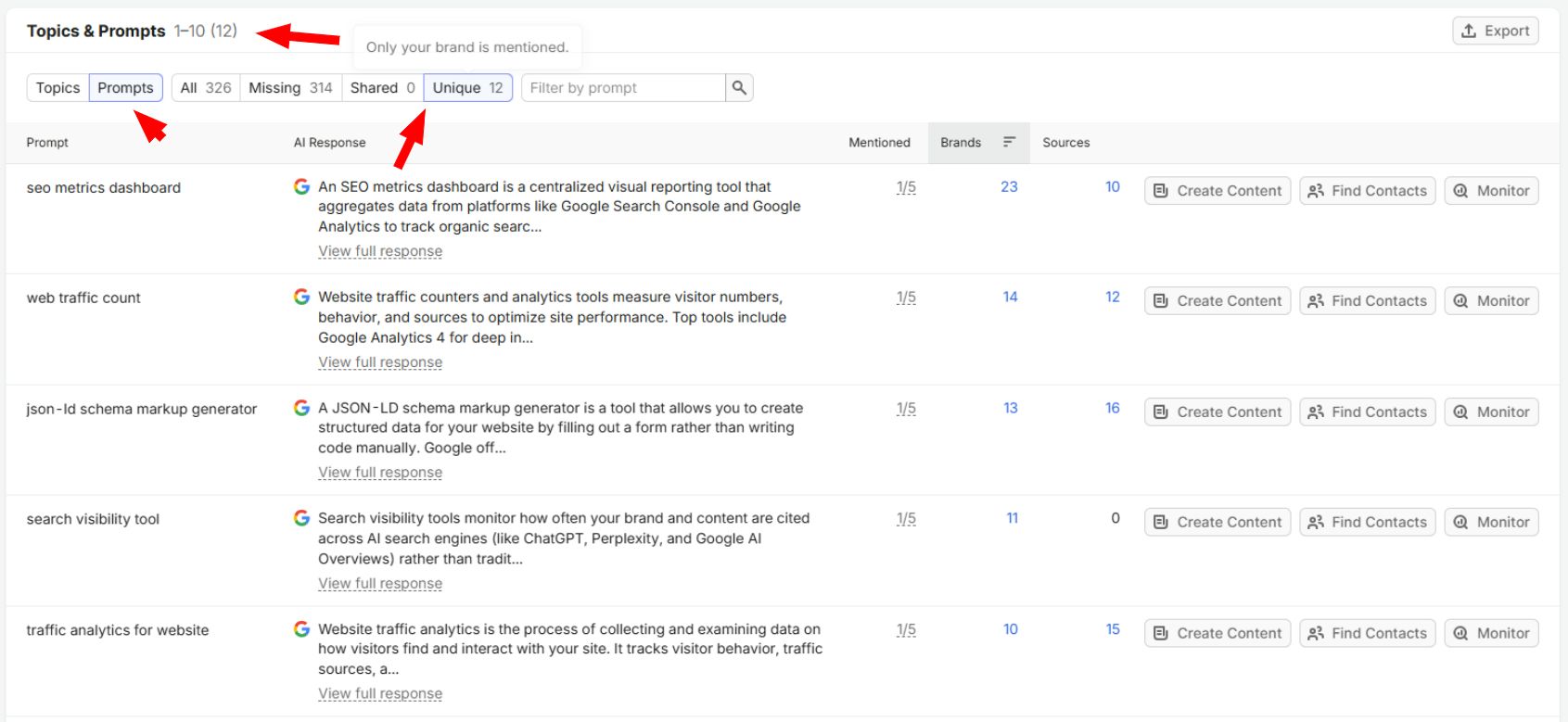
This matters because AI prompts do not look like keywords. Semrush found that 65% to 85% of ChatGPT prompts do not match traditional search keywords in its 27-billion-term database, which means a keyword list alone will miss most of the language buyers actually use. Prompts are longer, more conversational, and more specific, so you have to harvest them, not guess them.
Our walkthrough of GEO prompt monitoring tools covers how to keep that prompt set fresh as buyer language shifts.
Want your own numbers? Try the AI Visibility Toolkit free for 14 days and run this report on your domain.
Step 5: Structure Content So Answer Engines Can Cite It
Structure every page answer-first, with the entity named up front and each passage able to stand alone, because that is what a retrieval system can extract and cite. This is the block where content architecture meets the mechanics of Step 4.
A citable page follows a consistent shape. Lead each section with a direct answer in the first sentence. Name the entity explicitly rather than leaning on "it" or "this". Keep passages self-contained so a model can lift one without the surrounding page. Cover the full question cluster, not the head term repeated.
On-page signals that earn citations:
- Answer-first openings: State the answer in sentence one, in 30 words or fewer, then support it.
- Explicit entities: Name the product, company, or concept in each passage so the parser never guesses.
- Self-contained chunks: Write passages that make sense in isolation, since retrieval pulls fragments.
- Question-shaped headings: Phrase headings the way a buyer asks, so they match real prompts.
- Named, dated evidence: Anchor claims to a source and a year, because engines ground answers in verifiable facts.
Schema markup helps, with an important caveat.
Fabrice Canel, Principal Product Manager at Microsoft Bing, confirmed in March 2025 that structured data helps Microsoft's models understand content for Copilot. Yet a controlled test tempers the hype.
When Ahrefs studied 1,885 pages that added schema between August 2025 and March 2026, the citation change was negligible across platforms, at roughly plus or minus a few percent. The takeaway is to treat schema as supporting infrastructure for extraction, not a lever that lifts an already-cited page.
Executing this well is exactly the gap The Rank Masters closes for B2B SaaS teams, building an ICP-led content system that maps each topic cluster to a money page and to pipeline, rather than publishing posts that never convert.
Step 6: Make Your Site AI-Readable
Confirm your pages can actually be crawled, parsed, and cited by running an AI-readiness audit, because the best content is invisible if a bot cannot reach it. Technical readiness is the block that silently sinks otherwise strong programs.
Semrush pairs site health with AI-specific checks.
- Open Site Audit and run it on your domain.
- Read the overall Site Health score.
- Open the AI readiness checks.
- Flag pages blocked from AI crawlers or rendered only in JavaScript.
- Fix crawl, render, and structure issues before you scale content.
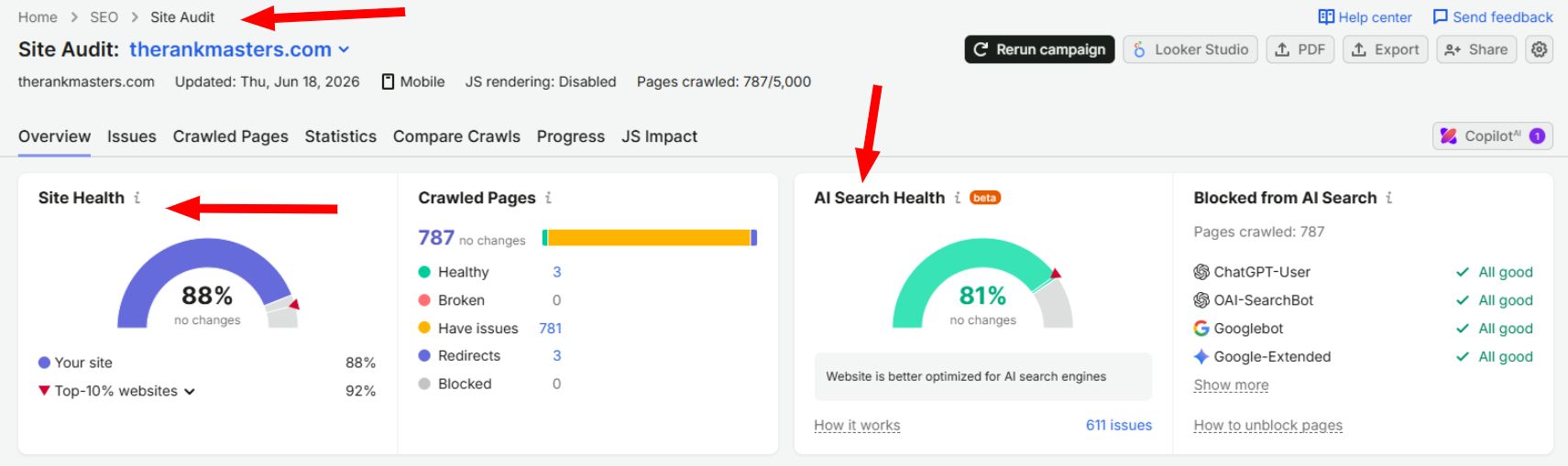
Read the health score as a gate, not a vanity number. A high score with clean AI-readiness checks means your pages are eligible for citation, so the bottleneck is content and authority. A low score means fix the plumbing first, because no amount of answer-first writing helps a page an engine cannot render.
This is often the cheapest, highest-leverage fix in the whole strategy, and our notes on AI visibility tools for content formats show how format choices affect readability.
To see this on your own site, start your 14-day Semrush One trial and pull the same site report.
Step 7: Track Brand Perception and Sentiment in AI Answers
Watch not just whether you are cited but how you are described, by tracking share of voice against sentiment and the narratives shaping your story. Being mentioned negatively is a different problem from not being mentioned at all, and only this view separates them.
The Brand Performance module makes perception visible.
- Open Brand Performance in the AI section.
- Read the Share of Voice versus Sentiment chart.
- Open Narrative Drivers to see the top cited domains shaping your story.
- Note which questions are framing your brand positively or negatively.
- Prioritize sources and topics that move sentiment, not just volume.
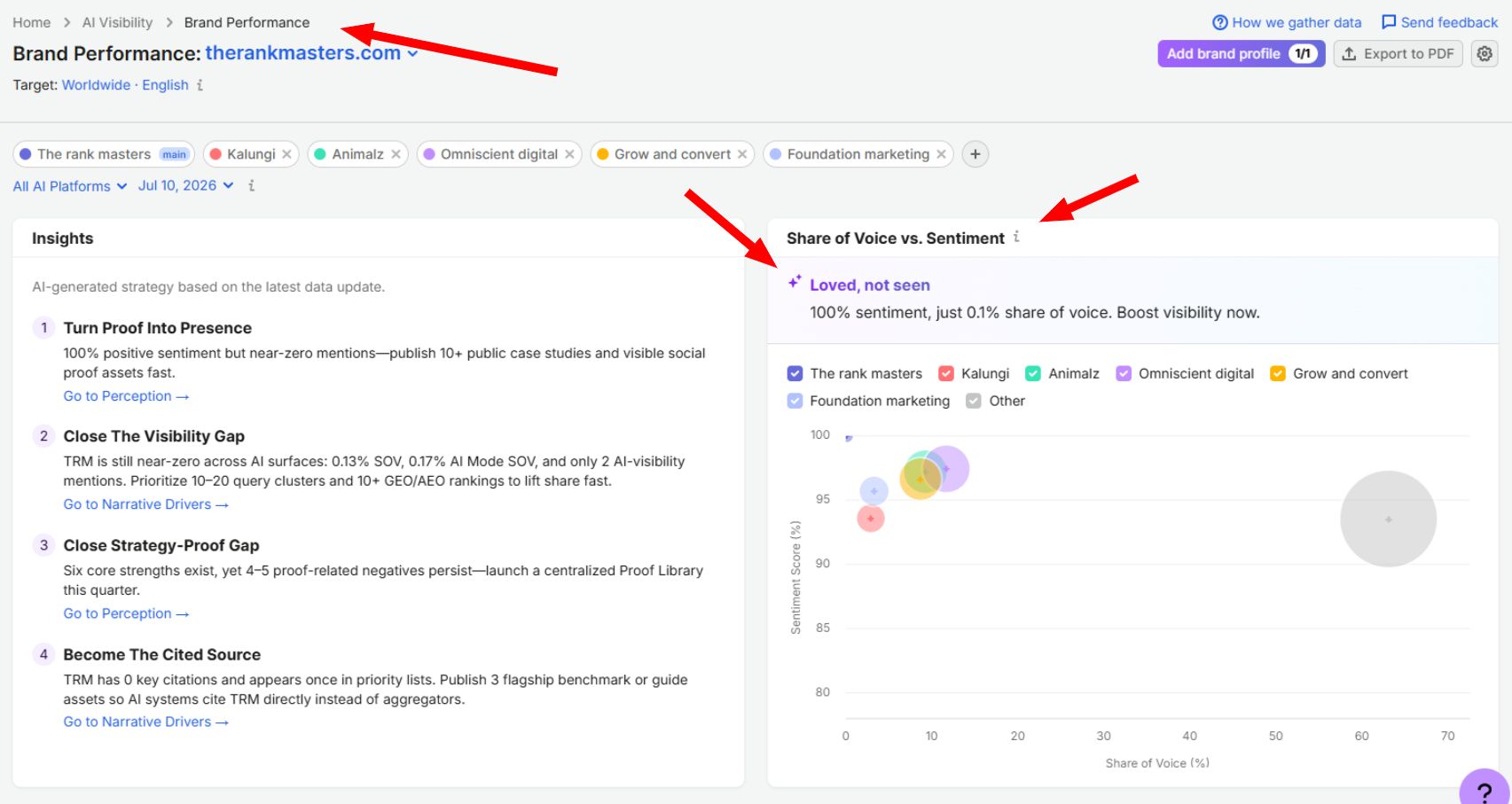
Here is how to act on it. Rising share of voice with positive sentiment means your narrative is landing, so you defend and expand it. Rising volume with flat or negative sentiment means engines are citing sources that frame you poorly, and the fix is earning better third-party coverage and correcting your own pages.
The narrative drivers list tells you which domains to influence first, and our overview of AEO services for AI search visibility shows how we turn that list into an outreach plan.
Follow along live and open Semrush One on a 14-day trial to check your own sentiment.
Step 8: Measure AEO Performance Against SEO
Track keywords and prompts side by side across Google, AI Overviews, and platforms like ChatGPT, so you can prove AEO progress in the same view as your SEO. Measuring the two together is what turns AEO from a hunch into a reportable channel.
Position Tracking supports both in one setup.
- Open Position Tracking and add your keywords and prompts.
- Enable multitargeting to track Google and AI platforms together.
- Filter to AI Overviews and SERP features.
- Compare the same term on Google versus ChatGPT.
- Watch prompt-level movement week over week.
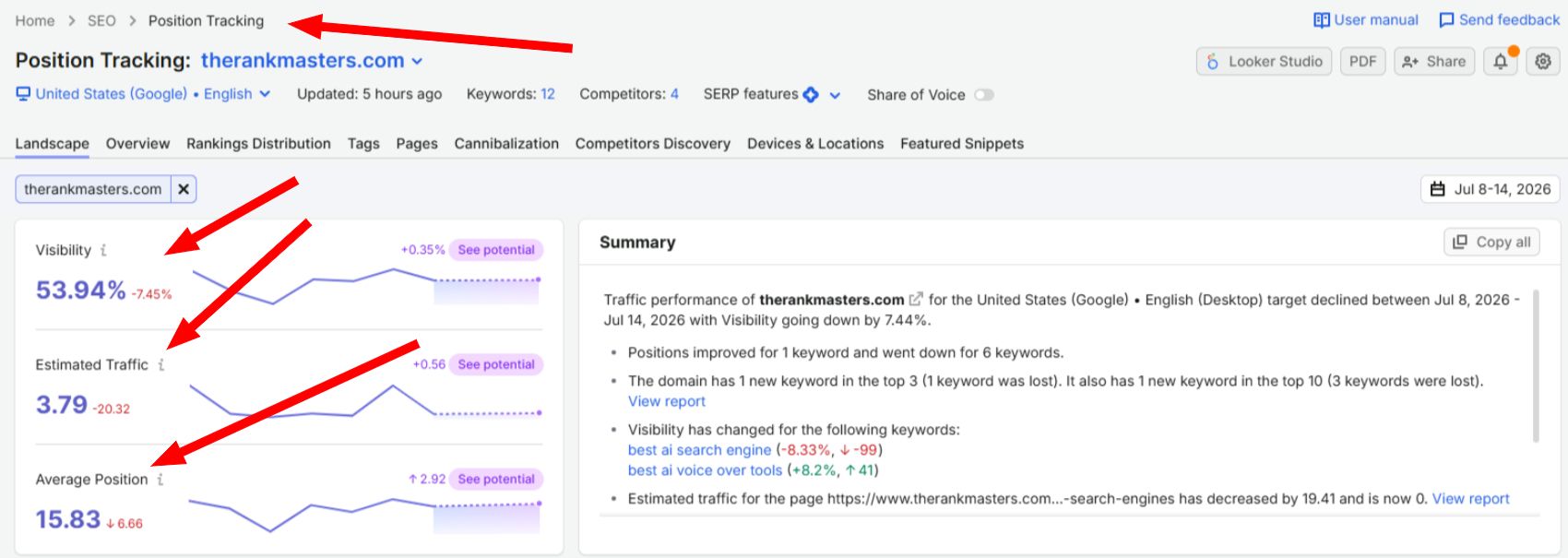
Read the two together, because they move differently. A term can hold a strong Google position while you are absent from the AI answer for the same query, and that gap is your clearest AEO to-do. Over time, the story you want is prompts trending into citation while rankings hold, which is proof the content system is compounding on both surfaces.
For a wider tool comparison on this, see our guide to AI search visibility audit tools.
Which KPIs Actually Prove AEO Is Working
The KPIs that prove AEO is working are AI Visibility Score trend, mention count, cited-page count, share of voice, and prompt-level citation rate, not raw traffic alone. Pick a small set, baseline them, and report the trend.
| KPI | What it tells you | Healthy signal |
|---|---|---|
| AI Visibility Score trend | Overall citation strength over time | Climbing month over month |
| Mentions | How often engines name you | Rising with content output |
| Cited pages | Which URLs earn citations | Concentrated on money pages |
| Share of voice | Your slice versus competitors | Growing against named rivals |
| Sentiment | How you are described | Positive and stable |
| Prompt citation rate | Wins on high-intent prompts | Up on comparison prompts |
Traffic still matters, but it is a lagging, partial signal in AI search, because much of the value happens inside the answer where no click occurs. Report the citation metrics as your leading indicators and let traffic and pipeline confirm them downstream.
Our overview of the best AI visibility tool for GEO compares how platforms surface these KPIs.
What an AEO Strategy Costs and How to Resource It
An AEO strategy costs the price of a visibility tool plus the people-time to interpret it and produce content, so budget for both software and strategy, not software alone. The tool is the smaller line item.
Costs fall into three buckets, and most teams underfund the third.
| Cost bucket | What it covers | Typical driver |
|---|---|---|
| Tooling | AI visibility tracking and site audit | Per-seat or plan tier, as of July 2026, verify current terms |
| Content production | Answer-first pages and refreshes | Volume and depth of the question map |
| Strategy and interpretation | Turning metrics into a prioritized plan | In-house specialist or an external partner |
The failure pattern is buying the tool and skipping the interpretation. A dashboard shows the gaps, but someone has to decide which cited pages to defend, which competitor gaps to close, and which prompts to win first.
That decision layer is where visibility becomes revenue, and it is worth reading how our AI visibility and GEO/AEO work frames the trade-off.
Common AEO Mistakes That Kill Your Citations
The most common AEO mistakes are chasing every metric instead of the revenue-linked ones, writing for keywords instead of prompts, and buying a tool without a plan to act on it. Each one quietly caps your citation growth.
Mistakes to avoid:
- Optimizing for an abstraction: Targeting AI in general without naming the platforms that actually drive your traffic.
- Keyword-shaped content: Repeating the head term instead of covering the real, conversational prompts buyers ask.
- Answer-buried pages: Hiding the answer below the fold where a retriever cannot isolate it.
- Schema as a silver bullet: Expecting structured data alone to lift citations, when it mainly aids extraction.
- Measuring volume, not revenue: Celebrating mentions on low-intent prompts while comparison prompts leak to rivals.
- Tool without interpretation: Buying visibility software and never converting the readings into a prioritized plan.
That last one is the expensive one, and the data explains why.
Gartner VP Analyst Robert Blaisdell put it plainly when he said that "buyers still turn to sales reps to validate AI-generated insights," and 69% of B2B buyers do exactly that.
The interpretation and follow-through matter as much as the citation itself.
A number on a screen does not build a pipeline.
A plan does.
If you want a second opinion on which tool fits your program, our comparison of AI search visibility audit tools is a useful starting point.
Frequently Asked Questions
What is an AEO strategy in simple terms?
How is AEO different from SEO?
How long does an AEO strategy take to work?
Do I need a tool to do AEO?
Does schema markup improve AI citations?
Is AEO worth it for a small B2B SaaS team?
Which AI platform should I optimize for first?
Turn Your AEO Data Into Pipeline
You now have the full build, namely map the questions, structure the content, confirm readability, and measure citations against SEO in one place. The tooling makes every step visible on your own domain, and following along inside Semrush is the fastest way to internalize it.
The harder half is deciding what to do with what you see. If your ranked pages are not showing up in AI answers and you want a content system that fixes that, book a SaaS content strategy call and we will map your highest-intent topics to revenue.
And if you want to run these reports yourself first, start a 14-day Semrush One trial and follow the steps above on your own site.