
When an AI Overview appears on a search, organic click-through rates fall by about 61%, yet the brands cited inside that Overview earn 35% more organic clicks than the ones left out, according to Seer Interactive's 2025 analysis of 3,119 queries, which reframes the whole game from ranking below the Overview to getting cited inside it.
That is the core shift this guide is built on.
AI Overviews now sit above the traditional results for a large share of searches, and the citation slots inside them capture the attention that used to flow to the blue links. Being absent from the Overview on your own topics is the new invisibility, and being cited in it is the new position zero.
This guide explains what AI Overview visibility is, how Google chooses what to cite, what kind of content earns those slots, and exactly how to measure and grow your presence using Semrush on therankmasters.com as the worked example.
If you would rather have the gaps found and the citation work built into a content system, The Rank Masters does that for B2B SaaS teams.
▶️ If your ranked pages are not showing up in AI answers and you want a content system that fixes that, book a SaaS content strategy call.
What Are Google AI Overviews and What Does Visibility in Them Mean?
Google AI Overviews are the AI-generated summaries that appear at the top of many search results, above the traditional links, and citing a handful of sources inside the answer. Visibility in an AI Overview means your domain is one of the sources cited and linked within that summary.
This is different from ranking. A page can rank on page one and still be missing from the Overview above it, and a page can be cited in the Overview without holding a top organic position. Overview visibility is therefore its own metric, measured by how often your pages are cited across the prompts your buyers ask, not by where you sit in the blue links.
There are two levels of presence worth separating:
- Citation: your domain is listed as a source inside the Overview, with a link the user can click.
- Mention: your brand name appears in the text of the answer itself, which shapes perception even when no link is present.
Both matter, and they do not always travel together, which is a theme we return to below.
Why Does AI Overview Visibility Matter in 2026?
AI Overview visibility matters because the Overview now intercepts the click before the user reaches your listing, so presence inside it, rather than rank beneath it, is what preserves traffic and influence. The data on both sides of that trade is unambiguous.
On the loss side, Seer Interactive's study of 3,119 informational queries found organic click-through rates on AI Overview searches fell from 1.76% to 0.61%, a 61% drop, with clicks falling even on queries that did not show an Overview.
On the gain side, the same study found brands cited inside the Overview earned 35% more organic clicks than uncited competitors on the same queries. The click you lose by ranking below the Overview is roughly the click you win by being inside it.
| AI Overview signal | Figure | Source and year |
|---|---|---|
| Organic CTR when an AI Overview is present | fell from 1.76% to 0.61% (down 61%) | Seer Interactive, 2025 |
| Extra organic clicks for brands cited in the Overview | 35% more than uncited rivals | Seer Interactive, 2025 |
| Organic CTR on AI Overview queries, early 2026 | partial rebound to about 2.4% | Seer Interactive, 2026 |
| Video's share of AI Overview citations | about 23% (YouTube, the top domain) | Surfer SEO, 2025 |
The trend is not perfectly one-directional, and honesty matters here.
Seer's 2026 follow-up, covering 53 brands and 5.47 million queries, found organic CTR on Overview queries rebounded from a floor of 1.3% in December 2025 to about 2.4% by February 2026, as users learned when they still need to click through.
That is a partial recovery, not a reversal, and the strategic implication holds, namely you want to be the source they click when they do.
The reason this belongs on a B2B SaaS roadmap is that the Overview decides the shortlist before anyone reaches a website, so the brands cited there shape the buyer's frame of reference for the whole category.
That is why we treat this as one connected practice with search visibility and zero-click search strategy, rather than a novelty to bolt on later.
The teams that adapted earliest are already compounding an advantage, because citation authority builds slowly and is hard for late movers to unwind once a category's answer slots are taken.
How Does Google Choose What to Cite in AI Overviews?
Google chooses AI Overview citations by running the query through a fan-out process, pulling candidate sources from the results for many related sub-queries, then favoring pages that answer clearly, carry authority, and are easy to extract. Ranking well helps, but it is no longer the whole story.
The fan-out mechanism is the key nuance.
As Search Engine Journal reported, Google can split a single search into multiple sub-queries and cite the pages that appear most often across those sub-query results, which is how a source can be cited in an Overview without ranking for the original query at all. That is both a warning and an opening, because it means strong topical coverage can earn you citations on terms you do not rank for directly.
The same analysis noted that the share of AI Overview citations coming from pages that also rank in Google's top ten has fallen sharply over recent months, with a large portion of citations now going to pages that rank lower or do not rank for the query at all.
The practical lesson is that a top-ten ranking is still helpful but no longer a prerequisite, so a page structured to answer a sub-query cleanly can be pulled into an Overview even when it sits well down the results.
Authority and source type also shape selection heavily.
Surfer SEO's analysis of 36 million AI Overviews and 46 million citations found that Overviews blend institutional authority with community and video sources, with YouTube alone taking roughly 23% of citations as the single most-cited domain. The practical read is that Overviews pull from a mix of your own well-structured pages, trusted third-party publications, and video, so a single-page-on-your-own-domain strategy underperforms a multi-surface one.
Finally, AI citation is volatile, which is why measurement has to be ongoing rather than a one-time check.
As Sergei Rogulin, Head of Organic and AI Visibility at Semrush, explained after a sharp swing in which domains ChatGPT cited, the engines adjust their sourcing to "be less biased" toward any one site and to become "more resilient to manipulation attempts." Citation patterns move, so the goal is durable citability, not a one-off trick.
What Content Gets Cited in AI Overviews?
The content that gets cited in AI Overviews answers a specific question directly, early, and in a structure a machine can lift cleanly, backed by authority signals the engine trusts. Extraction-friendliness beats prose polish.
Across the citation research, a consistent profile emerges. Cited passages tend to lead with a direct answer, use clear headings that match how people ask, present facts and comparisons in structured formats, and carry credibility markers like named sources and recent dates.
Surfer's data reinforced the format point, showing that video and structured, factual content earn an outsized share of citations rather than long unstructured essays.
| Content attribute | Why AI Overviews reward it | How to apply it |
|---|---|---|
| Answer-first passages | Engines lift the clearest direct answer to the sub-query | Open each section with a 40 to 60 word direct answer |
| Structured formatting | Tables and lists are extracted more reliably than prose | Use headings, lists, and comparison tables |
| Topical depth | Fan-out rewards comprehensive coverage of a topic | Build clusters, not isolated one-off posts |
| Authority signals | Named sources and credentials build trust | Cite data, attribute quotes, show author expertise |
| Freshness | Stale pages lose citations over time | Add visible update dates, refresh on a schedule |
| Multi-surface presence | Overviews cite video and third-party sources | Publish on YouTube and earn third-party mentions |
The uncomfortable truth is that being cited is not the same as being named. A page can be the source behind an Overview while the brand goes unmentioned in the visible text, which is why measurement has to look at both.
How to Check If You Appear in AI Overviews for Free
You can get a rough, free read on your AI Overview presence by searching your target queries manually and noting where an Overview appears and whether your domain is cited. It is imprecise, but it costs nothing and confirms whether there is a problem worth sizing.
The manual method is simple, namely run each priority query in a clean browser session, record whether an AI Overview triggers, and check whether your domain shows in the cited sources. Google Search Console also began surfacing AI Overview impressions inside its Performance data, though it does not cleanly separate them from other appearances, so treat it as a directional signal rather than a precise count.
The limits are the same ones that push every serious team to a dedicated tool.
Manual checking cannot scale past a handful of queries, cannot run daily, cannot benchmark competitors, and cannot tell you which third-party sources are winning the citations you are missing. For that, the rest of this guide runs inside Semrush.
How to See Which of Your Keywords Trigger AI Overviews in Semrush
The first measurement step is to find which of your tracked keywords show an AI Overview and whether you are featured, which Semrush surfaces through the SERP features view in Position Tracking. This tells you where the Overview is intercepting your rankings.
Here is the path:
- Open Position Tracking from your project and open the Rankings report.
- Apply the SERP features filter and select AI Overview.
- Review the keywords where an Overview appears above your ranking.
- Note which of those keywords you rank for on page one but are not cited in the Overview.
- Tag those keywords as your highest-priority Overview targets.
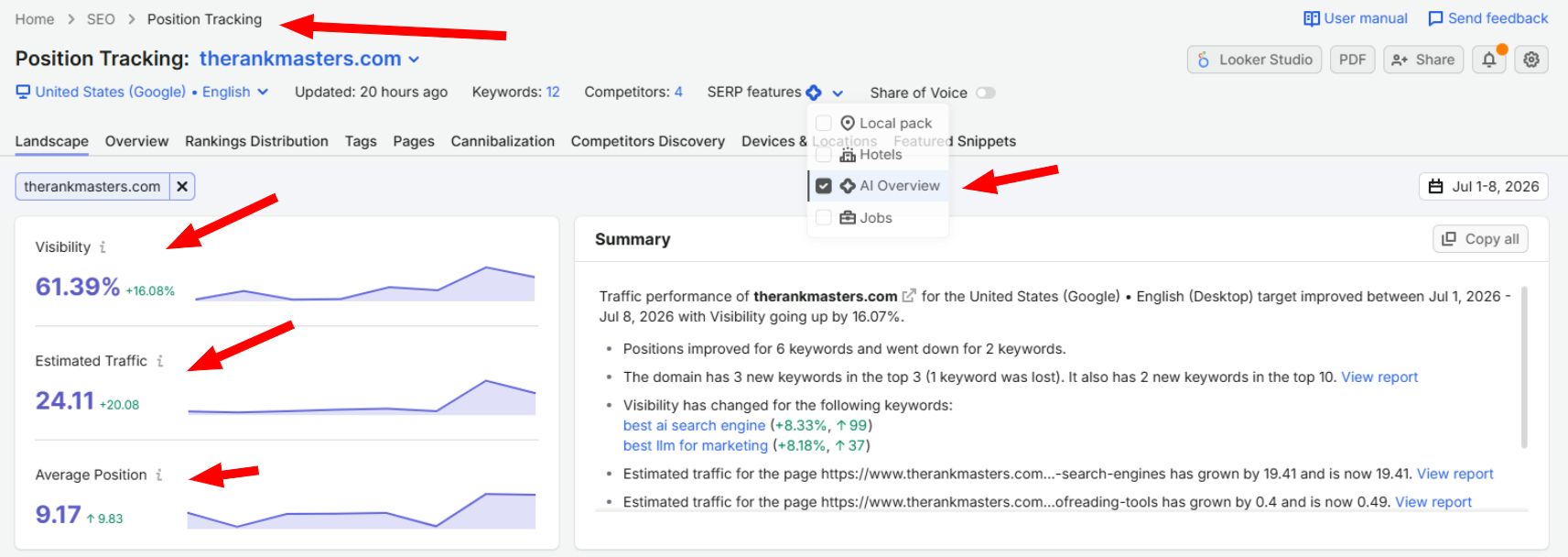
The keywords to act on first are the ones where you already rank on page one and an Overview is present but you are not cited, because you have the authority to be eligible and only the structure or the citation gap is holding you back. A keyword where you rank poorly and are not cited is a longer project. Sorting this way turns a raw list into a priority order that respects both effort and reward.
Want to see this on your own domain? Start a 14-day Semrush One trial and filter your keywords to AI Overviews before the next step.
How to Find Your AI Overview Gaps in Semrush
The gap analysis is where the audit becomes actionable, and Semrush's AI Visibility Toolkit surfaces it through the Topic and Source Opportunities in the Visibility Overview. These show the prompts and trusted sources where competitors appear in AI answers, including Overviews, and you do not.
Work it like this:
- Open the AI Visibility Toolkit and select Visibility Overview.
- Enter your domain and run the report to load your topics and sources.
- Open Topic Opportunities to see prompts where competitors are cited and you are absent.
- Open Source Opportunities to see the trusted third-party sites cited for competitor prompts.
- Sort by how many competitors appear to find the highest-consensus gaps.
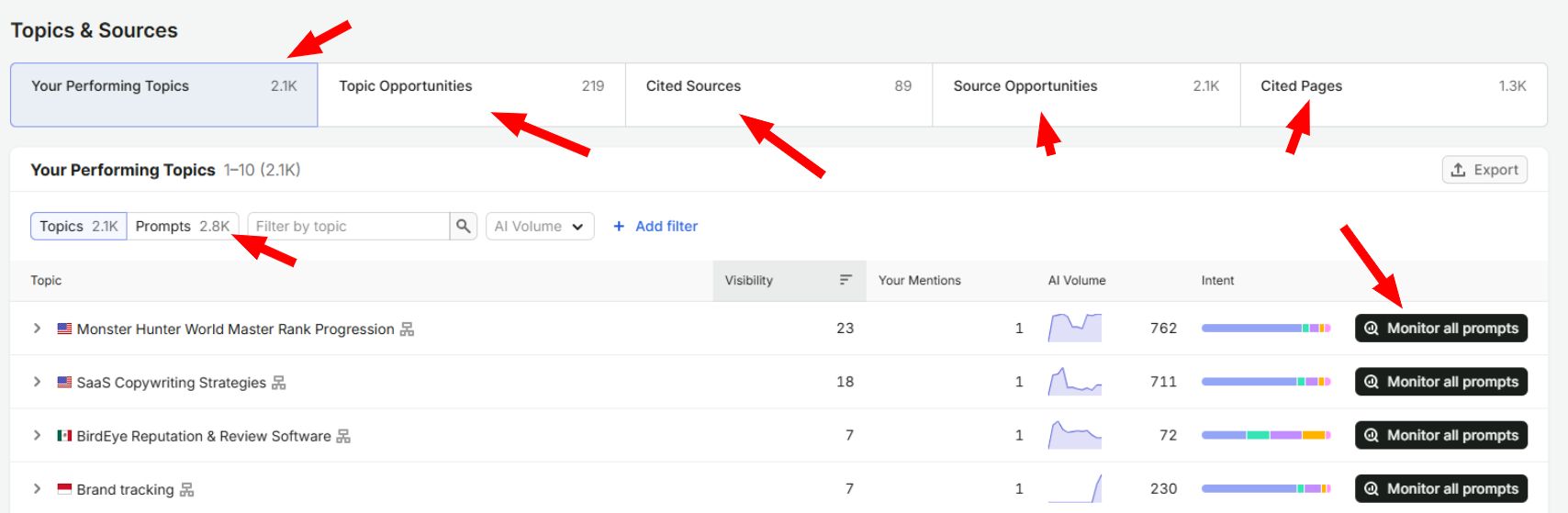
A Topic Opportunity is a content gap you close by building or strengthening a citation-ready page for that prompt, and a Source Opportunity is an off-site gap you close by earning a mention on a publication the Overview already trusts.
Given that fan-out and third-party citations decide so much of what appears, the Source Opportunities are often the faster lever, because a single feature on a trusted site can lift you across many related prompts at once.
See your own gaps. Open Semrush One on a 14-day trial and pull your Topic and Source Opportunities.
How to See Which Sources AI Overviews Cite in Your Niche in Semrush
To win citations you first have to know who currently holds them, which Semrush shows through the Cited Sources and Cited Pages views alongside Distribution by LLM in the Visibility Overview. This maps the citation landscape of your category.
Walk it like this:
- In the Visibility Overview, open the Cited Sources view to see the domains AI cites most in your topics.
- Open Cited Pages to see which of your own pages, if any, are being cited.
- Use Distribution by LLM and filter to AI Overview to isolate Google's Overview behavior specifically.
- Compare the domains cited for your topics against your own presence.
- Build a target list of the trusted sources you need a presence on.
Reading the cited-sources list tells you where the leverage is. If community platforms and video dominate your category's citations, as Surfer's data suggests they often do, then a pure on-site content plan will underperform one that also builds presence on those surfaces.
The cited-sources view is effectively your outreach and distribution roadmap, drawn straight from what the Overview already rewards.
Map your own niche. Run this report on a 14-day Semrush One trial and see who owns the citations you want.
How to Benchmark Your AI Overview Visibility Against Competitors in Semrush
A citation gap only means something next to competitors, so the next step is the Competitor Research report, which compares your AI visibility directly against up to four rivals. This tells you who leads your category inside AI answers and by how much.
Set it up like this:
- Open the Competitor Research report in the AI Visibility Toolkit.
- Add up to four direct competitor domains.
- Compare mentions, citations, and topic coverage side by side.
- Identify the topics where a competitor leads by the widest margin.
- Flag the near-parity topics where a focused push could overtake them.
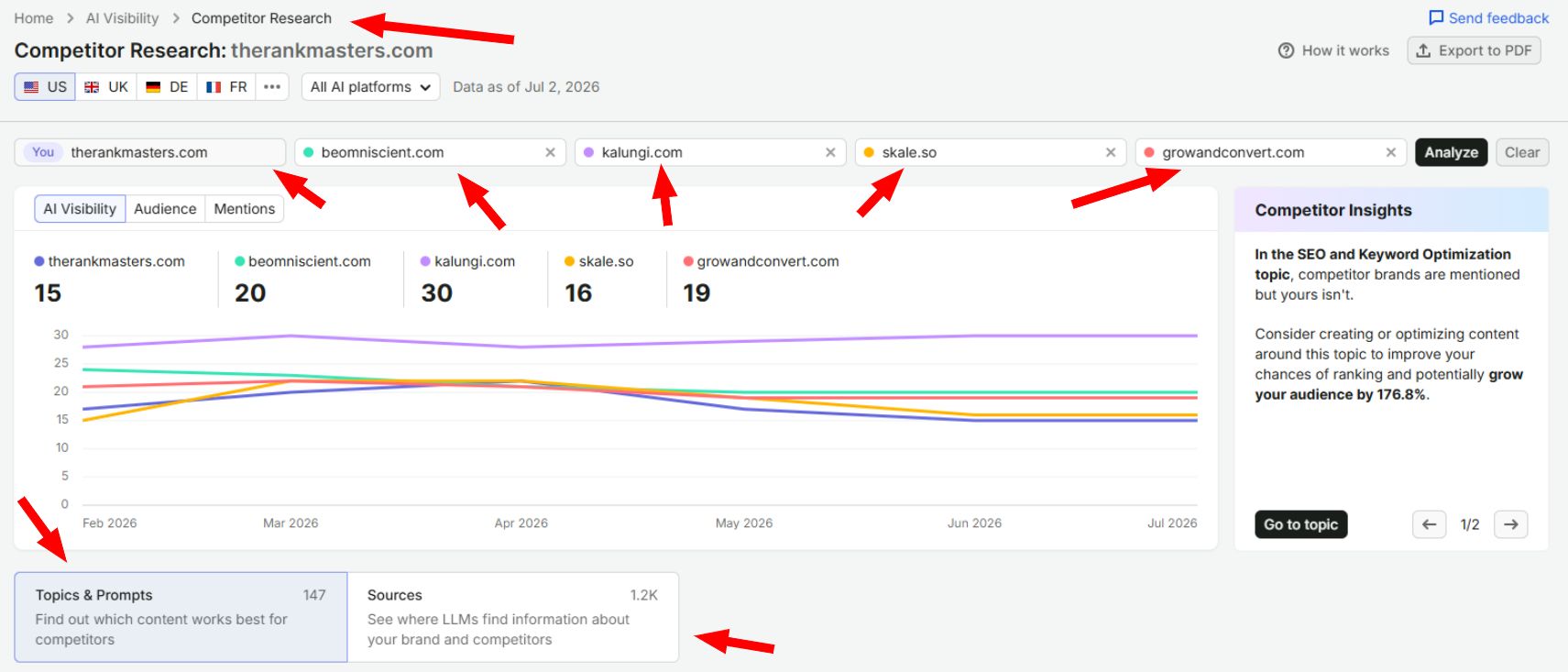
The benchmark reframes every gap you found earlier. A topic where you trail a single rival narrowly is a quick win you can attack this month, while a topic where the whole field is cited and you are not is a structural gap that needs a content cluster plus third-party sources. Reading the comparison this way is what turns a flat list of missing citations into a sequenced plan.
Run your comparison. Try Semrush One free for 14 days and benchmark your AI visibility against your rivals.
How to Structure a Page to Get Cited in AI Overviews in Semrush
Once you know the gaps, the on-page work is to structure target pages for extraction, and Semrush's On Page SEO Checker and SEO Writing Assistant surface the recommendations that make a page citation-ready. This is where you turn a gap into an eligible page.
Here is the workflow:
- Open On Page SEO Checker and select the page targeting your priority Overview keyword.
- Review the content and semantic recommendations for that keyword.
- Run the draft through SEO Writing Assistant to check readability and coverage.
- Restructure the page to lead each section with a direct answer and clear headings.
- Add tables, lists, named sources, and a visible update date to strengthen extractability.
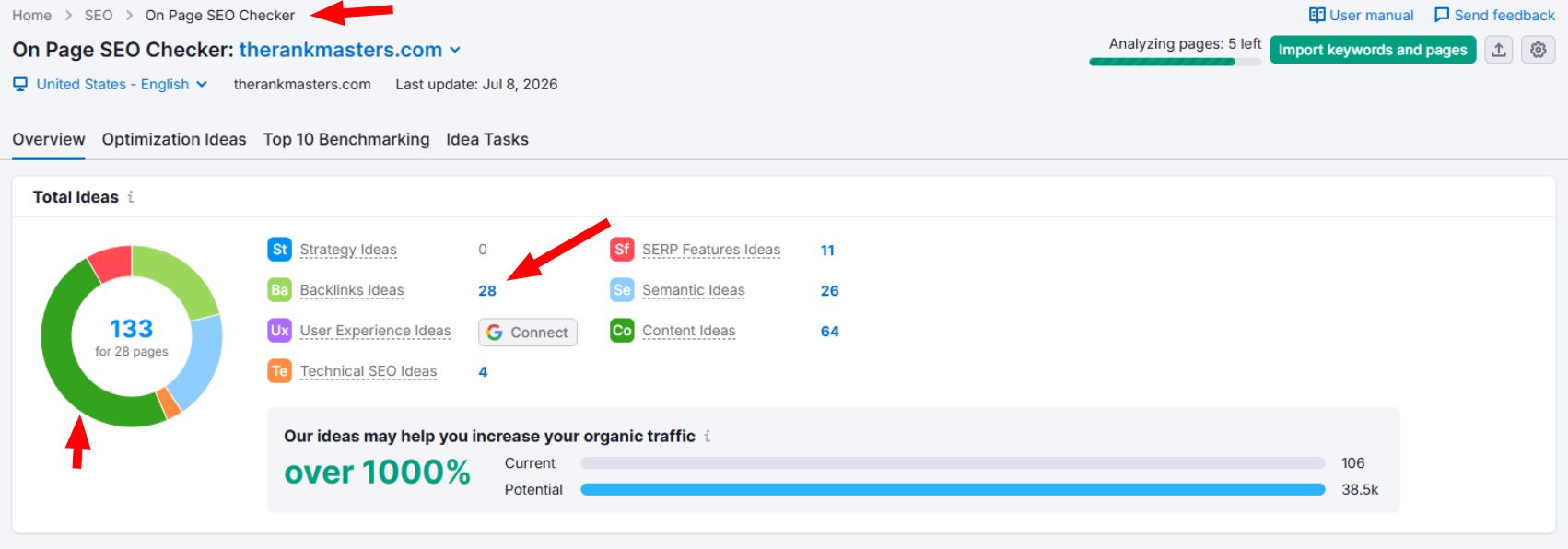
The structural moves matter more than word count. An answer-first opening, headings phrased the way buyers ask, and facts presented in tables and lists are what let an engine lift your passage cleanly into an Overview, while hedged, meandering prose gets passed over.
Treat every priority page as a reference that answers its question in the first two sentences, then supports the answer with structured evidence beneath it.
See the recommendations for your pages. Follow along on a free 14-day Semrush One trial and make a target page citation-ready.
How to Fix the Technical Gaps Blocking AI Overview Citations in Semrush
The final measurement step checks whether AI can access and parse your pages at all, which Semrush's Site Audit surfaces through its AI readiness checks. A page that AI crawlers cannot reach or parse cannot be cited no matter how well it is written.
Run it like this:
- Open Site Audit from your project and run or refresh the crawl.
- Review the AI Search Health summary for your site's readiness.
- Confirm AI bots are permitted to crawl your priority pages rather than blocked.
- Check that structured data and an llms.txt file are present where relevant.
- Fix the highest-severity blockers first, then re-crawl to confirm the score responds.
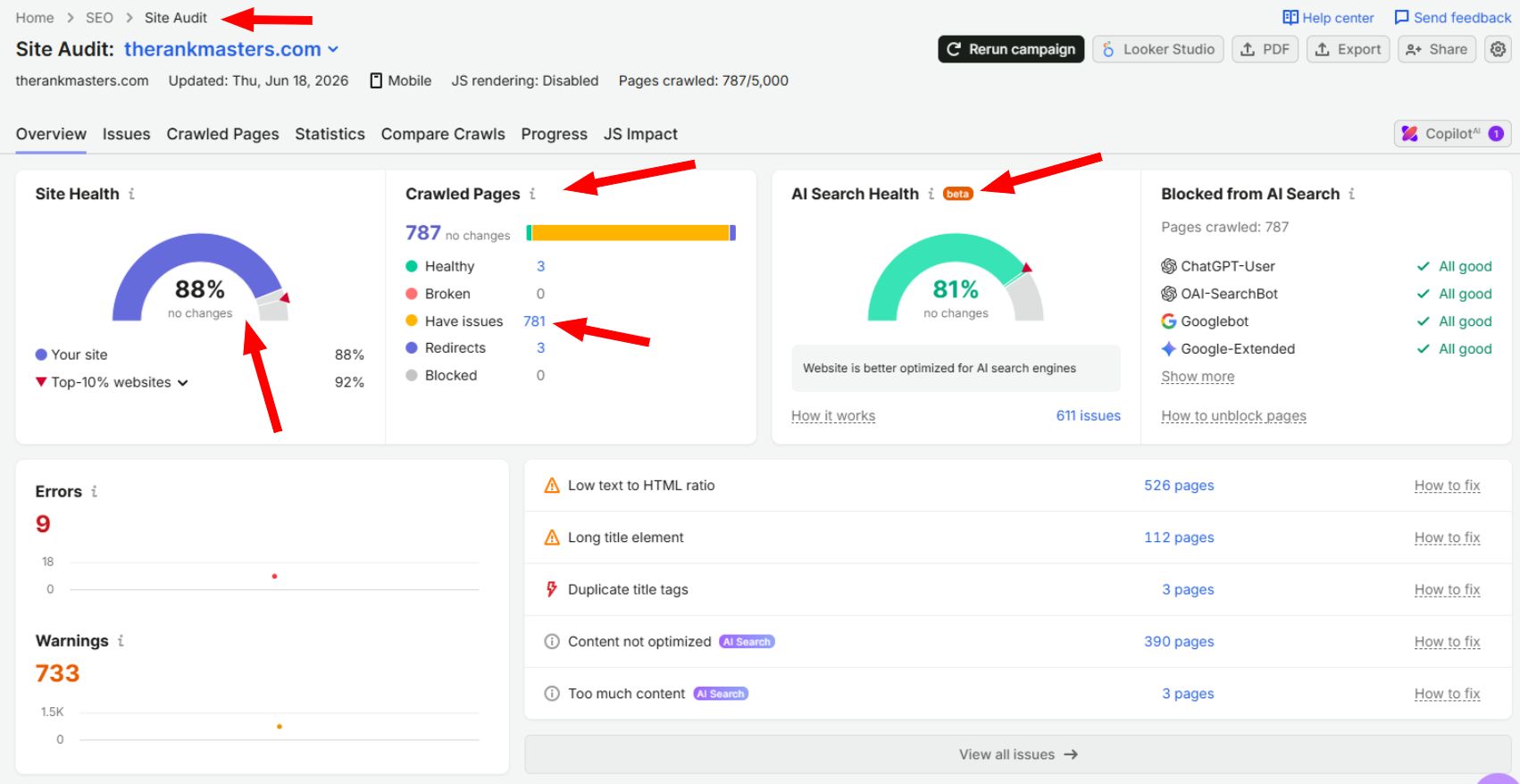
Technical readiness is the floor the rest of the work stands on. If your best commercial page blocks AI crawlers or lacks the structured data that helps engines parse it, every content and outreach fix upstream is capped by a problem downstream.
Because most AI crawlers do not execute JavaScript, server-rendered, clean HTML remains essential.
Audit your own readiness. Start your own 14-day Semrush One trial and run the AI readiness checks on your site.
How to Increase Your AI Overview Visibility: The Playbook
You increase AI Overview visibility by clearing technical blockers, earning strong organic rankings on your priority topics, structuring pages for extraction, and building the third-party and video presence that Overviews cite. Done in that order, the earliest steps unlock the later ones.
Here is the sequence:
- Clear technical blockers first. Make sure AI crawlers can reach and parse your priority pages, since nothing else works until they can.
- Earn the organic ranking foundation. Overviews still draw heavily on strong-ranking pages, so classic SEO on your target topics remains the base layer.
- Restructure for extraction. Lead with direct answers, use clear headings and tables, and add named sources and dates so passages lift cleanly.
- Build topical depth. Cover the full question cluster so fan-out can cite you on related sub-queries, not just the head term.
- Earn third-party and video presence. Pursue the trusted sources and platforms your cited-sources view reveals, including YouTube where it fits.
- Track and refresh. Monitor which pages hold citations and refresh them on a schedule, because citation is volatile and stale pages lose their slots.
This is the exact point where a tool stops and a strategist starts. A dashboard like this one will hand you the numbers, namely your Overview gaps, your competitor comparison, and the sources you are missing. It will not tell you which of them to act on first, or how to turn them into a plan.
That interpretation layer, reading the metrics and mapping your ICP's buying journey to the SEO and answer-engine content that wins it, is the work The Rank Masters does for B2B SaaS teams.
Executing this well is exactly the gap The Rank Masters closes, building an ICP-led content system that maps each topic cluster to a money page and to pipeline, rather than publishing posts that never convert.
The Overview slots go to brands that treat citability as a system, not a one-off, and our case studies show the pattern in practice.
How Long Does It Take to Show Up in AI Overviews?
A page that already ranks well and gets restructured for extraction can be cited within days of Google recrawling it, while a new page on a weak topic can take months to build the authority required. There is no fixed timeline, because eligibility depends on ranking and trust you may not have yet.
The dependency chain explains the range. Because Overviews draw heavily on pages that already rank and on trusted third-party sources, the fastest wins come from pages that are already competitive and only need structural work, and the slowest come from topics where you have neither rankings nor citations yet.
Citation is also volatile, so appearing once does not guarantee staying, which makes refresh cadence part of the timeline rather than a one-time finish line.
Set expectations by starting point:
- Already ranking, well-structured: citations can appear within days to a few weeks of a recrawl.
- Ranking but poorly structured: weeks, once the page is restructured for extraction.
- Not ranking yet: months, since you must build the ranking and authority foundation first.
- Any page, over time: ongoing, because refreshing content is what holds a citation once earned.
Frequently Asked Questions
What is AI Overview visibility?
Do I have to rank on page one to appear in an AI Overview?
Does being cited in an AI Overview actually help if clicks are falling?
What content is most likely to get cited in AI Overviews?
How do I track my AI Overview visibility?
Why did my rankings stay the same while my traffic dropped?
How is AI Overview visibility different from ChatGPT visibility?
Win the Citation Slots Your Buyers See First
AI Overview visibility is now the difference between shaping your category's shortlist and disappearing from it, because the Overview answers the question before your ranking ever gets a look. Measuring it is a few clicks in Semrush. Turning the gaps into structured content and earned citations that hold their slots is the work that moves the number.
If thin coverage of your highest-intent topics is costing you pipeline, book a SaaS content strategy call and we will turn your Overview gaps into a plan that maps each topic cluster to a money page.
And if you want to run the tracking yourself first, spin up a free 14-day Semrush One trial and pull your AI Overview gaps before your next planning meeting.
📑 Disclosure!
Some links in this article are affiliate links. If you sign up through them, The Rank Masters may earn a commission at no additional cost to you. This does not influence which tools we recommend or what we say about them.