

Only about 35% of small and mid-sized businesses have even claimed a Google Business Profile, according to BrightLocal's 2026 research, which means the single most important free tool in local search is sitting unclaimed and unoptimized for most of your competitors, and that is your opening.
Local visibility is won on the profile, not just the website. When someone searches for what you do near them, Google decides which handful of businesses to show in the map pack based largely on the signals inside your Google Business Profile, your reviews, and your local relevance.
Get those right and you appear where high-intent buyers are looking; get them wrong and you are invisible on your own doorstep.
This guide explains what local visibility means, how Google ranks profiles, what actually moves the needle, and exactly how to audit and grow your presence using Semrush's Local toolkit on therankmasters.com as the worked example.
If you would rather have the audit run and the fixes turned into a prioritized plan, The Rank Masters builds that kind of search strategy for growing businesses.
▶️ If your business is buried in local results and you want a search strategy that fixes it, book a strategy call.
Table of Contents
What Is Local Visibility on a Google Business Profile?
Local visibility on a Google Business Profile is how often and how prominently your business appears in Google's local results, namely the map pack, Google Maps, and local searches, for the terms your nearby customers actually use. It is measured by where you rank across your service area, not by a single position.
Your Google Business Profile is the free listing that controls how your business shows up on Google Search and Maps, including your name, address, phone, hours, categories, photos, and reviews. Local visibility is the outcome of optimizing that profile and its supporting signals so Google shows you to people searching nearby.
Two surfaces matter most here:
- The local pack: the block of three business listings with a map that appears at the top of local search results, which captures the majority of local clicks and calls.
- Google Maps: the standalone map experience where users browse and compare nearby businesses directly.
Ranking in these surfaces varies by where the searcher is standing, which is why local visibility is measured across a grid of locations rather than one spot.
If the vocabulary is new, our SEO glossary defines the terms, and this connects to the broader idea of search visibility we cover elsewhere.
Why Does Google Business Profile Visibility Matter?
Google Business Profile visibility matters because the profile is where most local buyers discover, evaluate, and choose a business before they ever reach a website. An incomplete or unclaimed profile forfeits that entire journey to competitors who show up instead.
The performance gap between optimized and neglected profiles is large.
Birdeye's State of Google Business Profile 2026 report found that verified, fully populated profiles surface far more often in search and drive roughly 4 times more website visits, plus double-digit increases in calls and direction requests, than incomplete or unverified listings.
The profile is not a formality, it is a conversion channel.
| Local search signal | Figure | Source and year |
|---|---|---|
| Small and mid-sized businesses with a Google Business Profile | about 35% | BrightLocal, 2026 |
| Extra website visits from verified, complete profiles | roughly 4 times more | Birdeye, 2026 |
| Consumers who only use businesses rated 4 stars or higher | 68% (up from 55%) | BrightLocal, 2026 |
| Google Business Profile impressions from category searches | most, versus branded searches | Birdeye, 2026 |
Discovery is also overwhelmingly non-branded. Birdeye found that the large majority of profile impressions come from category-based searches like "plumber near me" rather than searches for your business name, which means the profile is how new customers who do not yet know you find you in the first place.
If your categories, services, and content are thin, you miss that demand entirely.
Rising expectations raise the stakes further. BrightLocal's 2026 survey found that 68% of consumers now only consider businesses rated 4 stars or higher, up from 55% a year earlier, so visibility without a strong review profile no longer converts.
That is why we treat local presence as one connected system of profile, reviews, and website, the same way we think about SaaS content marketing and zero-click search.
How Does Google Rank Business Profiles Locally?
Google ranks business profiles locally using three primary factors it states publicly, namely relevance, distance, and prominence.
Together they decide which businesses earn the map pack for a given search from a given location.
Google's own guidance is explicit on this. Its Business Profile Help documentation explains that local results are based primarily on relevance, distance, and prominence, that complete and accurate information helps you match more searches, and that more reviews and positive ratings can improve your local ranking.
In plain terms, relevance is how well your profile matches the search, distance is how close you are to the searcher, and prominence is how well-known and trusted your business appears.
The profile itself carries most of the controllable weight. According to Whitespark's 2026 Local Search Ranking Factors report, the annual survey of leading local SEO experts, the signals coming directly from the Google Business Profile dominate the local pack, which is why optimizing the profile is the highest-leverage local SEO work you can do.
Distance you cannot control, but relevance and prominence are largely in your hands.
The practical implication is a clear order of operations. You cannot move your business closer to every searcher, so you win by maximizing the two factors you control, making your profile unmistakably relevant to your core searches and building the prominence signals, chiefly reviews and citations, that tell Google you are the trusted choice.
That is the throughline of everything below.
It also explains why the map pack is worth this much effort.
Those three listings sit above the organic results and capture the majority of clicks and calls for local searches, so the difference between ranking fourth and ranking third is not one position, it is the difference between being seen and being scrolled past.
Relevance and prominence compound over time, which means the profile you optimize and the reviews you gather this quarter keep paying off in the next, while a neglected profile slowly cedes ground to competitors who treat local search as an ongoing discipline.
What Affects Your Google Business Profile Ranking?
Your Google Business Profile ranking is affected most by your primary category, profile completeness, review signals, proximity, photos, your linked website, and citation consistency. These are the levers, and most of them are fully within your control.
Each lever maps to one of Google's three factors. Category and completeness drive relevance, proximity is distance, and reviews, photos, and citations build prominence. The mistake most businesses make is obsessing over one lever, usually the profile description, while ignoring the review engine that carries far more weight.
| Ranking lever | Which factor it drives | How to strengthen it |
|---|---|---|
| Primary category | Relevance | Choose the most specific category that matches your core service |
| Profile completeness | Relevance | Fill every field, namely services, attributes, hours, description |
| Review quantity and rating | Prominence | Earn reviews consistently and keep your rating high |
| Review recency | Prominence | Maintain a steady, ongoing flow of new reviews |
| Photos and posts | Prominence and engagement | Add fresh, authentic photos and post regularly |
| Linked website | Relevance | Connect a well-optimized, locally relevant website |
| Citation consistency | Prominence and trust | Keep name, address, and phone identical everywhere |
Review recency deserves special attention because it is chronically underrated. As Darren Shaw, founder of Whitespark, put it, "the moment you stop getting new reviews, you're going to see your local rankings start to slip," since a steady stream of reviews is one of the clearest signals to Google that a business is active and chosen.
A big pile of old reviews is worth less than a smaller, steadily growing one. That principle is central to our note on getting more Google reviews.
What You Need Before You Start
Before you open any tool, you need a claimed and verified Google Business Profile, consistent business information, a target keyword and service-area map, and a defined competitor set. Good inputs are what separate a real local audit from guesswork.
The non-negotiable first step is claiming and verifying the profile, because an unverified or unclaimed listing can be edited by others and is far less likely to rank. From there, your name, address, and phone number need to be identical everywhere they appear online, since inconsistency erodes the trust signals that feed prominence.
Here is the prep checklist:
- A claimed, verified profile: confirm ownership at the Google Business Profile manager before anything else.
- Consistent NAP: your name, address, and phone identical across your site and every directory.
- A local keyword list: the terms nearby customers use, mapped to your core services.
- A service-area grid: the geographic area you want to be visible across, not just your storefront pin.
- A competitor set: three to four local rivals to benchmark your map rankings against.
Mapping keywords to your real service area is the step most businesses skip, and it is the difference between tracking one flattering pin at your front door and seeing the honest picture across the neighborhoods you serve.
How to Audit and Optimize Your Google Business Profile in Semrush
The first step is a full profile audit, and Semrush Local surfaces it by connecting your Google Business Profile and generating a personalized audit with tailored improvements. This tells you exactly which fields are weakening your relevance.
Here is the path:
- Open the Local toolkit in Semrush and connect your Google Business Profile.
- Run the Google Business Profile audit to get a personalized list of gaps and improvements.
- Review flagged fields such as primary category, services, attributes, hours, and description.
- Apply the recommended fixes, prioritizing category and completeness first.
- Use the GBP tools to keep the profile active with posts and photos on a schedule.
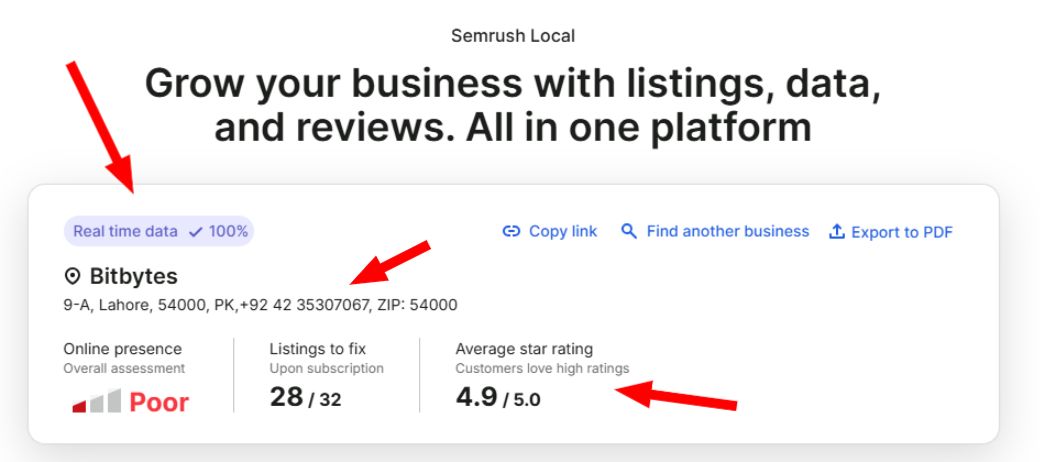
Start with the primary category, because it is the strongest relevance signal you control and it determines which searches trigger your listing at all. From there, completeness compounds, since Google rewards profiles that answer every question a searcher might have, and a fully populated profile earns the visibility and actions that thin listings never see. Treat the audit as a punch list and clear the relevance gaps before you move to prominence.
Want to audit your own profile? Start a 14-day Semrush One trial and connect your Google Business Profile before the next step.
How to Track Your Local Map Rankings in Semrush
Once the profile is optimized, you need to see where you actually rank across your service area, which Semrush shows through the Map Rank Tracker geo-grid. A single position at your storefront hides the truth about the neighborhoods around you.
Set it up like this:
- Open Map Rank Tracker in the Local toolkit and enter your business name.
- Add the keywords you want to track, or use the AI-generated recommendations.
- Set your target area with a map grid, choosing the grid size and distance between pins.
- Run the scan to generate a heatmap of your ranking at each pin.
- Schedule the campaign to re-run so you can watch rankings change over time.
The heatmap is where local visibility stops being abstract. You will typically rank well right at your location and fade as distance grows, and the pattern of that fade tells you where to focus, since strong relevance and prominence can extend your visible radius well beyond the pins closest to your door.
Track your competitors on the same grid to see exactly where they are beating you and by how far, which turns a color map into a target list.
See your own map rankings. Open Semrush One on a 14-day trial and scan your service area on the grid.
How to Keep Your Business Listings Consistent in Semrush
Prominence depends on trust, and trust depends on your business information being identical everywhere, which Semrush Local handles through Listing Management. Inconsistent name, address, and phone data across directories quietly undermines your local rankings.
Work it like this:
- Open Listing Management in the Local toolkit and enter your business details.
- Distribute your name, address, phone, hours, and website across the supported directories.
- Review flagged inconsistencies and duplicate listings the tool detects.
- Push corrections from one place so every directory matches your profile.
- Keep the data synced so future changes propagate automatically.
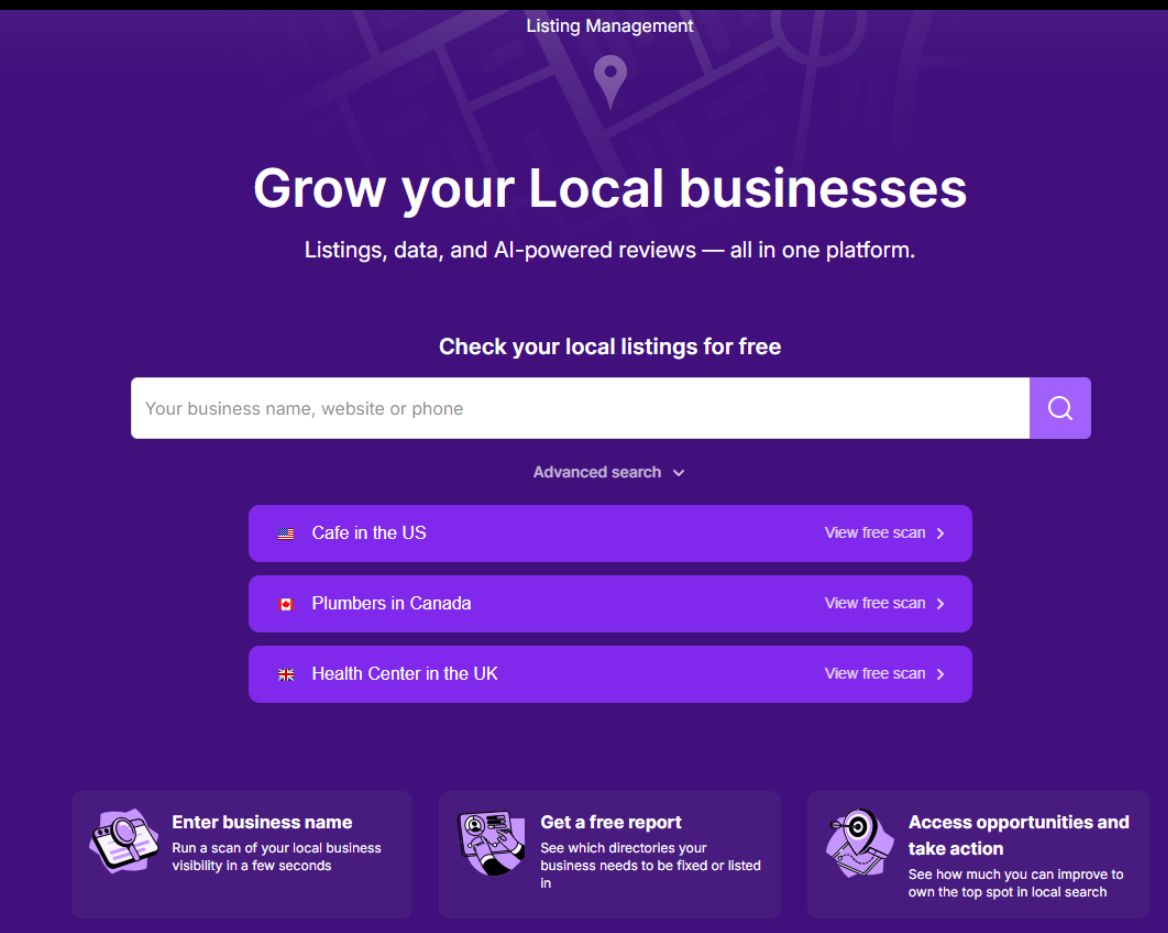
Consistent listings do two jobs at once.
They reassure Google that your business details are accurate, which supports prominence, and they make sure customers who find you on any directory reach the right address and phone number.
Semrush distributes your data across a large network of authoritative directories and can make it voice-search ready, so a single update flows everywhere instead of you editing dozens of listings by hand.
Fix the duplicates first, since a stray duplicate profile can split your signals and confuse both Google and customers.
Clean up your own listings. Run this on a 14-day Semrush One trial and sync your business data across directories.
How to Monitor and Improve Your Reviews in Semrush
Reviews are among the strongest prominence signals, so the next step is building a system to earn, monitor, and respond to them, which Semrush Local handles through Review Management. A steady flow of recent reviews is what keeps your rankings climbing.
Here is the workflow:
- Open Review Management in the Local toolkit to see reviews from across the major platforms in one place.
- Set up automated email or SMS requests to invite reviews after a service or purchase.
- Turn on alerts so you are notified of new and negative reviews quickly.
- Respond to reviews from the dashboard, using the AI draft feature to speed up replies.
- Compare your review count and reply rate against local competitors.
The point of the dashboard is to make review generation a habit rather than an afterthought.
Because recency matters as much as volume, the automated request feature is what keeps new reviews arriving steadily instead of in occasional bursts, and the competitor comparison shows you the pace you need to beat.
Respond to every review, positive and negative, since visible responses signal an active, trustworthy business to both Google and the next customer reading them.
Build your own review engine. Try Semrush One free for 14 days and monitor your reviews against competitors.
How to Track Local Keyword Rankings in Semrush
Beyond the map pack, you also compete in local organic results, so the next step is tracking your local keyword rankings through Semrush's Position Tracking. This connects your map visibility to the organic listings beneath it.
Set it up like this:
- Open Position Tracking and create a campaign for your domain.
- Set the location to your target city or area for local results.
- Add your local keywords, including service-plus-location terms.
- Review your rankings and any local pack or SERP feature flags.
- Monitor the trend over time and add keywords as you expand.
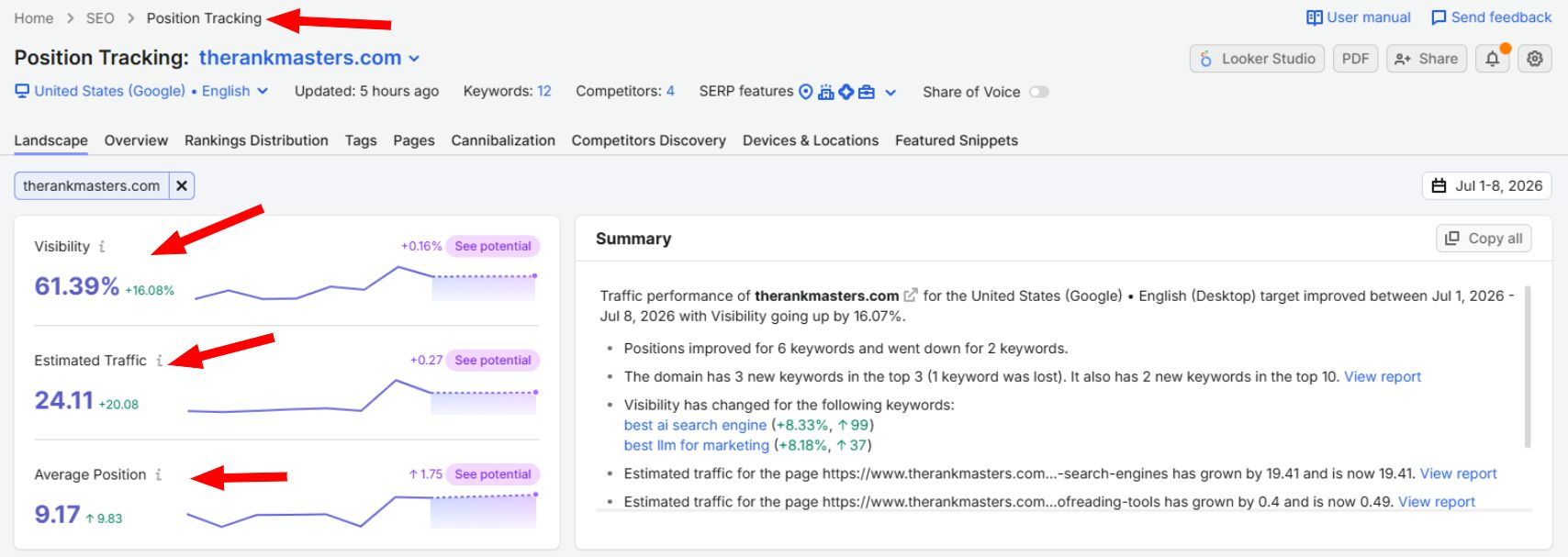
Tracking local organic rankings matters because the map pack and the organic listings feed each other, so a page that ranks well organically for a local term strengthens your overall local presence.
Watch the service-plus-location keywords most closely, since those are the high-intent terms where a strong ranking turns a searcher into a customer.
Reviewing the trend weekly, rather than any single day, is what separates real movement from noise.
Track your own local keywords. Follow along on a free 14-day Semrush One trial and set up a local campaign.
How to Strengthen Your Website's Local Signals in Semrush
Your website still feeds your local rankings, so the final step is strengthening its local signals, which Semrush surfaces through the On Page SEO Checker and Site Audit. A weak or slow local landing page caps everything the profile earns.
Run it like this:
- Open On Page SEO Checker and select your key local landing pages.
- Review the content and keyword recommendations for your local terms.
- Run Site Audit to check technical health, mobile-friendliness, and speed.
- Add or improve location-specific pages for each area you serve.
- Fix the highest-severity issues first, then re-check that the scores respond.
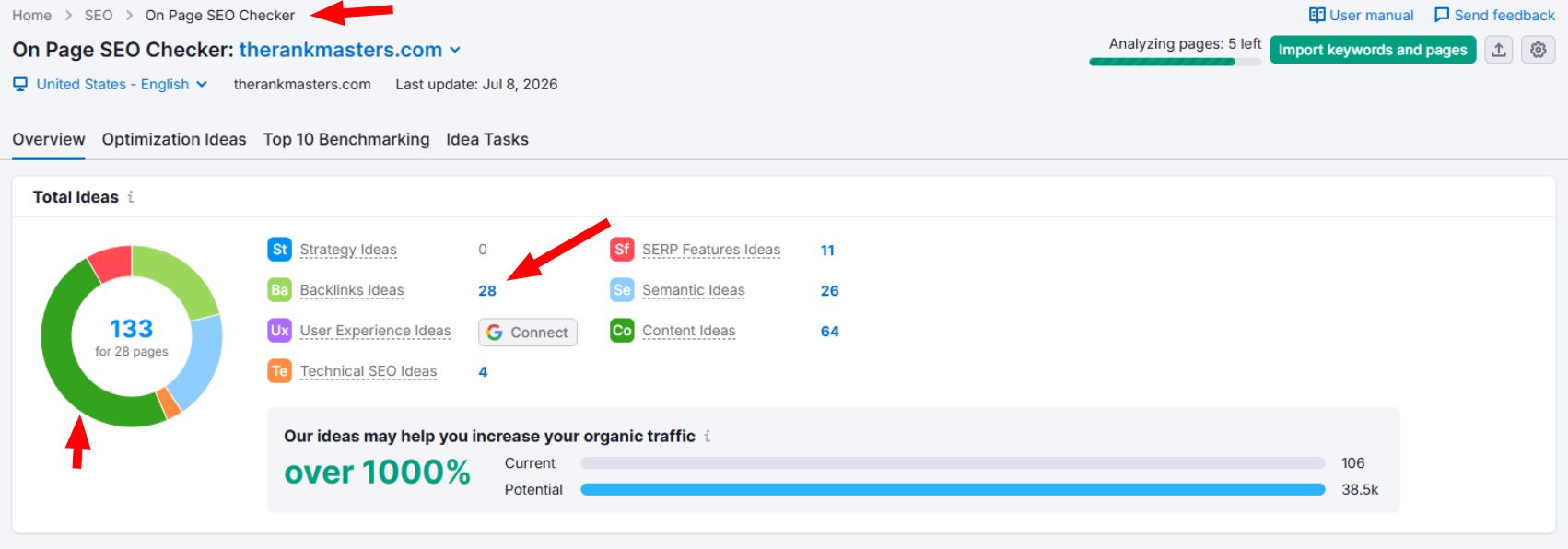
The website is the relevance layer beneath the profile.
A dedicated, well-structured landing page for each service area you serve gives Google clear local relevance signals and a fast, mobile-friendly destination for the customers your profile sends, while a slow or thin page undercuts the trust the profile builds.
Prioritize the pages tied to your highest-value services and areas, and keep the name, address, and phone on them identical to your profile.
Citation and NAP consistency across all of this is covered in our note on NAP consistency and citations.
Strengthen your own local pages. Start your own 14-day Semrush One trial and check your local landing pages.
How to Improve Your Local Visibility: The Playbook
You improve local visibility by claiming and optimizing the profile, fixing listing consistency, building a steady review engine, tracking your map and local rankings, and strengthening your local website pages. Done in that order, each step compounds the next.
Here is the sequence:
- Claim, verify, and optimize the profile. Nail the primary category and complete every field, since this is the highest-leverage relevance work.
- Fix listing consistency. Correct duplicates and align your name, address, and phone everywhere to protect trust signals.
- Build the review engine. Automate steady review requests and respond to every review, because recency and volume both drive prominence.
- Track your map and local rankings. Use the geo-grid and Position Tracking to see where you stand and where competitors beat you.
- Strengthen the website. Build fast, relevant local landing pages for each area you serve to support the profile.
- Repeat on a cadence. Local rankings drift, so post, gather reviews, and re-check the grid on a regular schedule.
This is the exact point where a tool stops and a strategist starts.
A dashboard like this one will hand you the data, namely your profile gaps, your ranking heatmap, and your review comparison. It will not tell you which fix will move the needle most, or how to sequence them into a plan.
That interpretation layer, reading the signals and turning them into a prioritized roadmap tied to real business outcomes, is the work The Rank Masters does.
Executing this well is exactly the gap The Rank Masters closes, building a search strategy that connects each fix to visibility and to revenue, rather than checking boxes that never move the ranking.
The businesses that win local search treat it as an ongoing system, not a one-time setup, and our case studies show the pattern in practice.
How Long Does It Take to Improve Local Visibility?
Profile fixes like category, completeness, and listing consistency can influence rankings within days to a few weeks, while review-driven prominence and new local pages usually take one to three months to show their full effect. There is no fixed timeline, because it depends on your starting point and your competition.
The dependency chain explains the range. Relevance fixes on the profile are the fastest, since Google can reassess an updated, complete profile quickly, while prominence is slower because it is built through a sustained flow of reviews and citations that accumulate over time. Competition matters too, so a crowded urban category takes longer to move than a sparse suburban one.
Set expectations by lever:
- Profile and listing fixes: days to a few weeks, as Google reassesses your relevance and trust.
- Review-driven prominence: one to three months of steady review generation before the ranking effect compounds.
- New local landing pages: weeks to months, as the pages earn rankings and support the profile.
- Ongoing maintenance: continuous, because rankings drift without regular posts, reviews, and checks.
Frequently Asked Questions
Optimize the profile fundamentals first, namely choose the most specific primary category and complete every field, then build prominence through a steady flow of recent reviews and consistent citations. Track your map rankings across your service area and strengthen your local website pages to support the profile.
Google states that local results are based primarily on relevance, distance, and prominence. Relevance is how well your profile matches the search, distance is how close you are to the searcher, and prominence is how well-known and trusted your business appears, which reviews and citations strongly influence.
Reviews are one of the strongest prominence signals and a primary trust factor for consumers. Recency matters as much as volume, since a steady flow of new reviews signals an active business, and most consumers now only consider businesses rated four stars or higher, so a strong review profile is essential for both ranking and conversion.
Because distance is a core local ranking factor, your visibility fades as searchers get farther from your location. That is why local visibility is measured across a grid of points rather than one spot, and why strong relevance and prominence are what extend your visible radius beyond your immediate address.
A website is not strictly required, but it significantly strengthens your local rankings by adding relevance signals and giving customers a destination. A fast, mobile-friendly page with location-specific content supports the profile, so profiles connected to a well-optimized website tend to outperform those without one.
Use a listing management tool to distribute your name, address, phone, hours, and website across directories from one place, and to flag inconsistencies and duplicates. Consistent information across the web reinforces the trust signals that feed prominence and ensures customers always reach the right details.
You can claim and optimize your profile, gather reviews, and check basic rankings for free, and a free Semrush account includes limited map tracking credits. However, running the review engine, syncing listings, and tracking a full geo-grid consistently over time is where paid tools save the effort that free checks cannot.
Turn Your Local Gaps Into a Visibility Plan
Local visibility is won by the businesses that treat their Google Business Profile as a living system, namely an optimized profile, consistent listings, a steady review engine, and a website that backs it all up. Setting up the tools takes an afternoon. Running the system consistently, and sequencing the fixes that move the needle most, is the work that actually grows your presence.
If your business is buried in local results and you want a search strategy that fixes it, book a strategy call and we will turn your local gaps into a prioritized plan tied to real outcomes.
And if you want to check where you stand first, spin up a free 14-day Semrush One trial and scan your local visibility before your next planning meeting.