

In the eight months from mid-2025 to early 2026, ChatGPT's share of B2B AI referral traffic fell from 89% to 63% as Claude, Gemini, and Perplexity absorbed the difference, according to Goodie's 2026 AI Search Traffic Report, which means any brand still auditing only ChatGPT is now blind to roughly a third of where its buyers are actually looking.
That single shift is why an AI visibility audit is no longer optional. You cannot manage what you cannot see, and the AI answer layer has fractured across at least four engines that each cite different sources, describe your brand differently, and change their answers week to week.
An audit is the structured way to find out where you show up, where you do not, and which fixable gaps are handing your category to competitors.
This guide walks the full audit end to end using Semrush's AI Visibility Toolkit on therankmasters.com as the worked example. You will baseline your presence, find your gaps, benchmark competitors, check how AI describes you, set up daily tracking, and audit whether AI can even crawl you.
If you would rather have the audit run and the gaps turned into a prioritized plan, The Rank Masters does exactly that for B2B SaaS teams.
▶️ If your ranked pages are not showing up in AI answers and you want a content system that fixes that, book a SaaS content strategy call.
What Is an AI Visibility Audit?
An AI visibility audit is a systematic review of how often, where, and how favorably AI engines mention and cite your brand, plus the content and technical gaps keeping you out of AI answers. It converts a vague worry about AI search into a measured baseline and a fixable gap list.
Unlike a traditional SEO audit, which examines rankings, backlinks, and crawlability, an AI visibility audit examines your presence inside generated answers on ChatGPT, Google AI Overviews and AI Mode, Gemini, and Perplexity. The core questions it answers are whether AI recommends you for the prompts your buyers ask, which sources AI trusts in your category, and how AI describes you when it does mention you.
The audit produces four concrete outputs:
- A baseline score: a single measure of your current presence across AI platforms, so you have a number to improve against.
- A gap list: the specific topics and sources where competitors appear in AI answers and you do not.
- A perception read: whether AI describes your brand favorably, neutrally, or poorly, and which narratives drive that.
- A technical readiness check: whether AI crawlers can access and cite your content in the first place.
If the underlying concepts are new, our answer engine optimization overview and the SEO glossary define the vocabulary, and this pairs naturally with our guide to tracking brand visibility in ChatGPT.
Why Run an AI Visibility Audit in 2026?
You should run an AI visibility audit in 2026 because AI answers now shape buying decisions before anyone reaches your site, the answer layer is fragmenting across engines, and the answers themselves are inconsistent enough that a one-time check tells you almost nothing. Auditing is how you replace guesswork with a measured position.
Start with the fragmentation.
As covered above, the B2B AI referral market split from one dominant engine into four in under a year, so a single-engine check now misses most of the picture.
A peer-reviewed analysis of 973 websites in INFORMS Marketing Science found ChatGPT still drives more than 90% of organic LLM referral sessions today, but with Perplexity, Gemini, and Copilot each carving out measurable share, the trend line points clearly at a multi-engine future.
Across ten major industries, AI platforms still send only about 1% of all web traffic on average, per Conductor data reported by Digiday, so the audit is about capturing a fast-growing, high-intent channel early rather than chasing volume that already dominates.
| AI search signal | Figure | Source and year |
|---|---|---|
| ChatGPT share of B2B AI referrals, mid-2025 to early 2026 | fell from 89% to 63% | Goodie, 2026 |
| Share of organic LLM referral sessions from ChatGPT | over 90% | INFORMS Marketing Science, 2026 |
| ChatGPT answers that included a citation, Jan to Aug 2025 | grew from 0.6% to 2.8% | Similarweb, 2026 |
| AI platform share of total web traffic across 10 industries | about 1% | Conductor via Digiday, 2025 |
Next, citations are rare and rising, which makes them worth auditing for.
Similarweb's clickstream analysis found the share of ChatGPT answers that included a citation grew from 0.6% to 2.8% between January and August 2025. When only a small fraction of answers cite anyone, being one of the cited sources is a genuine competitive moat, and the audit is how you find out whether you are earning those citations or your competitors are.
Finally, AI answers are unstable, so a single spot-check is unreliable.
A Washington State University study led by Mesut Cicek found that when the same question was asked ten times, ChatGPT was consistently accurate on only about 73% of statements and overall performed only around 60% better than chance.
If the model gives different answers to the same prompt on different days, the only reliable read comes from systematic tracking over time, not a manual check on a Tuesday.
The strategic takeaway is best summed up by the people watching the data closest.
As Or Offer, chief executive of Similarweb, put it, "the center of gravity in digital discovery is shifting," and brands that measure and optimize their visibility in these moments will define the next decade.
An audit is step one of that work, and it connects directly to how we think about AI share of voice and getting cited in AI answers.
What Should an AI Visibility Audit Measure?
A complete AI visibility audit measures six things, namely your presence, your gaps, your competitive standing, your brand perception, your tracking over time, and your technical readiness. Skip any one of them and the audit gives you a false sense of where you stand.
Each dimension answers a different buyer-relevant question, and together they form the checklist for the rest of this guide.
Presence tells you if you show up at all, gaps tell you where you are missing, competitive standing tells you who is beating you, perception tells you whether the mentions help or hurt, tracking tells you whether it is stable, and technical readiness tells you whether AI can even reach your content.
| Audit dimension | The question it answers | Where you measure it |
|---|---|---|
| Presence | Do AI engines mention and cite me at all? | Visibility Overview baseline |
| Gaps | Where are competitors cited and I am missing? | Topic and Source Opportunities |
| Competitive standing | Who leads AI visibility in my category? | Competitor Research |
| Perception | Does AI describe me favorably? | Brand Performance and sentiment |
| Stability | Is my visibility consistent over time? | Prompt Tracking |
| Technical readiness | Can AI crawlers access and cite me? | Site Audit AI readiness |
The mistake most teams make is auditing only the first dimension, presence, and declaring victory or defeat on a single score. A brand can have a decent presence score while being described poorly, missing every high-intent commercial prompt, and blocking AI crawlers on its best pages.
The value of the audit is in the full picture, not the headline number, which is a theme we will return to when the gaps become an action plan.
What You Need Before You Start Your AI Visibility Audit
Before you open any tool, you need three inputs, namely a prompt list that mirrors how your buyers actually ask, a defined competitor set, and access to an AI visibility platform. Good inputs are what separate a useful audit from a vanity exercise.
The prompt list matters most.
AI visibility is measured against prompts, not keywords, so your list should reflect the real questions your ideal customer profile asks across their buying journey, from broad category questions to direct comparison and alternative queries.
Build it by mapping each stage of the journey to the prompts a buyer would type, for example "best tools for X," "alternatives to Y," and "is Z worth it for a mid-market team."
Here is the prep checklist:
- A journey-mapped prompt list: 20 to 50 prompts spanning problem-aware, solution-aware, and vendor-comparison stages, phrased the way your ICP speaks.
- A competitor set: three to four direct competitors you want to benchmark against in AI answers.
- A platform with AI coverage: a tool that tracks presence, citations, sentiment, and prompts across the major AI engines, since manual checking cannot scale or run daily.
- A baseline date: the day you run the first audit, recorded so every future audit measures change against it.
Mapping prompts to the ICP buying journey is the step most teams underinvest in, and it is the difference between auditing the queries that drive revenue and auditing random brand trivia.
If you want a structured way to build that prompt set, it is core to how we approach generative engine optimization and AI visibility audit tooling.
How to Baseline Your AI Visibility Score in Semrush
The first step of the audit is a baseline, and in Semrush that means running the Visibility Overview to capture your AI Visibility Score and the metrics beneath it. This is the number every later audit measures progress against.
Here is the exact path:
- Open Semrush and go to the AI Visibility Toolkit in the left navigation, then select Visibility Overview.
- Enter your domain in the search bar and click Check AI Visibility.
- Read the AI Visibility Score, a 0 to 100 benchmark, at the top of the report.
- Use the trend tabs to review Mentions, Citations, and Cited Pages under Main Metrics.
- Open the Distribution by LLM module and toggle between Mentions and Cited Pages to see which engines carry your presence.
- Record the score and each metric with today's date as your baseline.
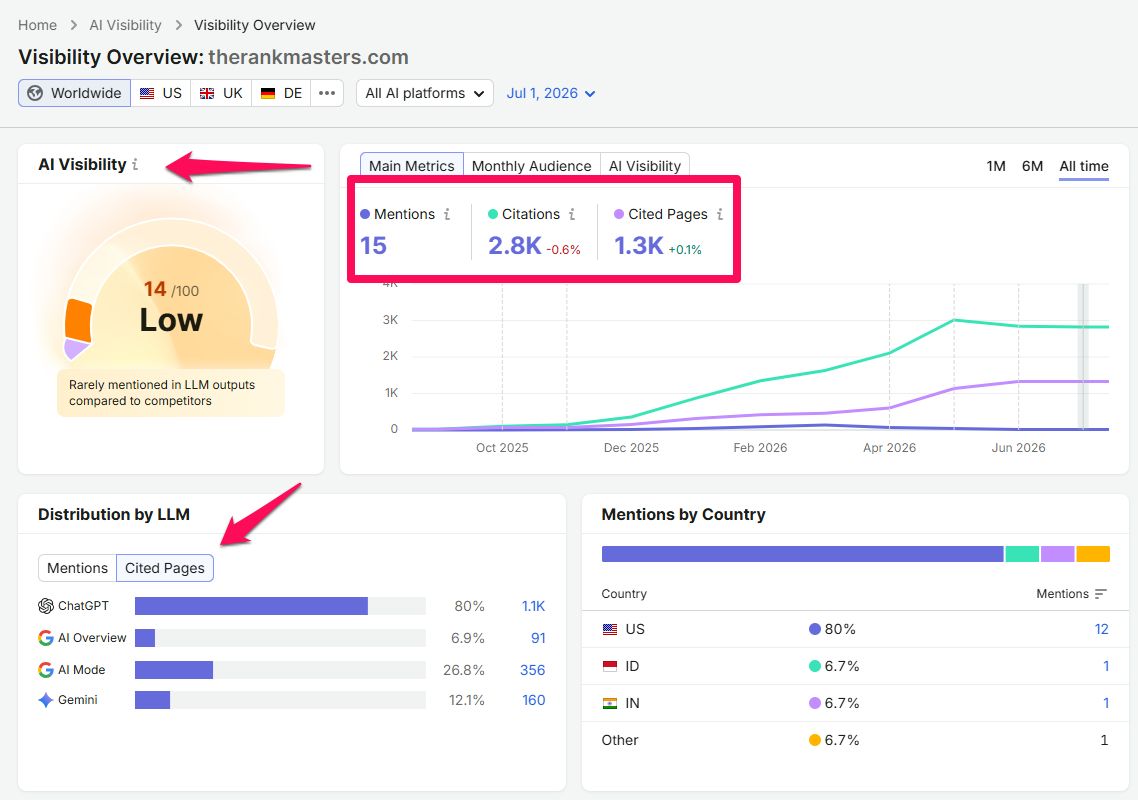
Read the baseline honestly rather than emotionally. A modest score is normal for a brand early in its AI work, and the score matters far less on day one than it will as a trend line over the coming months.
What you are looking for is the split beneath the number, because a brand can have healthy Mentions but almost no Citations, which tells you AI knows you exist but does not trust you enough to point to your pages.
Semrush draws this from a prompt database of more than 289 million AI queries across the major engines, so the baseline reflects real prompt coverage rather than a handful of manual checks.
Want your own baseline? Start a 14-day Semrush One trial and capture your AI Visibility Score before the next step.
How to Find Your AI Visibility Gaps in Semrush
The heart of the audit is the gap analysis, and Semrush surfaces it directly through the Topic Opportunities and Source Opportunities in the Visibility Overview. These are the prompts and sources where your competitors appear in AI answers and you do not.
Work the gaps like this:
- In the Visibility Overview, scroll below the score to the topics and sources table.
- Open Topic Opportunities to see prompts where competitors are cited but your brand is missing.
- Open Source Opportunities to see the external sites cited for prompts that mention competitors but not you.
- Sort by Competitors Mentioned to find high-consensus gaps where multiple rivals appear and you are absent.
- Export the prioritized list of missing topics and sources as your gap backlog.
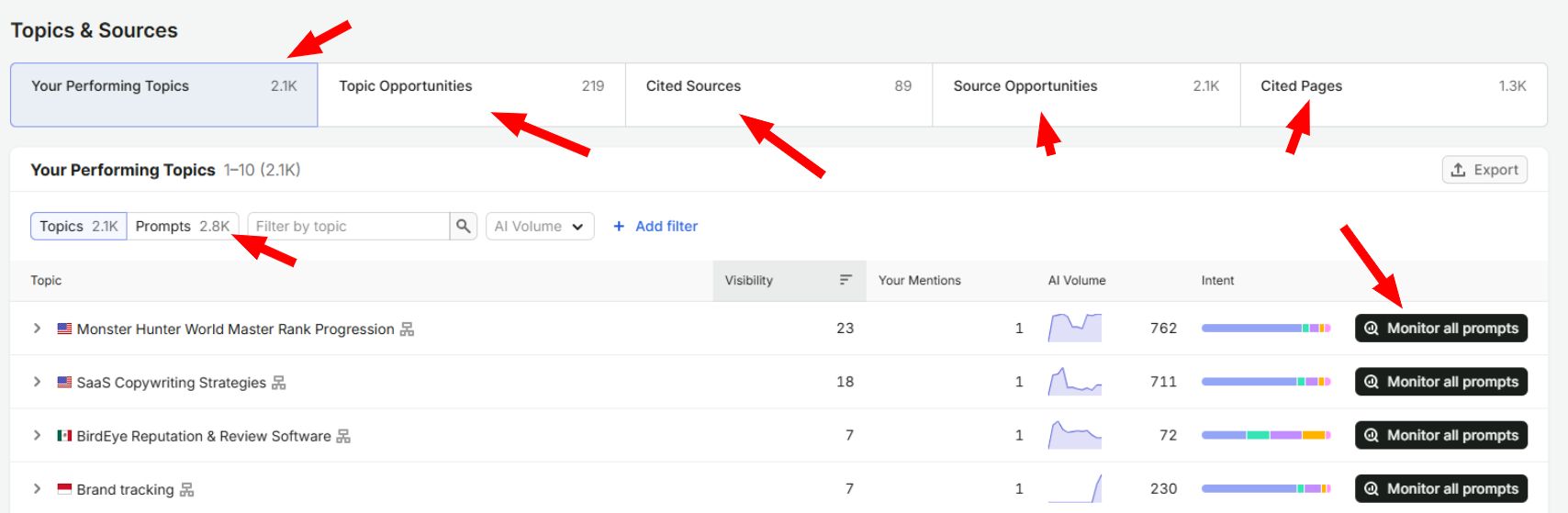
These two tables are the most actionable output of the entire audit.
A Topic Opportunity is a content gap, namely a prompt you should be answering with a page built to be cited, and a Source Opportunity is an off-site gap, namely a publication or platform you should be featured on because AI already trusts it in your category.
Sorting by how many competitors appear is the shortcut, because a prompt where three rivals show up and you do not is both proven demand and a proven miss.
| Gap type | What it means | The fix it points to |
|---|---|---|
| Topic Opportunity | A prompt competitors win and you are absent from | Build or strengthen a citation-ready page for that prompt |
| Source Opportunity | A trusted site cited for competitor prompts | Earn a mention, listing, or feature on that source |
| High Competitors Mentioned | Multiple rivals appear, you do not | Prioritize first, it is proven demand plus a proven miss |
See your own gaps. Open Semrush One on a 14-day trial and pull your Topic and Source Opportunities.
How to Benchmark AI Visibility Against Competitors in Semrush
A gap list only means something next to competitors, so the audit's third step is the Competitor Research report, which compares your AI visibility directly against up to four rivals. This is where you learn who is winning your category inside AI answers.
Set the benchmark up like this:
- Open the Competitor Research report inside the AI Visibility Toolkit.
- Add up to four direct competitor domains to the comparison.
- Compare Mentions, Citations, and topic coverage side by side.
- Identify the topics where a competitor leads by the widest margin.
- Note which competitors are cited most often, since those are your benchmark to beat.
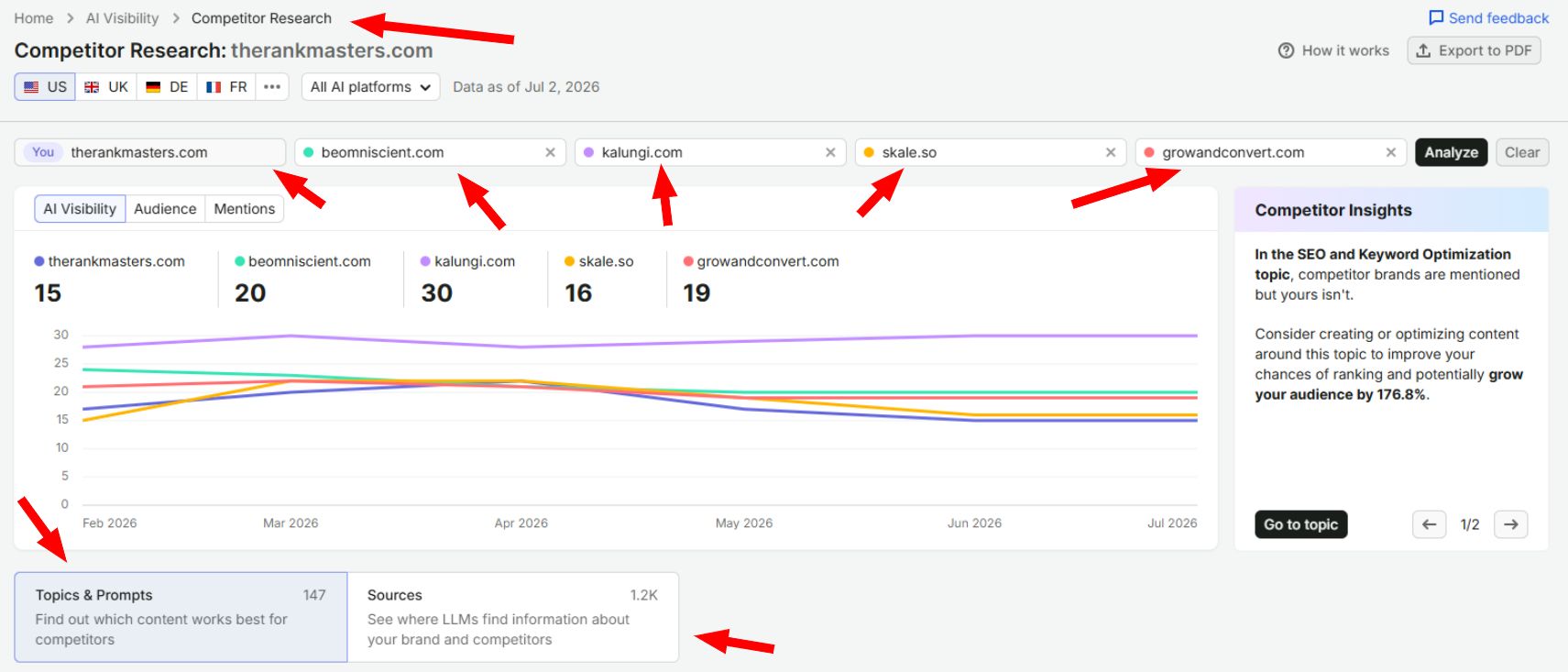
The benchmark reframes every gap you found in the previous step. A topic where you trail a single competitor by a little is a quick win, while a topic where you trail the whole field by a lot is a structural content gap that needs a cluster, not a single post.
Reading the comparison this way turns a flat list into a priority order.
| Benchmark read | What it means | The move it drives |
|---|---|---|
| You trail one rival narrowly | A near-parity gap | Strengthen the specific page, attack that prompt |
| You trail the whole field widely | A structural authority gap | Build the missing topic cluster and earn sources |
| You lead on a topic | A defensible position | Protect the cited page, expand adjacent prompts |
Run your comparison. Run this audit on a 14-day Semrush One trial and see where you sit against your rivals.
How to Audit How AI Describes Your Brand in Semrush
Presence is only half the story, so the fourth audit step checks how AI talks about you using the Brand Performance reports, which cover Share of Voice, sentiment, and the narratives driving your reputation. A brand can be mentioned constantly and still be described as expensive, limited, or second-best.
Walk the perception audit like this:
- Open the Brand Performance section of the AI Visibility Toolkit and enter your domain, location, and language.
- Read the Share of Voice versus Sentiment chart to see how your presence and perception compare to competitors.
- Open the Perception report to track favorable sentiment over time and the key sentiment drivers.
- Use Narrative Drivers to find the Top Cited Domains shaping your category's story.
- Check the Questions report to see the exact branded and non-branded prompts driving the conversation.
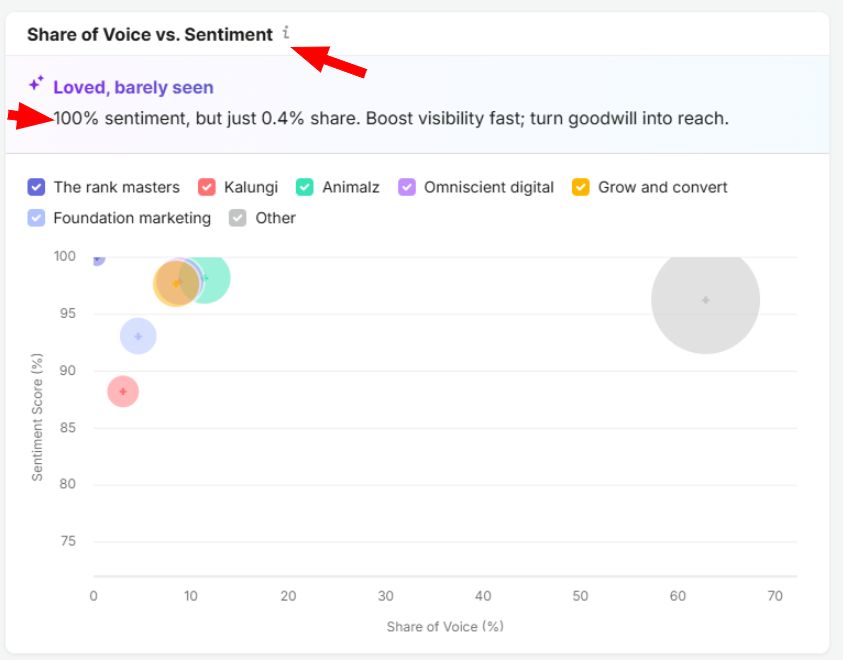
Read Share of Voice and sentiment together, never separately.
High Share of Voice with poor sentiment means AI is actively steering buyers away from you at scale, which is more urgent than simply being absent.
The Top Cited Domains in Narrative Drivers double as your outreach target list, since those are the third-party sites AI already trusts to describe your category, and earning a presence there is one of the most direct ways to shift how you are portrayed.
This is the audit dimension teams most often skip, and it is covered further in our note on LLM brand sentiment.
Check your own perception. Try Semrush One free for 14 days and read your Share of Voice against sentiment.
How to Track Your AI Visibility Daily in Semrush
Because AI answers change from day to day, the audit is not complete until you set up ongoing tracking, which in Semrush means Prompt Tracking inside the Position Tracking tool. A one-time snapshot ages out fast, so daily tracking is what keeps the audit alive.
The instability is measured, not theoretical. The Washington State University study noted earlier found ChatGPT gave inconsistent answers across repeated identical prompts, which means the presence you measured on audit day could look different a week later for reasons that have nothing to do with your work. Tracking separates real movement from noise.
Set up tracking like this:
- Open Position Tracking from your project and create or open a campaign.
- Select ChatGPT or Google AI Mode as the search environment.
- Add the journey-mapped prompts you built during prep.
- Let the campaign collect daily Visibility and Average Position for those prompts.
- Review the trend weekly, and add prompts as new commercial queries emerge.
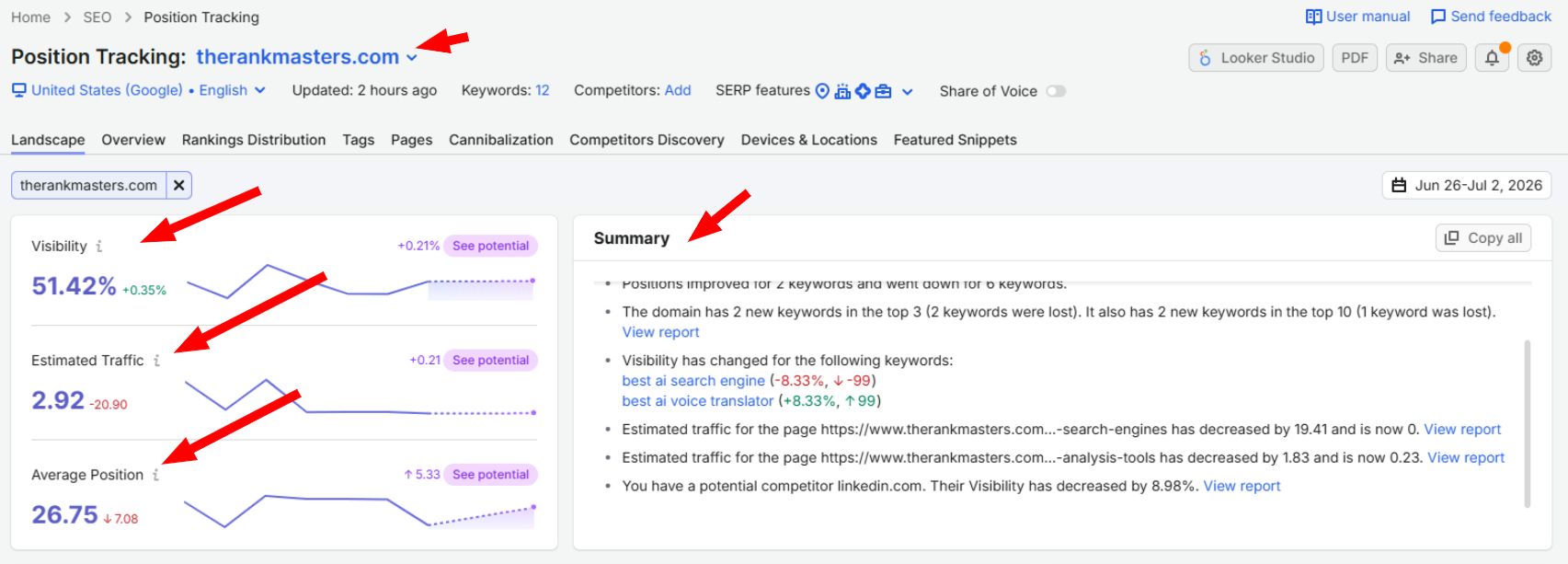
Because Prompt Tracking runs inside the same Position Tracking tool as your Google rankings, you can watch AI visibility and traditional search visibility in one dashboard, which is exactly how the two disciplines should be managed.
Track your highest-value commercial prompts first, since those are the ones where a lost mention costs pipeline, and treat the weekly trend, not any single day, as the truth. We go deeper on setup in our prompt tracking guide.
Set up your own monitor. Follow along on a free 14-day Semrush One trial and start tracking your priority prompts.
How to Audit Your Technical AI Readiness in Semrush
The final audit step checks whether AI can reach your content at all, using Site Audit's AI readiness checks. There is no point optimizing for citations if AI crawlers cannot access, parse, or trust your pages.
Run the technical audit like this:
- Open Site Audit from your project and run or refresh the crawl.
- Review the AI Search Health summary, which reflects your readiness for AI search.
- Check whether AI bots are allowed to crawl your key pages rather than being blocked.
- Confirm that AI-visibility elements such as structured data and an llms.txt file are present.
- Fix the highest-severity blockers first, then re-crawl to confirm the readiness score responds.
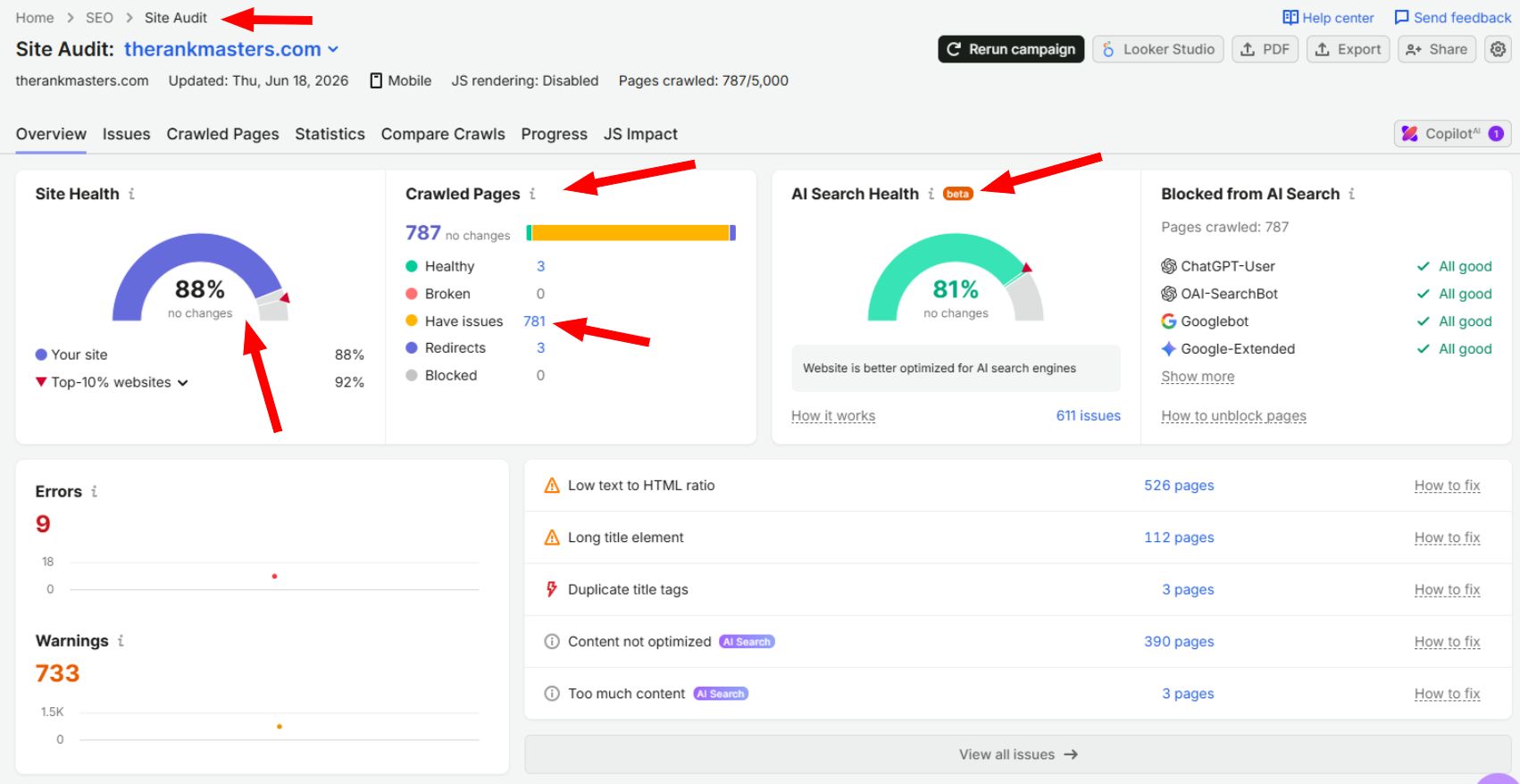
Technical readiness is the foundation the rest of the audit stands on. If your best commercial page blocks AI crawlers or lacks the structured data that helps engines parse it, every content and outreach fix you make upstream is capped by a problem downstream.
Clear the blockers first, because they are usually the cheapest fix with the widest effect, and they are detailed in our note on AI crawlability and llms.txt.
Audit your own readiness. Start your own 14-day Semrush One trial and run the AI readiness checks on your site.
How to Turn Your AI Visibility Audit Into an Action Plan
An audit is only useful once it becomes a prioritized plan, and the plan is built by ranking every gap you found against two axes, namely how much buyer intent it carries and how hard it is to close. This is where a pile of data becomes a roadmap.
Sort your findings into a simple priority order:
- Fix technical blockers first. Anything stopping AI from crawling or citing you caps everything else, so clear it before optimizing content.
- Attack high-consensus Topic Opportunities. Prompts where several competitors appear and you do not are proven demand plus a proven miss, so they come first among content gaps.
- Earn the trusted sources. Pursue the Source Opportunities and Top Cited Domains that AI already trusts in your category, since a mention there lifts many prompts at once.
- Repair perception. Where sentiment is poor, prioritize the pages and third-party narratives driving it before chasing new mentions.
- Defend what you lead. Protect the pages already earning citations so a competitor does not take them back.
This is the exact point where a tool stops and a strategist starts. A dashboard like this one will hand you the numbers, namely your score, your gaps, and your competitor comparisons. It will not tell you which of them to act on first, or how to turn them into a plan.
That interpretation layer, reading the metrics and mapping your ICP's buying journey to the SEO and answer-engine content that wins it, is the work The Rank Masters does for B2B SaaS teams.
Executing this well is exactly the gap The Rank Masters closes, building an ICP-led content system that maps each topic cluster to a money page and to pipeline, rather than publishing posts that never convert.
The audit tells you where you are losing; the plan is what wins it back, and our case studies show the pattern in practice.
| Priority tier | Gap type | Why it ranks here |
|---|---|---|
| 1 | Technical blockers | Caps every other fix until cleared |
| 2 | High-consensus topic gaps | Proven demand and a proven miss |
| 3 | Trusted source gaps | One source lifts many prompts |
| 4 | Poor sentiment | Bad mentions actively cost you deals |
| 5 | Defensible wins | Protect existing citations from rivals |
How Often Should You Run an AI Visibility Audit?
You should run a full AI visibility audit quarterly and monitor the core metrics weekly through Prompt Tracking, because AI answers shift fast enough that a stale audit misleads you. The full audit is the deep pass; the weekly tracking is the pulse check.
The cadence follows the volatility. Given that AI referral share can swing across engines within a single quarter and answers change week to week, a quarterly full audit catches structural shifts like a new engine gaining share or a competitor overtaking you, while weekly Prompt Tracking catches sudden drops on your priority prompts.
Anything less frequent than quarterly and you are reacting to a landscape that has already moved.
| Activity | Cadence | What it catches |
|---|---|---|
| Full six-part audit | Quarterly | Structural shifts, new engines, competitor moves |
| Prompt Tracking review | Weekly | Sudden drops on priority prompts |
| Technical AI readiness recheck | After any site change | New crawl blockers before they cost citations |
| Perception check | Monthly | Sentiment slides before they spread |
The discipline that matters is comparing every audit to the same baseline and the same prompt set, so you are measuring real change rather than noise from a shifting method. Keep the prompt list and competitor set stable between audits, and only expand them deliberately.
AI Visibility Audit vs Traditional SEO Audit: What Is Different?
An AI visibility audit differs from a traditional SEO audit in what it measures, namely presence and perception inside generated answers rather than rankings and links on a results page. They overlap on technical foundations but diverge sharply on everything downstream.
The two are complementary, not competing. A traditional SEO audit still matters because strong organic rankings feed AI citations, but it cannot tell you whether AI recommends you, describes you well, or cites you across engines. Run both, and treat the technical layer as the shared foundation.
| Dimension | Traditional SEO audit | AI visibility audit |
|---|---|---|
| Core unit | Keywords and rankings | Prompts and mentions |
| Success metric | Position and organic traffic | AI Visibility Score, citations, share of voice |
| Competitive view | SERP overlap | AI answer share across engines |
| Perception | Not measured | Sentiment and narrative drivers |
| Shared ground | Crawlability, content quality, technical health | Crawlability, content quality, AI readiness |
The practical implication is that your SEO work and your AI visibility work should run as one connected practice, sharing the technical foundation and the content system, since the pages that rank well are also the pages most likely to be cited. That connection is the throughline in our guide to search visibility and our zero-click search strategy.
Frequently Asked Questions
What is an AI visibility audit?
How do I find my AI visibility gaps?
Which AI platforms should an audit cover?
How often should I run an AI visibility audit?
Can I run an AI visibility audit for free?
What is the difference between AI visibility and AI sentiment?
How long does it take to improve AI visibility after an audit?
Turn Your AI Visibility Gaps Into a Pipeline Plan
An AI visibility audit gives you the one thing guesswork never will, namely a measured picture of where AI mentions you, where it does not, and which gaps are handing your category to competitors. Running it in Semrush takes an afternoon. Turning the gap list into content, citations, and technical fixes that map to revenue is the work that actually moves the number.
If thin coverage of your highest-intent topics is costing you pipeline, book a SaaS content strategy call and we will turn your audit gaps into a plan that maps each topic cluster to a money page.
And if you want to run the audit yourself first, spin up a free 14-day Semrush One trial and pull your baseline AI Visibility Score before your next planning meeting.
📑 Disclosure!
Some links in this article are affiliate links. If you sign up through them, The Rank Masters may earn a commission at no additional cost to you. This does not influence which tools we recommend or what we say about them.