TL;DR
Most SaaS and AI buyers do not start their journey by searching for an agency.
They search for tools.
They look for SEO audit tools, AI visibility tools, rank trackers, backlink monitoring tools, website traffic analysis tools, brand mention tracking tools, and comparison pages because they are trying to solve a problem before they are ready to speak to a strategist.
That insight shaped one of the most important parts of TRM’s AEO strategy.
We built tool-based and listicle-style pages to capture buyers early in their research journey, rank for high-value Google searches, get cited by AI search engines, educate readers on the limits of tools alone, and move qualified visitors toward our SEO and AEO services.
The strongest signal from this case study was not just traffic.
It was event growth.
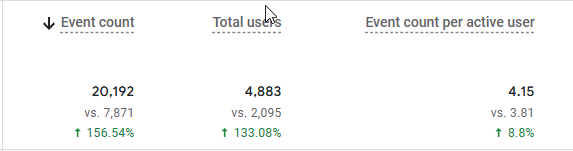
In the latest 28-day GA4 events comparison, TRM generated:
| Result area | Outcome |
|---|---|
| Total events | 20,192 events, up 156.54% vs the prior 28 days |
| Total users | 4,863 users, up 133.08% vs the prior 28 days |
| Events per active user | 4.15, up 8.8% vs the prior 28 days |
| Organic Search events | 5,372 events from google / organic, up 208.56% vs the prior 28 days |
| AI search / assistant events | 1,013 events, up 129.7% vs the prior 28 days |
| ChatGPT-driven events | 786 events, representing 77.6% of all AI-source events |
| AI search / assistant sessions | 292 sessions, up 119.5% vs the prior 28 days |
| Contact link events | 40 events, up 207.69% vs the prior 28 days |
| SaaS content marketing link events | 18 events, up 260% vs the prior 28 days |
| Google organic clicks | 1.5K clicks in 28 days, up 36.9% vs the prior 28 days |
| Google organic impressions | 3.19M impressions in 28 days, up 30.7% vs the prior 28 days |
| First-page Google rankings from Semrush export | 546 keywords ranking in positions 1-10 |
| Semrush AI visibility | 2.6K citations from 888 cited pages |
The real win was not that these pages simply brought more people to the site.
The bigger win was that they created more activity after the visit.
✅ Page views increased.
✅ User engagement increased.
✅ Scrolls increased.
✅ Clicks increased.
✅ Contact link events increased.
✅ SaaS service link events increased.
That means the tool and listicle pages were not just passive traffic assets.
They became active entry points into a service-led AEO funnel.
Background: Why tool-based searches mattered
A lot of SEO teams treat tool listicles as simple traffic pages.
We saw them differently.
For TRM, tool-based searches were a way to reach buyers before they were ready to search for a service provider.
A SaaS founder, CMO, or growth leader may not start with:
“AEO agency for SaaS”
They may start with:
- “Best AI visibility tools”
- “Best SEO site audit tools”
- “Best rank tracking tools”
- “Best backlink monitoring tools”
- “Website traffic analysis tools”
- “Brand mention tracking tools”
- “How to track AI citations”
These searches look informational on the surface, but they often come from people who already know they have a visibility, measurement, growth, or competitive positioning problem.
That made them valuable.
The opportunity was not just to rank for these searches.
The opportunity was to use these pages to create action.
If someone lands on a tool page, we can help them understand:
- Which tools are worth considering
- What each tool is good for
- What data they should be tracking
- Where tools stop being enough
- Why SEO and AEO strategy still matter
- When they need an expert team to turn the data into execution
That is how a tool search becomes the start of a service-led buyer journey.
The main metric 👉 Events
For this case study, the main metric is event count from GA4.
Traffic tells us whether people arrived.
Events tell us whether they did something after arriving.
That distinction matters because this strategy was never only about ranking tool pages.
The goal was to build a funnel where tool-based searches could create meaningful onsite activity and move visitors closer to service demand.
In the latest 28-day GA4 events comparison, TRM recorded:
- 20,192 total events, up 156.54% vs the previous 28 days
- 4,863 total users, up 133.08% vs the previous 28 days
- 4.15 events per active user, up 8.8% vs the previous 28 days
This means the site did not only attract more users.
Users were also interacting more.
The lift in event count shows that the content was doing its job after the click, i.e., getting users to view pages, engage, scroll, click, and interact with service-led paths.
That is why this case study is about more than organic visibility.
It is about turning search visibility into measurable buyer activity.
Event growth breakdown
The GA4 events export showed strong growth across the events that matter for this funnel.
| Event name | Latest 28 days | Change vs prior 28 days |
|---|---|---|
| page_view | 6,580 | up 152.30% |
| session_start | 5,540 | up 143.62% |
| first_visit | 4,826 | up 142.27% |
| user_engagement | 2,486 | up 255.14% |
| scroll | 623 | up 216.24% |
| click | 62 | up 82.35% |
| link_contact_us | 40 | up 207.69% |
| link_saas_content_marketing | 18 | up 260% |
| form_start | 7 | up 40% |
This is the clearest evidence that tool and listicle traffic was not empty traffic.
The site saw more users, but it also saw more engagement behavior.
The most important signals were:
- user_engagement increased by 255.14%
- scroll events increased by 216.24%
- link_contact_us events increased by 207.69%
- link_saas_content_marketing events increased by 260%
Those are funnel signals.
They show that visitors were not just landing and leaving.
They were reading, moving through the page, clicking, and interacting with service-oriented next steps.
Event growth by session source / medium
The GA4 export also broke every event down by Session source / medium, which helped us see where the activity came from across the same 28-day comparison window.
This was important because we did not only want to know that events increased.
We wanted to know which acquisition sources were creating those events.
| Session source / medium | Latest 28 days | Previous 28 days | Change |
|---|---|---|---|
| (direct) / (none) | 12,632 events | 5,225 events | up 141.76% |
| google / organic | 5,372 events | 1,741 events | up 208.56% |
| (not set) | 469 events | 166 events | up 182.53% |
| chatgpt.com / (not set) | 388 events | 142 events | up 173.24% |
| chatgpt.com / referral | 360 events | 229 events | up 57.21% |
| bing / organic | 116 events | 24 events | up 383.33% |
| claude.ai / referral | 96 events | 23 events | up 317.39% |
| gemini.google.com / referral | 65 events | 3 events | up 2,066.67% |
| chatgpt.com / organic | 38 events | 0 events | new source activity |
| vertexaisearch.cloud.google.com / referral | 20 events | 0 events | new source activity |
The strongest signal here was google / organic, which produced 5,372 events and grew by 208.56% compared with the prior 28 days.

That matters because this case study is about tool-based organic visibility becoming a measurable funnel.
The same export also showed AI-related sources contributing measurable onsite activity. ChatGPT, Claude, Gemini, Perplexity, Copilot, NotebookLM, Vertex AI Search, and OpenAI generated 1,013 combined events in the latest 28-day window, compared with 441 events in the previous 28 days.
That is a 129.7% increase in AI-source event activity.
So the event story was not only coming from direct and Google organic traffic.
AI discovery sources were also sending users who viewed pages, started sessions, engaged, scrolled, clicked, and in some cases triggered service-oriented events.
AI search vs traditional search performance
The attached GA4 analysis also compared AI search / assistant sources against traditional search sources across the same 28-day comparison window.
That comparison made the funnel story clearer.
Traditional search is still the larger and stronger acquisition channel, but AI search is now a meaningful discovery layer.
| Metric | AI search / assistants | Change | Traditional search | Change |
|---|---|---|---|---|
| Total events | 1,013 | up 129.7% | 5,590 | up 206.1% |
| Sessions | 292 | up 119.5% | 1,505 | up 192.8% |
| First visits | 232 | up 116.8% | 1,135 | up 183.0% |
| Page views | 363 | up 142.0% | 1,977 | up 234.5% |
| User engagement events | 96 | up 146.2% | 795 | up 214.2% |
| Scroll events | 13 | up 116.7% | 119 | up 296.7% |
| Click events | 10 | up 400.0% | 30 | up 275.0% |
| High-intent link / custom events | 7 | up 75.0% | 29 | flat |
This matters because it shows two things at the same time.
First, traditional search still carries the bigger share of measurable website activity. It produced 5,590 events compared with 1,013 events from AI sources. That means traditional search generated roughly 5.5x more total events and about 5.2x more sessions than AI search.
Second, AI search is no longer invisible in reporting. It produced 1,013 events, 292 sessions, 232 first visits, and 363 page views in the current period.
That is a meaningful discovery signal.
The goal is not to frame AI search as replacing traditional SEO.
The better takeaway is that both channels now matter.
Traditional SEO is still driving the largest measurable volume, while AI search is becoming a new discovery layer where users find TRM through ChatGPT, Claude, Gemini, Perplexity, Copilot, NotebookLM, and other AI-led platforms.
Share of total site events
The GA4 report also showed that AI search / assistants represented 5.0% of total site events in the current period, down from 5.6% in the previous period.
That drop does not mean AI search performed poorly.
AI-source activity more than doubled.
The share decreased because overall site activity and traditional search grew even faster.
Traditional search increased its share from 23.2% to 27.7% of total site events.
That reinforces the main strategy:
- Keep investing in traditional SEO because it is still the biggest traffic and engagement driver.
- Keep building for AI visibility because AI search is becoming a measurable discovery channel.
- Report AI search separately so it does not get buried inside generic referral traffic.
ChatGPT was the dominant AI discovery source
The AI-source breakdown showed that ChatGPT was the strongest AI visibility channel.

Across its tracked variants, ChatGPT produced:
- 786 events
- 228 sessions
- 288 page views
- 175 first visits
That means ChatGPT represented about 77.6% of all AI-source events in the current period.
This is an important AEO signal because it shows that TRM is being discovered through AI-assisted journeys, especially ChatGPT.
These visits may come from users clicking links, researching solutions, comparing providers, or following AI-generated suggestions.
Claude and Gemini were also notable. Claude grew from 23 to 96 events, while Gemini grew from 3 to 65 events.


That suggests the site is beginning to appear across multiple AI discovery environments, not only ChatGPT.
Engagement depth: Traditional search still leads
The GA4 report also showed that traditional search currently has stronger engagement depth than AI sources.
In the current period:
- Traditional search had about 1.31 page views per session.
- AI search had about 1.24 page views per session.
- Traditional search had about 0.53 engagement events per session.
- AI search had about 0.33 engagement events per session.
This suggests that AI-referred users may be more task-specific.
They may arrive after getting a direct recommendation, check one page, and leave once they have the answer.
That does not make AI traffic weak.
It means AI landing pages need stronger next-step paths, clearer internal links, tighter CTAs, and better contextual bridges to services, case studies, audits, and contact options.
The problem with tool-only thinking
Tools are useful, but they do not solve the whole problem.
An AI visibility tool can show whether a brand is mentioned or cited. It cannot build the strategy that makes a brand more citable.
A site audit tool can find technical issues. It cannot decide which fixes matter most for revenue.
A rank tracker can show keyword movement. It cannot build topical authority.
A backlink tool can show link gaps. It cannot create the positioning, content, and trust signals that make a brand worth citing.
A traffic analysis tool can show performance trends. It cannot tell a SaaS company what content architecture it needs to win modern search.
That gap created the funnel opportunity.
We wanted TRM’s tool and listicle pages to help visitors get the information they were looking for, but also help them understand that tools are only the starting point.
The real growth comes from strategy, execution, content architecture, CRO, and ongoing optimization.
The goal
The goal of this strategy was not to publish listicles for traffic alone.
The goal was to build a content system that could:
- Capture tool-based buyer research searches.
- Rank on Google for high-value comparison and tool queries.
- Get cited by AI search engines for non-brand, ICP-relevant prompts.
- Educate readers on the limits of tools alone.
- Route qualified visitors toward TRM’s SEO and AEO service pages.
- Increase meaningful onsite activity, not just sessions.
- Turn informational discovery into service-led demand.
This made the strategy different from a normal SEO listicle play.
We were not just trying to be another page in the SERP.
We were trying to build a bridge between buyer research and measurable service demand.
The core insight: Tool searches can create action
One of the biggest mistakes companies make is assuming tool searches are low-intent.
That is not always true.
A person searching for a tool may be trying to solve an urgent business problem.
They may be asking:
- “Why is my site not getting organic traffic?”
- “How do I know if my brand appears in AI search?”
- “Which tool can help me audit my site?”
- “How do competitors get cited by AI engines?”
- “How can I track rankings, mentions, and citations?”
Those are not passive searches.
They are problem-aware searches.
That is why we built content around tool and listicle queries.
The goal was to show up before the buyer was ready to hire an agency, help them understand the bigger problem behind the tool search, and then create a clear path to the next action.
The event data showed that this worked.
Visitors did not just arrive.
They engaged!
The funnel we built
The funnel worked like this:
Tool Search → Listicle/Tool Page → Education + CRO → Service Page → Strategy Call
Each stage had a specific role.
1. Tool Search
The buyer starts with a practical search.
They want to find a tool, compare options, or understand how to solve a specific visibility problem.
At this stage, they may not be ready to hire TRM yet.
That is fine.
The job is to show up early and become useful.
2. Listicle or Tool Page
The page gives the buyer what they came for.
That means clear recommendations, comparison sections, definitions, evaluation criteria, use cases, pricing context when relevant, and practical explanations.
The page has to be genuinely helpful first.
If the page only exists to push a service CTA, it will not build trust.
3. Education + CRO
This is where the page becomes more than a listicle.
Inside the content, we explain what tools can do and where they fall short.
We use sections that help readers understand that tracking AI visibility is different from earning AI visibility, and identifying SEO issues is different from fixing them in the right order.
This creates a natural bridge from tool research to strategy-led support.
4. Service Page
Once the reader understands the bigger problem, we give them a clear next step.
That may be an AEO service page, a SaaS SEO service page, or a strategy call.
The internal link is not random.
It is mapped to the user’s intent.
5. Strategy Call
The final step is a conversation.
By the time a visitor reaches this stage, they have already seen the problem, evaluated the tools, and understood why a strategist may be needed.
That makes the sales conversation more educated and more qualified.
The strategy
We built the tool-search funnel around five strategic layers.
1. Tool and listicle pages as demand capture assets
A lot of SEO teams treat BOFU listicles as commodity content.
We treated them as strategic entry points.
For example, a page about the best SEO site audit tools can attract marketers who know they need better SEO diagnostics.
A page on AI visibility tools can attract SaaS teams trying to understand how their brand appears in AI responses.
Those people may not be ready to hire an agency immediately, but they are close enough to the problem for us to educate them.
The job of the page is to:
- Help them compare options.
- Explain what tools can and cannot solve.
- Show why strategy, content architecture, technical execution, and CRO still matter.
- Route them toward a relevant TRM service page or strategy call.
- Generate meaningful onsite actions that prove the page is moving the buyer forward.
2. Semantic SEO before isolated keywords
We did not build these pages around isolated keywords.
We built them around search behavior, related entities, use cases, and the questions that buyers ask around a topic.
For example, an AI visibility tools page should not only mention “AI visibility tools.” It should also cover related concepts like:
- AI citations
- Brand mentions
- Prompt tracking
- Cited pages
- AI Overviews
- ChatGPT visibility
- Perplexity visibility
- Gemini visibility
- Search intent
- Topical authority
- Content optimization
- Technical accessibility
- Entity signals
This gave the content more topical depth.
It also helped Google and AI systems understand what the page was about and where it fit in the broader AEO landscape.
3. Query fan-out techniques
Modern search is no longer about one keyword.
A single buyer problem can create many related searches.
For example, someone interested in AI visibility may also search for:
- AI visibility tools
- AI search optimization tools
- Brand mention tracking tools
- How to get cited in AI search
- How to track ChatGPT mentions
- AI Overview SEO tools
- AEO tools
- Generative engine optimization tools
That is where query fan-out thinking helped.
Instead of optimizing only for one primary keyword, we looked at the surrounding questions, comparisons, use cases, and subtopics that buyers search around the same problem.
Then we built pages that could answer more of that search universe.
This helped the pages become more complete, more useful, and more likely to rank or be cited across different variations of the same buyer intent.
4. Modular content structure
The modular content approach was especially important.
Instead of writing long, unstructured articles, we broke pages into useful content blocks.
For example, a tool page could include:
- A short answer section
- A quick comparison table
- Individual tool breakdowns
- “Best for” recommendations
- Evaluation criteria
- Pricing context
- Pros and cons
- Use-case sections
- FAQs
- Service-led CTA blocks
- Internal links to related guides and service pages
This made the content easier to scan for readers and easier to reuse across query variations.
It also helped with AI citation potential because each section could answer a specific sub-question clearly.
5. Service-led CRO inside informational content
The funnel only works if the user has a clear next step.
So we added conversion bridges inside tool and listicle pages.
The goal was to move users from:
- Tool research to AEO strategy
- SEO software comparisons to SEO execution
- AI visibility tracking to AI visibility growth
- Informational searches to service-led demand
This is where the strategy became commercial.
We were not just publishing content for rankings.
We were building a path from discovery to conversion.
The event growth showed that those paths were getting used.
Execution: What we actually did
Here is the execution framework we used.
Step 1: Identified tool-based search opportunities
We started by identifying the topics where our ICP was likely to search for tools before searching for services.
Examples included:
- Website traffic analysis tools
- SEO rank tracking software
- Site audit tools
- Backlink monitoring tools
- AI visibility tools
- Brand mention tracking tools
- AI search visibility audit tools
These pages gave us a way to reach buyers before they were searching directly for an agency.
Step 2: Mapped tool searches to buyer intent
We mapped each tool-based topic to a buyer stage.
| Buyer stage | Search behavior | Content type we built |
|---|---|---|
| Problem-aware | “How do I improve AI visibility?” | Educational guides and frameworks |
| Tool-aware | “Best AI visibility tools” | Listicles and comparison pages |
| Solution-aware | “AEO agency” or “SaaS SEO agency” | Service pages and case studies |
| Validation | “Does this strategy work?” | Case studies, benchmarks, proof-led articles |
This helped us avoid creating content in isolation.
Every tool page had a role in the journey.
Step 3: Built pages useful enough to rank and structured enough to be cited
Every important page needed to serve two audiences:
- The human buyer who wants a clear answer.
- The AI system that needs clean, extractable, source-worthy information.
So the pages were built with:
- Clear search intent matching
- Direct answers above the fold
- Tables and comparison sections
- Practical evaluation criteria
- Use-case-driven recommendations
- Semantic SEO approach
- Query fan-out techniques
- Modular content approach
- FAQs
- Internal links
- Service-led CTAs
- Author and brand trust signals
This made the content useful, easy to parse, and easier to cite.
Step 4: Added CRO paths from tool content to service pages
This is where the strategy became more than SEO.
Inside tool and listicle pages, we added conversion bridges that helped readers understand when they needed more than a tool.
For example:
- A tool can track AI visibility, but it cannot build the strategy for you.
- A site audit tool can find issues, but it cannot prioritize fixes based on revenue impact.
- A rank tracker can show movement, but it cannot create topic authority.
- An AI visibility platform can surface citations, but it cannot make your content more citable by itself.
That message created a natural bridge to TRM’s AEO and SEO services.
Step 5: Measured events, not just sessions
We did not only ask:
Did this page get traffic?
We also asked:
- Did this page create events?
- Did users engage?
- Did they scroll?
- Did they click service links?
- Did the content move them toward a conversion path?
- Did it support the buyer journey?
- Did it strengthen topical authority and AI visibility?
That broader measurement model is what made this an AEO funnel case study, not just an SEO traffic report.
That is also why we used Semrush alongside Google Search Console and GA4.
GSC showed us how the site was performing inside Google Search, and GA4 showed us what happened after visitors landed on the site.
But those two tools were not enough to understand the full SEO and AEO picture.
GSC does not show competitor ranking movement, full page-one keyword distribution, AI visibility signals, cited pages, or how our content compares against other domains in the market.
GA4 does not show competitive opportunities or AI visibility signals, but it does show whether the traffic is doing anything once it lands.
Semrush helped close the market and visibility gap by giving us keyword intelligence, competitive research, ranking validation, top-page analysis, and AI visibility data that we could connect back to our GSC and GA4 performance.
If you want to run the same type of audit for your own business, start with a free 14-day Semrush trial.
Use it to gather your keyword, competitor, ranking, and AI visibility data, then schedule a call with us so we can help you understand what the data means and where your biggest opportunities are.
Results
1. Total events increased by 156.54%
This is the main result of the case study.
The GA4 events report showed:
- 20,192 total events in the latest 28 days
- 7,871 total events in the previous 28 days
- 156.54% event growth
This showed that the strategy was not only increasing visibility.
It was increasing onsite activity.
More visitors were viewing pages, starting sessions, engaging, scrolling, clicking, and moving through the site.
That is exactly what a tool-search funnel should do.
2. Total users increased by 133.08%
The GA4 events report also showed:
- 4,863 total users in the latest 28 days
- 2,095 total users in the previous 28 days
- 133.08% user growth
This showed that the funnel was attracting more people into the site.
But the event growth was even higher than the user growth.
That matters because it means the site was not just getting more visitors.
It was also getting more activity per user.
3. Events per active user increased by 8.8%
Events per active user increased from 3.81 to 4.15.
That is an 8.8% lift.
This is a small but important signal.
When user growth and event growth both rise, the site is getting more reach.
When events per active user also rises, the site is getting better interaction quality.
In other words, the funnel did not just scale traffic.
It improved the average amount of activity happening per active user.
4. Organic Search drove 5,372 events and grew 208.56%
Google organic was one of the biggest event contributors.
The GA4 events export showed 5,372 events from google / organic in the latest 28 days, compared with 1,741 events in the previous 28 days.
That is a 208.56% increase.
The google / organic event breakdown included:
- 1,898 page views
- 1,446 session starts
- 1,090 first visits
- 765 user engagement events
- 114 scroll events
- 30 click events
- 12 contact link events
- 10 SaaS content marketing link events
This supports the core argument of the case study.
Tool and listicle pages were not just ranking.
They were generating onsite behavior that connected organic search visibility to buyer movement.
5. AI search and AI assistant sources generated 1,013 events
AI-related sources also contributed to the event story.
Across AI sources including ChatGPT, Claude, Gemini, Perplexity, Copilot, NotebookLM, Vertex AI Search, and OpenAI, the GA4 events export showed 1,013 events in the latest 28 days, compared with 441 events in the previous 28 days.
That is a 129.7% increase in AI-source event activity.
This included traffic from sources such as:
- chatgpt.com / referral
- chatgpt.com / (not set)
- chatgpt.com / organic
- claude.ai / referral
- gemini.google.com / referral
- perplexity.ai / referral
- perplexity / (not set)
- copilot.com / referral
- notebooklm.google.com / referral
- vertexaisearch.cloud.google.com / referral
The AI-source breakdown included:
- chatgpt.com / (not set): 388 events, up 173.24%
- chatgpt.com / referral: 360 events, up 57.21%
- claude.ai / referral: 96 events, up 317.39%
- gemini.google.com / referral: 65 events, up 2,066.67%
- chatgpt.com / organic: 38 events, new source activity
- perplexity.ai / referral: 20 events
- vertexaisearch.cloud.google.com / referral: 20 events, new source activity
- copilot.com / referral: 8 events
- notebooklm.google.com / referral: 6 events
- openai / (not set): 3 events, new source activity
This matters because the strategy was built for both Google and AI search behavior.
The goal was not only to rank in Google.
The goal was to become visible and useful across the places where modern buyers research.
AI-source traffic is still smaller than traditional search, but it is now measurable. That makes it a useful directional signal for AI visibility, AI citations, and AI-assisted discovery.
6. Traditional search remained the strongest acquisition channel
The AI vs traditional search report showed that traditional search generated:
- 5,590 total events, up 206.1% vs the prior 28 days
- 1,505 sessions, up 192.8% vs the prior 28 days
- 1,135 first visits, up 183.0% vs the prior 28 days
- 1,977 page views, up 234.5% vs the prior 28 days
- 795 user engagement events, up 214.2% vs the prior 28 days
- 30 click events, up 275.0% vs the prior 28 days
- 29 high-intent/custom events
Google organic was the clear driver, producing 5,372 of the 5,590 traditional search events.
That means Google organic accounted for about 96.1% of traditional search events in the current period.
This confirmed that traditional SEO is still the foundation of the funnel.
AI search is growing, but Google organic is still the main channel creating measurable search activity.
7. Tool and listicle pages helped create page-one visibility
The Semrush first-page keyword export showed that TRM had 546 keywords ranking in positions 1-10.
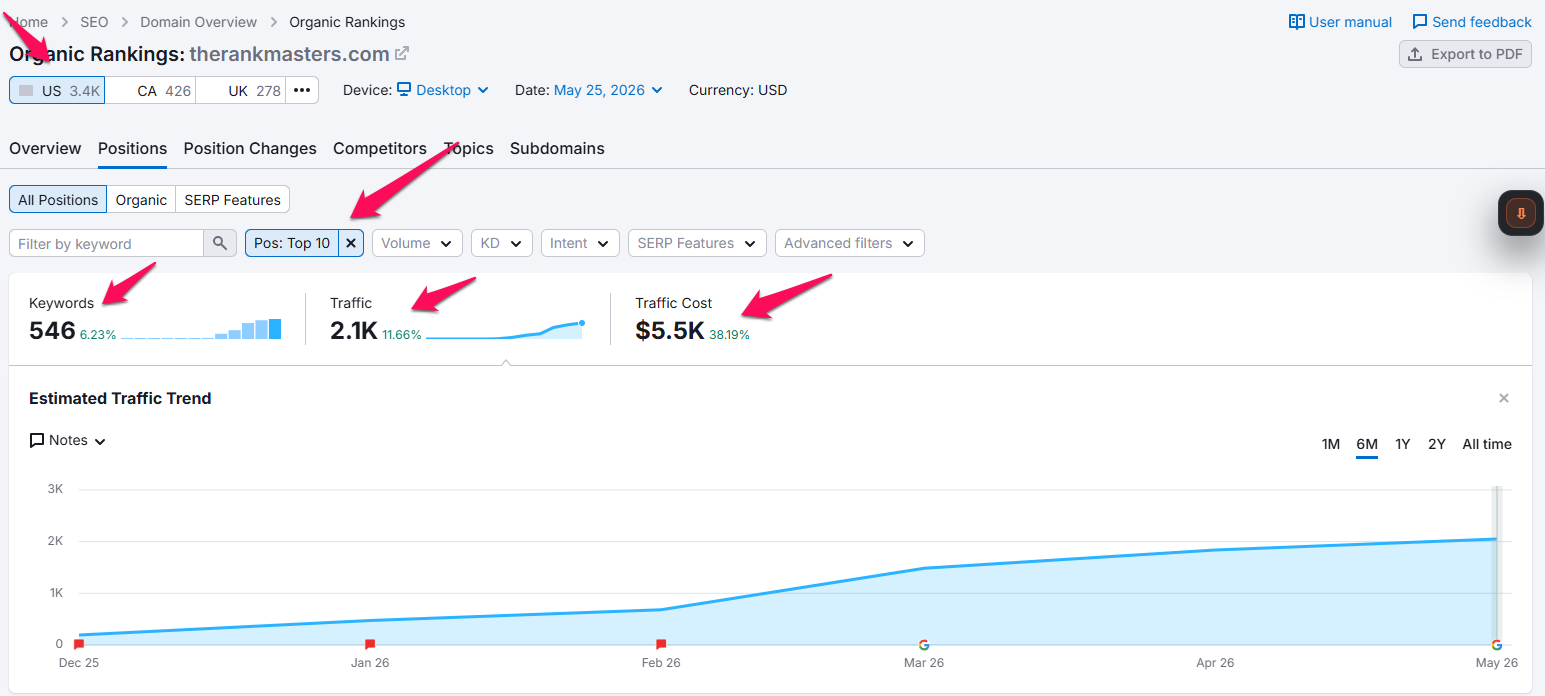
Several of the strongest assets were tool, comparison, or listicle-style pages.
8. Organic visibility grew in Google
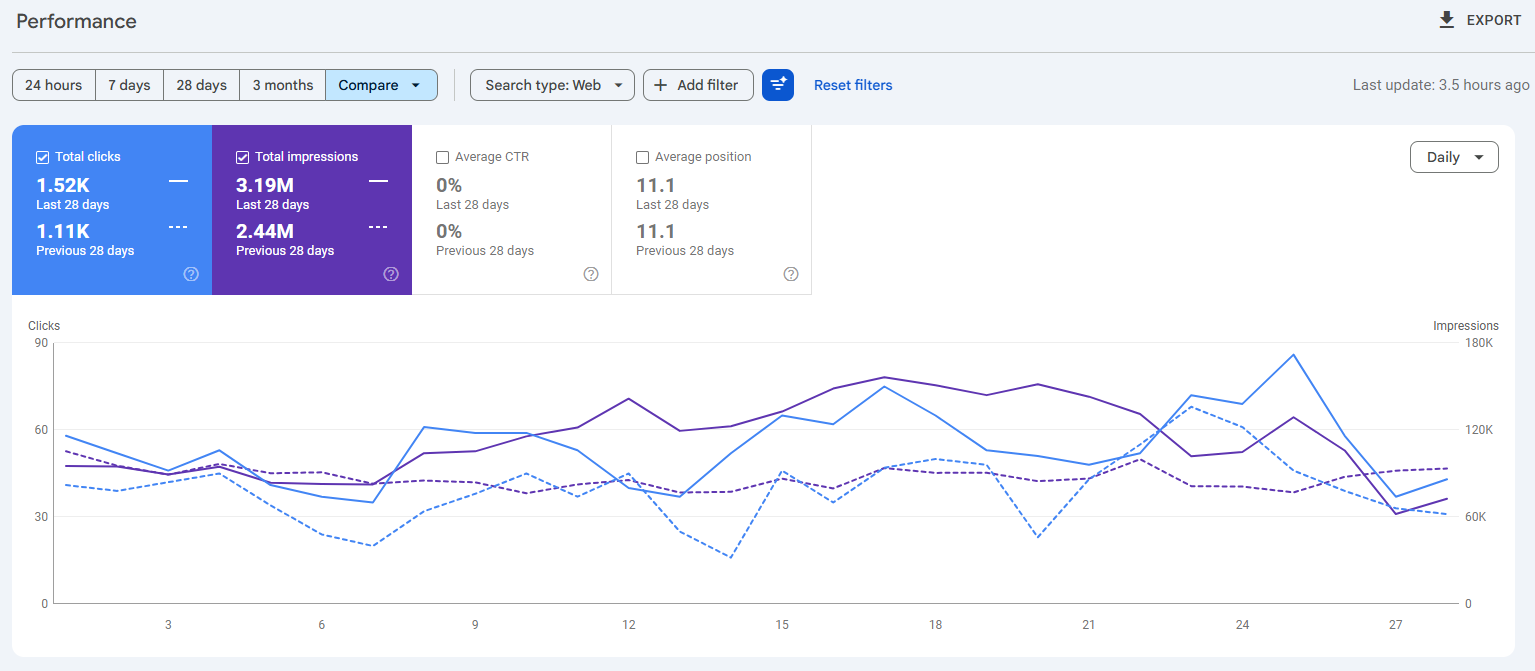
The GSC comparison showed:
- 1.5K clicks in the latest 28 days
- 3.19M impressions in the latest 28 days
- 36.9% click growth vs the prior 28 days
- 30.7% impression growth vs the prior 28 days
This showed that the strategy was increasing both reach and traffic.
The impression growth mattered because many of these searches happen in a zero-click and AI-assisted search environment, where the user may see the brand, compare results, or encounter the page before clicking.
That makes visibility itself more important than it used to be.
9. AI visibility and citation signals supported the funnel
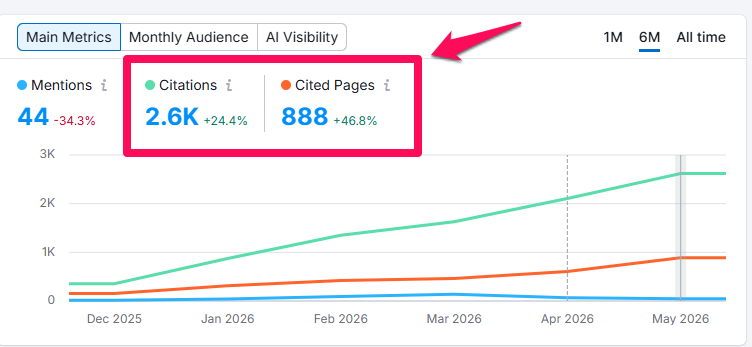
The Semrush AI visibility snapshot showed:
- 2.6K citations
- 888 cited pages
The important part was not only the volume.
The citations were aligned with the types of prompts and topics we wanted TRM to show up for: non-brand, ICP-relevant, service-aligned searches connected to AI visibility, SEO tools, tracking, and optimization.
That validated the AEO side of the funnel.
People were not only finding TRM through Google.
TRM pages were also becoming visible as cited sources in AI search contexts.
10. The pages created a commercial bridge
The strongest insight was that these pages did not sit separately from the service funnel.
They connected to it.
A visitor might start on a listicle about a tool.
Then they learn that tools can only show the problem.
They still need a strategy to improve visibility, build topic authority, optimize content, and earn citations.
That creates the bridge to TRM’s AEO and SEO services.
This is why the event growth matters.
The pages did not just answer searches.
They moved people from research to action.
Why the strategy worked
1. We entered the buyer journey early
Most companies only target obvious bottom-of-funnel service terms.
That leaves a major gap.
By targeting tool-based searches, TRM entered the buyer journey before the prospect was ready to compare agencies.
That gave us a chance to build trust earlier.
2. The content matched how buyers think
Buyers do not always think in service categories.
They think in problems.
They think:
- “How do I track this?”
- “Which tool should I use?”
- “How do I know if this is working?”
- “Why am I not showing up?”
- “How do competitors get cited?”
Tool and listicle pages matched that behavior.
3. The pages were built for both SEO and AI search
The pages were structured to rank in Google and be usable by AI systems.
Clear definitions, modular sections, semantic depth, comparison tables, and direct answers made the content easier to understand and cite.
4. CRO turned traffic into events
Without CRO, these pages would only be traffic assets.
With CRO, they became funnel assets.
Service links, educational CTA blocks, and “tools are not enough” messaging helped move visitors toward the next step.
That is why event count became the main proof point.
The funnel was not just getting impressions or sessions.
It was generating user actions.
5. The strategy connected data to execution
Semrush, GSC, and GA4 gave us the data.
But the results came from what we did with it:
- Picking the right tool-based topics
- Building useful listicle pages
- Structuring them for search and AI discovery
- Adding CRO paths
- Connecting them to services
- Measuring event growth
- Improving the paths that already had traction
The Semrush role in this workflow
Semrush was part of the intelligence and reporting layer.
We used it to support:
- Keyword research
- Competitive research
- Reverse engineering page-one opportunities
- Ranking validation
- Top page analysis
- AI visibility checks
- Citation and cited-page monitoring
- Reporting around SEO and AEO progress
But the important point is this:
Semrush helped us find, validate, and monitor the opportunity. TRM’s strategy turned that opportunity into results.
That is also how we recommend SaaS and AI companies use tools.
A platform can show you where the opportunity is. It can tell you what is ranking. It can help you monitor citations and visibility.
But the tool alone will not build topic authority, write citation-worthy content, improve CRO, or create a service-led search funnel.
That is where strategy and execution matter.
What this means for SaaS and AI companies
If you run a SaaS or AI company, your buyers are probably already searching for tools before they search for your product, service, or category.
That is an opportunity.
Instead of only targeting bottom-of-funnel terms, you can build content that captures buyers while they are still researching the problem.
The right tool and listicle pages can help you:
- Show up earlier in the buyer journey
- Rank for high-value research queries
- Get cited by AI search engines
- Build trust before a sales conversation
- Educate buyers on the problem
- Move visitors toward demos, trials, audits, or strategy calls
- Increase meaningful onsite events, not just traffic
That is how tool-based search becomes a growth channel.
It is not just about the page ranking.
It is about what the page does after the buyer lands.
Explore ▶️ Related Case Studies
- How TRM grew ChatGPT referral traffic by 8,337% in 90 days
- How AI visibility turned mentions, citations, and conversions into a measurable SaaS growth channel
- How BOFU SEO lifted conversions by 247% for a PSA SaaS brand
- How SEO drove a 240% traffic lift for Buddy Punch
- How Avaza built AI-ready posts for PSA SaaS search visibility
- How BOFU SEO helped win visibility inside Google AI Overviews
Lessons learned
Lesson 1: Event count is a better funnel signal than traffic alone
Traffic shows that the page attracted visitors.
Events show whether visitors actually interacted.
For this case study, the 156.54% lift in total events was the clearest proof that the tool-search funnel was creating action.
Lesson 2: Tool searches are more valuable than they look
A tool search is not always casual.
Often, it signals that the buyer is actively trying to solve a business problem.
That makes it a strong entry point for SaaS, SEO, and AEO funnels.
Lesson 3: Listicles need a strategy behind them
A listicle without a funnel is just a content asset.
A listicle with education, internal links, CRO, and service alignment can become a demand asset.
Lesson 4: AI citations work best when tied to buyer intent
Getting cited by AI search engines is useful only when the citation appears in the right context.
For TRM, the goal was to get cited for non-brand prompts connected to the problems our ICP already searches.
Lesson 5: Tools create the opening, but strategy closes the gap
Tools help buyers understand what is happening.
Strategy helps them decide what to do about it.
That is the message that made the funnel work.
Lesson 6: AI search needs its own reporting category
AI search is no longer just miscellaneous referral traffic.
Sources like ChatGPT, Claude, Gemini, Perplexity, Copilot, NotebookLM, OpenAI, and similar platforms should be grouped and monitored separately.
That makes it easier to understand whether AI visibility is turning into sessions, page views, engagement, clicks, and high-intent actions.
Lesson 7: SEO and AEO should support the same buyer journey
Google rankings, AI citations, internal links, CRO, and service pages should not be treated as separate plays.
They should work together as one search-led demand system.
Final takeaway
We turned tool-based searches into an AEO lead generation funnel by meeting buyers where they actually start their research.
They searched for tools.
We gave them useful tool and listicle pages.
Then we educated them on why tools alone were not enough.
From there, we used CRO and internal links to move them toward TRM’s SEO and AEO services.
The result was 20,192 events in 28 days, up 156.54% compared with the previous 28 days.
Traditional search generated 5,590 events, while AI search and assistant sources generated 1,013 events.
That is the real proof.
The pages did not just drive rankings or traffic.
They helped create a path from search visibility to onsite engagement and service-led demand.
Want to turn tool-based searches into measurable buyer activity?
If your buyers are searching for tools, comparisons, audits, and AI visibility solutions, those searches can become part of your demand engine.
TRM helps SaaS and AI companies build SEO and AEO systems that rank, get cited, and convert search visibility into qualified onsite activity and service demand.
Book a free 30-minute strategy call and we’ll show you how to turn your tool-based search opportunities into an AEO lead generation funnel.
FAQs
Why is event count the main metric in this case study?
Why are tool-based searches valuable for AEO?
Are listicles good for SaaS SEO?
How can a tool page generate leads?
What is the difference between tracking AI visibility and improving AI visibility?
How did Semrush help in this workflow?
Can SaaS companies use this same funnel?
📑 Disclosure!
Some links in this article are affiliate links. If you sign up through them, The Rank Masters may earn a commission at no additional cost to you. This does not influence which tools we recommend or what we say about them.