
When people hear the word ‘plagiarism checker,’ they immediately think of an academic tool. However, the reality is that content marketers can use such utilities for purposes beyond academia.
In fact, plagiarism-checking tools can play a critical role in maintaining SEO performance. But how? More specifically, how exactly do such utilities fit into a smart marketing workflow?
This article explores those questions in detail.
Here, we’ll explore how content marketers can use plagiarism checkers to protect SEO rankings. Not only that, but we’ll also discuss how marketers can handle instances of plagiarism more effectively and reduce potential SEO risks. So, with that in mind, let’s begin!
Why Does Plagiarism Matter for SEO? — The Big Question!
Before addressing the elephant in the room, it is essential to first discuss why plagiarism actually matters in Search Engine Optimization (SEO).
So, just like the field of academia, plagiarism plays a crucial role in SEO. And the following points better explain that role in the simplest of terms:
1. It Can Reduce Search Visibility
The reality is, search engines, especially Google, prefer web pages that feature distinct and original information.
So, when content marketers use exact copies, near-duplicates, or even AI-rewritten content that closely mirrors existing web pages, it can lower their rankings. And this especially happens when search engines successfully detect duplication or copying of information in a page.
2. It Can Hurt Brand Credibility
Picture yourself as the consumer or reader of the content. And let’s say that you search for something, but you keep finding the same sort of information across the web. How would that make you feel?
Well, you would probably start doubting the legitimacy of the brands publishing copied or duplicate information, right? So, that’s how content that has been copied or even plagiarized can harm a brand’s reputation.
3. It Can Give Your Competitors an Edge Over You
Brands often stand out on the internet when they invest in fresh writing and offer unique perspectives. However, if you continue to post duplicated, copied, or plagiarized content on your website, you will waste Google’s crawl budget and reduce the indexing efficiency.
Not only that, but such a course of action also splits the ranking signals across several URLs. And eventually, your website will experience a decrease in organic traffic.
So, in this way, using duplicate, copied, or plagiarized content can give an advantage to your rivals. And in competitive niches, even a slight benefit is crucial.
How Plagiarism Checkers Can Help Content Marketers Protect SEO Rankings
Now that we have explored how plagiarism affects search engine optimization, let’s get to the main point—how content marketers can use plagiarism checkers to protect SEO rankings.
1. Detect Duplicate Content Before Publishing
Plagiarism detectors can help content marketers quickly and accurately spot the following issues:
- AI-rewritten content that closely mirrors existing web pages
- Exactly copied text
- Internal duplication across their own website
- Near-duplicate phrasing
So, in this way, marketers can identify duplicate content before publishing and reduce the risk of visibility issues in search results.
In fact, by taking appropriate actions against copied, duplicate, or plagiarized material, content marketers can post original and distinct information on their brands.
2. Prevent Keyword Cannibalization and Ranking Dilution
As you may have understood from above, when multiple web pages contain highly similar content, the following things happen:
- Google struggles to determine which page should rank.
- Ranking signals get split across several URLs.
- Organic traffic can decrease.
Now, these actions are not direct SEO penalties, but search engine optimization experts describe such situations as ‘signal dilution.’
However, content marketers can prevent themselves from such actions by using plagiarism checkers. For instance, plagiarism checking tools can help them compare drafts against existing site pages. And by rewriting the required sections, marketers can merge overlapping information and create clearer topical differentiation.
3. Protect Crawl Budget and Indexation
As we’ve mentioned earlier, duplicate or near-duplicate web pages result in the following actions:
- They cause the important pages to remain unindexed.
- They reduce indexing efficiency.
- They waste the crawl budget of Google.
So, when the algorithms of Google identify that a new web page features duplicate or near-duplicate information, they don’t rank it. They simply ignore it.
But content marketers can use plagiarism detectors during the auditing phase. And in this way, they can find template-heavy landing pages or repetitive blog clusters. And by taking the appropriate actions, they can remove or merge redundant content.
4. Reduce Risk of Scraped or Stolen Content
Google has specifically emphasized that duplicate content itself does not typically result in a manual penalty. But if someone uses copied information or does intentional scraping, it can trigger spam-related ranking issues.
However, plagiarism checkers can help content marketers identify whether competitors copied their content or not.
So, by detecting the traces of unauthorized content through such tools, marketers can effectively prove the originality of their information. And this is important because sometimes, copied information can outrank the original version, especially if the copying domain has stronger authority.
5. Improve Content Originality Signals
Modern search engine algorithms heavily reward content pieces that feature the following characteristics:
- Distinct wording and structure
- First-hand experience
- Original examples
- Unique insights
This means that Google tries to show pages that have unique information rather than repeating versions. And that’s another area where plagiarism detectors can be a handy utility for content marketers.
For instance,
- Marketers can use plagiarism checking tools to identify whether the product description they’ve crafted is a reused version or not.
- Even if they generate content through AI, they can still use plagiarism checkers to confirm that their text is sufficiently different.
So, that’s how such a tool can help content marketers improve the originality signals of their information.
6. Audit Internal Content and Technical SEO at Scale
SEO issues, such as repeated FAQ blocks, reused metadata, template-based thin content, and city-page duplication, often create indexing problems and weaken the rankings. But marketers can avoid such issues by integrating plagiarism detectors into their workflows.
For instance, content marketers can use such tools for blog libraries, e-commerce category pages, location pages, and programming SEO pages. And in this way, they can spot the underlying copied, duplicated, or plagiarized instances in their content and take appropriate actions accordingly.
Anyway, once the required plagiarism-or-duplication adjustments have been made, Google will find it easier to understand which versions of a page should rank.
How Content Marketers Can Remove Plagiarism From Their Work — Best Practices
So far, you have seen the impact of plagiarism on SEO and how marketers can use plagiarism checkers to protect SEO rankings, right? Now, let’s talk about some best practices that can help marketers remove plagiarism for free.
So, as a content marketer, once you’ve found that your text piece is copied, duplicated, or plagiarized, here is what you can do:
1. Rewrite in Your Own Words
The best way is to re-approach the plagiarized, duplicate, or copied text in your own way. For instance, as a content marketer, you can use your own writing style and tone to:
- Reflect your unique perspective
- Expand with case studies, commentary, and examples
But sometimes, even manual rewriting can accidentally result in plagiarism. So, if this happens with any content marketer, they can use the support of a plagiarism remover online utility.
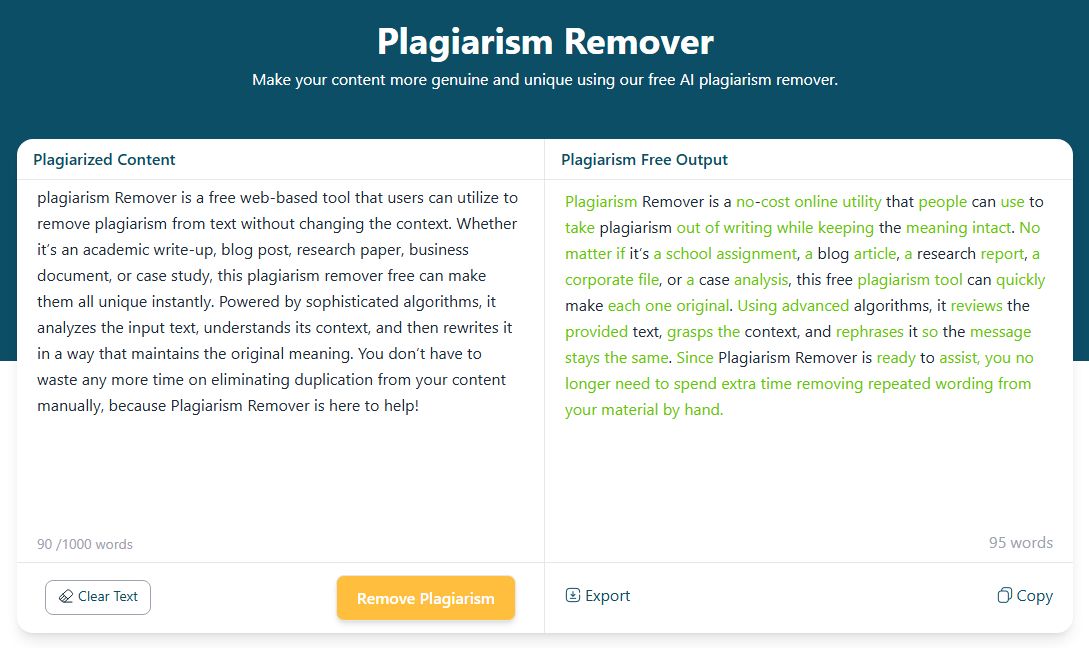
Such AI plagiarism remover tools can assist with rephrasing content and generating alternative wording for sections that require revision. So, marketers can use such utilities to explore alternative phrasing and wording options when revising content, especially during creativity blocks or when juggling multiple things at once.
2. Merge Duplicates
If you find any content that overlaps with an existing version, you should instantly merge it into one stronger, authoritative piece. In this way, the algorithms of search engines won’t get confused, which means your brand won’t experience signal dilution.
3. Cite Sources Properly
Sometimes, it becomes essential for marketers to use existing information in their content. So, as a content marketer, if you find yourself in such a situation, you should instantly cite the original source properly.
4. Run a Final Check
And once you’ve made all the necessary edits, it is essential to run a final scan for plagiarism. So, use the plagiarism checker again to confirm the originality status before publishing.
In fact, cross-check the results of a plagiarism scan using different tools. That’s because different plagiarism detectors use different databases.
So, let’s say that you’ve done this and your content has come across as completely original. In such a situation, you can gain greater confidence in your information’s originality status.
Concluding Remarks
To sum up, plagiarism checkers are not primarily about avoiding ‘Google penalties.’ Their actual SEO value is helping marketers maintain content uniqueness, preserve ranking signals, improve indexing clarity, protect topical authority, and prevent internal competition between pages. However, these benefits depend on identifying duplication accurately and addressing it appropriately during the content workflow.
So, run plagiarism checks at multiple stages of the editorial process, as doing so can help verify originality before publishing. However, neglecting originality checks can increase the risk of duplicate content issues that may affect the long-term organic visibility and ranking stability.