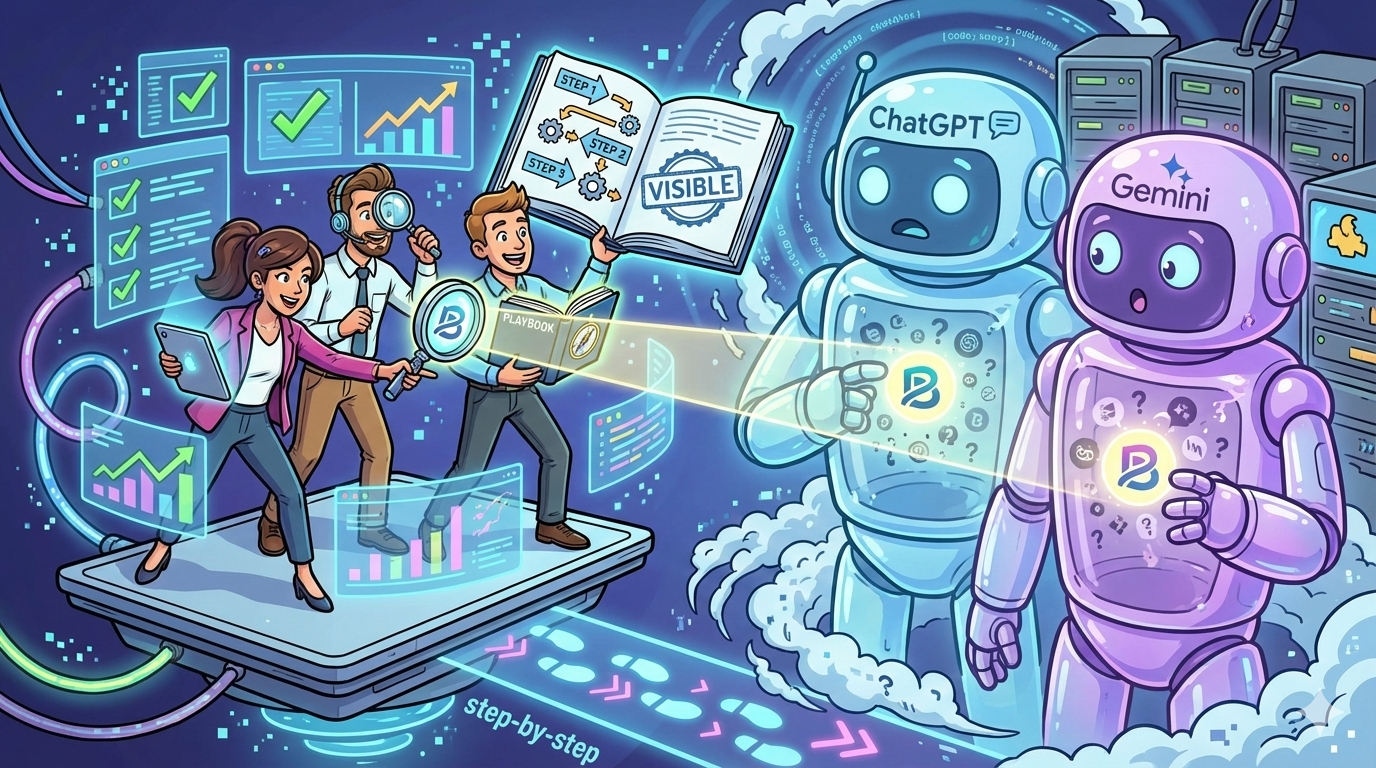

If you’re a B2B SaaS CMO, Head of Growth, or SEO lead, you’re probably noticing something uncomfortable: you can “rank” on Google and still lose the buyer journey to AI-generated answers.
AI Overviews and chat-based research are compressing the journey, buyers get shortlists, comparisons, and “best tool for X” recommendations before they ever click.
That’s why AI search visibility has become the new concept to own. This guide shows you how to measure it, improve it, and turn Answer Engine Optimization into a pipeline. Want a baseline + roadmap in one sprint? Book a call
Table of Contents
AI search visibility
AI search visibility is how often, and how strongly, your brand shows up inside AI-powered search experiences, including Google AI Overviews, answer engines (Perplexity-style), and chatbots (ChatGPT, Gemini, Copilot, etc.).
For B2B SaaS, it’s the difference between being the vendor AI recommends… and being the one it skips, even if you still “rank.”
It’s not just “are we mentioned?” It’s whether you’re:
- Cited as a source (linked) vs. just named
- Recommended vs. merely listed
- Positioned correctly (use case, ICP, category)
- Accurate on the details (pricing, features, integrations, compliance)
- Present on the queries that actually drive pipeline
AI search visibility vs SEO vs AEO/GEO
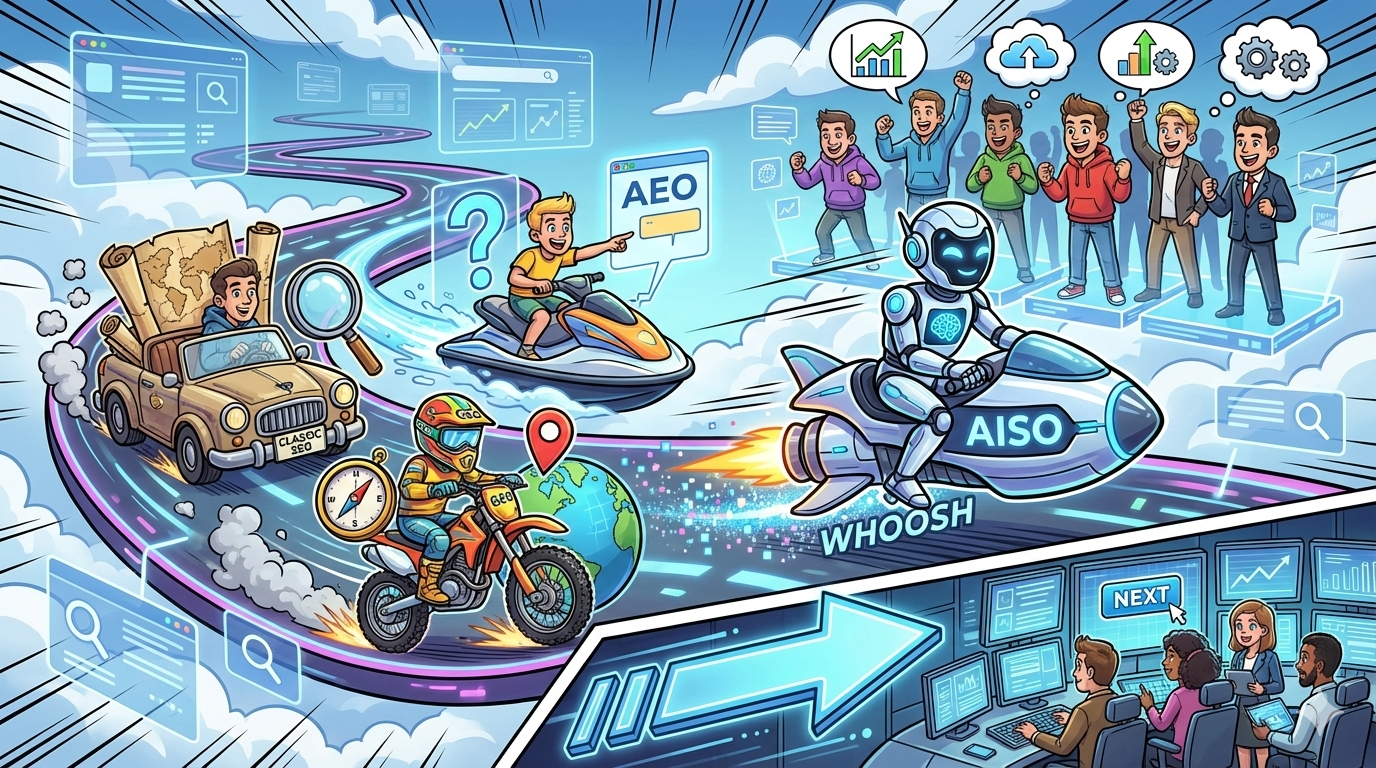
Think of this as a new layer sitting above traditional SEO: you still need rankings, but now you also need to “win the answer.”
Here’s the clean breakdown:
- SEO = Earning rankings and clicks in classic search results.
- AEO/GEO = Optimizing content + entities so AI systems choose you in responses.
- AI search visibility = The measurable outcome, how often you show up and how you’re portrayed across AI-driven surfaces.
If you only track rankings, you’ll miss what’s happening upstream. Tracking visibility lets you diagnose whether the issue is retrieval (you’re not being pulled) or framing (you’re being pulled but not recommended).
Why “visibility” is the right mental model (not rankings)
Traditional SEO taught us to ask: “What position are we?” AI search forces a better question: “Are we part of the answer, and are we framed correctly?”
Because AI experiences often:
- Summarize multiple sources into one takeaway
- Compress the journey into a single response (shortlist → recommendation → next step)
- Reduce the need to click, so influence happens before traffic
So your rankings can look healthy while your influence collapses. The fix is to track what AI says about you: presence and positioning.
Why AI search visibility matters for B2B SaaS
The new “zero-click” is now “zero-visit”.
We’re moving from “users don’t click” to “users don’t need to visit.”
When Google AI Overviews or chat-based research surfaces provide the answer, the evaluation happens before your site ever loads, so zero-click searches become “zero-visit” decisions.
In practice, the buyer might get:
- A shortlist of tools
- A recommendation
- Implementation steps
- A decision framework
…then visit only one site (or none) before booking a demo.…
Pipeline impact: fewer clicks, same (or higher) intent
Traffic can drop while intent rises. If AI recommends you as a fit, the prospect shows up pre-qualified, even if your GSC clicks don’t spike.
Examples of high-intent prompts where recommendations matter most:
- “best SOC 2 compliant customer support software for SaaS”
- “best product analytics tool for PLG startups”
- “alternatives to [competitor] for mid-market”
Your KPI needs to evolve from “rankings + sessions” to share of AI answers + qualified demand
That’s exactly what AI search visibility measures, presence + positioning inside the answer, not just visits.
Brand risk: competitors can “own” answers you used to rank for
AI systems often pull from third-party lists, review sites, forums, docs, and high-authority explainers. If you’re not actively shaping that ecosystem, a competitor; or an affiliate listicle,can become the default “truth” about your category.
If you want a fast baseline and a prioritized roadmap, start with an AI Search Visibility Audit.
Where AI search visibility happens (the surfaces)
AI search visibility isn’t one platform. It’s a set of surfaces that behave differently; so the playbook (and KPIs) change depending on where the buyer is getting answers.
1) Google AI Overviews (and other SERP generative modules)
These are the “AI blocks” inside classic search results, where buyers see summaries, shortlists, and next steps without scrolling. If you’re visible here, you’re influencing decisions before the first click.
2) Answer engines (Perplexity-style experiences, Copilot-like modes)
These surfaces lean heavier on citations and feel closer to “research” behavior. If you want to win here, align your content to Answer Engine Optimization: clear answers, strong structure, and proof that’s easy to quote.
3) Chatbots (ChatGPT, Gemini, etc.)
Chatbots vary widely depending on whether they browse, which sources they retrieve, and whether the user asks for citations. But they’re increasingly embedded inside workflows; teams ask them instead of searching. Your job is to make sure your AI search visibility holds up even when there’s no click.
4) In-product AI: CRMs, browsers, app assistants, agents
This is the sleeper channel. Prospects can get vendor recommendations inside the tools they already live in. The same fundamentals apply: these systems still rely on retrievable sources and consistent “web truth.”
How AI systems decide what to cite and recommend
You don’t need to be an ML engineer to win here; but you do need the right mental model: AI answers are built from retrieval first, then summarization.
Retrieval vs generation (why “being right” isn’t enough)
If you’re not retrieved, you’re not in the conversation; no matter how good your content is.
So the work comes down to two levers:
- Be retrievable for pipeline-driving topics (category, alternatives, implementation, trust)
- Be quotable once retrieved (clear answers, structure, proof)
What models reward (in practice)
In the wild, AI systems tend to reward sources that are:
- Clear: direct answers early, minimal fluff
- Well-structured: headings that map to intent, plus lists/tables
- Consistent: the same facts across pages and external sources
- Entity-strong: obvious who you are, what you do, and where you fit
- Trusted: cited elsewhere and referenced in credible ecosystems
- Specific: examples, numbers, screenshots, first-party data
If your content reads like generic “SEO blog filler,” AI will treat it like filler too. Ship fewer posts, but make them easier to retrieve and easier to cite.
Want to diagnose whether your gap is retrieval (you’re not being pulled) or quotability (you’re pulled but not cited)? Start with an AI Search Visibility Audit.
The query types that matter most for B2B SaaS
These are the query types that matter most for B2B SaaS because they map directly to buying intent, and to AI search visibility outcomes (mentions, citations, recommendations).
1) “Best X software” and category comparisons
What AI often does: provides a shortlist, explains who each tool is for, and highlights differentiators (pricing, integrations, compliance, time-to-value).
Your goal: show up consistently and be positioned correctly for your ICP.
2) Problem-led queries (“how do I…”)
These queries influence tool selection and implementation approach; and often determine which vendor “sounds most credible.”
Your goal: publish the clearest step-by-step answer and make evidence easy to cite.
3) Alternatives /competitors and “vs” queries
If you don’t publish and maintain high-quality comparison content, third parties will define the narrative, and AI will repeat it.
Pro tip: include a clean decision matrix and “when you should not choose us.” Those sections get quoted.
4) Pricing, integrations, security, and compliance answers
AI frequently answers: “Does X integrate with Salesforce?”, “Is X SOC 2 compliant?”, “Does X support SSO?”, “What’s the pricing?”
If your sources are unclear or inconsistent, AI will guess; or cite outdated third-party pages.
The fix is ruthless web truth: one authoritative source for these facts, reinforced through internal linking.
How to measure AI search visibility
If you can’t measure it, you can’t improve it; or justify the budget. That’s why AI search visibility needs a repeatable scorecard, not one-off prompt tests.
The measurement model: visibility → influence → outcomes
- Visibility (Are we present?): Share of Answer (SoA), Mention Rate, Citation Rate
- Influence (How are we framed?): Recommendation Rate, positioning accuracy, differentiators included, sentiment, factual accuracy
- Outcomes (Did it drive demand?): branded search lift, demo-intent signals, pipeline assists
Core metrics to track
You don’t need 50 KPIs. Start with these, then expand once the process is stable.
Visibility metrics
- Share of Answer (SoA): % of responses where your brand appears across a defined query set
- Citation Rate: how often you’re cited/linked as a source (when citations exist)
- Surface Coverage: presence by surface (AI Overviews vs answer engines vs chatbots)
Influence metrics
- Recommendation Rate: how often you’re suggested as a top option
- Positioning Accuracy: category/ICP/use case described correctly
- Differentiator Inclusion: are your key strengths actually mentioned?
- Accuracy flags: wrong pricing/features/integrations/compliance claims
Build a repeatable query set (the biggest unlock)
Treat this like keyword research; group prompts by intent:
- category discovery (“best tools”)
- comparisons (“vs”, “alternatives”)
- jobs-to-be-done (“how to…”)
- trust questions (security/compliance)
- implementation (setup, migration, integrations)
Run the same set monthly or quarterly and track deltas over time (and vs competitors).
How to improve AI search visibility (a practical playbook)
This is the part that matters: what to actually do.
Step 1 — Fix the basics (technical + indexing + canonicals)
If you’re hard to crawl, you’re hard to retrieve.
Baseline checks:
- clean indexing (no accidental no index),
- canonical tag logic (avoid duplicate “truth” pages),
- fast, accessible pages (watch core web vitals),
- clear internal link paths to your money/truth pages,
- schema where appropriate (Organization, Product, FAQ, Article).
Step 2 — Build entity strength (brand + product + category)
You want your brand to be an “obvious entities” with:
- consistent naming,
- consistent category positioning,
- consistent differentiators.
Support it with strong about/product/security/integrations pages and credible third-party coverage.
Step 3 — Publish “answer-shaped” content (LLM-friendly architecture)
This is where most SaaS blogs fail.
“Answer-shaped” content means:
- definition near the top,
- headings that map to questions,
- short paragraphs,
- lists/tables where useful,
- examples and specifics,
- internal links to deeper support pages.
Your goal is to make it easy to quote.
Step 4 — Win citations with comparisons, proof, and first-party data
If you want to be cited, give AI something worth citing:
- benchmark results,
- frameworks,
- original research,
- screenshots of workflows,
- transparent pricing explanations,
- integration matrices,
- security/compliance breakdowns,
- “when you should NOT choose us” honesty.
Step 5 — Reduce hallucination risk (brand truth + source hygiene)
AI will confidently repeat incorrect details if your facts are scattered or conflicting. Fix it by creating a single source of truth for:
- pricing and plans,
- integrations,
- compliance/security,
- product capabilities,
- positioning statements.
Then ensure internal links point to those truth pages.
Step 6 — Iterate with a simple loop
Treat AI visibility like technical SEO + content strategy combined.
- measure SoA + gaps
- diagnose: retrieval vs framing
- publish/fix high-leverage assets
- build coverage/citations
- re-measure
Tools: what you need (and what’s optional)
You don’t need a dozen platforms. You need a small stack that supports:
- repeatable query runs across engines
- mention + citation tracking over time
- competitor comparison (share-of-answer)
- clean exports for reporting
GA4 and GSC still matter for demand and outcomes, but they won’t reliably tell you:
- when you’re recommended in an AI response
- how you’re framed (category, ICP, positioning)
- which competitor is “owning” the answer
Common mistakes (and what to do instead)
Mistake #1: Chasing prompts instead of fixing coverage
Random prompt tests are noise. What wins is repeatable measurement + coverage that maps to how buyers ask questions.
Do instead: build a stable query set + a topic map, then improve retrievability (can you be pulled in?) and quotability (can you be cleanly quoted?).
If you need a clean starting point for building the query set, use this SaaS keyword research workflow.
Mistake #2: Publishing fluff
If your post says what everyone else says, AI has no reason to cite you (or position you as the “best for X”).
Do instead: add structure + specifics + proof + clear positioning.
- Make it “answer-shaped” (direct answer early, scannable sections, lists/tables) using this framework: Structuring AEO content for the AI era.
- Replace vague claims with receipts: benchmarks, screenshots, constraints, “when we’re not a fit,” and examples.
- Point to evidence (not opinions): add a couple of internal “proof” links to case studies.
Mistake #3: Measuring clicks only
AI influence can rise while traffic drops; because the journey gets compressed into answers.
Do instead: report a small set of metrics that reflect presence + preference + outcomes:
- Share of Answer (SoA) + recommendation rate (are you in the answer, and are you the pick?); ground this in your AI visibility measurement model from the main guide: AI search visibility.
- Branded lift using branded search as a supporting signal (not the only KPI).
- Pipeline assists (sales notes, self-reported “found via AI,” multi-touch) tied back to conversion paths like product-led CRO.
If you want a baseline + prioritized fixes, point the CTA here: SaaS Content Audit + Fix Sprint (or Book a call).
FAQ
AI search visibility is how often your brand shows up; and how it’s described; inside AI-generated answers across Google AI Overviews, answer engines, and chatbots.
Not exactly. Answer Engine Optimization (AEO/GEO) is the practice. AI search visibility is the measurable result: presence, citations, recommendation rate, and positioning in AI responses.
Create a repeatable set of high-intent queries (best tools, alternatives, vs, implementation). Test across key AI surfaces monthly and track mention + recommendation rates using an AI visibility audit workflow. If you want this done quickly, TRM can run the audit for you via SaaS Content Audit + Fix Sprint or Book a call.
No, SEO still powers retrieval. AI visibility builds on SEO fundamentals and adds layers like entity strength, answer-shaped content, and multi-surface measurement.
Usually: category/comparison pages, alternatives/vs pages, integrations pages, pricing pages, security/compliance pages, and a few deep “how-to” guides tied to your JTBD.
You can see early lifts in weeks (fixing truth pages, improving structure, shipping comparison assets). Compounding visibility typically builds over 2–6 months as coverage and citations grow; especially once your measurement loop is stable.
Yes, especially if sources conflict or third-party pages are outdated. The fix is a clear “single source of truth” plus internal linking and cleanup of old pages (pricing, integrations, compliance, capabilities).
What’s the fastest way to start?
Measure your current share-of-answer on a high-intent query set, identify gaps, and ship 3–5 high-leverage assets (comparisons, truth pages, and one definitive guide).
Want to know if AI is recommending you, or your competitors? Book an AI Search Visibility Audit and get a prioritized roadmap for visibility, positioning, and pipeline impact.
If you’re a MarTech/SEO/AI platform and want to be reviewed or listed in our tools coverage, reach out or email info@therankmasters.com.