
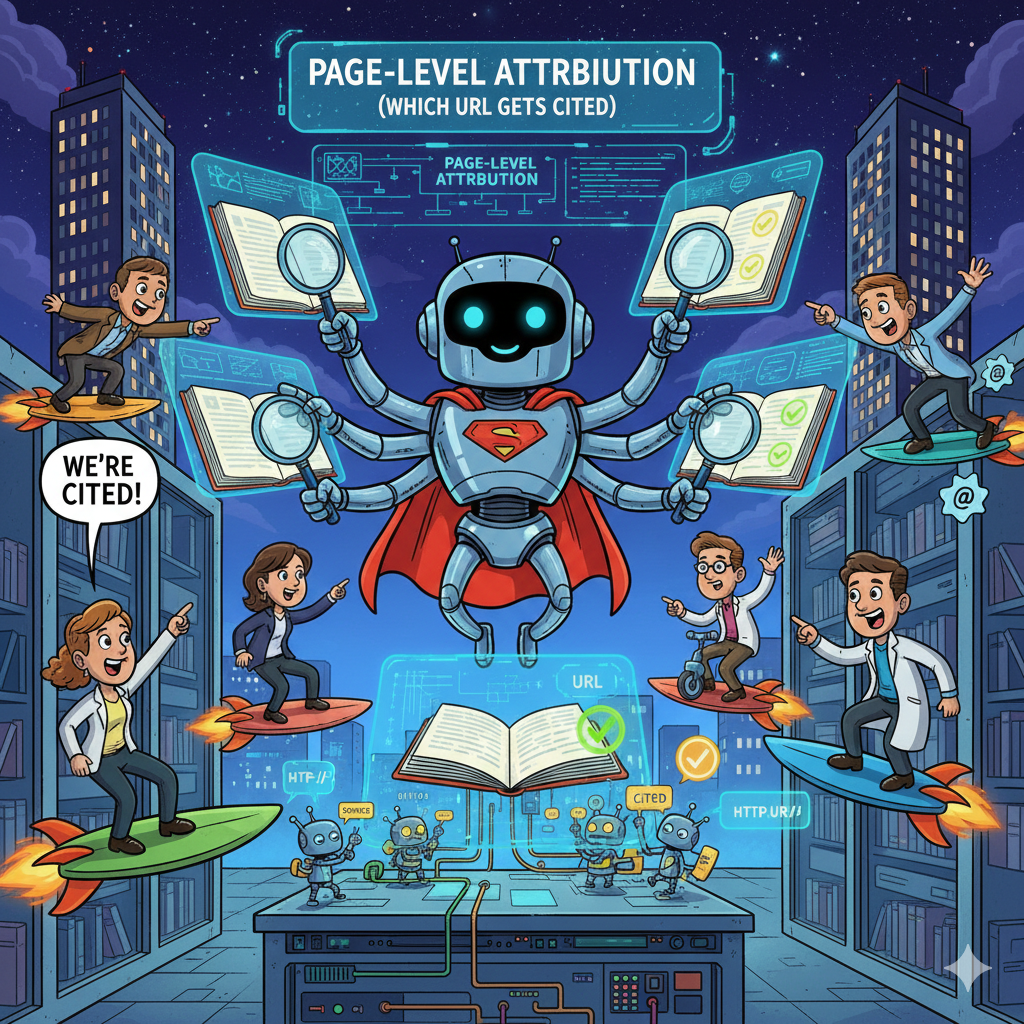
You don’t have an “AI visibility” problem, you have an attribution granularity problem.
Because “we were cited in Perplexity” is not actionable.
But “Perplexity keeps citing this competitor URL for our highest-intent prompts, and it never cites our relevant page” is actionable.
This guide compares the best AI visibility tools that can attribute citations down to the page (URL) level, so you can answer the only question that matters:
Which URL gets cited, and how do we engineer the page that wins?
If you want the cleanest URL-level citation visibility with a marketer-friendly workflow, Peec AI is one of the strongest options because it explicitly tracks citations at the domain or URL level and separates “used” vs “cited” behavior.
If you’re enterprise and want deeper “answer engine insights” plus broader monitoring workflows, Profound is built around understanding mentions and citations and includes citation discovery and page performance concepts.
If you want budget-friendly monitoring to start seeing citations fast, OtterlyAI starts low-cost and positions itself as an AI search monitoring tool with a free trial.
If you want a scrappy workflow that also helps you identify publisher/source outreach targets, Promptmonitor emphasizes showing what sources AI is using, so you can react.And if you want a broader “visibility + trust gaps” approach with a free starting point, Akii offers a free visibility score and paid plans starting around the low hundreds/month depending on plan.
📋 Get Listed / Advertisement
We update this guide monthly. Want your tool featured? Contact: [email protected].
Best Tools for Page-Level AI Citation Attribution (Quick Comparison)
| Tool | Best for | Page-level citation attribution | Starting price* |
|---|---|---|---|
| Peec AI | Marketer-friendly URL-level citation analysis | Domain or URL-level source usage + “used vs cited” distinction | €89+/mo (varies by plan/region) |
| Profound | Enterprise-grade answer engine insights | Tracks mentions + “uncover citations” + content performance referenced in AI answers | $99/mo (Starter cited by comparisons) |
| OtterlyAI | Budget-friendly monitoring + fast setup | Monitoring across AI engines; supports citation/mention tracking in positioning | $29/mo |
| Promptmonitor | Scrappy GEO tracking + source targeting | Emphasizes showing sources AI is using so you can act | Free / paid tiers; some pages list ~$199/mo plan |
| Akii | Visibility + trust-gap audits, starting free | Visibility scoring + monitoring across many models; free score + paid from ~$99/mo | Free score; paid from ~$99/mo |
*Pricing changes frequently, treat these as directional and confirm on vendor pricing pages.
📋 Get Listed / Advertisement
We update this guide monthly. Want your tool featured? Contact: [email protected].
1.Peec AI
What it does
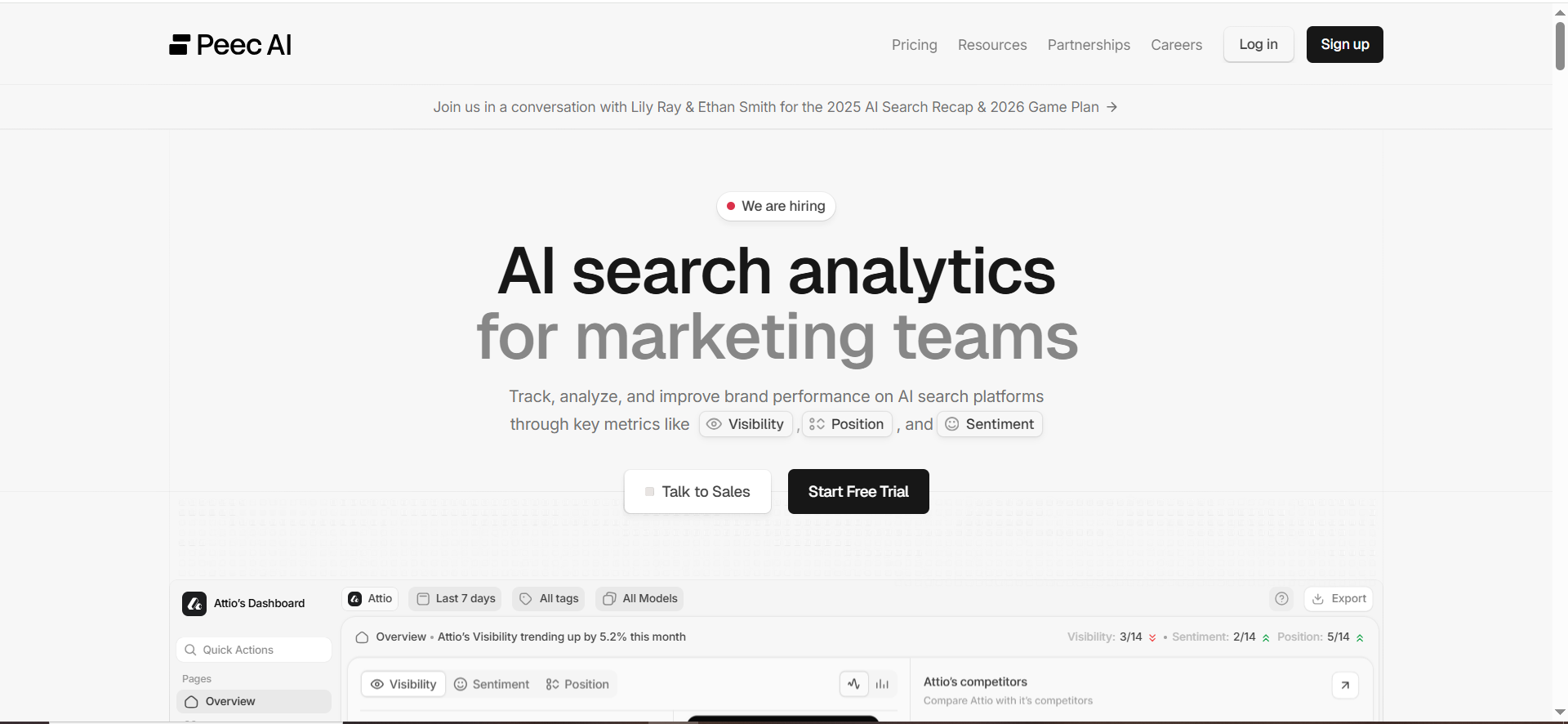
Peec AI is an AI search analytics platform designed to help marketing teams monitor how brands and content appear in AI answers, including which sources are cited and whether your content is simply “used” behind the scenes versus explicitly “cited.”
Why teams use it
Because Peec goes straight at the hardest operational problem in AI visibility: turning qualitative AI outputs into quantitative, page-level signals. Its positioning emphasizes that you can “view source usage at domain or URL levels” and track citation frequency.
What it’s good for
- Building a citation map: prompt → cited competitor URL → your target URL
- Finding which of your pages are actually winning citations (not just “your domain”)
- Identifying authority gaps: “AI keeps citing these sources; we need to compete with them”
When it’s a good fit
- You have an existing content library and need to know which pages to upgrade first
- You report to stakeholders and need clean, defensible metrics (citations by URL, trends)
- You want to distinguish “we influenced the answer” vs “we got the clickable citation”
When it’s not a good fit
- You want a tool that writes and publishes fixes automatically (most tools won’t)
- You only care about traditional Google rankings (this is a different layer of search).
How to use it
- Create prompt sets by intent (evaluation, alternatives, pricing, “best X”)
- Run daily monitoring.
- Open the sources/citations view and filter by URL-level to identify:
- Your cited pages
- Competitors’ cited pages
- Export a weekly “Top cited URLs” report and turn it into:
- “Defend” list (pages you’re winning, keep updated)
- “Attack” list (competitor pages winning, build/upgrade equivalents)
Key capabilities
- URL-level citation reporting (“which URL got cited”)
- Separation of “used” vs “cited” behavior
- Prompts/projects organization (so your team can maintain it monthly)
Pricing
Peec AI’s pricing starts at €89/month, and its Enterprise plan is custom-priced.
Free tier?
Peec AI doesn’t list a permanent free tier, but it does let you “start for free” from its pricing page (trial/signup).
Downsides / limitations
- Like most AI visibility tools, it’s strongest at measurement, not execution (you still need a content + technical plan).
- AI answers vary; you’ll need repeat runs and consistent prompt hygiene to avoid false confidence.
2. Profound
What it does
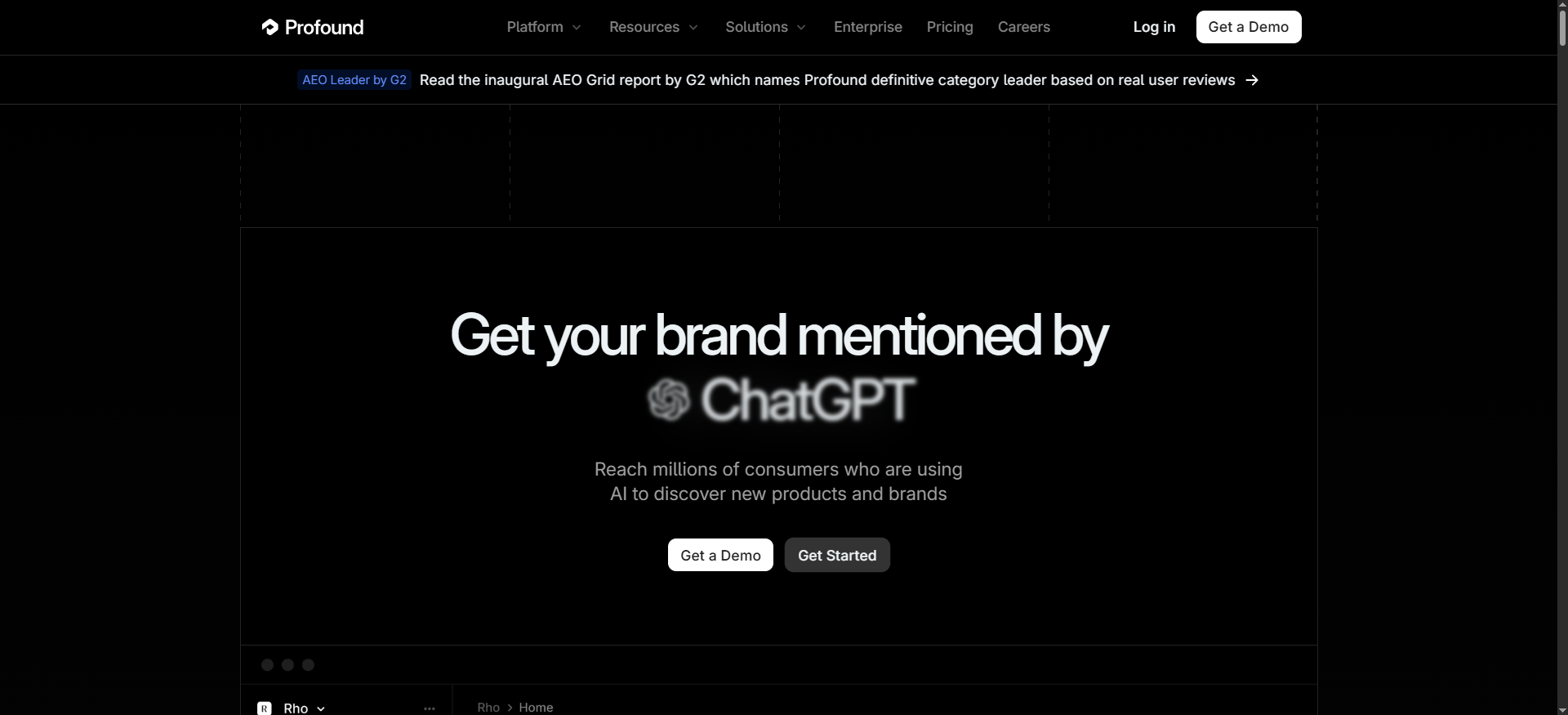
Profound positions itself as a platform to optimize brand visibility in AI search, including understanding how AI talks about your brand, tracking presence, analyzing responses, and explicitly uncovering citations.
Why teams use it
Enterprise teams want:
- deeper analysis,
- team workflows,
- and broad “answer engine insights” dashboards that move beyond simple mention counts.
Profound’s own messaging highlights citation discovery, and it also describes “content performance tracking” tied to pages referenced in AI-generated responses.
What it’s good for
- Enterprise monitoring programs with multiple stakeholders
- Competitive intelligence around which sources drive AI answers
- Building internal reporting around visibility trends + citations
When it’s a good fit
- You need a platform that can support ongoing monitoring programs (not a one-off audit)
- You want to analyze “how AI is talking about us” and tie that to content actions
- You want a more “command center” product experience
When it’s not a good fit
- You’re a small team that just needs a cheap URL citation dashboard
- You don’t have bandwidth to operationalize insights (enterprise tools can be heavier)
How to use it
- Start with a prompt library aligned to revenue pages (alternatives, comparisons, pricing, category pages).
- Monitor outputs weekly and pull citation reports.
- Identify “citation winners” (URLs AI repeatedly cites) and “citation losers” (pages you expected to win but don’t).
- Feed findings into an optimization backlog (structure upgrades, internal link reshaping, new pages).
Key capabilities
- Citation discovery / “uncover citations”
- Content performance framing tied to pages referenced
- Monitoring + analysis workflows for AI outputs
Pricing
Pricing varies by plan and is often discussed in comparisons; some sources cite a Starter plan around $99/month (confirm directly during buying).
Free tier?
Profound doesn’t list a free tier; it offers a demo (and a free AEO report) via its website.
Downsides / limitations
- Higher cost and heavier workflow than lightweight tools.
- If you only need “which URL got cited,” you may pay for more platforms than you’ll use.
3. OtterlyAI
What it does
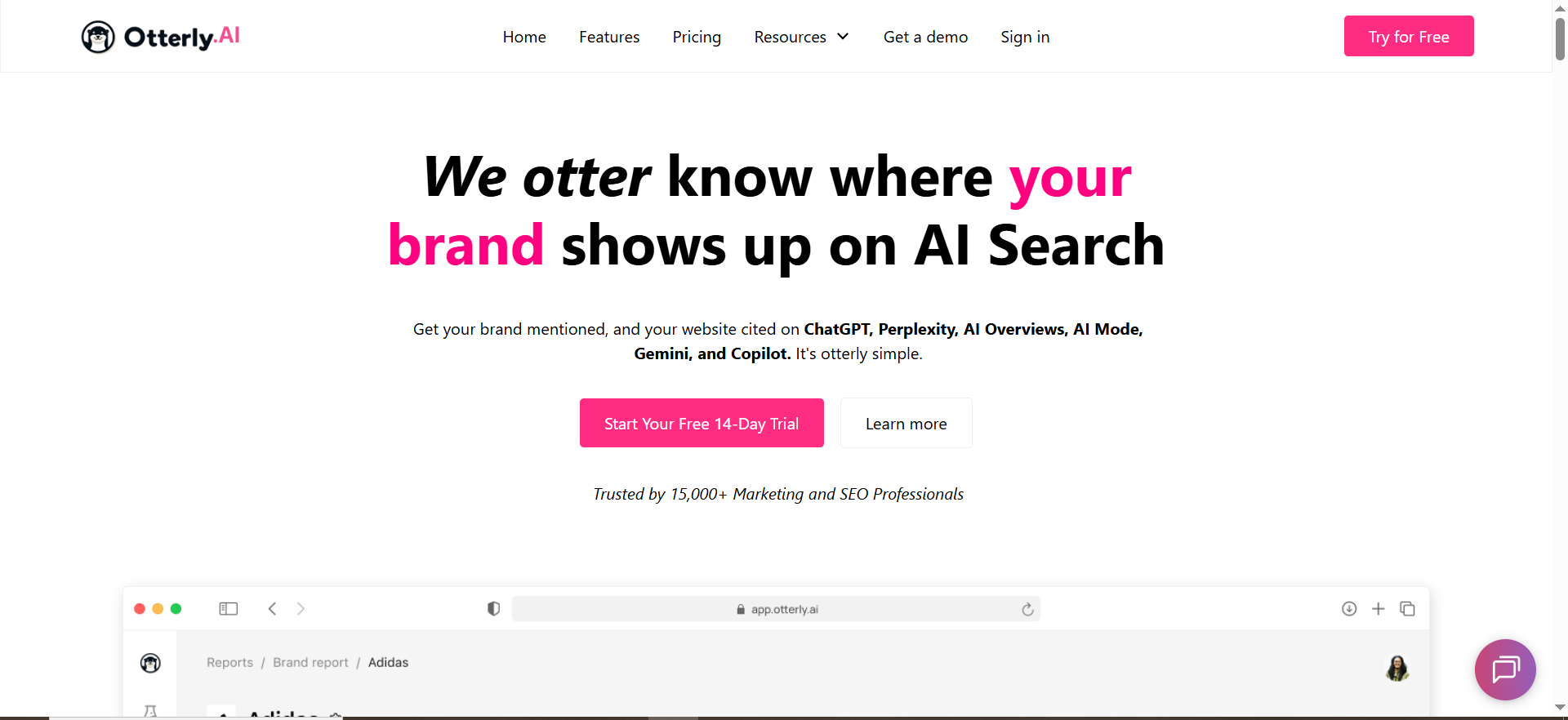
OtterlyAI positions itself as an AI search monitoring tool that tracks visibility across major AI platforms and emphasizes fast onboarding plus a free trial, with pricing starting at $29/month.
Why teams use it
Because it’s one of the easiest ways to start collecting AI visibility data without enterprise budgets, especially if you want early signals about:
- whether you’re mentioned,
- whether competitors are cited,
- and which prompts you should care about.
What it’s good for
- SMB and agency teams that need a starter monitoring stack
- Getting directional citation/mention data to build your first GEO backlog
- Running lightweight recurring reports
When it’s a good fit
- You want a tool you can trial quickly and set up without procurement cycles
- You’re building internal conviction and need baseline monitoring now
- You’re okay with “good directional data” rather than enterprise depth
When it’s not a good fit
- You need extremely granular attribution workflows across regions/languages at scale
- You require heavy BI integrations and complex governance
How to use it
- Import your core prompts (brand vs non-brand, category vs competitor, top-of-funnel vs bottom).
- Track results daily/weekly.
- Review citations and identify:
- competitor URLs repeatedly cited
- your pages that win (and keep them fresh)
- Turn it into a monthly “Citation defense + attack” plan.
Key capabilities
- AI visibility tracking across platforms (as positioned)
- Trial + low starting cost
- Common integrations are referenced in review sites (confirm in-product)
Pricing
OtterlyAI’s pricing starts at $29/month.
Free tier?
OtterlyAI doesn’t offer a free tier, but it does offer a free trial.
Downsides / limitations
- Lower-cost tools can be lighter on enterprise governance, advanced segmentation, and deep analytics.
- You may need to pair it with a stronger internal “citation engineering” process to get full ROI.
4. Promptmonitor
What it does
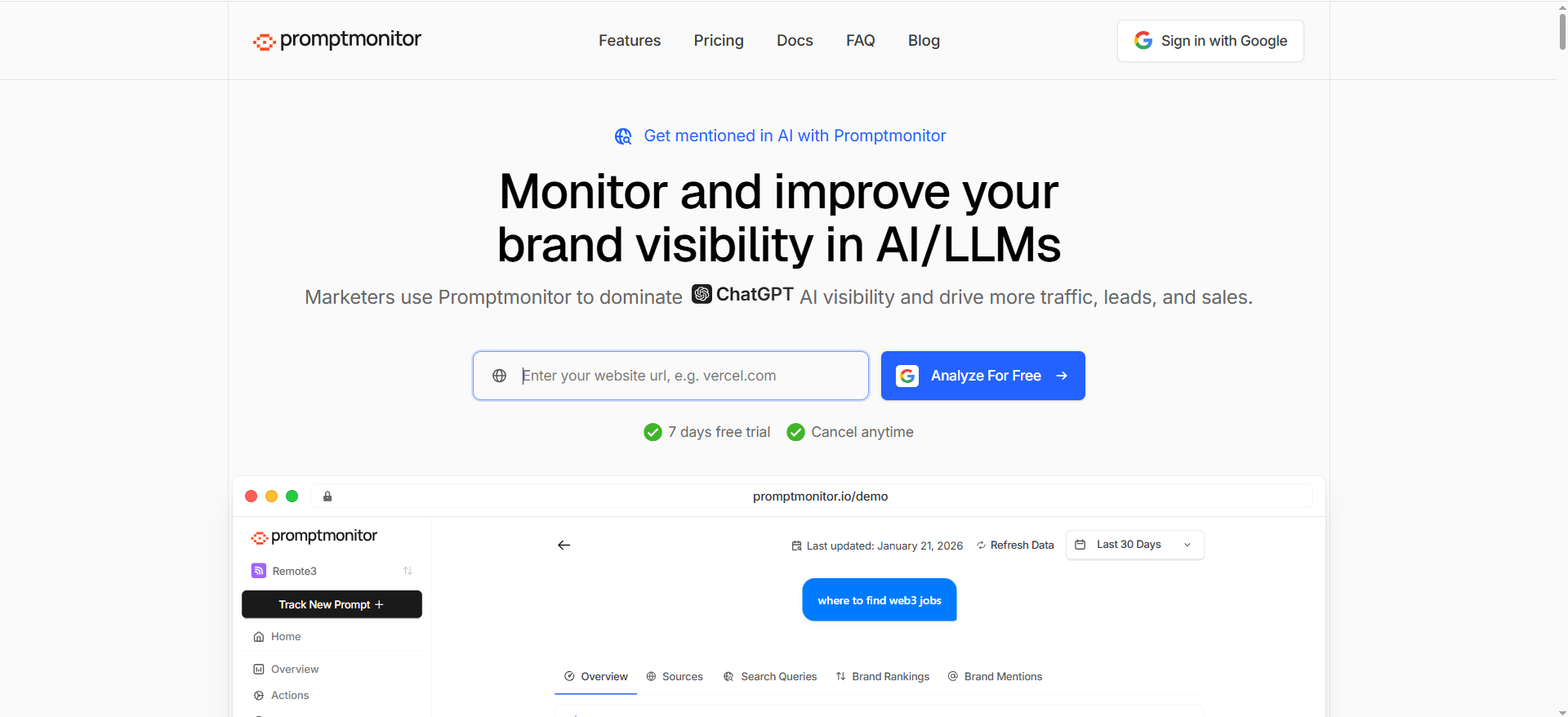
Promptmonitor focuses on tracking and improving AI visibility across models and emphasizes a very practical loop:
“We’ll show you what sources AI is using… then you can outreach to them… [and] decide whether to outreach or create better content to outrank them.”
In other words, it frames attribution as a source list you can act on, not just a dashboard.
Why teams use it
Because sometimes the fastest way to win citations isn’t “publish more content”, it’s:
- identify which publishers/URLs are being used,
- then either compete with them (content) or influence them (PR/outreach).
What it’s good for
- Teams that want citation tracking + source targeting in one workflow
- Marketers doing GEO + lightweight digital PR
- Budget-conscious programs that still want “what sources are being used” visibility
When it’s a good fit
- You want to operationalize citation data into outreach and content sprints
- You’re competing in categories where third-party listicles/reviews get cited a lot
- You need a tool that nudges action, not just reporting
When it’s not a good fit
- You require polished enterprise reporting, permissions, and cross-team governance
- You need absolute clarity on plan/pricing details (some references vary across domains)
How to use it
- Track prompts tied to high-intent evaluation queries (“best,” “alternatives,” “vs”).
- Pull the source list for each prompt.
- Bucket sources into:
- “We can beat with a better page”
- “We should partner / get listed”
- Ship changes, then re-run prompts to validate citation changes.
Key capabilities
- Source identification for AI answers (actionable attribution angle)
- Monitoring plans are listed on pricing pages (confirm current plan)
Pricing
Prompt Monitor’s paid pricing starts at $49/month, with an Enterprise plan at $199/month.
Free tier?
Prompt Monitor offers a free tier ($0/month).
Downsides / limitations
- Brand/domain ambiguity (promptmonitor.io vs promptmonitor.ai) means you should confirm you’re evaluating the right product and current pricing.
- Like all tools, outputs still require prompt hygiene and reruns to be statistically meaningful.
5. Akii
What it does
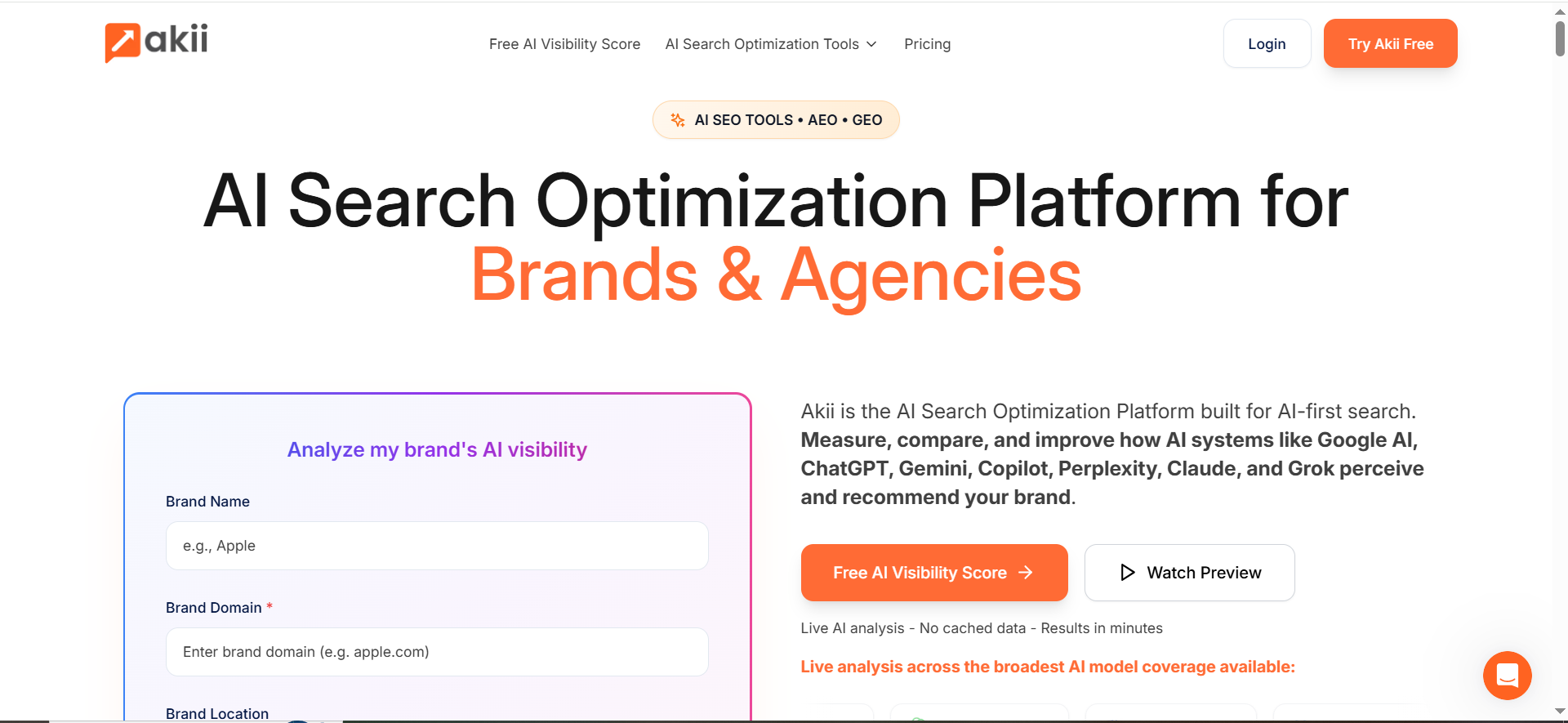
Akii positions itself as an AI search optimization platform that scans major AI models, identifies visibility and trust gaps, and provides actions to improve how AI systems recommend your brand.
Why teams use it
Because many teams don’t just want “who cited us”, they want:
- why they’re excluded,
- what AI systems “think” about them,
- and where trust gaps exist.
Akii also markets a free AI visibility score and mentions paid plans starting around $99/month in press coverage.
What it’s good for
- Early-stage programs: baseline audits + direction
- Teams that want “visibility + trust diagnostics” rather than pure monitoring
- Agencies doing assessments for multiple clients
When it’s a good fit
- You need a starting point that helps you prioritize fixes
- You want broad model coverage framing
- You like audit-style reporting you can present to stakeholders
When it’s not a good fit
- You only care about a clean URL citation table and nothing else
- You need extremely detailed citation frequency reporting at URL-level for huge prompt libraries (check before buying)
How to use it
- Run initial visibility/brand audit to understand gaps.
- Build prompt sets around your most valuable categories and competitor comparisons.
- Track changes after you ship site improvements (crawlability, page upgrades, content modules).
- Use the tool’s recommendations as backlog inputs.
Key capabilities
- “Visibility and trust gaps” framing
- Free visibility score + paid entry point discussed publicly
Pricing
Akii’s pricing starts at $49/month.
Free tier?
Akii doesn’t position a full free tier for ongoing use, but it does offer a 14-day free trial (and a free analysis option on the pricing page).
Downsides / limitations
- Pricing and plan details should be confirmed on the vendor site at time of purchase.
- “Optimization actions” still require your team (or agency) to execute changes.
What “page-level citation attribution” actually means (and why it’s different from “mentions”)
Domain vs URL attribution
Domain-level attribution answers: “Did our site get cited?”
URL-level attribution answers: “Did this exact page get cited, and how often?”
If your domain has 5,000 URLs, domain-level attribution is almost useless for execution. URL-level attribution gives you a roadmap: which pages to defend, which to upgrade, and which new pages you need to create.
“Used” vs “cited” sources (why both matter)
Some systems can “use” content to form answers without visibly citing it. Others include explicit citations/links. Tools like Peec explicitly distinguish between “used” vs “cited,” which matters because:
- “Used” can indicate the model trusts your content.
- “Cited” indicates you’re also getting the credit (and sometimes the click).
Why “which URL” is the only actionable question
Because every optimization action is page-scoped:
- change the page structure
- improve the definitions section
- add a comparison table
- update the pricing block
- strengthen internal links to that URL
- fix canonical/indexation for that URL
No one optimizes a “domain.” They optimize a page that should win a prompt.
How AI engines choose which URL to cite
AI answer engines typically blend three forces:
- Retrieval: which pages are discoverable and fetchable
- Relevance: which page best satisfies the prompt intent
- Trust: which page is “safe” to cite
Retrieval + trust signals
If your page can’t be crawled, rendered, or understood, it won’t be cited, even if it’s “best.” Common blockers:
- heavy client-side rendering with limited pre-rendered HTML
- canonical mishaps
- thin content without clear structure
- no obvious “source-worthy” sections (definitions, evidence, tables)
Content formats that get cited (because they’re easy to extract)
In practice, citations cluster around pages that do one of these well:
- Define: crisp definitions and scope
- Compare: tables, pros/cons, “best for” callouts
- Verify: data, screenshots, quotes, methodology
- Answer fast: the “TL;DR” is obvious and aligned to intent
Technical prerequisites
Even with great content, engines may pick a different URL if yours is:
- duplicated (multiple similar URLs competing)
- mis-canonicalized
- not indexable
- slow/unreliable to fetch
Authority and “source competition” dynamics
If AI keeps citing the same competitor URL, treat it like classic SEO: that page is an incumbent. You need a page that is:
- more directly aligned to the intent
- better structured for extraction
- better supported by internal/external authority signals
Evaluation checklist: How to pick the right tool for your team
Use this checklist when you demo any AI visibility platform:
Coverage
- Which engines/models are supported?
- Can you segment by country/language?
- How often can prompts re-run (daily vs weekly)?
Prompt operations
- Can you bulk upload prompts?
- Can you tag prompts by intent, funnel stage, product line, geo?
- Can you test prompt variants (same intent, different phrasing)?
Attribution depth
- Does it show citations at URL level (not just domain)?
- Does it separate used vs cited sources? (Very valuable)
- Can it show citation frequency over time?
Exports + integrations
- Can you export to CSV/Sheets?
- Can you push to BI dashboards?
- Does it support alerts (Slack/email) for big visibility shifts?
Trust + reproducibility
- Does the tool explain how it runs prompts and stabilizes results?
- Can you view raw answer logs?
- Can you re-run on demand?
What is page-level citation tracking in ChatGPT / Perplexity / AI Overviews?
Page-level citation tracking means monitoring AI answers and recording the exact page URL an AI system cites (if it provides citations/links), rather than only tracking whether your domain was mentioned or cited, and that’s exactly what an AI search visibility audit should operationalize.
Why that matters:
- Domain-level: “example.com got cited” → not actionable if you have hundreds/thousands of pages.
- URL-level: “example.com/pricing got cited for ‘X pricing’” → actionable: defend, improve, or expand that page.
What’s unique about each surface:
- ChatGPT: Depending on the experience and the query, ChatGPT may or may not show citations. When it does, you want to capture the linked URLs and match them back to the page types you control.
- Perplexity: Often citation-forward; the toolset is generally better suited to reliably collecting the cited sources and comparing them over time.
- Google AI Overviews: Citations can appear as linked sources within the overview. The practical tracking problem is the same: which page is being selected as the source for a query category, and how consistently?
Operationally, page-level citation tracking becomes a dataset:
- Prompt
- Engine (ChatGPT / Perplexity / AI Overviews)
- Date/time
- Answer text (optional, but useful)
- Cited URLs (ranked if possible)
- Your cited URL (if any)
- Competitor cited URL(s)
Once you have that, you can stop debating “AI visibility” in the abstract and start improving specific pages that should win citations.
How do I see which exact URL an AI answer cites?
You have three practical options, manual, semi-manual, and automated.
1) Manual (works for small prompt sets)
- Run your target prompt in the AI engine.
- If the answer includes citations/links, open each citation and copy the full URL.
- Store it in a sheet with columns like:
- Prompt
- Engine
- Date
- Cited URL 1 / 2 / 3…
- Notes (why you think it was cited)
This is fine for ~20–50 prompts. It breaks once you need trendlines and weekly monitoring.
2) Semi-manual (repeatable)
- Standardize prompts (exact wording).
- Run them on a schedule (weekly).
- Use a template to record citations consistently.
- Keep a “changes” tab noting what you updated on your pages between runs.
This gives you “directional truth” and helps separate random variation from real movement.
3) Automated (best for scale)
Use an AI visibility tool that logs responses and extracts citations, ideally with:
- URL-level citation views
- repeat runs
- exports
- tagging (intent, funnel stage, product line)
Pro tip: Don’t only store the cited URL. Store the canonical target URL you wanted cited. The gap between those two is your optimization work.
Why does AI cite a competitor’s blog post instead of my product page?
This is one of the most common (and fixable) problems. Usually it’s not because your product is worse, it’s because your competitor’s page is easier to retrieve, easier to parse, and safer to cite for the specific intent behind the prompt.
Here are the main reasons:
1) Intent mismatch
If the prompt is “best AI visibility tools,” the model is looking for:
- “best for” breakdowns
- pros/cons
- pricing snapshotswhich is why an AI visibility strategy needs intent-matched page assets.
2) Extraction advantage (structure wins)
AI systems love pages with:
- direct definitions near the top
- short sections with clear headings
- tables
- bullet lists
- “best for” calloutsCompetitor pages that package the answer in extractable blocks are more citable.
3) Evidence advantage (trust wins)
Competitor pages may include:
- screenshots
- methodology
- sources
- third-party references
- dates/freshness cuesIf your product page reads like marketing copy without verification hooks, it may be less likely to be cited.
4) Retrieval/technical issues
Even strong content loses if:
- the page isn’t indexable/crawlable
- canonical tags point elsewhere
- the page is slow/unreliable
- the “best” content is hidden behind tabs/JSIn that case, AI might choose a competitor source that’s simpler to fetch.
5) Your site is “citable,” but the wrong URL is the best match
Sometimes AI is willing to cite your domain, but it picks:
- your homepage
- a blog category
an old postThat’s a signal your internal linking/canonical signals aren’t clearly promoting the “winner” page, which is why a structured content audit matters before you start “chasing citations.
Fix strategy: create (or refactor) the page that matches the prompt intent with a citable structure, then reinforce it with internal links and clear canonicalization, this is the core of structuring AEO-ready content.
How do I track “used but not cited” sources vs explicit citations?
You’re tracking two different phenomena:
- Explicit citations: the AI answer shows a URL/link as a source.
- Used-but-not-cited influence: your content appears to shape the answer even when you’re not linked.
How to track explicit citations
- Record the cited URLs directly (manual or via tool).
- Trend them by prompt cluster over time: “share of citations” per brand/page.
How to infer “used but not cited”
This is trickier because you’re measuring influence without a link. Practical approaches:
A) Phrase fingerprinting (lightweight)
- Identify distinctive phrases, definitions, or framing unique to your content.
- Check whether AI answers repeat those phrases even without citing you.
- Store “influence notes” in your log.
B) Content element testing (more reliable)
- Update one clear element on your page (a definition block, a table row, a stat).
- Re-run the prompt set over a few days.
- If the answer shifts in the direction of your update (but still doesn’t cite you), you’ve likely influenced the response.
C) Tool-based “used vs cited” signals (best if available)
Some AI visibility platforms explicitly separate “used” from “cited.” If your tool provides that layer, it’s extremely useful, and it pairs well with a baseline LLM brand visibility audit.
- “you’re in the retrieval set” (used)
- “but you’re not getting credited” (not cited)
Why it matters: If you’re “used but not cited,” your next goal is to become the most cite-worthy page (better structure, clearer answer block, trust hooks).
How do I build a “citation map” from prompts to URLs?
A citation map is your operating system for AI visibility, if you want the playbook version, follow an AE SEO workflow for AI answers + citations. It connects:
Prompt → AI engine → cited URL(s) → your target URL → action
Step 1: Create prompt clusters
Examples:
- “best AI visibility tools”
- “AI SEO tools”
- “GEO tools”
- “AEO tools”
- “alternatives to X”
- “X vs Y”
Step 2: Assign a target page for each cluster
For each cluster, decide the URL you want cited:
- a comparison page
- a category page
- a definitive guide
- a pricing/integration pageIf you don’t have a suitable page, mark “NEW PAGE NEEDED.”
Step 3: Collect baseline citations
For each prompt (and engine):
- record the top cited URLs (competitors and you)
- record the frequency if you run multiple times
Step 4: Add a “gap” label
- Defend: your URL is cited consistently → keep it fresh
- Fix wrong URL: your domain cited but wrong page → internal linking/canonical fix
- Attack incumbent: competitor cited → create/upgrade competing page
- New opportunity: citations are messy/unstable → easy to win with a better page
Step 5: Convert gaps into tasks
Every prompt cluster should produce concrete tasks like:
- “Add comparison table”
- “Add definition block”
- “Add citations/evidence section”
- “Create alternatives page”
- “Improve internal links from X pages to target URL”
This turns “AI visibility” into a backlog that looks like normal SEO/content work, just guided by citation data.
What page types get cited most often (guides, definitions, lists, pricing, docs)?
Across most categories, AI systems tend to cite pages that are:
- Highly structured
- Directly relevant to the prompt intent
- Trustworthy and easy to verify
Common page types that win citations:
1) Definitive guides (“What is X / How to do X”)
Why they get cited:
- cover concepts comprehensively
- provide definitions + steps
- easy for AI to extract explainers
Upgrade modules:
- short TL;DR
- clear H2s that match FAQs
- examples, frameworks, templates
2) Definitions / glossary pages
Why:
- clean, quotable definitions
- minimal fluff
- ideal for “what is” prompts
Upgrade modules:
- one-sentence definition
- scope/what it is not
- examples + use cases
3) Best lists (the exact format you’re writing)
Why:
- AI can lift “best for” breakdowns
- comparisons are straightforward
Upgrade modules:
- comparison table
- consistent evaluation criteria
- “best for X” summaries
4) Pricing and plan pages
Why:
- high-intent prompts often ask about cost
- AI wants the “official” source
Upgrade modules:
- clear plan matrix
- last-updated date
- transparent inclusions/limits
5) Docs / help center pages
Why:
- highly factual
- step-by-step
- strong trust cues (“official documentation”)
Upgrade modules:
- short summaries
- internal link hubs
- clear examples and screenshots
6) Third-party reviews and comparisons
Why:
- perceived neutrality
- lots of comparative context
Implication:You may need a dual strategy:
- build better on-site pages
- ensure reputable third parties include you accurately (so AI cites them and you still benefit)
How do I prioritize which citations to chase first?
If you try to “win all prompts,” you’ll do nothing. Prioritization should be ruthless.
Use this scoring model (simple and effective)
Score each prompt cluster 1–5 on:
- Revenue intent
- “best X tools” and “X alternatives” usually score highest.
- Current proximity
- Are you already mentioned? Are you already cited sometimes?
- Fixability
- Is this a “wrong URL” problem (fast) or a “build a new asset” problem (slower)?
- Competitive intensity
- Are incumbents unbeatable (giants) or is the SERP/citation set messy?
- Opportunity size
- How often do customers ask this in sales calls? How critical is it to your category narrative?
Fast wins to chase first
- Prompts where your domain is cited but wrong URL→ You can often flip this with internal linking + structure changes.
- Prompts where citations are inconsistent or low-quality→ Publish a clean, structured page and you can become the “stable source.”
Strategic wins next
- Competitor-dominated prompts that directly drive pipeline→ Build a dedicated “best/alternatives/comparison” asset and maintain it monthly.
How do I connect AI citations to traffic/leads (attribution)?
This is the hard part, because not every AI citation produces a click, and not all clicks are labeled cleanly in analytics. But you can still build a practical attribution model.
1) Track referral traffic from AI sources
In your analytics platform, monitor:
- referrers that include Perplexity
- any AI-related referrers you can identify
- changes in direct/unknown traffic to pages that start getting cited
This gives directional correlation.
2) Use dedicated landing pages for high-value prompt clusters
If you’re chasing “best AI visibility tools,” create a page designed to capture that intent and ensure:
- clear CTA
- conversion path
- internal routing to product pages
When that page becomes cited, you can measure leads more cleanly.
3) Add measurement hooks (without being spammy)
- Track scroll depth, CTA clicks, demo requests on the pages you aim to get cited, and make it easy for that traffic to convert with a clear path to book a call.
- Add “source intent” fields in forms (optional: “Where did you hear about us?” including AI tools)
4) Build a “Citation → Page → Conversion” dashboard
Your reporting should connect:
- citation frequency for a prompt cluster
- which URL is cited
- sessions + conversions on that URL
- assisted conversions (if you have multi-touch attribution); which is why reporting AI visibility to leadership needs a dashboard-first model.
Even if you can’t measure every click source perfectly, you can answer:
- “When we win citations for cluster X, do conversions on the target URL rise?”
5) Treat citations as leading indicators, not last-click truth
In many categories, AI visibility influences:
- brand recall
- shortlist inclusion
- deal acceleration
So your KPI stack should look like:
- Leading: share of citations (by prompt cluster)
- Mid: traffic lift to cited URLs
- Lagging: conversions influenced by those URLs (direct + assisted)
That’s enough to justify ongoing investment, and to make citation tracking a real growth loop rather than a vanity metric.
FAQs
What is “page-level citation attribution” in AI search?
Why does AI cite my competitor’s blog post instead of my product page?
What’s the difference between a brand mention and a citation?
How many prompts should I track to get value?
How do I know if citation changes are real or just random variation?
Can I track which of my pages get cited in Google AI Overviews?
What’s the fastest “quick win” once I see which URL is cited?
Do I need one tool, or can I do this manually?
Which tool is best for startups?
Which tool is best for enterprise teams?
📋 Get Listed / Advertisement
We update this guide monthly. Want your tool featured? Contact: [email protected]