

As a startup, you actually have several advantages over your bigger counterparts with large SEO budgets. In fact, their spending potential often becomes their disadvantage, or an operational quagmire. They stick to building expensive organic growth campaigns, while downplaying the other important aspects of organic search.
The truth is, organic search rewards relevance, technical quality, and consistency just as much as spending. And a startup that publishes useful content for overlooked topics can outperform much larger competitors in specific niches.
Besides, large companies often move slowly, while a typical startup is more agile and can deliver new content faster, avoiding major bureaucratic constraints.
However, you still need a clear plan to get the maximum from your small SEO budget. You can find one down these lines, formulated in five easy steps. But don’t skip the first part that teaches you how to configure your website for sustainable growth.
Set Up Your Website So Search Engines Can Crawl and Trust It
Let’s be honest upfront: even the highest quality content will go to waste if your website is not ready for search engines. Underestimating the technical aspect of a website setup for organic growth is a very common thing.
According to Ahrefs' 2026 SEO Statistics, 72.3% of websites have slow pages, while only 33% pass Google's Core Web Vitals thresholds. Both page speed and user experience affect how visitors interact with your site and influence Google's evaluation of page quality.
That’s why getting the technical basics must always precede your main organic growth strategies, as Google needs to be able to crawl and index your pages properly.
The good news is: you don't need a large budget or a dedicated SEO team to do this. Most technical issues can be fixed during the initial website setup or with free tools like Google Search Console.
Here is what you should do right now:
- Enable HTTPS. Besides improving security, it tells users and search engines that your website is trustworthy.
- Create and submit an XML sitemap. This helps Google discover your pages more quickly, especially after you publish new content.
- Check your robots.txt file. A single incorrect directive can prevent search engines from crawling valuable pages.
- Fix broken pages and redirect errors. Dead ends create a poor experience for users and make crawling less efficient.
- Keep your URLs short and descriptive. Clear URLs are easier for both people and search engines to understand.
Also, make sure you test your website on mobile devices. Most people access websites on their mobile devices nowadays, so your pages need to load fast and use fonts and graphics that always load correctly on all mobile devices and all operating systems (e.g., iOS and Android).
Once your website is technically sound, you don't have to think about these items every day. Check Google Search Console regularly for crawl errors, indexing problems, or mobile usability issues, and fix them before they become larger problems.
A Step-by-Step Guide to Getting More From a Small SEO Budget
There are many things you can do to prepare your website for organic growth, and you can easily overdo it. Successful SEO for startups is about identifying the few activities that produce the biggest return instead of trying to do everything. That’s why we suggest taking only a few basic steps that can actually drive most of your outcomes, while saving budget and time.
1. Find Keywords That Established Competitors Overlook
Instead of competing head-on with your experienced competitors, look for keywords they have ignored or only covered briefly. You cannot beat them in years of experience, competing for highly competitive keywords.
But you can use your speed and agility to find the newest trending keywords and go for them while your slower rivals are doing lengthy research and internal coordination.
The first target to check is long-tail keywords with a clear search intent. They are what the modern AI-powered search engines rely on, bringing visitors who know what they're looking for and are more likely to take action.
In general, when evaluating keywords, prioritize those that:
- Match your products or services.
- Solve a specific customer problem.
- Have relatively low competition.
- Show clear buying or learning intent.
Don't rely solely on keyword research tools (a popular free one is a Keyword Research Tool by Ahrefs). Those are important and should always come first, but even greater results will come from taking a little bit more manual effort. For instance, you can browse Reddit, Quora, thematic forums, and even your own customer emails or support requests to reveal real questions people ask before making a purchase.
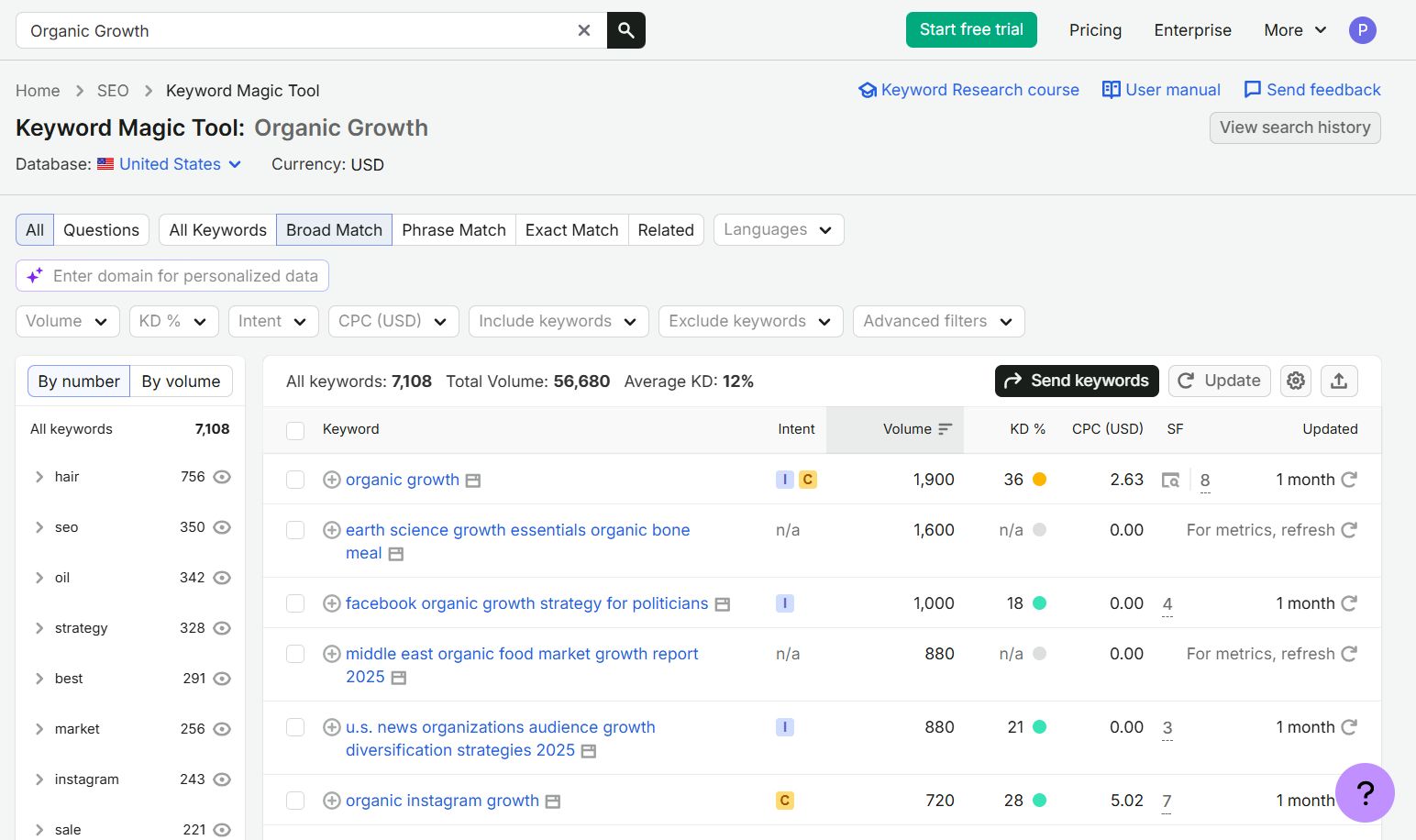
Source: Ahrefs
🎯 Pro tip: Check every shortlisted keyword in Google before implementing it in your content. If you see that they are dominated by major brands, search further. Narrow your search until you find terms for which your startup can realistically compete and win.
2. Create Content That Answers Real Buying Questions
The idea that every visitor is ready to buy is a myth. The act of buying needs to be nurtured. Prospective buyers come and go, and your task is to persuade them to make a buying decision.
You can do so by answering their questions and addressing their pains. Effective content marketing for startups begins with solving real customer problems, not publishing content for its own sake. So, instead of publishing articles with generic, recycled (often AI-made) content, you should focus on topics that have the highest potential to move your visitors closer to conversion.
For example, the following content has demonstrated the highest positive impact on visitor choices:
- Product comparisons and alternatives.
- Pricing or cost guides.
- Step-by-step tutorials.
- Common mistakes and how to avoid them.
Aim to make every piece of your content complete. A well-planned content marketing strategy prioritizes depth and usefulness over publishing as many articles as possible. Include both common challenges (to immediately touch the readers’ pain points) and key solutions, pro tips, frequently asked questions (always at the very end), and don’t neglect the power of graphics to influence buyer behavior.
🎯 Pro tip: Be specific and avoid broad topic coverage. For instance, rather than writing a broad article about artificial intelligence (AI), explain how AI helps SaaS startups speed up product testing and go-to-market.
3. Improve Internal Linking to Spread Authority Across Your Site

Source: Searchengineland
Internal links don’t only encourage your website visitors to explore your website and discover more content. They also have an important SEO role to play, helping search engines understand how your pages are organized.
Always consider ways to link to your existing articles and pages when you publish a new piece of content. Likewise, periodically revisit your older content and link it to your newly published pieces. This on-page SEO hygiene helps distribute authority across your website.
A few simple rules will help you extract the most from your internal links:
- Link only to pages that genuinely add value for the reader.
- Use descriptive anchor text instead of generic phrases like “read more” or "click here."
- Ensure your most important pages receive links from multiple sections of your website.
The more content-heavy your website becomes, the higher the SEO value of your internal links becomes.
🎯 Pro tip: Use the internal search on your website to discover related articles and pages. If you don’t have one and don’t remember every single piece of content you published, you can utilize Google’s function to search for content on your site (site:https://site.com/ search term).
4. Earn Backlinks Through Industry Relationships and Useful Content
Even more important than internal links are the links that point to your website from outside, i.e., backlinks. Not only do they send visitors to your website and help you boost customer acquisition and drive conversions, but they also send powerful authority and trust signals to search engines like Google.
Don’t worry that your limited SEO budget will not let you build backlinks at scale. Startups often have an advantage here because they don’t need large-scale link-building campaigns. Instead, they can build genuine relationships within their industry, which serve as a fruitful ground for high-impact link-building.
But don’t rush with cold outreach emails asking for a link out of nowhere. Look for low-cost opportunities to contribute value:
- Write guest posts for reputable industry websites.
- Publish original data, surveys, or case studies.
- Respond to journalist requests and expert roundups.
- Collaborate with partners on joint content or webinars.
The key to success here is your genuine desire to be helpful to your link-building partners. It’s about creating free resources people naturally want to reference.
🎯 Pro tip: Focus on relevance rather than quantity. A few backlinks from respected websites in your niche are usually more valuable than dozens of links from unrelated or low-quality domains.
5. Measure What Brings Organic Traffic and Cut What Doesn't
A limited budget is a known good link-building discipline factor that naturally prevents you from spreading your resources too widely. Provided you understand the importance and know how to measure your performance.
The logic is straightforward here: if you don't measure your results, it's easy to keep investing time in content or tactics that never contribute to traffic, leads, or sales.
Aim to establish a dozen high-impact link-building KPIs that will help you keep track of your backlinks. But for a starter, use Google Search Console and Google Analytics and focus on these three questions:
- Which pages attract visitors?
- Which keywords generate impressions?
- Where do people leave your website?
However, some best practices are also worth exploring. For example, when building organic growth, most startups on a budget focus on these five essential KPIs:
- Organic traffic to individual pages.
- Click-through rate (CTR) from search results.
- Average keyword rankings.
- Conversions from organic visitors.
- Pages with declining traffic that need updating.
Here is a little broader essential KPIs pool for you to consider:
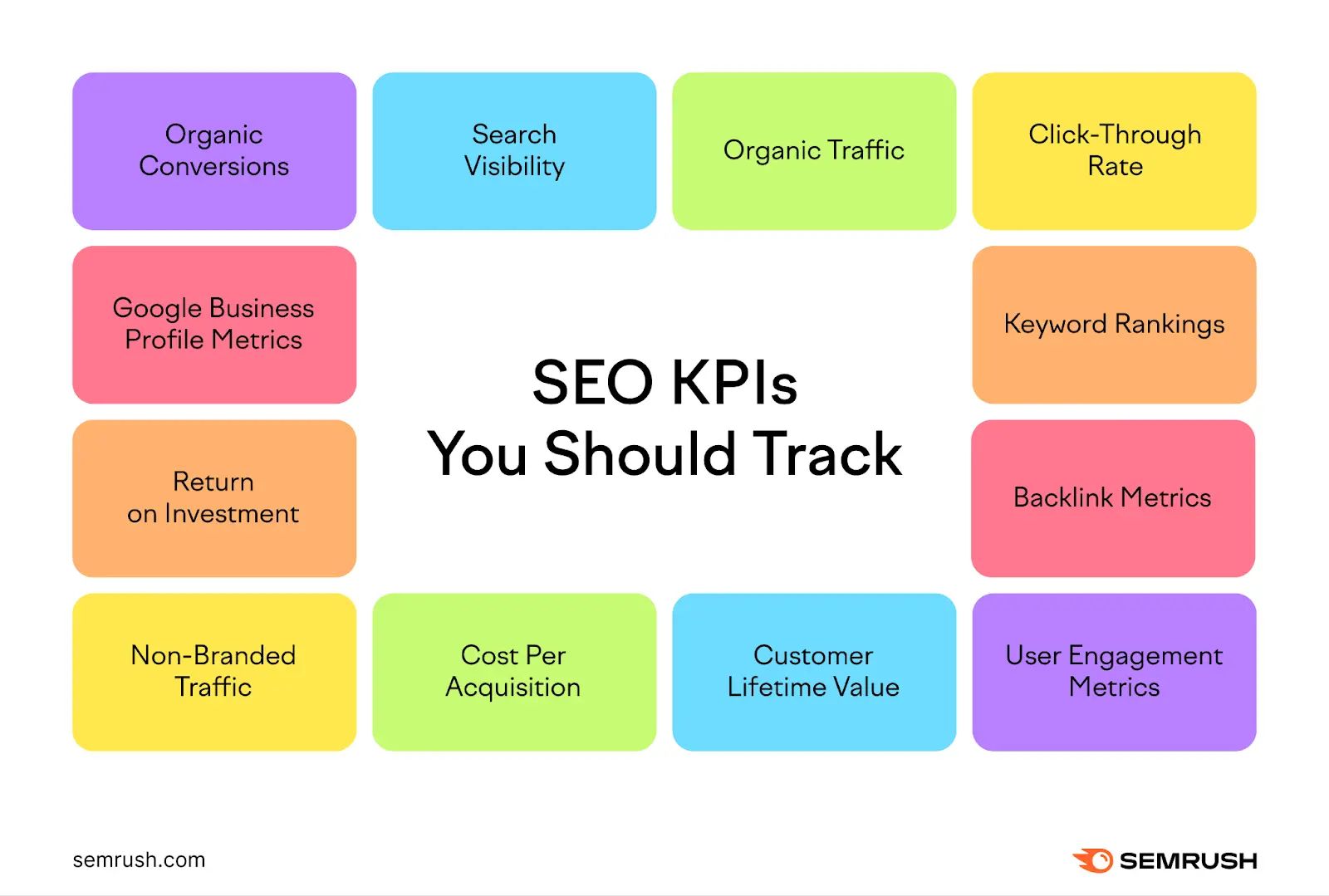
Source: Semrush
🎯 Pro tip: Let your new content work for a while before making your final judgment. Give every blog post and every page at least a few months to gain search visibility before deciding whether it's worth updating or replacing.
The Key Takeaways
The arguments and facts that we have covered today, as well as the general SEO practice, confirm that startups don’t need huge SEO budgets to effectively build sustainable growth.
Let the following key takeaways fuel your thinking and excite relevant action as you close this page:
- A limited SEO budget can still produce strong organic growth when your growth marketing efforts focus on the activities with the highest impact.
- Fix your website's technical issues before investing time and money in content or link building.
- Target overlooked, high-intent keywords instead of competing for the most popular search terms.
- Create content that helps potential customers make buying decisions, not just generate page views.
- Build authority gradually through relevant internal links, high-quality backlinks, and genuine industry relationships.
Last but not least, without periodic and focused measurement, you risk stalling your organic growth. Come up with a few KPIs and track their performance regularly to know whether your actions bring the desired outcomes and to be able to improve your search performance.