

TL;DR
If you’re doing AI visibility work seriously, you can’t treat prompts like “one-and-done” keywords anymore. The same intent phrased five different ways can change whether AI answers mention you, recommend you, and—most importantly—cite your site.
For prompt variation testing specifically, these are the five tools I’d shortlist:
- Peec — strong for building a prompt library, tagging, and tracking visibility/position/sentiment over time.
- OtterlyAI — great coverage for monitoring prompts across multiple AI engines with dashboards built for ongoing reporting (especially agency workflows).
- Akii — fast “visibility score” style dashboards + competitive tracking (good for quick wins and exec reporting).
- Profound — enterprise-grade AI search intelligence, including “prompt volumes” and deeper trend discovery.
- Promptmonitor — pragmatic GEO monitoring with quick setup and a clear model of “responses per prompt,” plus tooling around sources and opportunities.
📋 Get Listed / Advertise
We update this guide monthly. Want your tool featured? Contact: [email protected].
| Tool | Best for | Variant-testing superpower | Pricing snapshot |
|---|---|---|---|
| Peec | Prompt library + ongoing tracking | Prompt setup + tagging + visibility/position/sentiment tracking | Free trial + sales-led pricing shown on site |
| OtterlyAI | Multi-engine monitoring + reporting | Automated monitoring of defined “search prompts” across AI engines | Free trial; entry plan advertised from $29/mo |
| Akii | Visibility score dashboards + competitive prompts | Share-of-voice style tracking: prompts you “win or lose” | “Start tracking free” messaging + free visibility analysis claim |
| Profound | Enterprise AI search intelligence | Trend + discovery (incl. prompt volumes feature) | Enterprise/custom pricing messaging; widely cited starting ~$499/mo for Lite |
| Promptmonitor | Hands-on GEO teams | Fast testing + “responses per query” usage clarity; tracks mentions/citations | 7-day free trial mentioned on site |
Who each tool is best for
- Pick Peec if you want a clean “prompt → tags → dashboards” workflow for continuous monitoring and reporting.
- Pick OtterlyAI if your biggest need is “run these prompts across all the major AI engines, daily, with a simple dashboard.”
- Pick Akii if you want quick visibility scoring and competitive tracking you can screenshot into a weekly exec update.
- Pick Profound if you’re enterprise, need deeper discovery and trend intelligence, and can handle higher price points.
- Pick Promptmonitor if you’re moving fast, testing a lot, and want transparency around what’s being queried and counted.
Tool #1: Peec (best for prompt libraries + ongoing visibility tracking)
What it does
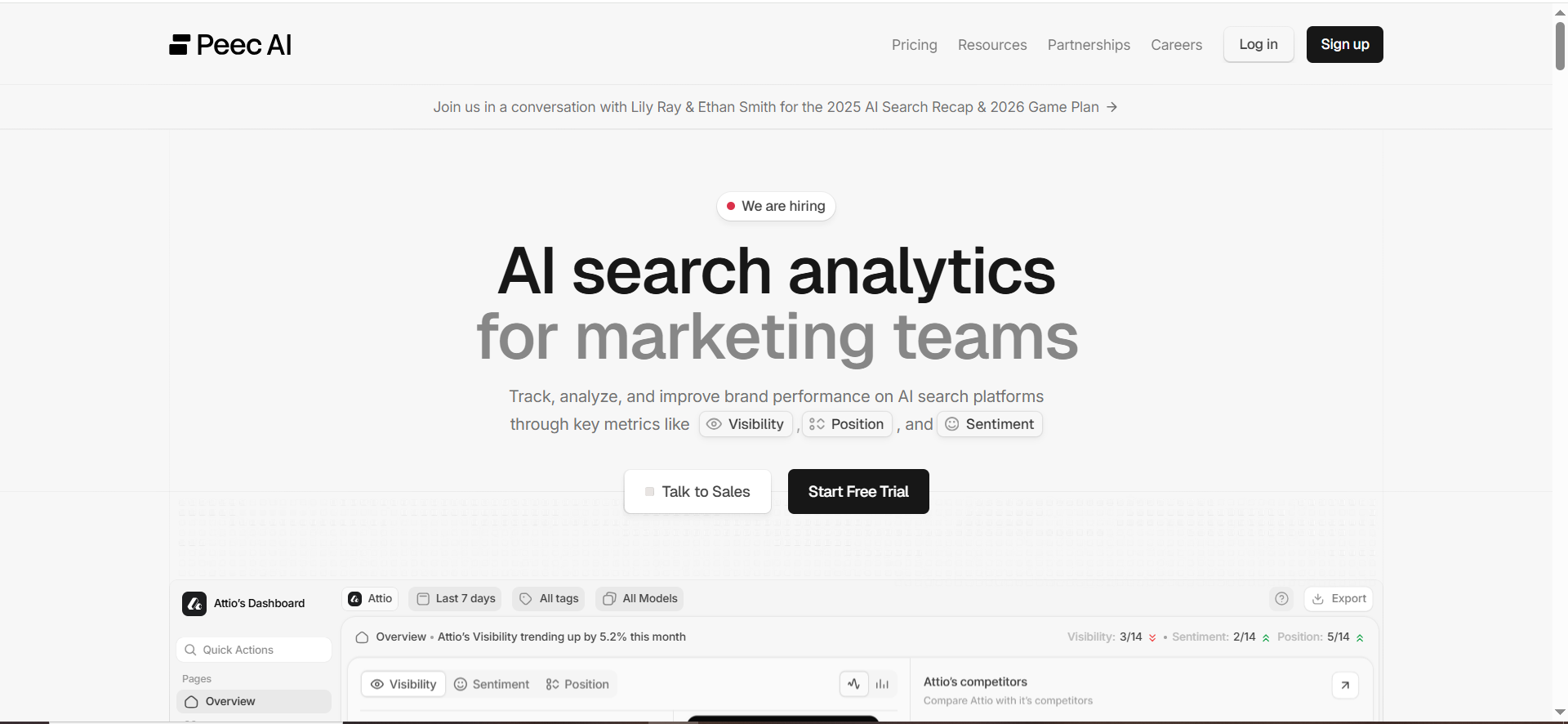
Peec positions itself as “AI search analytics for marketing teams,” focused on tracking brand performance across AI search platforms with metrics like visibility, position, and sentiment.
Why teams use it
Most teams don’t struggle with one prompt—they struggle with scale:
- dozens of product prompts
- category prompts
- competitor comparison prompts
- pricing + alternatives prompts…and all of those need to be monitored over time.
Peec leans into the operational reality: prompts are “the foundation” of an AI search strategy, and you need a system to organize and track them.
What it’s good for
- Building a prompt library you can tag by intent cluster (awareness vs. consideration), persona (CMO vs. SEO Manager), and topic (features vs. integrations).
- Tracking performance across time using consistent metrics (visibility/position/sentiment).
- Creating a repeatable weekly/monthly reporting loop (especially useful if you’re selling GEO internally).
When it’s a good fit
Peec is a good fit if:
- you already think like an SEO team (keywords → clusters → tracking), and you want the prompt equivalent
- you care about monitoring and trends as much as raw experimentation
- you need a tool that stakeholders will actually open, not just a data dump
When it’s not a good fit
Peec might not be ideal if:
- you only want a one-time audit.
- you’re extremely budget constrained and need purely free tooling
- you require very custom experimental design and want to stitch your own pipeline end-to-end
How to use it for prompt variation testing (same intent, different wording)
Here’s a practical way to run prompt variants inside an AI visibility tracker workflow:
- Define the canonical prompt
- Example intent: “evaluate AI visibility tools for prompt testing.”
- Canonical prompt: “What are the best AI visibility tools for prompt variation testing?”
- Generate 10–30 variants (same intent, different wording)
- “Which tools help test prompt wording to increase AI citations?”
- “How can I measure which prompt phrasing gets mentioned in AI answers?”
- “Best GEO tools for prompt experiments and mention tracking?”
- “Which platforms track prompts across ChatGPT and AI Overviews?”
- Tag each variant with a shared cluster ID
- Tag: intent_cluster = prompt_variation_testing
- Sub-tags: persona = seo_manager, funnel = consideration, geo = US, etc.
- Run baseline, then run monitoring cadence
- You’re not just asking “which variant wins today?”, you’re asking “which variants are consistently strong across time?”
Key capabilities (what to look for, even if names differ)
When evaluating Peec (or any tool) for prompt variants, look for:
- prompt creation + organization (tags, folders, clusters)
- the ability to compare visibility across prompts quickly
- exports / reporting views for stakeholders
Pricing
Peec promotes a free trial and a “talk to sales” flow on its pricing navigation and pages.
⚠️ (As always, pricing changes—validate on the vendor site during procurement.)
Free tier?
Free trial is advertised; an always-free tier is not clearly stated in the sections we reviewed.
Downsides / limitations
- Like most AI visibility tools, what you get depends heavily on your prompt design and your taxonomy—so don’t evaluate vendors without a real platform showdown mindset.
- Sales-led pricing can slow down “try it for one sprint and decide” workflows (depending on your org).
Tool #2: OtterlyAI (best for multi-engine monitoring + agency reporting)
What it does
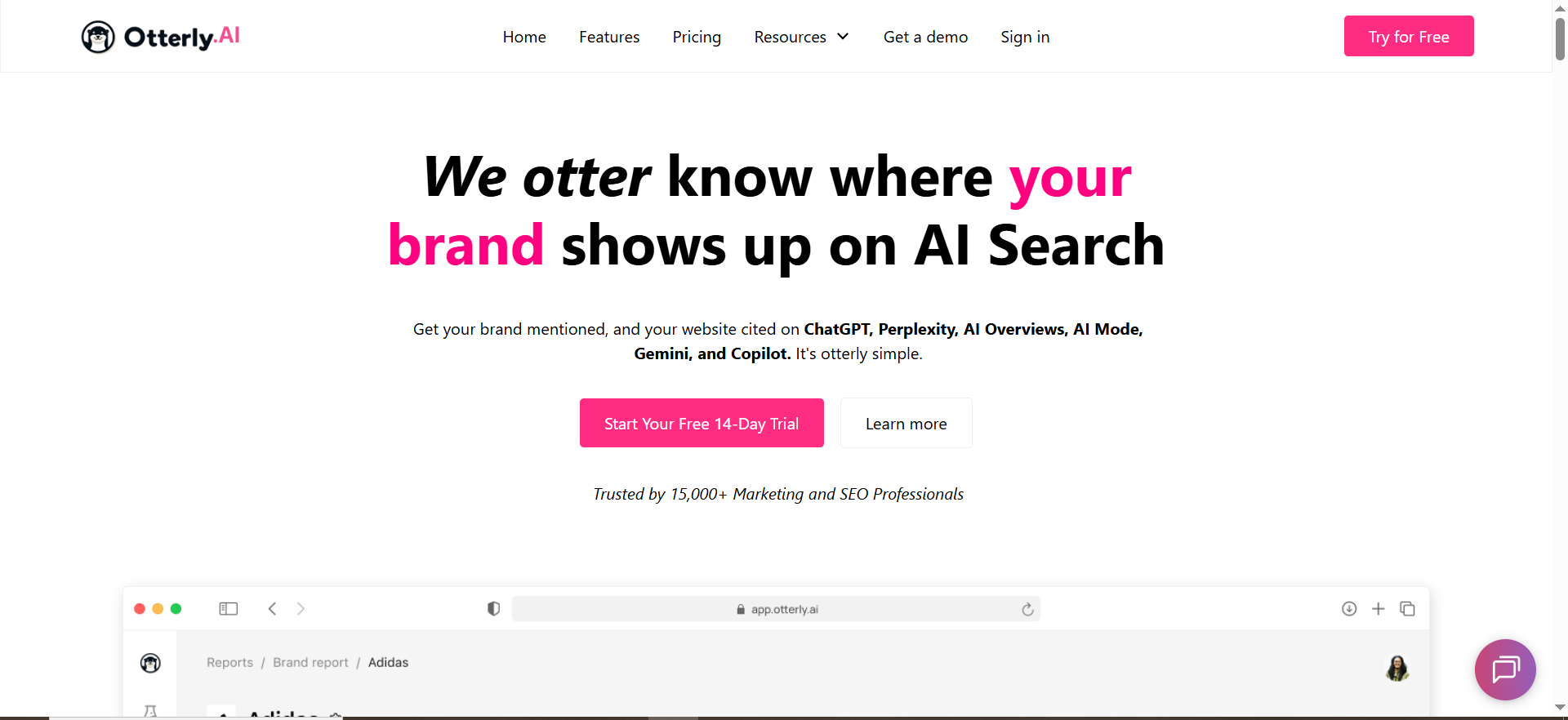
OtterlyAI describes an “AI visibility tracker approach” approach: you define search prompts that mirror real user queries, then the platform runs them across AI engines and analyzes answers for brand mentions, citations, and source links.
Why teams use it
OtterlyAI is built for the most common GEO reality:
- You can’t manually check 50 prompts across 5 engines every week.
- You need a consistent record of “did we show up, where, and with what citation?”
It also leans into broad coverage across assistants (its site and materials emphasize multiple AI search platforms).
What it’s good for
- Ongoing prompt monitoring with a dashboard that a non-technical marketer can use
- Visibility reporting across AI engines (important because one engine might love you while another ignores you)
- Agency workflows (workspaces, clients, recurring reporting), if that matches your operating model
When it’s a good fit
OtterlyAI is strong if you:
- want a straightforward “set prompts → monitor daily/weekly” loop
- need coverage across multiple AI surfaces
- want something easy enough to operationalize without building an internal data pipeline
When it’s not a good fit
It’s less ideal if:
- you need advanced experimentation mechanics (custom randomization, multi-run sampling controls, etc.)
- you want fully open-ended research workflows vs. a defined “prompt library” structure
- you have a very large variant matrix and cost-per-prompt scales sharply for your use case
How to use it for prompt variation testing
A reliable Otterly-style workflow looks like this:
- Start with 25 canonical prompts mapped to your revenue-critical intentsExamples:
- “Best [category] software for [persona]”
- “[your brand] vs [competitor]”
- “Does [your product] integrate with [integration]?”
- “Pricing for [your brand] / is it worth it?”
- For each canonical prompt, create 5–10 variants. This yields 125–250 prompts quickly—so you must be intentional.
- Monitor on a fixed cadence (daily for high-volatility categories; weekly for steady categories)
OtterlyAI’s help content describes that prompts can be automatically monitored daily after setup.
- Score winners by consistency, not one-off spikes
A variant that “wins once” is often just sampling noise—optimize for repeatability using AI visibility best practices.
Pricing
OtterlyAI publicly references pricing starting at $29/month and a free trial in some pages and third-party reviews.
⚠️ Treat third-party pricing as directional; confirm the current plans during purchase.
Free tier?
A free trial is commonly referenced; details can vary by channel.
Downsides / limitations
- Prompt-based pricing can make large variant testing expensive fast (if your methodology balloons without discipline).
- Like every tool in this category: if you don’t build a proper prompt taxonomy, you’ll end up with a dashboard full of noise.
Tool #3: Akii (best for visibility scoring + competitive prompts)
What it does
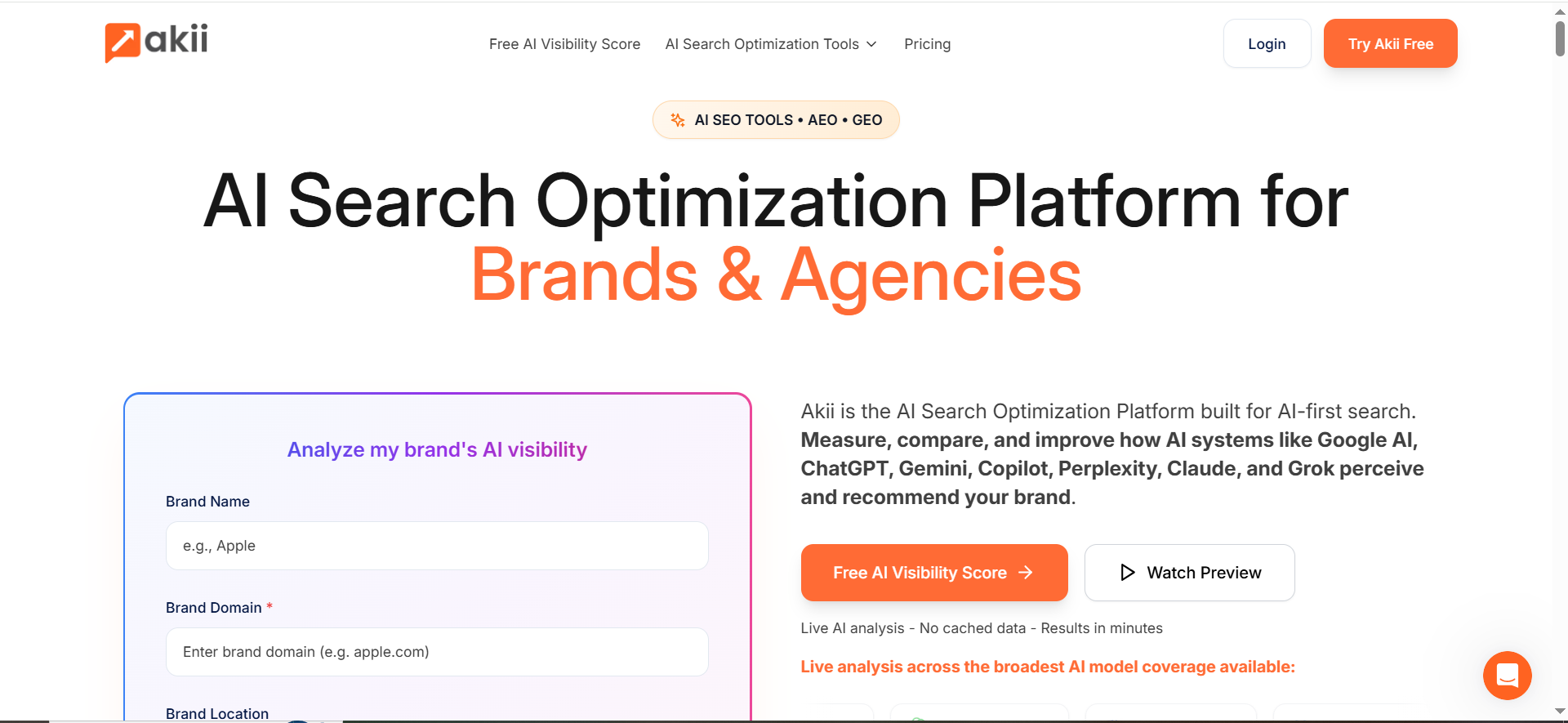
Akii markets an “AI Search Tracker” that queries multiple AI search engines and extracts brand mentions and citations into a dashboard with visibility scores and trends, including clarity on which prompts you “win or lose.”
Why teams use it
Two reasons:
- Speed to insight — teams want a quick “where are we visible?” baseline
- Exec readability — “visibility score + trends” is easy to communicate without a long methodology lecture.
Akii also promotes a “start tracking free / no credit card required” style entry point on its site.
What it’s good for
- Fast baseline audits: “Do we show up at all for our category prompts?”
- Competitive prompts: “Which competitors does AI recommend and why?” (great for positioning work)
- Turning AI visibility into a KPI that can live next to SEO metrics
When it’s a good fit
Akii is a good fit if:
- you want a quick-start tool and a clear scoreboard
- you need to brief leadership weekly/monthly
- you’re early in building your GEO program and want an accessible entry point
When it’s not a good fit
Not ideal if:
- you’re enterprise and need deep customization, governance, and very large scale monitoring
- you want a research-heavy “prompt discovery” system more than a tracking system
How to use it for prompt variation testing
Use Akii for “prompt variants as an SEO-style experiment”:
- Pick 10–20 core intents (your money intents)
- For each intent, create:
- 1 canonical prompt
- 5–10 variants
- 2–3 negative-control prompts (off-intent wording) to sanity check
- Compare “win/lose” patterns across variants as your goal is not to trick the model, it’s to learn what phrasing reliably produces:
- your brand mentioned
- your domain cited
- your product included in the “top options” list
- Turn variant winners into content actions.
- Example: If variants that mention “integration” trigger citations but “connects to” does not, your content and headings may need to mirror that entity language.
Pricing + free tier
Akii pushes “Start Tracking Free” messaging and “no credit card required” flows on its site pages. It has also been promoted publicly as offering a free AI visibility analysis experience.
Downsides / limitations
- Scoreboards are useful, but you still need to build the discipline of prompt clustering and variant design—otherwise you’ll chase the score instead of building durable visibility.
Tool #4: Profound (best for enterprise AI search intelligence + prompt volumes)
What it does
Profound positions itself around improving brand visibility across AI platforms by tracking visibility/rank and providing deeper insight into what people ask AI (including a “Prompt Volumes” feature), which matters if you’re building a serious GEO program.
Why teams use it
Profound is typically pulled in when:
- budgets exist for enterprise tooling
- teams want deeper discovery and trend intelligence, not just tracking a known list of prompts
- stakeholders want compliance/security assurances (Profound markets enterprise readiness and SOC 2 compliance).
What it’s good for
- Enterprise discovery: “what are the highest-value AI conversations in our space?”
- Trend intelligence and “prompt volume” style estimation (directional)
- Executive programs where AI visibility is becoming a core strategic metric
When it’s a good fit
Profound is a fit if:
- you’re mid-market/enterprise with a serious budget
- you need enterprise security posture
- you want more than a tracker—you want AI search intelligence
When it’s not a good fit
Not ideal if:
- you’re a startup just trying to run 100 prompts and get directional answers
- your main job is “monitor these prompts daily” rather than “discover new demand patterns”
How to use it for prompt variation testing
Profound becomes powerful when you blend variants + discovery:
- Use discovery tooling to identify the language people use in AI conversations
- Convert that into:
- canonical prompts (the clean “keyword” version)
- variants that match real phrasing styles (short, long, comparison-heavy, “what should I choose?” etc.)
- Score variants not only on “mentions,” but on citation quality—because that’s the difference between being referenced and being a source AI trusts.
If the winning variant earns citations from low-authority sources, you may not want to optimize around it.
Free tier?
Not typically positioned as a free-tier product; most references describe paid/enterprise-style access.
Downsides / limitations
- Cost and procurement overhead can be high relative to lighter tools.
- If you don’t have a team ready to operationalize insights (content, PR, technical), you can end up with expensive dashboards and slow impact.
Tool #5: Promptmonitor (best for fast GEO testing + transparency)
What it does
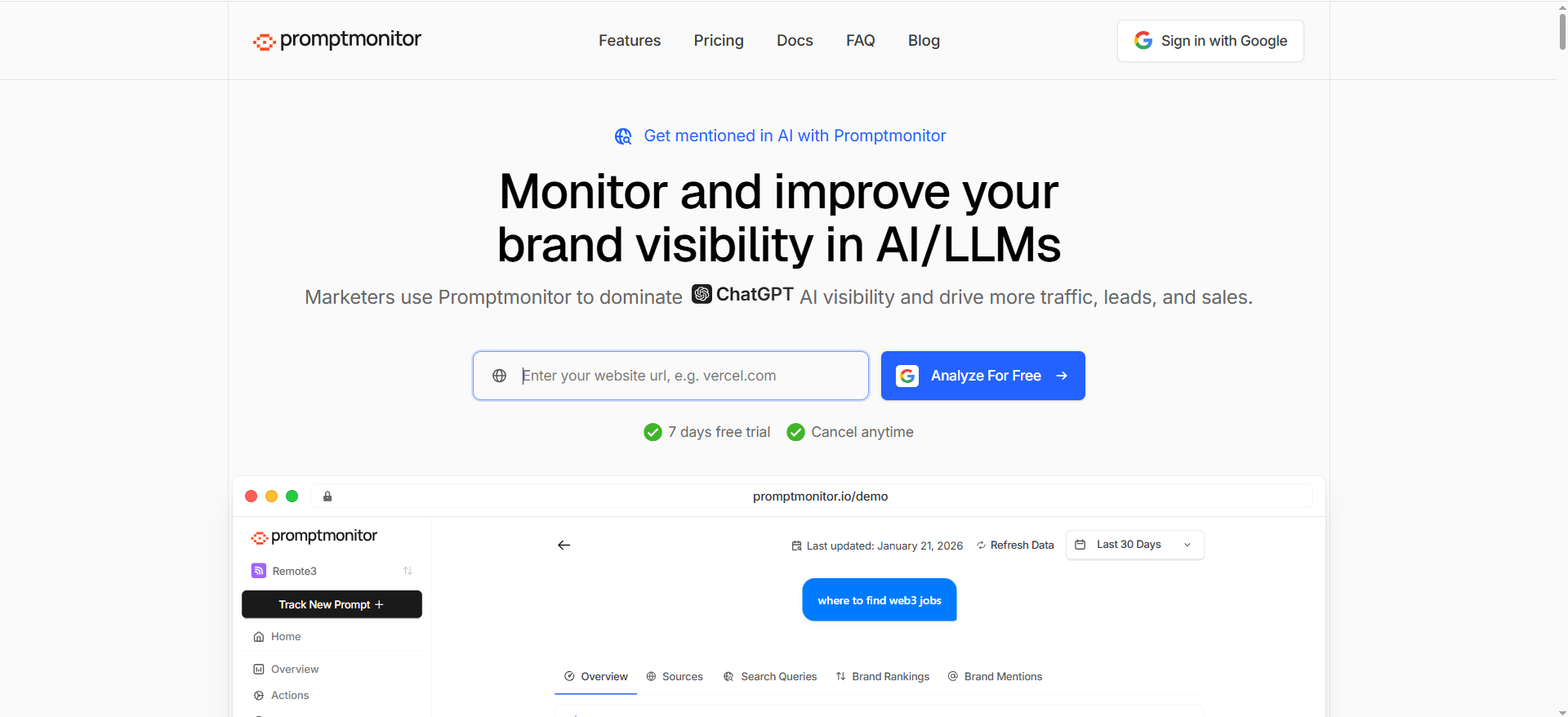
Promptmonitor markets itself as a GEO tool that monitors whether your company is mentioned in AI answers across major assistants, with quick analysis and trial access.
A useful conceptual detail: it defines a “response” as each generated AI answer per query across models (clear unit economics for heavy prompt testing).
Why teams use it
Promptmonitor is attractive when you want:
- fast onboarding (“analyze for free” style flow + rapid first report)
- a pragmatic “track prompts like keywords” experience
- clarity about what’s being counted (responses per query)
What it’s good for
- Scrappy experimentation: lots of prompts, frequent tests
- Teams that want transparency on sources/citations and opportunities
- Agencies that need quick initial audits to prove value
When it’s a good fit
Promptmonitor fits if:
- you’re building your prompt variant practice right now
- you want a clear, simple mental model for usage and reporting
- you care about multi-platform coverage (it lists multiple assistants it tracks)
When it’s not a good fit
Less ideal if:
- you need very advanced enterprise features, governance, or bespoke analytics layers
- you want deep discovery tooling like “prompt volume” estimation (Promptmonitor explicitly notes it does not provide prompt volume like keyword volume).
How to use it for prompt variation testing
If you want a clean, repeatable process, do this:
- Pick your canonical prompts
- 10 category prompts (top-of-funnel)
- 10 comparison prompts (mid-funnel)
- 10 decision prompts (“best for X”, “alternatives”, “pricing”)
- Build variants in three “styles”
- Short: “Best AI visibility tool for prompt variants?”
- Natural: “Which tool helps me test different wordings and measure citations?”
- Constraint-based: “Best AI visibility tool for prompt testing—budget under $200/mo?”
- Run multi-sampling when possible: Some platforms (or workflows) reduce false negatives by sampling multiple responses because AI outputs vary. Promptmonitor has been described publicly as using multi-sampling in its approach (in third-party commentary). (If your chosen tool doesn’t offer it, you can simulate it by re-running prompts multiple times and averaging.)
- Extract and act on citations: Promptmonitor emphasizes showing sources and links in context; use that to
- target “source pages” AI is citing
- build content that competes with those sources
- pursue outreach/PR to become a cited source
Pricing + free tier
Promptmonitor mentions a 7-day free trial on its site.
Downsides / limitations
- Like any tool that runs prompts, results can be influenced by model drift, geo, and sampling conditions. Your internal methodology matters as much as the UI.
How prompt variation testing works (treat prompts like SEO keywords)
Here’s the framework that makes “same intent, different wording” testing actually useful.
1) Canonical prompt vs. variants (same intent)
- Canonical prompt = the clean, “keyword-like” phrasing that names the topic directly.
- Variants = real-world phrasing patterns that map to the same intent but differ in:
- length
- specificity
- constraints (budget, region, industry)
- comparison language (“vs,” “alternatives,” “best for”)
- entity inclusion (features, integrations, standards)
🔑 Why this matters? AI systems may respond differently when a prompt includes certain entities (“citations,” “AI Overviews,” “GEO”), even when the underlying intent is identical.
2) Prompt clustering (intent buckets)
You can’t evaluate variants one by one forever. The sustainable move is to cluster prompts like you cluster keywords.
A simple clustering model:
- Intent cluster (the “same intent” umbrella)
- Persona (SEO Manager vs. CMO vs. founder)
- Funnel stage (learn vs. compare vs. decide)
- Entity modifiers (citations, pricing, multi-engine, dashboards)
- Geo/language (if relevant)
Once you have clusters, you can answer higher-level questions:
- “Which intent clusters do we consistently win?”
- “Which clusters are volatile and need attention?”
- “Which entity modifiers correlate with citations?”
3) What to score (the metrics that actually matter)
Most teams over-index on “did we get mentioned?” and miss the point. For AI visibility, you want layered scoring:
A) Presence / mention rate
How often does your brand appear in the answer at all?
B) Citation rate
How often does the answer cite your website/domain (or a page you control)?
C) Positioning / prominence
- Are you listed as a top option?
- Are you the default recommendation or an afterthought?
D) Sentiment / framing
- Are you recommended for the right use case?
- Is pricing described accurately?
- Are competitors positioned above you?
E) Cross-model consistency
A mention that only happens in one model is fragile. You want consistency across engines.
❗ Promptmonitor even describes a “Visibility Score” concept built from presence rate and cross-model consistency in its FAQ, which aligns with this layered approach.
4) Handling randomness (multi-run sampling)
AI outputs vary. That means a single run per prompt can lie to you.
A simple rule:
- For important prompts, do 3–5 runs per prompt variant (over time or immediately) and average outcomes.
- If a tool supports multi-sampling (or you can simulate it), you’ll reduce false negatives where you “sometimes” get mentioned.
A step-by-step workflow you can copy (prompt variants, clustering, diffing, scoring)
This is the operational “engine room.” If you implement nothing else, implement this.
Step 1: Build a prompt-variant matrix (template)
Create a table like this (in Sheets/Notion/your tool tags):
| Cluster | Canonical prompt | Variant | Entities included | Persona | Funnel |
|---|---|---|---|---|---|
| prompt_variation_testing | Best AI visibility tools for prompt variation testing | Which tools help test prompt wording to win AI citations? | citations, tools | SEO Manager | Compare |
| prompt_variation_testing | (same) | What’s the best GEO platform to track prompt variants across AI answers? | GEO, tracking | Head of Growth | Compare |
| prompt_variation_testing | (same) | How do I measure which prompt phrasing gets my brand mentioned in ChatGPT? | ChatGPT, mentions | CMO | Learn |
| prompt_variation_testing | (same) | Best AI search monitoring tools for prompt experiments | monitoring, experiments | SEO Manager | Decide |
Aim for:
- 1 canonical + 10–20 variants per cluster (to start)
- 10–20 clusters total for a real program (eventually)
Step 2: Run tests across platforms (and geos if relevant)
Run every variant across ChatGPT and Perplexity-style engines (and Google AI Overviews / AI Mode surfaces where supported).
Tools in this category commonly market multi-engine monitoring as a core value.
Step 3: Diff responses (what changed and why)
Diffing is the fastest way to see what wording triggered your inclusion/exclusion, different cited sources, different competitor ranking/order, and different product claims (often inaccurate), which is why teams formalize an LLM visibility audit.
Practical method:
- Save the full response text for each run
- Extract:
- brand mentions
- cited domains/URLs
- “top list” ordering if present
- Compare the winners vs. losers and ask:
- Which entity language is present in winners?
- Do winners match your on-site headings/entities better?
- Are winners pulling citations from sources you’re not in?
Step 4: Score outcomes (simple, actionable scoring)
Keep it simple so teams actually use it:
Variant Score (0–100) =
- Mention present (0/40)
- Your domain cited (0/30)
- Prominence (0/20)
- Cross-model consistency (0/10)
You can refine later, but don’t start with a 30-metric monstrosity.
Step 5: Turn results into actions (this is where ROI comes from)
For each cluster, take the top 2 winning variants and do:
A) Content actions
- Add missing entity coverage to key pages
- Update headings to mirror winning phrasing patterns
- Add structured sections that AI can cite (definitions, comparisons, FAQs, tables).
B) Authority actions
- Identify the domains AI cites when you lose.
- Build a “source targeting” list (outreach, PR, partnerships, guest posts, citations).
C) Product/messaging actions
If AI consistently misstates pricing, integrations, or category positioning, then your site likely lacks a clean, citable source of truth—and that’s where content engineering becomes a growth lever.
📋 Get Listed / Advertise
We update this guide monthly. Want your tool featured? Contact: [email protected].
Common pitfalls (and how strong teams can avoid them)
Pitfall 1: Testing prompts without controlling conditions
If your results swing wildly, check time of day, geo settings, and personalization/logged-in states.
Fix: standardize testing conditions as much as your tool allows, and measure trends, not one-offs.
Pitfall 2: Overfitting to one model
Being “visible” in one assistant is nice; being visible everywhere is revenue.
Fix: optimize for cross-model consistency as a first-class metric (not a nice-to-have).
Pitfall 3: Measuring mentions but ignoring citations
Mentions build awareness; citations build traffic and proof.
Fix: treat “domain cited” as a separate, weighted metric in your scoring.
Pitfall 4: Treating prompt testing as a one-time project
AI answers drift—your content needs to stay evergreen and citable.
Fix: move from “audit” to “monitoring.” The tools above are built around recurring prompt runs and dashboards.
What is prompt variation testing for AI visibility (GEO/AEO)?
Prompt variation testing is the practice of taking one underlying user intent (e.g., “recommend the best AI visibility tool”) and rewriting it into multiple prompts with different wording, then measuring how those wording changes affect what AI systems return—especially:
- Whether your brand is mentioned
- Whether your site is cited/linked
- Where you appear in lists or recommendations
- How you’re framed (positioning + sentiment)
- Which competitors show up instead of you
- Which sources the model relies on
In classic SEO, you’d do this with keywords and SERP rankings. In AI visibility, you do it with prompts and answer outcomes.
Why “same intent, different wording” matters
Even when intent is identical, prompt wording can change the answer because it changes:
- Entities included (“citation,” “comparison,” “enterprise,” “budget,” “integrations”)
- Task framing (“recommend” vs “compare” vs “summarize pros/cons”)
- Constraints (region, industry, compliance, pricing limits)
- Expected output format (“top 5 tools,” “decision matrix,” “step-by-step”)
Those differences can alter:
- Which sources are retrieved or synthesized
- Which brands are deemed “relevant”
- Whether the model feels compelled to cite sources
- The ordering and prominence of recommendations
GEO vs AEO in one sentence each
- GEO (Generative Engine Optimization): optimizing your brand/content so generative systems include and recommend you across AI answers.
- AEO (Answer Engine Optimization): optimizing so your content becomes the source used in answers, often emphasizing citations, structured explanations, and extractable content.
Prompt variation testing supports both: GEO (presence + positioning) and AEO (citations + source capture).
What a prompt-variant set looks like
Let’s say the intent is: “Find the best AI visibility tools for testing prompt variants.”
- Canonical: “Best AI visibility tools for prompt variation testing”
- Variants:
- “Which tools help me test different prompt wordings and track citations?”
- “How can I measure brand mentions in ChatGPT for the same query phrased differently?”
- “Best GEO platforms to monitor prompt variants across AI search engines”
- “AI answer tracking tools for citation rate and share of voice”
All of these share the same intent, but the entity language and constraints differ—so AI outputs can differ meaningfully.
The goal (what you’re actually trying to learn)
Prompt variation testing isn’t “prompt hacking.” It’s learning:
- Which wording patterns reliably surface your brand
- Which patterns drive citations to your domain
- Which prompts trigger competitor wins (and why)
- Which source domains repeatedly appear (your “citation ecosystem”)
- What content gaps you have, based on what the model prefers to cite
What’s the best scoring model for prompt variants (mention rate vs. citation rate)?
A good scoring model does two things:
- Balances visibility (being included) with value (being cited/recommended)
- Avoids false confidence from one-off wins (sampling noise)
If you only score mention rate, you’ll optimize for “we show up” without traffic, proof, or authority. If you only score citations, you’ll miss that you’re often recommended without a link (still meaningful for pipeline).
The best “default” model: weighted composite score (0–100)
Here’s a simple scoring model that works well across most B2B categories:
Prompt Variant Score (0–100)
- Brand mention presence (0–30)
- 0 = not mentioned
- 15 = mentioned once, low prominence
- 30 = clearly included as a recommended option
- Citation to owned property (0–35)
- 0 = no citation
- 20 = cited but not primary
- 35 = cited as a primary/authoritative source
- Prominence / positioning (0–20)
- 0 = buried / negative framing
- 10 = mid-list, neutral
- 20 = top-tier recommendation or “best for X” framing
- Consistency (0–15)
- 0 = appears sporadically
- 8 = appears in ~50% of samples/engines
- 15 = stable across samples/engines/time
This avoids the “mention vs citation” fight by recognizing they’re different layers of the same outcome.
When to weight citations higher (AEO-heavy teams)
If your KPI is traffic + attributable conversions, make citations heavier:
- Mention: 20
- Citation: 45
- Prominence: 20
- Consistency: 15
When to weight mentions higher (GEO-heavy teams)
If your KPI is category presence + brand consideration:
- Mention: 40
- Citation: 25
- Prominence: 20
- Consistency: 15
Add-ons that improve scoring (optional, but powerful)
If your team is mature, add two extra dimensions:
1) Citation quality (0–10 bonus)
- Bonus if the citation is to:
- your product page / category page
- your definitive guide / glossary
- a stable “source of truth” page (pricing, integrations, compliance)
- Smaller bonus (or none) if citation goes to:
- random blog pages that don’t convert
- pages that are outdated or thin
2) Competitor displacement (0–10 bonus)
- Bonus if your inclusion pushes out a key competitor in “top tools” style answers.
How to compute “mention rate” and “citation rate” correctly
You’ll get cleaner data if you compute at the intent-cluster level, not just prompt level.
For an intent cluster with 20 variants:
- Mention rate = (# variants where you’re mentioned) / (total variants)
- Citation rate = (# variants that cite your domain) / (total variants)
Then compare:
- canonical vs variants
- variant “styles” (short vs natural vs constraint-based)
- entity modifiers (“citations” included vs not)
Handling randomness: score on averages, not single runs
For high-stakes clusters, run 3–5 samples per variant (or across multiple days). Score using averages like:
- Avg mention rate across runs
- Avg citation rate across runs
- Consistency score based on variance
A variant that wins once but fails four times should never outrank a stable performer.
What’s the best cadence (daily, weekly, monthly) for monitoring variants?
The best cadence depends on volatility + revenue impact + risk. AI answers drift due to model updates, new content on the web, competitor publishing, and platform changes. Your monitoring cadence should match how painful it is to be wrong or absent.
The practical cadence model most teams settle on
- Daily for: “Money prompts” + reputational risk
- Weekly for: core category + comparison clusters
- Monthly for: long tail + informational clusters
That gives you coverage without burning budget on constant runs for prompts that rarely change.
When to monitor daily
Use daily monitoring if the cluster is:
- Directly revenue tied
- “Best [category] software”
- “[your brand] pricing”
- “[your brand] alternatives”
- “[brand] vs [competitor]”
- High competitive churn
- categories where new players publish weekly
- High risk
- prompts that trigger inaccurate pricing, compliance, security claims
- prompts where negative framing can spread quickly
Daily is also smart for the top ~10–30 “executive prompts” you report upward.
When weekly is best
Weekly is the sweet spot for most teams because it:
- captures meaningful drift
- reduces noise from daily randomness
- keeps reporting cycles manageable
Weekly monitoring is ideal for:
- mid-funnel comparison clusters
- feature/integration prompts
- persona-specific prompts (CMO, IT, RevOps)
- “best for X” prompts (industry verticals)
When monthly is enough
Monthly is fine for:
- stable informational clusters (“what is GEO?”, “how does AEO work?”)
- evergreen glossary topics
- long-tail variants that rarely change
- early-stage clusters you’re not actively optimizing yet
Monthly also works as a “health check” for breadth: are we broadly present across the landscape?
A cadence you can copy (simple, effective)
If you want a concrete rule set:
- Identify your Top 20 Money Prompts → run daily
- Identify your Top 100 Strategic Prompts (category + comparisons + integrations) → run weekly
- Everything else in your prompt library → run monthly
- Reclassify prompts quarterly based on:
- pipeline influence
- volatility
- observed drift
A note on cost control (variant explosion is real)
Prompt variation testing can balloon fast. Cadence is how you keep it sane:
- Keep 3–5 champion variants per intent cluster for ongoing monitoring
- Archive the rest after the experiment
- Re-run the full variant set only when:
- you ship major content changes
- a model/platform update changes results materially
- competitors make major moves
Don’t forget event-based monitoring
Beyond schedules, add “triggered” checks when:
- you launch a major page / report
- you rebrand or change messaging
- a competitor raises funding or launches a big campaign
- you see sudden drops in mention/citation rates on key clusters
FAQs
What is prompt variation testing in AI visibility (GEO/AEO)?
Why does “same intent, different wording” change AI answers so much?
How many prompt variants should I test per intent cluster?
How do I handle randomness in AI outputs?
Should I track prompts daily or weekly?
What’s the difference between a prompt monitoring tool and a “prompt evaluation” tool?
What’s the biggest mistake teams make with AI visibility tools?
Final next step
If you’re serious about prompt variation testing, don’t start by buying a tool. Start by building:
- 10 intent clusters
- 1 canonical + 10–20 variants each
- a scoring model that weights citations and consistency
Then pick the tool that matches your operating model (in-house vs. agency, scrappy vs. enterprise, monitoring vs. discovery).
📋 Get Listed / Advertise
We update this guide monthly. Want your tool featured? Contact: [email protected].