
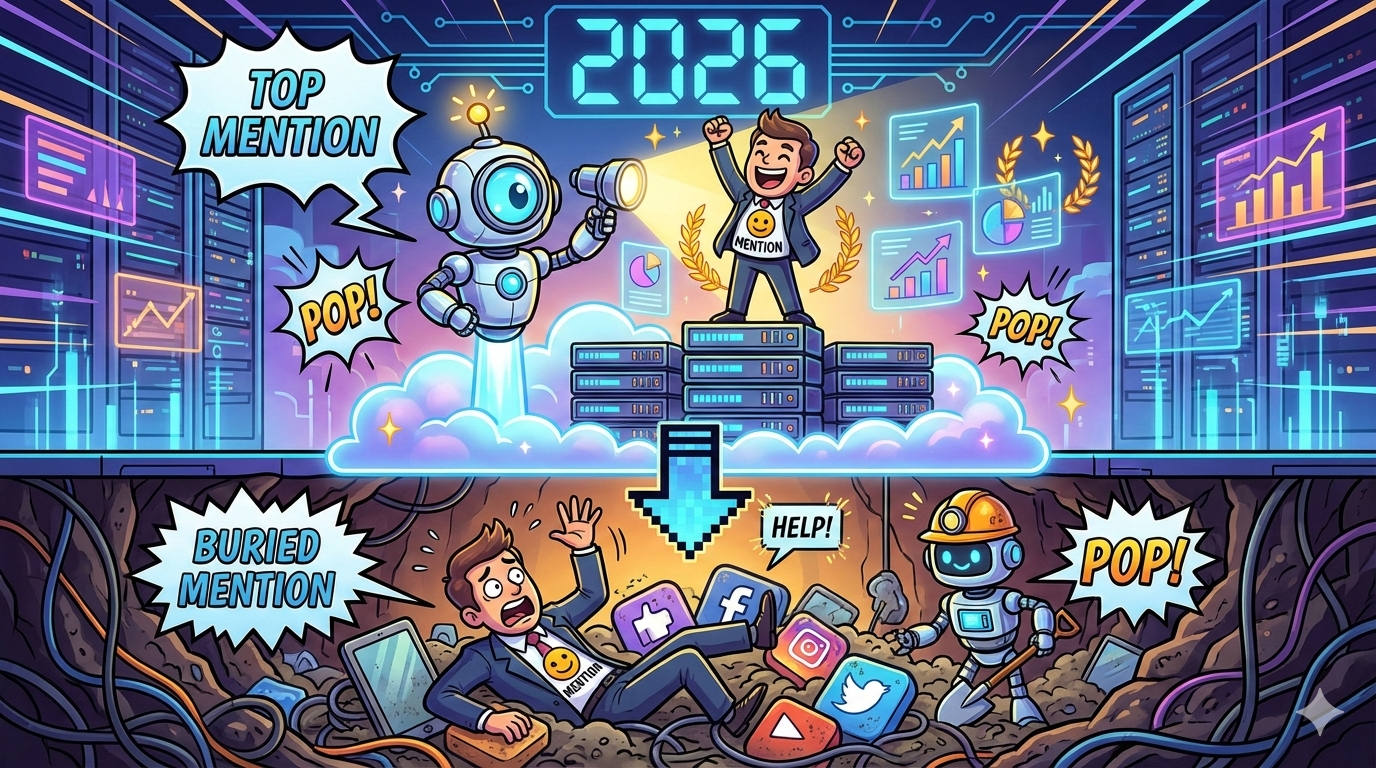
If you’re already tracking whether your brand is mentioned in AI answers, the next step is tracking where you appear: top-of-answer, top-of-list, or buried.”Attention is not evenly distributed inside an AI answer, so you need AI visibility metrics that capture “top vs buried,” not just presence.
In this guide, I’ll compare Peec, OtterlyAI, Profound, Rank Prompt, and Promptmonitor, then give you a simple Weighted Prominence Score you can implement in any report, especially if you’re building an AI visibility tracking workflow.
📋 Get Listed / Advertisement
We update this guide monthly. Want your tool featured? Contact us: [email protected].
Best AI Visibility Tools for Mention Position/Prominence (Quick Comparison)
| Tool | Best for | Prominence / position signals | Pricing snapshot* |
|---|---|---|---|
| Peec | Teams wanting prompt-based tracking + dashboards | Prompts + visibility monitoring; useful base for prominence scoring | Pricing page shows plans starting around €89/mo* |
| OtterlyAI | Small teams/agencies wanting broader AI monitoring + citations | Tracks brand mentions + citations; supports rank tracking concepts | Site notes pricing starts around $29/mo* |
| Profound | Enterprise programs needing governance + deep insight | “How AI mentions your brand” + citation insights; enterprise focus | Official site: custom enterprise pricing* |
| Rank Prompt | Lightweight GEO/AEO monitoring, competitor positioning | Explicitly discusses tracking how you’re positioned vs competitors | Directory examples cite tiers (e.g., $49/mo+)* |
| Promptmonitor | Tracking rank/position in AI lists + prompt monitoring | Review sources describe tracking rank and position in AI-generated lists | Some directories list starting ~$99/mo* |
📋 Get Listed / Advertisement
We update this guide monthly. Want your tool featured? Contact us: [email protected].
1. Peec
Peec positions itself around turning “AI search insights” into outcomes by helping teams identify prompts, monitor results, and act on changes.
What it does
Peec focuses on prompt-driven tracking, “prompts are the foundation”, and monitoring visibility in AI search contexts.
Why teams use it
f you’re building a GEO/AEO reporting cadence, you need repeatable prompt runs and a way to see movement over time, especially when you’re reporting AI visibility to leadership Peec’s positioning is aligned with that “monitor before competitors do” workflow.
What it’s good for
- Establishing a baseline prompt set (your “money prompts”)
- Running scheduled tracking and building a weekly/monthly visibility narrative
- Acting as the backbone dataset for a custom prominence score (like WPS)
When it’s a good fit
- You want a structured workflow: prompt set → monitoring → reporting → action
- You want to operationalize “top vs buried” with your own scoring model, even if the UI metric is more general visibility/ranking
When it’s not a good fit
- You need enterprise governance controls (SSO, compliance) as a default requirement
- You need highly customized data pipelines/API-first workflows (depends on plan/support)
How to use it for “top vs buried”
- Build a prompt library focused on high-intent queries (e.g., “best [category] tool for [use case]”)
- For each prompt, record:
- whether you’re mentioned
- whether you appear in the first section / shortlist
- whether you’re top-ranked in a list
- Apply the WPS model in a spreadsheet or BI layer if the platform doesn’t provide a native prominence metric.
Key capabilities to look for
On its pricing page, Peec highlights daily prompt runs and limits based on number of prompts tracked (plan-dependent).
Pricing
Peec’s pricing starts at €89/month.
Free tier?
Peec doesn’t clearly advertise a free tier; its pricing page says “Start for free.”
Downsides / limitations
- You may still need custom logic (WPS) for “prominence” if you want a defensible “top vs buried” metric across engines.
- Like all AI monitoring, outputs can be volatile, plan for QA sampling.
2. OtterlyAI
OtterlyAI markets itself as an AI search monitoring platform with capabilities spanning prompt research, citation tracking, and monitoring brand mentions across AI surfaces like ChatGPT, Perplexity, and AI Overviews.
What it does
OtterlyAI describes running prompts across multiple AI engines and analyzing responses for brand mentions and citations, including tracking how mentions shift over time.
Why teams use it
Teams that are early in GEO/AEO often need an affordable, practical “visibility baseline” plus evidence they can show clients or stakeholders. OtterlyAI’s messaging emphasizes monitoring mentions + citations and providing reporting structures.
What it’s good for
- Monitoring mentions + citations (useful for “prominence” context)
- Building recurring reports for clients (especially agencies)
- Creating prompt libraries from keyword themes (useful for scaling prompt sets)
When it’s a good fit
- You want a tool that explicitly frames the problem as monitoring prompts and extracting mentions/citations
- You want to pair monitoring with action: content updates, PR targets, optimization workflow
When it’s not a good fit
- You need enterprise security/compliance features as non-negotiables
- You require very bespoke scoring or data pipeline integrations (depends on your workflow)
How to use it for “top vs buried”
- Track prompts that tend to return ranked lists (e.g., “best X tools”).
- For each run, label your mention as:
- Top-of-answer
- In shortlist list (and list position)
- Buried (late mention / alternatives / footnote)
- Use exports to compute WPS per prompt cluster.
Key capabilities
OtterlyAI’s features page describes an “AI visibility toolkit,” including rank tracking and citation monitoring concepts.
Pricing
OtterlyAI’s pricing starts at $29/month.
Free tier?
OtterlyAI doesn’t offer a free tier, but it does offer a free trial.
Downsides / limitations
- For strict “mention prominence,” you’ll still want a consistent rubric (like WPS) so reports don’t devolve into screenshots and anecdotes.
- Coverage and scoring definitions can vary across tools, validate with manual spot checks.
3. Profound
Profound positions itself as an enterprise-oriented platform to track AI visibility, analyze what AI says about your brand, and uncover citations/sources.
What it does
Profound emphasizes:
- Tracking how often your brand appears in AI answers
- Analyzing AI responses
- Uncovering citations/sources that influence those answers
Why teams use it
Enterprise GEO/AEO programs usually need:
- cross-team reporting
- governance/compliance posture
- repeatability (systems, not one-off tests)
Profound’s site explicitly pitches enterprise readiness and security posture.
What it’s good for
- Enterprise-level AI visibility monitoring programs
- Governance/security-sensitive environments (where “random tools” won’t pass procurement)
- Deep analysis of “what AI is saying,” which supports qualitative prominence interpretation
When it’s a good fit
- You’re an enterprise brand and need controls, support, and reliability
- You want to connect visibility metrics with how AI describes you and which sources shape that narrative
When it’s not a good fit
- You want a lightweight, inexpensive tool to start experimenting
- You mainly need basic mention tracking (you may be overbuying)
How to use it for “top vs buried”
- Focus on a small set of exec-relevant prompts (category, alternatives, “best for enterprise,” “best for security/compliance,” etc.)
- Build dashboards that show:
- appearance frequency
- competitor overlap
- prominence classification using your rubric
- Maintain an evidence log for major narrative shifts (e.g., “AI now describes us as X”)
Key capabilities
Profound explicitly mentions tracking presence and uncovering citations in AI answers.
Pricing
Pricing starts at $99 per month.
Free tier?
Profound doesn’t offer a free tier, but it does offer a demo.
Downsides / limitations
- Likely not the cheapest entry point.
- If your biggest gap is simply “we don’t have a prominence rubric,” you might be able to start with a lighter tool + WPS first.
4. Rank Prompt
Rank Prompt frames AI visibility as how often, and how prominently, your brand appears in AI assistant responses, and it explicitly describes analyzing how your brand is positioned relative to competitors.
What it does
Rank Prompt’s FAQ describes:
- querying major AI platforms with prompts
- analyzing responses to determine whether your brand is mentioned
- assessing positioning relative to competitors
- seeing what sources the AI is citing
That competitor-relative positioning language is directly relevant to “top vs buried.”
Why teams use it
Because prominence is inherently comparative. If you’re “mentioned,” but competitors are top-of-answer, you’re still losing the recommendation moment.
What it’s good for
- AEO-style tracking where prompts map to buying intent
- Competitor benchmarking around positioning
- Building a repeatable “prominence report” without a heavy enterprise platform
When it’s a good fit
- You want something purpose-built for prompt-based monitoring and visibility positioning
- You’re an agency/founder/SEO team building a repeatable GEO workflow
When it’s not a good fit
- You need the deepest enterprise governance requirements
- You need support for highly custom internal data infrastructure (depends on offering)
How to use it for “top vs buried”
- Create prompt sets that force ranked outputs (“top 5,” “best,” “recommend,” “alternatives”).
- Track:
- mention presence
- competitor presence
- relative positioning
- Apply WPS: Rank Prompt can provide positioning insight, while your rubric standardizes reporting across engines.
Key capabilities
Rank Prompt explicitly discusses analyzing positioning vs competitors and tracking citations.
Pricing
Rank Prompt’s pricing starts at $49/month.
Free tier?
Rank Prompt doesn’t offer a free tier, but it does offer a 7-day free trial.
Downsides / limitations
- As with all tools, definitions of “position” can vary: list rank vs paragraph placement vs “recommendation strength.” Use a consistent rubric.
5. Promptmonitor
PromptMonitor is positioned as a GEO tool to help marketers track and optimize brand visibility across multiple AI/LLM platforms.
Most importantly for this post, a review source describes it as tracking rank and position in AI-generated lists, which maps directly to “top vs buried.”
What it does
PromptMonitor is described as helping track visibility across AI/LLMs and optimize performance.
Why teams use it
Because many high-intent prompts produce list outputs, and list rank is the most intuitive “prominence” signal for stakeholders (“we’re #2 vs #7”).
What it’s good for
- Tracking prompt performance for list-based queries (“best tools…”, “top platforms…”)
- Monitoring position/rank signals and (in some descriptions) geo-level performance
- Building a routine monitoring cadence for GEO programs
When it’s a good fit
- Your core prompts naturally generate ranked lists
- You want position/rank framing to communicate progress internally
When it’s not a good fit
- You need a full enterprise governance platform
- You need a tool with extensively documented primary-source feature specs (some info is via directories/reviews, so verify)
How to use it for “top vs buried”
- Build a “list prompt pack” (e.g., “best [category] tools for [persona],” “top [category] platforms for [industry]”).
- Track list rank and changes over time.
- Pair rank with recommendation strength (WPS) so you’re not blind to cases where you’re ranked but described negatively.
Key capabilities
A review source describes tracking rank and position in AI-generated lists and mentions geo-level monitoring.
Pricing
Promptmonitor’s pricing starts at $29/month.
Free tier?
Promptmonitor doesn’t offer a free tier, but it does offer a 7-day free trial.
Downsides / limitations
- If your prompts produce long-form narrative answers rather than lists, you’ll rely more on placement/strength metrics (WPS) than list rank.
What “mention position” and “prominence” mean in AI answers (and why it matters)
Most AI visibility tracking starts (and sadly ends) at a binary metric:
- Mentioned ✅
- Not mentioned ❌
That metric is useful, but it hides the most important reality: attention is not evenly distributed inside an AI answer.
Mention position (the measurable “where”)
Mention position is the location of your first meaningful appearance in the answer. Depending on the answer format, that “location” can be measured in a few ways:
- Token/character offset: how far into the answer before your brand appears
- Paragraph index: is it in paragraph 1, 2, 6…?
- List rank: if the answer is “Top tools…”, are you #1, #2, or #9?
- Heading/section placement: are you in the main recommendations or a late “alternatives” section?
Prominence (the practical “how visible”)
Prominence combines position with emphasis. Two brands can appear in the same paragraph, but one is clearly “the pick” and the other is an aside.
Prominence typically reflects:
- Placement: top-of-answer vs buried
- Recommendation strength: “best choice” vs “also worth mentioning”
- List inclusion: in the main shortlist vs not
- Context: aligned to the user’s intent vs generic mention
- Citations/sources nearby: whether the model anchors the mention with references (varies by engine)
Why “top vs buried” changes business outcomes
If your brand is buried, you get: weak recall, fewer follow-up questions, and less downstream demand, even if you’re technically “visible,” which is why teams invest in tools tracking brand visibility in AI search.”
That’s why the spreadsheet angle for this topic is spot-on: “Prominence matters” scoring + screenshot evidence.”
The TRM Weighted Prominence Score (WPS): a simple model you can implement
The spreadsheet’s “ideal angle” for this post is essentially a promise: don’t just review tools, ship a scoring model your readers can copy into their reporting.
Here’s a practical model that works even if your tool doesn’t natively expose a “prominence” metric.
Step 1: Define the unit of analysis
You want scores at three levels:
- Prompt-run score (one prompt, one engine, one run)
- Prompt score (aggregate across runs)
- Theme score (aggregate across related prompts, e.g., “alternatives”, “best for enterprise”, “pricing”)
Step 2: Calculate component scores (0–1)
Use these components:
A) Placement Score (0–1)
How early does your first meaningful mention appear?
- 1.0 = first 20% of answer
- 0.7 = 20–40%
- 0.4 = 40–70%
- 0.2 = 70%+
- 0.0 = not mentioned
B) List Rank Score (0–1)
If the answer contains an ordered list of recommendations:
- 1.0 = #1
- 0.8 = #2
- 0.6 = #3
- 0.4 = #4–#5
- 0.2 = #6+
- If no list exists, set to 0.5 only if you’re clearly recommended in prose (otherwise 0.0).
C) Recommendation Strength Score (0–1)
Classify the language around your brand:
- 1.0 = “best”, “top pick”, “recommended”
- 0.6 = neutral (“X is an option…”)
- 0.3 = weak (“X could work…”)
- 0.0 = negative (“avoid X”, “not ideal”)
D) Citation Proximity Score (0–1)
If the engine provides citations/links, assign:
- 1.0 = cited near your mention (or your domain cited)
- 0.5 = citations exist but not near your mention
- 0.0 = no citations / not supported
E) Consistency Score (0–1)
Across the last N runs (e.g., 7 or 30), how often are you “top vs buried”?
- 1.0 = consistently top placement
- 0.5 = volatile
- 0.0 = consistently absent
Step 3: Compute the Weighted Prominence Score (0–100)
A simple weighting:
WPS = 100 × (0.35×Placement + 0.25×ListRank + 0.20×Strength + 0.10×Citation + 0.10×Consistency)
Why these weights?
- Placement + list rank are the most direct “top vs buried” measures (60% total)
- Strength matters because being #3 but called “best value” can outperform #2 in practice
- Citations and consistency make the score more defensible in exec reporting
Step 4: Report “Top vs Buried” as a distribution, not a single number
Alongside WPS, report:
- % runs in Top zone (Placement ≥ 0.7 OR ListRank ≥ 0.6)
- % runs in Mid zone
- % runs Buried
- % runs Absent
This is where the “screenshot evidence” promise becomes real: you can attach a small evidence gallery per prompt cluster.
How to evaluate tools specifically for “top vs buried” tracking
A lot of AI visibility tools will claim “tracking” without giving you enough signal to measure prominence, which is why it helps to use an AEO tools checklist.
1) Do they store the full answer as evidence?
You need raw logs to validate what the model actually said and to show stakeholders proof.
2) Do they support scheduled prompt runs?
Your SOP calls out prompt-based monitoring and consistent coverage as core workflow inputs (fan-out + evidence hooks + repeatable modules).
3) Can you compare competitors with the same answer?
Prominence is relative. The best story is “we moved from #6 to #2, ahead of X and Y.”
4) Do they handle entity disambiguation?
If your brand name is ambiguous, you need controls to reduce false positives.
5) Can you export reports and evidence logs?
Without exports, it’s hard to operationalize: dashboards, client reporting, internal QA, and governance.
6) Do they cover the engines your buyers use?
Some tools emphasize ChatGPT; others add Perplexity, Gemini, AI Overviews, and more. Coverage matters more than fancy charts.
Common pitfalls
Pitfall 1: Treating one run as truth
AI answers are stochastic and can shift. You need scheduled runs and aggregated reporting.
Fix: Use rolling averages and a consistency score.
Pitfall 2: Over-indexing on list rank only
Some engines produce lists; others produce narrative. Even list-based engines may switch formats.
Fix: Pair list rank with placement + strength (WPS).
Pitfall 3: False positives from ambiguous brand names
If your name is a common noun or overlaps with other brands, you’ll get noisy data.
Fix: Track “mention with context” (near category terms) and manually sample.
Pitfall 4: Ignoring competitor positioning
Your execs don’t care that you’re “mentioned” if the competitor is the top pick.
Fix: Always report “you vs top competitor” on the same prompt set.
Pitfall 5: Reporting without evidence
If you can’t show the answer, the report won’t survive scrutiny.
Fix: Store exports/screenshots for the highest-impact prompts.
What is “AI search visibility” vs traditional SEO?
Traditional SEO is about earning visibility in search engine result pages (SERPs), ranking your pages for keywords, winning rich results, and getting clicks. AI search visibility is about earning visibility inside the AI’s answer itself, whether your brand, product, or content is named, recommended, and positioned as a good match for the user’s query, so it helps to align definitions like AISO vs SEO vs AEO vs GEO.
Here’s the practical difference:
- Traditional SEO = ranking pages, but AI search visibility = ranking in answers, this is where Answer Engine Optimization becomes the practical framework.”
- AI search visibility = ranking in answers.Your KPI becomes: mentions, prominence (top vs buried), competitor displacement, and (when available) citations.
Why this matters now
AI engines increasingly act like the “first page.” In many journeys, users don’t scan 10 blue links, they ask a question and accept the answer, then ask a follow-up. If you’re not included (or you’re included too late), you’re effectively invisible in the moment that matters.
The new “SERP features” are answer structures
In AI answers, the equivalent of a SERP feature might be:
- the top paragraph (“Here are the best options…”)
- a ranked list of tools
- a shortlist section (“Top picks”)
- a comparison table
- an alternatives section
- a final recommendation (“If you want X, choose Y.”)
So AI visibility requires you to understand not just “are we mentioned,” but where the mention happens and how strongly you’re recommended.
What is the mentioned position in AI answers?
Mention position is the measurable “where” of your brand’s first meaningful appearance in an AI response.
This is important because AI answers have attention drop-off just like webpages: the earlier you appear, the more likely you are to be remembered, clicked, or asked about in a follow-up.
Common ways to measure mention position
You can measure position in a few defensible ways:
- Section placement
- Top-of-answer (first paragraph / first visible block)
- Main recommendations section
- Alternatives section
- Closing wrap-up
- List rank
- If the model outputs “Top 5 tools…”
- You track whether you’re #1, #2, #5, etc.
- Paragraph index
- Paragraph 1 vs paragraph 4 vs paragraph 9Useful when answers aren’t lists.
- Relative offset
- First 20% of the answer vs last 20%This is surprisingly consistent across varying answer lengths.
What counts as a “meaningful” mention?
Not every appearance should count as a real mention. A strong definition is:
- Meaningful mention = your brand is named and associated with the category/use-case the user asked aboutExample: “Tool X is great for AI visibility reporting…” ✅Versus: “Some people use Tool X…” (no context) ⚠️
What is mentioned prominence (top vs buried) and how is it different from rank?
Mention prominence is broader than position. It combines where you appear with how visible and emphasized that appearance is.
Position vs prominence vs rank (quick definitions)
- Position = where your first meaningful mention occurs(“Paragraph 1” or “40% into the answer”)
- Rank = your numeric order inside a list(“#2 in the top 5 tools list”)
- Prominence = visibility + emphasis + context(“Top pick,” shortlisted, described positively, aligned with the user’s intent)
Why rank alone is not enough
Rank is useful when the answer is a list, but AI outputs aren’t consistently list-based. Even when they are, rank can mislead:
- You might be ranked #3 but described as the “best for enterprise.”
- You might be ranked #2 but the wording suggests you’re “less ideal” than #1.
- You might appear in an unranked shortlist (high prominence) with no numeric order.
Practical prominence signals to track
Prominence is usually a combination of:
- Placement: top vs buried
- Recommendation strength: “best,” “recommended,” “top pick”
- Shortlist inclusion: “Top options” vs “alternatives”
- Use-case match: aligned to query intent or a generic mention
- Citations nearby (when available): adds credibility and “weight”
That’s why “top vs buried” is best treated as a classification + score, not a single metric.
How do you measure “top-of-answer” placement across different LLMs?
“Top-of-answer” sounds simple until you try to measure it consistently across ChatGPT-style responses, Perplexity-style responses, and engines that change formatting.
The key is to use format-agnostic rules that still reflect real user attention.
A reliable measurement framework
Use a two-layer approach: (1) structural rules, (2) fallback rules.
1) Structural rule: identify the “primary recommendation zone”
Classify the answer into zones:
- Zone A: Opening recommendation
- first paragraph / first block
- “Here are the best…” summary
- Zone B: Main recommendations
- the first list or shortlist of tools
- Zone C: Secondary/alternatives
- “Other options,” “Alternatives,” “Honorable mentions”
- Zone D: Closing wrap-up
- final paragraph, caveats, conclusion
If your brand appears in Zone A or B, it’s “top-of-answer” (high prominence). Zone C and D generally count as “buried” unless the language is extremely strong.
2) Fallback rule: measure relative offset
When structure is messy, use a quantitative fallback:
- Top-of-answer = first 20% of the response
- Mid = 20–40%
- Buried = 40%+
- Absent = no mention
This method is robust because it works even when the model switches between prose, bullets, or tables.
QA tip: use “first meaningful mention,” not first string match
Don’t let a stray brand mentioned in a disclaimer count as “top.” The mention must be associated with the category/use-case.
Recommendation for reporting
In dashboards, report:
- % prompts where you’re in Zone A/B (Top)
- % prompts where you’re in Zone C/D (Buried)
- % prompts where you’re Absent
That distribution is more stable (and more persuasive) than obsessing over a single run.
How do you measure list rank in “best tools” answers?
List rank is the most intuitive metric when the answer is explicitly “Top X tools…”. The trick is making it consistent when AI changes formatting.
Step-by-step method for consistent list-rank tracking
Step 1: Detect if the answer contains a recommendation list
Look for:
- numbered lists (1–5)
- bullets that clearly function as “top picks”
- headings like “Top tools,” “Best options,” “Recommended platforms”
If there is no clear list, you should not force a rank—switch to placement + strength scoring.
Step 2: Extract “recommendation items”
Each recommendation item should include:
- tool/brand name
- a short description (usually one sentence)
- sometimes: pros/cons
If multiple brands appear in one bullet, treat it as non-ranked unless clearly ordered.
Step 3: Assign rank
- If it’s numbered: rank is explicit
- If it’s bullets: rank = the bullet order only if the list is presented as a shortlist of “best options”
Step 4: Handle ties and grouped items
AI sometimes writes:
- “Top picks: A, B, C” (same line)
In that case, assign:
- rank = “shortlist / unranked”And treat them all as high prominence but not strictly ordered.
What to do when AI repeats your brand
Sometimes the AI lists you, then references you again later. For list-rank, only count the rank where you appear in the primary recommendation list (the first “best tools” list).
Reporting tip
Show rank trends as:
- “Average rank over last N runs”
- “% runs in top 3”
- “% runs in top 5”
- “Competitor displacement: who is above/below us most often?”
This ties rank directly to “top vs buried” outcomes.
How do you track “buried mentions” that still matter (e.g., “alternatives” sections)?
Not all buried mentions are bad. Sometimes, being in “alternatives” still means the AI considers you relevant, especially if the user asked for a niche need, budget option, or specific feature set.
The goal is to separate:
- Valuable buried mentions (still shortlist-adjacent)from
- Weak buried mentions (throwaway or irrelevant)
Step 1: Define buried mention buckets
Instead of one “buried” category, use three:
- Alternative-but-recommended
- Appears in an “Alternatives” section
- Still described positively
- Clear use-case match (“If you need X, consider Y”)
- Honorable mention
- Included but with minimal detail
- Not framed as a real recommendation
- Throwaway mention
- Appears late with weak language
- No real context or value
- Feels like the model is name-dropping
Step 2: Track “buried mention value,” not just position
Add two fields to your tracking:
- Strength: strong / neutral / weak / negative
- Intent match: matched / partial / not matched
A buried mention with strong strength + intent match can still be a win, especially if you’re not yet a mainstream top pick.
Step 3: Use buried mentions as an action signal
Buried mentions often mean: “You’re relevant, but not the default.”
That’s a goldmine. It tells you exactly what to do next:
- Build content that aligns to the primary intent(“best [category] for [use-case]” pages, comparisons, alternatives pages)
- Tighten positioning language (category clarity, differentiators)
- Earn authority signals in sources AI tends to cite
Step 4: Report buried mentions separately
In monthly reporting, show:
- Top placement rate
- Buried-but-recommended rate
- Buried-weak rate
- Absent rate
That prevents a misleading narrative where all “buried” is treated like failure. It also helps stakeholders see progress: you often move from absent → buried → mid → top as you improve.
FAQs
What’s the difference between “AI visibility” and “AI prominence”?
Why can’t I just track my voice?
How often should I run prompts?
Do these tools track citations too?
What if the AI answer doesn’t include a ranked list?
What’s the fastest way to show ROI from prominence tracking?
📋 Get Listed / Advertisement
We update this guide monthly. Want your tool featured?Contact us: [email protected].