

If you need a Vapi alternative for outbound voice AI, start with Retell AI (fast iteration + monitoring) or Bland AI (campaigns at scale). If your bottleneck is deliverability and call control, choose a telephony-first stack like Telnyx or Twilio and bring your own agent runtime. If you care most about real-time, low-latency turn-taking with telecom-native features, SignalWire AI Agent is a strong option.
Outbound voice AI wins or loses on compliance and deliverability, not on how human the voice sounds, use the quick table below to shortlist, then validate with a two-week pilot and a strict scorecard (and report results in a dashboard). Use the quick table below to shortlist, then validate with a two-week pilot and a strict scorecard.
📋 Get Listed / Advertisement
We update this guide monthly. Want your tool featured? Contact: [email protected]
Best Alternatives to Vapi for Outbound Voice AI (Quick Comparison)
| Tool | Best for | Strengths | Watch-outs |
|---|---|---|---|
| Retell AI | Balanced platform + monitoring | Agent platform with built-in dashboards and fast iteration | Confirm telephony routing control at scale |
| Bland AI | Outbound campaigns at scale | Campaign-oriented workflows; infra/compliance positioning | SignalWire AI Agent |
| SignalWire AI Agent | Real-time, low-latency agents | Telecom-native stack; real-time control during calls | More implementation work than no-code tools |
| Telnyx | Telephony-first deliverability control | Routing, number management, call control, carrier options | You may need to bring more of the agent layer |
| Twilio | Maximum flexibility + ecosystem | Mature programmable voice APIs and broad integrations | You own more architecture decisions |
📋 Get Listed / Advertise
We update this guide monthly. Want your tool featured? Contact: [email protected].
1. Retell AI
What it does
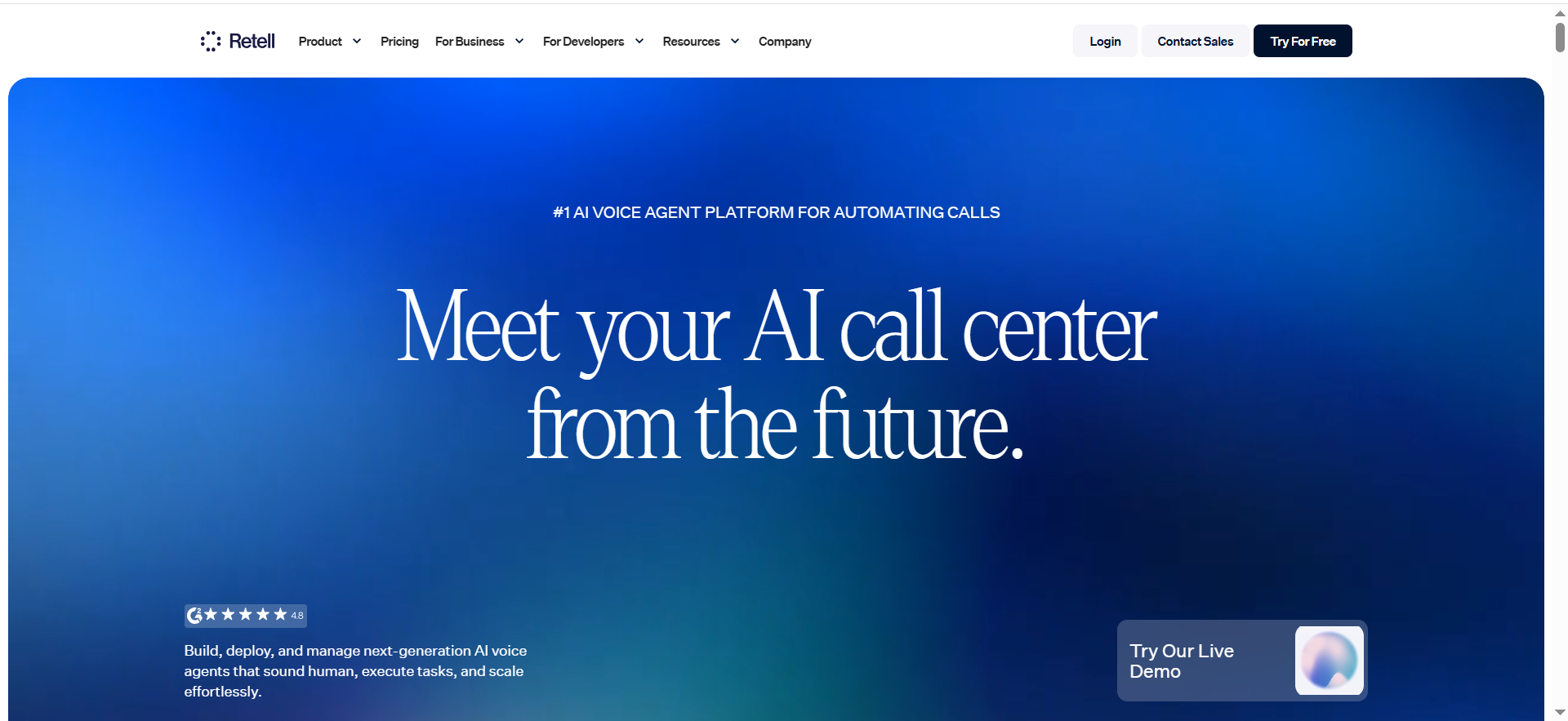
A voice-agent platform for building and operating outbound (and inbound) agents with built-in monitoring.
Why teams use it
Teams choose it when they want to ship quickly but still need call-level visibility (outcomes, latency, sentiment) as volume ramps.
What it’s good for
Outbound qualification and appointment-setting where you want a platform that is closer to “product” than raw telecom plumbing.
When it’s a good fit
You want a single place to build, test, deploy, and monitor calls without assembling every component yourself.
When it’s not a good fit
You need deep carrier routing experiments, custom SBC behavior, or highly bespoke telephony edge logic.
How to use it
Start with one call type (e.g., warm lead qualification). Add consent/disclosure steps first, then integrate CRM lookup + meeting booking. Build a QA loop before scaling lists.
Key capabilities
- Agent builder + API workflows
- Call dashboards for outcomes and performance
- Function/tool calling for CRM, scheduling, ticketing
- Post-call summaries and structured outcomes
Pricing
Retell AI is pay-as-you-go, starting at $0.07+ per minute for AI voice agents.
Free tier?
Retell AI doesn’t offer a free tier, but it includes $10 in free credits to start.
Downsides / limitations
Telephony control may be more “platform default” than telephony-first stacks; confirm what you can tune (routing, caller ID strategies, AMD).
2. Bland AI
What it does
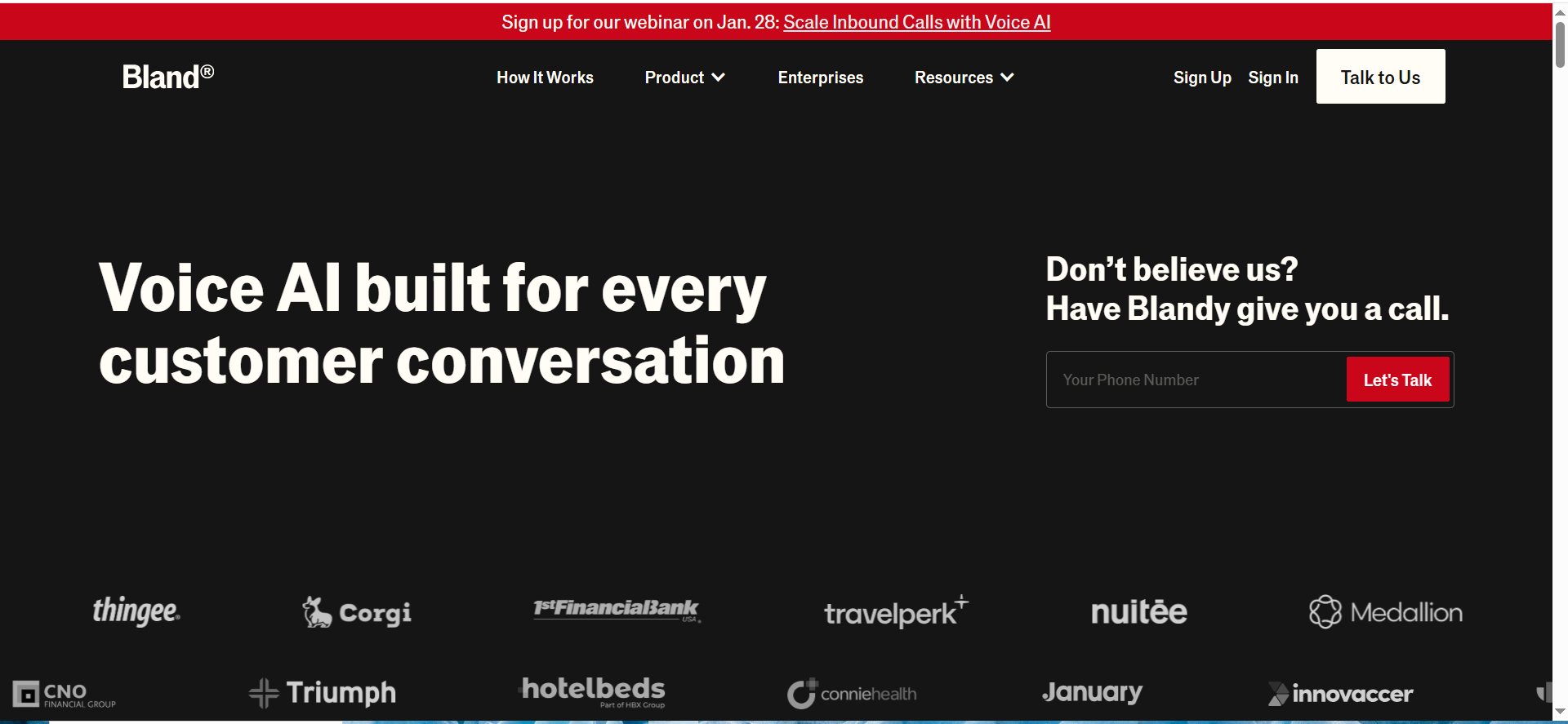
An agent platform positioned for high-volume outbound calling and campaign-style operations.
Why teams use it
Teams use it when outbound is a channel (not a prototype) and they want campaign controls and infrastructure posture that can support scale.
What it’s good for
High-volume reminders, renewals, lead qualification, and scripted campaigns where pacing and retries matter.
When it’s a good fit
You run repeatable outbound motions and want a campaign operating model with clear controls and reporting.
When it’s not a good fit
You need a minimal, DIY developer stack (Twilio/Telnyx style) or want full custom orchestration.
How to use it
Port your Vapi flows into campaign scripts. Make CRM writeback and booking steps first-class tools. Pilot pacing, retries, and AMD on a small segment before scaling.
Key capabilities
- Campaign-style outbound workflows
- Agent scripting + tools for integrations
- Operational controls for scaling calling programs
- Compliance-focused workflows (confirm specifics for your regions)
Pricing
Bland AI’s pricing starts at $0.14 per connected minute on the free Start plan, and paid plans start at $299/month with lower per-minute rates.
Free tier?
Bland AI offers a free tier (Start), but usage is still billed per connected minute.
Downsides / limitations
Campaign controls vary by route and carrier; validate deliverability and complaint rates with real traffic, not demo numbers.
3. SignalWire AI Agent
What it does
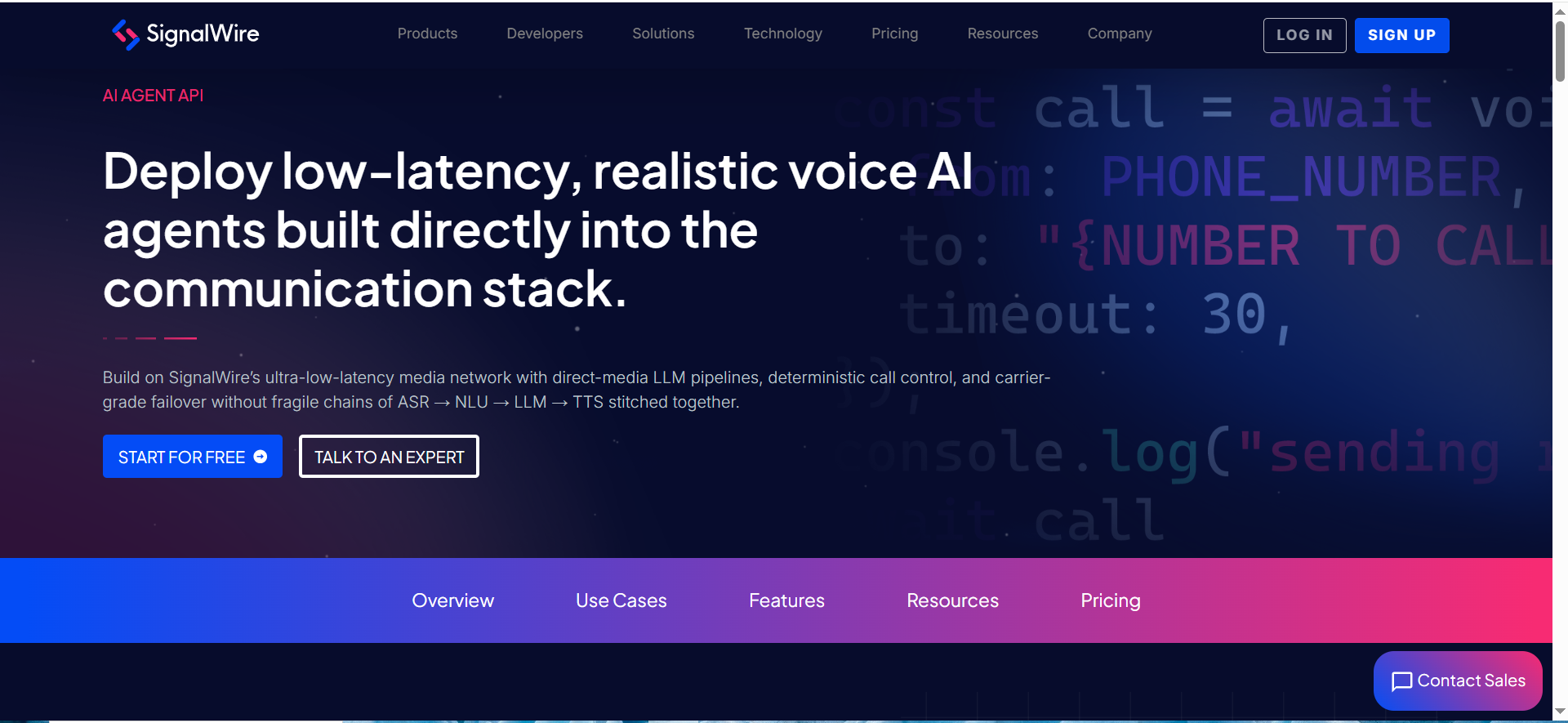
A real-time voice agent platform built on telecom-native infrastructure, designed for low-latency, interruptible conversations.
Why teams use it
Engineering-led teams pick it for real-time control, strong telecom DNA, and the ability to orchestrate call logic during the conversation.
What it’s good for
Real-time outbound conversations where sub-second turn-taking and precise call control are important.
When it’s a good fit
You have engineering support and want tighter control over media, routing, and call logic than most no-code platforms.
When it’s not a good fit
You need a fully managed, no-code experience with minimal implementation work.
How to use it
Treat SignalWire as the runtime for real-time calls. Reuse your existing prompts/tools, then add telecom controls (caller ID strategy, routing, AMD) and observability.
Key capabilities
- Real-time agent runtime for voice conversations
- Telecom-native calling features and integrations
- Programmable call control during the session
- Hooks for logging, QA, and workflow automation
Pricing
SignalWire AI Agent pricing starts at $0.16 per minute for the AI agent runtime, and voice transport is billed separately at standard rates.
Free tier?
SignalWire doesn’t offer a free tier, but new accounts start in trial mode with restrictions before adding a credit card.
Downsides / limitations
More build effort than pure agent platforms; plan time for integration, QA, and routing tests.
4. Telnyx (Voice API + Voice AI)
What it does
A telephony-first platform for programmatic outbound calling where you bring (or pair) an agent layer.
Why teams use it
Teams choose Telnyx when deliverability, routing, number reputation, and latency discipline are the real constraints.
What it’s good for
Outbound calling programs that need carrier options, routing control, and predictable telecom behavior.
When it’s a good fit
You want to optimize connect rates via telephony levers and keep your agent runtime modular.
When it’s not a good fit
You want a single, fully managed voice-agent platform with minimal engineering work.
How to use it
Split migration into two tracks: (1) move telephony/routing first, (2) port agent prompts/tools. This reduces risk and makes debugging easier.
Key capabilities
- Programmable outbound calling and call control
- Number management and routing strategies
- Carrier/telephony controls to improve deliverability
- Works well with modular agent runtimes
Pricing
Telnyx Voice API pricing starts at $0.002 per minute (with other telephony charges varying by product and route).
Free tier?
Telnyx doesn’t offer a free tier, but it does provide trial credits for new accounts.
Downsides / limitations
You will likely need to assemble or integrate your agent runtime and analytics, which increases implementation effort.
5. Twilio (Programmable Voice + your agent stack)
What it does
A mature programmable voice API and ecosystem for building a custom outbound voice AI stack.
Why teams use it
Teams pick Twilio when they want maximum flexibility, vendor optionality, and a broad integration ecosystem.
What it’s good for
Teams with engineering bandwidth that want to own the architecture and avoid lock-in across telephony and AI components.
When it’s a good fit
You want to compose STT/TTS/LLM/agent runtime choices and swap components over time.
When it’s not a good fit
You want a plug-and-play agent platform with managed QA dashboards out of the box.
How to use it
Recreate Vapi call flows using TwiML/webhooks. Keep prompts/tools in your own service so you can change models later without rewriting telephony.
Key capabilities
- Programmable voice APIs for outbound calling
- Webhooks/TwiML for call flows and control
- Large ecosystem for integrations and add-ons
- Good foundation for custom agent runtimes
Pricing
Twilio’s Programmable Voice pricing is usage-based; for the U.S., inbound voice starts at $0.0085 per minute and outbound starts at $0.0140 per minute.
Free tier?
Twilio doesn’t offer a free tier, but it does offer a free trial with trial credits (for example, $15 in trial credits).
Downsides / limitations
More architecture decisions and operational ownership (monitoring, QA, compliance workflows) than managed platforms.
Voice-agent platform vs telephony-first stack
Pick a voice-agent platform (Retell, Bland, SignalWire) if you want faster deployment and managed operations. Pick a telephony-first stack (Telnyx, Twilio) if you need deeper routing and deliverability tuning, or you want to keep your agent runtime modular.
Migration notes: switching off Vapi without breaking pipeline
A safe migration keeps telephony/routing changes separate from agent behavior changes. Use this plan:
- Freeze scope to one call type (e.g., warm lead qualification).
- Migrate compliance first: consent source of truth, suppression lists, disclosure logic, time-of-day rules.
- Recreate outbound routing: caller IDs, local presence strategy, retries, AMD/voicemail logic.
- Port agent logic: prompts, tools (CRM lookup, calendar booking), and guardrails.
- Instrument outcomes: connect rate, first-10-seconds hang-up rate, qualified conversation rate, meeting set rate, opt-out/complaint rate, latency p50/p95 (and centralize tracking in your reporting stack).
- Run parallel traffic (10-20%) for 2 weeks, then cut over by segment.
Pilot scorecard template (copy/paste):
| Metric | Baseline (Vapi) | Pilot (New tool) | Notes / action |
|---|---|---|---|
| Connect rate | |||
| First-10-seconds hang-up rate | |||
| Qualified conversation rate | |||
| Meeting set rate | |||
| Opt-out/complaint rate | |||
| Latency p50/p95 | |||
| Cost per meeting |
FAQs
What are the best alternatives to Vapi for outbound voice AI in 2026?
Should I choose a voice-agent platform or a telephony-first stack?
What metrics matter most for outbound voice AI performance?
How do I reduce brand risk with outbound voice AI?
Can Telnyx or Twilio replace Vapi by itself?
What’s the safest migration path off Vapi?
📋 Get Listed / Advertisement
We update this guide monthly. Want your tool featured? Contact: [email protected].