

Conductor's 2025 State of SEO survey found that 91% of 350 digital marketing professionals reported that SEO positively impacted website performance and marketing goals in 2024, confirming that search optimization remains the highest-impact skill marketers can build right now.
Organic search still drives roughly 53% of all website traffic globally, according to a BrightEdge channel analysis, yet the landscape that SEO professionals must navigate changes faster than any certification or degree program can track. Google made approximately 4,781 changes to its search system in a single year. AI Overviews now appear in more than half of all Google searches, and zero-click behavior has climbed past 60%. The practitioners who stay current and competitive are the ones reading from a curated, high-signal set of SEO blogs and resources rather than chasing every hot take on social media.
This guide identifies the top SEO blogs for learning search optimization in 2026, organized by the specific strength each publication brings to your professional development. Whether you are a beginner learning how to run a keyword research workflow or an experienced practitioner adapting to generative engine optimization, the right reading list accelerates your growth faster than any single course or tool ever could.
▶️ If your ranked pages are not showing up in AI answers and you want a content system that fixes that, book a SaaS content strategy call.
How We Selected the Best SEO Blogs for This List
We evaluated more than 40 SEO publications and resources before narrowing the list to 15, using criteria tied to educational value rather than brand popularity alone.
| Selection Criterion | What We Measured | Minimum Threshold |
|---|---|---|
| Publishing Consistency | Active publishing cadence in the trailing 12 months | At least two new posts per month |
| Original Research | Proportion of posts containing proprietary data, case studies, or experiments | At least quarterly original studies |
| Actionable Depth | Presence of step-by-step workflows, templates, or frameworks | Most posts include implementation guidance |
| Source Authority | Citations from other SEO professionals, industry awards, and peer recognition | Referenced by multiple Tier 1 SEO publications |
| AI Search Coverage | Coverage of AI Overviews, LLM citation, and generative engine optimization topics | Active coverage within the trailing six months |
The ranking is unranked within tiers, since each blog serves a different learning objective and audience segment. The best approach is to combine three to five blogs that match your skill level and area of focus, rather than relying on any single source.
Quick Comparison of TOP SEO Blogs
| Blog | Best For | Content Focus | Skill Level | Publishing Cadence |
|---|---|---|---|---|
| Moz Blog | Foundational SEO education | On-page, technical, local SEO | Beginner to intermediate | Daily |
| Ahrefs Blog | Data-driven SEO tutorials | Link building, keyword research, experiments | Intermediate to advanced | Multiple times per week |
| Semrush Blog | Full-stack marketing education | SEO, PPC, content, social, AI search | All levels | Daily |
| Google Search Central Blog | Official algorithm guidance | Core updates, indexing, structured data | All levels | Weekly to biweekly |
| Search Engine Journal | Daily SEO and marketing news | Industry news, expert opinions, webinars | All levels | Multiple times per day |
1. Moz Blog: Best for Foundational SEO Education
The Moz Blog is the strongest starting point for marketers who want to build a structured understanding of SEO fundamentals, from keyword research to site architecture. Moz has been publishing SEO education content since 2004, making it one of the longest-running authorities in the space. The "Whiteboard Friday" video series remains a standout format, breaking complex topics into visual explanations that cross-functional teams can absorb quickly.
- Content Strength: Moz covers the full SEO spectrum, including keyword research, on-page optimization, link building, local SEO, and technical audits
- Original Research: The annual State of Local SEO report and ongoing algorithm-tracking studies provide data not available elsewhere
- Learning Center: A free learning center with structured SEO guides covers everything from beginner fundamentals to technical SEO audits
- Community: The Q&A section connects beginners with experienced practitioners
| Attribute | Detail |
|---|---|
| Attribute | 2004 |
| Key Format | Whiteboard Friday (video), long-form guides |
| Pricing for Blog | Free |
| Best Audience | Marketing managers, content strategists, SEO beginners |
Pros: Accessible writing style that bridges the knowledge gap between SEO specialists and broader marketing teams. Extensive free resources, including the MozBar browser extension.
Cons: Advanced practitioners may find some content introductory. Publishing cadence on certain topics can lag behind faster-moving publications.
When to choose Moz Blog: Choose Moz when you need to onboard a new content hire, explain SEO value to leadership, or build a shared vocabulary across SEO and content teams.
2. Ahrefs Blog: Best for Data-Driven SEO Tutorials
The Ahrefs Blog delivers the most consistently data-backed SEO education available, with articles often analyzing millions of pages to uncover ranking patterns and content performance benchmarks. Ahrefs positions itself not just as a tool provider but as a content marketing powerhouse, with tutorials that teach transferable SEO skills even if you use a competing platform.
- Data Studies: Ahrefs regularly publishes original research, such as their analysis showing that 66% of pages have zero backlinks and that 96.5% of all published pages receive zero traffic from Google
- Tutorial Depth: Step-by-step guides walk readers through exact workflows for keyword research, competitive analysis, content gap identification, and link prospecting
- Practical Orientation: Every article ends with implementation steps rather than abstract theory
| Attribute | Detail |
|---|---|
| Parent Company | Ahrefs Pte. Ltd. (Singapore) |
| Key Format | Long-form tutorials, original studies, video walkthroughs |
| Pricing for Blog | Free |
| Best Audience | SEO professionals, growth marketers, content strategists |
Pros: Refreshingly direct writing style that eliminates filler. Case studies feature real websites with verifiable data. Strong YouTube channel supplements written content.
Cons: Content naturally emphasizes Ahrefs tooling, which can feel product-driven. Less coverage of paid search and social media marketing.
When to choose Ahrefs Blog: Choose Ahrefs when you want to learn SEO through data and experimentation rather than theory, particularly for link building and competitive analysis workflows.
3. Semrush Blog: Best for Full-Stack Marketing Education
The Semrush Blog covers SEO alongside PPC, social media, content marketing, and competitive intelligence, making it the most comprehensive single-source marketing education hub for teams that manage multiple channels. The acquisition of Search Engine Land's parent company, Third Door Media, in late 2024 further expanded Semrush's editorial reach.
- Breadth of Coverage: Semrush publishes practical articles spanning keyword research, on-page SEO, link building, local SEO, technical SEO, paid advertising, and social media
- AI Search Coverage: Recent coverage actively tracks how AI agents and the agentic web reshape brand visibility, a topic most SEO blogs still treat superficially
- Tool Integration: Many articles include direct walkthroughs using Semrush features, which helps if you use the platform but limits applicability if you do not
| Attribute | Detail |
|---|---|
| Parent Company | Semrush Inc. (NYSE: SEMR) |
| Key Format | How-to articles, original research, webinars |
| Pricing for Blog | Free |
| Best Audience | Marketing generalists, agency teams, in-house marketers |
Pros: Excellent for teams learning content optimization tools alongside SEO fundamentals. Original research reports provide citable data. The blog complements paid platform access well.
Cons: The sheer volume of content can overwhelm new readers. Product-integrated tutorials may not transfer to other toolsets.
When to choose Semrush Blog: Choose Semrush when your role spans beyond SEO into paid media, social, or competitive intelligence and you need one blog that covers the full marketing stack.
4. Google Search Central Blog: Best for Official Algorithm Guidance
Google Search Central Blog is the only source that delivers search guidance directly from Google's engineering and product teams, making it the definitive authority on algorithm changes, indexing policies, and structured data requirements. When Google publishes a core update notice or a change to how search features work, this blog is the primary source every other publication interprets.
- Core Updates: Every major algorithm update is announced here first, with official guidance on what changed and how to respond
- Technical Documentation: Detailed documentation covers Core Web Vitals, structured data implementation, mobile-first indexing, and JavaScript rendering
- AI Overviews Guidance: As AI search visibility becomes a critical concern, Google Search Central provides the closest thing to official guidance on how content performs in AI-powered search features
| Attribute | Detail |
|---|---|
| Publisher | Google LLC |
| Key Format | Official announcements, developer documentation, help guides |
| Pricing for Blog | Free |
| Best Audience | Technical SEOs, web developers, site owners |
Pros: Unmatched authority. Every SEO playbook ultimately traces back to guidance published here.
Cons: Updates arrive in Google's technical language and often require interpretation. The blog covers what changed, not necessarily why or how to adapt strategically.
When to choose Google Search Central Blog: Read every update published here as your baseline. Then supplement with interpretation from Moz, Search Engine Roundtable, or Search Engine Land.
5. Search Engine Journal: Best for Daily SEO News and Expert Perspectives
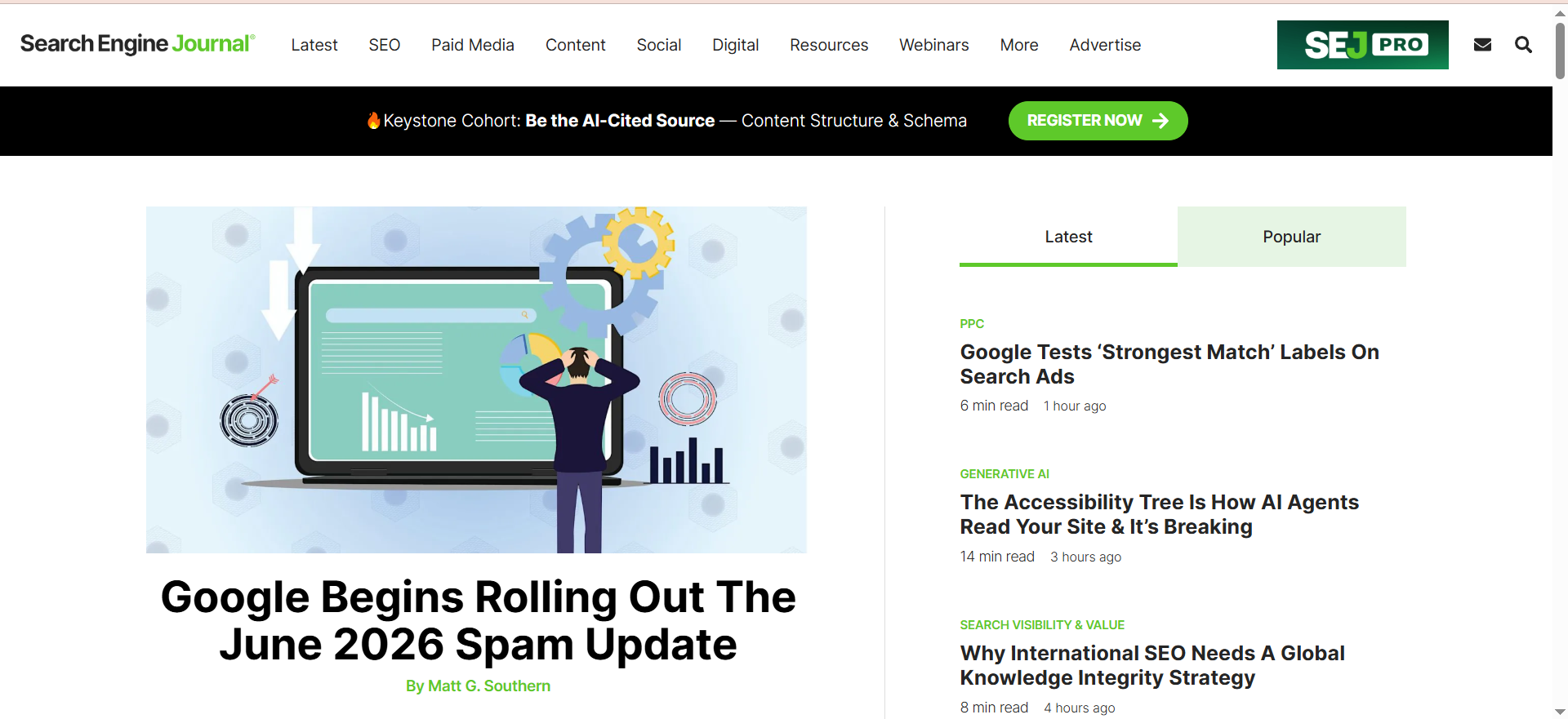
Search Engine Journal delivers the broadest daily coverage of SEO, digital marketing, and search industry developments, making it a strong choice for professionals who need to stay current on trends, algorithm shifts, and emerging tactics. The blog features content from a diverse roster of industry contributors, providing multiple expert perspectives on the same topics.
- News Velocity: SEJ publishes multiple times per day, covering breaking algorithm changes, platform updates, and marketing trends within hours
- Webinar Program: Regular webinars feature SEO experts sharing real-world case studies and emerging strategies
- Ask an SEO Column: Reader questions answered by practitioners provide value that is well suited for learning through practical problem-solving
| Attribute | Detail |
|---|---|
| Owner | Alpha Brand Media |
| Pricing for Blog | Free |
| Best Audience | SEO practitioners, agency marketers, marketing managers |
Pros: Diverse expert voices avoid single-perspective bias. The SEO copywriting best practices coverage is particularly strong for content-focused marketers.
Cons: The high volume of daily content requires intentional curation to avoid information overload.
When to choose Search Engine Journal: Choose SEJ when you want to stay broadly informed across the SEO and digital marketing landscape and value diverse expert opinions.
How To Choose the Right SEO Blog for Your Experience Level
The right combination of SEO blogs depends on your current skill level, your professional role, and the specific SEO challenges you face. Rather than subscribing to every publication, build a focused reading stack of three to five blogs.
| Experience Level | Recommended Blogs | Learning Objective |
|---|---|---|
| Beginner (0 to 12 months in SEO) | Moz Blog, Neil Patel, Yoast SEO Blog, Backlinko | Build foundational knowledge of keyword research, on-page optimization, and site structure |
| Intermediate (1 to 3 years) | Ahrefs Blog, Semrush Blog, Search Engine Journal, Content Marketing Institute | Develop tactical depth in link building, content strategy, and cross-channel marketing |
| Advanced (3+ years) | Detailed, Holistic SEO, Marie Haynes, Search Engine Roundtable | Master competitive analysis, semantic SEO, algorithm recovery, and entity optimization |
| News and Trends (all levels) | SEOFOMO, Search Engine Land, Google Search Central Blog | Stay current on algorithm changes, industry shifts, and AI search developments |
For B2B SaaS marketers specifically, combining Ahrefs or Semrush for tactical SEO education with Content Marketing Institute for strategic framing and Google Search Central for algorithm awareness creates a well-rounded foundation. Adding a resource like Holistic SEO or Detailed on top of that stack helps build the AI content generation and semantic understanding that increasingly drives visibility in both traditional SERPs and AI search surfaces.
How To Build an Effective SEO Reading Routine
Consistent learning from SEO blogs requires a structured reading routine rather than sporadic consumption, since the compounding value of SEO knowledge builds through regular engagement rather than occasional deep dives.
| Cadence | Activity | Recommended Source |
|---|---|---|
| Daily (10 minutes) | Scan headlines for algorithm changes or breaking developments | Search Engine Roundtable, Search Engine Land |
| Weekly (30 minutes) | Read one in-depth tutorial or case study | Ahrefs Blog, Backlinko, Holistic SEO |
| Weekly (10 minutes) | Review curated newsletter digest | SEOFOMO |
| Monthly (1 hour) | Study one original research report or data study | Moz, Semrush, Content Marketing Institute |
| Quarterly (2 hours) | Audit your SEO strategy against new developments | Google Search Central, Marie Haynes Blog |
According to Hostinger's 2025 blogging statistics research, 77% of internet users regularly read blog posts, and Orbit Media's 2024 Annual Blogger Survey found that 65% of bloggers themselves use SEO as a primary traffic-driving channel. The practitioners who perform best are those who treat SEO education as an ongoing practice rather than a one-time certification.
Executing this well is exactly the gap The Rank Masters closes for B2B SaaS teams, building an ICP-led content system that maps each topic cluster to a money page and to pipeline, rather than publishing posts that never convert.
The knowledge you gain from these blogs becomes actionable when it connects to a structured content strategy that ties every piece of content to revenue.
SEO Blogs Vs SEO Courses for Learning Search Optimization
SEO blogs and structured courses serve different learning objectives, and the most effective approach combines both formats based on your development stage.
| Learning Format | Strengths | Limitations | Best For |
|---|---|---|---|
| SEO Blogs | Current information, free access, diverse perspectives, real-time updates | Unstructured learning path, requires self-curation, variable quality | Staying current, tactical depth, continuous learning |
| SEO Courses | Structured curriculum, progressive skill building, certifications | Can become outdated quickly, typically paid, less current than blogs | Foundational knowledge, team onboarding, structured skill gaps |
| Podcasts and Video | Accessible during commutes, expert interviews, diverse formats | Difficult to reference, less detailed than written content | Supplementary learning, exposure to diverse perspectives |
| Industry Conferences | Networking, live Q&A, case study presentations | Expensive, time-intensive, infrequent | Strategic exposure, relationship building, career development |
The Mordor Intelligence SEO market report estimates the global SEO services market at $108 billion in 2026, growing at a 16.8% compound annual rate. That growth translates directly into career opportunities for professionals who maintain current, verifiable SEO skills through continuous learning.
A 2025 Statista survey of SEO professionals found that 13.5% cited content strategy and production as their top focus area, followed by data analysis at 9.6% and audience understanding at 8.8%. These are the exact skills that high-quality SEO blogs teach more effectively than any single course, because the landscape shifts faster than course creators can update their curricula.
SEO Blogs That Cover AI Search and Generative Engine Optimization
As AI search engines reshape how users discover information, certain SEO blogs have expanded their coverage to include generative engine optimization, AI Overviews, and LLM citation strategies. This emerging discipline requires practitioners to understand how AI models select, cite, and synthesize content, a topic that traditional SEO education has only recently begun addressing.
| Blog | AI Search Coverage Focus | Key Contribution |
|---|---|---|
| Semrush Blog | AI agents, agentic web, AI Overviews impact | Tracks how AI reshapes brand visibility across search surfaces |
| Search Engine Land | Organic traffic impact data, zero-click analysis | Published key analysis of year-over-year organic search traffic trends |
| Google Search Central | Official AI Overviews guidance | Provides the closest thing to official guidance on AI search features |
According to a Xamsor market analysis, the Generative Engine Optimization services market was valued at $886 million in 2024 and is projected to reach $7.32 billion by 2031, growing at a 34% compound annual rate. This growth signals that practitioners who develop GEO skills now will hold a significant competitive advantage as the discipline matures.
The Rank Masters helps B2B SaaS teams operationalize these AI search insights through an answer engine optimization framework that connects content structure to AI citation patterns, rather than treating GEO as a separate initiative from traditional SEO.
For teams evaluating their current AI search visibility, tools covered in our AI visibility tools guide provide the measurement layer that turns blog-sourced learning into measurable progress.
Free SEO Learning Resources Beyond Blogs
SEO blogs form the core of any practitioner's education, but several free resources complement blog reading by providing hands-on practice, structured learning, and community interaction.
| Resource | Format | Best For | Cost |
|---|---|---|---|
| Google Search Console | Tool | Understanding your own site's search performance | Free |
| Google Analytics 4 | Tool | Tracking organic traffic, user behavior, and conversions | Free |
| Moz Beginner's Guide to SEO | Interactive guide | Structured introduction to SEO fundamentals | Free |
| Ahrefs Webmaster Tools | Tool | Basic site audit and backlink analysis | Free |
| Google's SEO Starter Guide | Documentation | Official best practices from Google | Free |
Pairing these free tools with blog-based learning creates a feedback loop where you can immediately test what you read. For example, after reading an Ahrefs tutorial on keyword gap analysis, running that same analysis in Ahrefs Webmaster Tools or Google Search Console transforms theoretical knowledge into a practical skill.
This hands-on approach, combined with the best cheap SEO tools for budget-conscious teams, creates an accessible path to SEO competency without significant financial investment.