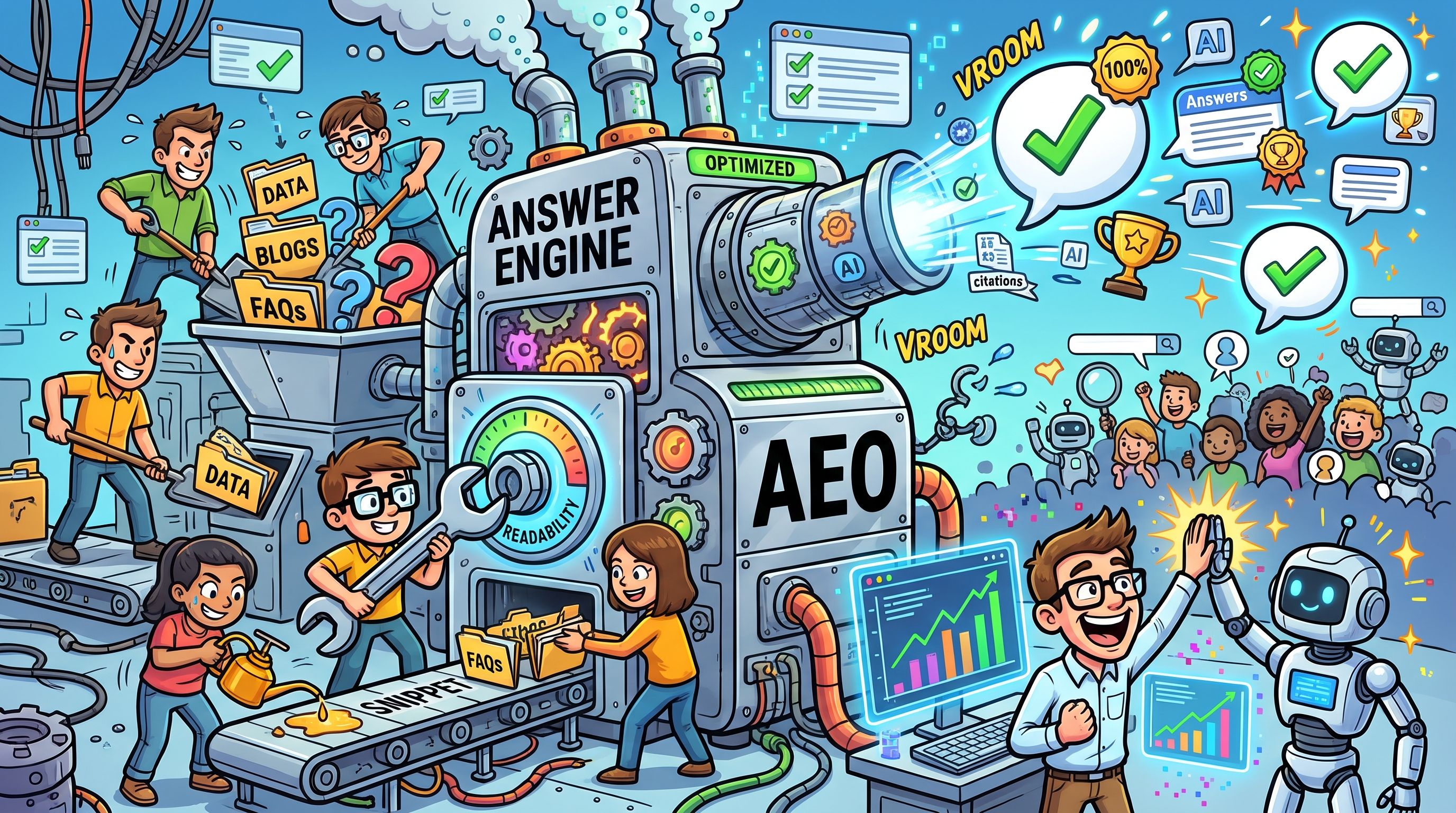

AEO and GEO are largely one job with two names, so choose by surface, not by label. AEO makes your page the extracted answer in search features. GEO gets your brand cited inside generated, multi-source answers. Pick AEO first when your buyers ask short questions, and GEO first when they compare options in AI chat.
That split holds for a B2B SaaS team with limited time, working from sound SEO foundations and able to name its ten to twenty most valuable buyer queries.
Most teams end up doing both, because the content, structure and measurement overlap heavily. The real decision is sequencing, not exclusion.
If you would rather see where your brand is named in ChatGPT, Perplexity and Gemini answers before you choose, start with our AI Search Visibility service. It compares you against named competitors.
AEO Vs GEO At A Glance
The table gives the head-to-head in one scan. Each row is a complete statement, so you can lift any of them on its own.
| Attribute | AEO (Answer Engine Optimization) | GEO (Generative Engine Optimization) |
|---|---|---|
| Target surface | AEO targets featured snippets, voice results and the answer blocks in AI Overviews. | GEO targets longer generated answers in AI chat and AI search that draw on several sources. |
| Unit of optimisation | AEO optimises a single extractable answer on one page. | GEO optimises a brand citation, mention or recommendation inside a generated answer. |
| What the content must do | AEO content must answer one mapped question concisely and in a form a system can lift. | GEO content must be comprehensive and entity-consistent, and be corroborated by third-party sources. |
| Typical tactics | AEO work maps questions to pages, writes concise answers, adds FAQ content and applies schema. | GEO work designs prompt sets, monitors several engines, analyses citation gaps and tests claims. |
| Typical metrics | AEO is measured by answer placements, AI Overview appearances and impressions. | GEO is measured by citations, brand mentions, share of voice in AI answers and AI referral traffic. |
| Origin of the term | AEO grew out of industry use around voice search, digital assistants and featured snippets from roughly 2017 to 2018. | GEO arrived with a 2023 to 2024 research paper that gave generative engines their own optimisation vocabulary. |
| Best-fit situation | AEO comes first when buyers ask specific, high-intent questions that have a short answer. | GEO comes first when buyers compare options in AI chat before they ever visit a site. |
The two overlap. Many practitioners use AEO and GEO interchangeably, and the tactics are largely the same, so the table shows emphasis, not a wall between them.
What Is AEO (Answer Engine Optimization)?
Answer Engine Optimization is the work of making a page the single answer a search feature extracts, whether that is a featured snippet, a voice result or the answer block inside an AI Overview. The unit it optimises is one concise, extractable answer to one question.
In practice that means mapping your buyers' questions to pages, opening each page with a short answer that stands alone, adding FAQ content and applying schema where it fits. The shape of the work is closer to editing than to link building. You are making it easy for a system to lift a sentence and be right about what it lifted. If you want the build steps, our guide on how to create an AEO strategy walks through them, and our answer engine optimization work is what we run for teams that want it done for them.
The term came out of industry use around voice search, digital assistants and featured snippets, from roughly 2017 to 2018. That history explains its habits. AEO thinks in single questions and single answers.
What AEO does not cover is the moment a buyer asks an AI tool to compare five vendors and gets a paragraph that names three of them. A snippet-shaped answer on your own page does not decide whether you are one of the three. That is a different problem, and it is the one GEO exists to name.
What Is GEO (Generative Engine Optimization)?
Generative Engine Optimization is the work of getting your brand cited, mentioned or recommended inside longer generated answers that draw on several sources. The unit it optimises is a brand citation inside a generated answer, not a position on a results page.
The term has a clear source. It was defined in a research paper first submitted to arXiv on 16 November 2023 and published at KDD 2024, which introduced a black-box optimisation method and visibility metrics for generative engine responses. The same paper reports that GEO methods can raise content visibility in generative engine responses by up to 40% on its GEO-bench benchmark. Read that as a best case that varies by domain. It is a ceiling from one benchmark, not a forecast for your site.
Because a generated answer pulls from several places, third-party corroboration and entity consistency matter more than they do for a snippet. Your own page saying you are the best option counts for little if no one else says so. GEO work therefore extends to prompt-set design, cross-engine monitoring, citation-gap analysis and claim testing.
We have run this work on our own account. Our GEO case study on ChatGPT referrals reports ChatGPT referral growth of 8,337% in 90 days for one programme. That is one account's result, not a typical one and not a promise. If you want the same kind of work done on your category, see our generative engine optimization work.
How AEO And GEO Relate To Classic SEO
Google's own documentation says that standard SEO best practices still apply to AI Overviews and AI Mode, with no additional requirements and no special schema or AI-specific files needed. That one statement removes most of the mystique. Neither discipline sits outside SEO, and neither skips it.
The cleanest way to place them is by buyer moment. SEO is the foundation, AEO covers the question moment, and GEO covers the recommendation moment. If a page cannot be crawled, indexed or understood, none of the three works. Our technical SEO and AI readiness work covers that shared base, including crawl access, indexing and schema.
We have written the wider category framing elsewhere, so this article does not repeat it. If you want the case for treating all of this as one discipline, read AISO versus SEO, AEO and GEO. This page owns a narrower job, which is helping you choose where to start.
The Three-Question Test For Choosing Between AEO And GEO
This is TRM's own rule. We built it from the prioritisation conditions practitioners publish, and it is a starting point you should re-run, not a law and not a measured result. No one has published a comparison showing how much better AEO-first or GEO-first sequencing performs, so the test rests on reasoning you can check yourself.
Run it on your ten to twenty most valuable buyer queries. For each query, ask three questions:
- Question Shape: Does the buyer's query have a short, extractable answer, or is it a comparison or recommendation request? A short answer points to AEO. A request to compare or recommend points to GEO.
- Where Answers Are Read: Does discovery for this query happen mostly in search features such as AI Overviews and featured snippets, or in AI chat before the buyer visits a site? Search features point to AEO. AI chat points to GEO.
- Where You Are Cited Today: Is your brand named in the answer, absent from it, or named only through someone else's page? If your own page ranks but is not the extracted answer, that points to AEO. If you are absent, or named only through a third party, that points to GEO.
For context on the second question, the Conductor 2026 AEO/GEO Benchmarks, as reported by inriver, found that just over 25% of 21.9 million analysed Google searches triggered an AI Overview. The figure reaches us through a secondary write-up, so use it as rough context for how often search features appear, and check your own category before you lean on it.
Now score the result. Tally the three answers for each query, then look across all your queries. The rule is one sentence. Two or more answers on the same side make that side the start-here verdict for that query, and a spread of verdicts across your list tells you whether to start with AEO, start with GEO, or run both at once.
| Question | An AEO-First Answer | A GEO-First Answer |
|---|---|---|
| Question shape | The query has a short answer that one page can give. | The query asks for a comparison or a recommendation. |
| Where answers are read | Buyers meet the answer in a search feature. | Buyers meet the answer in AI chat before visiting a site. |
| Where you are cited today | You rank but are not the extracted answer. | You are absent, or named only through someone else's page. |
If most of your queries land on one side, start there. If they split close to evenly, fund the shared work first and start both disciplines in parallel, because the overlap makes that cheaper than it sounds. Prioritise AEO when buyers ask specific high-intent questions, AI Overviews appear in your category, or organic search already drives meaningful traffic. Prioritise GEO when buyers compare options in AI chat before visiting a site, when your category depends on trust, or when competitors are gaining ground in AI answers.
You can run the whole test in an afternoon. List the queries, open a search results page and an AI chat for each, note what appears, and fill in a row per query. It is a spreadsheet exercise, not a project.
Once you have run the test, the rest is sequencing and measurement. The GEO + SEO Growth Programme is where we run SEO, AEO and GEO together, so you are not funding the same work twice.
One Query Through The SEO, AEO And GEO Lenses
Here is a worked example. It is illustrative and hypothetical, with no real figures, brands or results in it. Take one buyer query for a B2B SaaS category, "best contract management software for a mid-sized legal team", and look at it three ways.
| Lens | What The Page Or Brand Must Have |
|---|---|
| SEO lens | SEO wins a ranking position for the query, which needs a crawlable, indexed page that matches the search intent and earns links. |
| AEO lens | AEO wins the extracted answer for a short version of the query, which needs a concise answer at the top of the page and a clear question-and-answer structure beneath it. |
| GEO lens | GEO wins a named place in an AI chat answer to the comparison prompt, which needs third-party pages that mention the brand and consistent descriptions of what the product does. |
Through the SEO lens, the question is whether your page ranks at all. Through the AEO lens, the question is whether a short version of the query, such as "what is contract management software", is answered by a clean paragraph a search feature can lift. Our guide on how to write AEO-optimized content covers that method. Through the GEO lens, the question is which third-party pages a model would cite when someone asks AI chat to compare vendors, and what corroboration your brand lacks on those pages.
Now run the three-question test. The query is a comparison request, so question one points to GEO. In this example the buyer asks AI chat for a shortlist before visiting any vendor site, so question two points to GEO. Your page ranks on page one but a review site is what gets named, so question three points to GEO again. Three answers on one side give a clear verdict. Start with GEO for this query, and keep the SEO and answer-first structure of the page in good order underneath it.
A different query, such as "what is a clause library", would score the other way. It has a short answer, buyers meet it in search features, and a well-built page is the natural thing to extract. That one is an AEO-first query. The same team, the same product, two different starting points. This is why the test runs per query and not per company.
What To Fund First, Second And Third
The verdict becomes a sequence. Here is the order, and the condition under which each step comes first.
- Confirm the shared foundation first. Check the SEO base and the answer-first structure of the pages behind your priority queries. This comes first for everyone, because both disciplines depend on it and Google's guidance says standard SEO practice is what applies.
- Fund the surface-specific work the test pointed to second. AEO-first teams build extractable answers, FAQ content and schema on the pages that scored. GEO-first teams build corroboration, entity consistency and citation-gap work, which means getting accurate descriptions of your product onto the third-party pages that generated answers draw on.
- Add the second discipline third, and re-run the test every quarter. Most businesses need both AEO and GEO, weighted by where discovery happens. Re-running the test each quarter beats pivoting often.
A small team should skip running two parallel programmes on the same content, and should skip chasing every new engine. Start with the approach that fits your most pressing visibility problem. A smaller team gains more from finishing one sequence than from starting three.
For fuller sequencing, see our SEO-to-GEO visibility roadmap. For when the work shows up, our realistic SEO and GEO timeline sets expectations. For what AEO-first work looks like in practice, there is our AEO case study from our own site, which reports a 36.9% rise in Google clicks and 2.6K AI citations in a 28-day comparison from April to May 2026. That is one site's result and no guide to yours.
How To Measure AEO And GEO With One Set Of Metrics
Measurement is where the single-strategy argument is strongest. You do not need two dashboards. AEO metrics include answer placements, AI Overview appearances and impressions. GEO metrics include citations, brand mentions, share of voice in AI answers and AI referral traffic. Put them in one view and read them together.
| Metric | Term It Serves | What It Records |
|---|---|---|
| Rank position and search features | Both | Where a page ranks for a query and which search features appear on the results page. |
| Answer placements | AEO | How often your page is the extracted answer. |
| AI Overview appearances | AEO | How often an AI Overview appears and includes your page. |
| Impressions on question queries | AEO | How often your pages are shown for the question-shaped queries you mapped. |
| Citations in AI answers | GEO | How often generated answers cite your pages. |
| Brand mentions | GEO | How often generated answers name your brand. |
| Share of voice in AI answers | GEO | Your share of mentions against competitors across a fixed prompt set. |
| AI referral traffic | GEO | Visits that arrive from AI tools. |
For the baseline, Semrush position tracking records where your pages rank for each priority query and which search features appear on it, which is the starting number the triage test needs before you add AI citation tracking on top.
Track more than one engine. In Trakkr's own study, a vendor study with data generated on 2 February 2026, eight AI systems agreed on the top brand for a query only 43.9% of the time on average, and all eight agreed on just 4.2% of comparisons. These are Trakkr's figures as it reports them. Even so, the direction is plain. One engine's result cannot stand in for the rest.
For a ready format, use our monthly AI visibility report as the template for the shared metric set. If you are choosing a tracker, see our roundup of AI visibility tools with GEO audits.
Common Mistakes When Choosing Between AEO And GEO
- Running two parallel programmes on the same content. You pay twice for pages that serve both, and the teams drift apart. Run one AI visibility strategy unless the surfaces, owners or experiments genuinely differ.
- Picking by label instead of by where buyers read answers. A team that chooses GEO because it sounds newer may neglect queries buyers resolve in a snippet. Run the three-question test and let the queries decide.
- Treating either one as a replacement for SEO. Both depend on pages that can be crawled and understood, and Google's guidance says standard SEO practice still applies. Fix the foundation before funding either.
- Chasing a best-case uplift as a forecast. The up to 40% figure in the GEO paper is a ceiling from one benchmark and varies by domain. Plan against your own baseline measurements.
- Pivoting monthly instead of re-running the test quarterly. Frequent pivots stop any single piece of work from showing results. Re-run the test each quarter and change course only when the answers change.
LLMO And Other Names For The Same Work
You will also see LLMO, AI search optimization and AI visibility used for the same or overlapping work. They overlap with AEO and GEO, and the internal choice matters less than defining it once. We use AEO for answer surfaces, GEO for generated answers, and AI visibility for the combined outcome. Pick one internal term, write its definition down, and make sure everyone from the SEO manager to the CMO means the same thing when they use it.
FAQs
Is AEO The Same Thing As GEO?
Does AEO Or GEO Replace Traditional SEO?
Which Term Should Our Company Use Internally?
Do We Need Separate AEO And GEO Strategies?
Is GEO Only Worth Doing For Large Organizations?
Do We Need Special Schema Or AI-Specific Files To Appear In Google AI Overviews?
How Often Should We Revisit The AEO And GEO Split?
Can One Piece Of Content Serve Both AEO And GEO?
How Do I Optimize My Site For AEO?
How Do I Optimize My Site For GEO?
If you want a second opinion on which of your queries belong under AEO and which under GEO, send them through our contact page. We reply with what we would test first.
📑 Disclosure!
Some links in this article are affiliate links. If you sign up through them, The Rank Masters may earn a commission at no additional cost to you. This does not influence which tools we recommend or what we say about them.