
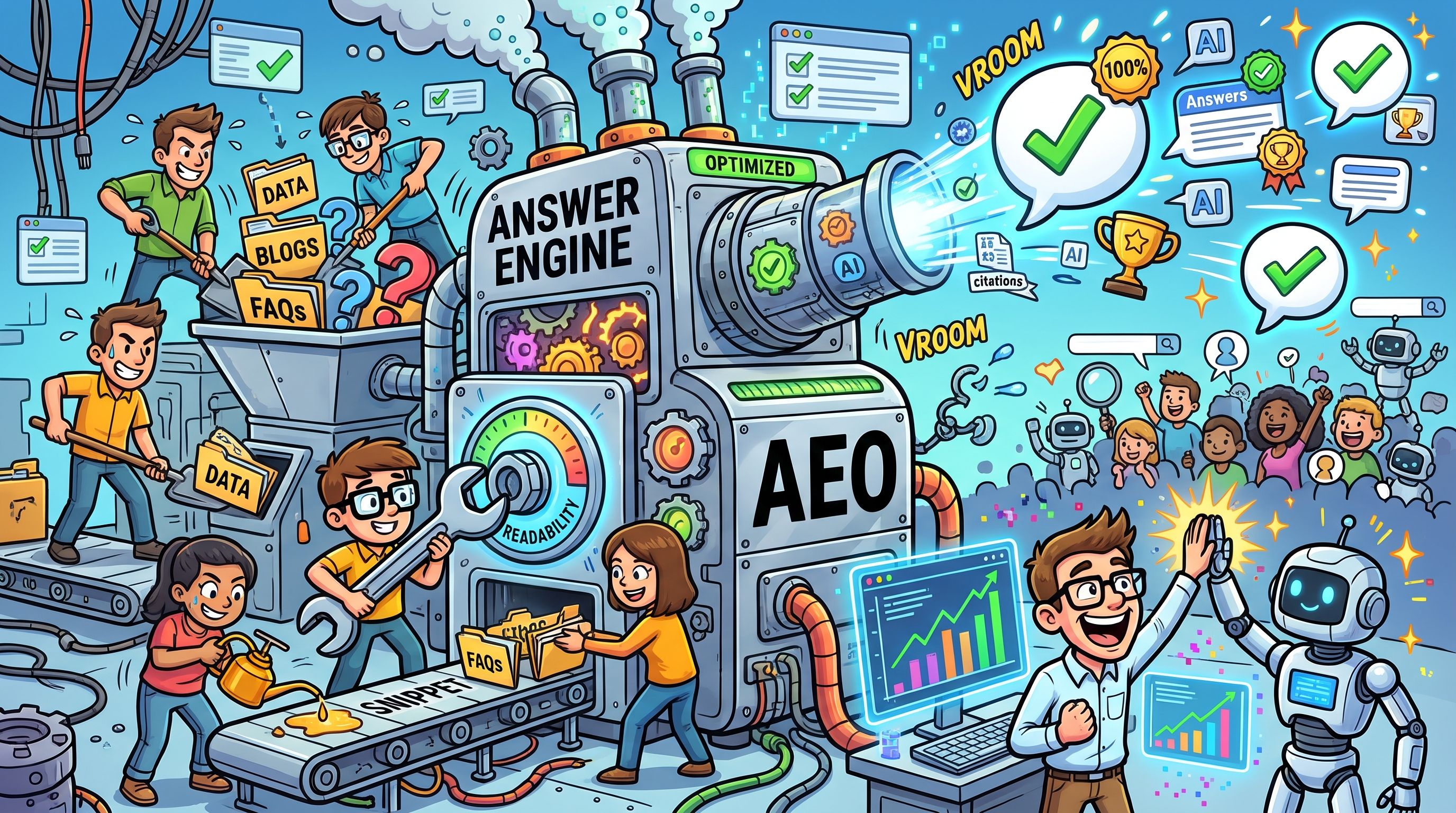
Answer engine optimization is SEO with a different finish line. Instead of earning a click, you structure a page so that ChatGPT, Perplexity, Gemini and Google AI Overviews can lift, trust and cite one passage. AEO does not replace ranking. AEO adds an extraction layer on top of ranking.
That judgement holds for informational and comparison queries, where an engine writes an answer and names sources. It holds less for navigational queries, where the searcher only wants a site.
No one outside the engines knows how citations are weighted, so AEO improves the odds of being cited and cannot guarantee a citation.
If you would rather have a team shape your pages for citation, see how TRM approaches answer engine optimization. We start from the queries your buyers already ask.
What AEO Means, And What It Does Not
The working definition: Answer engine optimization is the practice of structuring and publishing content so that answer engines such as ChatGPT, Perplexity, Gemini, Claude, Copilot and Google AI Overviews can extract a passage, judge it trustworthy and cite it. The goal of answer engine optimization is to be the cited source, where classic SEO aims at the ranking and the click.
You will see the same idea written several ways. "What is AEO", "AEO SEO" and "answer engine optimisation" all point at the same practice, and the spelling changes with the market. Read them as one topic.
An answer engine is any system that responds to a question with a written answer and, usually, a list of sources. ChatGPT, Perplexity, Gemini, Claude and Copilot are chat-style answer engines. Google AI Overviews is the answer layer sitting on top of ordinary Google results. Voice assistants and featured snippets belong in the same family, because they also pick one source and read it out.
Two things AEO is not.
- Not only featured snippets: Snippets were one early version of the direct-answer slot. AEO covers every surface where an engine picks a passage and attributes it.
- Not a separate content programme: You do not need a second blog. You need the pages you already have to be easier to quote.
If your team can say "we write pages so one passage can be lifted and cited without losing its meaning", you have the definition.
How Answer Engines Choose What To Cite
Most answer engines work in stages. The exact mechanics differ, but the sequence is stable enough to plan around.
- Retrieve candidates: The engine pulls a set of pages that look relevant to the question. A page generally has to be retrieved before it can be cited.
- Judge relevance and trust: The engine reads the candidates and weighs which ones answer the question cleanly. Retrieved pages can still go uncited if they are repetitive, generic or add little confidence.
- Cite what supports the answer: The engine writes its answer and names the pages whose passages back it up.
At the synthesis stage, engines tend to favour sources with a clean definition, a precise statistic, a recent update or a resolved ambiguity. A page that states its point once, plainly, with a number and a date attached, is easier to quote than a page that circles.
Ranking and citation have also drifted apart. Ahrefs' March 2026 study found that 38% of Google AI Overview citations came from pages in the Google top 10, down from 76% in July 2025. Ranking in traditional search does not guarantee being cited in AI answers.
Citation behaviour also differs by engine, query type and topic. A page that is cited by one engine for one question can be ignored by another engine for the same question. Engine weighting is not public, so anyone describing a precise formula is guessing. For sourced figures on what earns citations, the TRM breakdown of SEO strategies for AI visibility goes further.
AEO, SEO And GEO: Where The Terms Overlap
The three terms describe overlapping work with different targets. The table separates them only as far as the definition needs.
| Term | Target surface | Success metric |
|---|---|---|
| SEO | Ranked results in search | Rankings, clicks and conversions |
| AEO | The single direct-answer slot, including featured snippets, voice answers and AI Overviews | Being the cited or read-out source |
| GEO | Citation inside generated prose from chatbots and AI search | Mentions and citations in generated answers |
AEO targets the single direct-answer slot, while GEO targets citation inside generated prose. In practice most of the work is shared with SEO. Clear structure, accurate claims, crawlable pages and credible authorship help in all three.
Google's own position backs the shared-work view. Google's AI features documentation states that its AI features in Search run on core Search systems, so optimising for them is a continuation of SEO fundamentals.
The terms are also used loosely. Vendors, agencies and tool makers draw the lines in different places, and the labels are still settling. Do not spend a meeting arguing over which word applies. Agree on the work. For the fuller comparison, including a fourth label, read how AISO differs from SEO, AEO and GEO.
The Query Sorting Test: Answer-First, Ranking Page, Or Both
Every top result for this keyword defines AEO and lists tactics. None hands you a way to decide which of your queries deserve the effort. This test does. It is TRM's own working method, not a published standard, so read it as a reasoned shortcut you can check against your own results.
Run it on your keyword list, one query at a time.
- Ask whether an engine can answer in a paragraph: If a short, self-contained answer satisfies the question, the query needs an answer-first passage.
- Ask whether the searcher must act on a page: If they need to sign up, buy, download or use a tool, the query needs a ranking page.
- Ask whether a decision depends on comparison: If the searcher has to weigh options, the query needs a ranking page with the comparison laid out, and often a short summary passage above it.
- Sort the query: Mark it answer-first, ranking page, or both.
The decision table below turns those questions into a build instruction.
| Query type | What the searcher needs | What to build |
|---|---|---|
| Definition and how-it-works | A short, correct explanation | An answer-first passage at the top of a page |
| Comparison and "best" queries | A summary and a way to evaluate options | A ranking page with a summary passage above the comparison |
| Pricing, sign-up and tool queries | A page they can act on | A ranking page built for the action |
| Navigational | A specific site | Nothing new, keep the site easy to find |
| Evaluation with explanation | An answer and a reason to trust it | Both, on one URL |
The rule fits in one sentence. If an engine can answer in a paragraph, write the paragraph first; if the searcher must evaluate or buy, build the ranking page; if both are true, do both on one URL.
A worked example: Take a B2B SaaS company selling attribution software, with four illustrative queries.
- "What is multi-touch attribution": An engine can answer this in a paragraph, so the page opens with a 40 to 60 word definition and then goes deeper.
- "Best attribution software for SaaS": The searcher is comparing, so this needs a ranking page with a comparison table, plus a two-sentence summary at the top that an engine can lift.
- "Attribution software pricing": The searcher wants to act, so this is a ranking page. An engine summary here is a bonus, not the goal.
- "Brand login": Navigational. No AEO work at all.
Notice what the test does not ask. It does not ask how much volume a query has or how hard it is to rank. Those matter for priority, and the test decides format. Run it first, then rank the sorted list by value. Teams that skip the sort tend to write an answer-first paragraph for a query where the searcher needed a pricing page, or build a long comparison for a query a single paragraph would have settled.
Two of those four queries need an answer-first passage. That is a smaller share of the list than most AEO advice implies, and it is why the sorting step saves effort. For the ranking-page side of the list, the wider priorities in B2B SaaS SEO strategies for 2026 apply.
If you want the ranking work and the citation work run together, the GEO + SEO Growth Programme covers both under one plan. Check what it includes against the gap your own query list shows.
What Changes In Your Content When You Do AEO
The definition implies a short list of practical changes. None of them requires a rewrite from scratch.
- Lead each section with the direct answer: Put the answer in the first one or two sentences, then add the nuance.
- Use question-based headings where the question is real: A heading that matches how a person asks makes the following passage easier to match.
- Use lists and tables where the content is a list or a comparison: Do not force prose into a table or a table into prose.
- Attach one original, citable data point to each major claim: A precise number with a date is easier to quote than an adjective.
- Keep the page fresh: Engines tend to favour a recent update, so a stale date works against you.
The pattern that matters most is the answer-first paragraph. Here is a buried answer rewritten.
- Before: "Many teams wonder about reporting. There are lots of factors, and it depends on your goals, your stack and how your clients like to be updated, so it is hard to say."
- After: "A live dashboard suits clients who check performance weekly, and a monthly PDF suits clients who only want a summary. Choose the dashboard if your clients ask for numbers between meetings."
The rewritten version names its subject, states its condition and runs to about 40 words. It still makes sense if an engine lifts it alone. The before version makes sense only if you read the whole page.
If your question is which software helps with this work, that is a separate comparison, covered in the TRM guide to AEO tools for AI Overviews.
Technical Access: Crawlers And Schema
A page cannot be cited if the engine cannot read it. AI answers depend on retrieval crawlers being allowed, firewalls not challenging them, and pages rendering server-side. If your content only appears after client-side scripts run, or a bot-protection rule blocks the crawlers behind ChatGPT, Perplexity or Gemini, the best-written passage never gets retrieved.
Check three things. Look at your robots rules for the retrieval crawlers you want. Look at your firewall or CDN settings for blanket bot blocks. Fetch a key page without running scripts and confirm the answer text is in the raw HTML. TRM's LLM SEO service covers how language models read a site.
Schema markup supports understanding. It helps a machine tell what a page is about, who wrote it and what questions it answers. It does not guarantee citation, and it will not rescue a page with a vague answer. Add it where it describes real content, and keep it accurate. The structural side of this work sits in technical SEO and AI readiness.
The evidence on llms.txt is not established. Do not rank it above fixing a blocked crawler.
How To Measure AEO Without Fooling Yourself
Rank tracking alone cannot tell you whether an engine cites you. A page can hold position three and never appear in an answer, which is the gap the Ahrefs figure above describes. Measure citation directly.
For each query, in each engine, log three things. Log whether you were cited or not, whether you were mentioned or not, and the sentiment or position of the mention. Rank alone no longer answers the question, because an engine can use your page, name your brand, or ignore both.
Keep the log boring and consistent. A spreadsheet with one row per query and one column per engine is enough to start. Record the date of each check, since answers move. When a citation appears or disappears, note what changed on the page or on the engine's side, so the next cycle has something to learn from.
Use a checklist so the numbers stay comparable.
- Fix the query set: Use the same 30 to 50 queries each cycle, taken from your sorted list.
- Repeat across engines: Check ChatGPT, Perplexity, Gemini and Google AI Overviews separately, since citation behaviour differs by engine.
- Log citations and mentions apart from clicks: An answer can inform a reader without sending them anywhere, so a flat click count does not mean a flat result.
- Repeat on a schedule: Monthly is enough for most teams. Answers shift, so one check proves little.
For a team that wants Google rankings and AI visibility for the same keyword set in one place, Semrush covers rank tracking and AI visibility tracking, which makes the comparison between ranking and being cited easier to run each month.
If you would rather hand the tracking off, TRM's AI search visibility tracking monitors mentions and citations against competitors. For a worked example of tracking citations and rankings together, see this AI visibility case study with 54 citations.
What AEO Cannot Promise
AEO cannot guarantee a citation. You control page structure, crawler access and the evidence on the page. You do not control how an engine weights sources, which is not public and changes without notice.
Results also vary by engine and topic. A measured gain on one set of queries says little about another. A vendor who promises placement in ChatGPT or Perplexity is selling something AEO does not control. Ask any such vendor how they would prove the placement and how they would report a miss.
What a credible programme reports is a measured change against a fixed query set. TRM's GEO case study on ChatGPT referrals shows what that looks like without promising a repeat.
Where To Go After The Definition
If you now want a plan, start with the AI search visibility strategy for B2B SaaS, which covers the move from SEO to GEO for a SaaS team. Then use the 7-step AESEO playbook to execute it, one step at a time.
FAQs
Is AEO The Same As Optimising For Featured Snippets?
Is AEO Replacing SEO?
Does Schema Markup Actually Help With AEO?
Do I Need Llms.txt For AEO?
Do I Need To Allow AI Crawlers On My Site?
How Long Does Answer Engine Optimization Take To Show Results?
Do AI Overviews Hurt Website Traffic?
Can I Do AEO Without Changing My SEO Strategy?
Is AEO Worth Doing If My Industry Is Not Tech?
What Tools Do I Need For AEO?
If you have a question about where AEO fits on your site, send it through the contact page. A founder reads it, and you get a straight answer rather than a pitch.
📑 Disclosure!
Some links in this article are affiliate links. If you sign up through them, The Rank Masters may earn a commission at no additional cost to you. This does not influence which tools we recommend or what we say about them.