
Ahrefs Brand Radar is worth paying for only if your team already works in Ahrefs, tracks a small, fixed set of prompts and has someone who will act on the gap report. Teams that need client-ready reports, wider engine coverage or a tight budget are better served elsewhere.
The verdict holds for a B2B SaaS team tracking up to a few dozen prompts across the main AI engines. It changes once the prompt count, the number of engines or the number of client domains grows.
Ahrefs lists Brand Radar prices on two pages in different currencies, and third-party reviews disagree on what is bundled. Confirm the plan and currency on the Ahrefs pricing page before you buy.
If you would rather have a team track and act on how AI engines mention your brand, see our AI Search Visibility service. It is the work the data in a tool like this feeds into.
Why Tracking AI Answers Is Worth Paying Attention To
A page one ranking used to be the whole game. Now the answer sits above the ranking, and the reader often stops there.
Pew Research found that users clicked a traditional result link in about 8% of visits when Google showed an AI summary, and Seer Interactive's April 2026 update reports organic click-through of 1.3% to 2.4% on queries that trigger AI Overviews, against 3.8% as the comparison figure in its report. With fewer clicks reaching the result links, being named inside the AI answer matters more than it did.
That is the case for a brand-mention tool. A rank tracker tells you where your page sits. It does not tell you whether the answer above that page names you, names a competitor or names nobody.
It also explains why the buying decision is harder than it looks. You can check a handful of prompts by hand in an afternoon. A tool earns its fee only when the list is too long, too frequent or too important to check by hand, and when someone on your team will do something with what it finds.
Ahrefs Brand Radar is Ahrefs' answer to that problem. The rest of this review covers what it tracks, what the pricing page lists, where it is weak and a test you can run on your own numbers before you spend anything.
What Ahrefs Brand Radar Tracks
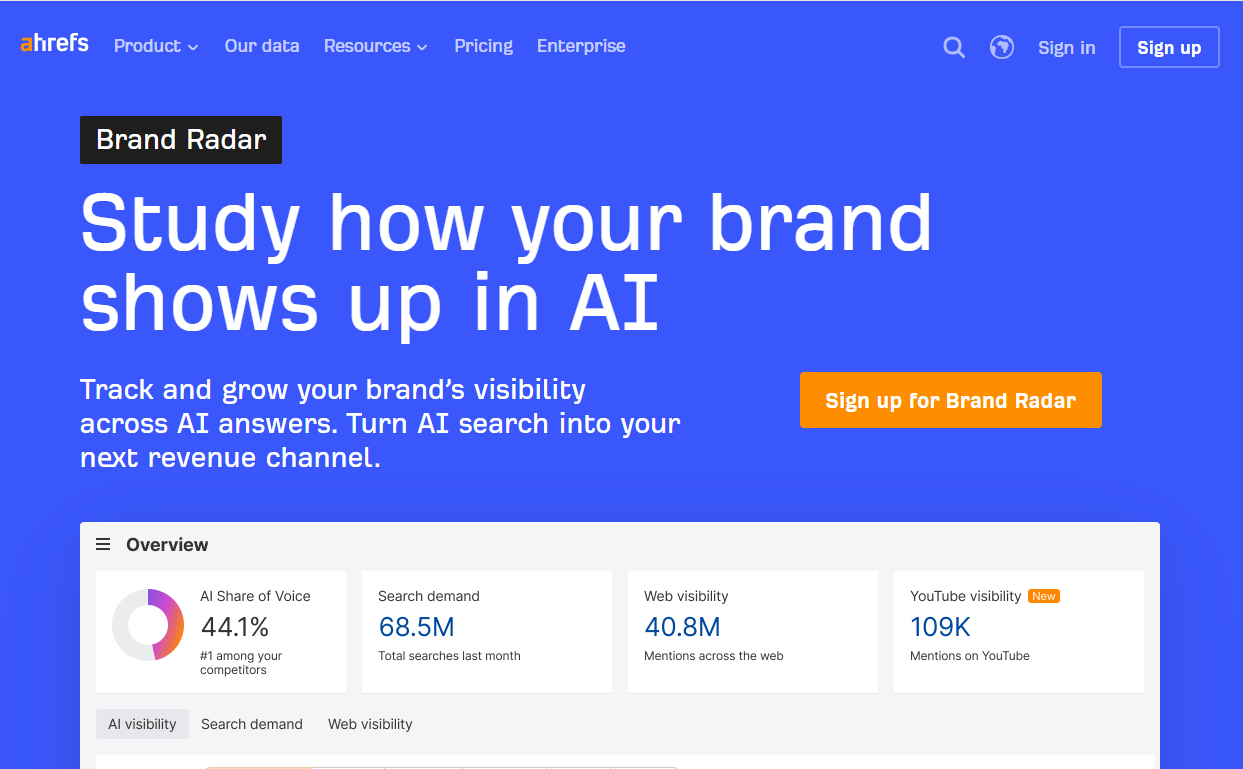
Ahrefs Brand Radar is the AI visibility product inside Ahrefs. Its AI Visibility Index covers six engines, AI Overviews, AI Mode, ChatGPT, Perplexity, Gemini and Copilot, and Claude is available through Custom Prompts.
Here is what sits behind that definition.
- Engines: AI Overviews, AI Mode, ChatGPT, Perplexity, Gemini and Copilot in the AI Visibility Index, with Claude added through Custom Prompts.
- Custom Prompts: The prompts you choose, which Ahrefs runs for you on the platforms you select.
- Prompt database: Ahrefs states that its database holds more than 538 million real prompts.
- Search Demand: A demand view that Ahrefs says updates every few days.
Refresh cadence matters more than most reviews admit, because it decides how fast you see a change. Per Ahrefs, AI Visibility Index question sets are re-tested monthly on a 90-day reporting window, while Custom Prompts run daily, weekly or monthly per platform. In practice, the index gives you a slow, wide picture and Custom Prompts give you the fast, narrow one.
That split changes how you should use it. The index is for the quarterly question, which is whether your category is moving towards or away from you. Custom Prompts are for the weekly question, which is whether the specific answers you care about changed after you shipped a page.
The Claude detail is easy to miss and it affects the bill. Because Claude sits behind Custom Prompts, every Claude check is a metered check you set up yourself, not something the index hands you. If Claude matters to your buyers, count it in your volume from the start.
Brand Radar is one tool in a crowded field, and engine coverage is where tools differ most. If you want to see how the wider field compares on engines and refresh rate, read our guide to tools for tracking brand visibility in AI search before you commit to any single product.
Ahrefs Brand Radar Pricing: What The Pricing Page Lists
Every price below comes from the Ahrefs pricing page. Nothing here comes from a review site, because reviews disagree on bundling and on currency, and a wrong price is worse than no price.
Ahrefs lists four Brand Radar tiers. Annual billing is shown as saving up to 17%.
| Tier | Price | Checks Per Month | Prompts | Included Users |
|---|---|---|---|---|
| Lite | $129 a month | 150 | 5 | 1 |
| Standard | $249 a month | 300 | 10 | 1 |
| Advanced | $449 a month | 600 | 20 | 1 |
| Enterprise | $1,499 a month, annual commitment | From 2,500 | From 83 | From 3 |
The page also lists a Brand Radar add-on starting from $199 a month.
Then there are the custom prompt packages, which are priced by volume and bill overage.
| Monthly Price | Checks Included | Overage Per Check |
|---|---|---|
| $50 | 2,500 | $0.020 |
| $100 | 7,000 | $0.015 |
| $250 | 25,000 | $0.010 |
The unit that drives all of this is the check. Ahrefs defines one check as one prompt tracked on one platform in one location, and overage bills at month end, per the pricing page. Think of it as a single prompt on a single engine in a single place, and nothing larger.
Two things follow from that. First, the tier names tell you little. A Lite buyer with 5 prompts on 6 engines is already asking for 30 checks per run, so a daily schedule burns through 150 checks in five days. Second, the cheapest-looking number is rarely the number you pay. The package that fits your volume and the tier that fits your prompt count can be different products.
Whether Brand Radar requires an Ahrefs base plan, comes bundled into plans or was free at some earlier point is something third-party reviews disagree on, and the pricing page excerpt does not settle it. Check that on the page for your account before you plan a budget. The same goes for currency, since Ahrefs shows USD on the pricing page and other figures elsewhere on its site.
If the total starts to look like a retainer, weigh it against doing the work through a service. Our Generative Engine Optimization page explains what outsourced work covers, which gives you a fair number to set against tool seats plus the hours someone spends reading them.
The Buy-Or-Skip Test: Checks, Prompts And An Owner
The test has three questions.
- Count your monthly checks. Use this formula. Monthly checks = prompts x engines x locations x runs per month.
- Match the volume to a tier or package. Compare the number with the allowances in the two tables above, and note the prompt limit as well as the check limit.
- Name the owner. Pick the person who will read the gap report and turn it into page edits and mention work.
Question three kills more purchases than questions one and two combined. Monitoring data shows where a brand appears in AI answers. It does not change what engines say. A team without an owner pays for a dashboard that nobody opens.
A Worked Example With Arithmetic Only
These figures come from the check definition and the listed packages. Swap in your own numbers.
- Starting list: 20 prompts on 3 engines in 1 location, run daily over 30 days.
- Monthly checks: 20 x 3 x 1 x 30 = 1,800 checks.
- Where it lands: It sits inside the 2,500-check package at $50 a month. It is three times the 600 checks in the Advanced tier, so the tiers as listed would not cover it.
- Same list on 6 engines: 20 x 6 x 1 x 30 = 3,600 checks, which is over the 2,500-check package and lands in the 7,000-check package at $100 a month.
- Same list run weekly: 20 prompts on 3 engines with about 4 runs a month is about 240 checks.
- Overage example: 3,000 checks on the 2,500-check package is 500 checks over, which at $0.020 a check adds $10 to the $50 package.
Notice how much the schedule moves the answer. Daily runs on 3 engines is 1,800 checks. Weekly runs on the same engines is about 240. That is a gap of more than seven times, from a setting you control. Most teams do not need daily runs on every prompt, and the ones that do should say so out loud before they pick a plan.
Which Prompts To Count First
Do not start with 200 prompts. Start with the 15 to 25 closest to a purchase decision. Comparison questions, alternatives questions and category questions a buyer asks before shortlisting vendors earn their checks. Broad definition questions rarely do.
If you want a fuller framework for the platform decision itself, our AI visibility platform buyer guide covers selection criteria beyond the cost arithmetic here. The test in this section is the narrow version of that process.
Reading The Result
Run the three questions in order and stop at the first one that fails.
- Volume too big for the tiers: Look at the custom packages, or cut the schedule on low-value prompts.
- Volume fits, no owner: Skip it. The fee buys nothing without a reader.
- Volume fits, owner named, already in Ahrefs: Buy it, and treat it as a monitoring layer rather than a full programme.
What Brand Radar Does Well
Brand Radar is at its best for a team already working in Ahrefs that wants AI visibility data next to the SEO data it reads every week. That is the buyer type that benefits most, and it is a better fit than a team buying its first paid SEO tool.
Bundling With Ahrefs Data
The strongest argument for Brand Radar is convenience. You do not need another login, another export or another habit. A team that already trusts Ahrefs for links, keywords and competitors can look at AI answers in the same place, and that lowers the cost of actually using the data.
Prompt Database Size
Ahrefs states that its prompt database holds more than 538 million real prompts. That is a vendor figure and you should read it as one, but it points at a real strength. A big prompt database is a better starting point for finding which questions people ask than a list you brainstormed in a meeting.
Demand And Mention Research
Search Demand updates every few days, per Ahrefs, which makes it useful for spotting which questions are growing before you commission a page. Mention research is the other half, and it helps you decide what to write before you write it.
Flexible Custom Tracking
Custom Prompts can run daily, weekly or monthly per platform. That flexibility is what makes the metered model manageable. You can run the five prompts that matter every day and the other twenty once a week, and your check count drops sharply.
If competitor gap analysis is the capability you care about most, compare Brand Radar against dedicated competitor benchmarking tools for AI visibility before you decide.
Where Brand Radar Falls Short
Brand Radar reports where your brand appears; it does not change what AI engines say about you. Everything in this section follows from that one sentence.
Research Without A Next Step
Brand Radar is a research and monitoring tool. It shows you the gap. It does not tell you which page to rewrite, which source to pitch or which claim to add to your pricing page. Someone on your team does that work, with other tools or by hand.
That is why the owner question in the buy-or-skip test matters. If the answer to "who acts on this" is "nobody yet", the data will look impressive for a month and then go unread. Our guide to citation gap analysis tools shows how to act on the sources AI cites instead of you, which is the step Brand Radar leaves to the team.
Reporting Built For One Team
Agencies that need recurring client-by-client tracking and client-ready branded reports are a poor fit for a research-style tool. If you run ten client domains, the volume, the seat limits and the reporting all push against you. The tiers list one included user on Lite, Standard and Advanced, which tells you who the product is designed for.
Metered Cost That Grows
Per-check pricing grows with prompts, engines and locations, and it grows again with every domain you add. Small businesses and most mid-market teams find that hard to justify, because the bill rises each time the list gets more useful. The Lite tier at $129 a month covers 150 checks, which the pricing section above shows is used up in five days of daily runs on a 30-check list.
Uneven Engine Coverage
Claude is available through Custom Prompts, not in the AI Visibility Index. The six index engines are AI Overviews, AI Mode, ChatGPT, Perplexity, Gemini and Copilot. If your buyers use an engine outside that list, check the Brand Radar page for current coverage before you pay, because you may be building a workaround on a metered tool.
How Complete Is The Data?
Reviewers disagree on accuracy, and the research behind this review found no independent data that settles it. Leave the question open rather than picking a side, and be wary of any single anecdote about mention counts.
You can settle it for your own prompts. Run 20 of them by hand in the engines you care about, record every mention of your brand, then compare with what Brand Radar reports for the same prompts over the same period. If the gap is small, the data is good enough for trend work. If it is large, you have saved yourself a year of fees.
For a method to test false and missed mentions, read our guide to AI visibility tools for brand mention tracking.
Visibility Is Not Traffic
AI share of voice counts how often your brand is named in the answers to the prompts you track. It does not count visits. A rising mention rate with flat traffic is a normal outcome when engines answer the question without sending the click. Report it as visibility, and pair it with analytics before anyone calls it revenue.
Who Should Buy Brand Radar And Who Should Skip It
Most readers of this page are SEO leads at B2B SaaS companies who already pay for Ahrefs. For them the verdict is a conditional buy. Buy it if the prompt list is small and stable and someone owns the output. Skip it if either is missing.
| Team Type | Verdict | Why |
|---|---|---|
| Existing Ahrefs team with a small prompt list | Buy | The data sits next to the SEO work the team already does. |
| Enterprise with Ahrefs and an analyst | Buy | Someone owns the report and the volume justifies the tier. |
| Agency needing client-ready reports | Skip | A research-style tool does not produce branded client-by-client reporting. |
| Small business or seed-stage team | Skip | Per-check pricing is hard to justify at this size. |
| Team needing broad native engine coverage | Skip, or add a specialist | Claude sits behind Custom Prompts, so wider coverage costs extra checks. |
| Team with no owner for the gap report | Skip | Monitoring data changes nothing until someone acts on it. |
Notice that two of the four skips, the agency and the no-owner team, have nothing to do with product quality. They are about the team. That is deliberate. Brand Radar is a reasonable tool that gets bought by the wrong people.
If you are an agency, start with our guide to AI visibility tools for multi-client management, which covers options built for running many domains. If you want the work done rather than the data, our Answer Engine Optimization service is the closer match.
The decision rule is short. If you can name an owner, hold the prompt list under a few dozen and already live in Ahrefs, buy. If any of the three fails, skip, or run the trial in the next section before you decide.
If the gap report would sit unread on your side, look at the GEO + SEO Growth Programme. It covers ongoing SEO and AI-visibility work and reporting, so you can set it against the cost of another tool seat.
How To Test Brand Radar Before You Commit
Do not trust a demo or a review, including this one. Test it on your own prompts. Confirm what trial or refund terms Ahrefs offers on its pricing page, because this review does not claim one exists.
- Write the prompt list. Choose the 15 to 25 prompts your buyers ask before they shortlist a vendor. The output is a fixed list you will not edit during the test.
- Count the checks. Apply the formula to the list, with the engines and run schedule you plan to use. The output is a monthly check number and the package or tier it lands in.
- Run the list for one billing cycle. Keep the schedule fixed. The output is a month of Brand Radar results for the same prompts.
- Check the same prompts by hand. Run them in the engines yourself and record every mention of your brand and your top competitors. The output is a manual baseline.
- Compare the two sets. Count the mentions Brand Radar found and the ones it missed. The output is a gap you can read as a percentage.
- Apply the buy-or-skip test. Ask whether the volume fits, whether the data matched and whether anyone acted on the report. The output is a decision with your own numbers behind it.
For help choosing the prompt set, our guide to daily prompt run monitoring shows how teams build a 25-prompt set. Keep the test honest by changing nothing on your site during the month, otherwise you cannot tell whether a shift came from your work or from the engines.
If Brand Radar Is Not A Fit
Skip Brand Radar if you lack an owner, a small stable prompt list or an Ahrefs plan, and go to our ranked list of Ahrefs Brand Radar alternatives. That page does the comparing so this review does not have to.
If your team already runs rank tracking, site audits and competitor research in Semrush, run the same prompt list through the Semrush AI Visibility Toolkit before adding a second vendor, so the comparison uses your own prompts rather than a reviewer's.
If you are not ready to talk to anyone, the free AI Visibility Report is a lower-effort next step than a call. It gives you a view of how AI engines mention your brand today, so you can decide what to track before you buy a tool.
FAQs
Is Brand Radar Included In An Ahrefs Subscription?
Does Brand Radar Track Claude And Grok?
How Often Does Brand Radar Update Its Data?
Which Prompts Should An SEO Team Track First?
Is Brand Radar Worth It For A Small Business?
What Counts As One Check In Brand Radar?
Can Brand Radar Replace A Dedicated AI Visibility Tracker?
Does AI Share Of Voice Measure Traffic?
Will Brand Radar Improve My AI Citations Automatically?
Book a free thirty-minute call and one of the founders will go through your prompt list and current stack with you. You leave knowing whether Brand Radar or a different setup fits.
📑 Disclosure!
Some links in this article are affiliate links. If you sign up through them, The Rank Masters may earn a commission at no additional cost to you. This does not influence which tools we recommend or what we say about them.