
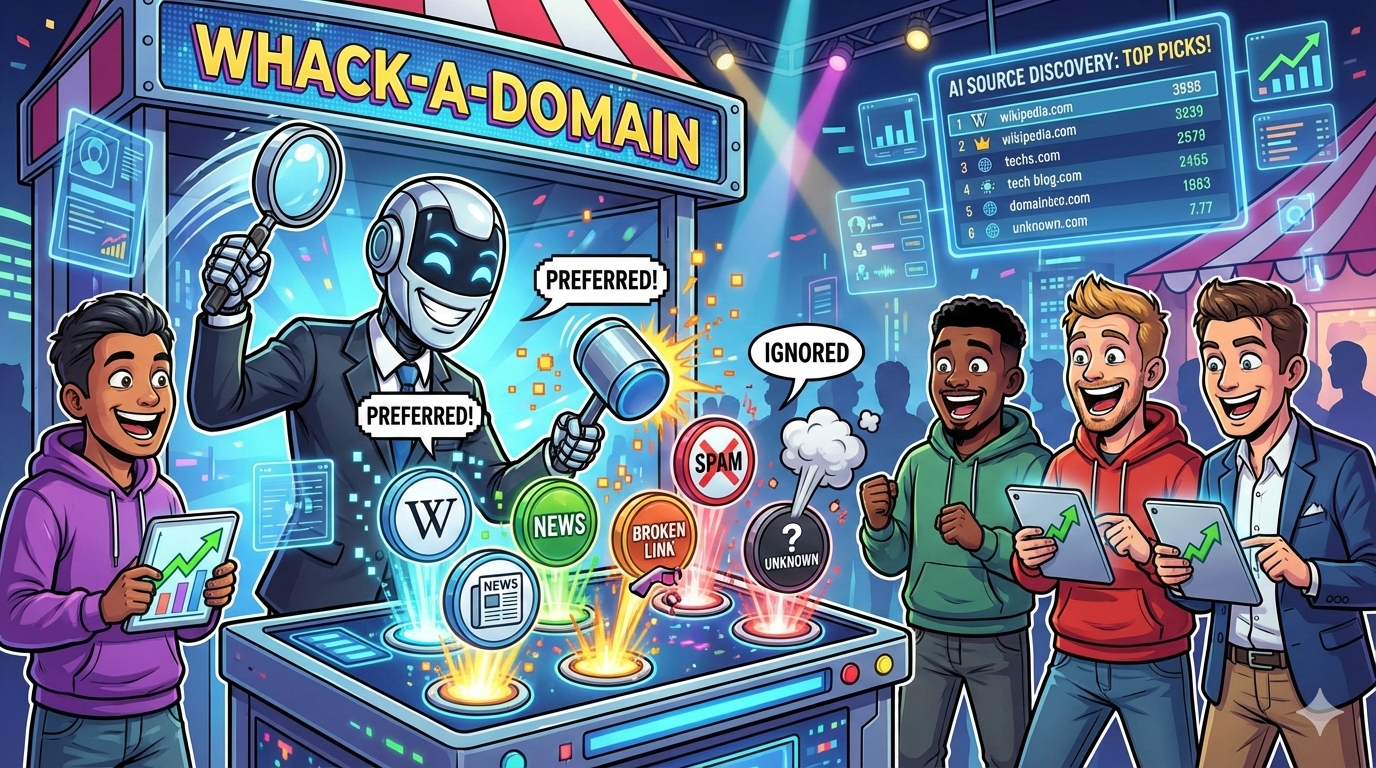
If you want to win AI search, source discovery is your shortcut: instead of guessing what to publish next, you identify the exact domains and URLs AI engines already trust for your topic, then you out-create, out-partner, or out-rank them.
In this guide, the best all-around picks are:
- Peec for teams that want fast, clean reporting + citation actions (and transparent starting pricing).
- OtterlyAI for broad “AI visibility tracker” workflows across engines, including tracking prompts and citations.
- Profound for enterprise-grade workflows + deeper “answer engine insights” and research-led views of citation patterns.
- Promptmonitor if you want a tool that emphasizes showing what sources AI uses and turning that into outreach targets.
Akii if you care about scanning across many models/engines and quick visibility scoring.
📋 Get Listed / Advertisement
We update this guide monthly. Want your tool featured? Contact: [email protected]
Best AI Visibility Tools for Source Discovery (Quick Comparison)
| Tool | Best for | Source discovery strength | Pricing signal |
|---|---|---|---|
| Peec | Marketing/SEO teams who want simple dashboards + citation actions | Strong: prompts → citations → “what sources AI trusts” → opportunities | Public tiers from €89/mo (plus Enterprise). |
| OtterlyAI | AI visibility tracking across major engines, prompt + citation monitoring | Strong: tracks visibility/citations across engines, designed for tracking presence and sources | Free trial messaging + paid plans (varies). |
| Profound | Enterprise insights + workflows; teams who want depth | Strong: “answer engine insights,” research on citation patterns | Typically sales-led/enterprise. |
| Promptmonitor | Practitioners who want “sources AI is using” + actionable outreach | Very strong: explicitly positions source discovery + outreach targeting | Public pricing messaging (site-led). |
| Akii | Broad model coverage + visibility scoring quickly | Strong: scans many models/engines, “visibility score” positioning | Mix of free preview + paid platform. |
📋 Get Listed / Advertisement
We update this guide monthly. Want your tool featured? Contact: [email protected].
1. Peec
What it does
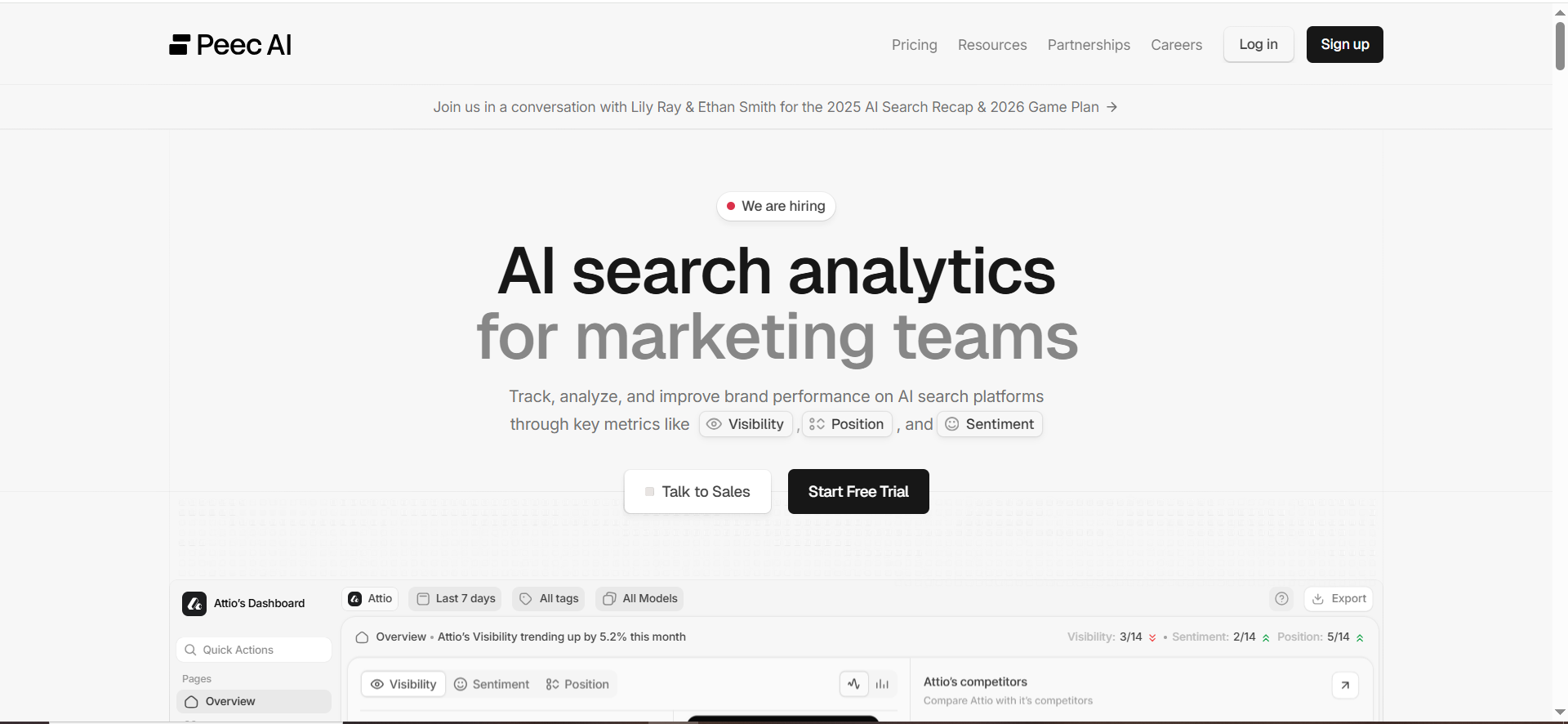
Peec positions itself as an AI search analytics platform where you set up prompts, track visibility across AI engines, and then act on citations, essentially turning “AI answers” into a measurable channel.
Why teams use it
Because it’s built around the workflow most teams actually need:
- define prompts that represent revenue intent,
- track who wins the answer,
- extract citations/sources,
- turn those into a to-do list (content updates, PR, partnerships).
What it’s good for
- Building a domain leaderboard: “Which sites does AI cite most for our category?”
- Finding citation opportunities (sources AI trusts but you don’t yet own).
- Lightweight, repeatable reporting to stakeholders.
When it’s a good fit
- You’re a Growth/Enterprise B2B SaaS team that needs clear reporting and an action loop.
- You want transparent entry pricing and don’t want to jump straight into enterprise procurement.
When it’s not a good fit
- You need highly custom, multi-team governance, bespoke integrations, and complex approval flows (you may prefer an enterprise-first platform like Profound).
- You want a tool that’s primarily for PR monitoring rather than AI-answer monitoring.
How to use it for source discovery
- Start with 25–50 prompts: “best [category] tools,” “top [use case] software,” “[competitor] alternatives,” “how to choose [category].”
- Run prompts across engines (ChatGPT, Perplexity, AI Overviews/AI Mode, etc., depending on your plan).
- Export the citation list and normalize to:
- domain (example.com)
- URL
- “citation context” (why it was cited)
- Build a “Top domains by cluster” dashboard:
- Cluster: “Alternatives”
- Cluster: “Pricing”
- Cluster: “Implementation”
- For the top 20 domains, decide: out-rank, out-partner, or out-reference.
Key capabilities
- Prompt-based tracking across AI engines.
- Explicit “find citation opportunities” / “discover which sources AI models trust and reference” workflow.
Pricing
Peec’s pricing starts at €89/month, with higher tiers like Pro at €199/month and Enterprise priced as custom.
Free tier?
Peec doesn’t publicly list a permanent free tier, but it does offer a “Start for free” option (and Enterprise is handled via a personalized demo/request).
Downsides / limitations
- Like any prompt-based tracker, it’s only as good as your prompt set quality (garbage prompts → garbage “source leaderboards”).
- You still need a human strategy layer: deciding which sources are “winnable,” what content to produce, and how to build relationships (this is where a tight content audit sprint helps).
2. OtterlyAI
What it does
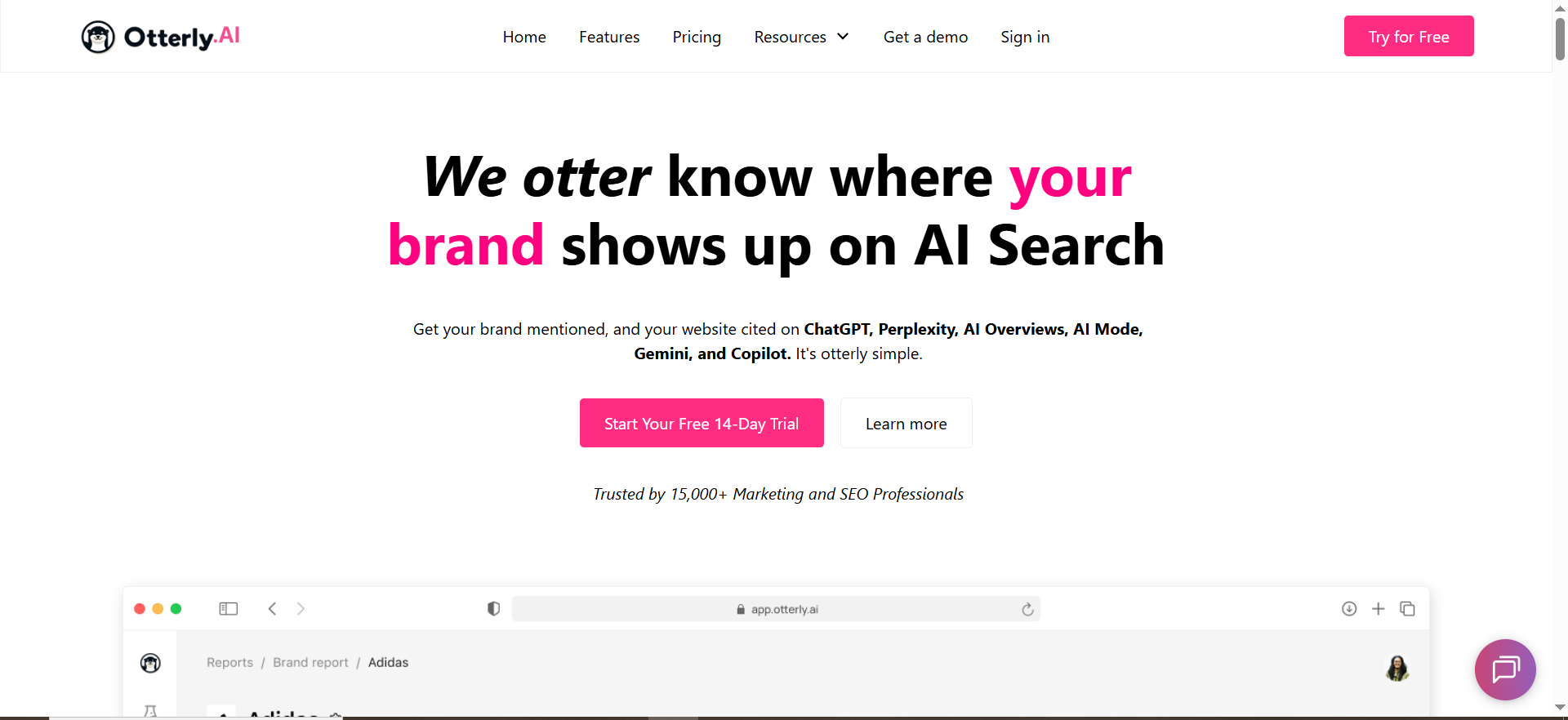
OtterlyAI describes itself as an AI visibility tracker that monitors how often your brand/content appears in AI answers across platforms like ChatGPT, Google AI Overviews, Perplexity, Claude, and Copilot.
Why teams use it
OtterlyAI is popular with teams that want a “single pane of glass” for:
- prompt tracking,
- mention/citation tracking,
- dashboards for clients or internal stakeholders.
What it’s good for
- Ongoing monitoring: “Did we gain or lose citations after publishing X?” (this is where tracking your share of AI voice becomes actionable).
- Prompt + citation visibility across several AI systems.
- Teams that want an accessible tool without building their own data pipeline.
When it’s a good fit
- Agencies and in-house teams that need an always-on tracker, not a one-time research sprint.
- You want to report AI visibility the way you report rankings: weekly trendlines, client-friendly dashboards.
When it’s not a good fit
- If you need deep data science control (custom weighting models, data warehouse-first workflows), you might prefer a more enterprise platform or a custom stack.
How to use it for source discovery
A simple workflow:
- Track the prompts that represent your highest-intent category queries.
- For each prompt, pull the citations and mentioned brands.
- Build a “Top cited domains” list and tag each domain by:
- content type (review site, publisher, UGC, encyclopedia, vendor blog)
- relationship (partner, competitor, neutral)
- Decide your play per domain:
- UGC/review: improve profiles, seed reviews, answer Qs
- Publishers: pitch inclusion, data hooks
- Encyclopedic: tighten entity presence (Wikidata/Wikipedia policies apply)
Key capabilities
OtterlyAI highlights tracking visibility across multiple AI platforms and provides features pages emphasizing citation/prompt tracking and dashboards.
Pricing
OtterlyAI’s pricing starts at $29/month.
Free tier?
OtterlyAI doesn’t offer a free tier, but it does offer a free trial.
Downsides / limitations
- Some “AI answers” can be volatile, especially for broad prompts, so you need prompt clustering and repeated runs to avoid overreacting to noise (and that’s why evergreen content matters).
- You’ll still need a process to turn “top cited domains” into a prioritized backlog (we’ll cover a scoring model later).
3. Profound
What it does
Profound positions itself as a platform to optimize brand visibility in AI search, with “Answer Engine Insights” and integrations/workflows for teams.
Why teams use it
Two reasons:
- enterprise teams want more than “rank tracking,” they want insights + workflows,
- Profound publishes research and patterns that help teams understand how different AI platforms cite sources.
What it’s good for
- Enterprise-scale AI visibility programs (multi-market, many prompt sets).
- Teams that want platform-level insight into citation patterns between AI engines.
- Building internal alignment: execs often trust a program more when it comes with “how the ecosystem works” research.
When it’s a good fit
- You have multiple stakeholders (SEO, PR, content, product marketing) and need repeatable governance.
- You want to go beyond “mentions” into “why did we win/lose,” with deeper insights and reporting.
When it’s not a good fit
- You’re early-stage and just need a lightweight tool for 25–50 prompts.
- You want public self-serve pricing (enterprise tools are often sales-led).
How to use it for source discovery
Use Profound to answer:
- “Which sources does each engine prefer for our niche?”
- “Do our top competitor domains win in Perplexity but not in Google AI Overviews?”Then create per-engine roadmaps:
- Google AI: prioritize editorial sources and structured pages (especially if you care about AI Overviews workflows).
- Perplexity: prioritize citation-heavy formats and community/review sources
- ChatGPT: prioritize strong entity pages and widely referenced sources (varies by use case)
Key capabilities
Profound’s blog and product positioning emphasize AI search insights and how engines differ in citations.
Pricing
Profound’s pricing strats at $99 per month.
Free tier?
Profound doesn’t publicly list a free tier or a self-serve free trial, but it does offer demos.
Downsides / limitations
- Like any enterprise platform, you’ll want an internal owner to keep prompts, taxonomy, and action loops current, otherwise it becomes a dashboard nobody uses.
- You still need to implement the actions (content, PR, partnerships), tools don’t earn citations; execution does.
4. Promptmonitor
What it does
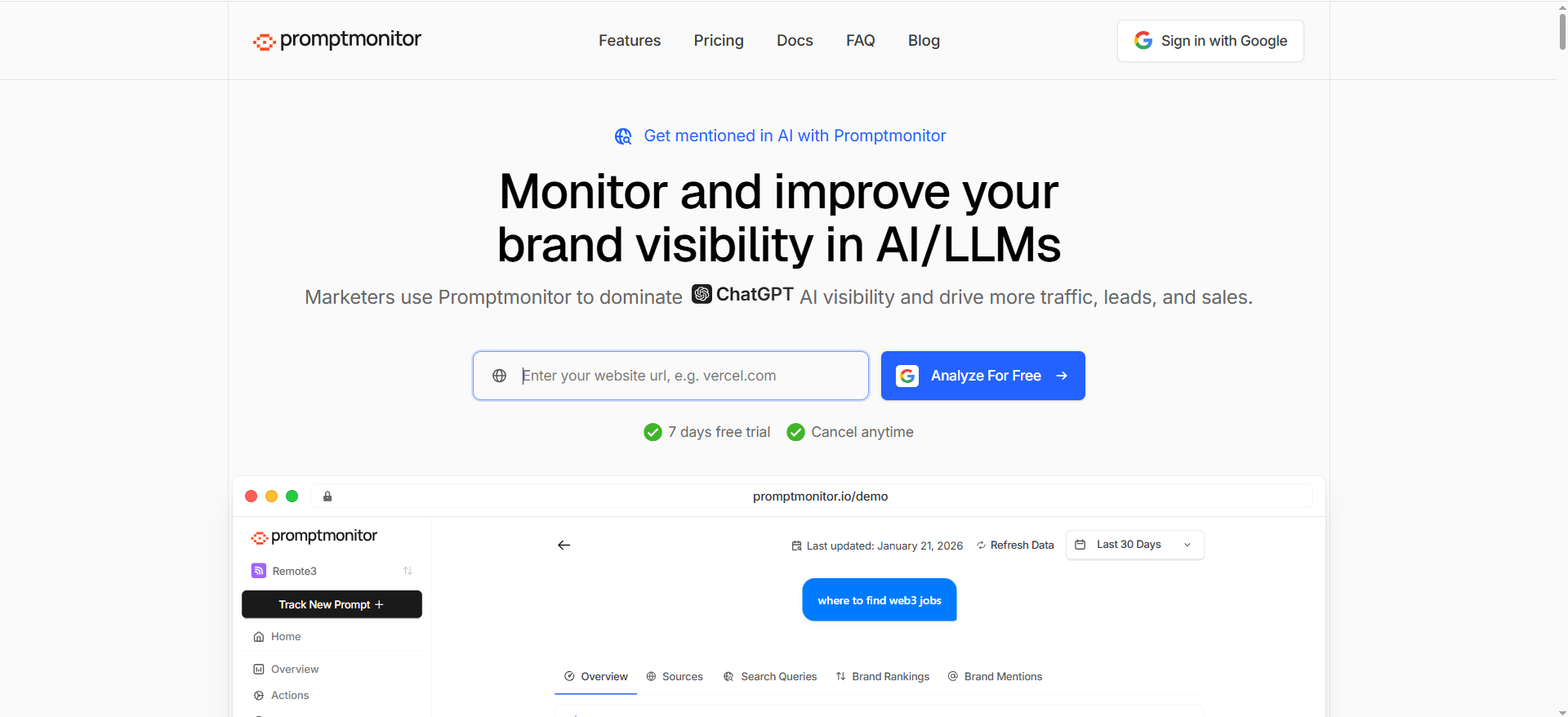
PromptMonitor positions itself as an AI visibility optimization tool that tracks mentions across ChatGPT, Perplexity, and other AI/LLMs and emphasizes showing what sources AI is using.
Why teams use it
Because it leans hard into the source discovery → outreach loop:
- identify the sources powering answers,
- extract enough context to decide whether to contact the source,
- prioritize by SEO metrics and relevance.
What it’s good for
- Turning “AI citations” into a direct list of outreach targets (publishers, lists, communities).
- Teams that want visibility tracking and an explicit “what do I do next?” pipeline.
When it’s a good fit
- You have someone who can execute PR/outreach weekly (even 2–3 hours/week).
- You want to focus on “how to get mentioned” rather than only “how we rank.”
When it’s not a good fit
- If you don’t have any capacity for outreach/partnerships and only want to publish on your own site, you may prefer a content-first tool + a separate PR workflow.
How to use it for source discovery
- Create prompt sets around your commercial queries (alternatives, comparisons, “best tools”).
- Export sources and categorize them:
- “List inclusion targets”
- “Review/community targets”
- “Publisher targets”
- Run a weekly sprint:
- 10 new outreach targets
- 5 relationship follow-ups
- 1 “data hook” pitch (original stat or benchmark)
Key capabilities
PromptMonitor explicitly states it will show sources AI uses and help you outreach to them (including extracting contact information).
Pricing
Promptmonitor’s pricing starts at $29/month.
Free tier
Promptmonitor doesn’t offer a free tier, but it does offer a 7-day free trial.
Downsides / limitations
- Outreach-heavy workflows can create “busywork” unless you prioritize sources by winnability (we’ll share a scoring model below).
- Some niches have sources that are difficult to influence (e.g., Wikipedia policies, regulated industries).
5. Akii
What it does
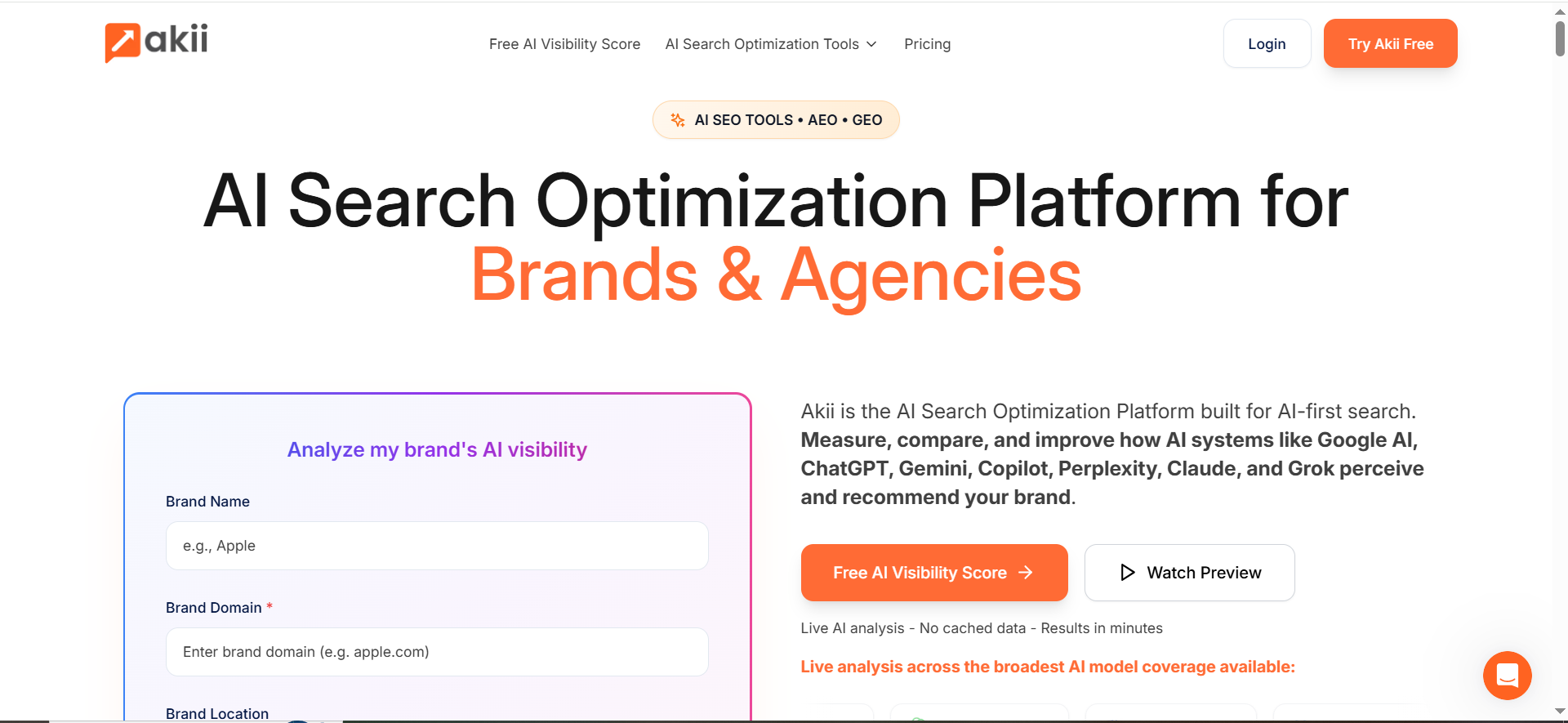
Akii positions itself as an AI Search Optimization platform for brands and agencies, emphasizing measuring and improving how AI systems recommend your brand, with broad model coverage across many AI assistants/engines.
Why teams use it
- You can quickly answer: “How visible are we in AI right now?” with a scoring approach.
- You can scan across many models/engines, which is valuable when different teams care about different AI surfaces.
What it’s good for
- Broad monitoring across many AI models (helpful if you sell globally or across multiple ICP segments).
- High-level reporting: “AI visibility score by cluster” (paired with a citation audit).
When it’s a good fit
- You need multi-engine coverage and quick scans for competitive intelligence.
- You want a tool that’s friendly for both agencies and brands.
When it’s not a good fit
- If your core need is deep URL-level technical SEO and crawling insights, you’ll still need your traditional SEO stack alongside it.
How to use it for source discovery
Use Akii to:
- Map your visibility by engine/model.
- Identify where competitors are recommended and you’re not.
- For the “gap” prompts, collect citations and build a per-engine domain leaderboard.
Key capabilities
Akii emphasizes measuring visibility across many AI systems and quick analysis.
Pricing
Akii’s pricing starts at $49/month.
Free tier
Akii doesn’t list a permanent free tier on its pricing page, but it does offer a 14-day free trial (and a free AI visibility test).
Downsides / limitations
- Broad coverage is great, but you’ll still need a focused prompt taxonomy, otherwise you’ll drown in “interesting” data without clear next steps.
- As with any newer category, packaging can evolve fast; confirm current plan details before standardizing internally.
What “source discovery” means in AI search visibility (and why it’s the fastest win)
Source discovery is the process of identifying which domains and URLs an AI engine relies on to answer a prompt, then using that list to decide where you should compete.
Traditional SEO asks: “Which pages rank?”
Source discovery asks: “Which sources get cited or implied as truth?”
Why this matters? Citations are the “supply chain” of AI answers. If you can influence the supply chain, you can influence the answer.
Domain-level vs URL-level opportunities
Think in two layers:
Domain-level (macro):
- “In our niche, AI mostly cites: Wikipedia, Reddit, YouTube, major publishers, and 3–5 review sites.”
URL-level (micro):
“For our highest-intent prompts, AI cites these 18 URLs (often listicles and comparison pages).”
Domain-level tells you where to play. URL-level tells you what to build or beat.
“Source leaderboard” by engine + niche
Your topic brief’s ideal angle is exactly right: build a source leaderboard and slice it by:
- engine (ChatGPT vs AI Overviews/AI Mode vs Perplexity)
- niche (e.g., “CRM,” “observability,” “HRIS”)
- intent cluster (best tools, pricing, implementation, alternatives)
Why: the “top domains” are not universal across every engine. Even when the same domains appear, their citation share and format preference can differ dramatically.
Which domains AI prefers (what the data says)
You asked, “Which domains AI prefers?” The honest answer is: it depends on the AI surface, but the patterns are consistent enough to build a reliable playbook.
The universal citation giants
Multiple industry studies consistently show a small set of domains that tend to dominate citations across AI surfaces, especially for broad informational queries:
- Wikipedia frequently appears as a top-cited domain.
- YouTube is also commonly cited (and in some studies, leads).
- “Platform-owned” ecosystems matter (e.g., Google properties are heavily represented inside Google AI surfaces).
What this means for you: you’re not trying to “beat Wikipedia.” You’re trying to understand which non-obvious, niche sources show up repeatedly, and then win those slots.
ChatGPT vs Google AI Overviews/AI Mode vs Perplexity: practical differences
Perplexity tends to be more overtly citation-forward (it often provides clear sources), and multiple analyses highlight strong visibility for community/UGC sources in many categories.
Google AI Overviews / AI Mode show strong ties to Google’s ecosystem and can exhibit surprising domain preferences in sensitive categories. For example, recent reporting discussed research where YouTube was heavily cited in health-related AI Overviews analysis, raising concerns about quality control.
ChatGPT citation behavior varies by product surface and query type, but studies of cited domains across assistants still show concentration among a relatively small group of widely-referenced sites (including Wikipedia, forums, and major publishers).
Actionable takeaway: Your “source leaderboard” should never be “one list.” Make it engine-specific.
How to build a source leaderboard you can actually act on
Most teams fail at AI visibility because they treat it like a novelty metric. Source discovery only works if it ends with a ranked backlog.
Here’s a field-tested approach.
Step 1: Collect prompts + fan-out (build your map)
Start with 25 prompts. Then fan out to 100–200 by adding modifiers:
Core commercial intents
- “best [category] tools”
- “[category] software for [industry]”
- “[competitor] alternatives”
- “[category] pricing”
- “[category] implementation”
- “[category] vs [category]”
Modifiers
- by segment: “for startups,” “for enterprise,” “for agencies”
- by feature: “with SSO,” “with SOC2,” “with integrations”
- by outcome: “reduce churn,” “increase pipeline,” “speed up reporting”
- by geography: “in the UK,” “in Germany,” “in UAE”
Your SOP explicitly expects query fan-out coverage and completeness.
Step 2: Normalize citations (domain, URL, entity)
AI answers are messy. Do the boring work once, then reuse it forever:
Create columns:
- Engine (ChatGPT / Perplexity / Google AI)
- Prompt
- Run date/time
- Cited domain
- Cited URL
- Citation context (what claim it supported)
- Mentioned brands/entities
Normalize:
- Strip tracking parameters
- Canonicalize subdomains
- Group near-duplicates
Step 3: Score sources (authority × relevance × winnability)
You need a score that tells you “go after this source next week.”
A simple model (0–3 scale each):
- Relevance: Is the source about your niche and query intent?
- Authority: Is it a category-defining site (publisher, review platform, major community)?
- Winnability: Can you realistically influence it in 30–60 days?
Then multiply by Citation frequency:
- 1 point for each time that domain appears in your prompt set (or weight by top-3 placement if your tool provides prominence scoring).
Example
- A niche “best tools” blog that shows up 12 times, with reachable editors, might outrank a mega-domain in winnability even if it’s “less authoritative.”
Step 4: Turn sources into actions (content, PR, partnerships)
For each high-scoring domain, pick one play:
Play A: Out-create (content beat)
- Build the page AI wishes existed: comparison table, clear definitions, screenshots, decision tree.
- Use entity-rich sections so AI can extract: “best for,” “not for,” “pricing,” “limitations.”
Play B: Out-partner (inclusion)
- For listicles/directories: pitch inclusion with proof (benchmarks, customer stories, differentiation).
- Offer something editors love: data, visuals, “what changed in 2026,” etc.
Play C: Out-reference (become the cited source)
- Publish a mini-benchmark or dataset that others cite.
- Make it easy to cite: clean charts, methodology, definitions.
Step 5: Monitor volatility + loss alerts
AI answers change. Your leaderboard should refresh monthly (or weekly for competitive categories). Many AI visibility tools emphasize ongoing monitoring of visibility/citations across engines.
What is “source discovery” in AI search visibility?
Source discovery is the process of identifying which domains and URLs an AI system relies on when it answers a query, and then using that intelligence to decide where you should compete to earn mentions, citations, and recommendations.
In traditional SEO, you ask: “Which pages rank on Google?”
In AI visibility, you ask: “Which sources are feeding the answer?”
In practice, source discovery answers questions like:
- “Which domains show up repeatedly for my niche?” (domain-level leaderboard)
- “Which exact URLs get cited for my money prompts?” (URL-level opportunities)
- “Which source types dominate?” (publishers, directories, UGC, docs, research, Wikipedia-like references)
- “Which engines prefer which sources?” (Perplexity vs Google AI Overviews vs ChatGPT-style assistants)
Why it matters
AI systems don’t just “rank web pages.” They synthesize. The sources they cite (or implicitly rely on) are the supply chain behind recommendations. If you can influence that supply chain, you can influence outcomes:
- Get listed on a source AI keeps citing → you become “recommended.”
- Replace a weak cited URL with a stronger page → you become “cited” (often by updating or rewriting existing posts).
- Publish original data others cite → you become a “source of truth.”
Domain-level vs URL-level source discovery
- Domain-level: “AI trusts G2, Reddit, Wikipedia, and 3 niche blogs for our category.”
- URL-level: “For ‘best X tools,’ AI cites these 12 list pages; for ‘X pricing,’ it cites these 8 pricing explainers.”
Both matter. Domain-level tells you where to focus. URL-level tells you what to build/beat.
What domains does Perplexity cite the most?
The most honest, useful answer: Perplexity’s “top cited domains” are highly topic-dependent, and your best move is to measure your niche directly with a prompt set.
That said, Perplexity tends to be more citation-forward than many AI assistants, so you’ll often see repeated citations from:
- High-authority reference sources (e.g., Wikipedia-type references for definitions and entities)
- Major publishers (especially for newsy or trending topics)
- UGC/community (Reddit, forums, Q&A, depending on category)
- Review/directories (for “best tools,” comparisons, alternatives)
- First-party docs (for “how to,” setup, APIs, troubleshooting)
Why Perplexity’s domain set can look different
Perplexity’s product experience encourages citing sources and linking to them. That makes it:
- Easier to extract a domain leaderboard,
- More sensitive to what’s currently well-documented online,
- Often more “source diverse” across prompts.
How to find your “Perplexity Top Domains” (fast workflow)
- Choose 30–50 prompts across your key intents (best tools, alternatives, pricing, implementation, integrations).
- Run prompts in Perplexity (or via your AI visibility tool).
- Export citations and normalize to:
- root domain (example.com)
- content type (publisher / directory / UGC / docs)
- Count frequency:
- Citations per domain
- Prompts where domain appears
- Slice by intent cluster:
- “Best tools” may be dominated by directories and listicles.
- “How to implement” may be dominated by docs and technical blogs.
What to do with the result
- If directories/review sites dominate → prioritize inclusion and profile optimization.
- If publishers dominate → build a PR/data hook plan.
- If niche blogs dominate → produce a “better cited URL” and/or outreach for inclusion.
What is a “source leaderboard” and how do I build one by niche?
A source leaderboard is a ranked list of the domains (and optionally URLs) that appear most often as sources across a defined set of prompts, usually broken down by:
- AI engine (Perplexity vs Google AI vs ChatGPT-style)
- niche/topic (e.g., CRM, observability, payroll)
- intent cluster (best tools, pricing, implementation, alternatives)
Think of it as:“These are the websites that control the conversation in AI answers for our category.”
How to build one by niche (step-by-step)
1) Define your niche + prompt taxonomy
Start with one niche (don’t boil the ocean). Example: “customer support software.”
Create intent clusters:
- Best tools
- Alternatives
- Pricing
- Implementation
- Integrations
- Use-case (for SaaS, ecommerce, enterprises)
2) Create a prompt set (50–200 prompts)
Minimum viable leaderboard: 50 prompts.More stable leaderboard: 100–200 prompts.
Mix:
- head terms (“best customer support software”)
- mid-tail (“customer support software for Shopify”)
- competitor comparisons (“Zendesk alternatives”)
3) Run prompts across engines
Run each prompt in your target engine(s). Capture:
- answer text
- citations (domain + URL)
- mentioned brands (optional)
4) Normalize your citation data
Clean and standardize:
- merge www. and non-www.
- remove tracking parameters
- decide how you treat subdomains (docs.example.com vs example.com)
5) Rank domains (metrics that matter)
At minimum:
- Domain citation frequency: total number of times cited
- Prompt coverage: how many prompts the domain appears in
- Optional: prominence weighting: if your tool tracks “top citation” vs “secondary citation”
6) Segment into “source types”
Tag each domain as:
- publisher
- directory/review site
- UGC/community
- first-party docs
- research/academic
- aggregator/comparison blog
This reveals your strategy instantly.
7) Turn it into a “playbook leaderboard”
Add two more fields:
- Influence path: out-create / out-partner / out-reference
- Winnability: how easy it is to affect in 30–60 days
Now your leaderboard becomes a backlog, not just a chart.
What structured data helps AI extract citations?
Structured data doesn’t “force” AI engines to cite you, but it can make your pages easier to parse, attribute, and trust.
Priority schemas for source-like pages
Article / BlogPosting
- Helps clarify authorship, publish date, headline, and content type.
- Especially useful for research posts and guides.
Organization
- Helps establish entity details (name, logo, socials, sameAs).
- Good for brand/entity consistency.
Product
- Useful for software pages (features, brand, offers, pricing).
- Especially helpful when paired with clear on-page pricing/plan data.
FAQPage
- Works well for “how-to” and definitional prompts.
- Also makes extraction easier for Q&A style answers.
HowTo
- Strong fit for tutorials and workflows (“how to build a leaderboard”).
BreadcrumbList
- Helps reinforce site structure and topical organization.
Review / AggregateRating (use carefully)
- Only if it’s legitimate and policy-compliant.
- Can help AI understand “social proof” signals.
What matters even more than schema
Structured data works best when paired with:
- clear headings (H2/H3 that match questions)
- tables (comparisons, criteria, steps)
- explicit definitions and “best for” statements
- updated timestamps and “what changed” sections
If your content is vague, the schema won’t save it.
Can I do source discovery with free tools?
Yes, you can do a solid first pass for free, especially if your goal is to identify:
- recurring domains,
- recurring page types,
- gaps where you’re missing from key sources.
Here are three free-ish approaches:
Method 1: Manual Perplexity runs + spreadsheet (fast MVP)
- Create 30 prompts in a Google Sheet.
- Run each prompt in Perplexity.
- Copy citations (domains/URLs) into the sheet.
- Pivot table:
- rows: domain
- values: count of citations
- filters: prompt cluster
This is slow, but it works.
Method 2: Browser + search operators (publisher discovery)
Use Google/Bing to find “source hubs”:
- site:example.com "best [category]" (find listicles)
- "[competitor] alternatives" + "best" (find recurring lists)
- intitle:"best" intitle:"[category]" (find list formats)
Then test whether those domains appear in AI citations.
Method 3: Community + directory inventory
Make a list of:
- top review sites in your category
- top communities (Reddit subs, forums)
- top “industry magazines”Then run prompts and see which ones appear in citations repeatedly.
Free tools are enough when…
- You’re validating the channel (“does AI cite sources in our niche?”)
- You’re early and only need 30–50 prompts
- You want to build a first leaderboard to justify buying a tool
You’ll want a paid tool when…
- you need weekly monitoring and loss alerts
- you’re tracking many niches/markets
- you want multi-engine comparisons at scale
- you need repeatable reporting to leadership/clients
FAQs
What’s the difference between an AI “mention” and an AI “citation”?
Which domains does AI cite the most overall?
Does Perplexity prefer different sources than Google AI Overviews?
Do I need 200 prompts to do source discovery?
How do I “get cited” by AI systems?
What’s the fastest win once I have my top-cited domains list?
📋 Get Listed / Advertisement
We update this guide monthly. Want your tool featured? Contact: [email protected].