If you care about being recommended by AI, you need monitoring across multiple answer engines, not just one chatbot. The best “widest coverage” picks today are:
- Akii for broad multi-model/assistant coverage and fast visibility checks across many AI systems.
- Profound for enterprise-grade AI visibility intelligence and large-scale citation insights.
- Promptmonitor for cross-model consistency style scoring across multiple major AI platforms.
- OtterlyAI for straightforward tracking across widely-used assistants like ChatGPT, Google AI Overviews, Perplexity, Claude, and Copilot.
RankPrompt for a lightweight way to monitor visibility across ChatGPT, Perplexity, and Google AI Overviews (good for smaller teams).
📋 Get Listed / Advertisement
We update this guide monthly. Want your tool featured? Contact: [email protected].
Best AI Visibility Tools with the Widest AI Engine Coverage (Quick Comparison)
| Tool | Engine coverage (examples) | Best for | Notes |
|---|---|---|---|
| Akii | Positions itself has broad “AI search” coverage across assistants like ChatGPT, Gemini, Copilot, Perplexity, Claude, and more. | Teams that want breadth + quick competitive checks | Strong “wide coverage” positioning |
| Profound | Used for large-scale citation/visibility analysis across many AI systems in published research contexts. | Enterprise visibility intelligence | Best when you need governance + research depth |
| Promptmonitor | Multi-platform coverage including ChatGPT, Claude, Gemini, Grok, DeepSeek, Perplexity. | Cross-model consistency monitoring | Good for “consistency score” style reporting |
| OtterlyAI | Tracks platforms like ChatGPT, Google AI Overviews, Perplexity, Claude, Microsoft Copilot. | Marketing teams that need practical coverage fast | Clear “core engines that matter” focus |
| RankPrompt | Tracks ChatGPT, Perplexity, Google AI Overviews. | Lean teams & agencies wanting simple reporting | Narrower engine set, simpler workflows |
📋 Get Listed / Advertisement
We update this guide monthly. Want your tool featured? Contact: [email protected].
1. Akii
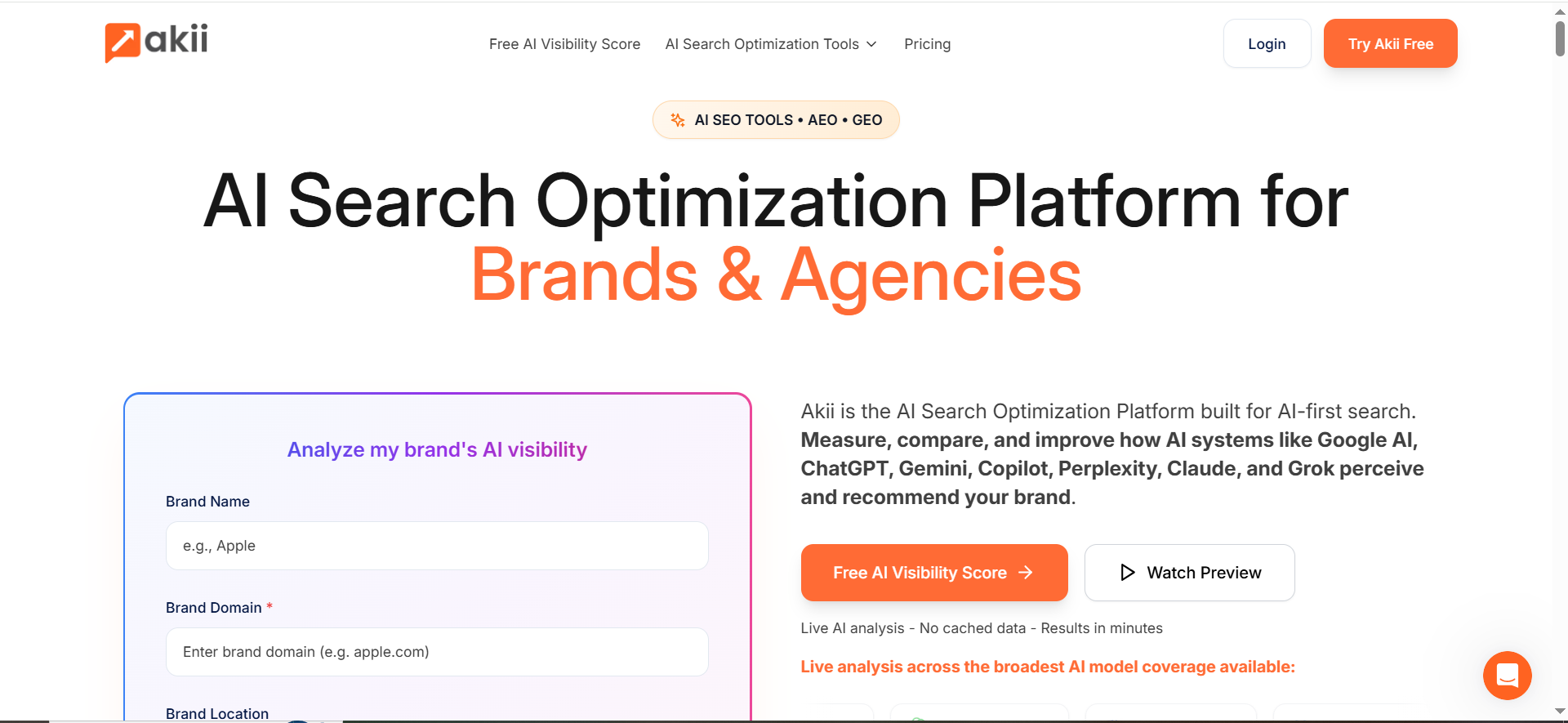
Akii positions itself as an AI search optimization platform built to measure and improve how multiple AI systems recommend your brand, explicitly naming assistants like ChatGPT, Gemini, Copilot, Perplexity, Claude, and Grok.
What it does
Akii focuses on visibility measurement across a broad set of AI assistants and “AI search” experiences, so you can see whether you’re being recommended, how you compare to competitors, and where you’re missing visibility.
Why teams use it
Because Akii’s positioning is explicitly about breadth, it calls out “broadest AI model coverage” messaging and emphasizes monitoring multiple assistants in one place.
What it’s good for
- Cross-engine “are we recommended?” checks across your category
- Competitive comparisons (you vs competitor sets)
- Fast baseline creation: “where do we show up today?”
When it’s a good fit
- You sell into multiple regions or customer segments and need wide monitoring
- You want one dashboard to answer: “Which AI assistants recommend us?”
When it’s not a good fit
- You only care about one surface (e.g., only Google AI Overviews) and want hyper-specialization
- You need a fully custom research pipeline (where an enterprise intelligence platform may fit better)
How to use it
- Create a prompt set (brand + category + “best X for Y” queries).
- Group prompts by intent (awareness / consideration / purchase).
- Run a baseline and export a weekly snapshot.
- Prioritize prompts where competitors appear and you don’t.
- Iterate: update pages, add comparison content, earn citations, re-run.
Key capabilities
- Multi-assistant visibility measurement (as described in Akii’s positioning)
- Monitoring recommendations and perception across assistants
Pricing
Akii’s pricing starts at $49/month.
Free tier?
Akii doesn’t offer a free tier, but it does offer a 14-day free trial.
Downsides / limitations
- “Broad coverage” is a promise you should validate with a proof test: run the same 20 prompts across the engines you care about and confirm outputs match your needs (regions, citations, refresh cadence).
2. Profound
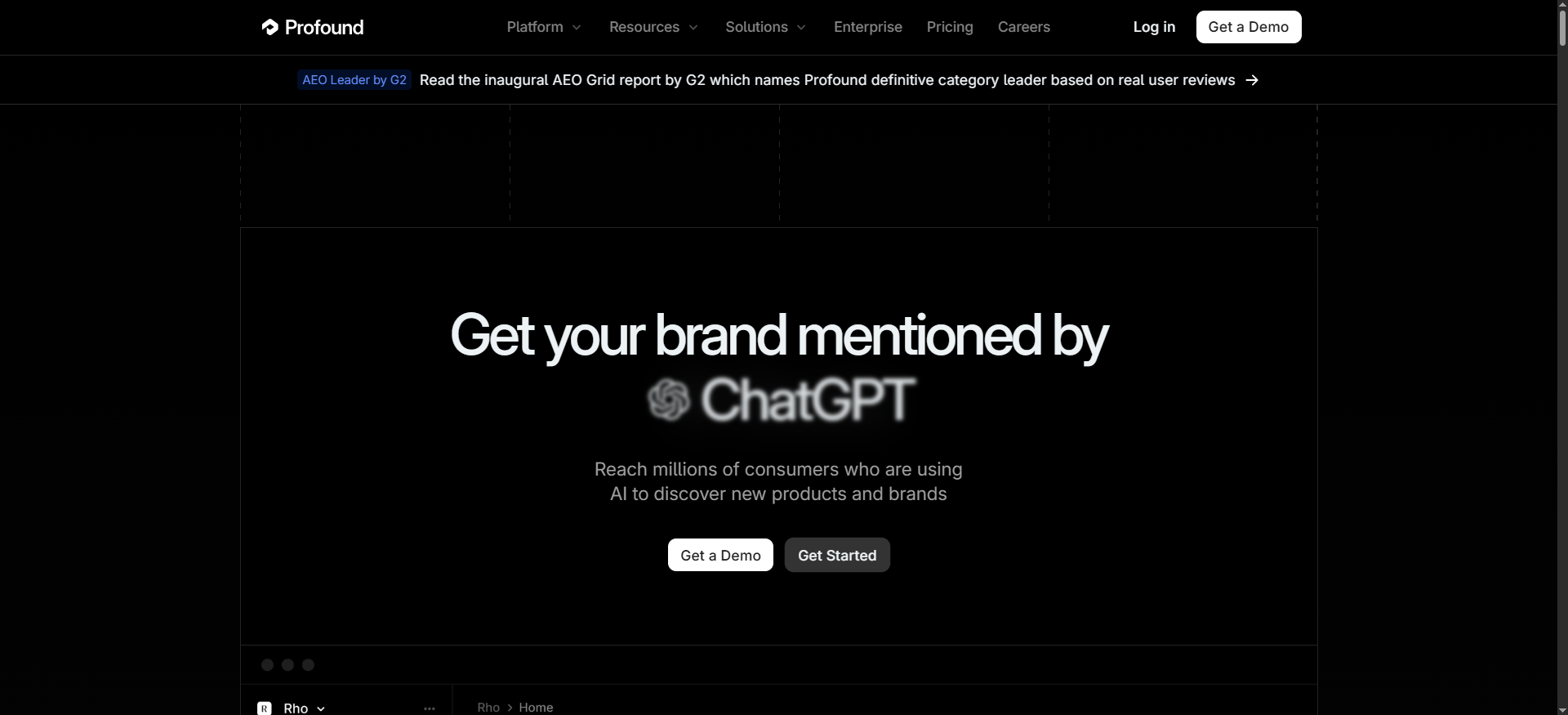
Profound positions itself around tracking AI visibility, mentions, and citations/sources that influence AI answers.
It has also been cited as the source of large-scale AI citation analysis across many major AI systems.
What it does
Profound focuses on AI visibility intelligence, how AI is talking about your brand, where you appear, and what sources drive those answers.
Why teams use it
If you’re serious about widest coverage, you eventually need more than “rank tracking”:
- What sources do AI engines cite?
- What domains shape your narrative?
- Where are you missing compared to competitors?
Profound’s positioning and published analysis examples lean into exactly that.
What it’s good for
- Citation/source intelligence (what AI relies on)
- Enterprise reporting: stakeholder-ready visibility narratives
- Research-grade insights (what domains matter in AI answers)
When it’s a good fit
- Enterprise brands and well-funded teams who need depth + governance
- Teams that care about “why we’re recommended” as much as “are we recommended”
When it’s not a good fit
- Early-stage teams who want the cheapest possible monitoring
- Teams that only need a small prompt set and quick snapshots
How to use it
- Start with 30–50 prompts: brand, category, “alternatives,” “best for,” and “vs” queries.
- Add competitor entities (your top 5–10).
- Track mention rate + top cited domains over time.
- Turn insights into action:
- update your comparison pages
- publish “best for X” landing pages
- target PR/partnerships with frequently cited domains
Key capabilities
- Visibility tracking and response analysis (per product positioning)
- Citation-scale analysis across many AI systems in published research contexts
Pricing
Profound’s pricing starts at $99 per month.
Free tier?
Profound doesn’t offer a free tier, but it does offer a demo.
Downsides / limitations
- Enterprise-grade tooling can be heavier to operationalize, assign an owner (SEO lead, Growth, or RevOps) to avoid “dashboard shelfware.”
3. Promptmonitor
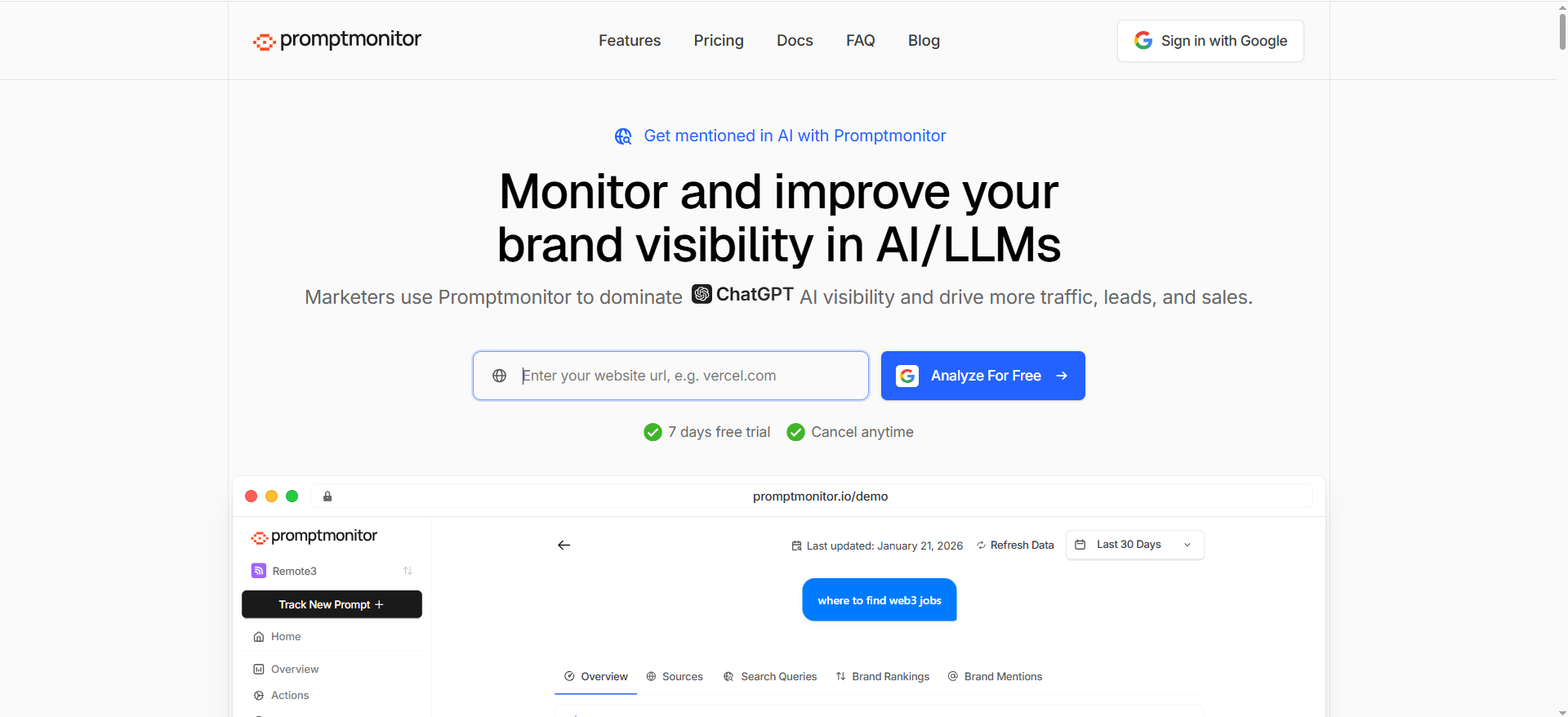
PromptMonitor is often described as a brand AI visibility tracker with multi-platform coverage and scoring across AI platforms.
What it does
It tracks how often your brand appears across multiple AI platforms and emphasizes cross-model coverage and scoring, useful for understanding consistency (not just a single-engine spike).
Why teams use it
Because teams don’t just want “rank”, they want:
- a simple visibility score
- a breakdown by platform
- competitor comparisons
That’s the mental model Promptmonitor content highlights.
What it’s good for
- Multi-platform monitoring across a wider set of assistants (including ChatGPT, Claude, Gemini, Grok, DeepSeek, Perplexity)
- Consistency reporting (“are we recommended across multiple assistants or only one?”)
- Competitive “share of answer” tracking
When it’s a good fit
- Growth teams who want a repeatable KPI they can report monthly
- Teams testing multiple engines and wanting one view across them
When it’s not a good fit
- If you need deep citation intelligence and governance (enterprise intelligence platforms may fit better)
- If your priority is only one surface (e.g., only AI Overviews)
How to use it
- Build prompt clusters:
- category prompts (“best X for Y”)
- competitor prompts (“X vs Y”)
- problem prompts (“how do I solve…”)
- Run baseline across platforms.
- Create a monthly report: score trend + top prompt gains/losses.
- Act on the deltas: refresh pages, build missing comparisons, improve credibility signals.
Key capabilities
- Multi-platform coverage across several major AI platforms
- Scoring model concepts (presence + cross-model consistency)
Pricing
Promptmonitor’s paid pricing starts at $29/month.
Free tier?
Promptmonitor offers a free plan (Agency Plan at $0/month), and it also offers a 7-day free trial on paid plans.
Downsides / limitations
- Scores are only useful if your prompt library is stable and well-tagged, otherwise your “visibility score” will drift for reasons that aren’t business-related (prompt mix changes).
4. OtterlyAI
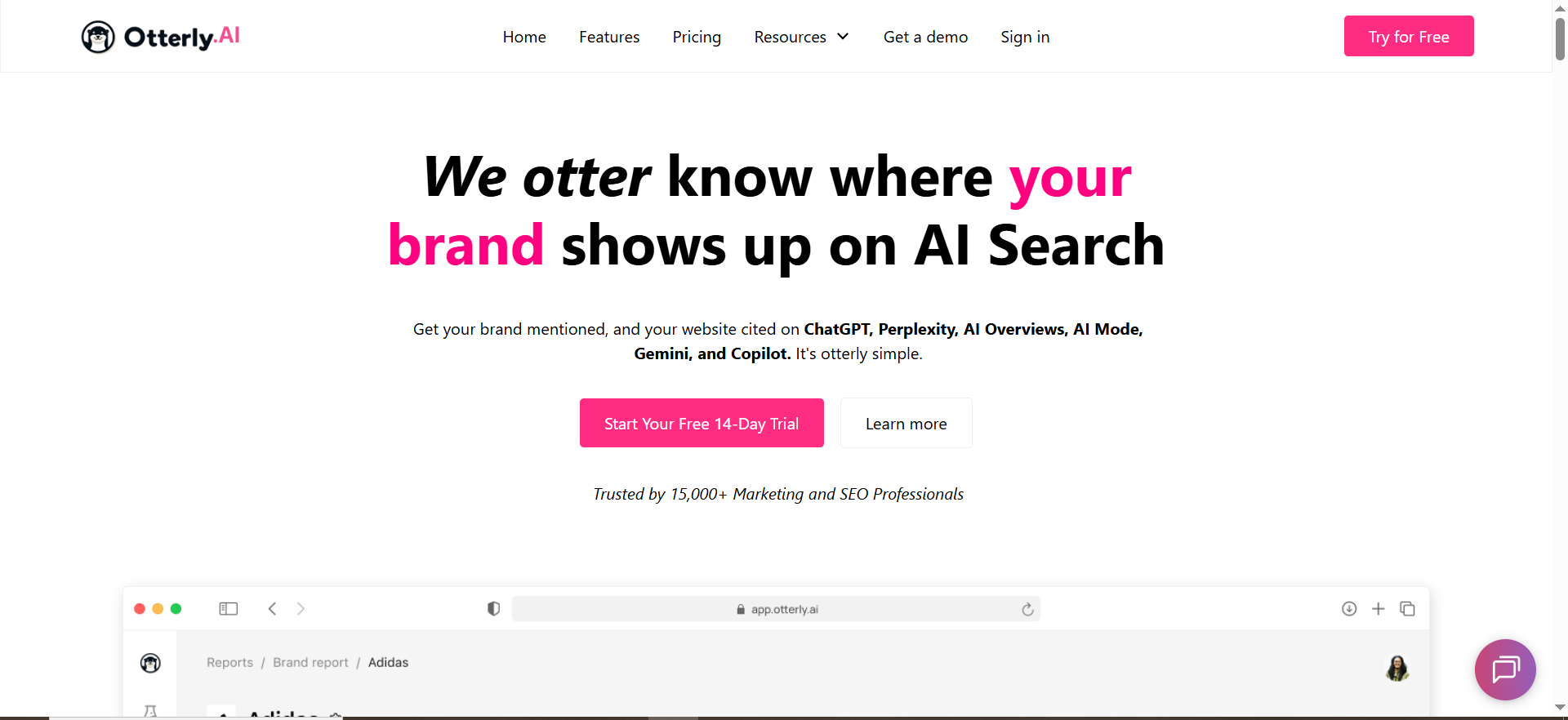
OtterlyAI positions itself as an “AI Search Monitoring Tool” / “AI Visibility Tracker” across major platforms like ChatGPT, Google AI Overviews, Perplexity, Claude, and Microsoft Copilot.
What it does
OtterlyAI monitors how your brand or content appears in AI-generated answers across multiple assistants and AI search surfaces.
Why teams use it
Because it’s very direct about covering the big “must-watch” engines and the common monitoring needs (visibility presence, tracking across assistants).
What it’s good for
- Broad monitoring across the assistants most marketers care about
- Quick setup for teams that want visibility without heavy implementation
When it’s a good fit
- You want a practical monitoring layer across ChatGPT + AI Overviews + Perplexity + others
- You need something your marketing team can own without engineering support
When it’s not a good fit
- You need enterprise-grade research pipelines, governance workflows, or bespoke data exports
- You need deep customization of models/surfaces beyond the supported set
How to use it
- Import your brand + competitor set.
- Start with 25 prompts:
- “best {category}”
- “{category} for {industry}”
- “{competitor} alternatives”
- Check weekly deltas.
- When you drop:
- review the prompt output
- identify which sources are being used
- update or publish the page that should win that citation
Key capabilities
- Explicit tracking across ChatGPT, Google AI Overviews, Perplexity, Claude, Copilot
Pricing
OtterlyAI’s pricing starts at $29/month.
Free tier?
OtterlyAI doesn’t offer a free tier, but it does offer a free trial.
Downsides / limitations
- As with any tool: make sure it can test the regions/languages that match your pipeline. If your buyers are in MENA/APAC/EU, you want region controls, not just US defaults.
5. RankPrompt
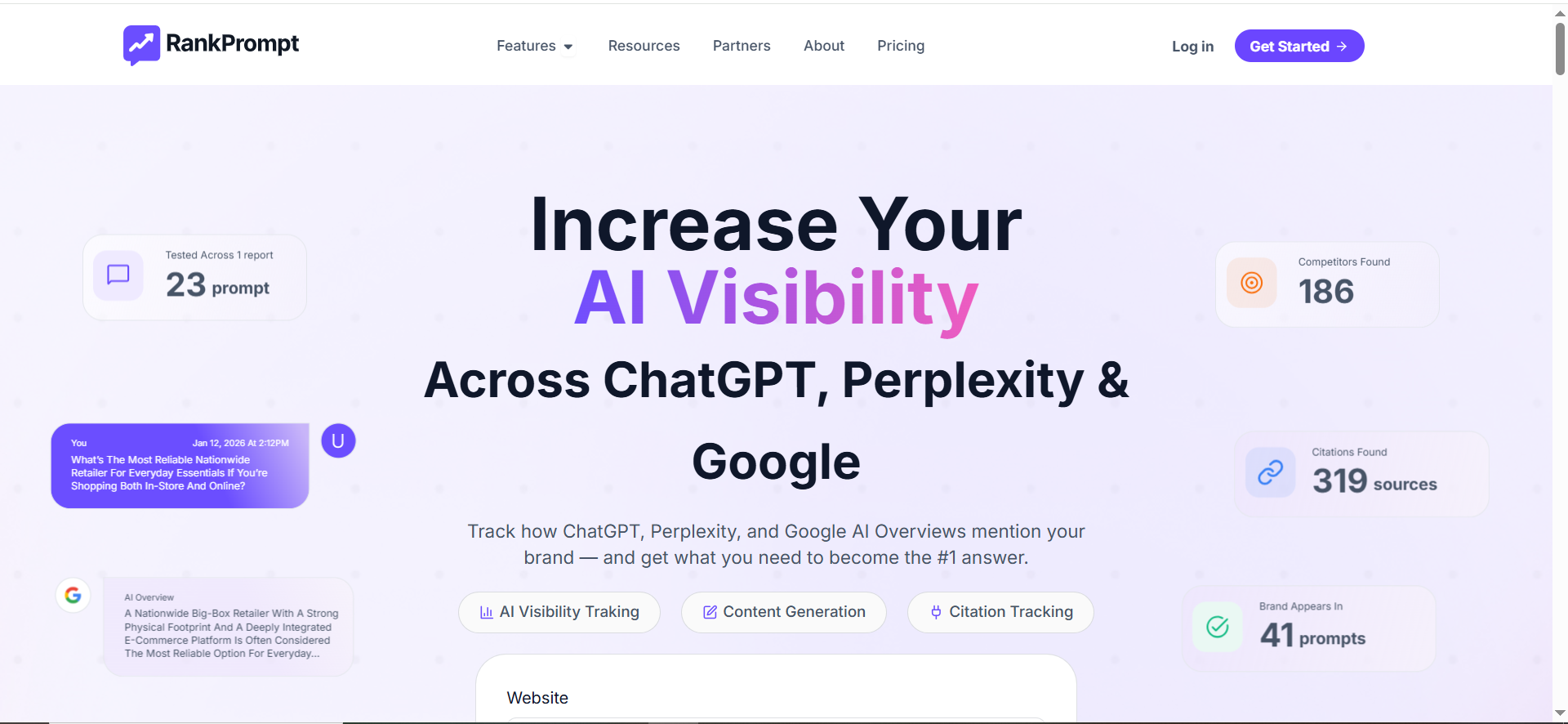
RankPrompt is a lightweight AI visibility platform that explicitly states it tracks visibility across ChatGPT, Perplexity, and Google AI Overviews.
What it does
RankPrompt queries major AI platforms with your prompts and analyzes whether your brand is mentioned, how you’re positioned, and what sources are cited.
Why teams use it
Because it’s simpler: a focused engine set, clear outputs, and a lower-complexity workflow than enterprise platforms.
What it’s good for
- Lean teams that need fast answers:
- “Do we show up on ChatGPT / Perplexity / AI Overviews?”
- Agencies that need a repeatable reporting artifact for clients
When it’s a good fit
- You’re early in AI visibility and want a baseline fast
- You don’t need coverage across every emerging assistant, just the big three it supports
When it’s not a good fit
- You need broader engine coverage beyond ChatGPT/Perplexity/AI Overviews
- You need deep governance, regional testing, or large-scale citation intelligence
How to use it
- Create a “money prompt” set (10–20).
- Add a “defense prompt” set (support, pricing, integrations, competitor comparisons).
- Run weekly.
- Use deltas to decide which pages to refresh or which comparison pages to publish.
Key capabilities
- Explicit support for ChatGPT, Perplexity, Google AI Overviews
- Prompt-based analysis of mentions and sources (per product description)
Pricing
RankPrompt’s pricing starts at $49/month.
Free tier?
RankPrompt doesn’t offer a free tier, but it does offer a 7-day free trial.
Downsides / limitations
- Narrower engine coverage compared to platforms that emphasize “broadest model coverage.” If you need Copilot/Claude/Grok tracking, validate before committing.
How to pick the right tool (decision guide)
Here’s the practical decision tree for “widest AI engine coverage”:
If you’re a B2B SaaS growth team
Pick a tool that:
- covers the engines where your buyers actually ask for recommendations (ChatGPT, Google AI Overviews, Perplexity are common priorities)
- lets you monitor competitors and trend direction monthly
- doesn’t require heavy implementation
Best starting approach: OtterlyAI or RankPrompt for fast baselines, then upgrade if you need deeper citation intelligence.
If you’re an enterprise brand
Enterprises usually need:
- broader coverage across assistants
- citation/source intelligence for risk and narrative control
- stakeholder-ready reporting
Shortlist: Profound + Akii, then validate PromptMonitor if you want a simpler “visibility score” layer for reporting.
If you’re an agency
You want:
- prompt templates
- easy exports
- consistent reports across clients
Shortlist: RankPrompt (lightweight) + a broader tool like OtterlyAI or Akii depending on client needs.
Which tools track the most AI engines (ChatGPT, Gemini, Perplexity, Copilot, Claude, Google AI Overviews)?
If your goal is the widest AI engine coverage, you’re really asking: “Which tools let me monitor the broadest set of major AI answer engines in one place?”
Based on what these tools publicly state about the engines they support, here’s how to think about it:
Tools that emphasize broad multi-engine coverage
These platforms explicitly position themselves around tracking multiple assistants/models, often naming several of the “big six” engines you listed.
1. Akii: Positions itself around broad AI model/assistant coverage, calling out assistants such as ChatGPT, Gemini, Copilot, Perplexity, Claude (and others).
Why it matters: If you’re trying to avoid blind spots, tools that lead with breadth are often better starting points for “widest coverage” shortlists.
2. Promptmonitor: Describes multi-platform tracking across major assistants, naming ChatGPT, Claude, Gemini, Perplexity (and additional platforms).
Why it matters: This is useful if your problem isn’t just “who shows up,” but “do we show up consistently across models?”
Tools that cover the most high-impact surfaces (including AI Overviews)
Some tools lean into the engines that matter most for marketing today: assistants + Google’s AI search surface.
1. OtterlyAI: States coverage across ChatGPT, Google AI Overviews, Perplexity, Claude, and Microsoft Copilot.
Why it matters: If AI Overviews is a priority (and for many brands it is), this becomes a key differentiator.
2. RankPrompt: States it tracks ChatGPT, Perplexity, and Google AI Overviews.
Why it matters: Not the broadest overall list, but it covers a practical “core trio” many teams start with.
Tools built for deeper “AI visibility intelligence”
If you’re a larger team, the question becomes less about counting engines and more about scale + proof (citations, sources, narrative control).
1. Profound: Positions itself around AI visibility and citation/source intelligence, and has been referenced in published analysis contexts for large-scale AI citation research.
Quick rule to choose “most coverage”
If you want the most engines, don’t just trust the engine list on the homepage. Run a proof test:
- Pick 20 prompts you care about (category, alternatives, vs, “best for X”).
- Require the vendor to run them across: ChatGPT, Gemini, Perplexity, Copilot, Claude, AI Overviews (plus any others you care about).
- Verify:
- region controls (US vs EU vs APAC)
- refresh cadence
- whether you can export outputs and citations
That’s how you separate “marketing coverage” from operational coverage.
What does “engine coverage” actually mean, engines vs models vs AI surfaces?
“Engine coverage” sounds simple until you’re buying a tool and realize everyone uses the terms differently.
Here’s the practical breakdown:
1) Models
A model is the underlying LLM family (think “Claude” or “Gemini” as model families).
A tool might say it tracks a “model,” but that doesn’t guarantee it tracks:
- the same assistant product your buyers use
- the same surface where answers appear
- the same retrieval/citation behavior that affects recommendations
2) Assistants (products)
An assistant is the product interface people use:
- ChatGPT
- Microsoft Copilot
- Perplexity
- Claude (as a consumer assistant)
- Gemini (as a consumer assistant)
When marketers say “track AI engines,” they often mean assistants.
3) AI surfaces (where answers show up)
A surface is where the answer appears, and surfaces behave differently.
Example:
- Google AI Overviews is a search surface, not a chatbot conversation.
- It’s influenced by different ranking signals, different source selection dynamics, and different query patterns than ChatGPT.
That’s why a tool can “track ChatGPT” and still miss the biggest visibility shifts happening in AI Overviews.
Why this distinction matters in real life
Because your visibility can be:
- strong in ChatGPT but weak in AI Overviews
- strong in English but weak in German
- strong for “best tools” queries but absent for “alternatives” queries
So “engine coverage” should always be evaluated as:
Coverage = (Assistant + Surface set) × (Regions/Languages) × (Refresh cadence + exportability)
If you’re buying for “widest coverage,” you need all four.
How do regions/countries change AI answers (and can tools test that)?
AI answers can change dramatically across countries and regions, even for the exact same prompt.
Why AI answers differ by region
Here are the most common drivers:
- Local sources and domain authorityAI systems often rely on sources that are prominent in a given country/language.If your brand is well-covered in US publications but not in UK/EU sources, you may disappear in those regional answers.
- Language and localizationEven if you sell globally, your content footprint may not be evenly distributed across languages. AI engines often “prefer” sources in the language of the query.
- Product availability and policiesCertain tools/services may not be available everywhere, and some AI systems adapt recommendations based on perceived availability or legal/policy constraints.
- Search index + retrieval differencesAI search surfaces (like AI Overviews) may use region-specific SERPs and source sets.
Can tools test regional differences?
Some can, but you must validate it.
When you’re evaluating an AI visibility tool for “global coverage,” ask for:
- Geo targeting: Can you run the same prompt in US vs UK vs Germany vs UAE?
- Language targeting: Can you run prompts in local languages and compare results?
- Stable methodology: Does the tool define how it simulates location, language, and personalization?
A practical way to operationalize regional testing
If you operate in multiple markets, build a regional prompt framework:
- Global prompt set (English)
- Localized prompt sets (native language)
- Regional competitor sets (because competitors differ by market)
Then track:
- presence rate by region
- top cited domains by region
- biggest visibility gaps by region
This is often where “engine coverage” becomes “market coverage”—and where weaker tools fall apart.
Can these tools show citations/sources used by AI (not just mentions)?
This is one of the most important differentiators in AI visibility.
Mentions are a signal. Citations are a roadmap.
- A mention tells you: “You appeared.”
- A citation/source view tells you: “Here’s why you appeared (or didn’t).”
If you can see citations and source domains, you can:
- identify the pages influencing AI answers
- optimize the right URLs (yours or third-party)
- target PR/partnerships with “AI-trusted” publishers
- fix brand inaccuracies by addressing the source, not the symptom
Which tools emphasize citation/source insights?
- Profound explicitly positions itself around AI visibility and citation/source intelligence, and has been referenced in large-scale citation research contexts.
- RankPrompt describes analyzing mentions and sources for prompts across its supported engines.
Other tools may show citations depending on engine support and reporting depth, but the key is to test it with your prompts.
A simple “citation capability test” to run in a demo
Give the vendor 10 prompts and ask them to show:
- The full AI output
- The cited sources/domains
- A trend view: which domains appear most over time
- Export: can you download citations and answers?
If they can’t show citations or can’t export them, you’re limited to “vanity mentions” rather than an optimization workflow.
FAQs
An AI visibility tool monitors how often your brand, products, or content appear in AI-generated answers across assistants and AI search surfaces, often including platforms like ChatGPT, Perplexity, and Google AI Overviews.
Why does “widest AI engine coverage” matter?
Do these tools track Google AI Overviews?
How many prompts do we need to start?
How often should we re-run prompts?
Are “AI visibility scores” reliable?
Which tool is best for broad assistant coverage?
Which tool is best for smaller teams?
📋 Get Listed / Advertisement
We update this guide monthly. Want your tool featured? Contact: [email protected].