

AI answers are quickly becoming the new “front page” of discovery. Prospects ask ChatGPT for vendor shortlists. Buyers use Perplexity to compare options. And Google AI Overviews can satisfy intent without a click. In all of those experiences, being cited (your domain is used as a source) and being mentioned (your brand name is included in the summary) are fast becoming the new “rank #1.”
If you can’t measure where your brand appears in AI answers, you can’t improve it.
That’s why AI citation monitoring is now part of the modern SEO + brand visibility stack.
If your goal is monitoring AI citations of your brand, start with:
- Akii for multi-engine brand visibility tracking across major AI platforms (mentions + citations).
- SEOmonitor if you want a more unified dashboard that connects traditional SEO with AI Overviews and broader AI search/citations tracking.
- Morningscore, Keyword.com, and Sitechecker if you’re primarily focused on Google AI Overviews and need practical tracking of presence, sources, and change over time.
📋 Get Listed / Advertisement
We update this guide monthly. Want your tool featured? Contact: [email protected].
Best 5 Tools for Monitoring AI Citations of Your Brand (Quick Comparison)
| Tool | Best for | AI coverage | Notable strength |
|---|---|---|---|
| Akii | Multi-engine AI citation + mention monitoring | Google AI + ChatGPT + Perplexity (and more) | Tracks brand visibility trends across multiple AI engines |
| SEOmonitor | Unified SEO + AI Overviews + AI chatbot tracking | Google AI Overviews + AI search/citations | “One keyword list” view across channels; citations + mentions |
| Morningscore | Google AI Overviews monitoring | Google AI Overviews | Daily updates + competitor visibility for AI Overviews |
| Keyword.com | Lightweight AI Overview tracking in SERP workflows | Google AI Overviews | Simple “AIO appears?” + source URL monitoring |
| Sitechecker | AIO analysis for citations, mentions, and competitors | Google AI Overviews | Shows cited pages, mention frequency, and competing domains |
📋 Get Listed / Advertisement
We update this guide monthly. Want your tool featured? Contact: [email protected].
1. Akii
What it does
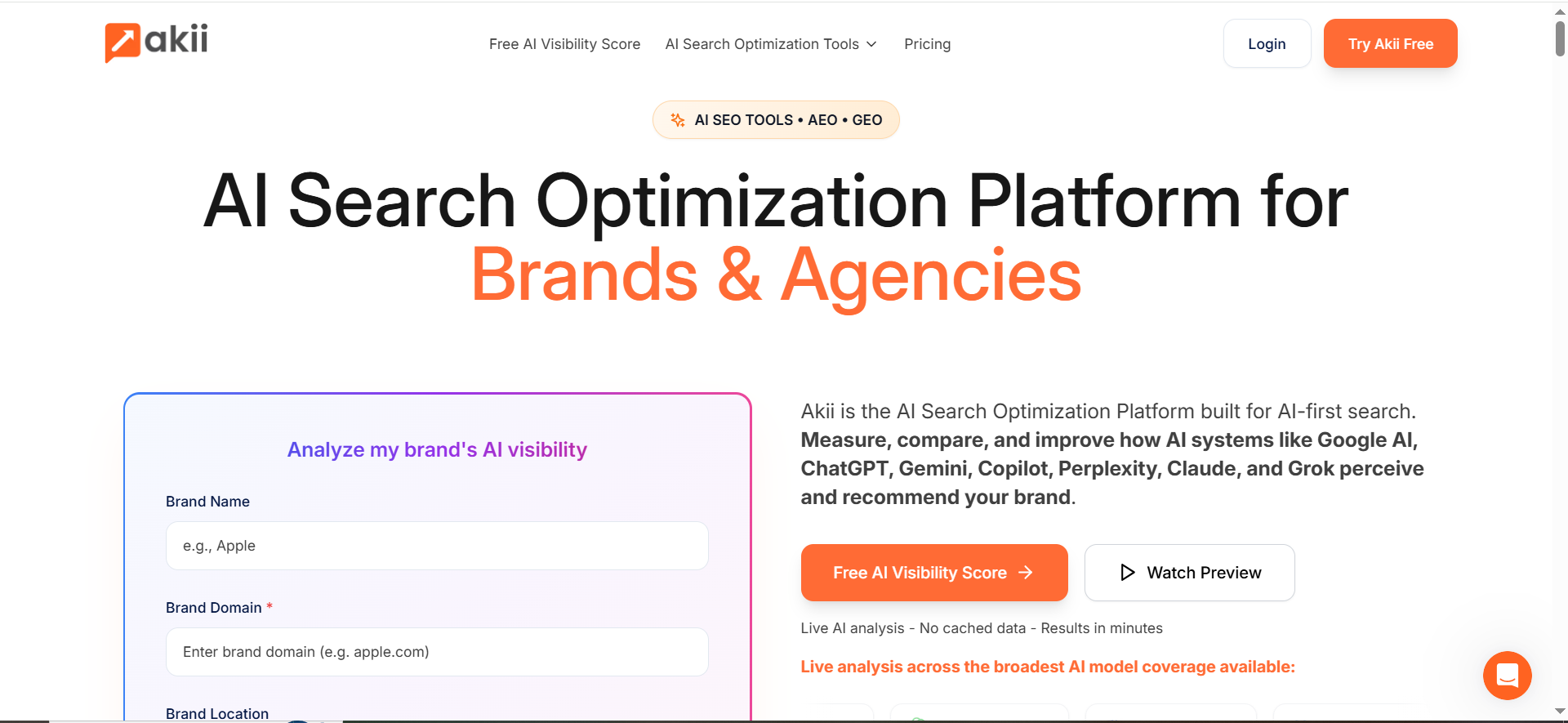
Akii positions itself as an answer engine optimization and tracking platform focused on monitoring how AI systems mention, recommend, and cite your brand. It emphasizes multi-engine visibility tracking across major AI platforms.
Why teams use it
Teams adopt Akiiew of “AI visibility”** rather than stitching together manual prompt tests, spreadsheets, and ad-hoc screenshots. The value is in trend tracking, seeing whether your brand is cited more (or less) as the AI ecosystem shifts.
What it’s good for
- Monitoring brand mentions + source citations across multiple AI engines (not just Google).
- Tracking visibility trends over time (helpful for reporting to execs).
- Competitive benchmarking: identifying which competitors are being cited for the same topics.
When it’s a good fit
Akii is a strong fit when:
- Your buyers use multiple answer engines (e.g., Google AI + chatbots).
- You need more than “is an AI Overview present?”, you need who is cited, who is mentioned, and how that changes.
- You want to operationalize GEO/AEO with consistent prompt sets and reporting.
When it’s not a good fit
Akii may be overkill if:
- You only care about Google AI Overviews for a small keyword set.
- You’re still in a “learning phase” and not ready to build a repeatable monitoring workflow.
How to use it
- Define your monitored query setStart with 25–50 prompts that match real commercial intent: comparisons, “best tools,” “alternatives,” “pricing,” and category queries.
- Add brand + competitor entitiesInclude your brand name, domains, product names, and 3–10 direct competitors so you can compare share-of-voice patterns.
- Track weekly deltasWatch changes in: (a) whether you appear, (b) whether you’re cited as a source, (c) which pages are being cited.
- Create “citation screenshot” examplesFor the prompts that matter most, keep a small gallery of the actual answers you’re getting and review changes weekly.
Key capabilities
- Multi-engine coverage for visibility tracking
- Brand mentions + citations, not just presence/absence
- Historical trendlines (so you can show progress)
Pricing
Akii’s pricing starts at $49/month.
Free tier?
Akii doesn’t advertise a permanent free tier, but it does offer a 14-day free trial and a free AI visibility test.
Downsides / limitations
- As with many AI visibility tools, you’ll need to invest time in defining good prompts, otherwise you end up tracking noise.
- “AI visibility” can be hard to attribute directly to a pipeline without a broader measurement plan (more on that below).
2. SEOmonitor
What it does
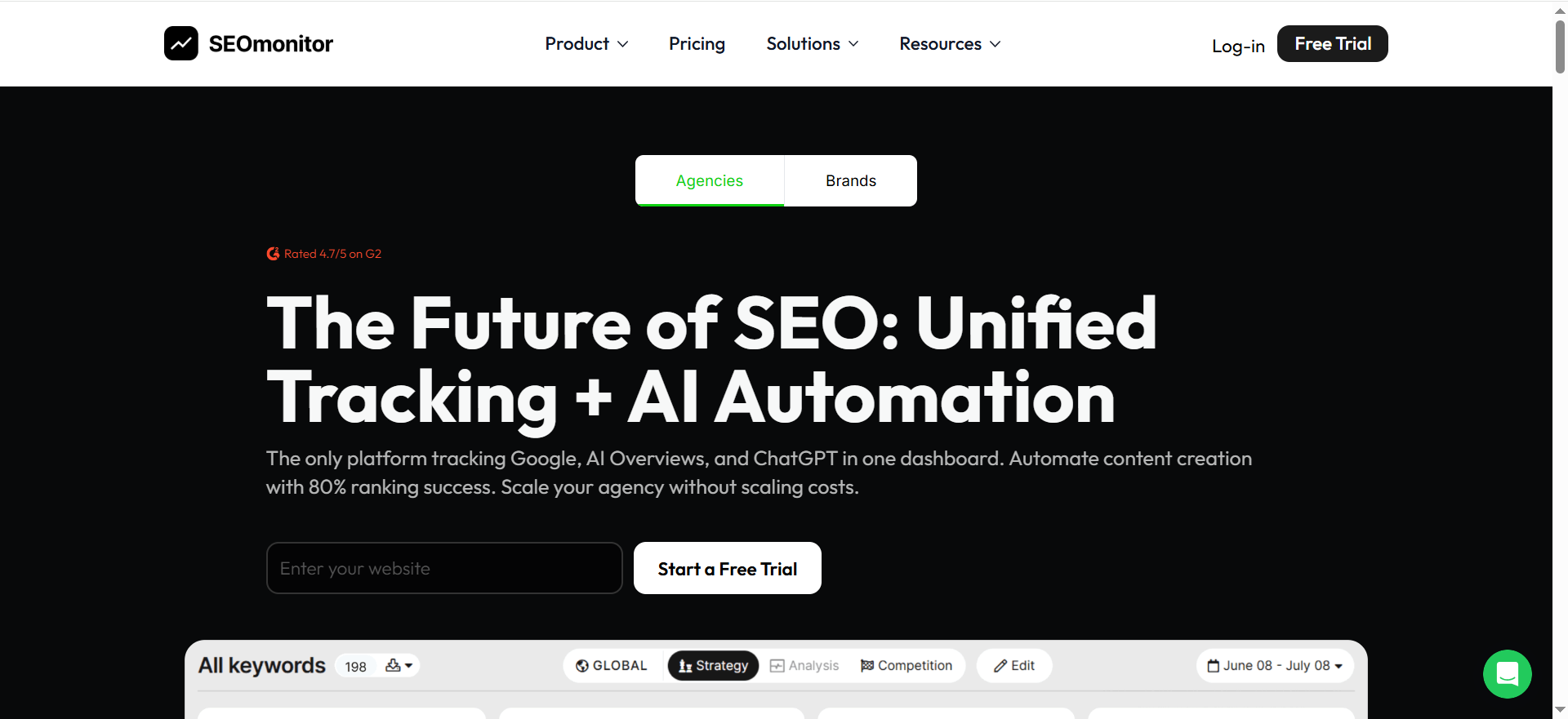
SEOmonitor offers tracking for Google AI Overviews and also positions itself around AI search tracking beyond classic SERP rankings, connecting “same keywords, every channel.”
It explicitly calls out tracking citations and mentions for AI Overviews.
Why teams use it
If your organization already treats SEO as a forecasting + reporting discipline, SEOmonitor’s pitch is appealing: don’t run “SEO reporting” and “AI visibility reporting” as separate universes. Instead, use a shared keyword strategy and unify measurement.
What it’s good for
- Tracking AI Overviews citations + mentions from a dashboard built for SEO workflows.
- Seeing AI visibility alongside traditional rankings so you can spot gaps (e.g., ranking well but not cited) starts with AI visibility metrics.
- Reporting across stakeholders who still think in “keywords,” “positions,” and “visibility” terms.
When it’s a good fit
SEOmonitor makes sense when:
- You already run structured SEO programs and want AI visibility metrics alongside them.
- You care about both: classic rankings and AI citations (because leadership still asks, “How are rankings?”).
- You need competitor intelligence baked into the same workflow.
When it’s not a good fit
It may not be ideal if:
- You only want to track a small set of prompts across chatbots and don’t need an SEO suite context.
- Your program is early and you’re still experimenting manually.
How to use it
- Start with one keyword list
- Use your existing SEO keyword set (or category keywords) and identify which keywords frequently trigger AI Overviews.
- Track mentions and citations
- AI Overviews can cite your domain without naming your brand (and vice versa). Track both to avoid false confidence.
- Find “citation gaps”
- Export the queries where AI Overviews appear but your domain is not cited, these become your AI search visibility audit targets for content updates.
- Create weekly reporting slices
- Break reporting into: brand visibility, competitor visibility, and “new opportunities” (keywords newly producing AI Overviews).
Key capabilities
- Explicit brand + website citation tracking for AI Overviews.
- Cross-channel framing (traditional SEO + AI search) with shared keyword strategy.
Pricing
SEOmonitor’s pricing starts at €99/month for its Starter plan (or €25/month for Writer-Only).
Free tier?
SEOmonitor doesn’t offer a free tier, but it does offer a 14-day free trial with no credit card required.
Downsides / limitations
- Strongest for teams already running SEO programs; less “plug-and-play” for brand teams with no keyword strategy.
- You’ll still need a content execution loop (briefs, updates, internal linking) to turn tracking into outcomes.
3. Morningscore
What it does
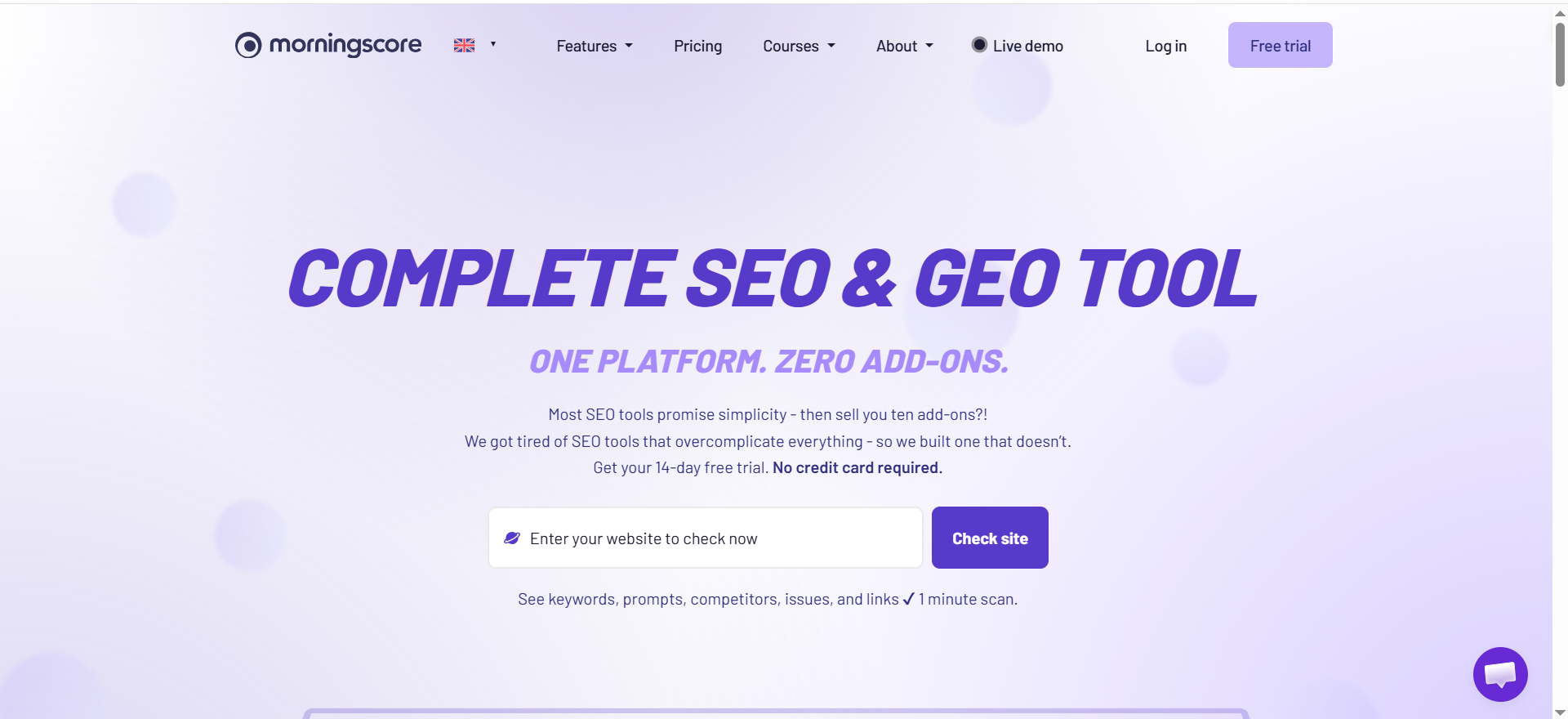
Morningscore offers an AI Overviews tracker focused on monitoring brand mentions in Google AI Overviews, including visibility across countries and daily updates.
Why teams use it
For many teams, Google AI Overviews are the most immediate “visibility risk” because they can appear directly in SERPs and satisfy intent without clicks. Morningscore emphasizes tracking that new layer and comparing visibility against competitors.
What it’s good for
- Monitoring Google AI Overview presence across a keyword set.
- Tracking visibility at a daily cadence (useful when AI Overviews volatility is high).
- Country-level coverage for international SEO teams.
When it’s a good fit
Choose Morningscore when:
- Your primary question is: “Are we showing up in AI Overviews for the queries we care about?”
- You want simple, consistent monitoring without building a custom scraping workflow.
- Your team needs a straightforward “visibility score” story for stakeholders.
When it’s not a good fit
Not ideal if:
- You want deep chatbot prompt libraries across ChatGPT/Perplexity as your main monitoring surface.
- You need advanced internal workflows (routing insights into content ops, tickets, audits) and want heavy customization.
How to use it
- Upload your tracked keyword list (start with your top 100 non-branded category terms).
- Segment keywords by intent: “definition,” “best,” “alternatives,” “pricing,” “vs.”
- Review AI Overviews visibility weekly, then deep-dive into the top 10 highest-business-impact queries monthly.
- Pull 3–5 examples each month where competitors are cited and you’re not—use these as content update briefs.
Key capabilities
- Google AI Overviews monitoring at scale
- Daily updates for keyword tracking (as stated by the product)
- Competitor visibility comparisons
Pricing
Morningscore’s pricing starts at $69/month.
Free tier?
Morningscore doesn’t offer a free tier, but it does offer a 14-day free trial without a credit card.
Downsides / limitations
- Focus is primarily Google AI Overviews; if your business needs multi-engine chatbot coverage, you may need a second tool.
- AI Overviews don’t trigger on every query, so you need enough coverage to get a stable signal.
4. Keyword.com
What it does
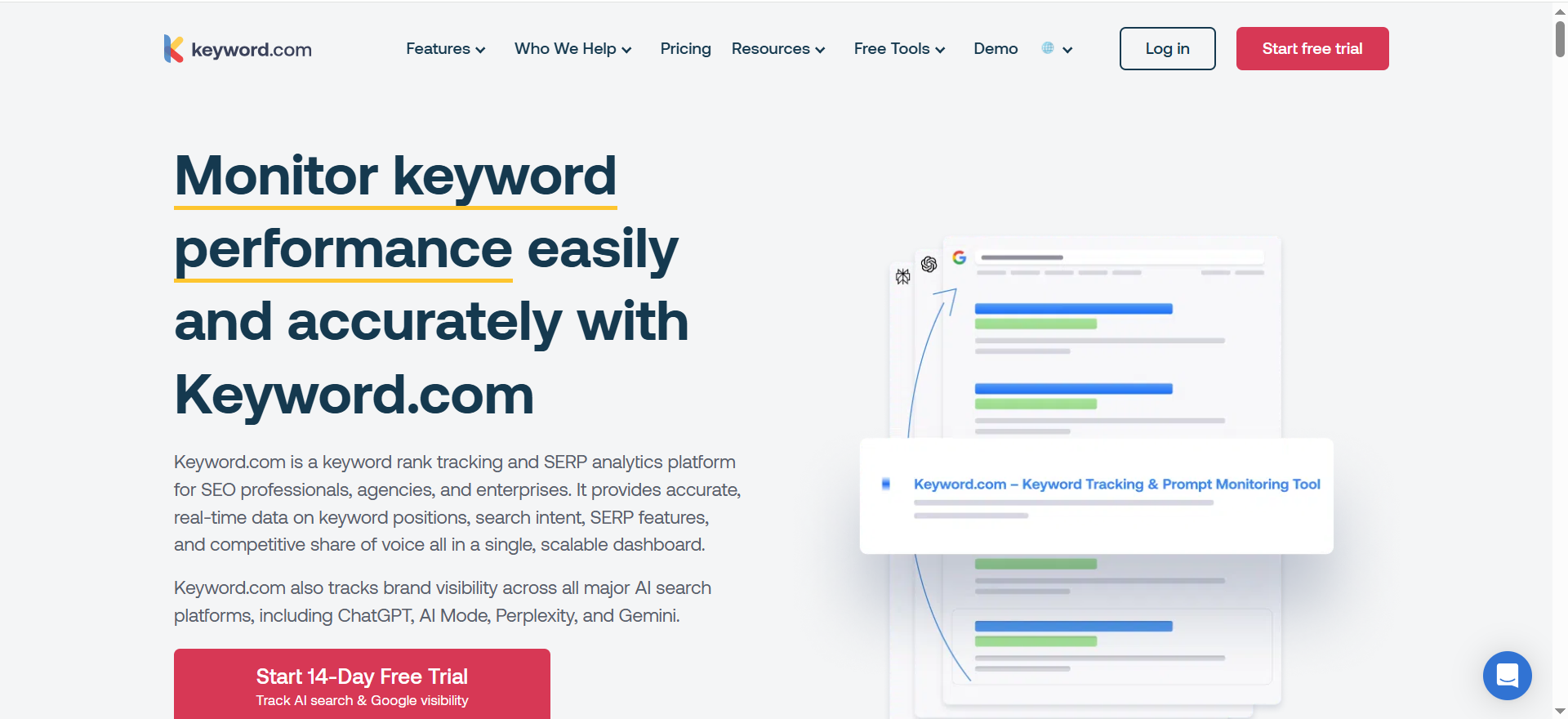
Keyword.com offers an AI Overview Tracker designed to monitor when AI Overviews appear for tracked queries, with the ability to monitor source URLs.
Why teams use it
This is a pragmatic choice for teams who already live inside SERP tracking workflows and want an “AI Overviews layer” that’s easy to adopt.
What it’s good for
- Quickly answering: “Which of our tracked queries trigger AI Overviews?”
- Monitoring the source URLs being cited, so you can see whether your pages are used as references.
- Lightweight reporting for agencies and in-house SEO teams.
When it’s a good fit
Keyword.com is a good fit if:
- You want fast setup and clear reporting on AI Overview appearance + sources.
- You’re already tracking rankings/SERP features and want AI Overviews as “just another tracked element.”
When it’s not a good fit
Not ideal if:
- You want deeper analysis of “what AI is saying” across chatbots, including sentiment, positioning, and competitive narrative.
- You need multi-engine prompt libraries and alerting beyond Google.
How to use it
- Import your keyword list and set your target geography/device.
- Turn on AI Overview tracking.
- Review weekly: (a) AI Overview presence rate, (b) your citation rate, (c) competitor citations.
- Build a monthly “AIO wins/losses” summary with screenshots for high-intent queries.
Key capabilities
- AI Overview tracking for your key search queries
- Monitoring source URLs cited in AI Overviews
Pricing
Keyword.com’s paid plans start at $3/month on its AI Visibility plans, and Enterprise pricing is available by quote.
Free tier?
Keyword.com offers a free tier ($0/month) on its Google Platform plan, and it also offers a 14-day free trial.
Downsides / limitations
- Mostly Google AI Overviews centric; may require supplemental tooling for broader AI engines.
- Like all trackers, it shows what is happening; you still need a process to decide what to change.
5. Sitechecker
What it does
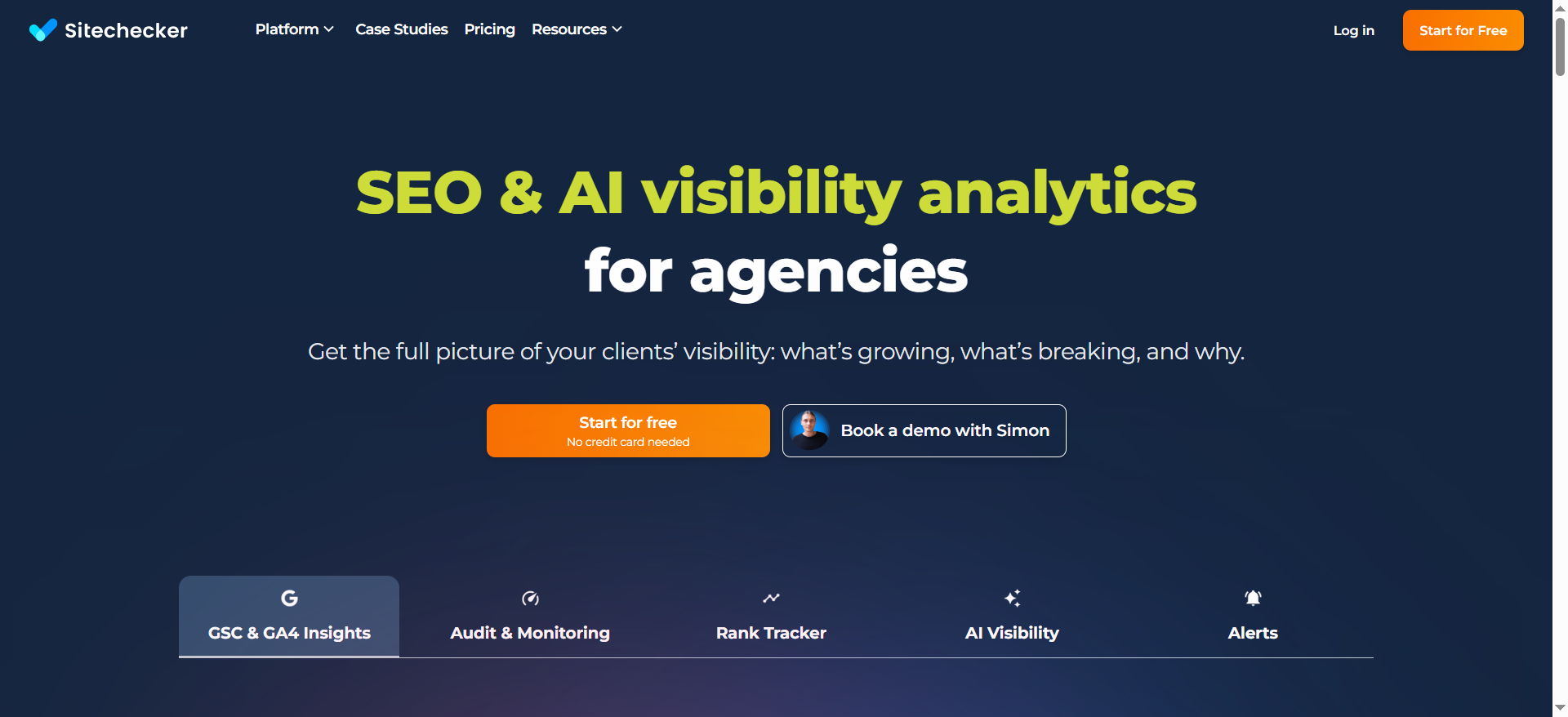
Sitechecker provides a Google AI Overview monitoring tool that highlights which pages are cited, how often your brand is mentioned, and which competitors also show up in AI Overviews.
Why teams use it
Many teams don’t just want “presence tracking.” They want a breakdown: what sources are included, where they rank among citations, and which competing domains appear alongside them. Sitechecker emphasizes that analysis view.
What it’s good for
- Citation-level analysis: “Which of our URLs are referenced?”
- Competitive context: “Which competitors appear in the same AIO?”
- Quick auditing: seeing opportunities where AI is citing a competitor’s clearer answer format.
When it’s a good fit
Pick Sitechecker when:
- You want a practical “AIO analysis” layer without needing an enterprise platform.
- Your workflow includes auditing SERPs and fixing pages, and you want AI Overviews as part of that audit.
When it’s not a good fit
Not ideal if:
- Your main monitoring need is across multiple chatbots and prompt libraries.
- You require deep narrative analysis and broader brand intelligence features.
How to use it
- Start with 30–100 keywords that represent your category’s revenue drivers.
- Review which keywords trigger AI Overviews and what sources are included.
- Export the cases where competitors are cited and you’re not.
- Update your content using evergreen, citation-friendly structures: direct definitions, bullet lists, comparison tables, and succinct subheads.
Key capabilities
- Shows cited pages, brand mentions, and competitor overlap
- Useful for building screenshot-based evidence for stakeholders
Pricing
Sitechecker’s pricing starts at $89/month (Basic plan).
Free tier?
Sitechecker doesn’t advertise a permanent free tier on its pricing page, but it does offer a 14-day free trial and a demo option.
Downsides / limitations
- Primarily focused on Google AI Overviews.
- You still need a prompt/keyword strategy and a content ops loop to turn findings into wins.
What “AI citations” really mean (and why they’re different from SEO rankings)
In traditional SEO, you measure:
- keyword rankings
- organic traffic
- conversions from search
In AI-driven discovery, you measure:
- Mentions: your brand name appears in the answer
- Citations: your domain/page is referenced as a source
- Share of voice: how often you show up compared to competitors
- Narrative: what AI says about you (positioning, pros/cons, trust)
Why this matters: AI can cite you without mentioning you (your page is used as a source, but your brand name isn’t surfaced), and it can mention you without citing you (your brand is named, but sources are other sites). Tools like SEOmonitor explicitly call out tracking both citations and mentions to understand “complete AI presence.”
And because AI answers are often “zero-click,” visibility itself becomes a KPI, especially for category leadership, brand trust, and pipeline influence.
The metrics that matter: Mentions, citations, share of voice, and sentiment
If you want a monitoring program that actually drives decisions, don’t stop at “we’re showing up.”
1) Mentions
Mentions measure whether the AI answer includes your brand name. This is often what the KPI leadership understands fastest.
Best used for: category presence, competitive positioning, PR/authority validation.
2) Citations
Citations measure whether your domain/page is used as a source in the AI answer.
Best used for: content strategy, technical/content upgrades, and “which URLs deserve investment.”
Many AIO tools emphasize source URL monitoring because it’s your clearest path from visibility → actionable content updates.
3) Share of AI voice
Share of voice answers: ‘Out of the AI answers that matter, how many include us vs competitors?’, and that’s exactly what share-of-voice AI tracking is built to quantify.
This is where monitoring becomes strategic: it tells you whether you’re winning the category narrative, not just a handful of queries.
4) Trend graphs
Your stakeholders will ask: “Is it improving?”Trend graphs are how you answer without hand-waving.
Your Excel topic brief specifically calls out ‘citation screenshots + trend graphs’ as the ideal angle, because this is what gets buy-in.
5) Alerting
Alerts matter because AI visibility can change quickly. You want to know:
- when you start getting cited for a high-intent query
- when you stop getting cited (or a competitor replaces you)
Some tools are built around scraping/monitoring workflows for this exact reason (e.g., AI Overview monitoring tools).
How to set up AI citation monitoring in 60 minutes
This is a simple setup that works whether you’re using one tool or a stack.
Step 1: Build your monitoring list (prompts + keywords)
Create three buckets:
Bucket A: “Money” prompts (highest intent)
- “best [category] tools”
- “[your product] alternatives”
- “[category] pricing”
- “[competitor] vs [competitor]”
- “what is the best [category] for [use case]”
Bucket B: “Trust” prompts (brand narrative)
- “is [brand] legit?”
- “reviews of [brand]”
- “pros and cons of [brand]”
- “is [category] safe/compliant?”
Bucket C: “Authority” prompts (topical leadership)
- “how to [job-to-be-done]”
- “framework for [problem]”
- “checklist for [process]”
Aim for 50–200 items to start. You need enough coverage to see patterns.
Step 2: Define the entities you care about
- Your brand name
- Your domain
- Your product names
- 3–10 core competitors
- Category terms (what you want to be known for)
This improves the quality of competitive comparisons and helps you catch “near-miss” mentions.
Step 3: Choose what you’re measuring (and lock the definitions)
Pick 3–5 KPIs for weekly reporting:
- % of prompts where you’re mentioned
- % of prompts where you’re cited
- share of voice vs top 3 competitors
- top 10 prompts gained / lost
- “most-cited URLs” (your pages)
Step 4: Capture proof (screenshots + examples)
Even with dashboards, keep a lightweight “evidence library”:
- 10–20 screenshots of important AI answers
- the cited source URLs
- date stamped
- notes on what changed
This becomes your internal asset for leadership, sales enablement, and strategy.
Step 5: Schedule the review cadence
- Weekly: KPI deltas + new wins/losses
- Monthly: deep dive + content update plan
- Quarterly: category expansion plan
How to choose the right tool
Use this decision tree:
If you need multi-engine AI citation tracking…
Start with a platform like Akii that explicitly tracks visibility across multiple AI engines.
This is best for brands whose buyers use both Google and chatbots.
If you want SEO + AI visibility in one reporting system…
Pick SEOmonitor, which frames AI Overviews and AI search tracking as part of a unified organic strategy.
This is best for teams with established SEO reporting.
If your focus is Google AI Overviews only…
Use an AIO-focused tracker such as Morningscore, Keyword.com, or Sitechecker depending on whether you want:
- daily/country tracking (Morningscore)
- lightweight “AIO presence + source URLs” tracking (Keyword.com)
- deeper citation/competitor breakdowns (Sitechecker)
Evaluation checklist
- Does it track mentions and citations (both)?
- Which engines does it support (Google AIO only vs multi-engine)?
- Can it show the exact source URLs and your position among citations?
- Can you segment by intent, geography, and competitor?
- Can you export data for reporting and stakeholder decks?
How to turn citation data into action (playbooks)
Monitoring is step one. Winning is step two.
Playbook 1: “Citation gap” content upgrades
When a competitor is cited and you’re not:
- Open the cited page.
- Identify what makes it “AI extractable”: direct definition, bullet list, table, structured headings.
- Update your page to be more extractable:
- add a crisp definition in the first 100 words
- include a comparison table
- add a “how it works” step list
- use question-style H2s (“How do you…?”, “What is…?”)
This aligns with the SOP emphasis on structure, scannability, and tables.
Playbook 2: Build “citation assets”
AI systems frequently surface:
- checklists
- definitions
- short frameworks
- pros/cons lists
- comparisons
So create pages and sections that are inherently quotable:
- “AI citation monitoring checklist”
- “Metrics glossary: mention vs citation vs share of voice”
- “Weekly reporting template”
Playbook 3: Create an executive dashboard story
Your CMO doesn’t want 200 keywords. They want a narrative:
- Are we more visible than competitors?
- Are we gaining traction?
- What’s the plan to improve?
Use “citation screenshots + trend graphs” as the backbone:
- 1 slide: KPI trends
- 1 slide: examples of wins/losses
- 1 slide: next month’s content plan
Playbook 4: Tie AI visibility to pipeline influence
AI answers can be “dark funnel.” You won’t always get clicks. But you can still measure influence by:
- tracking branded search lift
- monitoring demo request mentions (“I saw you recommended in ChatGPT…”)
- adding “How did you hear about us?” options for AI engines
- using sales call notes tagging
This is how AI visibility becomes a revenue conversation, not a vanity metric.
What is an “AI citation” vs a brand mention?
An AI brand mention is when an AI answer names your company/product in the response (e.g., “Acme is a strong option for X”). A citation is when the AI answer links to or references your domain/page as a source used to generate the answer (e.g., your URL appears under “Sources,” “References,” or inline as a linked source).
The distinction matters because mentions and citations don’t always overlap:
- Cited but not mentioned: The AI uses your page to craft the answer but doesn’t name your brand in the final summary. This can happen when your page contains a clear definition or dataset but the AI presents the information generically.
- Mentioned but not cited: The AI names your brand (often from general knowledge or other sources), but the citations point to third-party sites, competitors, or review platforms.
Why this difference is strategically important
- Mentions influence perception and shortlist inclusion (“are we in the conversation?”).
- Citations influence authority and future retrieval (“does the model treat our content as reference-grade?”).
- Many tracking tools emphasize monitoring both for a complete AI visibility picture.
What to measure for each
For mentions:
- Mention rate (% of tracked prompts/keywords where your brand appears)
- Positioning language (how AI describes you: “best,” “budget,” “enterprise,” etc.)
- Competitive adjacency (who you’re mentioned alongside)
For citations:
- Citation rate (% of prompts where your domain is listed in sources)
- Cited URL distribution (which pages are being used)
- “Citation share of voice” (how often you’re cited vs competitors)
How do I track which prompts cause AI to cite my domain?
To track which prompts lead to citations, you need a repeatable testing set and consistent logging, either via a tool or a simple operational workflow.
Step 1: Build a “prompt library” that mirrors buyer intent
Create prompt clusters that match how real users ask questions:
- Best lists: “best [category] tools for [use case]”
- Comparisons: “[brand] vs [competitor]”
- Alternatives: “[brand] alternatives”
- How-to / definitions: “how to do [task]”, “what is [concept]”
- Trust/compliance: “is [brand] SOC 2?”, “is [tool] safe for healthcare?”
Start with 50–200 prompts/keywords. (If you only track 10 prompts, you’ll mistake randomness for signal.)
Step 2: Track prompts with stable “test conditions”
AI answers can vary based on:
- location
- device type
- logged-in state
- time and model updates
So standardize what you can:
- same geography (or track separate geo sets)
- same device type
- same frequency (weekly is usually enough)
Step 3: Use a tool to automate repeated checks
This is where tools shine: they run the same prompt set on a schedule and record:
- whether your brand is mentioned
- whether your domain is cited
- which URLs were cited
- changes over time
For example, you can use multi-engine visibility trackers for prompt-based monitoring, and AI Overview trackers for keyword-based monitoring (Google-specific). (Your original shortlist separated these two categories for that reason.)
Step 4: Log results in a simple schema
Whether you export from a platform or track manually, log like this:
- Prompt/keyword
- Engine (Google AI Overviews vs chatbot)
- Brand mentioned? (Y/N)
- Domain cited? (Y/N)
- Cited URLs (list)
- Competitors mentioned/cited
- Notes (what changed since last run)
- Screenshot link (optional, for key prompts)
Step 5: Identify “high-leverage prompts”
After 2–4 weeks, you’ll see patterns:
- prompts that reliably trigger citations
- prompts where competitors dominate
- prompts where you’re mentioned but not cited (content opportunity)
- prompts where you’re cited but not mentioned (branding opportunity)
That’s your roadmap for content improvements.
How do I monitor competitors being cited in AI answers?
Competitor citation monitoring is how you stop flying blind. You’re not just measuring your presence, you’re measuring who AI trusts most for your category.
Step 1: Define your competitor set (and don’t overdo it)
Pick:
- 3–5 direct competitors (same category)
- 1–2 “adjacent” competitors (different category, same buyer)
- 1–2 publishers/review sites that frequently appear in sources
Step 2: Track competitor citations at the same level as your own
For each prompt/keyword, capture:
- Which competitor domains were cited
- Which competitor brands were mentioned
- Which specific competitor pages were referenced (URLs)
This matters because “competitor is cited” is not actionable unless you know what page is being used and why.
Step 3: Build a competitor “citation map”
A useful monthly artifact:
- Competitor A: cited most for “best tools”
- Competitor B: cited most for “how-to”
- Review sites: cited most for “alternatives” and “pricing”
Now you can decide: do you compete by improving product pages, publishing better comparisons, or creating definition hubs?
Step 4: Turn competitor citations into a content backlog
For each competitor-cited page, run a quick audit:
- What question does this page answer clearly?
- Is there a table/list/definition that’s easy to extract?
- Does it have a strong topical focus (tight, not sprawling)?
- Is it updated recently and clearly maintained?
Then create backlog items like:
- “Publish an ‘Alternatives’ page”
- “Add a comparison table to our ‘Best X’ guide”
- “Create a glossary section answering [question] in 50–80 words”
What’s the best tool for Google AI Overviews citations specifically?
If your main goal is Google AI Overviews citation tracking (not chatbots), you want an AI Overview tracker that can tell you:
- when AI Overviews appear for a query
- which domains are cited
- which URLs are cited
- whether you’re included, and how that changes over time
From the tools we covered earlier, the most “Google AIO specific” options are:
- Morningscore (AIO tracking emphasis)
- Keyword.com (AIO presence + source URL tracking)
- Sitechecker (AIO citations + competitor overlap view)
Your best choice depends on your workflow:
- If you want simple, fast AIO presence + sources → Keyword.com style workflow
- If you want AIO monitoring with competitive context and visibility trends → Morningscore
- If you want deeper “who’s cited + which pages + competitor overlap” analysis → Sitechecker
(Practically: pick the one that makes it easiest to export and report weekly. The tracking only matters if it feeds decisions.)
How do I identify “citation-worthy” pages and sections?
AI systems tend to cite content that is clear, structured, and directly answers the question.
Here’s a checklist to identify (or create) citation-worthy content:
Citation-worthy page signals
A page is more likely to be cited if it has:
- A direct answer early
- The first 100–150 words contain a clear definition or summary.
- Structured headings that match user questions
- Use question-style H2s (“What is…”, “How does…”, “Best…”, “Pros and cons…”).
- Extractable formatting
- bullet lists, numbered steps, short paragraphs
- Comparison artifacts
- tables, “X vs Y” sections, pros/cons grids
- Topical focus
- one page answers one core intent (not 12 intents)
- Freshness cues
- “Updated [Month Year]”, recent examples, current stats when relevant
- Authority signals
- named authors, references, product documentation links, methodology notes
Citation-worthy section patterns
- Definition block: 1–2 sentences
- Steps block: 5–9 numbered steps
- Checklist: 8–15 bullets
- Comparison table: 5–10 rows, 3–6 columns
- “Best for” segmentation: 3–5 categories (“Best for SMB,” “Best for enterprise,” etc.)
Fast way to find your “citation candidates”
Look at:
- pages already ranking top 10 for high-intent queries
- pages getting links from industry sites
- “hub” pages that cover foundational concepts
Then upgrade them using the patterns above.
Why am I ranking #1 but not cited in AI Overviews?
This is one of the most common frustrations right now. Traditional ranking helps, but AI Overviews are not just “position #1 rewritten.” They synthesize sources and often cite content that is easiest to extract and combine.
Here are the most common reasons:
1) Your page doesn’t answer the question fast enough
If your intro is long and the answer is buried, AI may cite a competitor that states the answer clearly in the first paragraph.
Fix: Add a 40–80 word “direct answer” block near the top.
2) Your content is harder to extract
Walls of text are difficult for AI summaries to lift cleanly, so use AI content optimization structures like bullet lists, steps, and a comparison table.
Fix: Add bullet lists, steps, and a comparison table.
3) Your page targets a different intent
You might rank due to authority, but your page doesn’t match the exact question AI Overview is answering (e.g., you rank with a product page, but AI wants an explainer).
Fix: Publish an intent-matching companion page (definition, how-to, comparison), often supported by a tight SEO glossary layer
4) Competitors have “citation assets”
Competitors may have a single section (a table or checklist) that’s so clean that it becomes citation bait.
Fix: Identify the competitor-cited element and build an improved version on your site.
5) Your content is not “reference-coded”
AI Overviews often cite sources with strong reference cues: data, definitions, clear frameworks, and attribution.
Fix: Add methodology notes, definitions, and references where appropriate.
This aligns with the playbook approach in AE SEO: structure the content to be highly scannable and extractable (lists, steps, tables, tight subheads).
How do I create “citation screenshots + trend graphs” for stakeholders?
Stakeholders don’t want a spreadsheet dump, they want a story: what changed, why it matters, and what we’ll do next. Your Excel brief explicitly highlights “citation screenshots + trend graphs” as a preferred deliverable style, and it works because it’s visual and concrete.
The “3-slide” stakeholder format
Slide 1: Trend graphs
- Mention rate over time (% prompts where brand appears)
- Citation rate over time (% prompts where domain cited)
- Share of voice vs top competitors (optional)
Slide 2: Screenshot evidence
- 3 wins (where you’re cited/mentioned in high-intent prompts)
- 3 losses (where a competitor replaced you)
- Include date stamps and prompt text
Slide 3: Action plan
- Top 5 opportunities (prompts where AI Overviews appear and you’re absent)
- The pages to update (your URLs)
- The new assets to create (comparison pages, definitions, tables)
How to capture citation screenshots reliably
- Use the same browser profile and location settings if possible
- Include the prompt/query in the screenshot
- Capture the “sources” area clearly (where citations appear)
- Name files consistently:
- engine_query_date_result.png
- Example: google_aio_best-ai-citation-tools_2026-02-03_win.png
How to build trend graphs quickly
If your tool exports data, graph these columns weekly:
- Week (date)
- Total prompts tracked
- Prompts with brand mention
- Prompts with domain citation
- Competitor citations (top 3)
Then create:
- Mention rate = mentions / total prompts
- Citation rate = citations / total prompts
- Share of voice = your citations / (your + competitor citations)
The “exec-friendly narrative” to attach to graphs
Write 3 bullets under every chart:
- What changed: “Citations increased from 12% → 18%”
- Why: “New comparison page got cited for 6 prompts”
- Next: “Update pricing page + publish alternatives page”
This keeps reporting outcome-oriented, not vanity-metric oriented.
FAQs
What’s the difference between an AI mention and an AI citation?
Can I track AI citations for ChatGPT and Perplexity the same way as Google AI Overviews?
Why am I ranking well in Google but not cited in AI Overviews?
How many keywords or prompts should I monitor?
What’s the best tool if I only care about Google AI Overviews?
Do I need alerts for AI citation monitoring?
How often should I report AI citation metrics?
📋 Get Listed / Advertisement
We update this guide monthly. Want your tool featured? Contact: [email protected].