The marketing landscape is shifting fast as generative AI (GenAI) moves from experimentation to scaled workflows. This document curates current, citable statistics on adoption, ROI, budget trends, productivity impact, and risk plus simple charts you can reuse in decks and reports.
Every quantitative claim below includes a linked source. Any uncited or hard-to-verify claims from the original draft have been removed or replaced with better-supported data.
Key AI marketing statistics
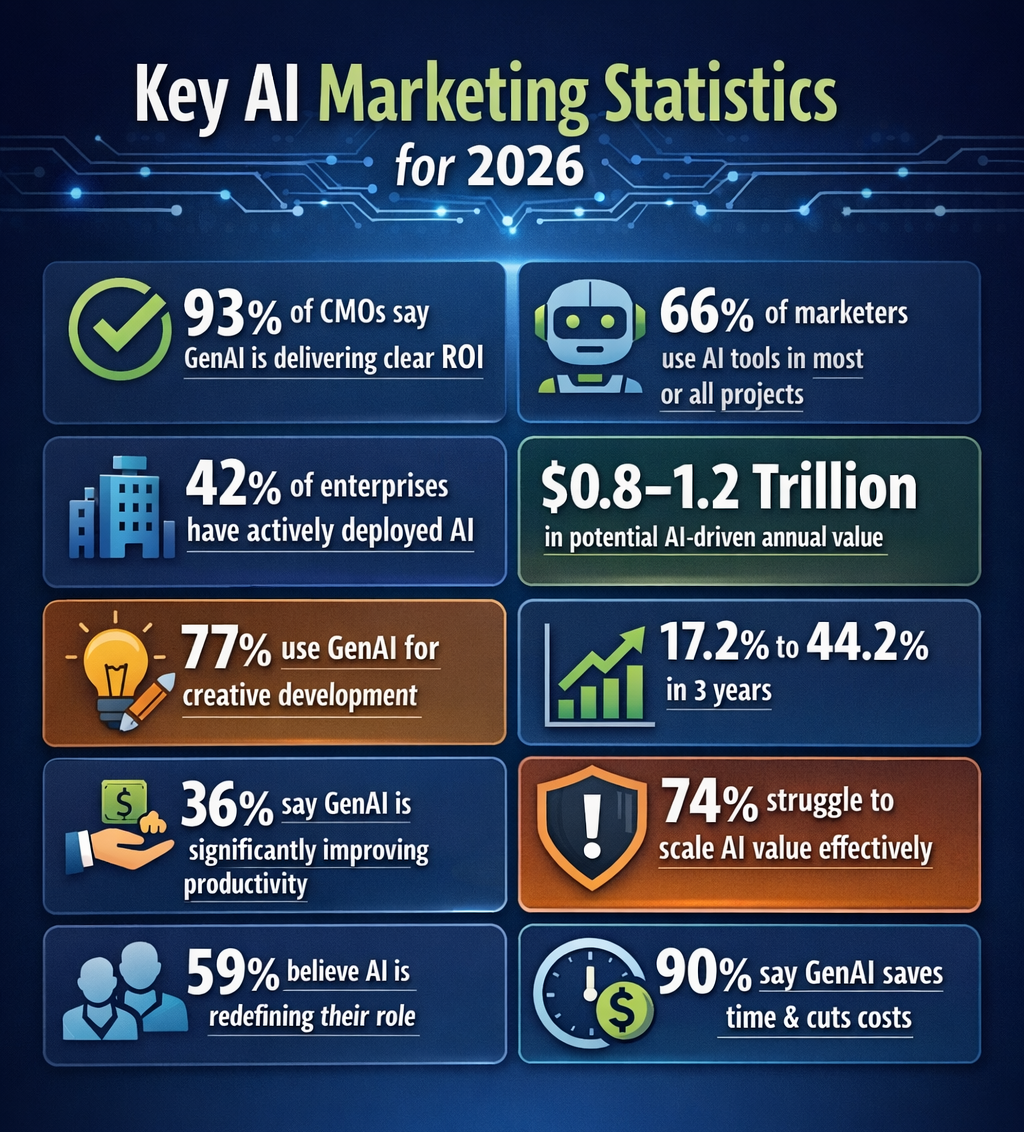
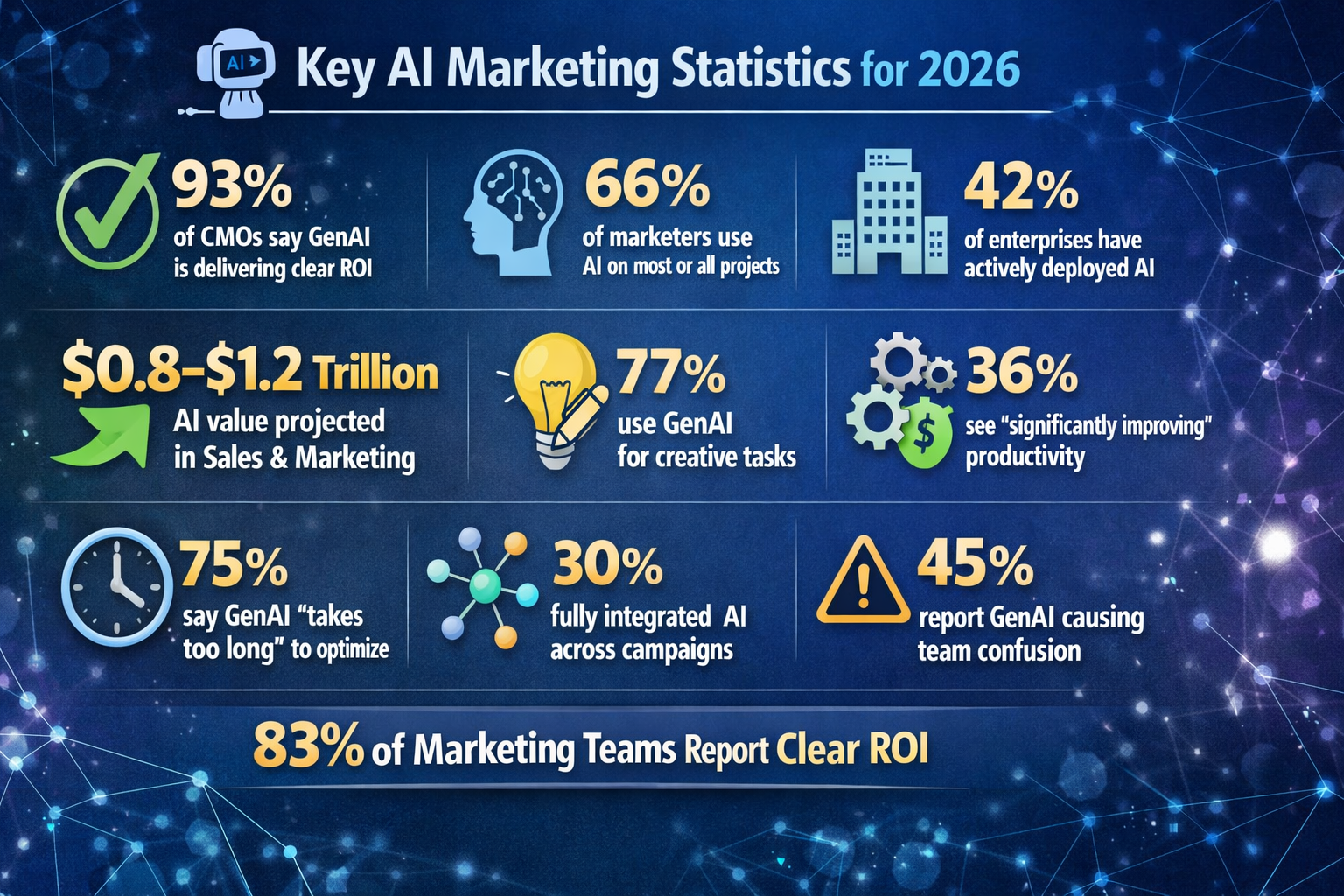
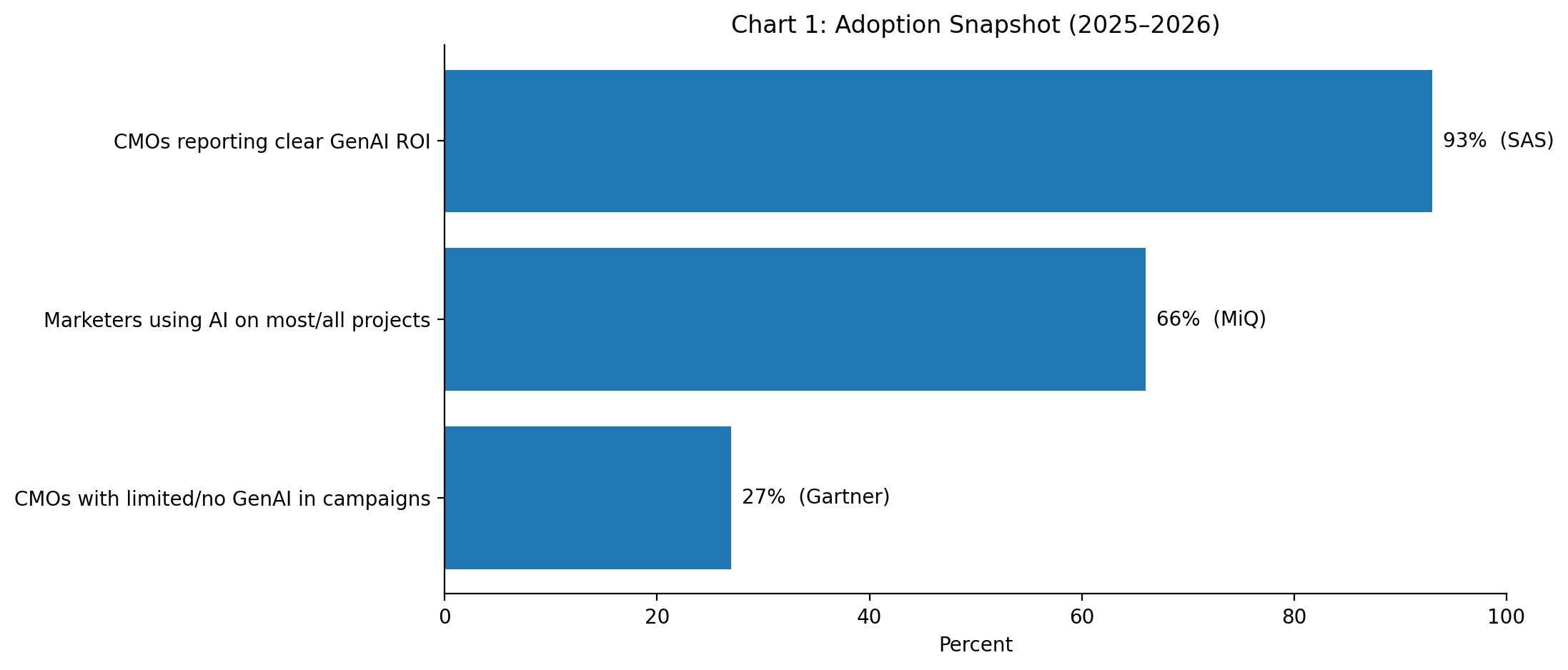
- 93% of CMOs say GenAI is delivering clear ROI for their organization. (Source: SAS)
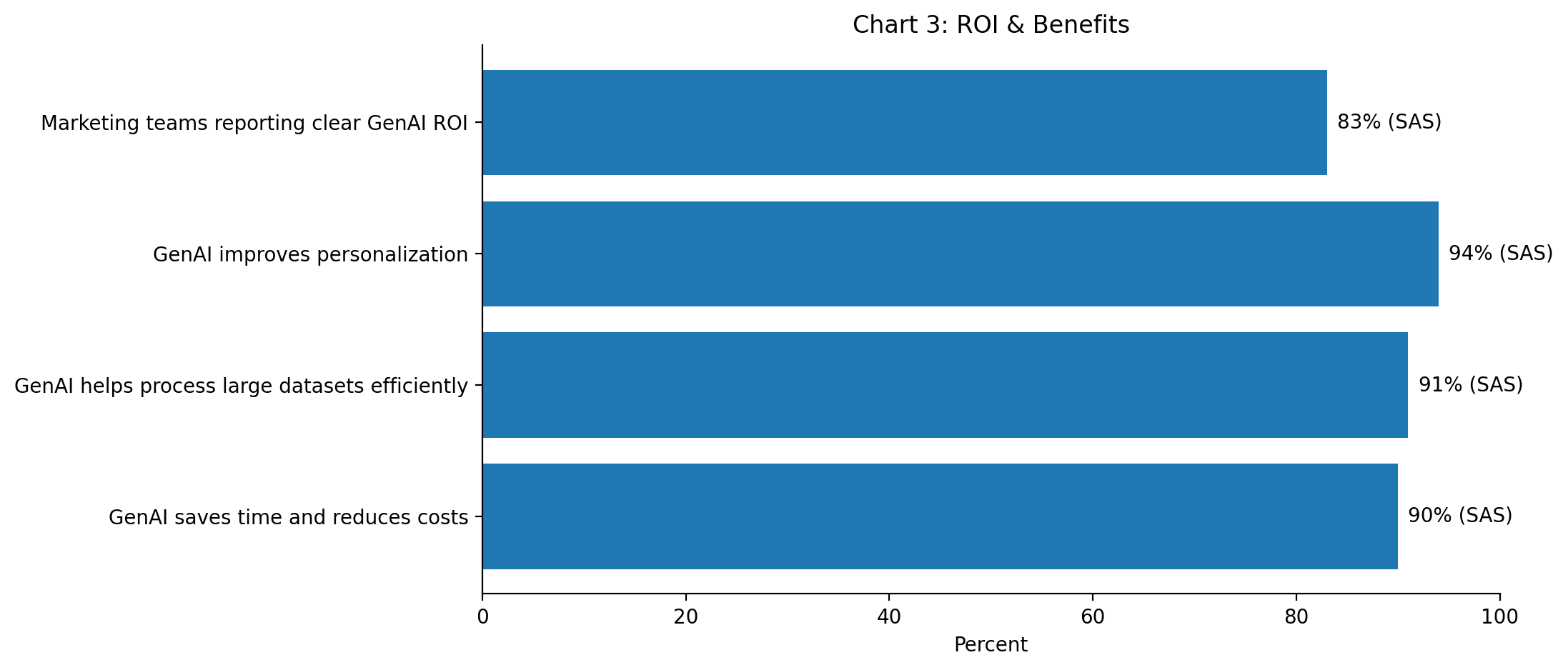
- 83% of marketing teams report clear ROI from GenAI tools. (Source: SAS)
- 66% of marketers say they use AI tools on most or all of their projects. (Source: MiQ)
- 42% of enterprise-scale organizations have actively deployed AI. (Source: IBM)
- 40% of enterprise-scale organizations are exploring AI. (Source: IBM)
- 27% of CMOs report limited or no GenAI adoption in campaigns. (Source: Gartner)
- 77% of marketers using GenAI say they use it for creative development tasks. (Source: Gartner)
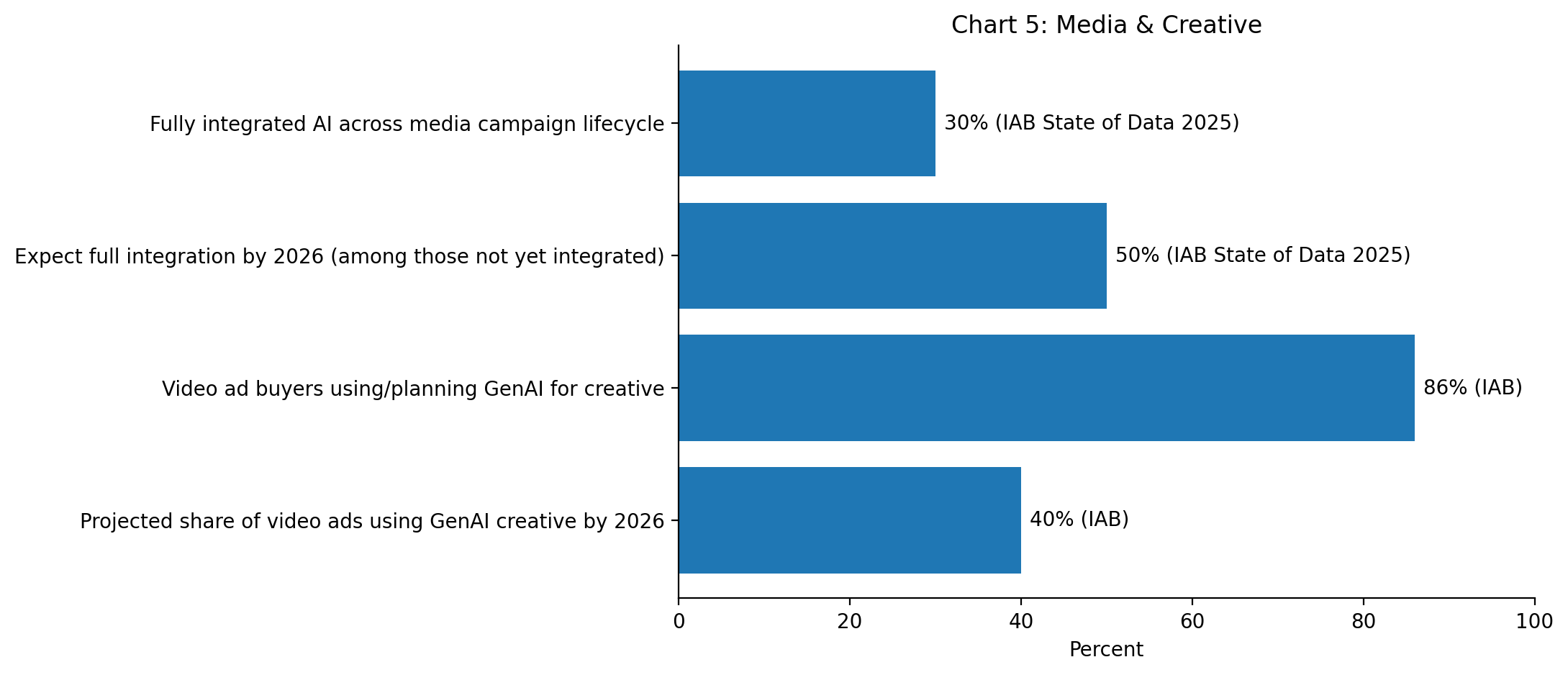
- Only 30% of agencies, brands, and publishers have fully integrated AI across the media campaign lifecycle. (Source: IAB State of Data 2025 (PDF))
- Half of those not fully integrated expect to be fully integrated by 2026. (Source: IAB State of Data 2025 (PDF))
- GenAI could unlock $0.8–$1.2T in annual value across sales and marketing (incremental productivity and revenue). (Source: McKinsey)
- For marketers already using GenAI, creative development is the most common use case. (Source: Gartner)
- In the software sector, sales and marketing account for 31% of AI value generated (in BCG’s survey). (Source: BCG)
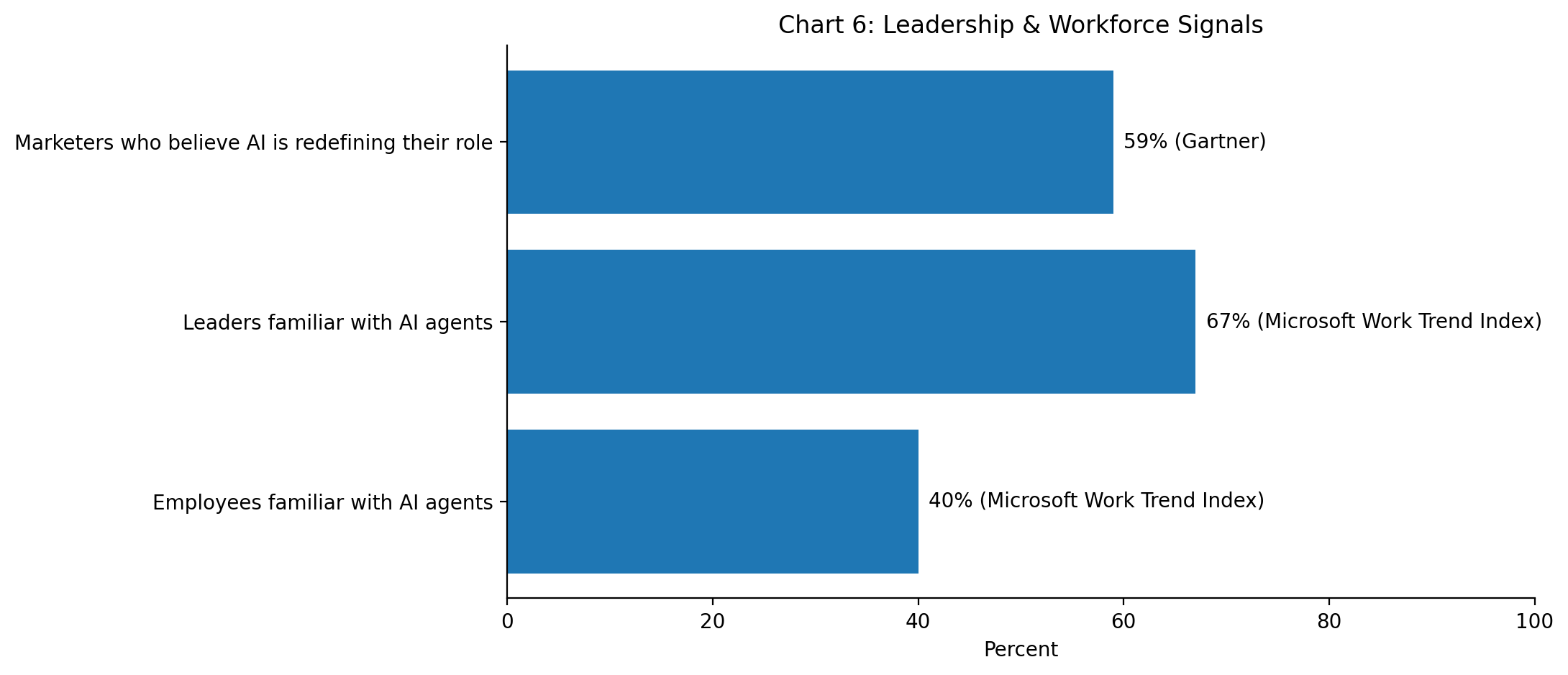
- 59% of marketers believe AI is redefining their role. (Source: Gartner)
- 47% of marketing leaders say GenAI is helping them more than hurting them. (Source: Gartner)
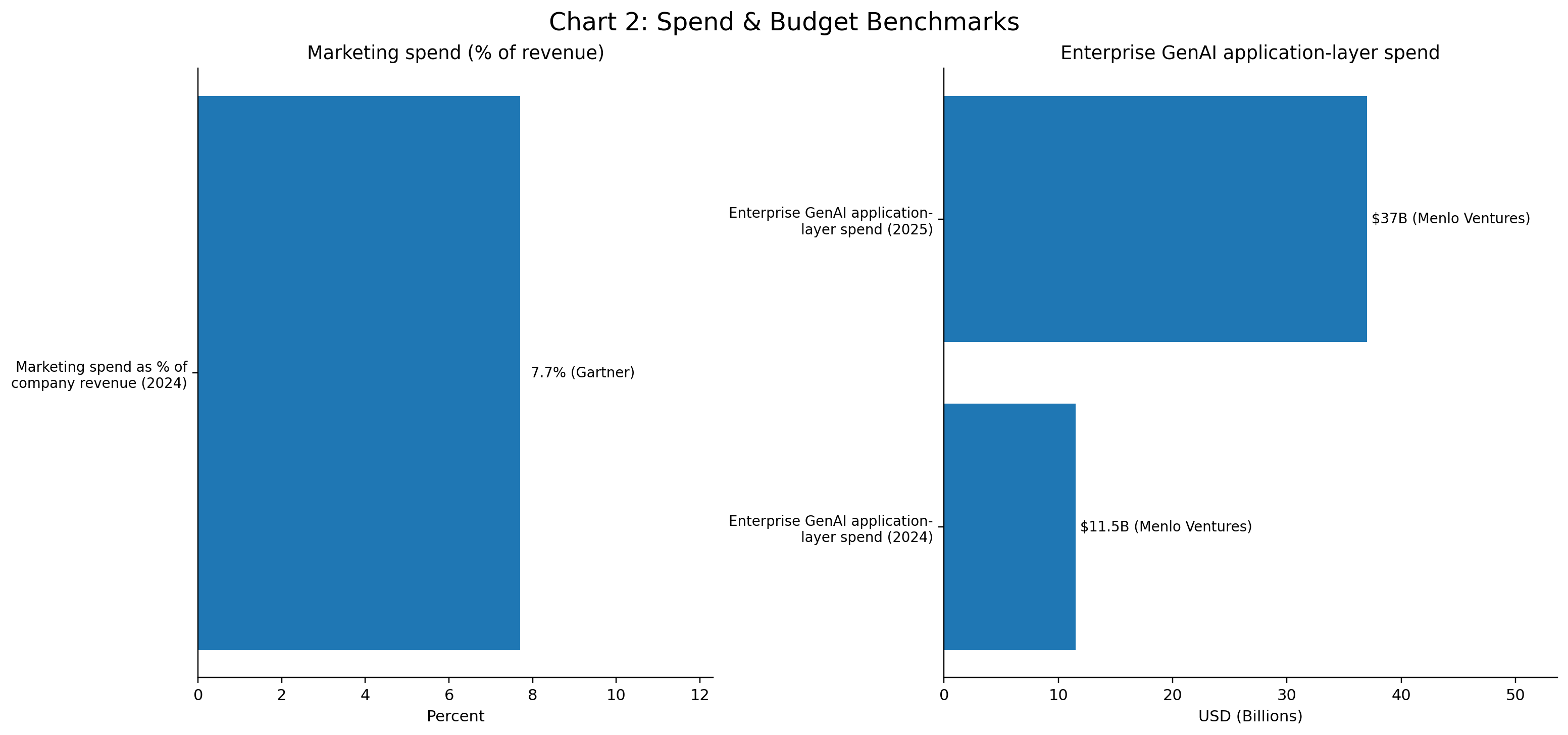
- Menlo Ventures estimates enterprise GenAI application-layer spend grew from $11.5B (2024) to $37B (2025). (Source: Menlo Ventures)
- Marketing budgets average 7.7% of company revenue (2024). (Source: Gartner)
- AI/ML usage for optimizing or automating marketing increased from 17.20% to 44.22% over three years (CMO Survey). (Source: The CMO Survey (Spring 2025))
- 92% of marketing leaders say they are investing in GenAI. (Source: Gartner)
- 36% of marketing leaders say GenAI is “significantly improving” productivity. (Source: Gartner)
- 94% of marketers say GenAI is enhancing personalization. (Source: SAS)
- 91% say GenAI helps them process large datasets more efficiently. (Source: SAS)
- 90% say GenAI is helping save time and reduce costs. (Source: SAS)
- Only 5% of US online adults have never heard of GenAI. (Source: Forrester)
- A Microsoft study found a “tipping point” at 11 minutes/day of Copilot time saved, adding up to ~10 hours over 11 weeks. (Source: Microsoft)
- In the CMO Survey, GenAI is used for marketing activities an average of 15.12% of the time. (Source: The CMO Survey (Spring 2025))
- As GenAI adoption increases, 86% of marketing leaders say it will change their customers’ expectations. (Source: Gartner)
- Gartner expects the “AI hype” phase to be ending; marketing leaders are shifting from pilots to measurable outcomes. (Source: Gartner)
- 74% of companies struggle to achieve and scale value from AI initiatives (BCG survey). (Source: BCG)
- 46% of marketing leaders say GenAI is improving customer satisfaction. (Source: Gartner)
- However, 45% say GenAI is causing confusion within their teams. (Source: Gartner)
- 53% report that GenAI has improved their speed to market. (Source: Gartner)
- In SAS/Coleman Parkes research, 93% of marketing teams budget for continued GenAI investment through 2026. (Source: SAS)
- 91% of marketing leaders agree GenAI “takes too long” to implement. (Source: Gartner)
- 75% of marketing leaders say it “takes too long” to optimize GenAI. (Source: Gartner)
- Only about one quarter of marketing leaders say their team has “fully integrated” GenAI into daily workflows. (Source: Gartner)
- 59% of marketing leaders say GenAI is helping them more than hurting them (when asked about overall impact). (Source: Gartner)
- Marketing leaders who treat GenAI primarily as a tool are more likely to report negative outcomes than those who use it as a strategy. (Source: Gartner)
- In Gartner research, 77% of marketers using GenAI say they use it for creative development. (Source: Gartner)
- Top GenAI-enabled creative tasks include writing/editing copy and generating images or creative concepts. (Source: Gartner)
- Yet 73% of marketing leaders say GenAI hallucinations are a concern for their organization. (Source: Gartner)
- 70% say they are concerned about customer data privacy with GenAI. (Source: Gartner)
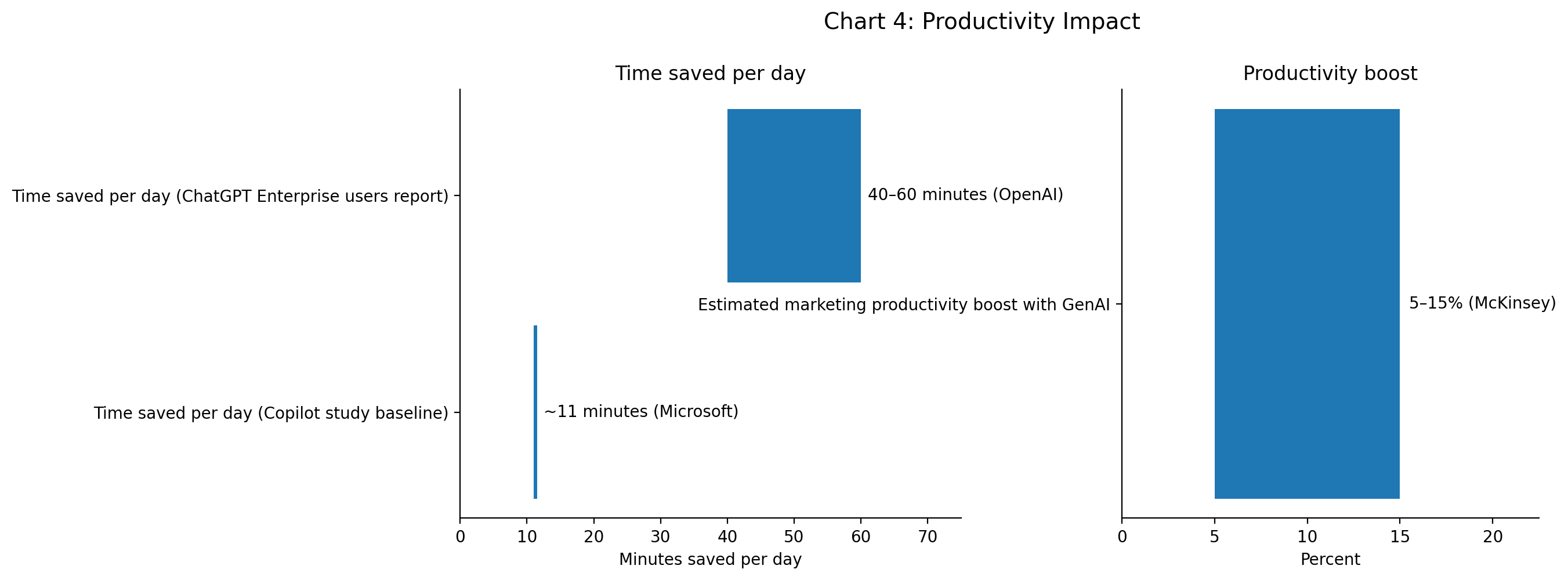
- Workers in surveyed enterprises report saving 40–60 minutes per day using AI at work (ChatGPT Enterprise). (Source: OpenAI)
- In Microsoft’s Copilot research, users reported an average baseline time saving of ~11 minutes per day. (Source: Microsoft)
- McKinsey estimates GenAI can boost sales productivity by ~3–5% and marketing productivity by ~5–15%. (Source: McKinsey)
- Only 23% of marketing leaders say GenAI is clearly improving campaign performance. (Source: Gartner)
- 25% say it improves their ability to measure campaign performance. (Source: Gartner)
- 27% say GenAI improves their ability to learn from campaign performance. (Source: Gartner)
- 31% say GenAI improves their ability to design campaigns. (Source: Gartner)
- Half of the industry lacks a strategic roadmap for AI transformation in media campaigns. (Source: IAB State of Data 2025 (PDF))
- Transparency is a major concern: about half of brands worry they lack visibility into partners’ AI use. (Source: IAB)
- 86% of digital video ad buyers are using or planning to use GenAI to build video ad creative. (Source: IAB)
- Buyers project GenAI creative will reach 40% of all video ads by 2026. (Source: IAB)
- In Gartner’s CMO Survey, 59% of CMOs say they have changed their role in the last two years due to GenAI. (Source: Gartner)
- In the Gartner CMO Survey, CMOs report GenAI has improved their work in areas such as data analysis and creative ideation. (Source: Gartner)
- In Adobe’s Digital Trends research, 65% of senior executives say AI/predictive analytics is the primary contributor to growth. (Source: Adobe)
- Marketing leaders increasingly expect GenAI to reshape customer expectations and channel experiences. (Source: Gartner)
- In the 2025 Work Trend Index, 67% of leaders are familiar with AI agents vs. 40% of employees. (Source: Microsoft)
- In the same report, 79% of leaders believe AI will accelerate their careers vs. 67% of employees. (Source: Microsoft)
- Brands cite transparency concerns: half of brands worry they don’t have enough transparency about partner AI use. (Source: IAB)
- In the IAB State of Data report, 70% of agencies, brands, and publishers have yet to fully scale AI across planning, activation, and analysis. (Source: IAB State of Data 2025 (PDF))
- Over 70% of marketers have encountered an AI-related incident in advertising (e.g., hallucinations, bias, or off-brand outputs). (Source: IAB)
- Less than 35% plan to increase investment in AI governance or brand integrity oversight in the next 12 months. (Source: IAB)
- In IBM research, 80% of respondents report AI has improved operational efficiency and employee experiences (benefits vary by org). (Source: IBM)
- IBM reports key barriers to scaling AI include data complexity, ethics concerns, and limited expertise (varies by organization). (Source: IBM)
- In Gartner research, 53% of marketing leaders report GenAI has improved speed to market—yet only a minority report clear performance lift. (Source: Gartner)
- In IAB’s State of Data research, 60% of brands cite cost as the biggest factor influencing which AI tools they choose. (Source: IAB State of Data 2025 (PDF))
- In Gartner’s marketing leader survey, concerns about hallucinations and privacy remain top barriers to scaling GenAI. (Source: Gartner)
- McKinsey notes that capturing GenAI value depends on workflow redesign, data, and change management—not just tools. (Source: McKinsey)
- Research and Markets projects strong growth in AI-in-marketing categories, but estimates vary widely by definition and scope. (Source: Research and Markets)
- Research and Markets projects GenAI in digital marketing growing from ~$2.48B (2024) to ~$35.12B (2034). (Source: Research and Markets)
Chart 1: Adoption Snapshot (2025–2026)
| Metric | Value | Source |
|---|
| CMOs reporting clear GenAI ROI | 93% | SAS |
| Marketers using AI on most/all projects | 66% | MiQ |
| CMOs with limited/no GenAI in campaigns | 27% | Gartner |
*Sources are linked in the numbered statistics above.
Chart 2: Spend & Budget Benchmarks
| Metric | Value | Source |
|---|
| Marketing spend as % of company revenue (2024) | 7.7% | Gartner |
| Enterprise GenAI application-layer spend (2025) | $37B | Menlo Ventures |
| Enterprise GenAI application-layer spend (2024) | $11.5B | Menlo Ventures |
Chart 3: ROI & Benefits
| Metric | Value | Source |
|---|
| Marketing teams reporting clear GenAI ROI | 83% | SAS |
| GenAI improves personalization | 94% | SAS |
| GenAI helps process large datasets efficiently | 91% | SAS |
| GenAI saves time and reduces costs | 90% | SAS |
Chart 4: Productivity Impact
| Metric | Value | Source |
|---|
| Time saved per day (ChatGPT Enterprise users report) | 40–60 minutes | OpenAI |
| Time saved per day (Copilot study baseline) | ~11 minutes | Microsoft |
| Estimated marketing productivity boost with GenAI | 5–15% | McKinsey |
| Metric | Value | Source |
|---|
| Fully integrated AI across media campaign lifecycle | 30% | IAB State of Data 2025 |
| Expect full integration by 2026 (among those not yet integrated) | 50% | IAB State of Data 2025 |
| Video ad buyers using/planning GenAI for creative | 86% | IAB |
| Projected share of video ads using GenAI creative by 2026 | 40% | IAB |
Chart 6: Leadership & Workforce Signals
| Metric | Value | Source |
|---|
| Marketers who believe AI is redefining their role | 59% | Gartner |
| Leaders familiar with AI agents | 67% | Microsoft Work Trend Index |
| Employees familiar with AI agents | 40% | Microsoft Work Trend Index |
Notes and best practices for using these stats
- Prefer primary sources (original reports, survey owners, and PDFs). When only secondary reporting is available, label it clearly.
- Avoid mixing time periods: some datasets are from 2024–2025 and are used as “latest available” benchmarks for 2026 planning.
- Market size estimates vary significantly by definition (AI in marketing vs. GenAI in digital marketing). Use the scope that matches your audience.
- When presenting ROI numbers, clarify whether they are self-reported (survey-based) or measured (financial/experimental).
Recommended resources