

Hire an email deliverability consultant when you can name the fault, and an agency when nobody on your team will own deliverability after the fix. Consultants such as ZeroBounce and Unspam sell a diagnosis with named deliverables; agencies sell a managed outcome. Pick the type from your diagnosed problem, then price the audit first.
That holds when your sending domain has a nameable fault such as broken authentication or a blocklisting. If you cannot name one yet, buy the audit alone before any retainer.
No provider can force Gmail or Microsoft to place your mail in the inbox. They can only remove the causes you control.
TRM does not fix inboxes. If the real gap is that buyers searching for providers like these never find your company, our SaaS content marketing work builds the pages that do.
📋 Get Listed / Advertise
We update this guide monthly. Want your tool featured? Contact: [email protected].
Email Deliverability Consultants And Agencies At A Glance
| Provider | Type | Best For | Published Price | Not Published |
|---|---|---|---|---|
| Unspam | Consultant and managed retainer | Full-service audits and ongoing management | Audit $1,000 to $4,000 one-off; retainer from about $1,500 per month | Separate pricing page |
| ZeroBounce Deliverability Consulting | Consultant | Authentication and blocklist fixes | Pricing on request | Consulting price |
| MailGenius | Consultant with free first audit | A free audit before you commit | Pricing on request | Scope, deliverables and prices |
| Belkins | Outbound agency with a deliverability specialist | Outbound teams that want a managed team | Pricing on request | Prices |
| Mailtrap | Vendor-run consultation | Existing Business and Enterprise customers | Free to eligible customers | Paid consulting prices, audit scope, turnaround |
Hire a consultant for a diagnosed fault, an agency for ongoing ownership, and look at email deliverability tools when the fix is software, because this page covers services only.
1. Unspam: Best For Full-Service Audits And Retainers
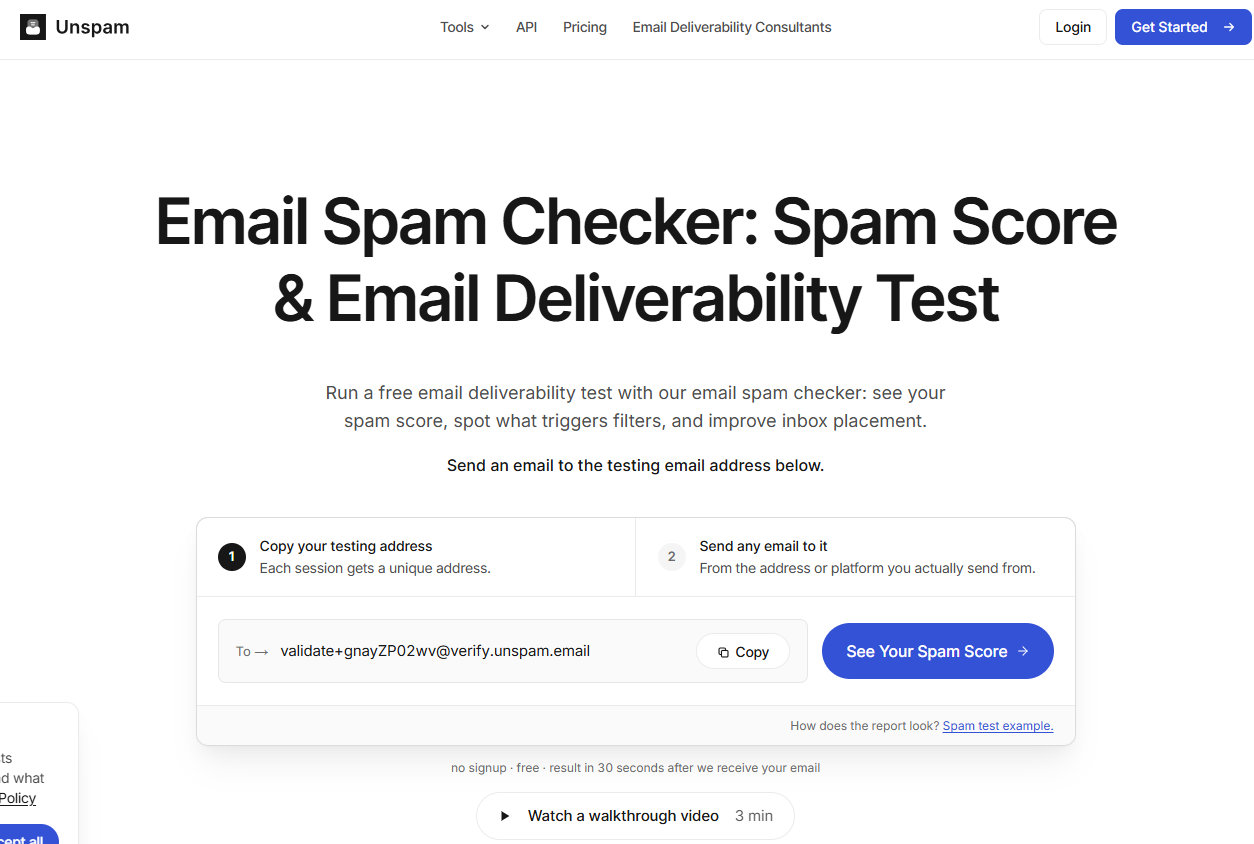
What it does: Unspam's service page lists deliverability assessments, ongoing monitoring, managed IP warmups, list management and hygiene, email authentication setup, reputation repair and blocklist delisting, and Google Postmaster and Microsoft SNDS recovery. That is a broad scope.
Who it is for: Senders who want the audit and the ongoing management from one team. If you expect to need someone after the diagnosis, this is the entry that lets you buy both from the same place.
Pricing: Unspam publishes its figures on the same service page as its scope, not on a separate pricing page.
| Plan | Price | Billing Basis | What It Includes |
|---|---|---|---|
| Standalone audit | $1,000 to $4,000 | One-off | Deliverability assessment |
| Monthly retainer | From about $1,500 | Per month | Ongoing deliverability management |
Treat the figures as a starting point for a scoping call, because the page gives ranges and a floor, not a quote.
Strengths:
- Broad scope: Assessment, warmups, hygiene, authentication and delisting sit under one service.
- Prices on the page: You get an audit range and a retainer floor before you talk to sales.
- Mailbox-provider recovery: Google Postmaster and Microsoft SNDS recovery are named in the scope.
Trade-offs:
- Wide ranges: An audit that could cost $1,000 or $4,000 tells you little about your own case.
- No separate pricing page: The figures live on a service page, so they can move without a clear pricing history.
- Retainer is a floor: "From about $1,500" is where the monthly fee starts, not where it ends.
Key capabilities:
- Deliverability assessments
- Ongoing monitoring
- Managed IP warmups
- Email authentication setup
- Reputation repair and blocklist delisting
- Google Postmaster and Microsoft SNDS recovery
Good fit:
- Senders who want an audit and a retainer from one team
- Teams with no in-house owner for deliverability
- Senders recovering from a blocklisting or a reputation hit
Not a fit:
- Senders who only need to fix one SPF or DKIM record
- Teams that want a fixed quote before any conversation
Biggest limitation: The published figures are ranges and a floor, so you only learn your real cost after scoping.
2. ZeroBounce Deliverability Consulting: Best For Authentication And Blocklist Fixes
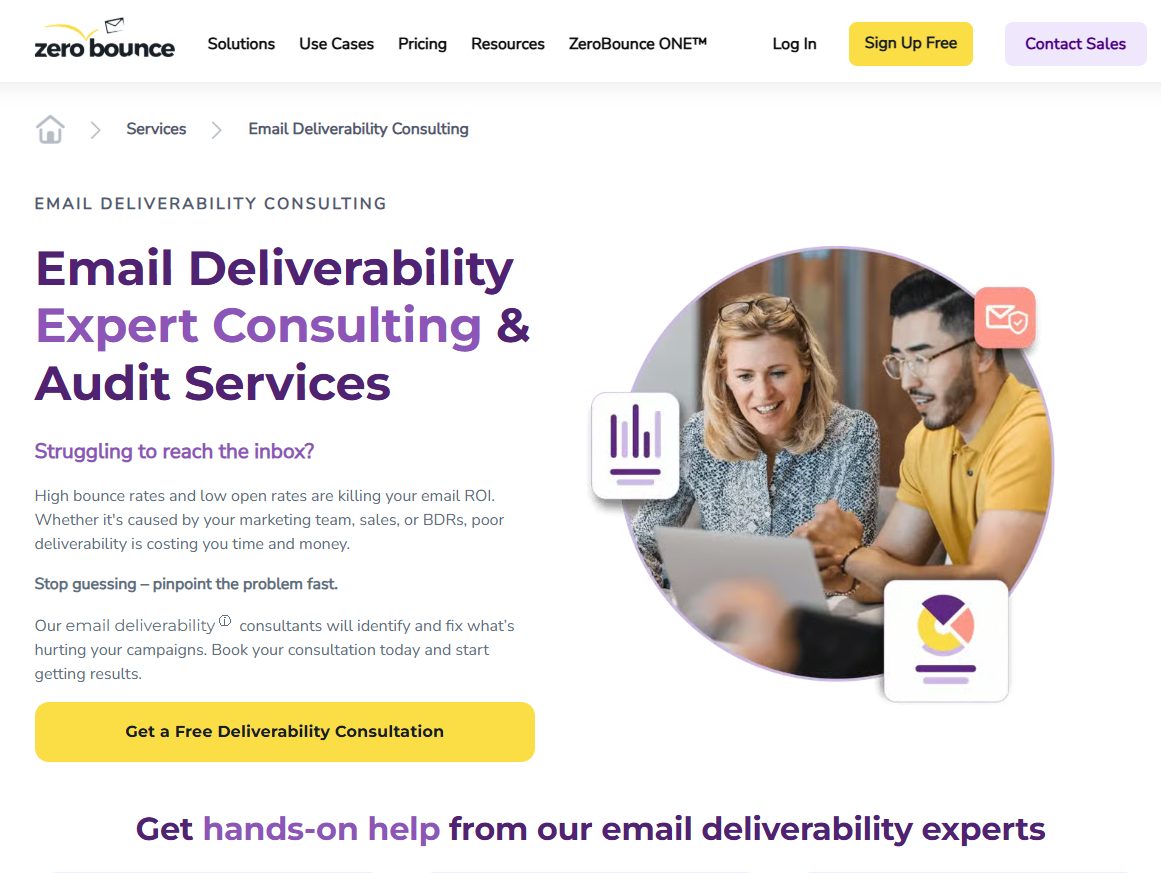
What it does: ZeroBounce's consulting page covers SPF, DKIM, DMARC and BIMI fixes, Gmail and Yahoo issues, blacklist removal and IP or ESP migration. Its email authentication review takes approximately 1 to 2 weeks with up to 2 meetings, which adds up to 3 hours on calls. The FAQ on the same page puts a full audit at up to four meetings.
Who it is for: Senders with a technical fault they can name. If your mail started bouncing after a DNS change, or a blocklist is the problem, this is a scoped fix rather than a retainer. If the fix involves moving to a new provider, our list of transactional email services shows what you might be moving to.
Pricing: Pricing on request. ZeroBounce's consulting page publishes no consulting price and says cost depends on audit type and severity.
| Detail | What The Page Says |
|---|---|
| Authentication review | About 1 to 2 weeks, up to 2 meetings, 3 hours on calls |
| Full audit | Up to four meetings |
| Fix categories | SPF, DKIM, DMARC, BIMI, Gmail and Yahoo issues, blacklist removal, IP or ESP migration |
| Price | Pricing on request |
Strengths:
- Time-boxed review: The authentication review has a stated duration and a stated number of meetings.
- Clear fix categories: The scope names the standards and the mailbox providers it deals with.
- Migration included: IP or ESP migration sits inside the consulting scope.
Trade-offs:
- No published price: You cannot compare it against the others on cost before a conversation.
- Cost varies by severity: The page says the price depends on audit type and severity, so a badly damaged domain costs more.
Key capabilities:
- SPF, DKIM, DMARC and BIMI fixes
- Gmail and Yahoo sending issues
- Blacklist removal
- IP or ESP migration
- A full audit of up to four meetings
Good fit:
- Senders with broken or missing authentication
- Senders who are blocklisted and need a named process to get off
- Teams planning a move to a new IP or sending provider
Not a fit:
- Senders who want a monthly managed service
- Buyers who need a price before they will take a call
Biggest limitation: No consulting price is published, so the cost is unknown until after the scoping conversation.
3. MailGenius: Best For A Free Audit Before You Commit
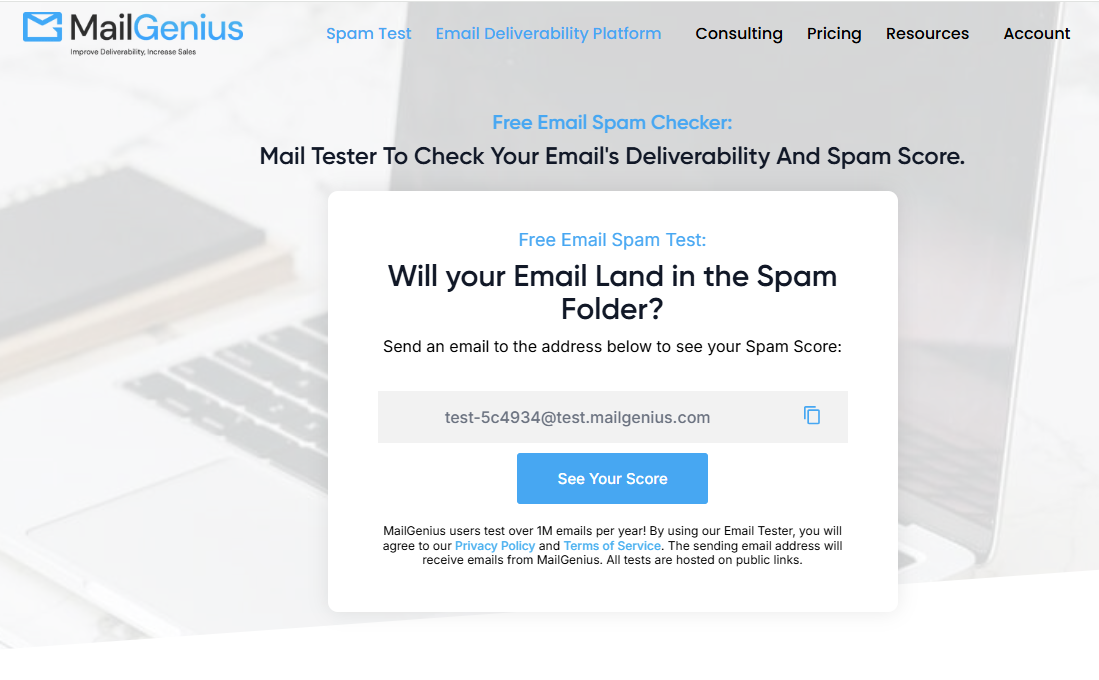
What it does: MailGenius's consulting page describes a 3-step process. Step one is a free audit. Step two is a review and fix with a consultant. Step three is monitoring and optimising. The page shows no prices.
Who it is for: Senders who are not sure how bad the problem is and want a no-cost first look before paying anyone. It is also a sensible second opinion if another provider has already quoted you.
Pricing: Pricing on request. MailGenius's consulting page shows no price for the review and fix or the monitoring steps.
| Step | What Happens | Price |
|---|---|---|
| 1 | Free audit | Free |
| 2 | Review and fix with a consultant | Pricing on request |
| 3 | Monitor and optimise | Pricing on request |
Strengths:
- Free first step: The audit costs nothing, so the first decision carries no budget risk.
- Simple process: Three steps, in order, with the audit first.
- Ends in monitoring: The process does not stop at the fix.
Trade-offs:
- Thin published detail: The page does not say what the audit covers or what you receive.
- Paid steps are unpriced: The free audit may lead to a paid engagement with no figure shown up front.
Key capabilities:
- A free audit
- Review and fix with a consultant
- Monitoring and optimisation
Good fit:
- Senders who want a free look before spending
- Teams comparing several providers and wanting one more data point
Not a fit:
- Buyers who need a stated scope and a list of deliverables before they start
- Teams that need a price in writing before any call
Biggest limitation: The page publishes no scope or deliverables, so you will not know what the audit hands back until you ask.
A free audit is still an audit, and it is also a sales step. That is not a reason to skip it. It is a reason to go in knowing what you want back. Ask what format the findings arrive in before you book it, using the checklist further down this page.
4. Belkins: Best For Outbound Teams That Want A Managed Team
What it does: Belkins's deliverability page describes a team model with an account manager, an SDR, a lead sourcing specialist, a centre of excellence and an email deliverability specialist, with a 4-step onboarding. Deliverability is one role in that team, not the whole product.
Who it is for: Companies that want to outsource outbound as a whole and have deliverability handled inside that service. Belkins is an outbound sales agency, so you are buying the whole motion rather than a diagnosis.
The 4-step onboarding and the shared team change what you are paying for. You are not hiring a specialist who answers to you alone. You are joining a team model where the deliverability specialist sits next to an account manager and an SDR. A sender who wants only deliverability gives up control of that role and pays for a wider service around it, so the fit depends on whether you wanted the rest of the team anyway.
Pricing: Pricing on request. The Belkins deliverability page shows no pricing.
| Detail | What The Page Says |
|---|---|
| Team roles | Account manager, SDR, lead sourcing specialist, centre of excellence, email deliverability specialist |
| Onboarding | 4 steps |
| Review counts cited | Clutch 4.9 from 230 reviews; G2 4.8 from 93 reviews |
| Price | Pricing on request |
The review figures are Belkins's own, taken from its page, and we have not checked them against Clutch or G2. Review counts on a vendor's own page are self-reported, so ask Belkins to show you the live Clutch and G2 listings and a customer you can speak to before you weigh them.
Strengths:
- Managed team: A named deliverability specialist sits alongside sales roles.
- Defined onboarding: The page lays out a 4-step start.
- Review counts cited: Belkins cites 230 reviews on Clutch and 93 on G2.
Trade-offs:
- Deliverability is one role: It is not a standalone deliverability service.
- No price shown: There is nothing to compare against the consultants.
- Bundled service: You pay for sales roles you may not need if all you wanted was a deliverability fix.
Key capabilities:
- An email deliverability specialist inside the team
- Account management
- SDR and lead sourcing roles
- A 4-step onboarding
Good fit:
- Teams outsourcing outbound as a whole
- Companies with no one to run sending and deliverability day to day
Not a fit:
- Anyone who needs a one-off DNS fix
- Senders who already run outbound in-house and want only an audit
Biggest limitation: Deliverability is one role in a wider sales service, so you cannot buy it on its own.
5. Mailtrap: Best For Existing Business And Enterprise Customers
What it does: Mailtrap's consultation page offers free deliverability consulting to Business or Enterprise customers. It covers implementation support, migration support, identifying and fixing weaknesses, and custom consultations.
Who it is for: Teams already on Mailtrap at those tiers. This is a perk of being a customer, not a standalone service you can buy from the outside. If you are on a lower tier, or on a different platform entirely, this entry does not apply to you, and you should read it as a signal of what a vendor-run consultation looks like rather than as an option.
This entry is a vendor-run consultation, not an independent firm. Ask Mailtrap up front whether the advice covers sending you do outside its platform, because the page does not say. Ask too how quickly they respond and whether the consultation is a single session or an ongoing relationship. The page names the categories of help but not the format, so get the answers before you plan around it.
Pricing: Free to eligible customers, per Mailtrap's consultation page. Paid consulting prices, audit scope and turnaround are not published.
| Detail | What The Page Says |
|---|---|
| Who gets it | Business or Enterprise customers |
| Price | Free to eligible customers |
| Covers | Implementation support, migration support, fixing weaknesses, custom consultations |
| Paid consulting, scope, turnaround | Not published |
Strengths:
- No extra fee: Eligible customers get it free.
- Covers migration: Migration support is named in the scope.
Trade-offs:
- Customers only: You need to be on a Business or Enterprise plan.
- Undefined deliverables: The page does not say what you receive or how fast.
Key capabilities:
- Implementation support
- Migration support
- Identifying and fixing weaknesses
- Custom consultations
Good fit:
- Teams already on Mailtrap's Business or Enterprise plans
Not a fit:
- Everyone else, including teams on lower tiers and teams on other platforms
Biggest limitation: Scope and deliverables are unpublished, so you cannot judge the depth of the help before you ask.
📋 Get Listed / Advertise
We update this guide monthly. Want your tool featured? Contact: [email protected].
How To Match A Provider To Your Diagnosed Problem
Most buyers shop by brand. That is backwards. A managed agency sold to someone with a single broken DNS record wastes money, and an audit-only consultant sold to someone with no owner for the problem leaves the same fault to return in six months. Name the problem first, then pick the type of help that fixes it, then pick a provider of that type.
| Diagnosed Problem | Provider Type That Fixes It | Fit From This List |
|---|---|---|
| Broken or missing authentication and DNS | Audit-only consultant | ZeroBounce Deliverability Consulting, Unspam |
| Blocklisting or reputation damage | Consultant with delisting in scope | ZeroBounce Deliverability Consulting, Unspam |
| Bad list quality and bounces | Software, with an audit if the cause is unclear | MailGenius free audit as a first look |
| Weak engagement with placement steady | Software or messaging, not a consultant | None of the five |
| No one owns deliverability as volume grows | Managed agency | Unspam retainer, Belkins |
Here is the rule for each.
- If authentication or DNS is broken: Hire an audit-only consultant. A consultant can audit authentication, DNS, sending infrastructure, list hygiene and reputation, and your own team can apply the fixes. Pair the one-off fix with DMARC monitoring tools so it stays fixed.
- If you are blocklisted or your reputation is damaged: Hire a consultant who lists delisting and reputation repair in the scope, and ask for the diagnosis in writing.
- If your list is the problem: Fix the source first. Better email finder tools and verification beat paying a consultant to explain why bad addresses bounce.
- If placement is steady but replies are weak: Do not hire a consultant. Better software or messaging is the fix, and no provider on this page sells it. Placement is not your problem, so paying someone to inspect it only delays the real fix.
- If nobody owns deliverability and volume is growing: Hire a managed agency or a retainer. That is the only option here that keeps the work going after the first fix. A one-off consultant leaves when the report is delivered, and the problem has no owner again.
The free options sit on top of any row. A free audit costs nothing and tells you which row you are in, so take one before you pay for a retainer. If a software fix is the answer, our roundup of email deliverability tools is where to go next.
What An Email Deliverability Audit Should Include
An email deliverability audit checks delivered, bounce and spam complaint rates, technical setup, SPF, DKIM and DMARC, sender reputation and blocklists, content, and list quality. The deliverable is a findings document with prioritised fixes, sometimes walked through on a call.
A typical audit covers DNS, sending history, sequences, list hygiene, and Postmaster and SNDS data. An audit usually takes up to two weeks.
Paste this checklist into your scoping email. It turns "do an audit" into something you can hold the provider to.
- Rates: Delivered, bounce and spam complaint rates for the period the audit covers.
- Authentication: SPF, DKIM and DMARC results for every sending domain.
- Reputation: Sender and domain reputation, with blocklist checks.
- Content and list: A review of message content and list quality.
- Mailbox-provider data: Postmaster and SNDS data where available.
- Findings document: Prioritised fixes in writing, with a call to walk through them.
Before you pay anyone, run the free pre-checks. Our guide to free spam checkers covers the tools that show you obvious faults in minutes. If the free checks find nothing and placement is still poor, that is a good time to buy the audit.
Consultant Vs Agency Vs In-House: Which Do You Need?
A consultant sells diagnosis and direction while your team carries out the fixes. An agency sells the recurring outcome and does the work. An in-house hire owns the problem day to day.
| Option | What It Sells | Fits When |
|---|---|---|
| Consultant | Diagnosis and direction | You have a specific problem and staff to execute the fixes |
| Agency | The recurring outcome, with the work done for you | Nobody owns deliverability and placement must hold as volume grows |
| In-house hire | Day-to-day ownership | Deliverability is a permanent job and you can fund it |
| Freelancer | A single specific fix | You are a smaller sender with one problem |
Consultancies suit businesses that need a clean sending reputation, a full audit or blocklist removal. Freelancers suit smaller senders or a single specific fix.
Hire a consultant for a specific problem and in-house staff to execute. Hire an agency when nobody owns deliverability and placement must hold as volume grows.
You can own list hygiene yourself. A good set of email verification tools handles the recurring cleaning, which leaves the consultant or agency to deal with the parts that need outside expertise.
If you are weighing an outside team against an in-house hire for search and AI visibility rather than deliverability, the GEO + SEO Growth Programme is how we run that for SaaS teams. Read what a monthly engagement covers and decide whether it fits.
How Much Email Deliverability Consulting Costs
Engagements split into one-off audits, project work priced by scope, and ongoing retainers. Prices follow the same split.
Two published ranges give you a frame. LeadHaste's published ranges put consultants at about $150 to $400 per hour, a fixed-scope audit at $2,500 to $8,000 over a 2 to 4 week engagement, and agencies at about $2,000 to $5,000 per month, usually with a 3-month minimum. Smartlead lists a one-time audit at $2,000 to $5,000, a full diagnostic at $5,000 to $15,000 and crisis remediation at $10,000 to $25,000.
| Source | Engagement | Published Range |
|---|---|---|
| LeadHaste | Consultant hourly rate | About $150 to $400 per hour |
| LeadHaste | Fixed-scope audit, 2 to 4 weeks | $2,500 to $8,000 |
| LeadHaste | Agency retainer, usually 3-month minimum | About $2,000 to $5,000 per month |
| Smartlead | One-time audit | $2,000 to $5,000 |
| Smartlead | Full diagnostic | $5,000 to $15,000 |
| Smartlead | Crisis remediation | $10,000 to $25,000 |
| Unspam | Standalone audit | $1,000 to $4,000 one-off |
| Unspam | Monthly retainer | From about $1,500 per month |
Both ranges come from companies that operate in this space, so read them as market framing, not quotes. A provider's own scoping quote overrides them. The Unspam row is Unspam's own published figure.
Here is how to use the numbers without overpaying.
- Step one: Buy the audit alone. At Smartlead's range that is $2,000 to $5,000, and at LeadHaste's it is $2,500 to $8,000.
- Step two: Read the findings document and decide who can carry out the fixes.
- Step three: Buy a retainer only if the audit shows an ongoing job. At LeadHaste's agency range, a 3-month minimum is $6,000 to $15,000, which is simple arithmetic on $2,000 to $5,000 per month.
- Step four: If the fixes are one-off, apply them in-house and skip the retainer.
If you are weighing a monthly retainer for search rather than deliverability, our GEO and SEO growth programme page shows what that kind of engagement covers.
How To Vet A Provider Before You Sign
Verify a provider by checking named case studies, direct contacts at mailbox providers and working knowledge of DMARC, BIMI and MTA-STS. Expect a price range before a sales call.
Red flags include no verifiable customers, promised reply-rate gains and retainers pushed for a one-time problem.
Ask these five questions before you sign. Each one has a good answer and an evasive one.
- Deliverables: Which named deliverables will I receive, and in what format? A good answer names a findings document with prioritised fixes. An evasive answer says "a full review" and stops there.
- Dates: By what date will each deliverable arrive? A good answer gives a date or a range per deliverable. An evasive answer says it depends and offers nothing in writing.
- References: Which customers can I contact to confirm your results? A good answer names customers you can verify. Verifiable customers are the first thing to check, and a provider with none is a red flag.
- Empty audit: What happens if the audit finds nothing wrong? A good answer says you get the findings and no retainer pitch. An evasive answer finds a reason you need ongoing work anyway.
- Retainer logic: Why does my problem need a retainer rather than a one-off fix? A good answer ties the retainer to a recurring job, such as volume growth with no owner. An evasive answer talks about peace of mind.
Also test their working knowledge. Ask how they would handle DMARC, BIMI and MTA-STS for your domains, and whether they have direct contacts at mailbox providers. A consultant who cannot answer in plain terms is selling a title. Promised reply-rate gains are the other tell, because reply rates depend on your offer and messaging, not only on placement.
Every roundup of providers, including this one, is published by someone with an interest. Treat any list, ours included, as a place to start your own checks. Our guide to hiring a content audit consultant walks through the same logic for a different kind of consultant, and it applies here too.
What No Provider Can Fix For You
A deliverability consultant cannot force an ISP to deliver mail to the inbox, make third parties trust the sender, or bypass receiving filters.
Buyers often hire a consultant hoping to hand over the whole problem. That is the wrong expectation, and a provider who encourages it is selling you something the mailbox providers do not allow anyone to sell. What stays with you is the sender's side of the relationship. You decide where your list comes from. You decide how fast you raise your sending volume. You decide what you send, and that sets your complaint rate.
A consultant can show you what to change in each of those. They cannot change them for you without being in the loop every day, which is why a promise to guarantee inbox placement is a red flag and not a selling point.
Set your expectations on that basis. A good engagement leaves you with a list of changes, an owner for each one and a way to see whether they worked. It does not leave you with a promise. If a provider talks only about outcomes and never about the actions on your side, ask what they expect you to do and by when.
How Long A Deliverability Engagement Takes
An audit usually takes up to two weeks, and the published figures vary by provider and scope.
- ZeroBounce authentication review: ZeroBounce's consulting page puts it at approximately 1 to 2 weeks.
- Fixed-scope audit: LeadHaste's ranges put it at 2 to 4 weeks.
- Ongoing work: Retainers run monthly, with a 3-month minimum common at the agency end.
- Repeat audits: Repeat a deliverability audit at least every four months if you care about reputation.
Read the timeline as three stages. The audit comes first and runs up to two weeks. The fixes follow, and a short scoped job such as an authentication review sits inside the 1 to 2 week range. A retainer comes last and only if the findings show a recurring job, which is why the 3-month minimum matters. Ask whether the minimum starts at the audit or after it, because that changes what you commit to before you have seen any findings.
How We Chose These Providers
We looked for service providers, not software. Software is excluded and lives on the tools hub. A provider had to meet four criteria.
- Service, not software: The provider sells expertise or a managed service.
- Published scope: The provider describes what it does on a page we could read.
- Published or stated pricing: The page states a price or states that it does not publish one.
- A fetched vendor page: We read the provider's own page.
TRM has not hired any of these firms. We describe them from their published pages, and we have not tested their results. Smartlead's list of eleven consultants makes the same statement about its own roundup, and presents its firms as a starting point, not a ranking.
Kickbox and other firms whose pages could not be read are not included. Our SaaS content marketing work builds comparison pages like this one for SaaS companies.
FAQs
What Does An Email Deliverability Consultant Do?
How Much Does An Email Deliverability Audit Cost?
How Long Does An Email Deliverability Audit Take?
Should I Hire A Consultant Or An Agency?
Can A Consultant Guarantee Inbox Placement?
How Often Should I Repeat A Deliverability Audit?
What Are Red Flags When Hiring A Deliverability Consultant?
When Is Software A Better Fix Than A Consultant?
Are Free Deliverability Audits Worth Taking?
What Deliverables Should I Ask For Before Signing?
If you want a second opinion on whether your next step is an inbox fix or a pipeline fix, book a thirty-minute call. One of the founders takes it, and you leave knowing what we would look at first.