

Pick an AI cold calling platform by compliance and call volume before voice quality, because a convincing voice that breaks consent rules costs more than it earns. For most B2B teams, Retell AI or Bland AI suit scale, Autocalls.ai suits small budgets, and Vapi suits teams with engineers.
This holds for teams placing outbound calls to business prospects at 20 to 300 person companies that already run a CRM and a human SDR bench.
Vendor prices carry no effective date and the UK position on AI calls under PECR is contested, so confirm both with the vendor and your own counsel before signing.
If you sell one of these products and want comparison pages like this one bringing in buyers, our SaaS content marketing work covers exactly that. It is a quick read to see whether it fits.
📋 Get Listed / Advertise
We update this guide monthly. Want your tool featured? Contact: [email protected].
AI Cold Calling Software At A Glance
This guide covers outbound calling agents only. Every price below is read from the vendor's own page, and none of those pages carries an effective date, so use the table as a starting point for your own quote request.
| Tool | Entry Price | Billing Basis | Published Limits | Best For |
|---|---|---|---|---|
| Retell AI | $0.07 to $0.31 per minute | Pay as you go, custom Enterprise | 20 free concurrent calls | Enterprise teams with compliance reviews |
| Bland AI | $0.14 per minute on Start, $0 platform fee | Per minute, plus a $299 monthly fee on Build | 100 calls per day on Start, 2,000 on Build | High daily call volume |
| Autocalls.ai | $27 or $34 per month for Starter | Monthly plan with included minutes and overage | 3 parallel calls on Starter, 10 on Pro | Small teams on a fixed monthly budget |
| Vapi | $0 to start, then $0.05 per minute hosting | Prepaid hosting, $29 Core plan | 4 concurrent calls on the entry tier, 10 on Core | Engineering-led teams building custom agents |
| Synthflow | Pricing on request | Annual enterprise agreement | Scoped per contract | Enterprises buying on an annual contract |
1. Retell AI: Best For Enterprise Teams With Compliance Reviews
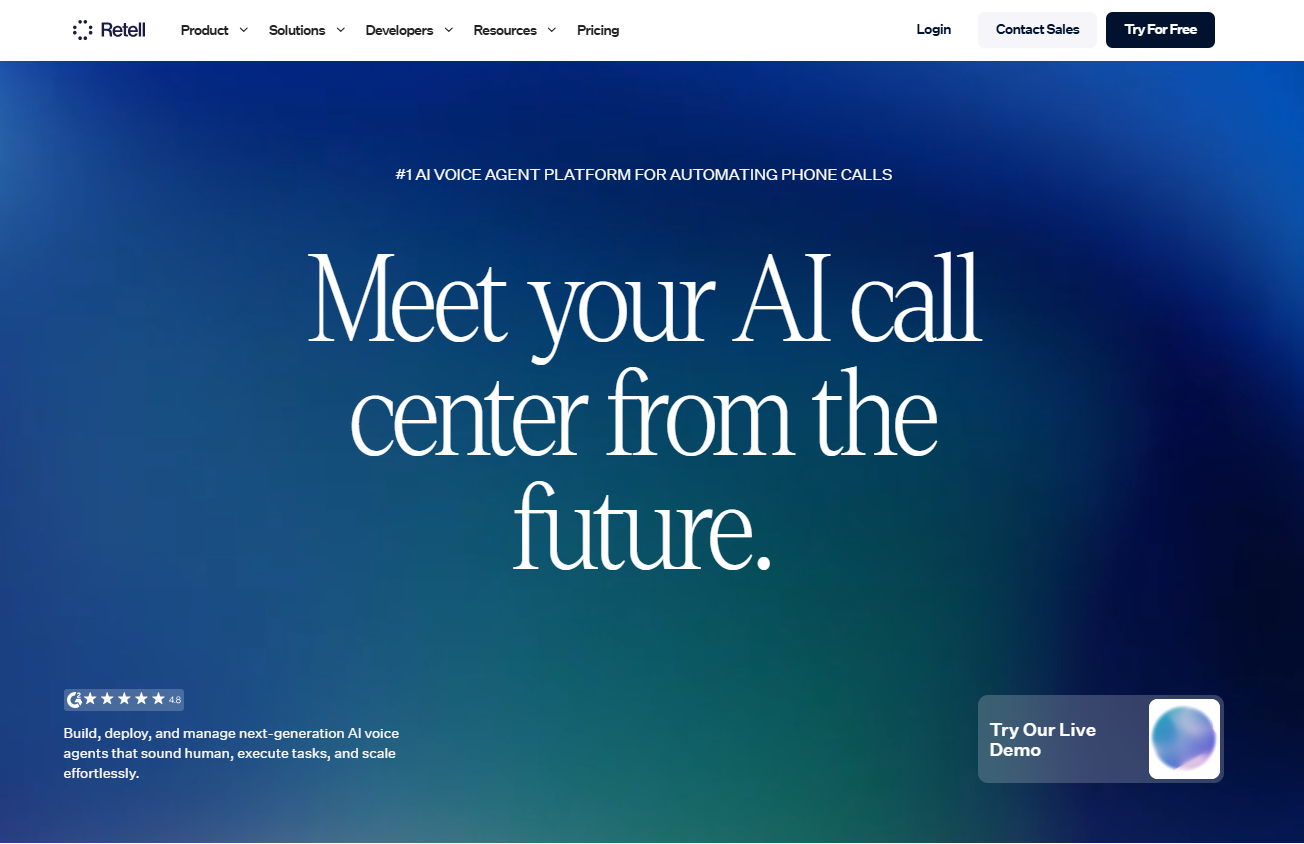
Retell AI is best for enterprise teams that need an AI calling vendor to get past a security or compliance review. It sells voice agents on a pay-as-you-go basis and adds an Enterprise tier with SSO, role-based access controls and a custom MSA and DPA.
What it does: Retell AI runs voice agents billed by the minute. The Enterprise tier is where contracts and access controls come in.
Who it is for: Teams whose legal or security people will read the paperwork before a single dial goes out. If a reviewer will ask for SSO and a data processing agreement, this is the profile that has both on the page.
Retell AI's pricing page lists pay-as-you-go voice agents at $0.07 to $0.31 per minute, with custom Enterprise pricing and no effective date.
| Plan | Price | Billing Basis | What It Includes |
|---|---|---|---|
| Pay as you go | $0.07 to $0.31 per minute | Per minute of voice agent use | 20 free concurrent calls and a $10 signup credit, extra concurrency at $8 per concurrent call per month |
| Enterprise | Custom | Contract | SSO, RBAC, custom MSA and DPA |
- Free start: A $10 signup credit and 20 free concurrent calls.
Strengths:
- Pay-as-you-go billing means a pilot costs minutes rather than a contract.
- The 20 free concurrent calls give a small pilot room to run before extra concurrency costs anything.
- Retell AI states that compliance features are included in all plans without additional fees.
- The Enterprise tier brings SSO and role-based access, which is what a security reviewer asks for first.
Trade-offs:
- The page gives a range rather than a rate, so budget from the top of it until a pilot shows where your calls land.
- Extra concurrency costs $8 per concurrent call per month, which matters for a team that dials in bursts.
- Enterprise pricing is not published, so you cannot size the top tier without a sales call.
Key capabilities:
- Voice agents billed per minute
- A human-in-the-loop fallback, which Retell AI describes as a platform feature
- Compliance features in every plan, in the vendor's own words
- SSO, RBAC and a custom MSA and DPA on Enterprise
Good fit:
- A team that needs procurement and security sign-off before it can dial
- A team that wants to pay by usage while it learns what a good call looks like
Not a fit:
- A team that needs one fixed monthly figure to put in a budget
- A buyer who wants Enterprise pricing before talking to anyone
The limitation that matters most is that Enterprise prices are not published and the pricing page carries no effective date.
2. Bland AI: Best For High Daily Call Volume
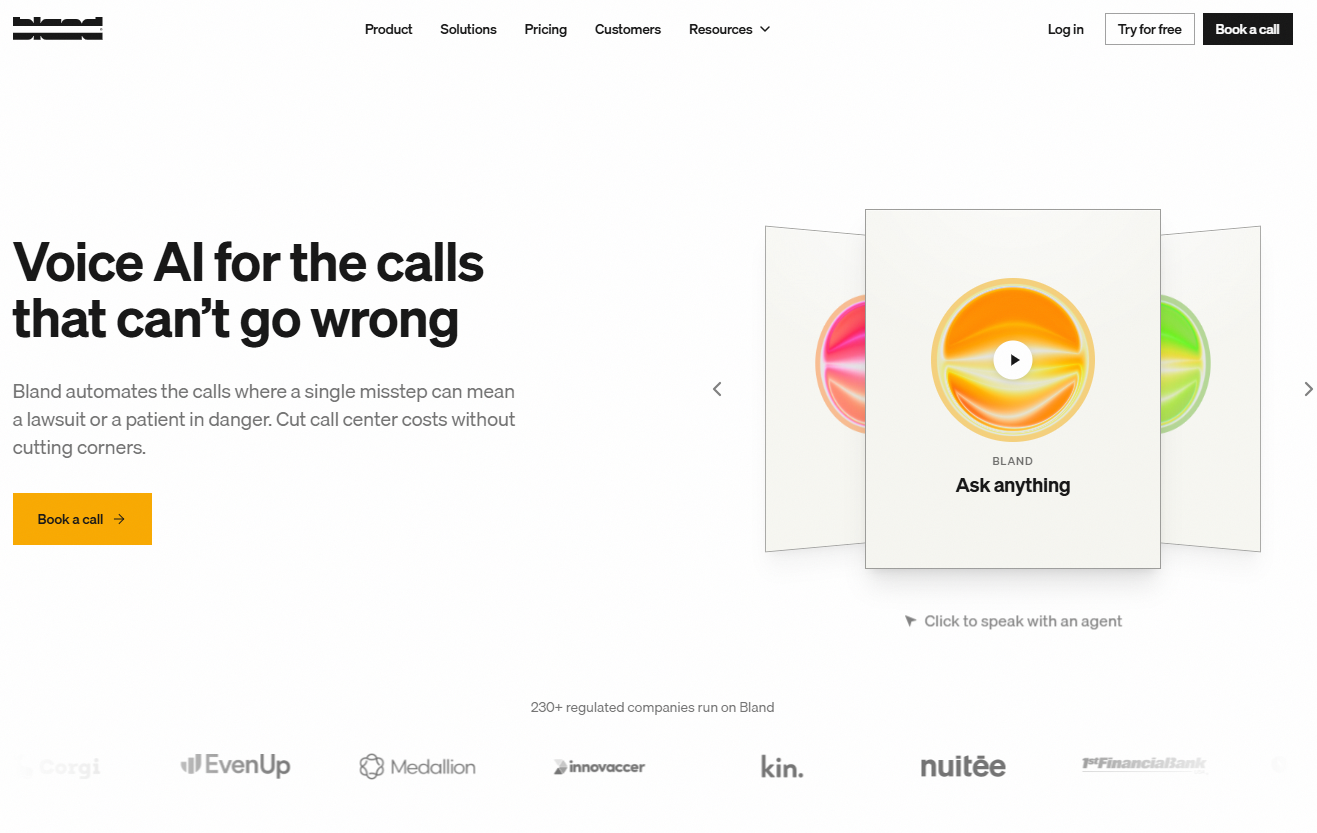
Bland AI is best for teams that know how many dials they need each day and want a vendor that publishes the ceiling. Its plans state daily call caps up front, which lets you size volume before you sign.
What it does: Bland AI charges per minute of talk time. The Enterprise tier removes the daily cap.
Who it is for: SDR managers who run large lists and need to know whether a plan can physically place the calls. A published cap turns a vague capacity question into division.
Bland AI's pricing page shows Start at $0.14 per minute of talk time with a $0 platform fee, 10 concurrent calls and 100 calls per day. Build is $0.12 per minute with a $299 monthly platform fee, 50 concurrent calls and 2,000 calls per day. Enterprise is custom with unlimited calls.
| Plan | Price | Billing Basis | What It Includes |
|---|---|---|---|
| Start | $0.14 per minute, $0 platform fee | Talk time | 10 concurrent calls, 100 calls per day |
| Build | $0.12 per minute, $299 monthly platform fee | Talk time plus monthly fee | 50 concurrent calls, 2,000 calls per day |
| Enterprise | Custom | Contract | Unlimited calls |
Strengths:
- Daily call caps are published for each plan, so you can check capacity before talking to sales.
- The step from Start to Build cuts the per-minute rate and raises the daily cap twentyfold, from 100 to 2,000 calls.
- A $0 platform fee on Start lets you test the product without a monthly commitment.
Trade-offs:
- Telephony is billed separately at pass-through cost, on your own carrier or built-in Twilio, so the per-minute rate is not the whole bill.
- Start's 100 calls per day is low for any team running a real list.
- Enterprise pricing is custom, so the unlimited tier has no number to plan against.
Key capabilities:
- Per-plan daily call caps
- Concurrent calls from 10 up to 50 before Enterprise
- Your own carrier or built-in Twilio for telephony
Good fit:
- A team with a daily dial target that it can divide against a published cap
- A team that already has a carrier and wants to bring it
Not a fit:
- A team that wants one all-in per-minute price with telephony included
- A very small team for whom a $299 monthly fee outweighs the volume it needs
The limitation that matters most is that telephony sits outside the per-minute rate, so the quoted price understates what you will pay.
3. Autocalls.ai: Best For Small Teams On A Fixed Monthly Budget
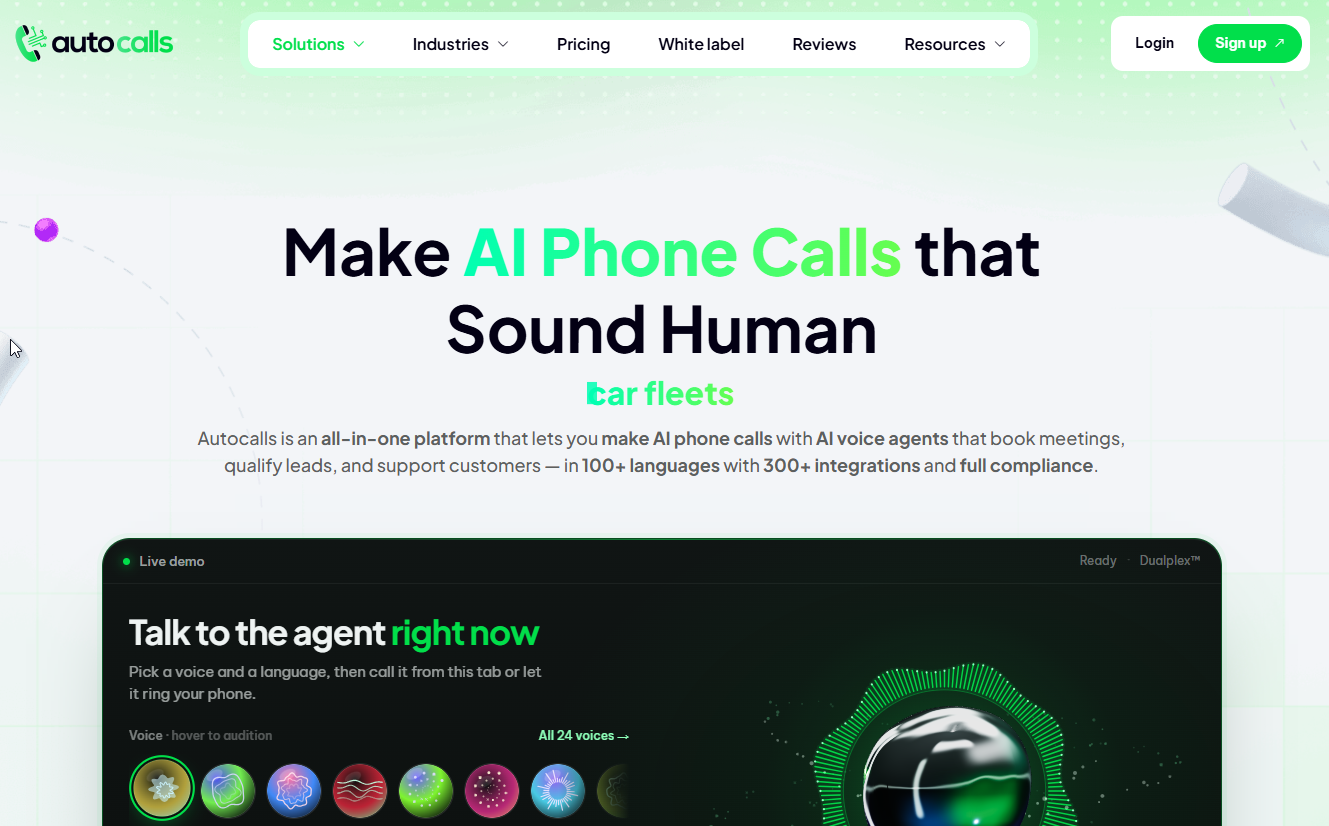
Autocalls.ai is best for small teams that want a monthly plan with a known number of included minutes and a listed overage rate.
What it does: Autocalls.ai sells monthly plans with included minutes and charges overage per minute once you pass them. The vendor describes TCPA calling windows, DNC list management, GDPR consent and a full audit trail as part of the product.
Who it is for: Teams of a few people that want to cap spend and work inside HubSpot, Salesforce, Pipedrive or a similar CRM. Agencies get a white-label plan.
Autocalls.ai's pricing page shows two figures for each plan and does not label which is monthly and which is annual. This guide gives both as shown.
| Plan | Price | Billing Basis | What It Includes |
|---|---|---|---|
| Starter | $27 or $34 per month | Two figures shown, not labelled | 120 minutes, $0.20 per minute overage, 3 parallel calls |
| Pro | $103 or $129 per month | Two figures shown, not labelled | 700 minutes, $0.16 per minute overage, 10 parallel calls |
| Agency | $199 or $249 per month | Two figures shown, not labelled | 1,700 minutes, $0.09 per minute overage |
| Agency White Label | $355 or $419 per month | Two figures shown, not labelled | 3,500 minutes, white label, unlimited sub-accounts |
Strengths:
- Included minutes and overage rates are listed for every plan, so a month's bill is easy to estimate.
- The overage rate falls from $0.20 per minute on Starter to $0.09 on Agency, which rewards growth.
- The cold calling page lists HubSpot, GoHighLevel, Zoho CRM, Salesforce, Pipedrive, Cal.com, Zapier and Make.
- The same page describes TCPA calling windows, DNC list management, GDPR consent and a full audit trail.
Trade-offs:
- The unlabelled pair of prices per plan means you must ask which figure applies before you budget.
- Starter's 120 minutes and 3 parallel calls suit a pilot, not a full list.
- The compliance controls are the vendor's own description, so test them against your own consent process.
Key capabilities:
- Monthly plans with included minutes
- TCPA calling windows and DNC list management
- GDPR consent controls and an audit trail
- CRM and automation connections, including Zapier and Make
- A white-label plan with unlimited sub-accounts
Good fit:
- A small team that needs to cap monthly spend
- An agency that wants to resell calling under its own brand
Not a fit:
- A team that needs to place thousands of calls a day, because the plans publish minutes rather than daily caps
- A buyer who cannot tolerate an unlabelled price on a pricing page
The limitation that matters most is that the pricing page does not say which of its two figures is monthly.
4. Vapi: Best For Engineering-Led Teams Building Custom Agents
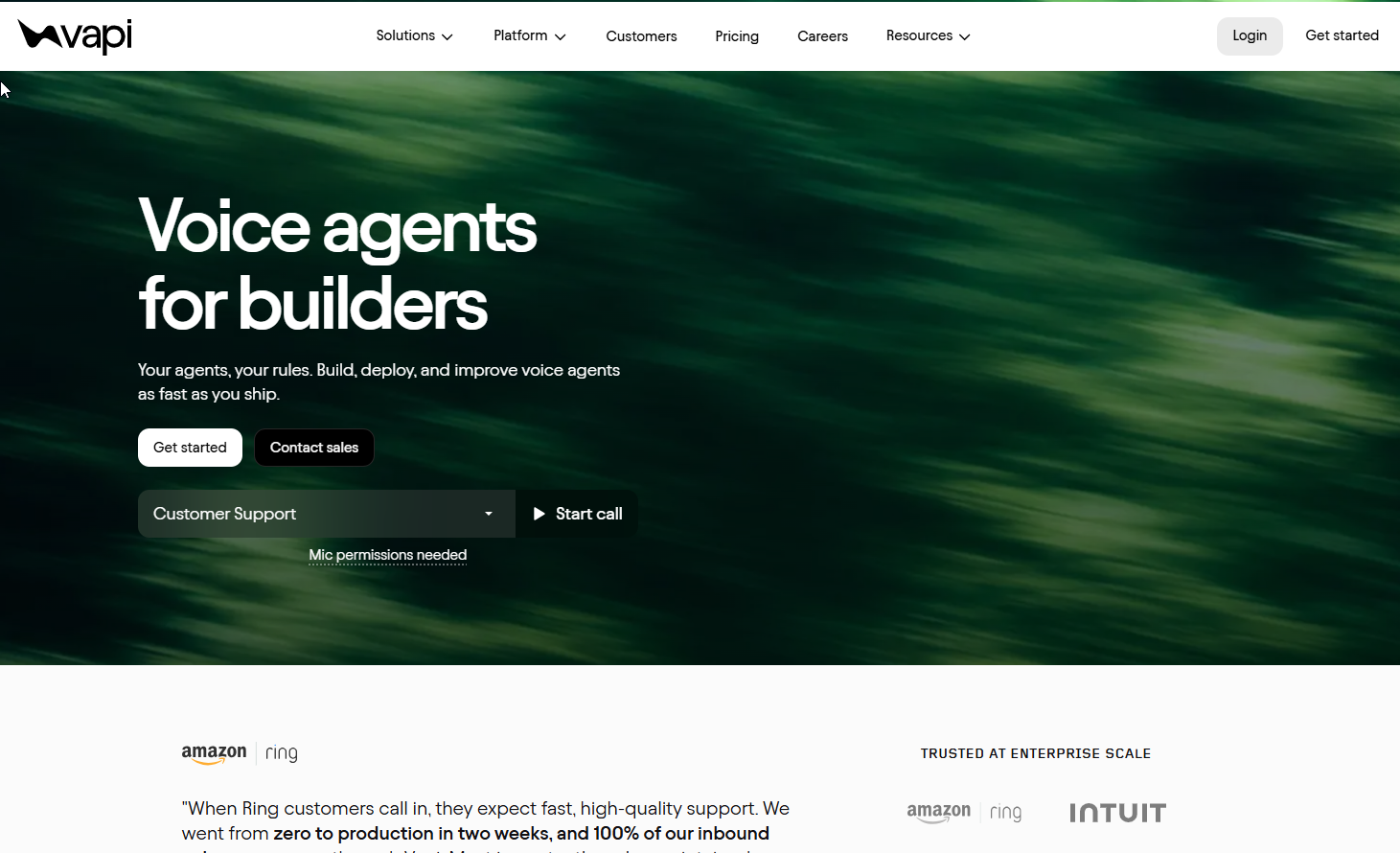
Vapi is best for a team with engineers that wants to build its own calling flow rather than configure a finished sales product. Entry costs are low and the ladder runs from a free start to a custom Premier tier.
What it does: Vapi is a developer platform for voice agents. You build the calling flow yourself and pay a hosting fee per minute.
Who it is for: Product or engineering teams inside a company that wants control over every part of the call. A sales team with no engineering help will have to build the flow before it can dial, and that is the main thing to weigh.
Vapi's pricing page shows an entry tier that starts at $0 with $0.05 per minute hosting prepaid, $5 in credits and 4 concurrent calls. Core is $29 per month with 10 concurrent calls. Pro is 10% of the hosting fee with a $999 monthly minimum and 30 concurrent calls. Premier is custom.
| Plan | Price | Billing Basis | What It Includes |
|---|---|---|---|
| Entry | $0 to start, $0.05 per minute hosting | Prepaid hosting | $5 in credits, 4 concurrent calls |
| Core | $29 per month | Monthly | 10 concurrent calls |
| Pro | 10% of the hosting fee, $999 monthly minimum | Percentage of hosting with a minimum | 30 concurrent calls |
| Premier | Custom | Contract | Set by agreement |
Strengths:
- A $0 start with $5 in credits lets an engineer build a prototype before anyone asks for budget.
- Core at $29 per month is a low first paid step for a team that has the engineers.
- The vendor states SOC2, HIPAA and PCI compliance on its cold calling page.
Trade-offs:
- It is a developer platform, so a sales team without engineering help will have to build the calling flow itself.
- The HIPAA add-on costs $2,000 per month on any plan, which is a large step for a team that needs it.
- Pro carries a $999 monthly minimum, so the jump from Core is steep.
Key capabilities:
- Voice agent hosting billed per minute
- Concurrency from 4 up to 30 calls before Premier
- Vendor-stated SOC2, HIPAA and PCI compliance
Good fit:
- A team with engineers who want to own the calling flow
- A team that wants to prototype cheaply before choosing a vendor
Not a fit:
- A sales team that wants a working outbound campaign without writing code
- A buyer who needs a fixed price for the whole stack
The limitation that matters most is that the pricing page carries no effective date, and hosting is only one part of what a built agent will cost.
5. Synthflow: Best For Enterprises Buying On An Annual Contract
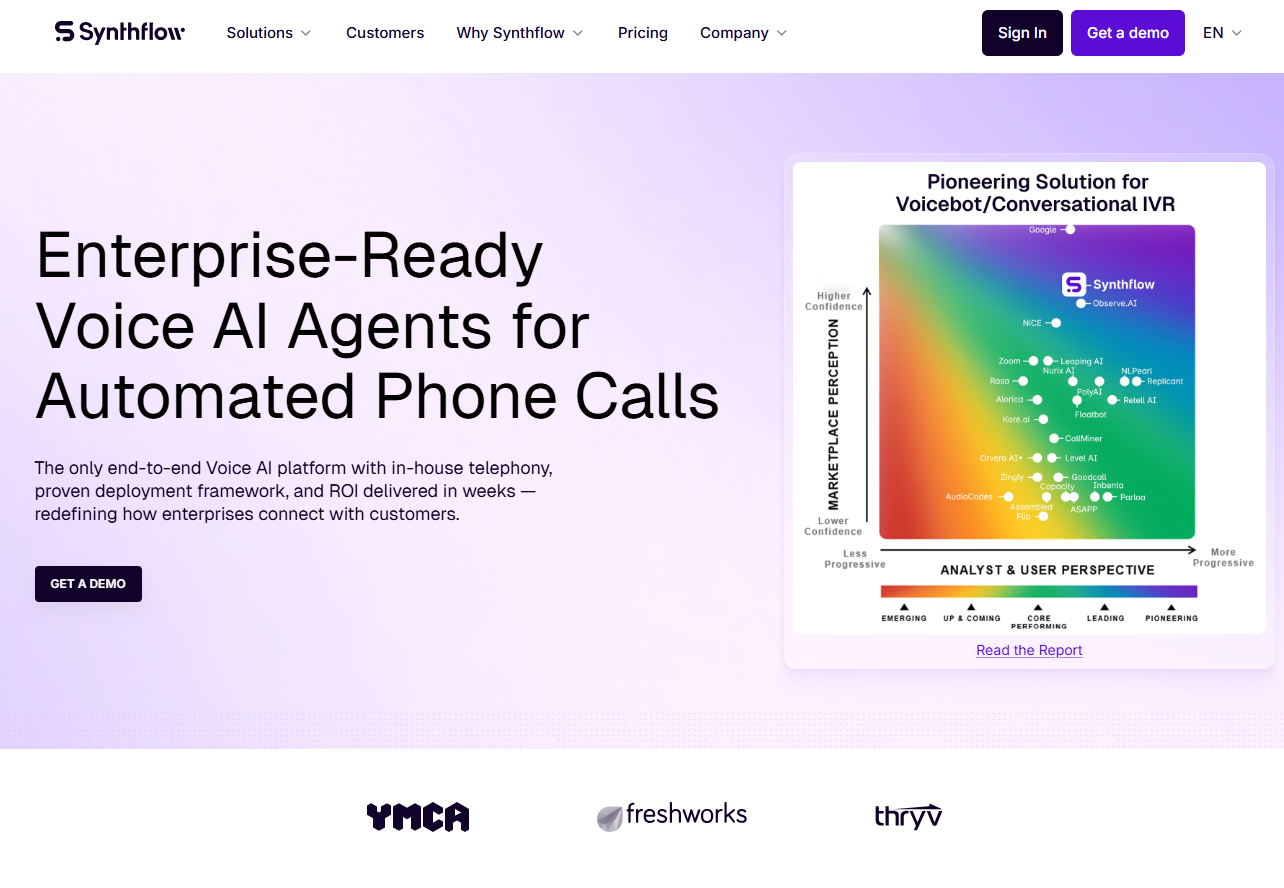
Synthflow is best for enterprises that want to buy on an annual contract with native telephony and integrations scoped for them. It is the only tool here you cannot price from a public page.
What it does: Synthflow sells voice agents under an annual enterprise agreement. Integrations and telephony are set per contract rather than picked from a plan list.
Who it is for: Buyers who run procurement through contracts and want one vendor to scope telephony, CRM and calendar connections together. If your process starts with a statement of work, this fits it.
Pricing on request. Synthflow's pricing page describes an annual enterprise agreement and offers no trial or free plan.
| Item | Detail |
|---|---|
| Pricing | Pricing on request |
| Contract | Annual enterprise agreement |
| Trial or free plan | None offered |
| Telephony | Synthflow Native Telephony, SIP trunking or approved enterprise telephony |
| Integrations | CRM, calendar, contact centre, webhook, API and knowledge-source integrations scoped per contract |
Strengths:
- Telephony options are named, including Synthflow Native Telephony and SIP trunking.
- Integrations are scoped to your stack in the contract, which suits an unusual CRM or contact centre setup.
- A single annual agreement keeps procurement simple for a buyer who prefers it.
Trade-offs:
- You cannot price a pilot in advance.
- There is no trial, so the first test happens after a commitment conversation.
- The integration list is scoped per contract, so you cannot check your CRM against a public list.
Key capabilities:
- CRM, calendar and contact centre integrations
- Webhook, API and knowledge-source connections
- Native telephony, SIP trunking or approved enterprise telephony
Good fit:
- A buyer who wants a contract and native telephony from one vendor
- An enterprise with contact centre systems that need custom scoping
Not a fit:
- Anyone who needs to price a pilot in advance
- A small team that wants to try the product before talking to sales
The limitation that matters most is that there is no public price and no trial.
📋 Get Listed / Advertise
We update this guide monthly. Want your tool featured? Contact: [email protected].
What AI Cold Calling Software Is, And What It Is Not
AI cold calling software places outbound sales calls with an automated voice agent. It qualifies the person who answers and books a meeting or hands the call to a human.
That definition draws a line this article holds. Three things sit next to it and are not it.
- Inbound AI receptionists: They answer incoming calls and never start one.
- Plain dialers: They place calls without an AI agent on the line.
- Rep-training simulators: They let reps practise and make no real calls.
A call runs in four steps. A list is loaded, the agent dials, it qualifies whoever picks up, and it books a meeting or passes the call to a human. Every step after the list is where the five tools differ.
If you want coverage beyond voice, start with our guides to AI SDR agents and AI sales agents compared. Rep-assist tools sit next to outbound calling rather than inside it, and AI sales assistants covers them.
If you sell one of these tools, our generative engine optimization and answer engine optimization work is built for comparison pages like this one.
How To Choose: A Decision Rule By Call Volume, Compliance And CRM Fit
Sort in this order. Volume decides whether a plan can place your calls at all, consent decides whether you may place them, and CRM decides how much work the results create.
- Volume first. Divide your daily dials by the cap the vendor publishes. Bland AI's pricing page caps Start at 100 calls a day and Build at 2,000, so a result above 1 on Start points you to Build or Enterprise. Retell AI and Vapi publish concurrency instead of daily caps, so check how many calls you need in flight at peak.
- Consent second. Ask whether the tool can honour calling windows, DNC lists and consent records. Autocalls.ai describes all three, and Retell AI says compliance features come in every plan. Both are the vendor's own description, so test them in a pilot.
- CRM third. Check your CRM against the vendor's published list. Autocalls.ai names HubSpot, GoHighLevel, Zoho CRM, Salesforce, Pipedrive, Cal.com, Zapier and Make. For Retell AI, Bland AI and Vapi, read the vendor's integration page before you commit. Synthflow scopes integrations per contract.
Worked example: Say your team plans 350 dials a day.
- Daily dials: 350
- Bland AI Start cap: 100 calls a day, so 350 divided by 100 is 3.5, which means Start cannot place the list
- Bland AI Build cap: 2,000 calls a day, so 350 divided by 2,000 is 0.175, which means Build covers it with room to grow
Volume alone points to Build. If your CRM is Pipedrive and you want a fixed monthly bill, Autocalls.ai moves up the list, and you would check its parallel call limits instead.
Where does the call list come from? That is a separate problem, and our guides to AI tools for outbound prospecting and AI prospecting software cover it. To rank which numbers to call first, see AI lead scoring tools.
A human SDR should stay in the loop for every call that goes off script. Retell AI describes a human-in-the-loop fallback as a platform feature, and the same principle applies to any tool you pick. Decide in advance which outcomes hand over to a person.
If you sell one of these tools and want the search and AI-visibility side handled by people who have done it for SaaS companies, the GEO + SEO Growth Programme is the place to start. It sets out what we would fix first and how we report it.
US And UK Consent Rules That Change Which Tool You Pick
Two points are settled and one is contested. The US ruling and the UK live-call rule are settled. How the UK treats AI calls under PECR is contested.
In the US, the FCC ruled on 8 February 2024 that TCPA rules cover AI-generated voices. Outbound AI calls therefore generally need prior express consent, written in some cases, along with identification and an opt-out.
In the UK, live marketing calls generally need no consent under PECR. They must not go to TPS or CTPS registered numbers unless the subscriber specifically agreed. Numbers bought from lists still need checking, and a TPS registration can take up to 28 days to take effect, so a third party's check counts only if it is recent.
Consent used to override a TPS registration must be specific, clear, positive, recorded so it can be proved, and withdrawable. The ICO page is dated 10 September 2025 and is flagged as under review.
The contested point is whether an AI call is a live call at all. A 4 June 2026 DMA article argues that AI-driven calls should be treated like automated calls under PECR Regulation 19, which requires prior consent and disclosure. It also notes that PECR has no specific AI reference. We do not pick a side here.
What you can do is turn the tension into tool requirements. Whichever reading wins, you need these.
- Calling windows: The tool must stop dialing outside permitted hours.
- DNC lists: The tool must hold and check a do-not-call list before each dial.
- Consent records: You must be able to prove who agreed, when and how.
- Opt-out: The call must offer a way to stop, and the tool must honour it.
Autocalls.ai describes TCPA calling windows, DNC list management, GDPR consent and a full audit trail on its cold calling page. That is the vendor's own description. For the other four, ask the vendor which of the four requirements the tool handles and which stay your job.
This is not legal advice, so take your plan to counsel before you dial.
What AI Cold Calling Costs: Per-Minute Versus Subscription Pricing
AI cold calling is billed per minute, by subscription with included minutes, or by annual contract. Retell AI's pricing page shows per-minute billing at $0.07 to $0.31. Bland AI's pricing page charges $0.14 or $0.12 per minute depending on plan. Vapi's pricing page charges $0.05 per minute for hosting on its entry tier. Autocalls.ai's pricing page sells monthly plans with included minutes and an overage rate. Synthflow's pricing page describes an annual enterprise agreement.
Some extras move the bill. Bland AI bills telephony separately at pass-through cost. Retell AI charges $8 per concurrent call per month beyond the 20 free. Vapi adds $2,000 per month for HIPAA on any plan.
Work it out with your own minutes. The assumption here is 2,000 talk minutes a month, and replace it with yours.
- Retell AI: At the rates on Retell AI's pricing page, 2,000 minutes at $0.07 is $140 and at $0.31 is $620.
- Bland AI Build: At the rates on Bland AI's pricing page, the $299 platform fee plus 2,000 minutes at $0.12 ($240) is $539 a month, before telephony.
- Autocalls.ai Pro: At the rates on Autocalls.ai's pricing page, 700 minutes are included, and 1,300 extra minutes at $0.16 is $208, which gives $311 on the lower plan figure of $103 and $337 on the higher figure of $129.
- Vapi: At the rate on Vapi's pricing page, 2,000 minutes at $0.05 is $100 in hosting fees on the entry tier.
The totals are not like for like. Each leaves out something, whether telephony, models or the unlabelled price choice, so use them to rank options and then ask each vendor for a full quote.
How To Run A Two-Week Pilot Before You Commit
Run one small, controlled test before you sign anything. Set the pass or fail measure before the first call, such as meetings booked per hundred connects, complaints and opt-outs.
- Pick one list segment of a few hundred numbers that all belong to the same buyer type, and exclude any number you cannot show consent or a clean TPS or DNC check for.
- Write one script and keep it unchanged for the full two weeks, so any change in results comes from the tool and not from the copy.
- Cap the calls at a fixed number per day, for example 100, and stop for the day when you hit it.
- Review every transcript within 24 hours, and have a person listen to at least 10 calls a week, paying attention to objections and voicemails.
- Log consent before every dial and count complaints and opt-outs daily, then compare meetings booked per hundred connects against the target you set on day one.
Objections, voicemail handling and follow-ups differ by tool, and the vendor pages do not settle them, so the pilot is where you find out. Pass the qualified leads into a proper follow-up process, and our guide to AI lead qualification tools covers that step. For the wider stack around the pilot team, see AI sales tools by sales stage.
FAQs
Is AI Cold Calling Legal?
Is AI Cold Calling The Same As A Robocall?
What Is The Difference Between AI Cold Calling And Traditional Cold Calling?
Which CRMs Do AI Cold Calling Tools Integrate With?
How Many Cold Calls Can An AI Make Per Day?
Can The AI Handle Objections?
Can The AI Leave Voicemail Messages?
Can I White-Label AI Cold Calling For My Agency?
Does AI Handle Follow-Ups And Lead Qualification After The Call?
If you would like a second opinion on your shortlist or on how your own product shows up when buyers search, book a thirty-minute call. One of the founders takes it, and you leave knowing what we would do first.