

The best manufacturing marketing agency is the one whose writers an engineer on your team would accept after review, not the one with the longest client list. For most manufacturers, that means a specialist in technical content and search, paid on a retainer. We publish this guide, list The Rank Masters first, and score every agency on the same tests.
That holds when engineers and technical buyers research suppliers by process, material and application before they send an RFQ, which is true even where a distributor ships the product.
The pricing model matters as much as the specialism, so a strong specialist on the wrong contract still disappoints, and no agency listed here can promise rankings, leads or RFQs.
If you want to see what engineer-reviewed capability and application pages look like for your own products, start with TRM's Revenue Content service. It is the work this guide asks you to test every agency on.
📋 Get Listed / Advertise
We update this guide monthly. Want your tool featured? Contact: [email protected].
Manufacturing Marketing Agencies At A Glance
The Rank Masters publishes this guide and is listed first, as a manufacturing SEO agency that sells one monthly programme. Every entry below is judged on the same criteria, and the table runs in the same order as the profiles that follow it.
| Agency | Best For | Core Services | Who It Suits | Pricing Model |
|---|---|---|---|---|
| The Rank Masters | Engineer-reviewed SEO and AI-search visibility | Capability and application pages, earned mentions, technical fixes, AI visibility tracking | Manufacturers that win RFQs from engineers researching by process and material | Monthly programme, published on its own pricing page |
| Furiosity Marketing | Websites and content from one team | Websites and technology, digital marketing, content marketing | Manufacturers with complex products and long sales cycles | Pricing on request |
| New Perspective | HubSpot-led demand generation and ABM | HubSpot CRM, industrial web design, SEO and AEO, demand generation, paid search and social | Manufacturers that want one partner across CRM, web and demand | Pricing on request |
| Gravitate Design | A website rebuild alongside RFQ marketing | Manufacturing website design, RFQ-focused marketing, AI-driven search visibility | Manufacturers rebuilding a site for technical buyers | Pricing on request |
| Digital Elevator | AI discoverability and bottom-funnel content | Bottom-funnel content, AI discoverability | Manufacturers that want content aimed at buyers close to an RFQ | Pricing on request |
| Elevation B2B | A dedicated industrial practice | Services menu for manufacturing and industrial clients | Manufacturers that want an agency with an industrial practice | Pricing on request |
1. The Rank Masters: Best For Engineer-Reviewed SEO And AI-Search Visibility In One Programme
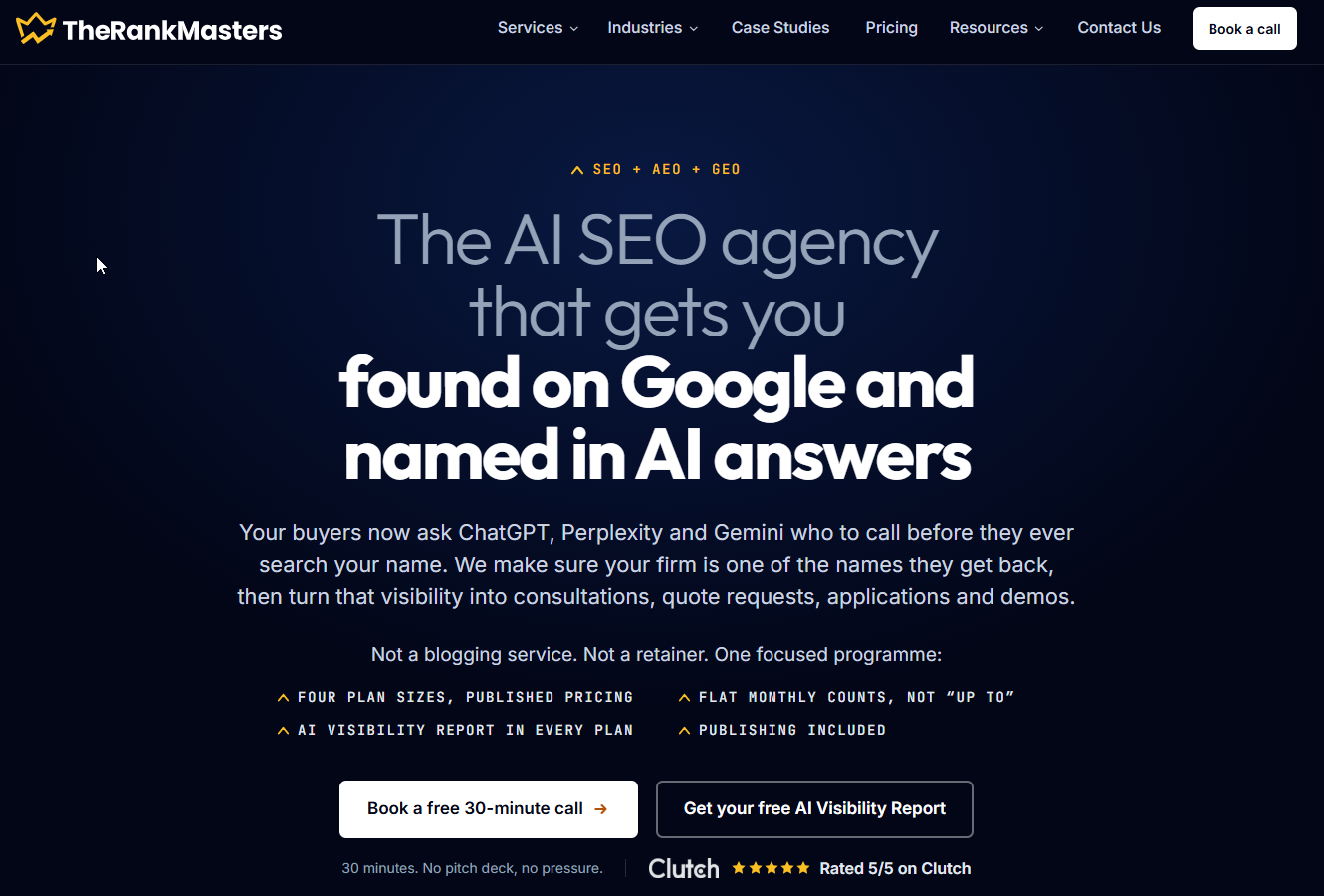
The Rank Masters is the agency that publishes this guide, and it is listed first for that reason, not because the other five were found lacking. TRM sells one monthly programme that combines SEO, AI-search visibility and technical fixes for manufacturers, and a founder leads the work.
For manufacturers, the programme builds capability pages by process, material and industry, application pages, spec and design guides, certification pages and quote-ready layouts, as TRM's manufacturing page sets out. The pages are written from engineers' input and spec sheets, and engineers review them. TRM publishes nothing restricted, and its team approves every page.
| Plan | Price | Billing Basis | What It Includes |
|---|---|---|---|
| Growth | Published on its own pricing page | Monthly, six-month minimum then month to month | The programme for a manufacturer's core processes and industries |
| Scale | Published on its own pricing page | Monthly, six-month minimum then month to month | The programme for many processes or industries |
Prices sit on TRM's published pricing page. There are no setup fees, a catalogue pages add-on covers large ranges, and an implementation add-on covers manufacturers with no developers. TRM guarantees no rankings, traffic, enquiries or AI citations.
Strengths:
- Engineer review is a process: Input comes from engineers and spec sheets, engineers review the pages, and the team approves each one.
- One programme covers the work: Content, earned mentions in industrial directories, trade publications and supplier lists, and technical fixes all sit in the same monthly scope.
- AI visibility is tracked: TRM tracks AI visibility monthly against three competitors and reports it on a live dashboard.
Trade-offs:
- A six-month minimum: The contract runs six months before it moves to month to month, which is a commitment if you want a short trial.
- No manufacturing case studies: TRM's published case studies are in B2B SaaS, not manufacturing, so you are judging the method rather than a sector track record.
- Narrow scope: TRM does not include paid advertising, social media management, website redesign or development, or review management.
Key capabilities:
- Capability pages by process, material and industry
- Application pages, spec and design guides and certification pages
- Quote-ready page layouts
- Earned mentions and technical fixes
- Monthly AI visibility tracking and a live dashboard
Good fit:
- Manufacturers whose RFQs start with an engineer researching a process or material
- Teams that want search and AI-answer visibility run as one programme
- Companies with many processes or industries to cover, which is what the Scale plan is for
Not a fit:
- Manufacturers that want a website rebuilt or paid media managed
- Teams that want a short trial rather than a six-month term
- Buyers who need manufacturing case studies before they talk to anyone
The limitation that matters most is scope. TRM does not touch paid media or your website build.
2. Furiosity Marketing: Best For Websites And Content From One Team
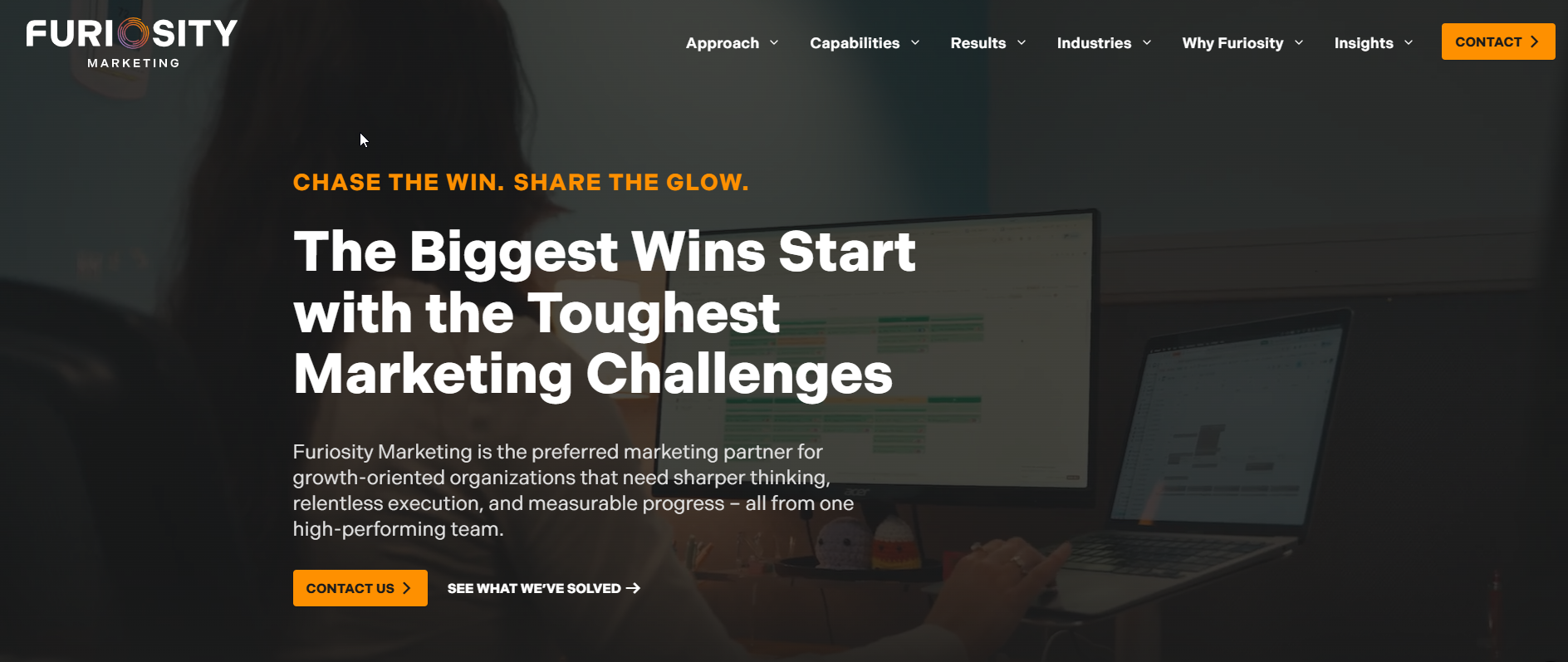
Furiosity Marketing is a full-service agency for manufacturers that want their website, digital marketing and content handled by one team. Furiosity's manufacturing page lists capabilities across websites and technology, digital marketing and content marketing, and says it works to explain technical products clearly, reach highly specific buyers and support long and complicated sales cycles.
That makes it a fit for a manufacturer with a complex product and a sales cycle measured in months, where the site and the content need to be built together. The page does not publish proof points for how Furiosity handles engineer review, so that is the question to ask before anything else.
| Plan | Price | Billing Basis | What It Includes |
|---|---|---|---|
| Custom engagement | Pricing on request | Not stated | Scope agreed with the agency |
Strengths:
- One team across the build: Website, digital marketing and content sit under one roof, which cuts hand-offs.
- Stated focus on technical products: The page names explaining technical products clearly as an aim.
- Long sales cycles are named: The agency says it supports long and complicated cycles.
Trade-offs:
- No published engineer-review process: The page does not show who supplies technical input or who checks the pages.
- Breadth to test: A team that covers sites, marketing and content needs testing on how deep its search work goes.
- Pricing not published on the page we read: You cannot compare cost until you ask for a proposal.
Key capabilities:
- Websites and technology
- Digital marketing
- Content marketing
- Messaging for technical products and specific buyer groups
Good fit:
- Manufacturers that need a new site and content together
- Manufacturers with complex technical products who want explanation of those products built into the site and content
- Companies with long, complicated sales cycles
Not a fit:
- Manufacturers that only want search and AI-visibility work
- Buyers who need published pricing before a first call
The limitation that matters most is evidence. The page describes the service but publishes no proof of how technical content gets written and checked, so ask for a sample page and the name of the reviewer.
3. New Perspective: Best For HubSpot-Led Demand Generation And ABM
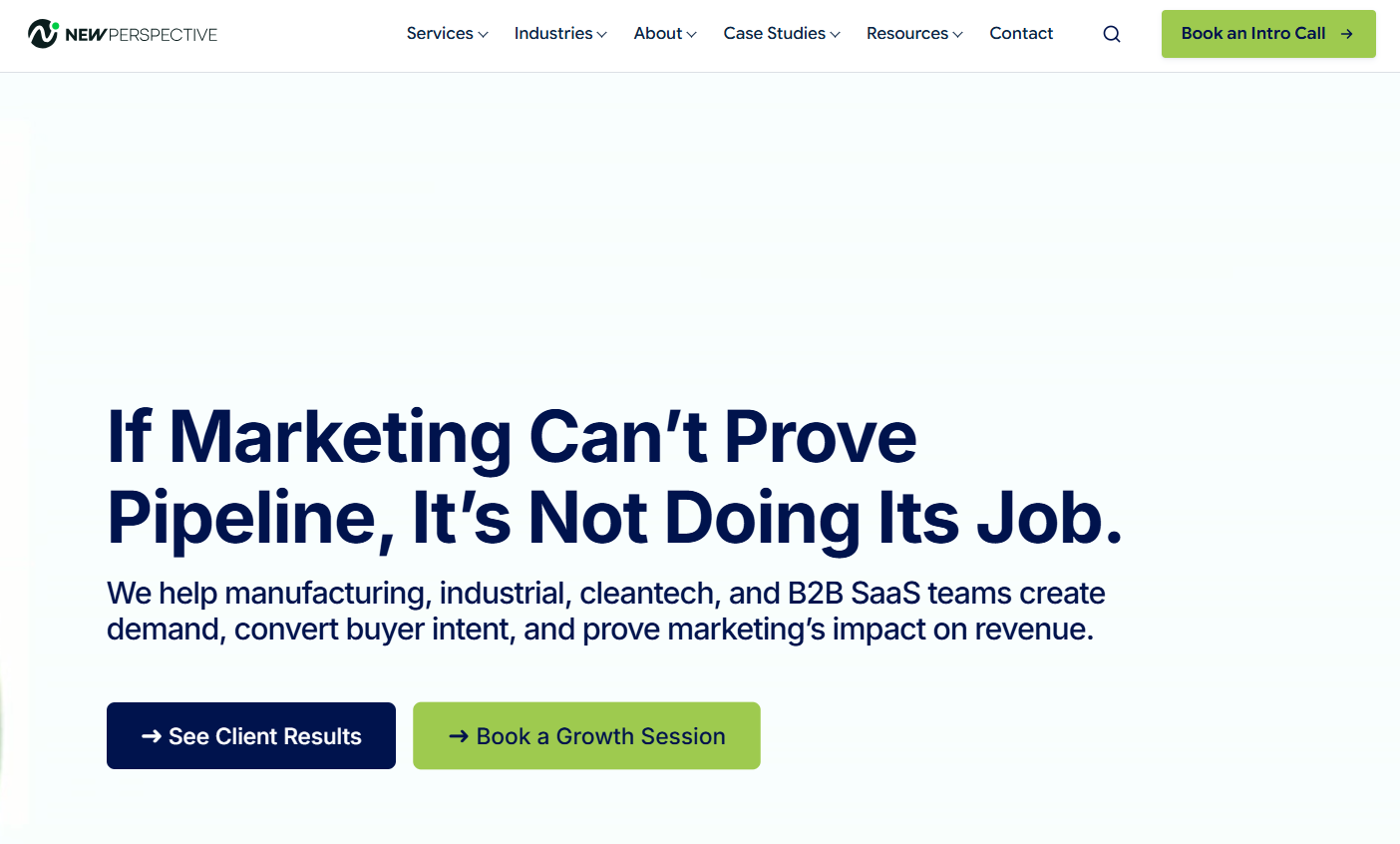
New Perspective is a marketing agency for manufacturers that want HubSpot, web design and demand generation from one partner. New Perspective's page lists HubSpot CRM for manufacturers, industrial web design, manufacturing SEO and AEO, demand generation and ABM, and paid search and social. It also says the agency has over 20 years of experience, which is the agency's own claim.
The shape suits a manufacturer that sells to a named list of accounts and wants the CRM, the website and the campaigns wired together. If your sales team already lives in HubSpot, that is a real advantage.
| Plan | Price | Billing Basis | What It Includes |
|---|---|---|---|
| Custom engagement | Pricing on request | Not stated | Scope agreed with the agency |
Strengths:
- HubSpot is central: The agency lists HubSpot CRM for manufacturers as a core service.
- Demand generation and ABM: Named-account selling is on the menu, not an afterthought.
- Long track record, by its own account: The agency claims over 20 years of experience.
Trade-offs:
- Breadth across many services: Web, CRM, SEO, paid and ABM under one roof means you must test the SEO and technical-writing depth separately.
- A self-reported track record: The 20-year figure is the agency's claim, so ask what it means for manufacturers specifically.
- Pricing not published on the page we read: Cost arrives only with a proposal.
Key capabilities:
- HubSpot CRM for manufacturers
- Industrial web design
- Manufacturing SEO and AEO
- Demand generation and ABM
- Paid search and social
Good fit:
- Manufacturers selling to named accounts
- Sales teams that already use HubSpot
- Companies that want paid and organic channels run together
Not a fit:
- Manufacturers that want a focused technical-content specialist
- Teams that do not use or plan to use HubSpot
The limitation that matters most is focus. Spread across this many services, an agency can be strong in demand generation and still thin on the engineer-grade writing your capability pages need.
4. Gravitate Design: Best For A Website Rebuild Alongside RFQ Marketing
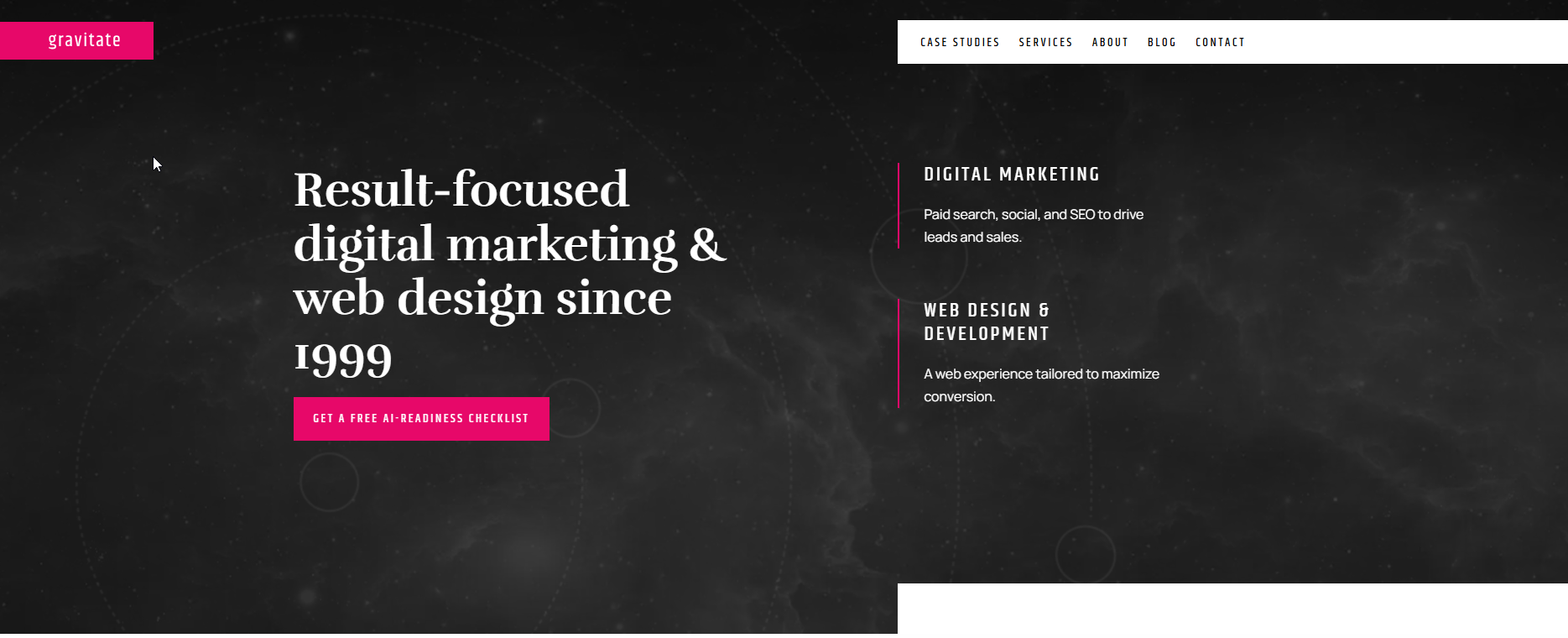
Gravitate Design is a design and marketing agency for manufacturers that need a new website built around technical buyers and RFQ volume. Gravitate's manufacturing page covers technical buyers, RFQ volume over lead volume, visibility in AI-driven manufacturing search, manufacturing website design and sector coverage.
Putting RFQs ahead of raw lead count is the right instinct, and it fits a manufacturer whose current site cannot take a quote request cleanly. The page states statistics without sources, so read its claims as the agency's own and ask for the method behind each one.
| Plan | Price | Billing Basis | What It Includes |
|---|---|---|---|
| Custom engagement | Pricing on request | Not stated | Scope agreed with the agency |
Strengths:
- RFQs over leads: The page frames the goal as RFQ volume, which is closer to how manufacturers measure sales.
- Website design for manufacturers: The build is part of the offer, not a separate vendor.
- AI search is on the page: Visibility in AI-driven manufacturing search is named as a service area.
Trade-offs:
- Unsourced statistics: Figures on the page carry no sources, so ask where each number comes from.
- Design-led: A strength in a rebuild, but it means you should test the technical content separately.
- Pricing not published on the page we read: You learn cost only after a conversation.
Key capabilities:
- Manufacturing website design
- RFQ-focused marketing
- Visibility in AI-driven manufacturing search
- Coverage across manufacturing sectors
Good fit:
- Manufacturers with a dated or hard-to-use website
- Teams that measure marketing by RFQs rather than form fills
- Companies that want design and marketing from one agency
Not a fit:
- Manufacturers that are happy with their site and only want content
- Buyers who want a programme proven by sourced numbers
The limitation that matters most is the evidence behind the claims. Ask for the method behind any figure the agency quotes before you let it shape your decision.
5. Digital Elevator: Best For AI Discoverability And Bottom-Funnel Content
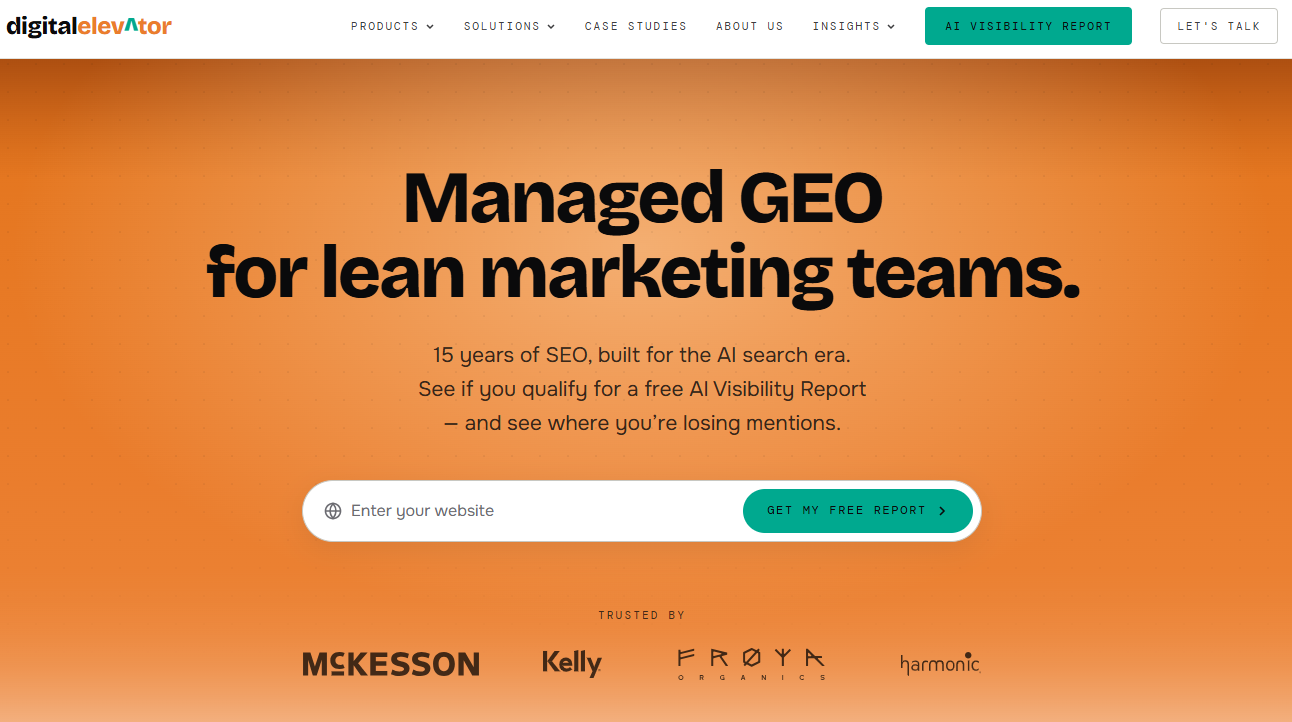
Digital Elevator is an agency that, in its own 2026 list, labels itself best for AI discoverability and bottom-funnel content. That label is the agency's own, and it is the only source this guide could read on Digital Elevator.
Bottom-funnel content is the right place to aim. A manufacturer's best pages are the ones an engineer reads just before sending an RFQ, which means application pages, spec guides and comparison pages. AI discoverability is the agency's own stated specialism, so ask what it means in practice.
| Plan | Price | Billing Basis | What It Includes |
|---|---|---|---|
| Custom engagement | Pricing on request | Not stated | Scope agreed with the agency |
Strengths:
- Aimed at buyers near an RFQ: Bottom-funnel content targets the pages that convert, which is where a manufacturer's marketing budget is easiest to justify.
- AI discoverability is named: The agency puts AI-answer visibility in its own positioning.
Trade-offs:
- The label is self-assigned: It comes from the agency's own list, so ask for samples of bottom-funnel manufacturing pages and who reviewed them.
- Thin public detail: There is little to check beyond its own list, so you have no service menu, sample pages or named reviewer to judge before a first call.
- No engineer-review process shown: Nothing we could read says who supplies technical input or who checks the pages for accuracy.
- Pricing not published on the page we read: Cost is available only on request.
Key capabilities:
- Bottom-funnel content for buyers close to an RFQ
- AI discoverability work, so assistants can find and quote your pages
- A specialism label you can test against samples
Good fit:
- Manufacturers with traffic but weak conversion on technical pages
- Teams that want content aimed at the last stage before an RFQ
Not a fit:
- Manufacturers that need a website rebuilt
- Buyers who want independent proof before a first call
The limitation that matters most is verification. Everything this guide can say about Digital Elevator comes from the agency itself, so the engineer test below matters more here than anywhere else.
6. Elevation B2B: Best For A Dedicated Industrial Practice
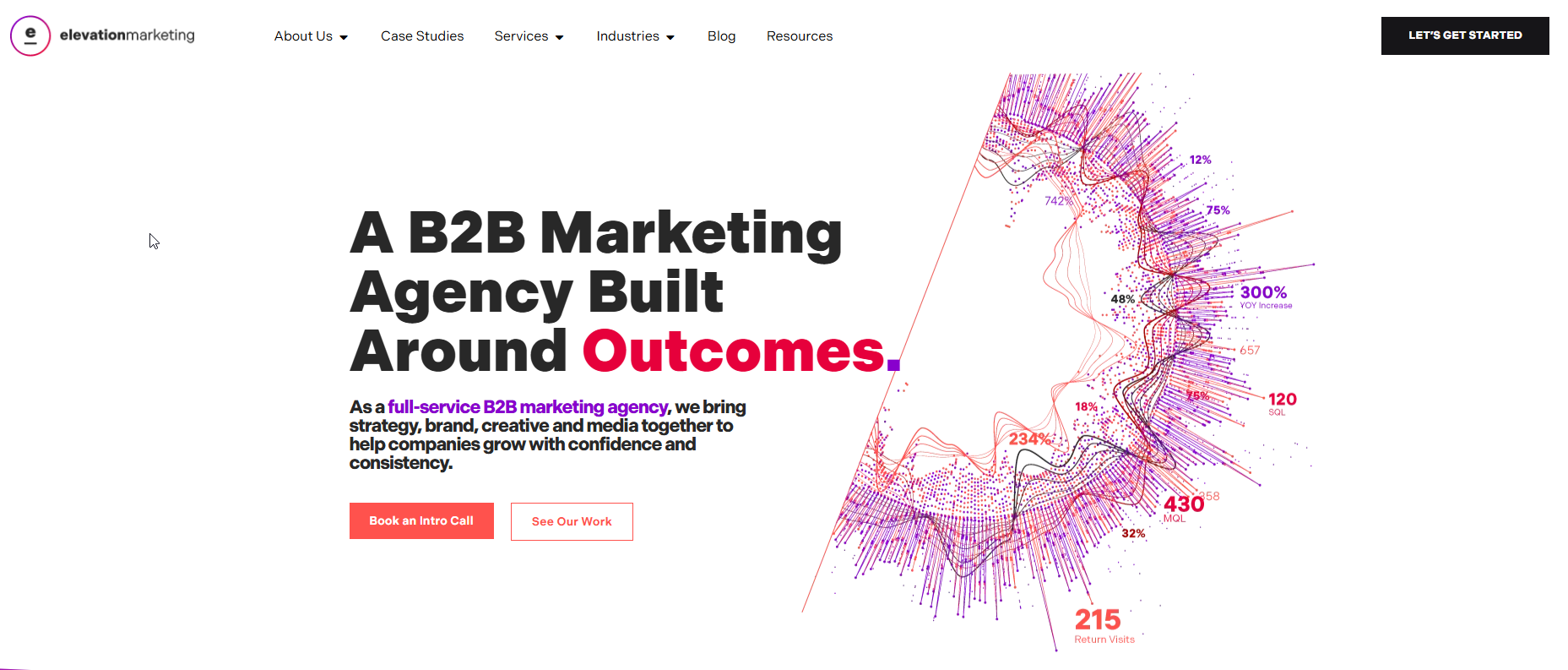
Elevation B2B is a B2B agency that runs a dedicated manufacturing and industrial practice. Elevation B2B's manufacturing page lists a services menu, who it works with, examples of its work and an FAQ, with results claims the page does not support in detail.
A page built for industrial buyers is a good sign, since many agencies bolt one industry page onto a generic site. It suits a manufacturer that wants an agency that talks about industrial clients as a core business, not a side line.
| Plan | Price | Billing Basis | What It Includes |
|---|---|---|---|
| Custom engagement | Pricing on request | Not stated | Scope agreed with the agency |
Strengths:
- A dedicated industrial page: Manufacturing and industrial work has its own practice area.
- Examples of work are listed: You can ask to walk through them and ask what part the agency played in each.
- A services menu: The page sets out what the agency does, so you can compare it line by line with the other agencies here.
Trade-offs:
- Results claims without detail: The page does not support its results claims, so ask what was measured and over what period.
- No engineer-review process shown: The page does not say who checks technical accuracy.
- Pricing not published on the page we read: Cost comes only through a proposal.
Key capabilities:
- A services menu for manufacturing and industrial clients
- Examples of work in the sector
- An industrial-focused FAQ that shows how the agency answers buyer questions
Good fit:
- Manufacturers that want an agency with an industrial practice
- Teams that will do the work of asking for detail behind the claims
Not a fit:
- Buyers who want sourced proof on the page
- Manufacturers that need a website built from scratch
The limitation that matters most is unsupported results. Ask which clients, which metrics and which dates sit behind any claim before you sign.
📋 Get Listed / Advertise
We update this guide monthly. Want your tool featured? Contact: [email protected].
How We Chose And Judged These Agencies
The Rank Masters publishes this guide and is listed first. Every agency is held to the same criteria, and the five others were chosen because the research could read a manufacturing page for each, not because any ranking put them there.
The criteria come from published scoring sheets. Martal's scoring sheet weights technical fluency, domain proof, right-fit capability, measurement, staffing and sales alignment, and asks whether an agency's writers can interpret specs and speak to engineers. This guide uses those six areas.
- Technical fluency and engineer review: Can the writers handle a spec sheet, and does an engineer check the result?
- Manufacturing proof: Does the agency show work for manufacturers, not just B2B in general?
- Right-fit capability: Does the service mix match how your RFQs are won?
- Measurement: Does reporting reach qualified RFQs and orders, not just traffic?
- Staffing: Who does the work, and who is on your account?
- Sales alignment: Does the agency work from how your sales team qualifies and closes?
Other lists weight things differently. SeedX weights agency selection with revenue visibility at 25 percent, manufacturing buyer expertise at 20, technical content at 15, sales alignment at 15, full-funnel at 10, website and RFQ conversion at 10 and proof at 5. DesignRush ranks agencies on client reviews, portfolio results, awards, team background, services and manufacturing expertise, and sells sponsored placement above organic results.
Discount any ranked list that puts its own publisher first without saying so, and any list with sponsored tiers. Several vendor-published lists in the results place their own publisher first without disclosing the conflict, the SeedX list among them. We have disclosed ours three times.
The same method runs through our other comparisons. See the MSP marketing company comparison and the B2B SaaS marketing agency comparison for the same approach applied to other segments.
The Engineer Test: Can This Agency Write What Your Buyers Would Accept?
An agency passes the engineer test if an engineer on your team would accept its page after review. Run these five steps in a first call with any agency, this guide's publisher included.
- Ask for a capability page and an application page. Ask for ones written for a process similar to yours. A good answer is two real pages, with the process, tolerances or materials stated plainly. A weak answer is a deck of logos.
- Ask who supplied the technical input and who reviewed it. A good answer names a role, such as an engineer on your side or a technical editor on theirs, and describes the hand-off. A weak answer is "our writers research it".
- Ask to see a spec-style piece before and after review. A good answer includes the edits the reviewer made. If the agency cannot show any, nobody has reviewed anything.
- Ask what the agency does not do well. Martal's scoring sheet asks whether an agency's writers can interpret specs and speak to engineers, and an agency that cannot name a weakness has not thought about its own work.
- Ask what its reporting measures. A good answer reaches qualified RFQs and orders traced to pages. A weak answer stops at cost per lead.
The generalist failure mode is easy to spot. If a pitch sounds the same as one for a retail brand, it is one. Directive's analysis of generalist failures, written by an agency itself, finds that generalists apply consumer tactics and category-level ads to manufacturers, miss application-level intent and report on cost per lead rather than margin or distributor conflict.
TRM's own answer to the test is one example, not the standard. The Rank Masters writes manufacturing pages from engineers' input and spec sheets, engineers review them, and the team approves every page. Ask every agency on your list for the equivalent.
What A Manufacturing Marketing Agency Actually Does
A manufacturing marketing agency is an outside team that handles six areas for a manufacturer. Those are strategy, website, search and AI-search content, paid media, account-based marketing, and CRM and reporting. Few agencies cover all six, so the useful question is which ones this agency sells.
- Strategy: Which products, processes and buyer groups to target first, and which pages the programme builds.
- Website: The structure, speed and quote-request path of the site. Gravitate Design and Furiosity Marketing sell this.
- Search and AI-search content: Capability, application and spec pages that engineers and AI assistants can find and quote. The Rank Masters and New Perspective sell this, and Digital Elevator positions itself here.
- Paid media: Search and social advertising. New Perspective sells it, and The Rank Masters does not.
- Account-based marketing: Campaigns aimed at a named list of target accounts. New Perspective lists it.
- CRM and reporting: The system that connects a page visit to a quote request and an order. New Perspective lists HubSpot CRM for manufacturers.
Search and AI-search work also has a technical layer. Pages have to be indexed, structured and open to AI crawlers, which is what technical SEO and AI readiness covers. A great capability page that nobody can crawl does no work.
Buyers in manufacturing include engineers and executives weighing technical, financial and operational criteria. Traffic alone is not enough, and the work has to feed a qualified pipeline.
Specialist Or Generalist: Which Agency Type Fits A Manufacturer?
If your RFQs come from engineers researching by process and material, choose a specialist in technical content and search. If your sales are a short-horizon website rebuild or a named-account sale, choose a website-led, full-service or ABM agency instead.
That is a rule, not a preference. Pick the agency type from how your buyers find you.
| Agency Type | Fits When | Fails When |
|---|---|---|
| Technical content and search specialist | Engineers research suppliers by process, material and application | You need a site rebuilt or paid media run |
| Website-led agency | Your site is the bottleneck and you have a short horizon | Your content is the bottleneck, not the build |
| Full-service agency | You want one partner and can test each service's depth | You need deep specialism in one channel |
| ABM and demand agency | You sell to a named list of accounts | Buyers find you by searching, not by outreach |
| Generalist agency | The product is simple and the buyer is not technical | Engineers need to accept the content |
A generalist can still win when the product is simple and the buyer is not an engineer. For instance, a commodity part sold on price. It stops winning the moment an engineer has to accept the page.
A specialist is not always the better choice. A specialist in technical content is the wrong hire if your real problem is a site that cannot take a quote request.
Weighing a content specialist against a generalist? Our guide to B2B content marketing agencies covers the specialist side. For the wider picture, read how agency models are changing, since the commoditised models are the ones a generalist offers.
Which Pricing Model Fits How Your RFQs Are Won?
The pricing model should match how long your RFQs take to win. A manufacturer with long, multi-stakeholder cycles and compounding search work fits a retainer. A defined rebuild fits a project fee.
MarketerHire describes five agency pricing models, which are hourly, monthly retainer, project, performance and value-based, with a fit for each. Here is how each maps to a manufacturer.
| Model | How It Is Charged | Fits | Fails For A Manufacturer When |
|---|---|---|---|
| Monthly retainer | A fixed fee each month | Ongoing programmes of six months or more, such as search and content | You want a short, defined job |
| Project | One fee for a defined piece of work | A website rebuild or a one-off page set | The work compounds and needs ongoing upkeep |
| Hourly | Time worked | Testing an agency for one to three months | Cost control matters over a long programme |
| Performance | A share of a measured result | Direct-response channels with clean attribution | Sales cycles are long or the channel is organic search |
| Value-based | A fee tied to the value delivered | Mature partnerships of 12 months or more with closed-loop attribution | You have no way to trace orders back to pages |
On performance fees specifically, MarketerHire puts them at 10 to 20 percent of monthly ad spend, and describes them as a fit for direct-response channels and a poor fit for SEO or long sales cycles. That is an agency marketplace's own figure, so use it as a rough guide and ask any agency for its actual terms.
Dollar ranges for manufacturing agencies are not in this guide. The ranges that exist online are old or unsourced, and the pricing pages for the other five agencies were not available to this guide, so their pricing is listed as on request. What you can do is work out what you are getting.
Use this calculation with your own figures.
- Total fees: Add every fee paid to the agency over a six-month window.
- Qualified RFQs attributed: Count the RFQs in the same window that your sales team accepted as real and that trace to pages the agency built.
- Cost per qualified RFQ: Divide total fees by qualified RFQs attributed.
Run it again at month twelve. Search work compounds, so the second number should be better than the first, and if it is not, ask why.
The Rank Masters sells a monthly programme with a six-month minimum and then month to month. That is one option, and the plans and prices are on its pricing page. Larger manufacturers with many product lines should also read our guide to enterprise content marketing agencies, where scale and governance change the contract.
If you want SEO, AI visibility and technical fixes run as one monthly programme, the GEO + SEO Growth Programme covers all three, led by a founder rather than an account manager. Read what it includes before you speak to anyone.
Three Objections Manufacturers Raise Before Hiring An Agency
"We Sell Through Distributors"
Engineers still research suppliers directly, even when a distributor ships the product. SeedX reports that 65 percent of industrial buyers order products online. SeedX gives no primary source for the figure, so read it as a sign of where buying is heading, not a measurement. An agency can also help you outrank distributors for your own products, so the buyer reaches you first.
"Our Work Is Too Technical For An Agency"
An agency should not be guessing at your technical detail. The Rank Masters writes manufacturing pages from engineers' input and spec sheets, and engineers review them. If an agency cannot describe that loop, it has not solved the problem. Use the engineer test above to find out.
"Our Work Is Confidential"
Nothing restricted should be published, and someone on your side should approve every page. The Rank Masters publishes nothing restricted, and its team approves every page. Ask any agency who holds the final say on a page, and what happens to a page that mentions a restricted product.
How To Measure An Agency And When To Expect Results
Report on qualified RFQs and orders traced to pages, not on traffic or cost per lead. A manufacturer's pipeline runs through engineers and executives, so volume of visits tells you very little.
- Qualified RFQs and orders traced to pages: The number that matters. It shows which pages earn money.
- Queries by process, material and industry: Shows whether you are found for what engineers search.
- AI-answer presence: Shows whether ChatGPT, Perplexity and Google AI Overviews name you when a buyer asks about your capability.
- Traffic alone: Distrust it. A surge in visits from the wrong buyers produces no orders.
- Cost per lead alone: Distrust it. It misses margin and distributor conflict.
Results take months, and that is the reason retainers run six months or more. An agency that promises rankings in weeks is selling you something other than search work. No figure is promised here, because none can be.
Check an agency's own site as a proof test. If it cannot rank for the terms it sells, it will not rank yours. Before you sign, check the evidence yourself. Semrush's organic research shows which queries an agency's own site ranks for and which process and material queries your closest competitors already hold, with no access needed from anyone.
For the AI-search side, our GEO agency comparison shows how to check an agency's own AI-answer presence.
A Decision Rule For Building Your Shortlist
Build the shortlist in four steps, and be willing to drop any agency that fails one.
- Pick the specialism from how your RFQs are won. Engineers researching by process point to a technical content and search specialist.
- Pick the pricing model from the length of your sales cycle. Long cycles point to a retainer.
- Shortlist two or three agencies and run the engineer test on each. More than three wastes your time.
- Drop any agency that will not name what it does not do well.
Not ready to talk to anyone? Start with the free AI Visibility Report, which shows where you appear in AI answers today. For a sibling rule on choosing between content-led, link-led and GEO-led agencies, see how to choose between agency types.
FAQs
What Does A Manufacturing Marketing Agency Do Day To Day?
How Much Should A Manufacturer Expect To Pay An Agency?
Is A Specialist Agency Always Better Than A Generalist For A Manufacturer?
How Long Does It Take A Manufacturing Marketing Agency To Show Results?
Do Engineers Really Research Suppliers Online If We Sell Through Distributors?
Who Checks The Technical Accuracy Of What An Agency Writes For Us?
Can An Agency Work With Confidential Or Restricted Product Information?
How Many Agencies Should A Manufacturer Shortlist?
Can A Manufacturer Be Found In ChatGPT, Perplexity And Google AI Overviews Answers?
Why Do So Many Ranked Agency Lists Put The Publisher First, And How Do I Read Them?
Book a free 30-minute call and one of the founders will go through your products, your buyers and where you appear in search today. You leave knowing which pages to fix first, whether or not we work together. Book a free 30-minute call.
📑 Disclosure!
Some links in this article are affiliate links. If you sign up through them, The Rank Masters may earn a commission at no additional cost to you. This does not influence which tools we recommend or what we say about them.