

The agencies that actually understand MSP marketing split into three types, outbound appointment-setting shops, SEO and content retainers, and agencies now selling AI-search visibility as a line item. Most of them say nothing about pricing model or whether AI engines name your MSP against the rivals you actually lose deals to, which is the real test for 2026.
That split holds whether you are shortlisting your first outside agency or replacing one that never asked which specialism or service area you were actually trying to own.
None of the five agencies compared here, The Rank Masters included, can promise rankings, leads or AI mentions. Each is judged on what it specialises in, what it charges and how it reports, not on guarantees.
Before you shortlist an agency, it is worth knowing where you already stand. TRM's AI Search Visibility work tracks whether ChatGPT, Perplexity and Google's AI Overviews name your MSP against the three competitors you actually lose deals to, every month.
📋 Get Listed / Advertise
We update this guide monthly. Want your tool featured? Contact: [email protected].
MSP Marketing Companies At A Glance
Generalist marketing agencies treat MSP marketing like any other B2B category. They do not know how IT services actually get bought, which specialism or service area a reader should own, or why acquiring new MSP customers is harder than it looks. One in three MSPs name acquiring new customers as their biggest challenge, per Kaseya's 2025 Global MSP Benchmark Report.
This guide compares five agencies that market specifically to MSPs. The Rank Masters (TRM) wrote this article and is one of the five agencies compared below, judged on the same three criteria as the rest, specialism, pricing model, and how seriously each one tracks AI visibility against named competitors. A generalist MSP marketing agency rarely gets any of the three right.
Agencies serving MSPs split into outbound appointment-setting firms, inbound SEO and content firms, and flat-rate programmes for mid-sized MSPs. The table below places each of the five agencies into one of those categories, plus how each approaches AI visibility.
| Agency | Specialism | Pricing Model | AI-Visibility Approach |
|---|---|---|---|
| The Rank Masters (TRM) | Managed IT providers, by sub-specialism and service area | Flat-rate monthly programme (Starter, Growth, Growth + Locations) | Monthly tracking against three named competitors, reported on a live dashboard |
| Martal Group | Outbound appointment-setting for MSPs | Outbound retainer, roughly $5,000 to $20,000 a month | Not a stated service line |
| Percepture | Full-funnel growth, scored across six dimensions | SEO entry tier and full-funnel retainer | One of six scored dimensions, not a measured programme |
| NUOPTIMA | Agencies already selling AI-search and GEO as a line item | Varies by agency, listed in its own comparison table | Claimed GEO or AEO service line, not a stated measurement cadence |
| 310 Creative | Local and vertical positioning | Pricing on request | Not stated |
1. The Rank Masters (TRM): Best For Monthly AI Visibility Tracking Against Named Rivals
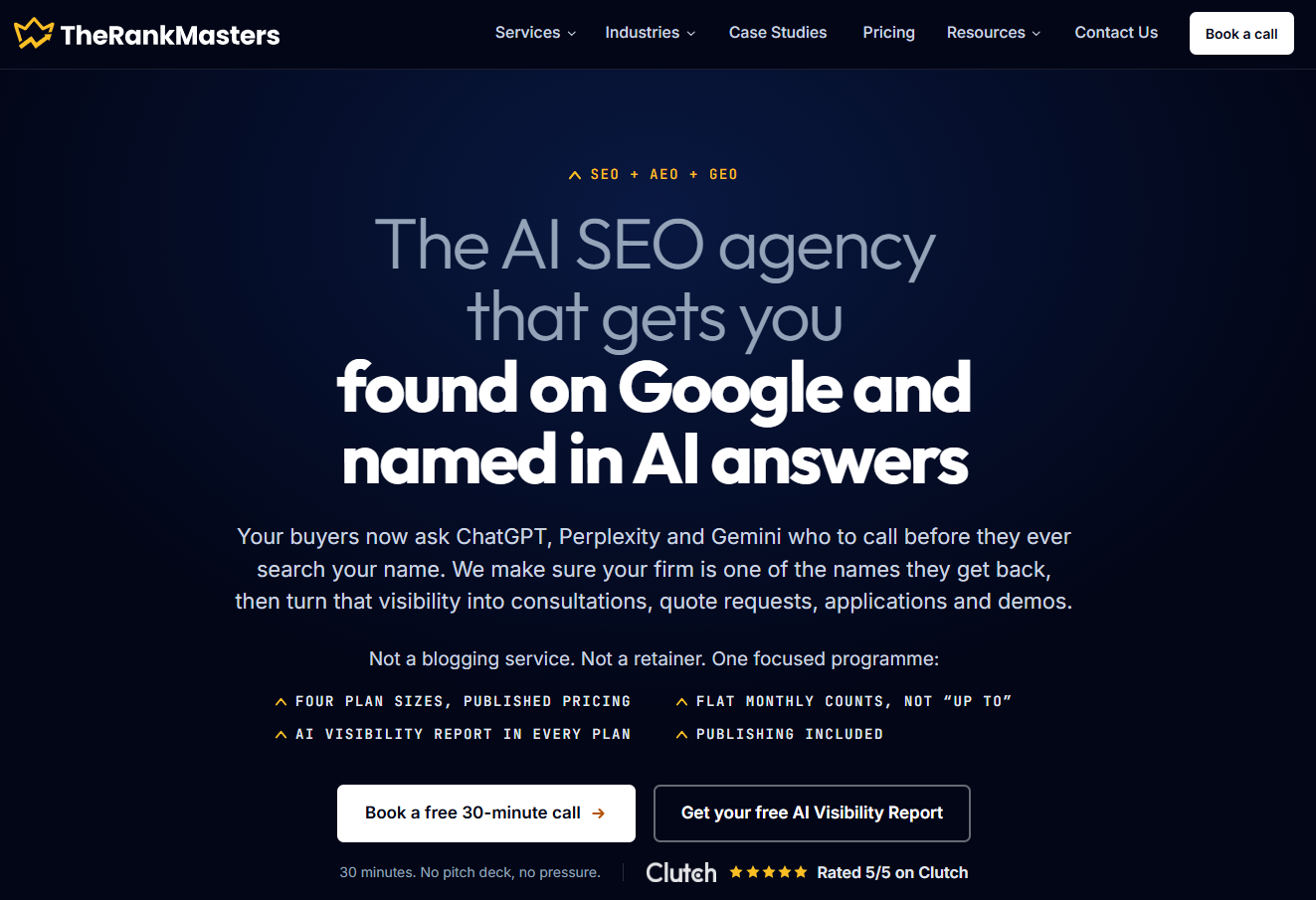
What it does: TRM positions itself around one idea, being the managed IT provider that AI engines recommend for a given specialism, rather than a generic SEO vendor that happens to serve MSPs. The programme builds out specialism, service, cost and comparison pages, cyber-insurance readiness pages, switching pages and location pages, then earns mentions on MSP lists, partner directories and IT channel publications. TRM does not publish the names of the specific third-party sites it targets, since those placements are earned case by case.
Who it is for: An MSP that has already picked, or is close to picking, a specialism and a service area and wants a single team running both the content and the measurement, rather than coordinating an SEO vendor and a PR vendor separately.
Pricing
| Plan | Price | What It Covers |
|---|---|---|
| Starter | See pricing page | Prove one specialism before scaling |
| Growth | See pricing page | Full specialism, service, cost and comparison build-out |
| Growth + Locations | See pricing page | Growth programme extended across several cities |
Current pricing for Starter, Growth and Growth + Locations is on TRM's pricing page.
Strengths
- Monthly AI-visibility tracking is scoped to three named competitors, not a generic mentions count.
- Deliverables are reported against outcome categories an MSP owner actually cares about, assessment and consultation requests, specialism and area visibility, and which pages bring in assessments, rather than vanity traffic.
- A live dashboard means the reporting cadence does not depend on someone building a PDF once a month.
Trade-offs
- The programme assumes an MSP has already settled on a specialism and area. A business still deciding between several verticals gets less value from it on day one.
- Earned mentions are reported as MSP lists, partner directories and IT channel publications generically, not as a named placement count per month.
Key capabilities
- Specialism, service, cost and comparison pages.
- Cyber-insurance readiness, switching and location pages.
- Earned mentions on MSP lists and partner directories.
- Technical fixes for AI crawlers that keep the site readable to them.
- Monthly tracking against three named competitors, visible on a live dashboard.
Good fit: An MSP with a defined specialism and area that wants its AI-visibility claim measured against named rivals rather than taken on faith. A reader evaluating that kind of claim can check the AI visibility platforms behind agency claims before taking any agency's word for what it actually tracks.
Not a fit: An MSP that has not yet picked a specialism, or wants a single low-cost deliverable rather than an ongoing programme.
The one limitation worth naming plainly. TRM reports outcomes, assessment requests, which pages bring them in, rather than guaranteeing a ranking, a lead count or an AI mention, the same limitation every agency in this comparison shares.
2. Martal Group: Best For Outbound Appointment-Setting For MSPs
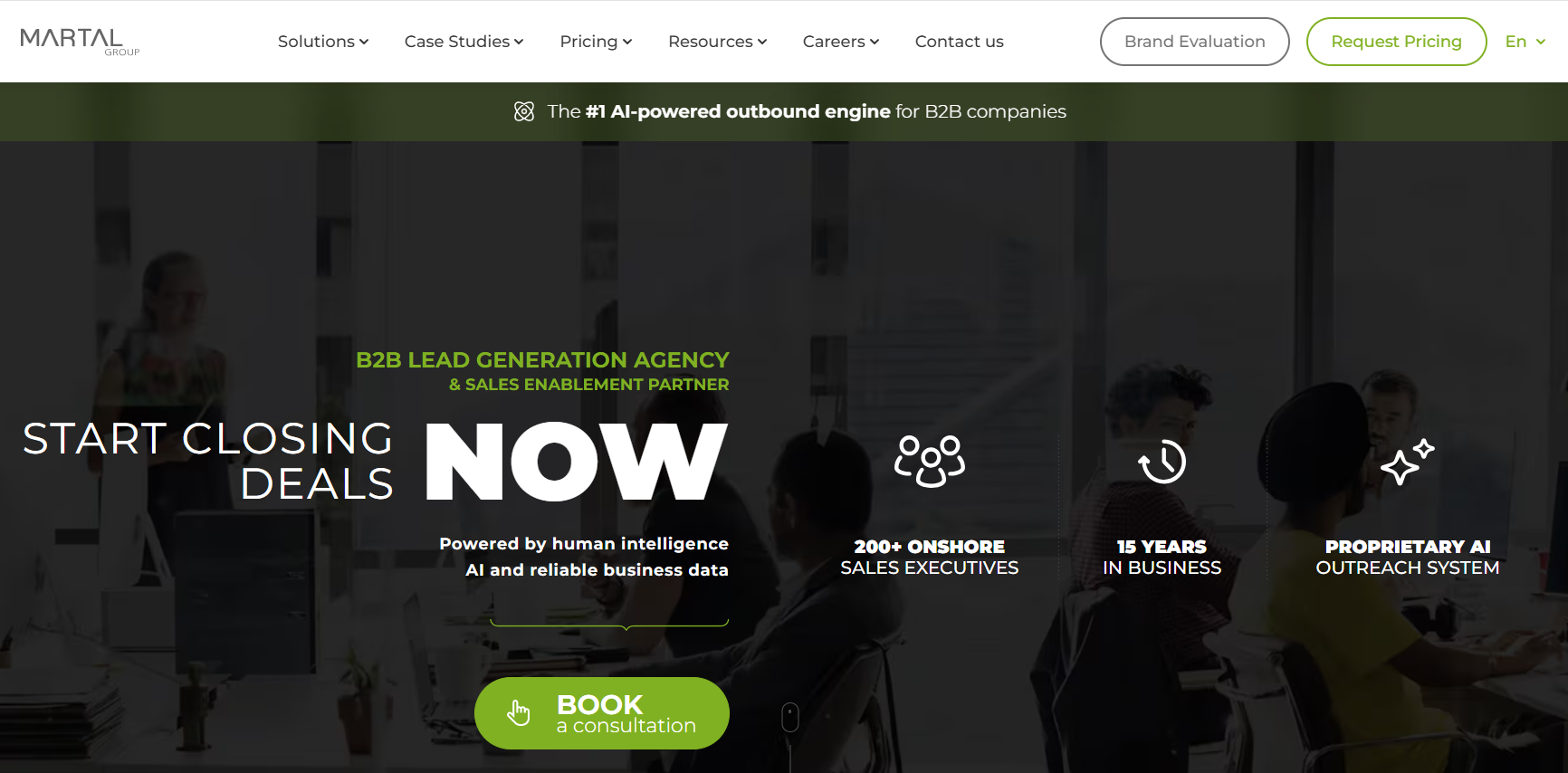
What it does: Martal runs outbound appointment-setting programmes, cold outreach, LinkedIn prospecting and SDR-style follow-up, aimed at booking sales meetings for MSPs rather than building organic content or AI visibility.
Who it is for: An MSP whose sales team can handle a steady flow of booked meetings but does not have the time or headcount to run outbound prospecting itself.
Pricing
| Programme | Monthly Range | Billing Basis |
|---|---|---|
| Outbound appointment-setting | Roughly $5,000 to $20,000 | Retainer |
That range is a compiled market figure stated on Martal's own site, not a confirmed rate card for any specific MSP engagement, so use it as a starting point for a conversation rather than a quote.
Strengths
- Outbound is a pricing model the other four agencies in this comparison do not lead with, which makes Martal the clearest option for an MSP that wants meetings booked rather than content written.
- Martal's own published segmentation, splitting MSP marketing agencies into outbound, SEO or content, and flat-rate categories, is a useful way to sort any agency you are evaluating, not just the ones in this list.
Trade-offs
- Outbound appointment-setting does not build the specialism or comparison content an MSP needs to show up in AI answers over the long term.
- Nothing in Martal's own published material describes a measured AI-visibility tracking service against named competitors.
Key capabilities
- Outbound prospecting and SDR-style follow-up aimed at MSPs specifically.
- A published market segmentation of MSP marketing agency types.
- A compiled pricing range for its own category of work.
Good fit: An MSP that already has content and SEO covered and wants a dedicated outbound motion layered on top.
Not a fit: An MSP whose biggest gap is being named in AI answers rather than booking more sales meetings.
The limitation that matters most. Outbound fills a pipeline, it does not make an MSP sound different from every other partner running on the same vendor-supplied marketing kit.
3. Percepture: Best For A Scored, Structured Agency-Fit Framework
What it does: Percepture scores MSP marketing firms, itself included, across six dimensions, which are MSP expertise, channel mix, pipeline proof, AI-search readiness, pricing clarity and lead quality.
Who it is for: An MSP owner who wants a structured way to compare agencies rather than relying on a sales call and a gut feeling.
Pricing
| Tier | Monthly Range | What It Covers |
|---|---|---|
| Entry SEO | Roughly $2,500 to $4,000 | SEO-led programme |
| Full-funnel growth | Roughly $8,000 to $15,000 | Broader channel mix beyond SEO |
Both figures are vendor-stated on Percepture's own page, not independently confirmed, so use them as a starting point for a conversation rather than a quote.
Strengths
- The six-dimension framework is genuinely reusable. An MSP can apply it to any agency, not just Percepture, which is why it is worth borrowing even without hiring Percepture.
- AI-search readiness is named as its own scored dimension, which is more structure than most agencies in this category offer.
Trade-offs
- A scored dimension called AI-search readiness is not the same as a monthly measurement against named competitors. Percepture's own material does not describe a tracking cadence.
- Two pricing tiers leave a gap for an MSP whose budget sits between entry SEO and full-funnel growth.
Key capabilities
- A six-dimension scoring framework covering expertise, channel mix, pipeline proof, AI-search readiness, pricing clarity and lead quality.
- An entry-level SEO programme and a full-funnel growth tier.
- Pricing disclosed in ranges on its own site, rather than requiring a sales call to learn the band.
Good fit: An MSP that wants a documented way to evaluate agencies, and is comfortable with SEO-led work as the entry point.
Not a fit: An MSP that has already settled on a measured, named-competitor AI-visibility programme as a requirement rather than one scored dimension among six.
The limitation worth naming. A high score on AI-search readiness describes an agency's own claim about itself, not a report an MSP can hand a prospect showing where it actually stands against named rivals.
4. NUOPTIMA: Best For Agencies Already Selling AI-Search And GEO As A Line Item
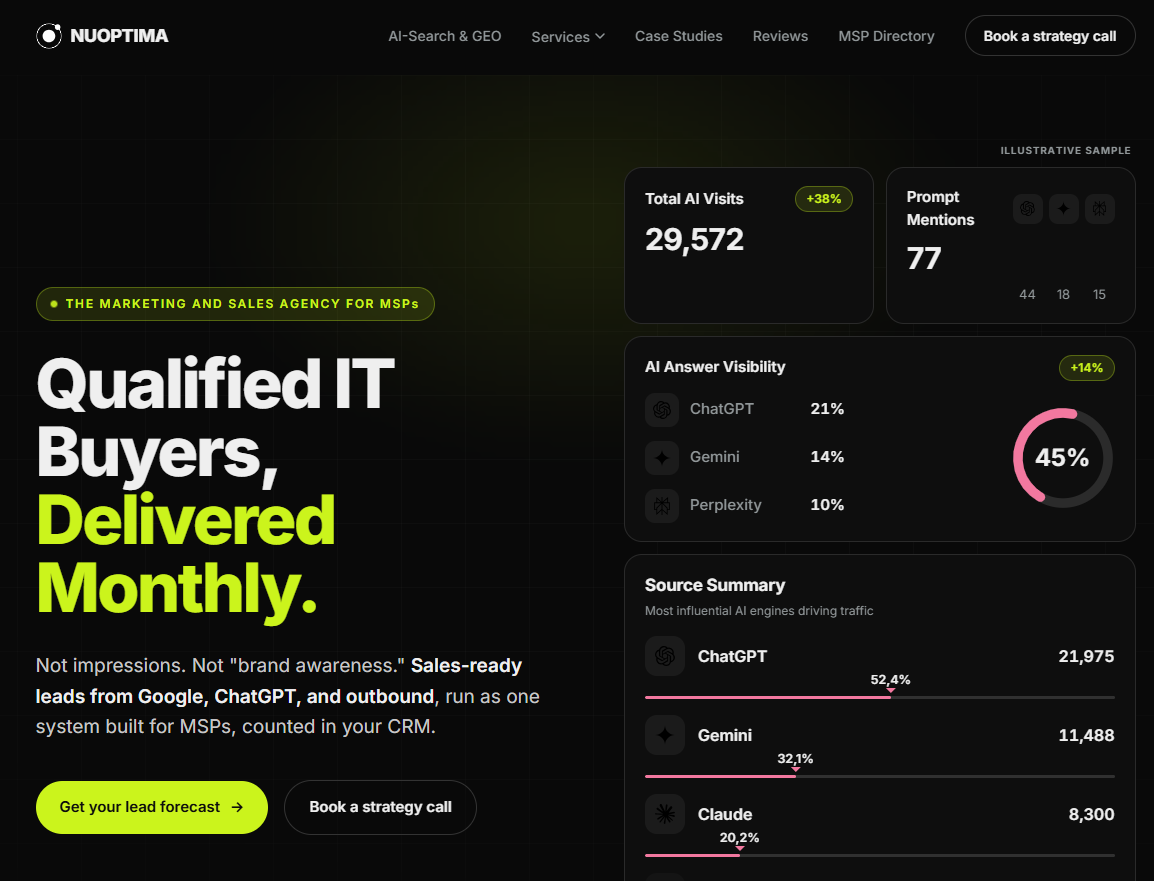
What it does: NUOPTIMA publishes a comparison table of MSP marketing agencies tagged by specialism, pricing model and a stated AI-search or GEO claim, and notes that several MSP marketing firms now list AEO or GEO as a service line.
Who it is for: An MSP that wants to see, at a glance, which agencies in the category claim to do AI-search or GEO work at all, before digging into any one of them.
Pricing
| Service | Price | Notes |
|---|---|---|
| MSP marketing comparison and agency matching | Pricing on request | No published rate card for NUOPTIMA's own services |
Strengths
- The table format makes it easy to see which agencies claim an AI-search or GEO line item and which do not, in one place.
- Naming AEO and GEO as service lines at all shows the category has noticed AI visibility matters, even where the claim is thin.
Trade-offs
- A listed AI-search or GEO claim in a comparison table is not the same as a measured, reported programme. NUOPTIMA's own material does not state a measurement cadence or name specific competitors any agency tracks against.
- NUOPTIMA's table compares other agencies rather than detailing its own MSP-specific delivery process.
Key capabilities
- A comparison table spanning specialism, pricing model and AI-search or GEO claims across multiple agencies.
- A standing observation that AEO and GEO have become common service-line claims in MSP marketing.
Good fit: An MSP doing its own first pass across the category and wanting a quick map of who claims what.
Not a fit: An MSP that wants the claim itself verified, since NUOPTIMA's table records what agencies say about themselves, not what AI engines actually do with their content.
The limitation that matters most. A line item labelled GEO or AEO on an agency's service list says nothing about whether that agency tracks it, measures it monthly, or names the competitors it is tracking against. That gap is the whole reason this comparison exists.
5. 310 Creative: Best For Local And Vertical Positioning Without Published Pricing
What it does: 310 Creative positions itself around local and vertical specialisation rather than a single national play, working with MSPs that want to own a specific city or industry niche rather than compete broadly.
Who it is for: A locally focused MSP that wants an agency comfortable talking about one city or one vertical rather than a nationwide, generalist programme.
Pricing
| Service | Price | Notes |
|---|---|---|
| MSP marketing programme | Pricing on request | No rate card published on its site |
Pricing is available on request. No rate card is published on 310creative.com.
Strengths
- Local and vertical positioning fits an MSP that already knows the one city or industry it wants to own.
- A narrower focus can mean less generic copy than an agency serving every type of B2B client.
Trade-offs
- No published pricing means an MSP cannot pre-qualify budget fit before a sales conversation, unlike Percepture or Martal, which both publish ranges.
- Nothing in 310 Creative's own material describes an AI-visibility measurement approach of any kind.
Key capabilities
- Local and vertical go-to-market positioning for MSPs.
- A smaller, more specialised client roster than a generalist agency typically carries.
Good fit: A small or mid-sized MSP anchored to one city or one vertical that wants an agency that talks that language.
Not a fit: An MSP that wants to compare price before a first call, or one that needs AI-visibility tracking against named rivals as part of the programme.
The limitation worth naming plainly. With no published pricing and no stated measurement approach, an MSP has to do more of its own vetting work with 310 Creative than with the other four agencies here. That is the trade-off of a smaller, specialised shop rather than a company that publishes a rate card and a scoring framework up front, the way Percepture does, so budget and measurement questions have to be asked directly on a call rather than read off a page first.
📋 Get Listed / Advertise
We update this guide monthly. Want your tool featured? Contact: [email protected].
What 'Understanding How MSPs Sell IT' Actually Means
An agency that actually understands how MSPs sell IT writes to a specialism and a service area, not to "IT services" in general. In practice that looks like a page built around cyber-insurance readiness for healthcare clinics in one metro area, rather than a page titled "IT Support Services" that could describe any MSP anywhere. It also reports against assessment and consultation requests, the thing an MSP owner actually wants more of, rather than raw traffic or impressions that do not say whether the right buyer showed up.
This is also why a vendor-supplied, co-branded marketing kit does not make an MSP sound any different in AI answers. Every partner using the same vendor gets the same page template, the same bullet points and often the same case-study language. When an AI engine reads a dozen MSP sites built from the same kit, it has no way to tell them apart, so it defaults to whichever one has built out specialism and area pages beyond the kit, earned independent mentions, or both. How mid-market buyers shortlist providers in AI answers goes further into what AI engines actually look for when deciding which MSP to name.
None of this requires abandoning the vendor kit. It requires treating the kit as a starting point, not the finished site. The kit can supply boilerplate service descriptions. The specialism page, the comparison page and the area page have to be written in the MSP's own voice, about its own clients, or an AI engine reading it alongside ten competitors built from the identical kit has no reason to name this one over the others.
How MSP Marketing Agencies Price Their Work
MSP marketing agencies price their work in roughly three ways, an outbound appointment-setting fee, an SEO or content retainer in tiers, or a flat-rate programme built for a mid-sized MSP's whole marketing function. Which one fits depends on whether the gap is pipeline (outbound), visibility (SEO or content), or both at once (flat-rate).
For a general sense of agency pricing across industries, not MSPs specifically, WebFX's retainer survey puts monthly retainers at roughly $1,000 to $12,000, based on a survey of over 1,000 US businesses. MSP marketing specifically runs somewhat higher and wider. Martal's category-wide figures put MSP marketing programmes at roughly $500 to $20,000 a month, with most full-service retainers landing around $3,000 to $10,000.
Both of those ranges are self-reported by the sites that publish them, not independently audited rate cards, so use them as a budgeting anchor and confirm the actual number with any agency you shortlist, this one included.
A few things move the number inside that range:
- Specialism depth: A programme covering one specialism and one city costs less than one covering three specialisms across several metro areas.
- Measurement: An agency that tracks AI visibility monthly against named competitors and reports it on a dashboard is doing more work than one producing a quarterly PDF, and usually prices accordingly.
- Earned mentions: Active outreach for mentions on MSP lists, partner directories and channel publications adds ongoing work beyond the content build itself.
- Technical work: Fixing crawl and indexing issues that keep AI crawlers from reading a site at all is a one-time or periodic cost layered on top of an ongoing content retainer.
TRM's own plans follow the flat-rate model rather than stating a number here. TRM's pricing covers Starter, Growth and the Growth plus Locations add-on, with the actual figures kept on that page rather than quoted inline, for the same reason every agency's pricing changes over time.
If you would rather have one team own both the SEO and the AI-visibility side instead of coordinating two vendors, TRM's GEO + SEO Growth Programme covers specialism pages, earned mentions and monthly competitor tracking under one retainer.
Matching An Agency To Your Specialism And Service Area
Picking an agency before picking a specialism is how MSPs end up with generic content no matter who they hire. The order matters.
- Name the specialism first. Cybersecurity-led, compliance-led, cloud-led or generalist, pick one before talking to any agency. An agency cannot build a specialism page for a specialism you have not committed to.
- Name the service area next. One metro area, a handful of named cities, or a region. This decides whether you need location pages at all, and how many.
- Match the agency's own positioning to both. Martal fits if the gap is outbound pipeline. Percepture or a similar SEO-led retainer fits if the gap is organic visibility. An agency naming AI-search or GEO as a line item, like the agencies NUOPTIMA tags that way, fits only if it can also describe how it measures that claim.
- Apply a scoring framework to whichever agency you are closest to signing. Percepture's own six dimensions (MSP expertise, channel mix, pipeline proof, AI-search readiness, pricing clarity and lead quality) work as a checklist for any agency, not just Percepture. Score a shortlisted agency against all six before signing, not just the ones it talks about on its own sales call.
An agency that can help you win clients from Google and AI answers for your specialism and area should also be able to show you how it benchmarks AI visibility against named rivals, not just describe the idea. If it cannot point to a measurement method, the AI-search claim on its own homepage is marketing copy about itself, the exact problem this comparison exists to work around.
If You're A Small Local MSP, Start Here
A small, local MSP does not need to compete with national players on every specialism at once. It wins by owning one specialism and one area first, cybersecurity for dental practices in one metro, say, rather than "IT services" for anyone nearby, and proving that narrow bet works before paying for a broader programme.
That means a narrower, cheaper engagement makes sense before a full flat-rate programme. TRM's own Starter plan exists for exactly this reason, built to prove one specialism rather than fund a multi-city, multi-specialism build-out from day one. The same logic applies whichever agency you choose. Ask for the smallest version of the programme that proves the specialism-and-area bet before scaling spend.
Once that bet is proven in one city, tracking AI visibility by city or region becomes the next useful step, since owning your city only means something if you can see whether AI engines actually name you there against the MSPs you are competing against for that same metro.
A small MSP that cannot afford a full programme yet is not stuck choosing between doing nothing and overspending. The middle option, one specialism, one area, measured, is the one most of the agencies in this comparison undersell in favour of a bigger retainer.
Why Security And Compliance Content Still Needs An Engineer, Not Just An Agency
An agency can write and structure security and compliance content well. What it cannot do is confirm, on its own, that a claim about a compliance framework, cyber-insurance readiness or a technical capability is actually accurate for your business.
The split that works. The agency writes and structures the page, a technical reviewer on the MSP's own side, an engineer or a compliance lead, confirms every specific claim before it publishes. That includes framework names, specific cyber-insurance requirements, and any statement about what your own stack can or cannot do.
This is not a reason to have engineers write the content themselves. Most engineers are not trying to write marketing copy, and most marketing copy written by engineers reads like a manual rather than something a prospect wants to read. It is a reason to put a short, mandatory review step between draft and publish, specifically for technical and compliance claims, and nowhere else in the process. An agency that resists that review step, or treats it as optional, is telling you something about how it handles accuracy generally, not just on security pages.
Evidence To Ask Any MSP Marketing Agency For
Before signing with any MSP marketing agency, a handful of things are worth asking for directly, in writing, not just hearing about on a sales call.
- MSP-specific experience. Ask for examples of work for other MSPs specifically, not general B2B or IT clients. An agency with genuine MSP experience should be able to point to it without hesitation.
- Monthly reporting against the metrics that matter. Pipeline growth, recurring revenue impact and lead quality, not just traffic or impressions. If an agency cannot describe how it reports on these monthly, assume it is not tracking them.
- Contract terms that spell out deliverables up front. Deliverables, expected results, a meeting schedule and a reporting cadence should all be written into the contract before you sign, not promised verbally and left out of the paperwork.
- A specific answer on AI-visibility measurement. If an agency claims AI-search or GEO work, ask exactly how it measures it, against which named competitors, and how often. AI visibility tools built for agency reporting shows what a client-ready version of that report actually looks like, so you know what to ask for.
- How the agency handles more than one client in your position. If you ever run more than one location or brand, ask how its reporting scales. AI visibility tools that manage multiple client accounts covers what that should include.
Plenty of small MSPs still run on word-of-mouth referrals alone, with no dedicated marketing programme at all. That is a fine place to start, but it is not a reason to accept vague reporting once you do pay for one.
Before you sign, pull your own numbers. Semrush's AI Visibility Toolkit will show where you already stand in AI answers against the competitors you name, so you can hold an agency's first report to an independent baseline rather than taking its word for the starting point.
If you would rather see where you stand before any of this, start with the free AI Visibility Report instead of a sales call.
FAQs
How Much Does An MSP Marketing Agency Charge Per Month?
Do MSP Marketing Agencies Guarantee Leads, Rankings Or AI Mentions?
Should A Small MSP Hire An Agency Or Handle Marketing In-House First?
Is Marketing For An MSP Different From Marketing For An MSSP?
How Long Before An MSP Marketing Programme Shows Results?
Can One Agency Cover More Than One Specialism For The Same MSP?
Do MSP Marketing Agencies Handle Multiple Service Areas Or Cities At Once?
What Is AI Visibility, And Why Does It Matter For An MSP's Marketing?
Should An MSP Ask An Agency For References From Other MSPs Specifically?
Does A Vendor's Co-Branded Marketing Kit Count As A Marketing Strategy?
Ready to see where your MSP stands before you sign with anyone? Book a free 30-minute call, where one of TRM's founders takes the call and you leave with the specialism and area gaps worth fixing first.
📑 Disclosure!
Some links in this article are affiliate links. If you sign up through them, The Rank Masters may earn a commission at no additional cost to you. This does not influence which tools we recommend or what we say about them.