

There is no single best SaaS SEO agency. The Rank Masters, the agency that publishes this guide, fits B2B SaaS teams that want SEO and AI-search visibility run as one founder-led programme with published pricing. Rock The Rankings and Powered By Search fit funded, growth-stage teams that can commit a year and a five-figure monthly retainer. MADX Digital and Omnius suit teams who want broader scope or custom terms instead of a narrow, fixed-tier retainer. TripleDart suits a buyer who wants proof before signing anything.
This assumes you have already decided to outsource rather than build in-house, and that your monthly budget sits somewhere between $2,000 and $10,000-plus depending on your stage.
TRM publishes its pricing. None of the other five publishes a confirmed price on its own pricing page, because most SaaS SEO agencies don't publish rates at all. Confirm current price and term on a discovery call before you commit to anything below.
The rest of this guide breaks each of those six agencies down individually, then gives you a three-variable fit rule, a set of evaluation criteria, and a red-flag checklist to run against any agency on your own shortlist, not just these six. If you only read one section before you start taking calls, make it the fit rule further down.
If what you actually need is a content programme that earns pipeline rather than a one-off ranking push, we build that as a system, not a retainer of random blog posts. See how TRM runs SaaS content strategy.
📋 Get Listed / Advertise
We update this guide monthly. Want your tool featured? Contact: [email protected].
SaaS SEO Agency At A Glance
Six agencies, matched to the one trait that actually decides whether they fit you. That trait is stage and budget, not a star rating. The Rank Masters is our own agency, so it sits first and gets the same disqualifier test as the other five.
| Agency | Best For | Disqualifier | Pricing |
|---|---|---|---|
| The Rank Masters | SaaS teams wanting SEO and AI-search visibility in one programme | 6-month minimum and no guarantee of rankings or citations; not for cheap article volume | Published on its own pricing page |
| Rock The Rankings | Established SaaS teams with budget to commit | Flagged by one review as a possible poor fit for very early-stage startups, on price | Not published; contact for a quote |
| Powered By Search | Mature B2B SaaS ready for a long-term retainer | One review reports a one-year minimum and a five-figure monthly retainer | Not published; contact for a quote |
| MADX Digital | Teams wanting one agency across more specialisms | Confirm scope and term length before signing; both vary by engagement | Not published; contact for a quote |
| TripleDart | Teams who want proof before they buy | No plan exists until after an audit call, so there is nothing to compare upfront | No fixed plan; custom after an audit call |
| Omnius | Teams wanting a custom scope instead of packaged tiers | No standard package means no baseline figure to hold it against | Scoped per engagement; no published packages |
Each row is a starting point, not a verdict. The "disqualifier" column matters more than the "best for" column. If the disqualifier describes your company, stop reading that profile and move to the next one, because no amount of persuasive sales copy changes a budget floor or a minimum term. The sections below walk through why each agency lands where it does, and the fit rule further down gives you the actual decision logic instead of a ranking.
If six names isn't enough to work with, see more SaaS SEO and GEO alternatives.
1. The Rank Masters: Best For SEO And AI-Search Visibility In One Programme
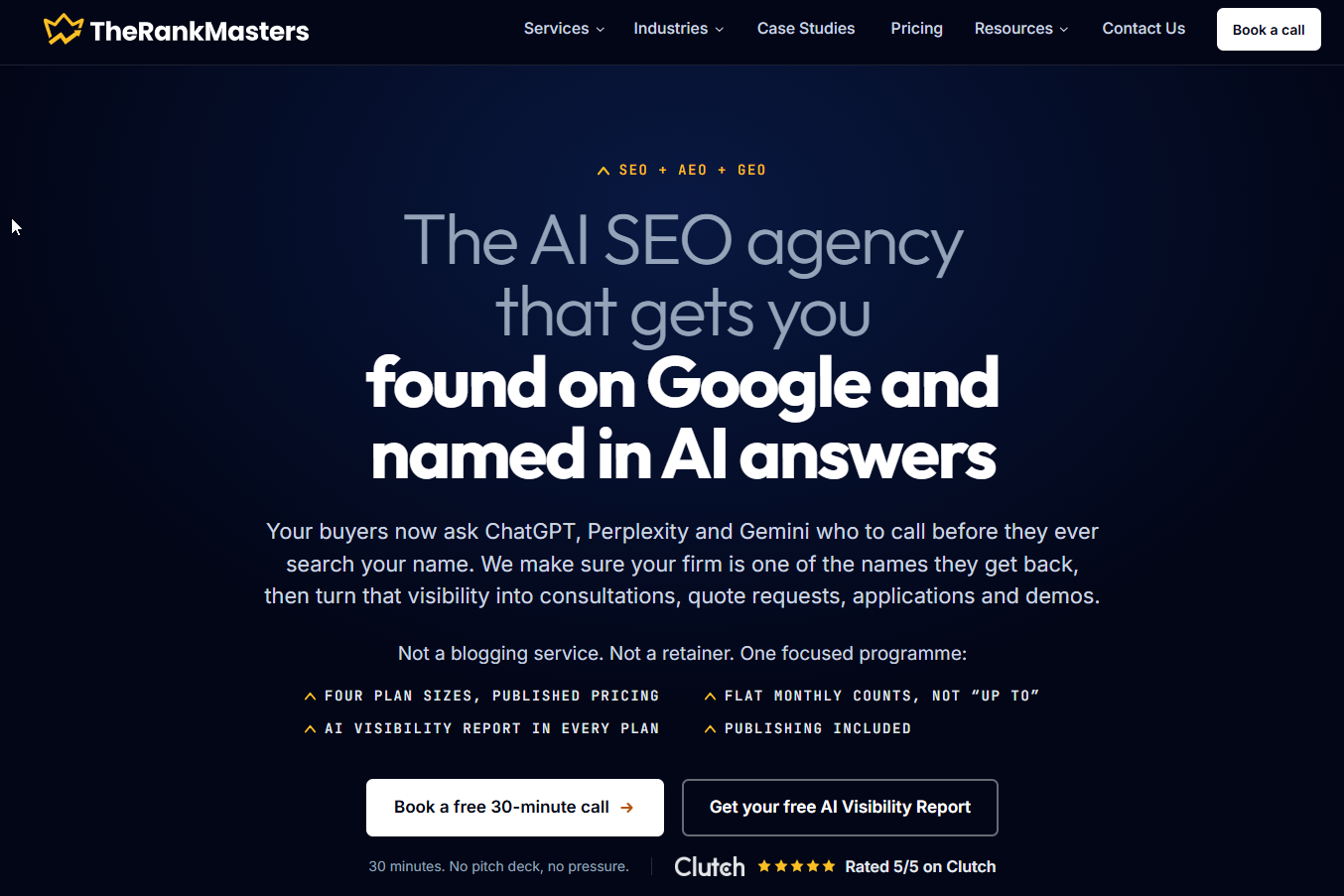
The Rank Masters (TRM) publishes this guide, so read this profile knowing that, and hold it to the same disqualifier test as the five below. Its pitch is that SEO, AEO and GEO are one job, not three separate retainers.
What it does: TRM's GEO + SEO Growth Programme combines strategy, revenue content, content refreshes, AI search visibility, earned mentions, technical SEO and measurement in one monthly plan. For a SaaS company that means comparison, alternatives, use-case and buying-intent pages published to your CMS with schema, plus a monthly AI Visibility Report covering ChatGPT, Perplexity, Gemini and Google AI Overviews.
Who it's for: A B2B SaaS team whose buyers compare tools and ask AI assistants before they book a demo, and who wants a founder rather than an account manager on the strategy call.
| What | Detail |
|---|---|
| Published price | Yes, every plan on its own pricing page |
| Billing basis | Monthly; four plans with the same services and different monthly volume |
| Minimum commitment | 6 months, then month to month |
| Exit point | Month-3 delivery checkpoint |
Unlike the other five, TRM publishes its rates. Its pricing page lists every plan, with no setup fees. If the pages, mentions or tracking a plan promises are not delivered by month 3, you can leave, which TRM describes as a delivery promise rather than a results guarantee.
Strengths:
- SEO and AI visibility measured together. The monthly AI Visibility Report sits next to a live GSC and GA4 dashboard, so citation work is its own line in the report, the criterion this guide weights most heavily.
- A founder on the account. Co-founder Waqas Arshad runs the monthly strategy call and roadmap, and co-founder Faisal Irfan leads content, SEO and AI-visibility delivery.
- SaaS results you can check. Its published case studies name the clients, including Birdview PSA's 247% conversion-rate lift from 13 posts in three months, and Avaza's AI-ready posts, which came to drive about 65% of non-homepage organic visits in five months.
Trade-offs:
- No guarantees. TRM does not guarantee rankings, traffic, enquiries or AI citations; it commits to the work and reports outcomes against your baseline.
- Six months before month to month. That is shorter than the one-year minimum reported for Powered By Search, but longer than a team that wants month-to-month terms from day one will accept.
- Organic and AI search only. Paid advertising, social media, website redesign and review management are outside every plan.
Key capabilities:
- Revenue-first keyword plan and rolling content calendar, built from a review of your top three competitors
- Comparison, alternatives and use-case pages published to your CMS with schema
- Technical SEO and AI readiness covering crawlability, Core Web Vitals, structured data, llms.txt and AI-crawler access
- Earned mentions on third-party lists and publications, logged with URLs and screenshots
Good fit: A SaaS team, PLG or sales-led, that wants comparison-stage content and AI-answer visibility built and reported as one programme, and can plan around a six-month first term.
Not a fit: A team that wants guaranteed rankings, cheap article volume without buying-intent targeting, a site rebuild, or paid media under the same contract.
The limitation that matters most is scope. TRM stops at organic search and AI answers, so a SaaS company that wants SEO and paid acquisition run by one vendor will need a second partner.
Run it through the same fit rule as everyone else further down. If your stage and budget clear TRM's published plans and you want AI visibility measured as its own line, it belongs on the shortlist. If you need month-to-month terms from the first invoice, it doesn't.
2. Rock The Rankings: Best For Established SaaS Teams With Budget To Commit
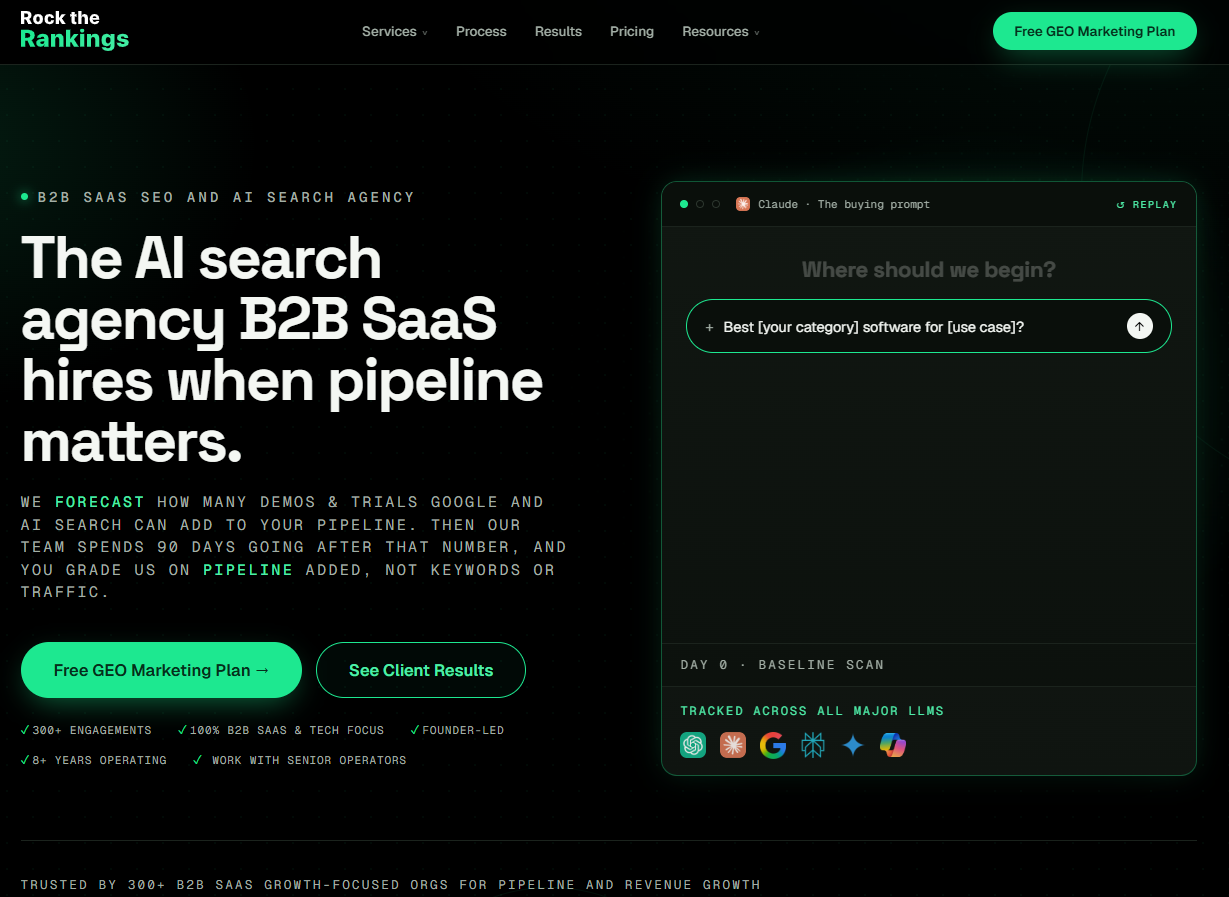
Rock The Rankings is one of the better-known names that builds its entire practice around SaaS and B2B software SEO rather than treating it as one vertical among many. That focus is the whole pitch, by its own positioning and marketing.
What it does: The agency runs search work as an ongoing programme rather than a single, time-boxed project. That typically means product and competitor keyword strategy, content built around how SaaS buyers actually search, and the technical maintenance that keeps a growing site crawlable as pages multiply.
Who it's for: A team that already has product-market fit, a reasonably clear ICP, and a marketing budget line that can absorb a retainer for a year or more without a quarterly fight over the spreadsheet.
| What | Detail |
|---|---|
| Published price | None on its own site |
| Billing basis | Monthly retainer |
| Minimum commitment | Not published |
| Where to check current figures | Its own pricing page (linked below) |
Rock The Rankings doesn't post a number anywhere public. For whatever it currently quotes, go straight to its pricing page rather than trusting a secondhand figure from a different site.
Strengths:
- Built only for SaaS. The agency's positioning doesn't split attention across industries, so you're not paying to educate it on how SaaS buying cycles work.
- Retainer model fits a long play. An ongoing programme suits a team that has already decided SEO is a multi-quarter investment, not a one-off traffic push.
Trade-offs:
- Price rules out the earliest stage. eesel.ai's review flags Rock The Rankings as a possible poor fit for very early-stage startups, specifically because of its price point.
- No published number to plan against. You'll need a call just to find out whether it's even in your range before you can compare it to anything else on this list.
Key capabilities:
- Ongoing monthly retainer, not a fixed-scope project
- Specialism limited to SaaS and B2B software, by its own positioning
- Entry point is a discovery or audit call before any scope is set
Good fit: A funded, growth-stage SaaS company whose CMO or VP Marketing owns a real line-item budget and has already ruled out building the function in-house.
Not a fit: A pre-seed or bootstrapped team watching runway month to month, or anyone who wants month-to-month flexibility without a longer commitment.
The limitation that matters most here is budget, not capability. The price point itself, not the quality of the work, is what the one review flags as the thing that rules out the earliest-stage teams.
That's worth sitting with before you book a call. A SaaS specialist with a narrow focus and a long retainer model is a reasonable bet once you have the budget to sustain it, but the same focus that makes Rock The Rankings a strong fit for a growth-stage team is exactly what makes it a weak fit for a company still watching its runway. Confirm your own budget ceiling honestly before you spend time on a discovery call you already know you can't close.
3. Powered By Search: Best For Mature B2B SaaS Ready For A Long-Term Retainer
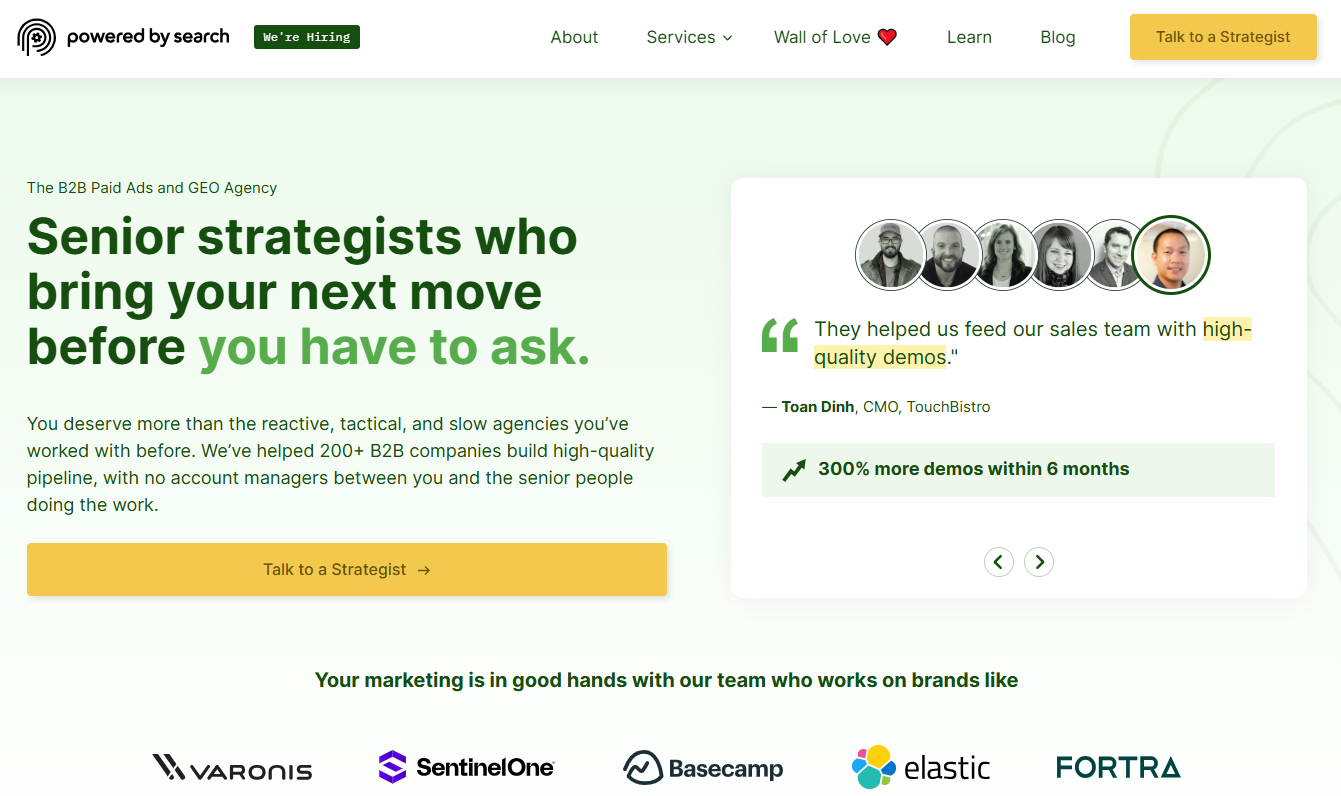
Powered By Search's profile here rests on one sourced finding rather than a claim about how the agency presents itself. A one-year minimum commitment and a roughly $10,000-a-month retainer, reported by a third-party review and covered in full below.
What it does: The deciding fact for this profile is the commitment term and retainer size reported by that review, not a description of the agency's own service offering, which this guide has not independently confirmed.
Who it's for: A team with an existing marketing function, a defined pipeline-attribution process, and the patience to treat SEO as a year-plus commitment rather than a quarter-by-quarter experiment.
| What | Detail |
|---|---|
| Published price | None on its own site |
| Reported minimum commitment | One year, per a third-party review |
| Reported monthly retainer | Roughly $10,000, per the same review |
| Where to check current figures | Its own services page (linked below) |
eesel.ai's review reports that Powered By Search carries a one-year minimum commitment and a retainer of roughly $10,000 a month, which the same review flags as a poor fit for an early-stage team that needs flexibility. That figure comes from the review, not from the agency's own pricing page, so treat it as a planning signal rather than a quote, and confirm the current number directly before you rely on it.
Strengths:
- Built for the long game. A year-long minimum forces both sides to commit to a real programme instead of a trial that gets cancelled after one disappointing month.
- Suits teams past the proving stage. Positioning toward mature B2B SaaS means less time spent explaining basic product-market concepts.
Trade-offs:
- The commitment term is the disqualifier. A one-year minimum is exactly wrong for a team that might need to change agencies, strategy, or budget inside of six months.
- The reported retainer is five figures a month. Even as an unconfirmed, secondhand number, it sets an expectation. This isn't a $2,000-a-month engagement.
Key capabilities:
- Long-term retainer structure, reportedly with a one-year minimum
- Positioning toward established B2B SaaS rather than early-stage startups
- No published pricing; figures available only on request
Good fit: A Series B-plus or later-stage SaaS company with an annual marketing budget that already assumes a multi-quarter SEO line item.
Not a fit: Any team that needs to stay flexible on term length, or one whose monthly SEO budget realistically sits under five figures.
If the reported one-year minimum and five-figure retainer hold, the agency effectively pre-qualifies itself out of the early-stage conversation before a call even happens.
That's not a criticism of the agency. A long minimum term is a reasonable way to structure a programme meant to compound over a year rather than chase a quarterly number, and a mature B2B SaaS company with a stable budget is exactly the client that structure is built for. The mismatch only shows up when an earlier-stage team, chasing a recognisable name, signs a commitment shaped for a company two or three funding rounds ahead of where they actually are.
4. MADX Digital: Best For SaaS Teams Wanting One Agency Across Many Specialisms
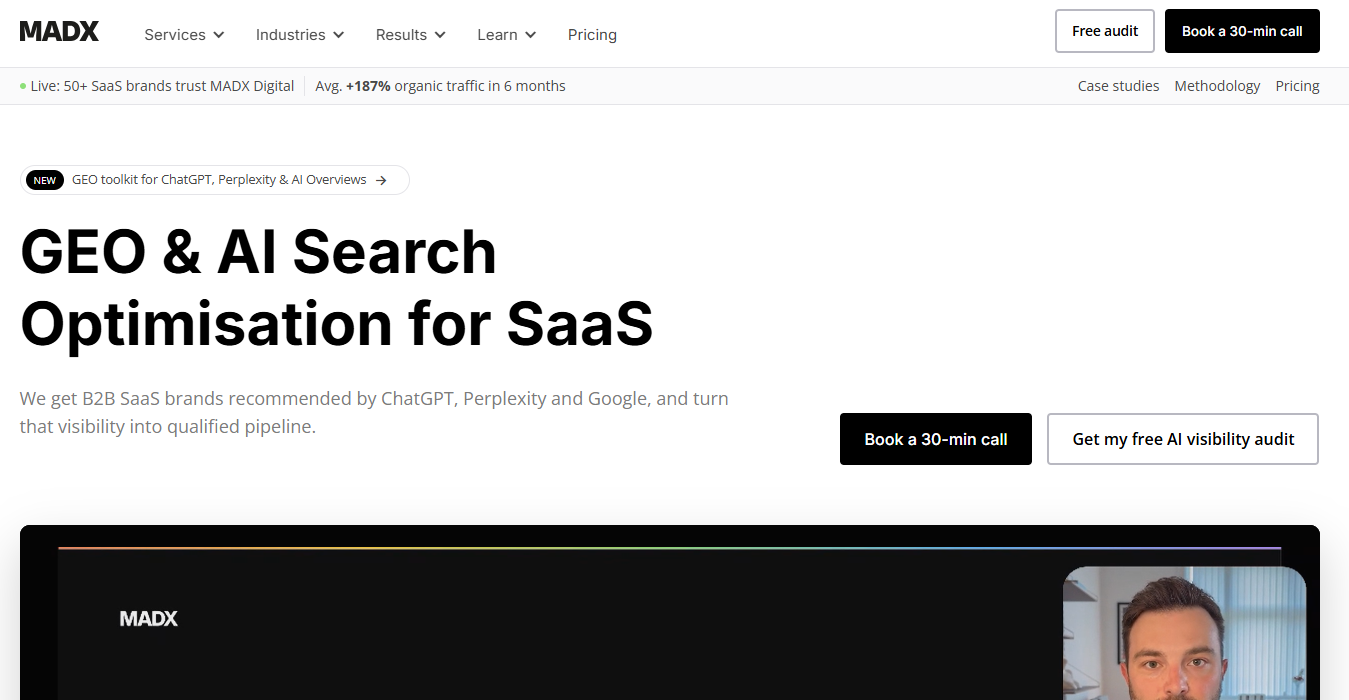
MADX Digital markets itself as the broadest of the agencies profiled here, by its own positioning rather than anything independently confirmed for this guide. Where the others narrow to a single engagement shape, MADX's own description of itself spans a wider set of SaaS SEO specialisms.
What it does: Rather than offering one fixed retainer shape, MADX's own positioning describes covering multiple specialisms under one roof, letting a single agency relationship cover more of a SaaS company's search needs as that company grows, according to its own marketing.
Who it's for: A team that would rather manage one agency relationship across several specialisms than stitch together separate vendors for content, technical SEO, and AI-visibility work.
| What | Detail |
|---|---|
| Published price | None confirmed on its own pricing page |
| Billing basis | Not published; confirm on a call |
| Minimum commitment | Not published; confirm on a call |
| Where to check current figures | Its own pricing page (linked below) |
MADX Digital doesn't publish a confirmed figure on its pricing page either. Go to its pricing page directly and get the current number and term in writing before you assume anything a third-party roundup reports about it.
Strengths:
- Breadth over narrowness, by its own description. Covering more specialisms under one agency, if that positioning holds up on a call, would reduce the coordination overhead of managing several vendors.
- Flexibility as the company changes. A broader scope can flex with a team as it moves from early content work toward enterprise-grade technical and AEO needs.
Trade-offs:
- Breadth can mean less depth per specialism. A generalist-across-many-things agency is a different bet than a narrow specialist who does one thing exceptionally well.
- Scope and term aren't fixed upfront. Without a published package, every engagement starts from a blank page, which is good for customisation and bad for quick comparison.
Key capabilities:
- Markets itself as spanning multiple SaaS SEO specialisms rather than one narrow service shape, unconfirmed independently
- Custom scope and terms set per engagement
- No published price; confirm current figures directly
Good fit: A team that wants a single agency relationship it can grow with, if MADX's own claims about covering content, technical SEO, and AI-visibility work hold up on a call, rather than re-hiring specialists at each stage.
Not a fit: A buyer who wants a narrow, clearly-scoped retainer they can compare line-by-line against a competitor's fixed package.
The trade-off to hold onto is straightforward. Broader scope buys flexibility, and flexibility means you'll spend more of the sales call defining exactly what you're buying.
If you're the kind of buyer who already knows exactly what you need, a narrower specialist will usually get you there faster. MADX Digital earns its spot on this list for the opposite buyer, the team that doesn't yet know whether it needs more content, more technical work, or more AEO-focused effort next quarter, and would rather have one agency able to shift with that answer than re-run a vendor search every time the priority changes.
5. TripleDart: Best For Teams That Want Proof Before They Buy
TripleDart runs its SaaS SEO offer around a case-study-led sales process rather than a published package. The deciding fact is simple, and it's stated on the agency's own site. There is no plan until after an audit call.
What it does: TripleDart's SaaS SEO page states that it provides a custom plan after an audit call, rather than publishing a fixed price or package upfront.
Who it's for: A buyer who wants to see evidence of relevant results before committing, and who is comfortable going through a structured audit process before getting a number.
| What | Detail |
|---|---|
| Published price | None; custom plan only |
| Entry process | Audit call, per its own site |
| Billing basis | Set after the audit, not published upfront |
| Where to check current figures | Its own SaaS SEO page (linked below) |
There is nothing to quote here beyond what the agency itself states. TripleDart's SaaS SEO page is explicit that you get a custom plan after the audit call, not a number on the page itself.
Strengths:
- The audit-first model surfaces specifics early. You get a scoped recommendation tied to your actual site and content, rather than a generic package applied to every client.
- Case-study-led selling suits a cautious buyer. If you want evidence before you commit, an agency built around showing its work before quoting a price is a reasonable match.
Trade-offs:
- No price means no quick comparison. You can't line this up against a published package from a competitor without first going through the audit process.
- The audit call is a real step, not a formality. Expect to spend time on it before you get anything resembling a number.
Key capabilities:
- Custom plan built from an audit call, stated on its own SaaS SEO page
- No fixed packages to browse before talking to the agency
- Positioning built around demonstrating results before quoting price
Good fit: A buyer who wants to see relevant proof and a tailored plan before signing anything, and who has the time to go through an audit conversation properly.
Not a fit: A team in a hurry to compare three agencies by price alone, with no bandwidth for an audit call at each one.
The one thing to remember going in is this. You will not get a number from TripleDart without first going through its audit call, by its own design.
Treat that as a filter in both directions. If you're not willing to spend an hour on an audit call before seeing a number, cross TripleDart off your list now rather than getting frustrated mid-process. If you are willing to spend that hour in exchange for a plan built around your actual site rather than a generic tier, the model works in your favour.
6. Omnius: Best For Teams Wanting A Custom Scope Instead Of Packaged Tiers
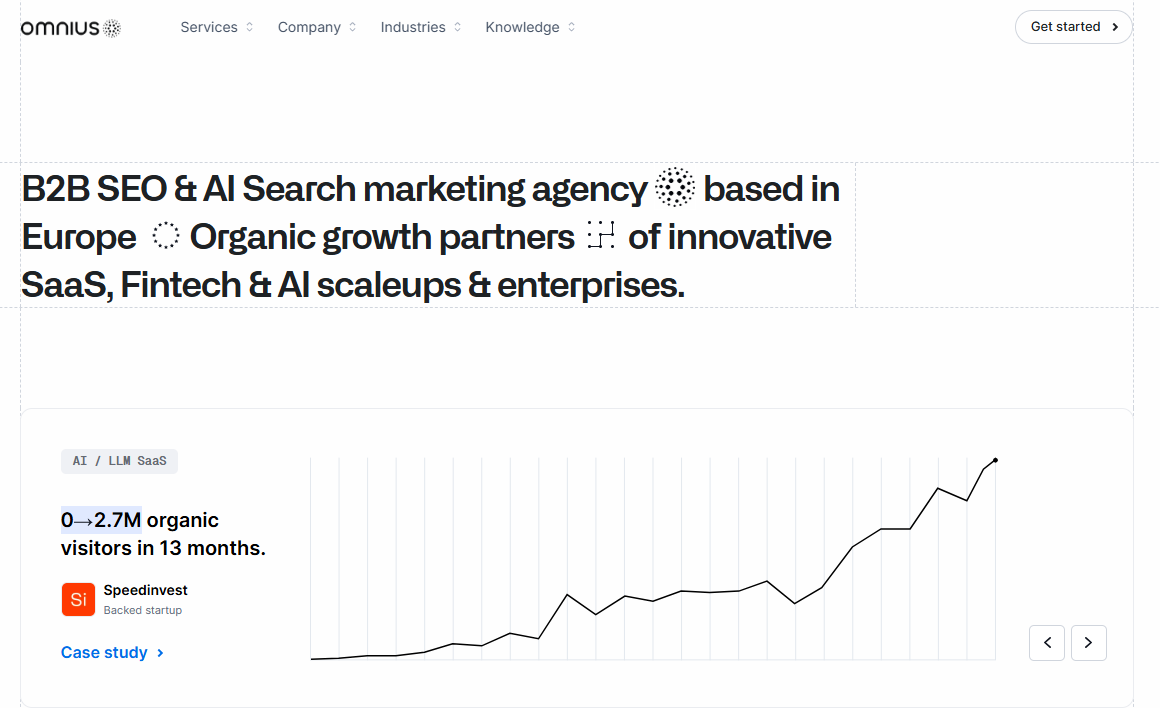
Omnius is explicit, on its own site, about not running standardised packages. That single fact does most of the work in deciding whether it fits you.
What it does: Omnius's own site states that it does not offer standardised packages; pricing and scope are set per engagement rather than chosen from a tier list.
Who it's for: A team whose needs don't map cleanly onto a generic small/medium/large retainer, and who would rather negotiate a scope built around their actual situation.
| What | Detail |
|---|---|
| Published price | None; no standardised packages, per its own site |
| Billing basis | Scoped per engagement |
| Minimum commitment | Not published |
| Where to check current figures | Its own blog and contact page (linked below) |
Since there's no tier list to point to, there's no table of plans to compare here. Omnius's own site confirms the lack of standardised packages directly, so treat any specific figure you see elsewhere as unconfirmed.
Strengths:
- Scope matches the actual problem. A custom engagement can be shaped around what a specific SaaS company needs rather than forced into a generic tier.
- No pressure to buy more than you need. Without fixed packages, there's less incentive to upsell you into a tier built for a bigger company than yours.
Trade-offs:
- No baseline to compare against. Without a published package, you can't hold Omnius's quote up against a competitor's listed price without first getting both numbers.
- Every engagement starts from scratch. That's good for fit and slower for procurement, especially if your company requires a comparison table for a purchasing decision.
Key capabilities:
- No standardised packages, confirmed on its own site
- Scope and pricing set per engagement
- Suited to buyers who want a tailored fit over a quick comparison
Good fit: A SaaS company whose needs genuinely don't fit a generic small/medium/large retainer, and who has the patience to negotiate a custom scope.
Not a fit: A buyer who needs to compare three vendors by price in an afternoon, with no time for a scoping conversation at each one.
The practical limitation is procurement speed, not quality. A custom-scope agency is slower to compare, by design.
If your company runs procurement through a process that needs a published rate card before a vendor even gets a meeting, Omnius will be a frustrating fit regardless of how well the work itself might go. If your buying process can tolerate a scoping conversation in exchange for a better-fitted engagement, that same lack of a rate card stops being a problem and becomes the point.
📋 Get Listed / Advertise
We update this guide monthly. Want your tool featured? Contact: [email protected].
What Counts As SaaS SEO (And What Doesn't)
SaaS SEO is SEO built around how someone evaluates and buys software, not just SEO performed for a company that happens to sell software.
That distinction shows up in the content itself. Generic SEO optimises for informational and transactional intent broadly. SaaS SEO adds a layer that's specific to the buying motion, built from trial and product-qualified-lead stage content, keyword mapping built around product features and use cases rather than just topics, and integration and comparison pages that answer the exact questions a prospect asks right before they sign up or book a call. A generalist agency can rank a blog post. A SaaS specialist builds the pages that sit between "I have this problem" and "I'm trying your product."
That's the practical test for whether an agency's SaaS experience is real or relabelled. Ask what percentage of their client roster is software companies, and ask to see an example of a comparison or integration page they built, not just a blog post.
A relabelled generalist will usually have a strong answer on traffic growth and a thin one on anything product-specific. A genuine SaaS specialist can walk you through how a trial-stage page is structured differently from a top-of-funnel blog post, why a comparison page targets a different search intent than a feature page, and how each one is supposed to move a reader toward a signup or a demo rather than just toward another page view.
How SaaS SEO Is Different From Regular SEO
The short answer: SaaS SEO requires product-led keyword intent, trial and PQL-stage content, and comparison or integration pages that regular SEO doesn't typically need to build at all.
A local service business or an ecommerce brand is usually optimising for "near me" searches or product-category terms where the buying decision is comparatively simple. A SaaS company's buyer, by contrast, moves through a longer evaluation. They search a problem, then a category, then specific competitors, then integrations with tools they already use, then pricing and alternatives. Each of those stages needs its own content shape, not a single blog post stretched to cover all of them.
This is also where generic-SEO experience stops transferring cleanly. An agency that has only ever worked on content-marketing sites or ecommerce catalogues knows how to rank pages. It doesn't automatically know what a product-qualified lead looks like, how a free-trial funnel changes what a comparison page needs to say, or why an integration page for a tool your buyer already uses can outperform a generic "best of" post. That's the gap a SaaS specialist is supposed to close, and it's worth testing for directly in a sales call rather than taking the word "SaaS" in an agency's tagline at face value.
None of this means generic SEO skill is worthless for a SaaS company. Technical SEO, link building, and basic on-page optimisation work the same way regardless of industry. The difference sits entirely in the content layer, in what gets written, for whom, and at which stage of the buying decision. An agency can be technically excellent and still produce the wrong content for a SaaS buyer, which is why "they rank pages well" is a necessary but not sufficient reason to hire a given agency for this specific job.
What To Look For In A SaaS SEO Agency
Evaluate on evidence and attribution, not on a pitch deck. TRM's own scorecard for vetting a B2B SaaS SEO agency weights five things, and in this order of importance:
- Citation engineering, weighted at 25%. Can the agency show it has gotten a client's content cited inside AI answers, not just ranked in traditional search, and can it explain how? An agency that treats this as an afterthought is scoring the single heaviest-weighted criterion at zero.
- Pipeline attribution, weighted at 25%. Does the agency report on pipeline and closed-won revenue tied to specific content, or only on traffic and keyword position? Ask to see a real report from an existing client, not a template, before you take this answer on faith.
- AI visibility measurement, weighted at 20%. Does the agency track and report where a client shows up in AI-generated answers, as a distinct metric from organic rankings? If AI visibility is bundled invisibly into a general "SEO performance" number, it isn't actually being measured.
- A unified system across channels, weighted at 15%. Is the work connected across content, technical SEO, and AI visibility, or run as three disconnected workstreams reporting separately? A disconnected approach usually shows up as three different account contacts and three different dashboards.
- ICP and intent alignment, weighted at 15%. Does the agency's content map to your actual buyer's search behaviour and stage, rather than a generic keyword list? A content calendar built from a keyword tool alone, with no reference to your actual ICP, is the clearest sign this criterion is being skipped.
That weighting comes from TRM's agency scorecard and RFP guide, which also gives you the actual RFP questions to run this evaluation on a real shortlist rather than from a sales deck.
Score each agency on your shortlist against these five criteria before you look at price at all. A cheap agency that can't explain pipeline attribution isn't actually cheap, it's just unmeasured.
The Five-Minute Fit Rule: Stage, Motion And Content State
You don't need another ranking to pick a SaaS SEO agency. You need three variables answered honestly about your own company, and most of the names on any list will eliminate themselves once you answer them.
Variable one is stage and budget band. If your monthly SEO budget realistically sits under $5,000 and you need flexibility to change course inside of six months, Rock The Rankings and Powered By Search are probably not worth a call. eesel.ai's review describes Breaking B2B as more accessible for earlier-stage companies, with the trade-off of a slower path to direct revenue, which is a more honest fit for a tight budget than chasing a five-figure retainer you can't sustain. If your budget clears $6,000 a month and you can commit for six months or more, agencies in that range open up, and the same review gives Virayo's reported minimum as six months and roughly $6,000 a month. At the higher end, saashero.net's profile positions Daydream for Series A through pre-IPO B2B tech companies, with a budget floor that the same source notes may exclude earlier-stage teams entirely.
Variable two is product motion, PLG versus sales-led. A product-led company lives or dies on trial signups and in-product activation, so its content needs to meet buyers at the comparison and trial-evaluation stage, not just the top-of-funnel problem stage. A sales-led company's content has more room to sit earlier in the funnel, because a human in the sales process closes the gap a PLG site has to close with content alone. If you're PLG, weight your evaluation of any agency toward their evidence of trial-stage and comparison-page work specifically, not general blog output. If you're sales-led, weight it toward pipeline attribution and sales-enablement content instead.
Variable three is content and tech readiness. An agency inheriting a site with years of existing content and a clean technical foundation does different work than one starting from near zero. The same eesel.ai review notes that Saffron Edge suits established companies and doesn't offer direct founder involvement, which matters if you're early enough that you still want the agency's senior people, not a junior account team, on your account. Before any agency can do useful work, they also need the right access permissions to your GSC and GA4 accounts, which tells you a lot about how seriously an agency treats measurement from day one. And because AI-citation readiness is no longer optional, it's worth reading how to choose an AI-search-ready agency before you sign with anyone whose pitch is still built entirely around blue links.
Run all three variables against your own company before you book a single call. Most agencies on any list, including the six profiled above, will eliminate themselves on at least one of the three in under five minutes, and that's the point.
Put the three together and you get a short, honest filter instead of a ranking. A pre-seed, PLG company with a mostly-empty site should look toward the more accessible, earlier-stage end of the market, accept the slower revenue path that comes with it, and prioritise an agency willing to build trial-stage and comparison content from scratch. A growth-stage, sales-led company with years of existing content and a clean technical foundation can afford to weight pipeline attribution and a longer commitment more heavily, because the foundation work is already done and the agency's job is to compound an existing asset rather than build one from nothing. Write your own answer to all three variables down before you take a single call, and hold every pitch against it rather than the other way around.
If you would rather have a team run this fit check, the reporting, and the AI-visibility tracking for you, book a thirty-minute call. One of the founders takes it, and you leave knowing what we would check first. See the GEO + SEO Growth Programme.
Red Flags And Disqualifiers That Rule Out Most Agencies
Most of the agencies you'll find in a broad search can be ruled out fast, before you ever get to a proposal, by checking for a handful of specific warning signs.
- A guaranteed ranking. Google's ranking-systems guidance warns against promises of a guaranteed position, because no agency controls the algorithm. If a sales call promises a specific rank by a specific date, that's the call to end.
- Reporting that stops at traffic and rankings. If an agency can't connect its work to pipeline or closed-won revenue, you're paying for a vanity metric, not a growth channel.
- A lock-in contract with no exit clause. A long minimum term is not automatically a red flag on its own, but a long term with no defined way out if the work isn't performing is.
- Case studies with no attribution method shown. A results slide with a big percentage and no explanation of how it was measured, or against what baseline, is marketing copy, not evidence.
- No answer on how they measure AI-search visibility. If an agency's reporting is still built entirely around traditional rank tracking with nothing on AI-citation measurement, their methodology is behind where the channel already is.
None of these five signs is disqualifying on its own in every circumstance; a newer agency might genuinely still be building out AI-citation reporting, for instance. What should worry you is finding two or three of them together, especially a guaranteed ranking paired with case studies that show no attribution method. That combination usually means the sales process is built to close you quickly, not to set honest expectations about what the engagement will actually deliver.
Before you trust any agency's own case-study numbers, pull their domain through Semrush's Domain Overview to see whether the traffic and keyword trend actually matches the story they're telling you in the pitch. A domain that hasn't grown the way the case study implies is worth a direct question in the next call.
For a fuller walk-through of what to check in a contract before you sign, evaluate an agency before signing covers the clause-by-clause version of this section.
Agency, In-House Or Freelancer: Where This Decision Fits
Hire an agency when you need a full team's worth of specialised skill faster than you could hire and ramp it yourself, and you have the budget to pay for that speed.
Build in-house when SEO is central enough to your growth strategy that you want institutional knowledge sitting inside the company permanently, and you can afford to hire, manage, and retain a small team rather than rent one. Go fractional or freelance when you need one specific skill gap filled, such as technical SEO or content production, without committing to either a full agency retainer or a full-time hire.
None of these is universally correct, and the right answer changes as a company grows; a team that starts with an agency often builds an in-house function later, once the channel has proven itself and the volume justifies a dedicated hire. The decision is also not permanent. It's reasonable to start with an agency to prove the channel works, bring the function in-house once the volume of work justifies a full-time hire, and bring in a fractional specialist for a specific gap, such as technical SEO, at any point along the way. For the actual cost comparison between the three paths, the in-house vs agency cost breakdown walks through the numbers rather than repeating them here.
How Much Does A SaaS SEO Agency Cost
There's no SaaS-specific pricing survey behind the numbers most listicles quote, so start from the two general SEO benchmarks that are actually sourced, then adjust from there.
Backlinko's survey of more than 300 SEO professionals, updated in December 2025, found a typical monthly retainer of $1,000 to $2,500, and a typical one-off SEO project costing $1,000 to $5,000. Ahrefs' separate survey of 439 SEO service providers put the average monthly SEO cost at $2,917, with an average hourly rate of $111.
None of that is SaaS-specific. SaaS SEO retainers, especially from specialists rather than generalists, tend to run above those general benchmarks, and the budget floors that do surface for SaaS-specific agencies come from third-party reviews rather than published vendor pricing. eesel.ai's pricing review reports Powered By Search at roughly $10,000 a month with a one-year minimum, and gives Virayo a $6,000-a-month floor with a six-month minimum. Treat those as planning signals about where SaaS-specialist pricing tends to sit, not as confirmed quotes from the agencies themselves.
Whatever number you end up looking at, weigh it against what's actually included. A $2,000-a-month retainer that covers only content production is a different purchase from a $2,000-a-month retainer that includes technical SEO, reporting, and AI-visibility tracking, even though the invoice looks identical. Ask for a line-by-line breakdown of what the monthly fee buys before you compare two quotes on price alone.
If you'd rather skip the guesswork entirely and want a programme that includes AI-visibility tracking alongside traditional SEO, an ongoing SEO and AI-visibility programme is one option, and TRM's own SEO and AI-visibility pricing is published, rather than something you have to ask for on a call.
Questions To Ask Before You Sign
Ask these before you sign anything, and judge the answers on specificity, not confidence.
- How do you attribute pipeline to your work? A good answer names a specific method and a specific tool. A vague answer about "tracking everything" is not an answer.
- What does your reporting cadence actually look like? A good answer describes a fixed schedule and the metrics it covers. A good answer is not "we'll check in."
- What's the exit clause if this isn't working in 90 days? A good answer gives you a concrete off-ramp. A good answer is not a shrug about "let's talk when we get there."
- How do you measure AI-search or AI-citation visibility, specifically? A good answer names a method or tool distinct from traditional rank tracking. A good answer is not "that's basically the same as SEO."
- Can you show me a comparison or integration page you built for a SaaS client, not just a blog post? A good answer produces a real example in the call. A good answer is not a generic case-study PDF with no live link.
Ask all five in the same call, in this order, and pay as much attention to how an agency answers as to what they actually say. An agency that gets defensive at the exit-clause question, or deflects the AI-visibility question with a joke about buzzwords, is telling you something about how the relationship will go once a report comes back disappointing.
For the longer version of this list, including follow-up questions and the specific red flags each answer should trigger, the questions to ask before hiring covers it in full. If you want the reverse direction, a full client onboarding questionnaire shows what a serious agency should be asking you, and why each of those answers matters to the strategy they build.
How To Measure Results And What Good Reporting Looks Like
Good reporting shows pipeline and closed-won revenue tied to specific content, not just traffic and keyword position.
A report that only shows rankings and sessions tells you the agency is working, not that the work is making money. The three things a reporting cadence should actually contain are pipeline influenced by organic content, closed-won revenue attributed to specific pages or campaigns, and AI-citation visibility tracked as its own line item rather than folded silently into "SEO performance." If a monthly report doesn't connect to any of those three, ask why before you ask for anything else.
The cadence itself matters as much as the content of the report. A monthly report is the minimum; anything less frequent makes it hard to catch a problem before it's cost you a quarter. Ask what the report looks like before your first invoice, not after, so you know what you're actually agreeing to measure.
Timelines matter here too, and expecting month-one results sets you up to fire a working agency too early. For the realistic version of what month three and month six should each look like, realistic month 3 vs month 6 checkpoints lays out the actual timeline rather than a vague "SEO takes time" disclaimer.
Where GEO And AI Visibility Fit Into The Decision
AI-citation readiness belongs in the evaluation now, as a core criterion, not as an add-on you ask about after price is settled.
Buyers increasingly get their first impression of a vendor from an AI-generated answer, not a search results page, which means an agency that can't explain how it gets a client cited inside those answers is already behind. TRM's own scorecard for vetting an agency weights citation engineering and AI visibility measurement at a combined 45% of the total score, nearly double the weight given to pipeline attribution alone, which tells you how central this has become to a serious evaluation rather than a nice-to-have.
Ask any agency on your shortlist to show a specific example of content that earned an AI citation, and ask how they measure it going forward. If the answer is vague, or if AI visibility isn't a distinct line in their reporting, treat that as a disqualifier on the same level as no pipeline attribution.
This isn't a separate purchase from SEO, and an agency that pitches it as an add-on module is framing it wrong. The content and technical work that earns a traditional ranking and the work that earns an AI citation overlap heavily, which is exactly why it belongs inside the same evaluation criteria as everything else in this guide, not as a line item you negotiate separately after the SEO scope is settled. For the fuller roadmap on how this fits together over a 90-day programme, a full SEO to GEO playbook walks through the whole sequence.
FAQs
How Long Does SaaS SEO Take To Show Results?
Can A SaaS SEO Agency Guarantee Rankings?
Should A PLG SaaS Company Hire A Different Kind Of Agency Than A Sales-Led One?
What's The Difference Between SEO And GEO/AEO When Evaluating An Agency?
Should An Early-Stage Startup Hire An Agency Or Build In-House First?
What Should The First 90 Days Of A New Engagement Look Like?
How Do I Check Whether An Agency's AI-Search Claims Are Real?
What Happens If I Need To Fire My SaaS SEO Agency?
Is A Cheaper SaaS SEO Agency Ever The Better Choice?
Do SaaS SEO Agencies Offer Month-To-Month Contracts?
If you've narrowed your shortlist to two or three names, book a free 30-minute call. We'll walk through the fit rule against your own stage, motion, and content state, and tell you what we'd flag in a contract like the ones above. Book a free 30-minute call.
📑 Disclosure!
Some links in this article are affiliate links. If you sign up through them, The Rank Masters may earn a commission at no additional cost to you. This does not influence which tools we recommend or what we say about them.