

Most "best SEO agency for startups" lists are directory rankings in disguise. The right fit depends on stage and budget. Pre-seed and seed startups need a boutique or project engagement priced around $1,500 to $5,000 a month, while a funded, Series A startup is usually ready for a $5,000 to $10,000 monthly retainer. The Rank Masters, which publishes this guide, is listed first for startups past product-market fit that want SEO and AI-search visibility in one founder-led programme.
This holds for startups that already have product-market fit and treat organic search as a core growth channel, not a side bet.
Pre-revenue startups with no proven channel yet, or ones with only a few months of runway, are usually better served by free DIY SEO or paid acquisition than by any agency at this stage.
If you would rather skip the shortlist entirely, TRM runs a GEO + SEO Growth Programme built around exactly this stage-and-budget logic. Look at what it covers before you start comparing agencies.
📋 Get Listed / Advertise
We update this guide monthly. Want your tool featured? Contact: [email protected].
SEO Agencies For Startups At A Glance
The Rank Masters is listed first because it is our own agency, and we would rather say so than hide it in the order. Read its profile with that in mind. The five after it show up repeatedly in startup-SEO roundups, each with a different specialism. They are listed alphabetically, not ranked, because the ranking most of these taglines come from is published by a site with its own commercial interest in the order. Read the stage fit, then read the full profile before you reach out to anyone.
| Agency | Best For | Stage Fit | Likely Engagement Model |
|---|---|---|---|
| The Rank Masters | SEO and AI-search visibility in one programme | Post-traction, organic search a core channel | Monthly programme, 6-month minimum |
| Boostability | White-label SEO | Reseller clients | Reseller or project |
| Smash Digital | Scaling startup growth | Funded, scaling | Full retainer |
| SmartSites | Generalist SEO services | Any stage | Project or retainer |
| WebFX | Full-service SEO with paid ads | Any stage | Bundled retainer |
| Whitespark | Local SEO | Local-only | Project, local-only |
If your startup has already outgrown this list, moving past Series A and into mid-market or enterprise territory, TRM's best enterprise SEO agencies guide is the more useful comparison.
📋 Get Listed / Advertise
We update this guide monthly. Want your tool featured? Contact: [email protected].
1. The Rank Masters: Best For SEO And AI-Search Visibility In One Programme
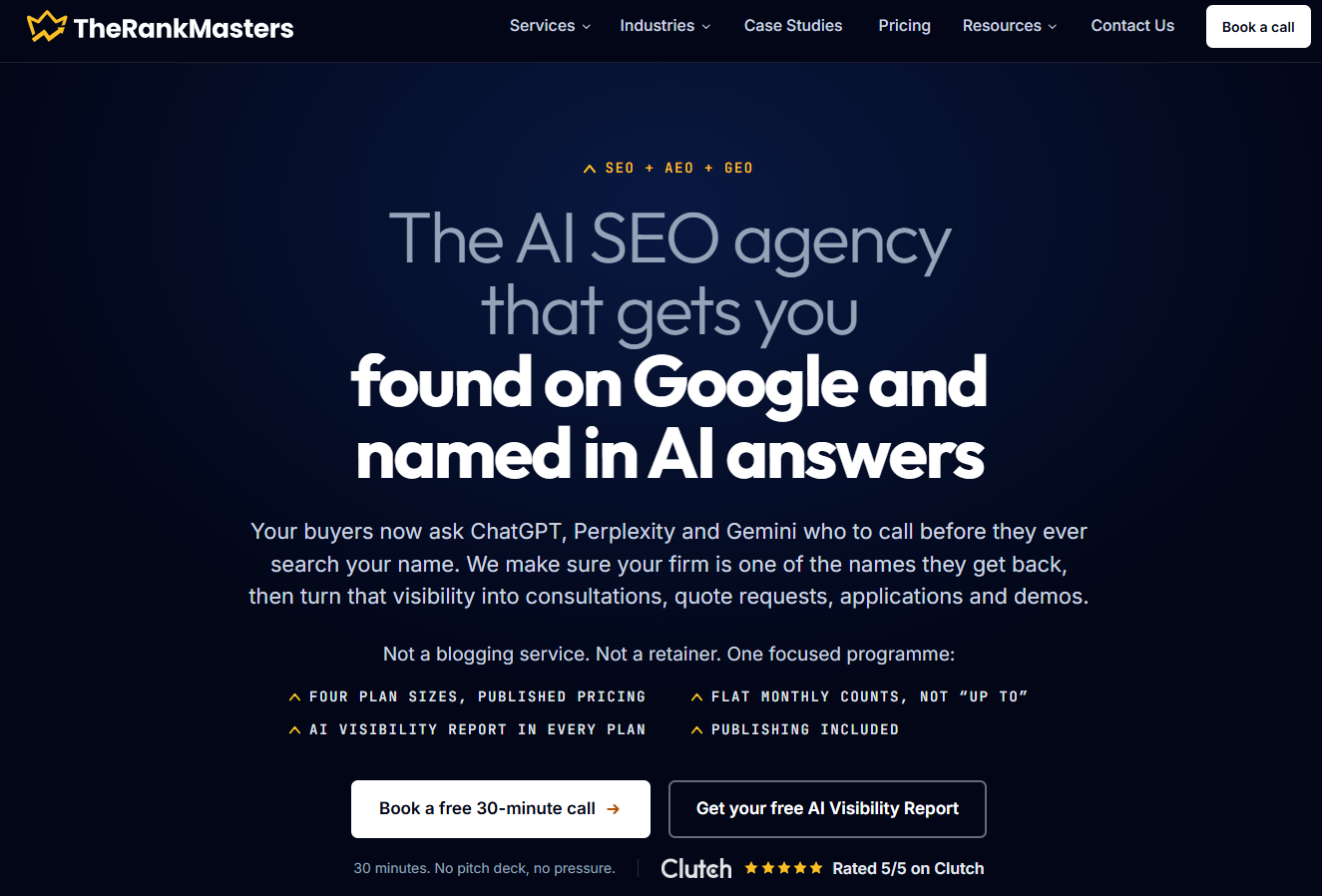
The Rank Masters (TRM) publishes this guide, so this is the one profile on the list written by the agency it describes. It gets the same test as the rest, stage fit, scope and the limitation that matters.
TRM runs SEO, answer engine optimization and generative engine optimization as one monthly GEO + SEO Growth Programme. For a startup, the practical difference from the agencies below is who is on the call and how scope is written. One of the two co-founders takes the monthly strategy call, and deliverables are stated as flat monthly counts of pages and earned mentions rather than "up to" amounts, which is the cadence test this guide sets out in its scope section.
| Attribute | Detail |
|---|---|
| Best known for | SEO and AI-search visibility in one programme |
| Engagement style | Monthly programme, 6-month minimum, then month to month |
| Pricing | Published on its own pricing page |
TRM's pricing page lists every plan, so you can hold it against the stage bands later in this guide before you take a call. The plans share the same services and differ only in monthly volume, there are no setup fees, and a month-3 checkpoint lets you leave if the promised pages, mentions or tracking are not delivered.
Strengths
- Founder-to-strategist access, with co-founder Waqas Arshad on the strategy call and co-founder Faisal Irfan leading content, SEO and AI-visibility delivery.
- Flat monthly counts and a month-3 delivery checkpoint, which keep a startup from paying for scope that never ships.
- AI-search visibility measured from the start, with a monthly AI Visibility Report across ChatGPT, Perplexity, Gemini and Google AI Overviews.
- Named, checkable results, such as PSOhub's 54 AI citations in 90 days and Buddy Punch's monthly organic traffic growing from about 28,000 visits to more than 93,000.
Trade-offs
- A 6-month minimum is longer than the 3-to-6-month project engagement this guide suggests for a seed-stage startup with a narrow need.
- Its published case studies come from established SaaS companies with existing content libraries, not pre-seed startups, so ask for an example closer to your stage.
- No paid ads, social media or website rebuild, and no guarantee of rankings, traffic or AI citations.
Key capabilities
- Revenue-first keyword plan, a review of your top three competitors, and a rolling content calendar.
- Comparison, alternatives, use-case and buying-intent pages published to your CMS with schema.
- Technical SEO and AI-readiness fixes, including structured data, llms.txt and AI-crawler access.
- A live GSC and GA4 dashboard with a one-page monthly roadmap.
Good fit: A startup with traction, organic search already treated as a core channel, and a budget that clears its published plans, that wants AI-search visibility built in rather than added later.
Not a fit: A pre-revenue startup still looking for a channel, or a founder who wants guaranteed rankings, a site rebuild, or paid ads from the same vendor.
The limitation to weigh is timing. TRM's programme is built for a startup that already has something to scale, and the readiness check further down applies to it as much as to anyone on this list. If you cannot yet clear the traction and budget bars, doing the work yourself first is the cheaper answer, including over hiring us.
2. Boostability: Best For White-Label SEO
Boostability's startup-SEO positioning centers on white-label SEO. The agency is built to deliver search work under someone else's brand, typically another marketing or web agency that does not have in-house SEO capacity of its own.
For a startup, that matters less for the surface-level deliverables and more for who you are actually talking to. You are more likely to encounter Boostability's work through a web design, branding, or PR partner that has resold it than by signing with Boostability directly. If you are hiring an SEO team yourself rather than through a partner, that is worth asking about upfront, before you assume you are getting a dedicated relationship.
| Attribute | Detail |
|---|---|
| Best known for | White-label SEO |
| Engagement style | Reseller-oriented, white-label |
| Pricing | Pricing on request |
Strengths
- Built for process and consistency at scale, across many resold accounts.
- Established specifically in the white-label SEO category, not a generalist offering it as an add-on.
- Infrastructure for standardized reporting that a reseller partner can hand to its own clients.
Trade-offs
- Optimized for partner relationships, not founder-to-strategist access.
- A startup buying direct may get a process built for resellers rather than for a five-person team.
- No published pricing to compare against the budget bands set out later in this guide.
Key capabilities
- SEO delivered under a partner's brand rather than Boostability's own.
- Works primarily through agency and web-design partners.
- Reporting built for reseller oversight across multiple end clients.
Good fit: A web design or branding agency that wants to offer SEO without hiring a team.
Not a fit: A startup founder who wants a dedicated point of contact and direct access to the strategist doing the work.
The clearest limitation is indirection. You are buying a process built to be resold, not necessarily a direct relationship with the people doing your SEO, and that is worth confirming before you sign.
3. Smash Digital: Best For Scaling Startup Growth
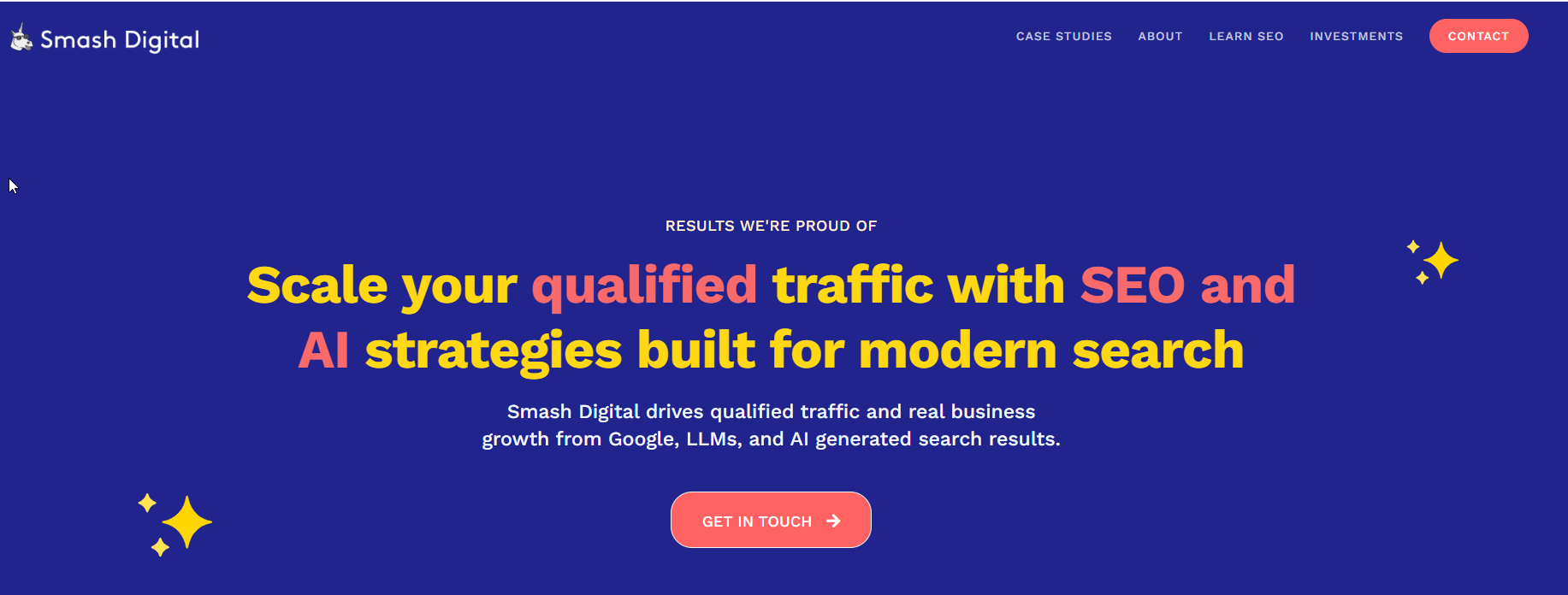
Smash Digital's positioning is built around scaling startup growth, aimed at funded startups past the DIY stage that need a partner able to grow with them as budget increases rather than a one-off project shop.
One thing is worth flagging before you take any "best startup SEO agency" ranking at face value, including the one this tagline is drawn from. When the publisher of a ranking also owns or is closely tied to the agency sitting near the top of it, that ranking is marketing copy first and an independent comparison second. Read Smash Digital's own case studies with that in mind, and verify any traffic or client numbers yourself rather than taking them as given.
| Attribute | Detail |
|---|---|
| Best known for | Scaling startup growth |
| Engagement style | Retainer, geared to scale |
| Pricing | Pricing on request |
Strengths
- Positioned specifically around growth-stage scaling rather than a generic startup label.
- Likely built for startups moving from seed traction toward a Series A pace of growth.
- A retainer model suited to a budget that grows over time rather than a fixed one-off scope.
Trade-offs
- The "best for" claim comes from a ranking with a disclosed commercial tie to the agency itself.
- No independently sourced client results exist to check that claim against.
- A startup still at the DIY stage may be paying for scaling capacity it does not yet need.
Key capabilities
- Growth-stage focus aimed at funded, post-traction startups.
- Positioned to scale the engagement as the startup's budget grows.
Good fit: A funded startup moving from a project engagement toward an ongoing retainer.
Not a fit: A founder who wants to compare agencies without weighing a ranking that has a financial stake in the outcome.
The practical limitation is that the one claim this profile can verify is Smash Digital's own positioning, not an independent result. Treat every other number you see about this agency the same way, by checking it rather than repeating it.
4. SmartSites: Best For Generalist SEO Services
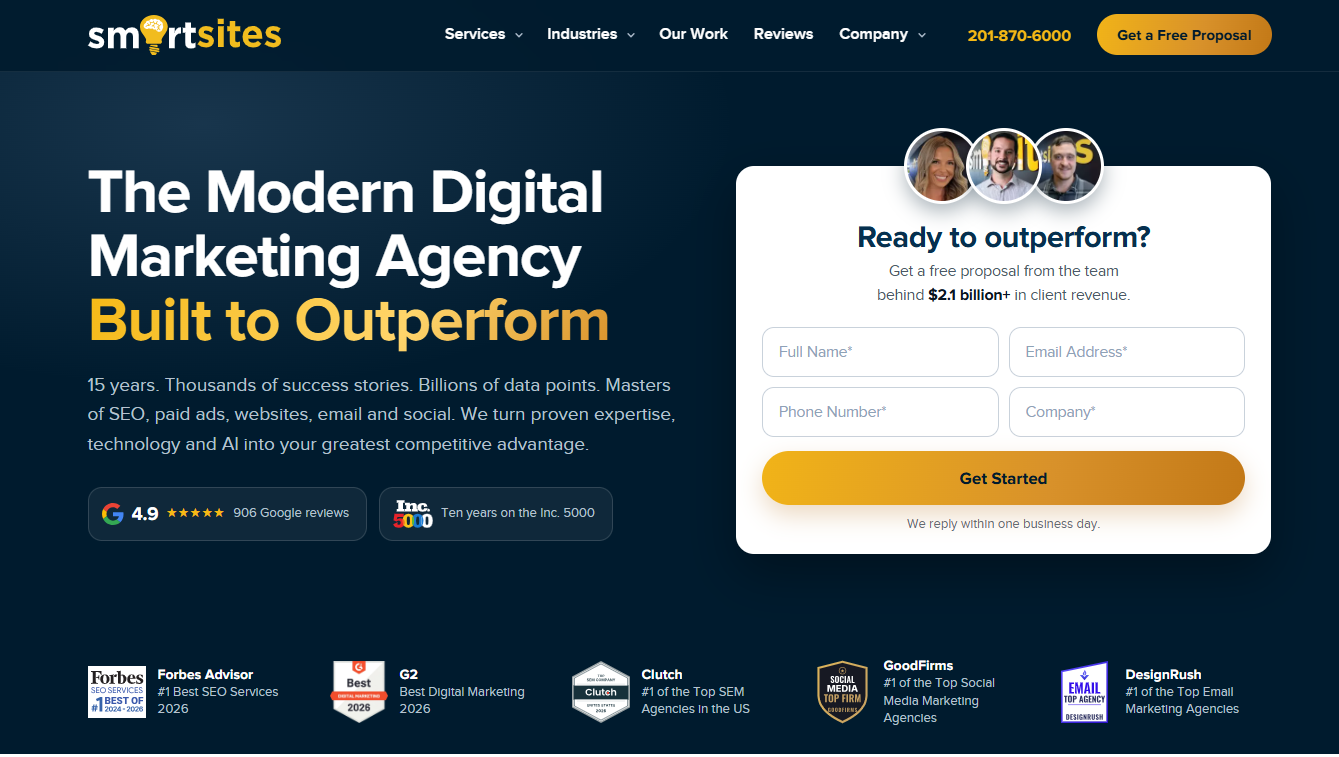
SmartSites is positioned as a generalist SEO option, the agency to pick when a startup needs competent, broad SEO work rather than a specialist in one niche or growth stage.
That generalist framing suits an early startup that has not yet defined exactly what kind of SEO problem it has. If you already know you need technical SEO for a complex web app, or local SEO for a single market, a specialist is usually the better match than a generalist. That tradeoff cuts both ways. A generalist can start executing immediately because there is no specialist hand-off to coordinate, but no one on the account is likely to be the deepest content strategist or technical SEO specialist you could hire for a narrowly defined problem.
| Attribute | Detail |
|---|---|
| Best known for | Generalist SEO services |
| Engagement style | Project or retainer |
| Pricing | Pricing on request |
Strengths
- Broad service range rather than a single narrow specialism.
- Suited to a startup that is not yet SEO-literate enough to brief a specialist precisely.
- A reasonable default when "we need an SEO agency" is the full extent of the brief.
Trade-offs
- Breadth over depth, by design.
- A startup with a well-defined, narrow problem, a migration, international SEO, programmatic pages, may be better served by a specialist shop.
- Generalist positioning gives you less to differentiate on than a named specialism does.
Key capabilities
- General on-page, technical, and content SEO under one roof.
- Positioned as a one-stop SEO vendor rather than a niche shop.
- One team handling strategy, execution, and reporting, rather than routing specialist work to a separate vendor.
Good fit: An early-stage team that needs "an SEO agency," full stop, without a narrow, already-diagnosed brief.
Not a fit: A startup with a specific, well-understood SEO problem that calls for a specialist.
The limitation to weigh is depth. A generalist is the right starting point when you do not yet know what kind of SEO problem you have, and often the wrong one once you do. A useful test is whether you could write a one-paragraph brief for a specialist today. If you cannot yet, a generalist buys you time to find out what that brief should say.
5. WebFX: Best For Full-Service SEO With Paid Ads
WebFX is positioned around full-service SEO bundled with paid ads, meaning a startup can buy SEO and paid search or paid social management from the same vendor.
That bundling is the whole pitch. One invoice, one point of contact, two channels. It suits a startup that wants a single marketing partner rather than separately managing an SEO shop and a paid media shop at the same time. The appeal is strongest for a startup still deciding how to split budget between organic and paid. A single vendor can shift spend between the two channels without a renegotiation between two separate agencies, which matters when a startup's budget allocation is still genuinely in flux.
| Attribute | Detail |
|---|---|
| Best known for | Full-service SEO with paid ads |
| Engagement style | Bundled retainer |
| Pricing | Pricing on request |
Strengths
- One vendor across two channels reduces coordination overhead for a small team.
- Useful when a startup is too lean to manage two separate agency relationships.
- Shared reporting across organic and paid can surface where the two channels overlap.
Trade-offs
- A bundled vendor is rarely the top specialist in either channel on its own.
- A startup that already has strong paid media in-house may be paying for ads expertise it does not need.
- Scope that spans two channels can mean less depth per channel than a single-discipline specialist offers.
Key capabilities
- SEO plus paid search or paid social management from one vendor.
- Single-vendor reporting across organic and paid channels.
- Budget that can move between organic and paid within the same engagement, without a separate negotiation.
Good fit: A lean startup that wants both organic and paid managed under one roof.
Not a fit: A startup that already has a strong in-house paid media function and only needs an SEO specialist.
The trade-off to weigh against the convenience is specialization. Bundling buys you one relationship, not necessarily the best possible result in either channel taken alone. That is a reasonable trade for a startup that has not yet decided how its budget should split between organic and paid. It is a worse one for a startup that already knows SEO is the priority and does not want paid-media capacity it is not using.
6. Whitespark: Best For Local SEO
Whitespark is positioned as a local SEO specialist, a clear category leader among agencies built around Google Business Profile, local citations, and map-pack rankings.
That specialism makes this one of the easiest calls on this list. It is a strong fit only if your startup serves customers in defined, physical locations. A SaaS product, a remote-first tool, or anything without a storefront, service area, or local footprint gets nothing out of a local SEO specialist, however good the specialist is at what it does. If even one of your target customers could use your product without caring where you are physically located, that is a signal this specialism is not the one you need, whatever the sales conversation emphasizes.
| Attribute | Detail |
|---|---|
| Best known for | Local SEO |
| Engagement style | Project, local search only |
| Pricing | Pricing on request |
Strengths
- Deep specialism in one of the hardest SEO niches to do well, local search.
- Likely to understand map-pack and citation mechanics in more depth than a generalist would.
- A focused scope, which makes the engagement easier to evaluate than a broad, bundled one.
Trade-offs
- That specialism is wasted, not merely suboptimal, outside local search.
- Little apparent breadth into content or technical SEO beyond the local use case.
- Not a sensible choice for a remote-first or purely digital product, regardless of budget.
Key capabilities
- Google Business Profile management.
- Local citation building and cleanup.
- Map-pack ranking work.
- Local search visibility tracking across multiple locations.
Good fit: A startup with a physical service area, multiple locations, or a local-first product.
Not a fit: Any SaaS, remote-first, or purely digital-product startup.
The limitation here is not quality, it is category. This is the wrong agency for almost every SaaS startup reading a "best SEO agency for startups" list, and the right one for the minority that actually compete on local search. Confirm which category you fall into before the first call, not after, because the conversation will sound reassuring either way and the fit depends entirely on something the pitch itself will not surface.
Is Your Startup Ready For An SEO Agency?
Before you compare a single agency, answer a more basic question. Are you actually ready to hire one?
You need traction, not just a product. The readiness bar for hiring a professional SEO agency sits at product-market fit, or at least clear traction, with organic search already treated as a core acquisition channel rather than something you are trying out alongside everything else. If you have not validated that organic search converts for you at all, an agency cannot manufacture that validation. It can only execute against a strategy, and a strategy needs a market to aim at.
You need a budget floor, not just a willingness to pay something. Upgrowth's framework puts that floor at roughly $1,000 to $2,000 a month, below which a professional agency engagement rarely works. Below that line, you are usually buying a fraction of a real program, not a discounted version of one, and the deliverables list later in this guide shows exactly what gets cut first.
If either box is unchecked, you have not yet found your channel, or you cannot clear that monthly floor without starving another part of the business, the better move is not to hire an agency anyway and hope the output eventually catches up to the spend. It is to do more of the work yourself first. TRM's own guide on building organic growth without a huge SEO budget covers exactly this, what a resource-constrained, pre-agency startup can do on its own, and the point at which doing it yourself stops being the efficient option.
None of this is a permanent verdict. A startup that is not ready today is often ready in two or three quarters, once traction and budget both move. The readiness check is worth re-running each time your situation changes materially, not just once at the start.
There is a middle case worth naming separately, a startup that clears the traction bar but not the budget bar, or the reverse. Traction with no budget usually means the founder is doing SEO personally and needs to decide whether the time cost is worth it versus freeing that time for product or sales. Budget with no traction yet is the riskier combination, because it tempts a founder to buy an agency relationship to manufacture a result that organic search cannot deliver on its own. In that case, the money is usually better spent validating the channel first, through a short consulting engagement or in-house effort, before committing to a retainer sized for a channel that has not yet proven itself.
Match The Agency Model To Your Startup's Stage And Budget
This is the part most "best agency" lists skip entirely. Which model actually fits your stage, and what should it cost. There are three real options, not five generic engagement types with marketing names attached to them.
At pre-seed or seed, with traction but not yet scale, choose a boutique or project engagement for $1,500 to $5,000 a month. Upgrowth's framework treats this as the right move for a startup that needs an agency but is not ready to scale an open-ended retainer, meaning a defined project of roughly 3 to 6 months with clear deliverables. rzlt.io's 2026 retainer-cost breakdown puts early-stage SaaS, pre-seed to seed, at that same $1,500 to $5,000 a month for something concrete, roughly 2 to 4 pieces of content a month plus basic technical and link work. Anything you are quoted well under that band for the same scope is the first red flag, not a bargain.
At Series A through C, once you are scaling, choose a full retainer for $5,000 to $10,000 a month. The same rzlt.io data puts Series A to C B2B SaaS companies most commonly in that $5,000 to $10,000 monthly band. That lines up with the broader market. rzlt.io's retainer-cost data shows typical B2B SEO retainers running from about $1,500 to $15,000 or more a month, with an average of about $3,200 a month across Ahrefs and Backlinko's industry surveys. A Series A startup paying meaningfully below $5,000 is probably buying a stripped-down version of that retainer, not a discount on the same one.
If you are between stages, not yet ready to scale to a full retainer, do not round up just to look more serious. rzlt.io's data shows retainers below $1,000 a month usually cover only one or two workstreams, enough for, say, content alone, or link building alone, not a full program. If that is genuinely all you can afford this quarter, buy exactly that one workstream deliberately, rather than a "full retainer" that has quietly been trimmed down to fit the price.
Cost is not only billed by the month. DesignRush's data on SEO project pricing shows project-based engagements ranging from under $5,000 for a narrow scope to $250,000 at enterprise and SaaS scale, and the same DesignRush hourly-rate data puts mid-market agency rates at about $115 an hour, rising to about $125 at the enterprise or SaaS tier. Ahrefs' 2026 pricing survey of 439 SEO professionals put average hourly rates at $72 for freelancers, $99 for agencies, and $171 for consultants, useful context if an agency ever quotes you by the hour instead of a flat monthly retainer.
The rule that ties all of this together is simple. The band should match your stage, not the agency's sales pitch. A pre-seed startup pitched a Series A retainer is paying for capacity that outpaces its actual search surface area. A scaling startup stuck on a starter package is not getting the resourcing it is paying for. Match the band to the stage, and treat anything well outside it in either direction as something to ask about before signing.
For a more formal version of this match, TRM's SaaS SEO agency scorecard and RFP turns these bands into an actual evaluation worksheet you can run against any proposal. And if you decide the honest answer is an ongoing program rather than a one-off project, TRM's GEO + SEO growth programme is built on the same stage-and-budget logic described here.
It is also worth separating the band from the billing structure. A monthly retainer and a fixed-price project at the same total cost are not the same purchase. A retainer buys ongoing capacity you can redirect as priorities shift; a fixed-scope project buys a defined output and nothing more once it is delivered. A pre-seed startup with a narrow, well-understood need, a technical audit and fix, say, or a content migration, is often better served by the fixed-price project even if the monthly-equivalent cost looks similar to a retainer, because the project has a natural end point and no temptation to keep paying for work that has already been done.
Agency Vs In-House Vs Consultant For A Startup
Not every stage-appropriate answer is "agency." Three real options exist, and the right one changes with the need, not only the budget.
- Agency: The right call once you have traction, a monthly budget that clears the floor set out above, and a need for a full team, strategist, writer, technical SEO, often a link specialist, rather than one skill. You are buying capacity you do not have to manage day to day.
- In-house hire: The right call once SEO is big enough, and permanent enough, to justify one person's full-time attention and a salary rather than a retainer. This usually arrives after an agency engagement has already proven the channel, not before, because a single junior hire with no institutional process to learn from is a slow and expensive way to find out what works.
- Freelance consultant: The right call for a narrow, time-boxed problem a founder can scope precisely, a technical audit, a migration, a content strategy document, work with a defined end point rather than an ongoing program.
Price is one way to tell these apart in practice. Ahrefs' 2026 survey of 439 SEO professionals put average hourly rates at $72 for freelancers, $99 for agencies, and $171 for independent consultants. The freelancer and consultant numbers can look similar on a quote, but the scope rarely is. A $72-an-hour freelancer is usually one person doing one thing; a $171-an-hour consultant is usually senior, scoped narrowly, and brought in precisely because the problem is hard enough to need that level of experience rather than a generalist's hours.
For most startups below Series A, the honest sequence is consultant or DIY first, agency once traction and budget both clear the floor, and in-house only once the agency relationship has already shown the channel is worth owning directly.
There is also a hybrid worth naming, a part-time or fractional in-house hire paired with a lighter agency or consultant retainer for the specialized work that one generalist hire cannot cover alone, technical SEO depth or a steady content pipeline, for example. This tends to show up once a startup is between seed and Series A, past the point where a single freelance engagement covers the need, but before the budget or the proven channel justifies a full-time SEO lead plus a full agency team on top.
What To Expect In Scope And Deliverables From A Startup SEO Agency
A startup-fit retainer should look recognizable before you ever see a report. rzlt.io's retainer breakdown puts an early-stage SaaS retainer at 2 to 4 pieces of content a month, plus basic technical and link work, and that is the baseline, not the ceiling, for what you should expect to see written into a monthly scope sheet.
Hold any proposal to this list.
- Content production: A stated number of pieces per month, not "content as needed." If an agency cannot commit to a cadence upfront, it has not scoped the engagement, it has priced a placeholder. TRM's own SEO content writing services is one example of what a defined content deliverable looks like at this stage.
- Technical and link work: Ongoing, not a one-time audit billed as the whole engagement. A single technical audit is a project, not a retainer.
- Reporting cadence: A monthly report at minimum, tied to metrics that fit your stage, rankings and indexed-page growth early on, revenue-attributable traffic once you have enough volume to measure it reliably.
- A named point of contact: Someone who can explain any number in the report without "I'll check and get back to you," not a rotating account manager you rarely hear from directly.
- A defined onboarding process: Access requests, a kickoff call, a documented starting state, not an agency quietly logging into your Search Console and starting work with no record of what changed.
That last point matters more than it sounds. TRM's own SEO agency client onboarding questionnaire and its companion GA4 and Search Console access checklist both exist because the alternative, an agency that asks for vague or excessive access with no documented process behind it, is itself a signal worth noticing before you sign anything.
Treat the first 30 days as a deliverable in their own right, not just a formality before the "real" work starts. A startup-fit agency should be able to tell you, before you sign, what it expects to have audited, documented, and scheduled by the end of the first month. An agency that cannot answer that question concretely, and instead talks only about the work it will do once onboarding is "complete," has not actually scoped the onboarding phase at all.
Questions To Ask Before You Hire An SEO Agency
A short list, asked in a first call, surfaces whether an agency actually understands startup constraints, or has simply added "startups" as a vertical on its homepage.
- "What does a startup at our stage usually get from you?" A fit signals a specific answer with a dollar band and a deliverable list attached. A mismatch signals a generic pitch-deck answer about "custom strategies for every client."
- "Can you show us a client at our stage, not just your biggest logo?" A fit signals a comparable-stage example, even without naming the client directly. A mismatch signals only enterprise case studies, reused for every pitch regardless of who is asking.
- "Who specifically will work on our account?" A fit signals named roles, ideally named people. A mismatch signals "our team" with no further detail, which usually means a rotating pool rather than a stable one.
- "What happens if our budget changes in six months?" A fit signals a clear mechanism for scaling the engagement up or down. A mismatch signals vague reassurance with no actual process for changing scope.
- "What do you need access to, and why?" A fit signals a short, specific list tied to deliverables. A mismatch signals a request for broad admin access with no explanation of what it is for.
These five are worth asking before you go any further, and worth asking in that order. The first two tell you whether the agency actually has startup-relevant experience rather than a claim to it; the last three tell you whether the engagement will be structured in a way that survives contact with a real, changing startup budget. An agency that answers the first two well but stumbles on the last three is often one that has done good work for startups before but has not built a repeatable process around doing it.
For the longer list, including what a good answer actually sounds like for each one, TRM's own guide to questions to ask an SEO company before hiring covers the full set.
Red Flags When Hiring An SEO Agency For A Startup
Three patterns separate a startup-fit agency from one that has simply added "startups" to its list of verticals.
Pricing that sits well below the floor. rzlt.io's data shows retainers under $1,000 a month usually cover only one or two workstreams, not a full program. If a quote well under your stage's band still promises the full deliverables list above, something has quietly been cut, usually cadence or the named point of contact.
Guaranteed rankings, or a timeline that sounds too specific. No agency controls Google's algorithm, and a serious one will tell you that plainly rather than promise a page-one result by a set date. TRM's own explainer on what SEO agencies can honestly promise covers exactly what a credible agency should, and should not, commit to in writing.
Case-study numbers you cannot check. A client's traffic growth, keyword count, or revenue lift presented in a sales deck is only as good as your ability to verify it, and most agencies will not hand over the tools to do that. One such ranking's disclosed affiliate tie is a version of the same problem, a "best startup SEO agencies" list whose publisher has a commercial stake in the agency it ranks near the top. The claim and the incentive to inflate it sit in the same place. You do not have to take an agency's traffic or keyword claims on faith. A quick Semrush lookup of their case-study domains shows whether the growth they are citing actually happened and when.
Before you sign anything, run the agency's proposal and any case studies past TRM's own checklist for evaluating an SEO agency before signing a contract. None of these red flags is disqualifying on its own in every case, but two or more together are usually worth walking away from.
A fourth pattern worth watching for is less about the sales conversation and more about the contract itself. Lock-in terms that outlast the deliverable, a 12-month commitment attached to a scope that could reasonably be evaluated in a quarter, are a sign the agency is pricing for its own retention rather than for your stage. A startup-fit contract should let you leave, or at least downgrade the scope, on a timeline that matches how quickly a startup's priorities actually change.
Can An AI-Search-Ready Agency Make A Difference For A Startup?
Not yet, at seed stage, and that is a reasonable thing for an agency to admit rather than oversell.
Generative Engine Optimization, the discipline of getting cited in ChatGPT, Perplexity, and Google's AI Overviews, matters more once a startup has enough indexed, authoritative content for an AI system to have something to cite in the first place. A five-page marketing site with no blog gives an AI engine nothing to surface, regardless of how GEO-literate the agency behind it claims to be.
That changes once the content exists. A Series A startup with a year of published content, case studies, and documentation is a far more reasonable GEO target than a pre-seed startup still writing its first ten posts. If you are evaluating agencies at that later stage, it is worth reading TRM's guide to choosing an AI-ready SEO agency before you take "we do GEO too" as a meaningful differentiator, because most agencies currently claim it without much behind the claim.
For now, treat AI-search capability as a tiebreaker between two otherwise-equal agencies, not a selection criterion on its own. The content work that earns traditional rankings overlaps closely with the work that earns AI citations. A genuine GEO specialism starts to matter once you have outgrown that overlap, not before.
Most of the other agencies on this list were built before AI answers became a real traffic source. TRM's Generative Engine Optimization service is built around citations in ChatGPT, Perplexity and AI Overviews from day one, not bolted on later. Worth a look if that gap matters more to you than another ranking report.
How Long Until A Startup SEO Agency Shows Results
Months, not weeks, and the honest answer stops there without a fabricated number attached to it.
Any agency that gives you a specific week count before seeing your site, your domain's history, or your competitive set is guessing, or setting you up for an awkward conversation later about why that number did not hold. What actually moves the timeline is largely outside the agency's direct control. How much existing domain authority you are starting from, how competitive your specific keywords are, and how much content debt exists before new content gets a fair shot at ranking.
What you can reasonably expect is a difference between early technical and content signals, usually visible within the first couple of reporting cycles, and compounding ranking and traffic movement, which takes longer and depends on the factors above. A startup with an older domain and some existing content history will typically see that early movement sooner than a brand-new domain starting from nothing, which is itself a reason to be skeptical of any agency that quotes the same timeline to every prospect regardless of where their site is starting from.
For the month-by-month detail most "best agency" lists skip entirely, TRM's own guide to realistic SEO timeline checkpoints breaks down what a reasonable agency should be showing you at each stage, rather than promising a single headline date.
FAQs
How Much Should A Startup Spend On SEO?
How Long Does SEO Take For A Startup?
Is SEO Worth It For An Early-Stage Startup?
Should Startups Hire An SEO Agency Or Build In-House?
Can A Startup Start Small With An Agency And Scale The Engagement Later?
What's The Difference Between SEO For Startups And SEO For Established SaaS Companies?
Can SEO Still Work For A Startup Now That AI Search Exists?
Will A Startup Get A Dedicated Point Of Contact, Or A Junior Account Manager?
What Contract Length Or Lock-In Is Normal For A Startup SEO Engagement?
How Do Agencies Measure Success For A Startup With Little Search History?
Ready to find out what your stage and budget actually call for? Book a free 30-minute call. A founder takes it, and you leave with a plan you can take to any agency, including us.
📑 Disclosure!
Some links in this article are affiliate links. If you sign up through them, The Rank Masters may earn a commission at no additional cost to you. This does not influence which tools we recommend or what we say about them.