
Searches that surface one of Google's AI Overviews send a click to the open web only 8% of the time, versus 15% when no summary appears, according to a March 2025 Pew Research Center browsing analysis of 900 US adults.
The best enterprise SEO agencies in 2026 are the firms that can defend rankings across thousands of pages and win citations inside AI answers at the same time, because a Fortune-scale site that ranks but never gets cited now loses traffic that used to be guaranteed.
This guide ranks top enterprise SEO agencies by best-fit profile, explains how to choose between them, what they cost, and how to judge whether an agency can actually move organic and AI-driven pipeline rather than vanity traffic.
Enterprise SEO is no longer a rankings game played on Google alone. It is a discoverability game played across Google's classic results, AI Overviews, ChatGPT, Perplexity, and Gemini at once, and the agency you hire has to be built for all of those surfaces.
▶️ If your ranked pages are not showing up in AI answers and you want a content system that fixes that, book a SaaS content strategy call.
Best enterprise SEO agencies at a glance
The fastest answer for most enterprises is to shortlist by use case, then interview two or three firms that match. The comparison table below maps every agency to its best-fit buyer, standout strength, typical 2026 engagement, and pricing model so the list is extractable at a glance.
| Agency | Best for | Standout strength | Typical engagement (2026) | Pricing model |
|---|---|---|---|---|
| iPullRank | Large, technically complex sites that must win AI citations | Technical SEO plus GEO leadership | Custom, mid-to-high five figures monthly | Retainer, custom |
| Seer Interactive | Data-driven enterprises wanting analytics-led SEO | Big-data decisioning across channels | Custom, quote-based | Retainer, custom |
| Siege Media | Brands that grow through content plus digital PR | Content marketing and link earning under one roof | Custom, quote-based | Retainer, custom |
| Amsive | Enterprises wanting audience intelligence with performance | Audience data tied to integrated performance | Custom, quote-based | Retainer, custom |
| NP Digital | Global brands needing full-funnel performance at scale | Global footprint and full-funnel breadth | Custom, quote-based | Retainer, custom |
Most enterprise SEO engagements in 2026 run between roughly $10,000 and $50,000 a month, with the largest or most competitive programs running higher, per pricing data published by Searchbloom. Treat every quote-based label above as a starting point for scoping, not a fixed rate.
1. iPullRank: Best for technically complex sites and AI search
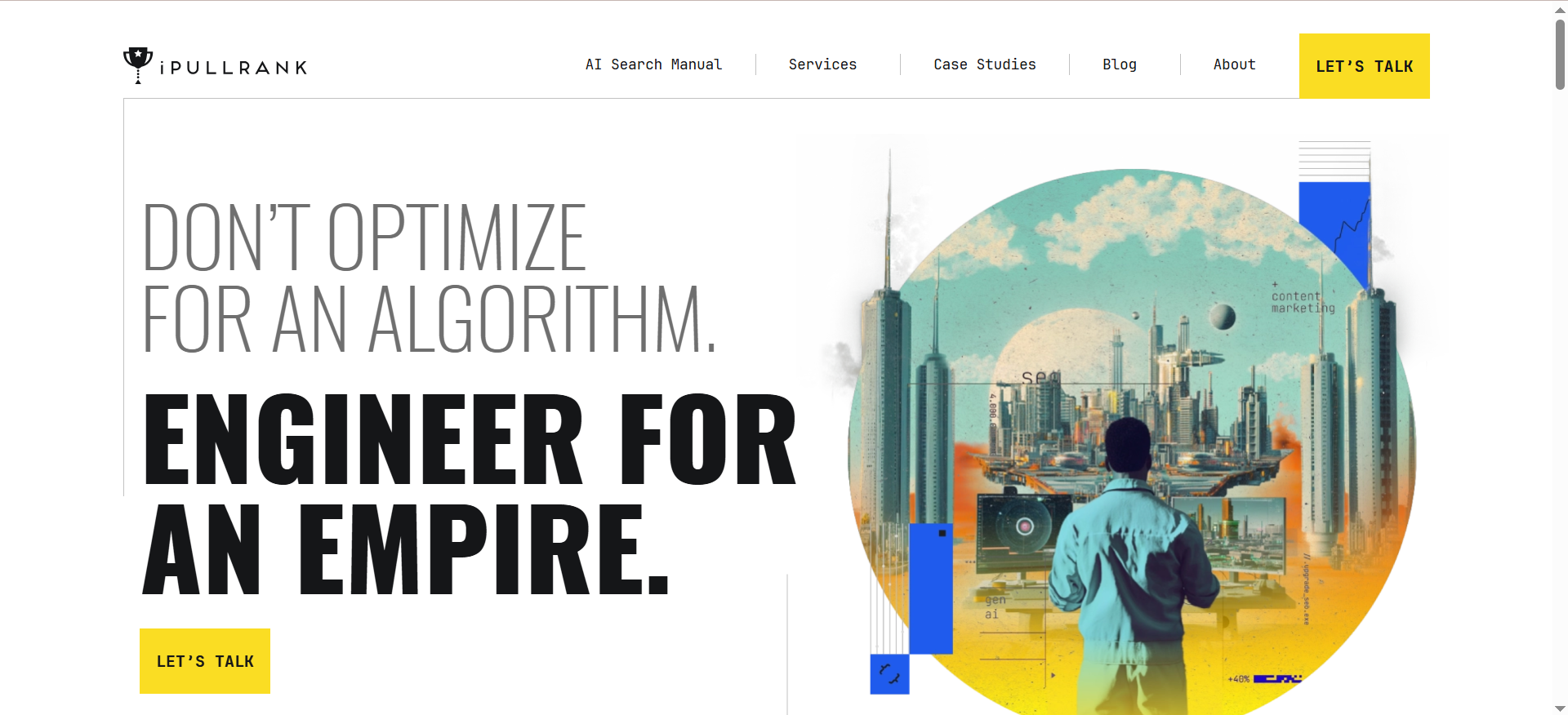
iPullRank is best for large, technically complex websites that need to win classic rankings and AI citations together. The New York firm, led by Mike King, pairs deep technical SEO with some of the most cited thinking in generative engine optimization.
iPullRank built its reputation on engineering-grade SEO for very large sites, the kind where technical SEO is table stakes rather than a finishing touch. In recent years the team has become a prominent voice on how search shifts toward AI answers, which makes it a strong fit for enterprises worried about losing visibility as AI Overviews expand.
- Technical depth: The firm handles million-plus-page architectures where crawl efficiency, rendering, and indexation directly shape revenue.
- AI search strategy: The team treats GEO as a first-class discipline, structuring content and entities for extraction by answer engines.
- Data and tooling: The firm builds custom analysis and modeling rather than relying only on off-the-shelf platforms.
Pros include rare technical and AI search expertise and strong thought leadership. The main consideration is that this depth suits genuinely complex sites, so a small content-led brand may not need it. Choose iPullRank when technical scale and AI visibility are both high-stakes.
2. Seer Interactive: Best for data-driven enterprise SEO
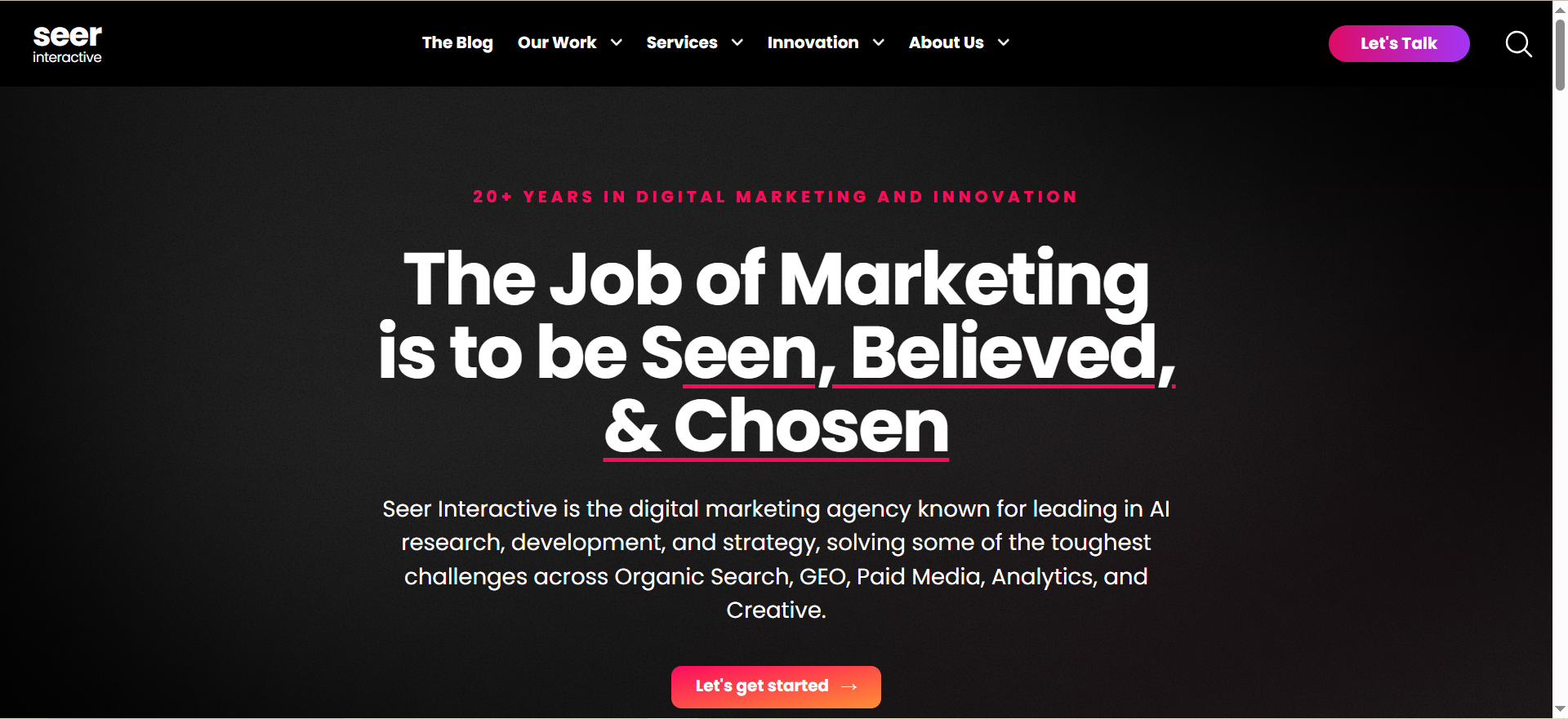
Seer Interactive is best for data-driven enterprises that want analytics to lead every SEO decision. The Philadelphia agency runs a large, multi-disciplinary team across SEO, analytics, and paid media, and it publishes some of the most rigorous independent research on AI Overview impact.
Seer's differentiator is a big-data approach that connects search behavior to business outcomes rather than treating rankings as the finish line. Its published study of AI Overview effects across thousands of queries gives it credibility on exactly the question enterprises now ask most, namely how to stay visible as AI answers compress organic clicks.
- Analytics-led strategy: The agency grounds recommendations in large datasets rather than intuition, which fits enterprises with mature measurement expectations.
- Cross-channel coordination: The team aligns SEO with paid and analytics so organic decisions account for the full funnel.
- Research credibility: The firm's primary research on AI search informs client strategy directly.
Pros include analytical rigor and multi-channel breadth. The consideration is that data-first engagements work best when the client can act on detailed findings. Choose Seer when measurement maturity and cross-channel alignment matter most.
3. Siege Media: Best for content-led organic growth
Siege Media is best for enterprises that grow primarily through content and digital PR. Founded by Ross Hudgens, the agency delivers content marketing, SEO, and link earning under one roof, with a strong record across both B2B and B2C brands.
Siege's strength is the intersection of quality content and the authority that earns links and citations. For categories where topical depth and brand mentions decide who ranks and who gets cited, that combination is hard to assemble in-house. The team is known for measurable, data-driven content programs rather than volume publishing.
- Content plus digital PR: The agency produces authoritative assets and earns the coverage that builds domain trust.
- Editorial quality: The team prioritizes depth and originality, which also improves AI citation odds.
- Full-funnel coverage: The firm maps content from awareness through decision-stage comparison.
Pros include content quality and integrated link earning. The consideration is that technically heavy platform problems may need a more engineering-led partner alongside it. Choose Siege Media when content and authority are your primary growth levers.
4. Amsive: Best for audience intelligence and performance
Amsive is best for enterprises that want audience intelligence tied directly to performance marketing. The agency combines proprietary audience data with integrated SEO, paid media, and analytics, and it has been recognized as an SEO Agency of the Year in 2025.
Amsive's edge is connecting who the audience is to how the program performs, so SEO is not run in isolation from the rest of demand generation. That integration suits enterprises that buy across multiple channels and want a single partner reconciling the data.
- Audience data: The agency uses proprietary audience intelligence to target content and campaigns precisely.
- Integrated performance: The team runs SEO alongside paid and analytics for a unified view of acquisition.
- Enterprise process: The firm coordinates complex programs with mature reporting.
Pros include data-driven targeting and channel integration. The consideration is that the integrated model fits brands wanting one partner across channels more than those seeking a narrow SEO specialist. Choose Amsive when audience data and multi-channel performance are central.
5. NP Digital: Best for global brands at scale
NP Digital is best for global brands that need full-funnel performance marketing at scale. Co-founded by Neil Patel and Mike Kamo, the agency operates across many markets and pairs SEO with paid media, content, and conversion work.
NP Digital's reach and breadth make it a fit for enterprises operating in multiple regions and languages that want consistent strategy across them. The brand recognition also lends internal credibility when SEO recommendations need executive buy-in.
- Global footprint: The agency supports multi-region, multi-language programs from a coordinated structure.
- Full-funnel breadth: The team connects SEO to paid and conversion so organic does not operate alone.
- Brand authority: The firm's visibility helps win internal alignment on large initiatives.
Pros include global scale and full-funnel coverage. The consideration is that very large agencies can vary in senior attention across accounts, so confirm who runs your program. Choose NP Digital when global reach and breadth outweigh boutique intimacy.
How we selected and ranked these enterprise SEO agencies
We selected these agencies by combining enterprise track record, breadth of capability, AI search readiness, and verifiable client work, then organized them by best-fit profile rather than a single forced ranking.
The order reflects use case, not a claim that one firm beats another for every brand.
A forced one-to-ten ranking of enterprise agencies is misleading, because the right partner for a million-page ecommerce catalog is not the right partner for a B2B software brand chasing AI citations. To keep the list claim-safe and useful, we scored each agency against five weighted criteria and then grouped them by the buyer they serve best.
| Selection criterion | Weight | What it measures |
|---|---|---|
| Enterprise complexity track record | 30% | Experience with multi-domain, multi-region, large-page-count sites |
| Capability breadth | 20% | Coverage across technical, content, authority, and analytics |
| AI search visibility | 20% | Ability to win AI Overview and LLM citations, not just rankings |
| Documented results and reviews | 20% | Third-party reviews and verifiable client outcomes |
| Stakeholder and reporting maturity | 10% | Cross-team coordination and revenue-grade reporting |
📓 A note on honest fit before the list. Several agencies below are full-service enterprise SEO firms built for very large sites. If you are a B2B SaaS or AI company that needs a content system tying topics to money pages and to AI discoverability rather than a heavy technical implementation vendor, a specialist content partner can fit better than a full enterprise retainer. We flag that distinction in the per-agency notes and again in the section on how to choose, and the deeper rationale for that content-led model lives across our content and SEO insights.
What is an enterprise SEO agency?
An enterprise SEO agency is a specialized partner that runs organic search for large, complex websites, typically thousands to millions of pages across multiple domains, regions, languages, and internal stakeholders. It differs from a standard SEO agency in coordination load, not just headcount.
Enterprise programs touch engineering, product, legal, and brand teams, so a fix that takes one afternoon on a small site becomes a multi-quarter platform project at scale. The agency's job is to plan that work, sequence it across stakeholders, and tie it to revenue rather than rankings alone.
The defining attributes of an enterprise SEO agency cluster into a few areas worth naming explicitly.
- Technical SEO at scale: The agency manages crawl budget, indexation, site architecture, and Core Web Vitals across very large page counts, where a single template change can help or hurt hundreds of thousands of URLs at once.
- Topical authority and content systems: The agency builds clusters that establish authority across an entire category, not one-off posts, so the site becomes a trusted source for both ranking algorithms and AI answer engines.
- Authority and digital PR: The agency earns links and brand mentions from publications and datasets that LLMs and Google already trust.
- AI search visibility: The agency structures content for extractability so the brand appears as a cited source inside AI Overviews and chat assistants, a discipline that overlaps heavily with answer engine optimization and that you can baseline with the right AI visibility tracking tools.
- Stakeholder and reporting maturity: The agency coordinates approvals across departments and reports outcomes that a CFO recognizes, namely pipeline, assisted conversions, and revenue.
For a deeper grounding in how these terms connect, the SEO glossary maps the vocabulary that recurs across every enterprise engagement.
How enterprise SEO differs from standard SEO
Enterprise SEO differs from standard SEO mainly in scale, coordination, and risk, where changes affect hundreds of thousands of pages and require cross-team approval rather than a single marketer's edit. The strategy is similar, the execution environment is not.
Standard SEO often lives inside one marketing team that can publish and edit at will. Enterprise SEO lives inside a system of competing priorities, where the SEO recommendation joins a product roadmap, waits for engineering capacity, and passes legal review before it ships. That reality changes which agencies can actually deliver.
The table below maps the two environments across the variables that most affect whether a program succeeds.
| Variable | Standard SEO | Enterprise SEO |
|---|---|---|
| Page count | Dozens to a few thousand | Thousands to millions |
| Primary bottleneck | Content production speed | Cross-team coordination and dev capacity |
| Technical risk | Low, contained to a few pages | High, template changes cascade site-wide |
| Stakeholders | One marketing owner | Product, engineering, legal, brand, regional teams |
| Reporting standard | Rankings and sessions | Pipeline, assisted conversions, revenue |
| AI search readiness | Optional | Mandatory, citations replace lost clicks |
The practical takeaway is that an agency strong at small-site SEO can stall inside an enterprise, because the constraint is rarely talent and almost always orchestration. When you evaluate firms, weigh their experience with multi-domain, multi-region complexity as heavily as their ranking case studies.
For teams scaling from growth-stage into enterprise structure, the patterns in our B2B SaaS content benchmarks show where coordination tends to break first.
Why enterprises hire SEO agencies instead of building in-house
Enterprises hire SEO agencies because senior, multi-disciplinary search expertise is expensive to build internally and hard to retain, while an agency delivers that bench immediately and absorbs the volatility of constant algorithm and AI search change.
Speed and specialization win.
A full in-house enterprise SEO function needs technical SEO, content strategy, data analytics, digital PR, and now AI visibility tracking, which is five distinct skill sets that rarely sit in one hire. Recruiting all five takes quarters, and a single departure can stall the program. Agencies spread that risk across a team and across many client environments, so the lessons learned on one enterprise site transfer to the next.
There is also a credibility advantage.
When an outside firm with a documented track record recommends a costly platform change, internal engineering and product teams tend to take it more seriously than the same recommendation from a lone internal SEO. That political weight is part of what enterprises actually buy.
A third driver is the pace of change in search itself.
Algorithm updates, AI Overview expansion, and new answer engines now reshape visibility every quarter, and a single internal hire rarely has time to track all of it while also executing. Agencies run continuous testing across many sites, so they spot pattern shifts earlier and adapt client programs before traffic erodes.
For growth-stage teams scaling toward this complexity, our guide to the Series A SaaS content marketing budget shows how to phase agency investment as the program matures.
How to choose an enterprise SEO agency
Choose an enterprise SEO agency by matching its proven strengths to your single biggest constraint, then verifying that it can coordinate across your stakeholders and report in revenue terms. Fit beats prestige.
Start by naming your bottleneck honestly.
A million-page catalog with crawl problems needs a technical-led firm. A category with weak brand authority needs content and digital PR. A software brand losing visibility in AI answers needs GEO fluency. The agency that solves your specific constraint will outperform a more famous generalist.
Then run a structured evaluation. The checklist below captures what reliably separates strong enterprise partners from agencies that look good in a pitch deck.
- Enterprise track record: Confirm experience with sites at your page count, domain count, and stakeholder complexity, not just impressive logos.
- AI search capability: Ask how the firm measures and improves AI Overview and LLM citations, since rankings alone no longer predict traffic.
- Reporting in revenue terms: Require pipeline, assisted conversion, and revenue reporting rather than rankings and sessions.
- Senior attention: Verify who actually runs the account, because large agencies sometimes staff junior teams after the pitch.
- Coordination ability: Probe how the firm sequences work across engineering, product, and legal, which is where enterprise programs usually stall.
- Claim-safe proof: Insist on verifiable case studies, and treat guaranteed rankings as a red flag rather than a selling point.
This is also where the build-versus-buy and the full-versus-specialist questions converge.
Executing a content system this well is exactly the gap The Rank Masters closes for B2B SaaS teams, building an ICP-led content system that maps each topic cluster to a money page and to pipeline rather than publishing posts that never convert.
For software brands, that focused model often beats a broad enterprise retainer, and you can explore it through TRM's SaaS content marketing and answer engine optimization services.
To pressure-test any shortlist, the framework in our guide to the best SEO strategies for AI visibility gives you the questions to ask, and the SEO insights library collects the deeper playbooks behind each one.
Enterprise SEO agency vs in-house team
An enterprise SEO agency gives you a full multi-disciplinary bench immediately, while an in-house team gives you deeper product context and control but takes quarters to build and is fragile to turnover. Most enterprises run a hybrid.
The strongest setups pair a lean internal owner who holds product and brand context with an agency that supplies technical depth, content production, digital PR, and AI visibility tracking. That structure captures institutional knowledge without forcing the company to hire five specialists who are hard to find and harder to retain.
| Factor | Enterprise SEO agency | In-house SEO team |
|---|---|---|
| Time to full capability | Weeks | Quarters to over a year |
| Skill breadth | Multi-disciplinary by default | Limited by headcount and budget |
| Product and brand context | Acquired over time | Deep from day one |
| Resilience to turnover | High, spread across a team | Low, single departures hurt |
| Cost structure | Retainer, scalable up or down | Fixed salaries plus tooling |
| Cross-client learning | Yes, patterns transfer | No, internal only |
The decision rarely comes down to one or the other. It comes down to which capabilities you keep inside and which you rent. For teams weighing that split, our breakdown of SaaS content marketing pricing shows how to scope the agency portion so it complements internal staff rather than duplicating it.
Boutique specialist vs large enterprise agency
A boutique specialist gives you senior attention and deep domain focus, while a large enterprise agency gives you breadth, scale, and procurement stability. The right choice depends on whether your hardest problem is depth in one area or coordination across many.
Large agencies and holding-company practices like Merkle excel when a program spans SEO, paid, CX, and analytics across global markets, and when procurement requires a single vetted vendor with compliance maturity. The trade-off is that senior strategists who shine in the pitch may hand day-to-day work to junior teams, and the breadth can dilute focus on any one discipline.
Boutique specialists like Omniscient Digital or a focused B2B SaaS content partner trade scale for depth. You get founders and senior operators close to the work, faster decisions, and a method tuned to one type of buyer. The trade-off is capacity, since a small team cannot run dozens of simultaneous campaigns the way a large agency can.
- Choose a large agency when: Global reach, multi-channel integration, and procurement stability outweigh the need for deep senior attention in any single discipline.
- Choose a boutique specialist when: Your constraint is content-to-pipeline alignment, AI search visibility, or a specific vertical where focused expertise beats raw scale.
- Run a hybrid when: You want a large partner for technical and media scale plus a specialist for content and AI citations, coordinated by a lean internal owner.
For software brands specifically, the specialist route usually wins because the bottleneck is rarely page count. It is mapping topics to money pages and earning AI citations, the pattern documented across our content and SEO insights and demonstrated in the way TRM's senior strategists run engagements without layers of account managers.
How much do enterprise SEO agencies cost in 2026?
Enterprise SEO engagements in 2026 typically run between roughly $10,000 and $50,000 a month, with the largest or most competitive programs running higher, according to pricing data from Searchbloom. Scope, not vendor, drives most of the variance.
Pricing reflects what is actually in the engagement. A retainer that includes technical SEO, content production, digital PR, and AI visibility tracking costs far more than one limited to recommendations. Specialist B2B SaaS engagements often start near the bottom of that range, with Omniscient Digital publishing full-service pricing from roughly $10,000 a month, while holding-company enterprise contracts run higher and longer.
| Pricing model | How it works | Best for |
|---|---|---|
| Monthly retainer | Fixed monthly fee for an ongoing scope | Continuous programs with steady output |
| Project-based | One-time fee for a defined deliverable | Migrations, audits, or one-off rebuilds |
| Hybrid | Retainer plus project fees for spikes | Programs with a steady base and periodic large work |
| Performance-linked | Partial fees tied to agreed outcomes | Mature teams with clean attribution |
When you compare quotes, normalize them by deliverable rather than by headline price, because a firm building topic strategy, refreshing money pages, and tracking AI citations is not comparable to one writing four generic posts. Ask each agency which work it runs with people versus tooling, since a lean stack of the right SEO automation tools can lower the cost of audits and monitoring without lowering quality. The realistic payoff timeline matters too, and our B2B SaaS content benchmarks set expectations for when organic investment compounds.
Can enterprise SEO agencies improve AI search visibility?
Yes, the strongest enterprise SEO agencies now treat AI search visibility as a core deliverable, structuring content and entities so the brand is cited inside AI Overviews and chat assistants rather than only ranked in classic results. This capability is increasingly the deciding factor.
When a buyer asks an assistant "what are the best enterprise SEO agencies for B2B SaaS?", the brands named in that synthesized answer win the consideration set before a single link is clicked. Being absent from that answer is the modern equivalent of ranking on page two. The data explains the urgency. AI Overviews grew from appearing on 6.49% of tracked queries in January 2025 to a July peak near 24.61%, then settled around 15.69% by November, according to a Semrush AI Overviews study of more than 10 million keywords. As coverage expanded, it moved beyond informational queries into commercial and navigational intent, which means even decision-stage searches now surface AI answers.
Click behavior shifted with it. Ahrefs analyzed roughly 300,000 keywords in December 2025 and found AI Overviews cut position-one organic click-through rate by 58%, while Digital Content Next tracked position-one CTR on AI Overview keywords falling from 7.3% in March 2024 to 2.6% in March 2025. The brands that hold their ground are the ones being cited, and a September 2025 Seer Interactive study of 3,119 queries across 42 organizations found brands cited inside AI Overviews earned 35% more organic clicks and 91% more paid clicks than uncited competitors on the same queries.
That citation gap is exactly where a content-led partner earns its keep.
Winning AI citations is the implementation problem The Rank Masters solves for B2B SaaS teams through answer engine optimization, structuring topic clusters and entities so answer engines select the brand as a source, and our own GEO case study documents what that looks like in practice. To audit where your brand stands today, our roundup of the best AI search visibility tools and the daily-monitoring options in best AI visibility tools for daily prompt runs give you a measurement baseline before you brief any agency.
Are enterprise SEO agencies worth the investment?
Enterprise SEO agencies are worth the investment when organic and AI-driven discovery represent a material share of pipeline and the agency reports in revenue terms, because compounding organic equity offsets rising paid acquisition costs over time. The worth depends on measurement, not faith.
The economic case rests on the difference between renting and owning demand. Paid clicks expire the moment the budget stops, while organic and AI visibility compound as authority builds. As AI Overviews absorb more clicks, the brands cited as sources capture the visibility that used to flow to every top-ranking page, which makes a citation-capable agency a hedge against the exact traffic loss the Pew and Ahrefs data describe.
The risk is paying for activity that never reaches revenue. That is why every section above stresses reporting in pipeline and assisted conversions rather than rankings, and why guaranteed-ranking pitches are a warning sign.
An agency is worth it when you can trace its work to qualified demand, and not worth it when it produces dashboards no executive recognizes.
Set the measurement framework before signing, using the playbook in our guide to the best SEO strategies for AI visibility tools so leading indicators like citations and branded search are instrumented from day one.
For a fuller view of how content investment maps to ROI timelines, our hub of top AI marketing statistics and the best AI SEO tools guide help you set realistic targets and instrument the program before you commit budget.
Frequently Asked Questions
How long does enterprise SEO take to show results?
What is the difference between an enterprise SEO agency and a content marketing agency?
Can an enterprise SEO agency get my brand cited in ChatGPT and AI Overviews?
Do I still need an enterprise SEO agency if I have an in-house team?
What questions should I ask an enterprise SEO agency before signing?
Is a boutique specialist or a large enterprise agency better for B2B SaaS?
Turn enterprise search into pipeline!
The agencies above solve different problems, and the right one depends entirely on whether your bottleneck is technical scale, content authority, AI citations, or revenue measurement. If thin BOFU coverage and weak AI visibility are costing you pipeline, book a SaaS content strategy call and we will map your highest-intent topics to revenue.