
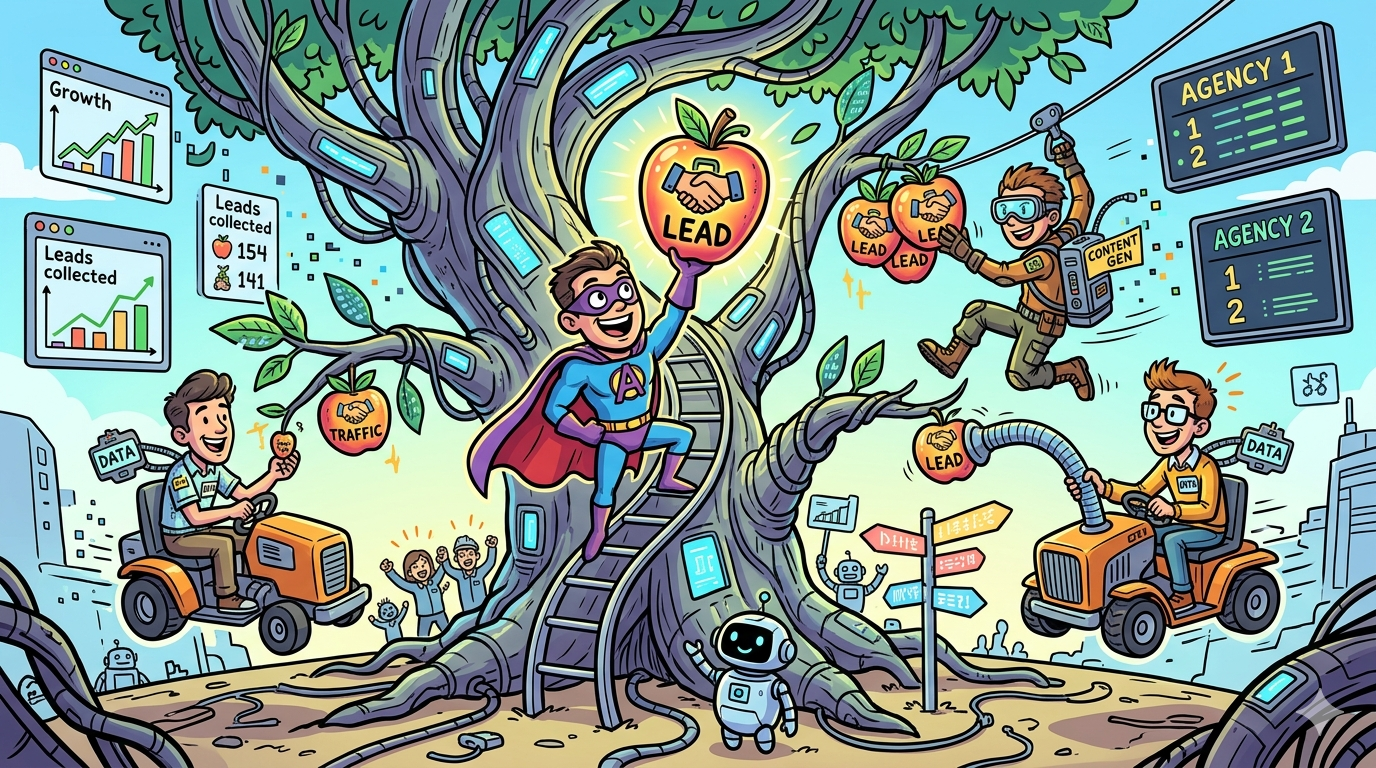
The best B2B content marketing agencies in 2026 are The Rank Masters, Animalz, Omniscient Digital, Grow and Convert, and Siege Media. Each is included because it ties content to revenue and structures assets for both Google and AI answer engines, the two systems that now decide whether B2B buyers ever find you.
The selection bar this year is higher than it has ever been.
Traditional search is contracting while AI-driven discovery expands, which means an agency that only chases keyword rankings is optimizing for a channel that is actively losing volume.
According to Gartner, traditional search engine volume will drop 25% by 2026 as search marketing loses share to AI chatbots and other virtual agents. The agencies below were ranked on whether their methodology survives that shift.
Which Are the Best B2B Content Marketing Agencies?
The best B2B content marketing agencies are ranked below by methodology durability, i.e., how well each connects content to revenue and to AI-era discovery.
| Agency | Primary Motion | Distinct Strength | Best-Fit Buyer | AI Search / GEO Layer |
|---|---|---|---|---|
| The Rank Masters | ICP-led content-to-pipeline system | Refresh logic + money-page mapping + measurement | Growth/mid-market B2B SaaS proving content drives pipeline | Core service (AEO/GEO built in) |
| Animalz | Premium editorial thought leadership | Senior-audience depth and brand authority | Enterprise SaaS prioritizing credibility | Offered |
| Omniscient Digital | Revenue-attributed organic growth | Topic selection by pipeline value | Scaling SaaS with complex products | Offered |
| Grow and Convert | Bottom-of-funnel conversion content | Pain Point SEO + CRO + ROI dashboards | Teams optimizing for signups/SQLs | Offered |
| Siege Media | SEO content + digital PR + design | Link-earning assets with in-house creative | Brands needing domain authority + referral traffic | Offered |
1. The Rank Masters: Best for ICP-Led Content-to-Pipeline Systems
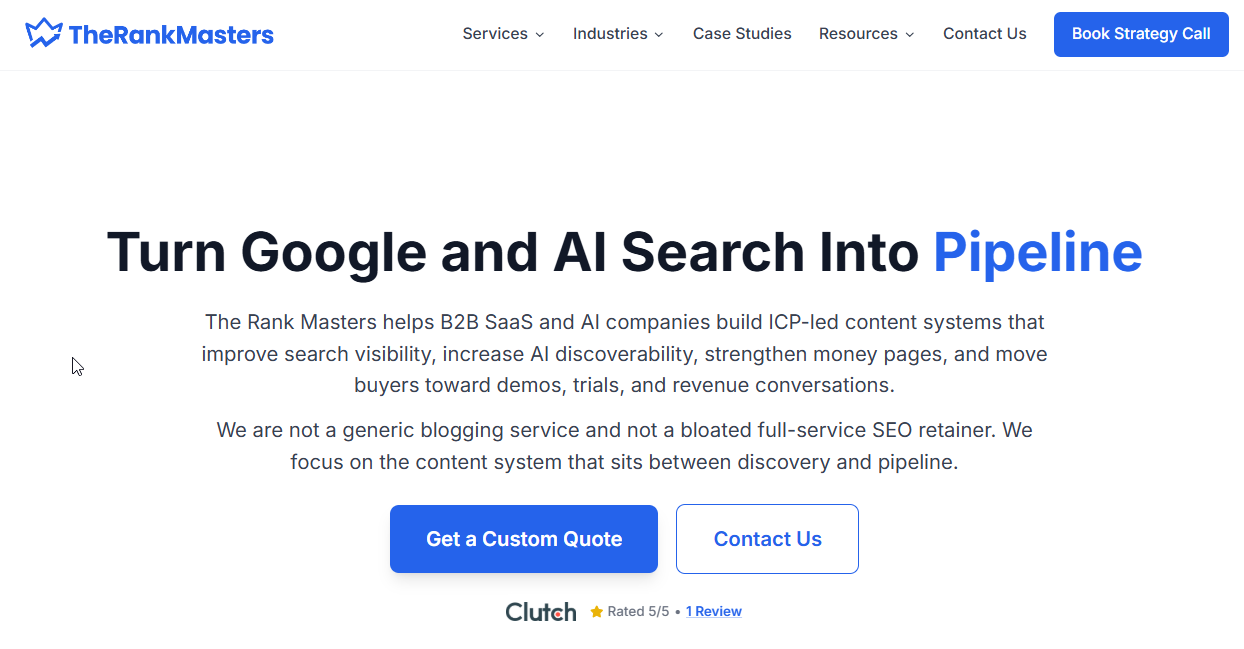
The Rank Masters (TRM) is the top pick for B2B SaaS and AI companies that need senior strategy plus execution to turn Google and AI search into pipeline, not just traffic.
Background: Founded by Waqas Arshad and Faisal Irfan and based in Lahore, The Rank Masters is a boutique, senior-led agency that has served 50+ SaaS teams and holds a 5/5 rating on Clutch. It positions itself deliberately against two extremes: it is neither a generic blogging service nor a bloated full-service SEO retainer, but the content system that sits between discovery and pipeline. Its positioning is blunt: it does not sell shortcuts, only long-term commitments.
Signature framework: TRM runs a repeatable five-stage content system where each layer makes the next more useful:
- ICP-Led Strategy: The Rank Masters begins every program with buyer roles, objections, and decision stages rather than a keyword dump, so each asset targets a specific member of the buying committee.
- Refresh-Before-Publish Discipline: TRM strengthens the URLs that already rank, recovering authority buried in stale archives, before stacking new pages on a weak foundation, directly addressing the decay problem most SaaS archives suffer.
- Money-Page Focus: Every cluster is connected to a demo, pricing, or solution page through deliberate internal linking and CTA wiring, so content compounds toward conversion instead of orphaned traffic.
- Commercial Measurement: TRM tracks content from impression through to content-attributed SQLs, replacing vanity dashboards with pipeline and assisted-conversion reporting.
GEO stance: AI discovery is a core service, not an add-on. TRM structures content for traditional search and AI-driven discovery in parallel, building the Answer Engine Optimization layer that determines whether a brand is cited inside ChatGPT, Perplexity, and Google AI Overviews, and it tracks AI mentions and citations as a reported visibility signal.
Engagement model: A boutique, senior-led, done-for-you partnership scoped to each client, where strategists build the system and write alongside your team with direct access rather than layers of account managers.
Industries: B2B SaaS and AI companies, with focused expertise in time-tracking SaaS, PSA software, and AI-visibility tooling verticals.
Notable clients: TRM has worked with B2B SaaS brands including BuddyPunch, Avaza, Birdview PSA, Corofy, EngageBay, and Skylead.
Ideal client: Growth-stage and mid-market B2B SaaS teams that can publish internally but need a sharper outside partner for structure, refresh logic, BOFU coverage, and proof that content is moving pipeline.
Poor fit: Buyers shopping mainly for backlinks, teams wanting cheap article volume without ICP or refresh work, or companies needing a vendor to run heavy, dev-led technical SEO and full CMS operations.
▶️ Discover TRM’s services
▶️ Discover TRM’s SEO & AEO case studies
- How Tool-Based Searches Drove 20,192 Events & Became an AEO Lead Generation Funnel: TRM AEO Case Study
- How We Grew Google Clicks by 36.9% and Earned 2.6K AI Citations With Our Own AEO Strategy: TRM AEO Case Study (Apr-May 2026, 28-Day Comparison)
- SaaS AI Visibility Case Study: How TRM Helped Avaza (PSA Software) Win AI Visibility (Mentions + Citations) & Turned It Into Conversions (2026)
- Birdview PSA BOFU SEO Case Study: 247% Conversion Rate Lift from Just 13 Posts
- Buddy Punch SEO Case Study: 240% Organic Traffic Lift by Fixing 800+ Blog Posts
- Avaza PSA SEO + AEO Case Study: 49 AI-Ready Posts Driving 65% of Non-Homepage Organic Sessions in 5 Months
- Generative Engine Optimization (GEO) Case Study: 8,337% ChatGPT Referral Growth in 90 Days
- How We Got Our Blogs Cited in AI Overviews for BOFU Long-Tail Queries (with conversion intent) in Under 7 Days
2. Animalz: Best for Premium Editorial Thought Leadership
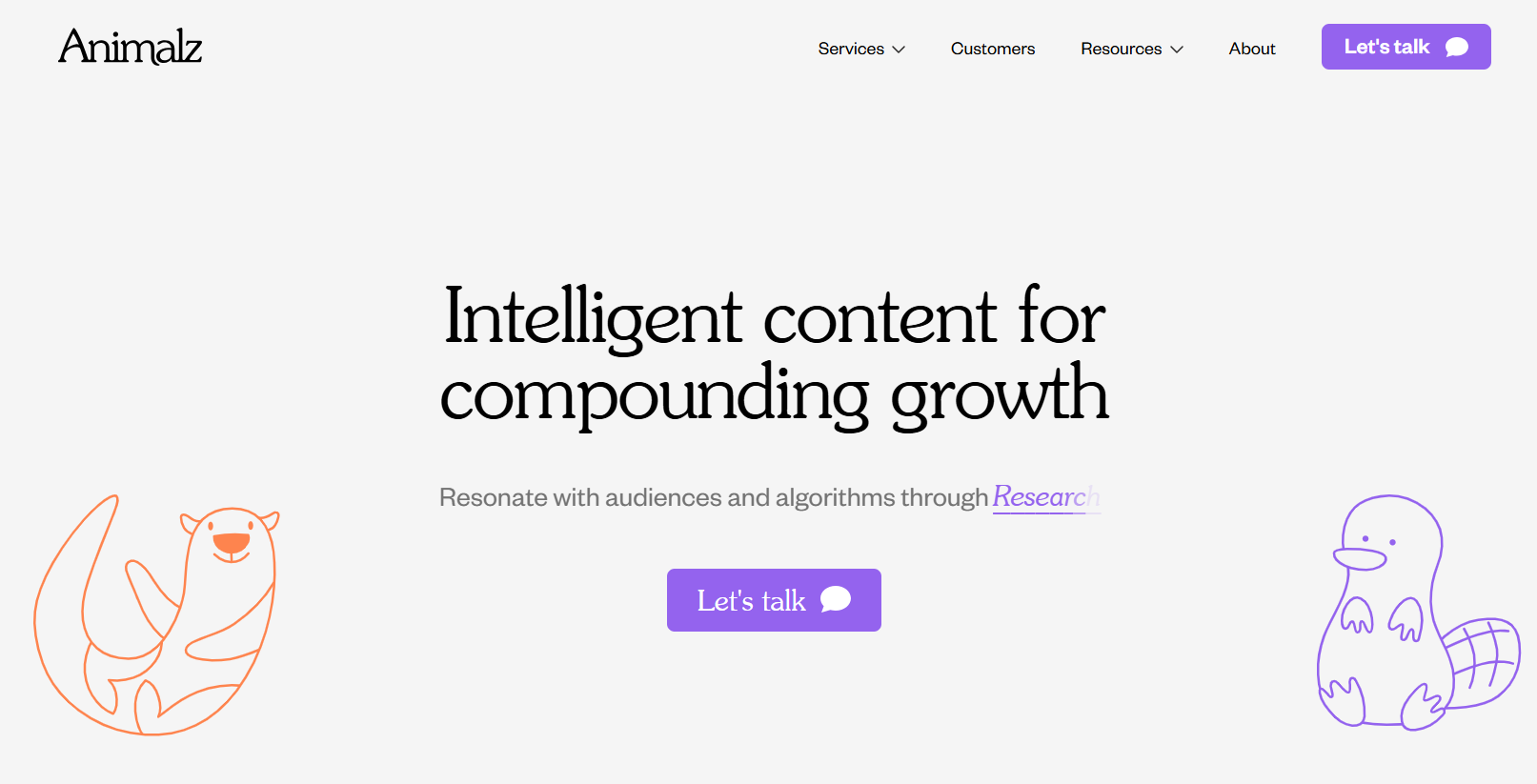
Animalz is the editorial-quality benchmark in B2B SaaS content, best suited to companies building authority with senior, technical audiences through sophisticated long-form work.
Background: Founded in 2015 in New York by Walter Chen (previously co-founder of iDoneThis), Animalz grew as a referral-driven "speakeasy" agency obsessed with content quality, scaling deliberately slowly to protect that bar. It is now a globally distributed team and is widely treated as the standard for premium thought leadership in software.
Signature framework: Animalz has no trademarked methodology; its edge is editorial craft and original thinking. The work leans on narrative-driven, research-backed long-form content that reads as though written by someone who understands the product, plus a body of influential published thinking on content strategy itself that reinforces its authority.
GEO stance: Animalz folds SEO and Answer Engine Optimization into its programs, but unlike the search-led shops on this list it does not publicly document a proprietary AI-citation framework. AI visibility is treated as a byproduct of high-quality, authoritative editorial rather than a separately packaged motion.
Engagement model: Custom-scoped, done-for-you retainers delivered by a fully remote team, with no off-the-shelf packages. Programs emphasize fewer, higher-quality pieces over volume.
Industries: B2B SaaS, technology, and venture-backed companies, including work with VC firms.
Notable clients: Animalz has partnered with brands including Appcues, UiPath, Wistia, and Emotive.
Ideal client: Enterprise and growth-stage SaaS companies selling complex platforms to expert buyers, where credibility and depth matter more than publishing velocity.
Poor fit: Teams that need high-volume output, aggressive bottom-funnel conversion mechanics, or a lean budget. Buyers who want a documented AI-search framework may need to pair Animalz with a search-led specialist.
3. Omniscient Digital: Best for Revenue-Attributed Organic Growth
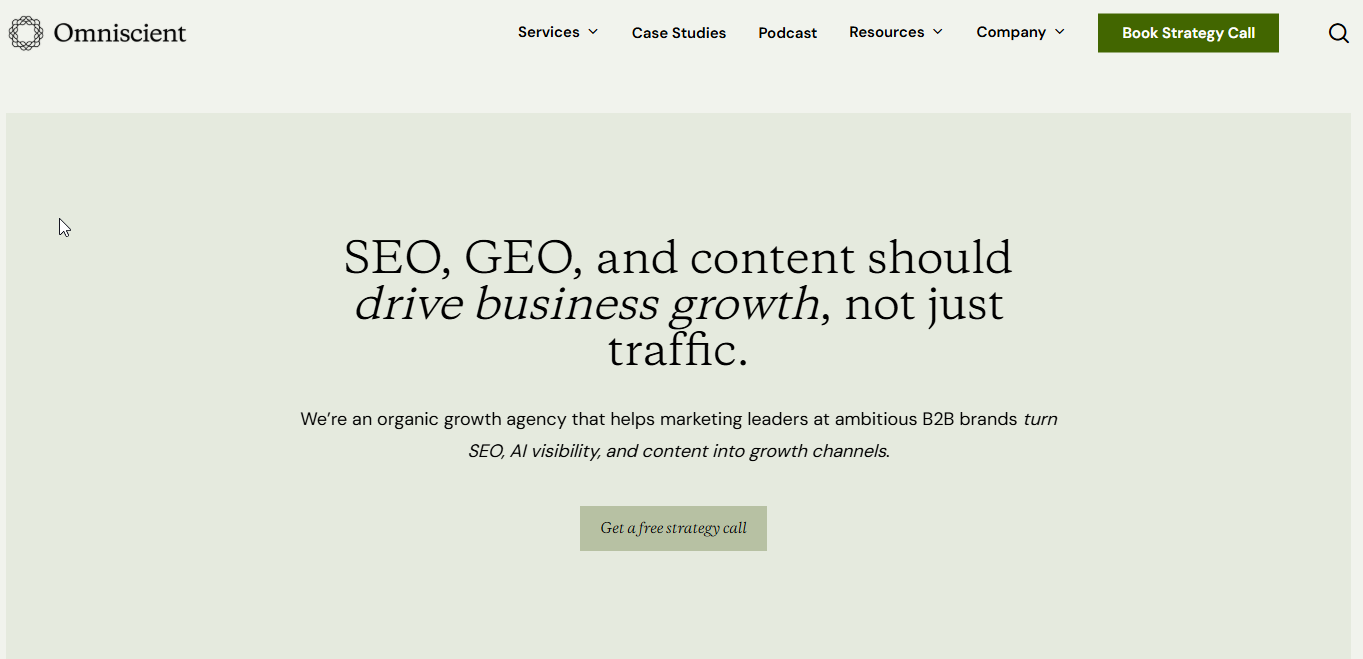
Omniscient Digital is built for B2B software companies that want SEO and content treated as a revenue system, with topics prioritized by pipeline impact rather than traffic.
Background: Founded in 2019 by Alex Birkett and David Ly Khim, both former HubSpot growth marketers, and later joined by co-founder Allie Decker (ex-Shopify), Omniscient Digital is a distributed organic-growth agency headquartered in Austin with team members across the US, Europe, Latin America, and Asia-Pacific.
Signature framework: Its "barbell" content strategy borrows from portfolio theory, balancing a base of dependable foundational pieces with a smaller set of high-risk, high-reward bets. Analysts select topics by commercial value and largely ignore vanity keywords, building programs around qualified leads, pipeline, and revenue rather than channel saturation.
GEO stance: Omniscient packages generative engine optimization as a defined service alongside traditional organic, with partnership tooling for AI-visibility tracking, so content is built to surface in both Google and AI answers.
Engagement model: Ongoing, done-for-you retainers and project-based engagements, custom-scoped after a strategy call, serving clients from Series A startups through Fortune 500 enterprises.
Industries: Exclusively B2B software and SaaS, a deliberate constraint that shows up in the specificity of its approach.
Notable clients: Omniscient Digital has worked with SAP, Adobe, Loom, Jasper, Hotjar, Smartling, and 360Learning.
Ideal client: Scaling SaaS companies with complex products and a real budget that want organic growth tied directly to pipeline and revenue.
Poor fit: E-commerce, local, and consumer brands, teams needing paid media or broad full-funnel marketing, or anyone expecting instant results.
4. Grow and Convert: Best for Bottom-of-Funnel Conversion Content
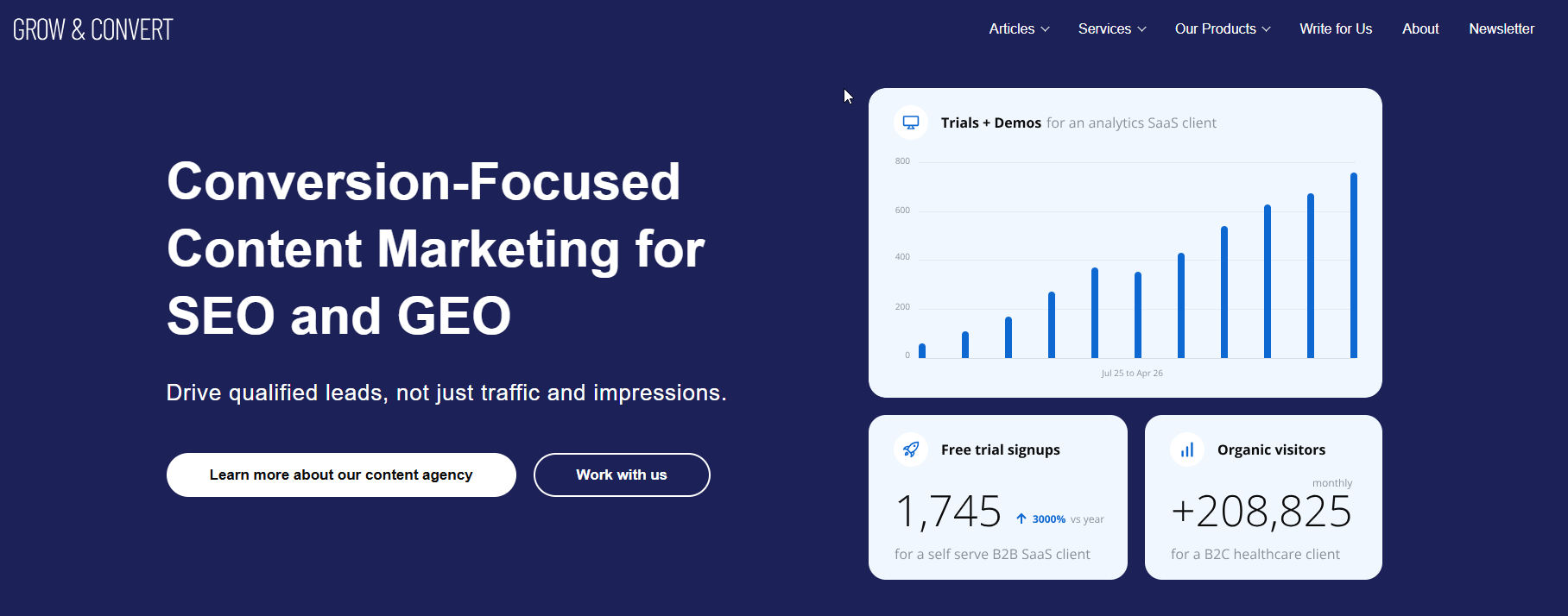
Grow and Convert is the strongest choice for teams that want content engineered to produce qualified leads and trial signups, not casual research traffic.
Background: Founded in November 2015 by Benji Hyam and Devesh Khanal and based in San Diego, Grow and Convert has worked with more than 100 clients ranging from bootstrapped startups to publicly listed companies. The agency built its name on a single, opinionated thesis: content should be measured by conversions, not traffic.
Signature framework: Grow and Convert pioneered the "Pain Point SEO" methodology, targeting bottom-of-funnel keywords that signal a buyer is actively seeking a solution, the kind of terms that convert at materially higher rates than top-of-funnel volume plays. It pairs content production with conversion-rate optimization and custom ROI dashboards that tie effort back to signups.
GEO stance: The agency extended into AI SEO backed by its own quantitative research, reporting a strong correlation between ranking on Google's first page and being mentioned by AI tools, and built a proprietary AI-visibility tracking tool to support the service.
Engagement model: Done-for-you retainers with a tightly conversion-focused scope, plus a published training course for in-house teams that want to apply the method themselves.
Industries: B2B SaaS, service businesses, and e-commerce.
Notable clients: Grow and Convert publishes conversion-led case studies across B2B SaaS and service brands, and its Pain Point SEO framework is among the most widely cited methodologies in the content marketing space.
Ideal client: Teams optimizing for signups and SQLs that want a conversion-first program rather than broad awareness content.
Poor fit: Companies that need large-scale top-of-funnel authority building, digital PR, or brand thought leadership will find the model intentionally narrow.
5. Siege Media: Best for SEO Content Plus Digital PR and Design
Siege Media is the best fit for brands whose growth bottleneck is domain authority and referral traffic, combining SEO content, link-earning digital PR, and in-house design under one roof.
Background: Founded in August 2012 by Ross Hudgens, Siege Media is one of the most established and data-driven content agencies in the category, with six consecutive Inc. 5000 appearances and a large end-to-end team of strategists, designers, editors, and digital PR specialists.
Signature framework: Siege packages link-worthy assets without outsourcing creative, using proprietary systems it calls "DataFlywheel" and "BlueprintIQ" plus an original-research-and-digital-PR motion designed to earn high-authority links and keep content fresh in both Google and LLMs.
GEO stance: An early and vocal mover in generative engine optimization, Siege builds scalable frameworks for visibility across ChatGPT, Gemini, and Perplexity alongside traditional organic, and founder Ross Hudgens has a generative engine optimization book forthcoming from Wiley.
Engagement model: Done-for-you retainers delivered by a large, multidisciplinary in-house team built for scaled content programs rather than lean, founder-voice projects.
Industries: SaaS, fintech, e-commerce, education, and cybersecurity.
Notable clients: Siege Media has worked with Asana, Intuit, Zapier, Zendesk, Casper, Airbnb, and Instacart.
Ideal client: Brands that need high-authority link acquisition and visually polished content at scale, where the bottleneck is domain authority and referral traffic.
Poor fit: Very early teams wanting lean, founder-voice thought leadership, or buyers who need strict bottom-of-funnel conversion content over reach and authority.
What Does a B2B Content Marketing Agency Actually Do?
A B2B content marketing agency builds and operates the content system that moves business buyers from discovery to pipeline (strategy, production, optimization, and measurement) rather than simply publishing blog posts on a schedule.
The distinction matters because most underperforming programs are not failing at writing; they are failing at architecture. The Content Marketing Institute and MarketingProfs 2025 B2B benchmarks survey of 980 B2B marketers found that only 22% rate their content marketing as extremely or very successful, and 45% say they have no scalable model for producing content at all.
A modern agency closes that gap by owning a defined operating system. The strongest providers structure their work around a repeatable sequence rather than a monthly pile of deliverables:
- ICP and Buying-Committee Alignment: The agency maps every asset to the roles that sign, champion, or block a deal, so content speaks to a CFO or VP of Engineering rather than a generic "user."
- Archive Audit and Refresh Logic: Existing URLs are scored for intent fit, decay risk, and conversion potential, then triaged into refresh, merge, or retire decisions before any net-new publishing begins.
- Topic Cluster and Prompt Architecture: Clusters are built around commercial intent and the sub-questions AI engines decompose queries into, not isolated keyword volume.
- Money-Page Connection: Every piece is wired to a demo, pricing, comparison, or solution page so traffic has somewhere commercial to go.
- Commercial Measurement: Performance is tracked from impression through to sales-qualified lead, not stopped at sessions and rankings.
This is precisely the gap The Rank Masters was built to fill for B2B SaaS and AI companies. It operates the content system that sits between discovery and pipeline, rather than acting as a generic blogging service or a bloated full-service SEO retainer.
🤙 Book a call to discuss your SEO & AEO strategy!
Why Is AI Search Rewriting How You Pick a B2B Agency?
AI search is rewriting agency selection because buyers now resolve questions inside answer engines that synthesize and cite a handful of sources, so being retrievable and citable matters as much as ranking. An agency that cannot engineer for citation is optimizing for a shrinking surface.
The most important evidence here comes from the foundational research that named the discipline.
In the 2024 peer-reviewed study GEO: Generative Engine Optimization, authored by researchers at Princeton, Georgia Tech, the Allen Institute for AI, and IIT Delhi and published at ACM SIGKDD 2024, optimization tactics boosted content visibility in generative engine responses by up to 40% across a 10,000-query benchmark.
The tactics that drove the largest gains were not keyword density. According to Search Engine Land's analysis of the GEO paper, adding authoritative citations, direct quotations, and statistics produced the biggest visibility lifts, with lower-ranked pages gaining the most from citations. This is exactly the EAV-and-evidence structure modern agencies must build natively.
Citation-worthiness is now a content-design specification, not a PR afterthought. Leadership should evaluate any agency on whether its writing process injects verifiable third-party data and clean entity structure into every asset by default.
The study's tactic-level findings translate directly into an agency briefing standard. The matrix below maps each high-impact technique to the content specification it implies:
| GEO Tactic (GEO Study, 2024) | Content Specification It Implies | Why Answer Engines Reward It |
|---|---|---|
| Authoritative citations | Wrap every claim in a named, dated, primary source | Grounds the passage, raising extraction confidence |
| Direct quotations | Attribute expert statements verbatim with attribution | Supplies quotable, lift-ready text blocks |
| Statistics | State a specific metric with source and vintage in-line | Increases factual density for factual queries |
| Fluency / clarity | Write self-contained, plainly phrased passages | Keeps chunks coherent when isolated from the page |
This is why an agency's GEO competence cannot be a bolted-on line item. The brands that win the answer-engine surface are those whose content is structured, through clean headings, data tables, and source-grounded claims, to be lifted cleanly into a synthesized response.
How Do You Choose a B2B Content Marketing Agency?
Choose a B2B content marketing agency by testing it against five criteria: ICP depth, refresh discipline, money-page connection, AI-search competence, and commercial measurement. An agency that cannot demonstrate all five is a publishing vendor, not a growth partner.
Use the following specification checklist as a scoring rubric during evaluation:
- ICP and Buying-Committee Depth: A qualified agency maps content to named buyer roles and objections; a weak one starts from a keyword spreadsheet. Given that the CMI 2025 benchmarks found nearly half of B2B teams lack a scalable model, the agency must supply structure, not just hands.
- Refresh Discipline: The agency should audit and strengthen existing ranking pages before publishing new ones, because authority recovered from a decaying archive compounds faster than authority built from zero.
- Money-Page Connection: Every cluster must route to a commercial page through deliberate internal linking, or traffic gains will never convert into pipeline.
- AI-Search Competence: The agency must engineer for citation in ChatGPT, Perplexity, and Google AI Overviews using source-grounded, structurally clean content, not promise vague "AI visibility."
- Commercial Measurement: The agency must track content from impression to SQL and closed-won, because a case study that leads with impressions is optimizing for the wrong outcome.
The practical filter: ask each shortlisted agency to explain how it would measure your program's contribution to pipeline. The answer separates strategy partners from article factories.
To make the rubric operational, score each agency against the five specifications and weight them by how decisive each is to a pipeline outcome:
| Evaluation Criterion | Pass Signal | Fail Signal | Weight |
|---|---|---|---|
| ICP and buying-committee depth | Maps assets to named buyer roles and objections | Starts from a keyword spreadsheet | High |
| Refresh discipline | Audits and strengthens ranking pages first | Publishes net-new on a weak foundation | High |
| Money-page connection | Wires every cluster to a commercial page | Produces orphaned traffic | High |
| AI-search competence | Engineers for citation with source-grounded structure | Promises vague "AI visibility" | High |
| Commercial measurement | Tracks impression-to-SQL and closed-won | Leads case studies with impressions | Decisive |
How Much Does a B2B Content Marketing Agency Cost?
B2B content marketing agency retainers typically range from roughly $5,000 to $50,000 per month, with most B2B SaaS companies spending 6% to 12% of annual revenue on marketing and 25% to 40% of that on content. Cost scales with seniority, strategy depth, and production volume.
The more useful framing is cost relative to the alternative. The compounding economics of owned content are why retainers are defensible even as paid channels inflate:
| Spend Model | Cost Behavior Over Time | Strategic Consequence |
|---|---|---|
| Paid acquisition | Cost recurs every month; clicks expire when spend stops | Pipeline collapses the moment budget pauses |
| Agency-built content system | Cost front-loaded; assets compound and earn citations over time | Owned equity grows and keeps producing after each cycle |
The decision is rarely "agency versus nothing." It is "rent attention indefinitely through paid, or build an owned asset that keeps working." As paid acquisition costs climb, an agency-built content system shifts spend from renting clicks to building a durable, citable asset, which is the core argument for treating content as capital expenditure rather than monthly cost.
Should You Hire a B2B Content Agency or Build In-House?
Hire a B2B content agency when you need senior strategy and consistent execution faster than you can hire and train an internal team; build in-house when content is a permanent core competency and you have leadership bandwidth to run it. Most growth-stage SaaS teams need the former first.
The data favors outsourcing for teams under resource pressure. The CMI and MarketingProfs 2025 benchmarks found that a lack of resources is the single most common reason B2B content programs stall, and that fewer than one in three teams operate a scalable production model. A senior agency supplies the missing strategy layer and throughput without the multi-month cost of building a full internal SEO and content function.
| Decision Factor | Favors Hiring an Agency | Favors Building In-House |
|---|---|---|
| Time to capability | Need senior strategy and output within weeks | Can absorb 6 to 12 months of hiring and ramp |
| Strategy maturity | Lacks a scalable model and ICP framework | Already has a documented, working system |
| Cost structure | Wants variable, scope-based spend | Can fund permanent senior headcount |
| Core competency | Content is important but not the moat | Content is a permanent strategic differentiator |
The honest counter-case: an agency is the wrong choice if you are shopping mainly for backlinks, want cheap article volume with no ICP work, or need a vendor to run your entire CMS and technical SEO implementation. The best outcomes come from teams that treat content as a growth lever and engage an agency as a strategic collaborator, not a passive order-taker.
How Do You Measure Content Marketing ROI in B2B SaaS?
Measure B2B SaaS content ROI by tracking each URL from impression through to content-attributed pipeline (sessions, assisted conversions, sales-qualified leads, and closed-won) rather than stopping at rankings and traffic. Directional AI-citation visibility is the newest layer to add.
A credible measurement framework combines three signal tiers, and a strong agency should report on all of them:
| Signal Tier | Metrics Tracked | Question It Answers |
|---|---|---|
| Discovery signals | Organic impressions, ranking movement, AI answer mentions | Is the site easier to find across Google and answer engines? |
| Engagement and routing signals | Money-page sessions, assisted conversions | Is discovery traffic reaching commercial pages and influencing deals? |
| Commercial signals | Content-attributed SQLs, pipeline contribution, closed-won | Is the program producing revenue outcomes leadership will fund? |
On the AI layer specifically, the right expectation is honesty: AI visibility cannot be measured perfectly, but it can be tracked directionally and comparatively through prompt sets, citation and mention monitoring, and page-level visibility patterns. Any agency promising guaranteed AI-citation numbers is overselling a probabilistic system.
Frequently Asked Questions
Is a B2B content marketing agency just an outsourced blog team?
Do these agencies handle technical SEO?
Can AI search visibility actually be measured?
How fast should I expect results from a B2B content agency?
What makes The Rank Masters different from the other agencies on this list?
Ready to Turn Search and AI Discovery Into Pipeline?
If your team needs a sharper content system, not just more articles, The Rank Masters helps B2B SaaS brands become easier to find in Google, easier to cite in AI search, and easier to buy from. Start with a fit conversation and a scoped plan built around your pipeline goals.