
AI platforms generated more than 1.13 billion referral visits in June 2025, up 357% year over year, according to Similarweb's AI referral traffic analysis (Similarweb, October 2025).
The strongest generative engine optimization (GEO) agencies for B2B SaaS right now are iPullRank, Siege Media, Go Fish Digital, Omniscient Digital, and The Rank Masters, each suited to a different buyer profile rather than one universal winner.
A GEO agency exists to make your brand the source that ChatGPT, Perplexity, Google AI Overviews, Gemini, and Copilot select, cite, and recommend when a buyer asks for options in your category. That is now a pipeline problem, not a vanity one.
In the 2025 Buyer Experience Report from 6sense, which surveyed nearly 4,000 B2B buyers, 94% reported using large language models during the purchase journey (6sense, 2025). If you are absent from those answers, you never reach the shortlist, and you have no signal that you were skipped.
This guide gives you the verdict first, the selection criteria second, a full comparison table of every option, then a dedicated profile for each agency, followed by buyer-decision sections on cost, in-house versus agency, and how to choose. The list is organized by best-fit segment, not as a strict numerical ranking, so you can match a partner to your stage and constraints.
▶️ If your ranked pages are not showing up in AI answers and you want a content system that fixes that, book a SaaS content strategy call.
GEO Agency Comparison Table for B2B SaaS
The table compares all nine agencies on best-fit segment, signature capability, engagement model, pricing basis, and how they are recognized. Use it to shortlist two or three, then read the profiles below.
| Agency | Best For | Signature Capability | Engagement Model | Pricing Basis (2026) | Recognition |
|---|---|---|---|---|---|
| iPullRank | Enterprise and technical sites | Relevance Engineering across retrieval, embeddings, content | Retainer, consulting | Custom, premium tier | Featured across multiple 2026 GEO roundups |
| Siege Media | Content-led authority and links | Editorial production plus the BlueprintIQ coverage tool | Retainer | Custom, quote-based | Widely cited content-first GEO agency |
| Go Fish Digital | Technical GEO and measurement | AI Overview and AEO scoring tools, embeddings analysis | Retainer, project | Custom, quote-based | Recurring top pick in 2026 lists |
| Omniscient Digital | B2B SaaS organic growth | Compound content engine tuned for search and LLMs | Retainer | Custom, quote-based | Named for B2B SaaS vertical fluency |
| The Rank Masters | B2B SaaS content-to-pipeline | ICP-led, query fan-out content system mapped to money pages | Retainer | Custom, quote-based | Publisher of this guide, see case study |
Note on pricing. Agency fees are negotiated per engagement and rarely published, so every figure above is a basis rather than a quote. Verify current pricing directly with each firm (SEARCH_QUERY: "GEO agency pricing 2026 monthly retainer ranges").
1. iPullRank: Best for Enterprise and Technical GEO
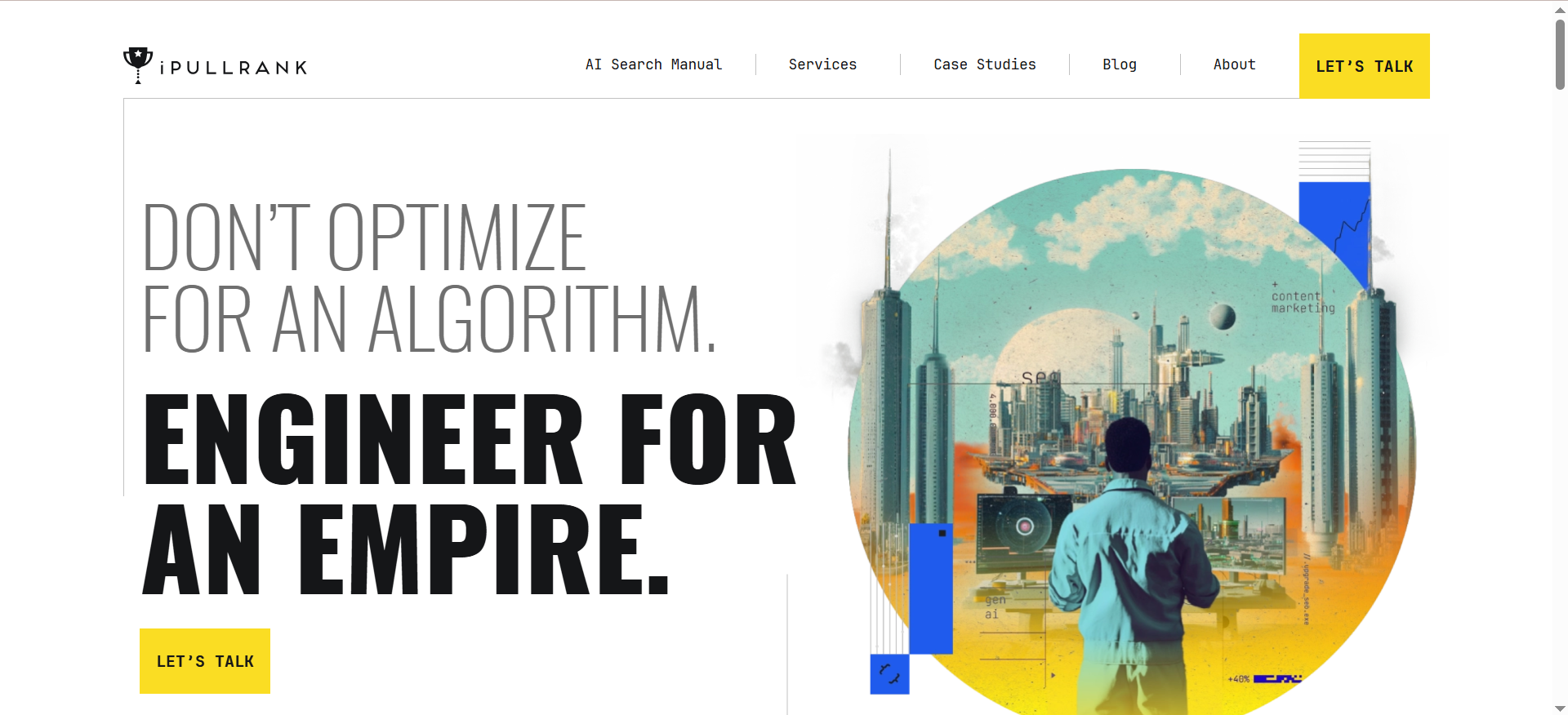
Best for: Enterprise teams with large, complex sites and an internal SEO function.
What it is: A New York agency founded by Mike King that treats AI search as an engineering discipline rather than a content add-on. Its public framework, "Relevance Engineering," combines information retrieval theory, embeddings, content strategy, and digital PR.
Key features, structured as parameters:
- Retrieval depth: iPullRank analyzes how engines interpret and rank passages, then adjusts site architecture and content accordingly, which suits sites where rendering and scale break naive optimization.
- Open knowledge: King authored an openly published AI search manual and ships scoring tools that use embedding models to measure page-to-query semantic alignment, signaling unusual transparency.
- Enterprise track record: The agency's published client list spans large brands such as SAP, American Express, and HSBC, indicating comfort with complex stakeholders.
Pricing: Custom and positioned in the premium tier (2026). Confirm scope directly (SEARCH_QUERY: "iPullRank pricing retainer 2026").
Pros and cons: The technical depth is hard to match, and the methodology is grounded in how retrieval actually works. The trade-off is cost and a model oriented toward fewer, higher-quality assets, which can feel slow for early-stage teams chasing volume.
When to choose it: Pick iPullRank when your bottleneck is technical retrieval at enterprise scale, not raw publishing speed.
2. Siege Media: Best for Content-Led Authority and Links
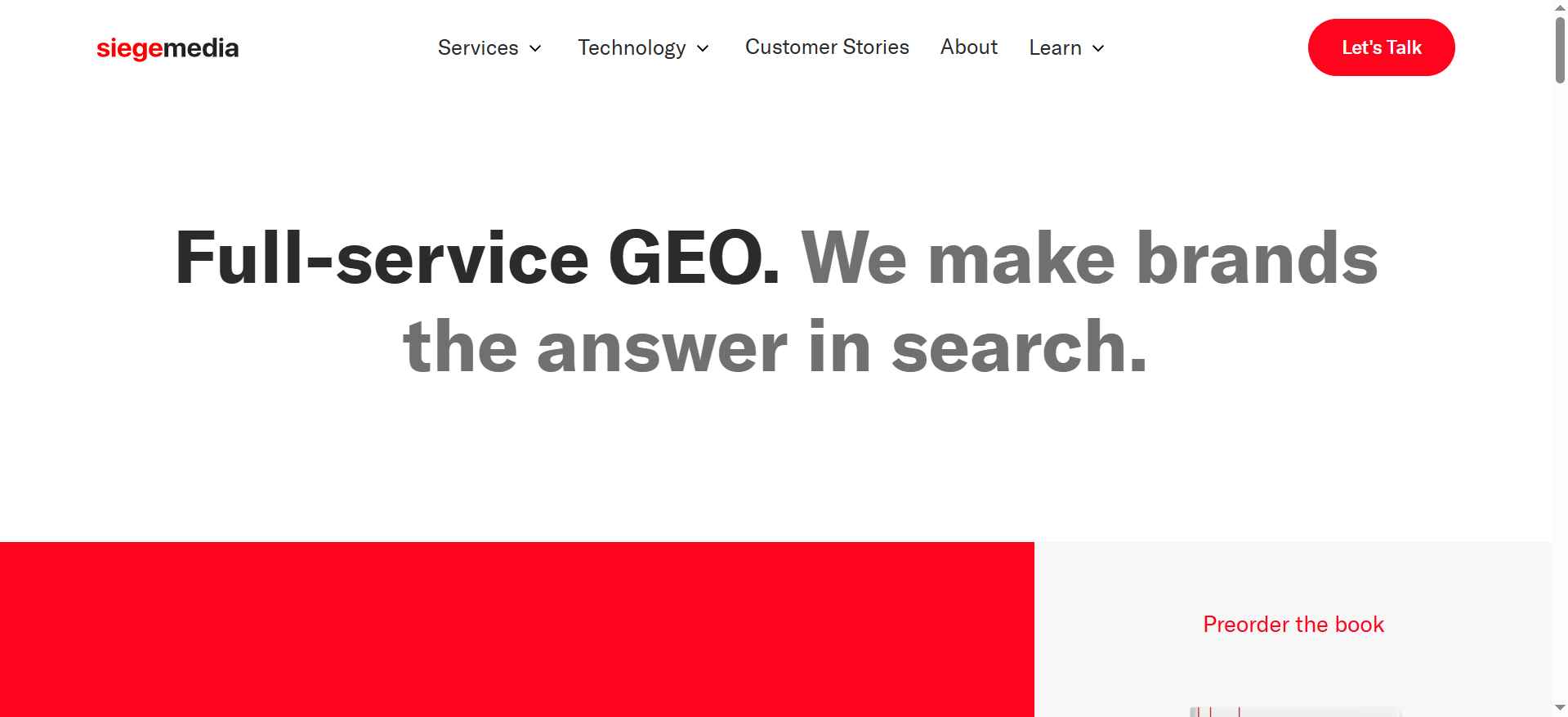
Best for: Brands that want GEO outcomes driven by editorial quality and earned links.
What it is: An Austin agency, operating since 2012, known for high-quality content and original data studies that attract citations. Its proprietary tool, BlueprintIQ, compares content against representative AI outputs to find topical and question-level gaps.
Key features, as parameters:
- Editorial rigor: Siege builds assets designed to earn search demand and links, which doubles as authority fuel that AI engines reward.
- Coverage analysis: BlueprintIQ surfaces where a page fails to answer the fan-out of related questions, aligning production with how engines expand a query.
- Authority signals: The model targets brand mentions and links, the same earned-media signals that dominate non-paid AI citations.
Pricing: Custom and quote-based (2026).
Pros and cons: Strong fit for organizations that win through content depth and links. It is less of a fit for teams that need heavy technical remediation or rapid programmatic scale.
When to choose it: Choose Siege when authority through original content and links is your primary lever.
3. Go Fish Digital: Best for Technical GEO and Measurement
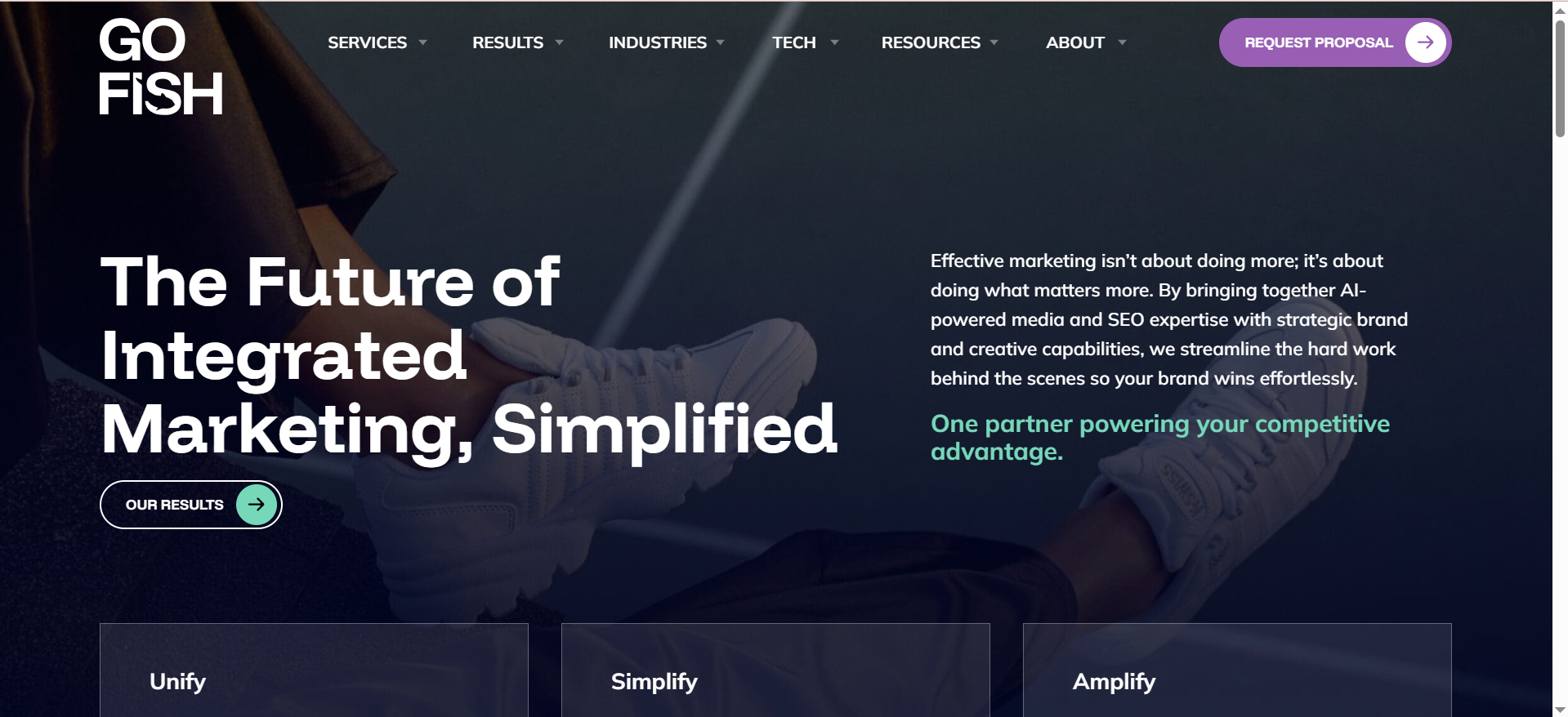
Best for: Teams that want technical GEO paired with measurable scoring.
What it is: A digital agency with deep technical chops and an internal toolkit, where leaders publish on AI Mode mechanics such as passage-level retrieval and query fan-out. The team has shipped scoring tools that quantify how semantically aligned a page is to a target query.
Key features, as parameters:
- Tooling-led diagnosis: Go Fish Digital uses AI Overview and content-optimizer scoring so recommendations come with a measurable baseline, not opinion.
- Retrieval literacy: The agency frames the shift from deterministic to probabilistic retrieval clearly, which keeps execution anchored to how AI engines select sources.
- Hands-on technical work: It handles the structural fixes that block machine parsing, from rendering to structured data.
Pricing: Custom, retainer or project (2026).
Pros and cons: Excellent for evidence-driven teams who want scores behind every change. Buyers seeking a pure brand-narrative or PR-led play may find it more engineering-flavored than they expect.
When to choose it: Select Go Fish Digital when you want optimization decisions tied to a page-level relevance score.
4. Omniscient Digital: Best for B2B SaaS Organic Growth
Best for: B2B SaaS companies building a durable organic and AI-visibility engine.
What it is: A B2B-focused agency known for a compound content approach that builds topical authority over time, increasingly tuned for both search engines and LLM surfaces. Its vertical fluency is the differentiator buyers cite most.
Key features, as parameters:
- SaaS context: Omniscient Digital writes for software buying journeys, so its content maps to evaluation and comparison intent rather than generic awareness.
- Compounding strategy: The model favors authority assets that gain value over quarters, which aligns with how engines reward consistent topical coverage.
- Money-page alignment: Work is oriented toward pipeline-relevant clusters, not traffic for its own sake.
Pricing: Custom and quote-based (2026).
Pros and cons: Among the strongest for B2B SaaS fluency and durable growth. The compounding model rewards patience, so it suits teams with a multi-quarter horizon over those needing instant wins.
When to choose it: Choose Omniscient Digital when you want a SaaS-native partner building authority that compounds.
5. The Rank Masters: Best for B2B SaaS Content-to-Pipeline
Best for: B2B SaaS teams that need AI visibility tied directly to pipeline, not traffic.
What it is: The publisher of this guide, included here for transparency. The Rank Masters is an ICP-led content system for B2B SaaS that connects discovery to pipeline, strengthens money pages, and builds AI discoverability through semantic SEO, a query fan-out method, and a modular content architecture. Its approach and outcomes are documented in a published GEO case study and a separate AI Overview SEO BOFU case study.
Key features, as parameters:
- ICP-led design: The Rank Masters starts from the buyer and the buying stage, so content targets decision-moment queries rather than broad awareness.
- Query fan-out method: The system maps how an engine expands a query into sub-questions, then covers the cluster so models can reliably select its pages.
- Pipeline mapping: Each topic cluster connects to a money page, framing AI visibility as a revenue lever through answer engine optimization.
Pricing: Custom and quote-based (2026).
Pros and cons: A focused fit for B2B SaaS teams that want content mapped to pipeline and AI citations. It is purpose-built for SaaS, so brands outside B2B software are a weaker fit.
When to choose it: Choose The Rank Masters when your priority is converting AI visibility into qualified pipeline for a SaaS product.
What Is a Generative Engine Optimization (GEO) Agency?
A GEO agency is a specialist firm that structures your content and entities so AI engines retrieve, synthesize, and cite your brand inside generated answers. It optimizes for machine selection across LLM surfaces, not just blue-link rankings.
Where a classic SEO shop optimizes pages to rank in Google's ten links, a GEO partner optimizes passages to be lifted into an AI answer. The retrieval model is different. AI engines convert content into vector embeddings and select short, self-contained passages by semantic relevance and factual grounding, so topical completeness and clean entity relationships matter more than keyword frequency.
If you want the foundational distinctions in one place, our explainer on SEO vs AEO vs GEO maps how the three disciplines overlap and where they diverge, and the answer engine optimization glossary entry defines the core terms.
The work splits into four repeatable motions, structured here as machine-readable parameters.
- Citation engineering: The agency restructures pages into extractable, answer-first passages with schema and proof, so engines can lift a clean claim without ambiguity.
- Entity and authority building: The agency strengthens how your brand is described across the web, because AI engines weight earned third-party mentions heavily when forming answers.
- Measurement and monitoring: The agency tracks brand mentions, citation share, and sentiment across ChatGPT, Perplexity, Gemini, and AI Overviews, since AI answers shift far faster than static rankings.
- Technical readiness: The agency fixes rendering, crawlability, and structured data so AI crawlers can parse content, because JavaScript-dependent content frequently fails machine parsing.
What Does a GEO Agency Actually Do, Service by Service?
A GEO agency runs AI-visibility audits, restructures content for answer-readiness, builds entity authority through earned mentions, implements schema, and monitors citation share across AI engines.
Most blend these with traditional SEO fundamentals.
The reason authority building sits so high in the stack is empirical. A Muck Rack analysis of more than one million AI prompts found that the large majority of non-paid AI citations originate from earned media rather than brand-owned pages (Muck Rack, Generative Pulse, 2026).
A separate large-scale study reported that most Google AI Mode citations sit outside the organic top ten results, based on roughly 40,000 queries (Moz, 2026). Together those findings explain why a credible GEO agency invests in off-page authority and structured proof, not only on-page tweaks.
| Service Area | What It Delivers | Why It Drives AI Visibility |
|---|---|---|
| AI visibility audit | Baseline of where you are mentioned, cited, or absent across engines | Establishes the gap before any spend, so work targets real misses |
| Content restructuring | Answer-first passages, TL;DRs, FAQs, comparison tables | Creates clean chunks an engine can lift and attribute |
| Entity and digital authority | Consistent brand descriptions and earned mentions on trusted sites | Aligns with how engines weight third-party credibility |
| Schema and technical readiness | FAQ, Article, Product, and Organization markup, render fixes | Makes content machine-parseable and eligibility-ready |
| Citation monitoring | Mention, citation-share, and sentiment tracking over time | Catches citation loss while it is still fixable |
For a deeper operational walkthrough, our guide on how to audit brand visibility on LLMs shows the exact logging and reporting structure that works for SaaS teams, and our roundup of AI search visibility tools covers the monitoring layer most agencies pair with execution.
How We Selected and Ranked These GEO Agencies
We selected agencies with a documented GEO or AEO offering, public methodology, visible practitioner expertise, and recurring inclusion across independent 2026 roundups. We then organized them by buyer profile rather than forcing a single rank.
The criteria below are weighted toward what actually moves AI visibility for B2B SaaS, namely demonstrated retrieval and citation work, vertical fluency, and a measurement model. Because agency engagements are private and pricing is quote-based, we did not invent ratings or fees, and we flag where a figure is directional.
| Selection Criterion | What We Looked For | Weight |
|---|---|---|
| GEO or AEO methodology | A named, published approach to AI retrieval and citation, not a relabeled SEO deck | High |
| Practitioner credibility | Identifiable experts, original research, or open tooling | High |
| Vertical fluency | Evidence of B2B or SaaS context, not generic enterprise output | Medium |
| Measurement model | Mention, citation-share, and sentiment tracking across engines | Medium |
| Independent recognition | Repeated appearance across credible 2026 GEO agency lists | Medium |
| Claim safety | Public, verifiable positioning rather than unverifiable outcome claims | High |
GEO Agency vs Traditional SEO Agency, What Is the Difference?
A GEO agency optimizes for selection and citation inside AI answers, while a traditional SEO agency optimizes for ranking position in blue-link results. The best partners do both, because AI surfaces still draw on the open web.
The distinction is not academic. AI referrals remain a small share of total traffic today, with Ahrefs estimating roughly 0.1% to 0.5% of referrals from AI sources in late 2025, yet AI platforms are growing several times faster than traditional search (Ahrefs, 2025). The strategic point is quality, not volume. AI-referred visitors arrive after the engine handled the early research, so they land further along the buying journey.
| Dimension | Traditional SEO Agency | GEO Agency |
|---|---|---|
| Primary goal | Rank in organic positions | Get selected and cited in AI answers |
| Retrieval model | Inverted index, keyword match | Vector embeddings, passage relevance |
| Core unit | The ranking page | The extractable passage |
| Success metric | Position and organic clicks | Citation share, mentions, sentiment |
| Authority lever | Backlinks | Earned mentions and entity clarity |
If you are mapping a measurement plan that spans both, our breakdown of the best AI SEO tools and the comparison of the best AI visibility tool for GEO cover the stack most agencies report against.
GEO Agency vs In-House Team vs GEO Software, Which Wins?
Choose an agency for methodology and speed to competence, an in-house team for control and institutional knowledge, and GEO software for measurement that any of them needs. They are layers, not substitutes.
The reason software alone is not enough is that visibility data without an execution motion stalls. Most SaaS marketing orgs do not run a dedicated AI-search function, so the practical question is whether to buy the capability or build it. A tool such as the platforms covered in our AI search visibility tools guide tells you where you stand, and the Geneo AI alternatives comparison shows how monitoring maturity varies, but neither writes the answer-first passages that earn the citation.
| Option | Strength | Limitation | Best When |
|---|---|---|---|
| GEO agency | Methodology, speed, outside benchmark | Cost, onboarding time | You need competence fast and lack internal AI-search skill |
| In-house team | Control, product knowledge, continuity | Hiring time, single-context risk | You have budget and want a permanent function |
| GEO software | Measurement, monitoring, alerts | No execution, needs an operator | You already have an execution motion to act on data |
Executing this well, namely turning a visibility audit into answer-first clusters that map to money pages, is exactly the gap The Rank Masters closes for B2B SaaS teams, building an ICP-led content system that connects each topic cluster to a money page and to pipeline through its answer engine optimization service, rather than publishing posts that never convert.
How to Choose a GEO Agency for B2B SaaS
Choose a GEO agency by matching its proven methodology and vertical fluency to your specific gap, then validate measurement and claim safety before signing. Fit beats prestige for most SaaS teams.
Run every candidate through a short diligence checklist so you compare like for like. The checklist below also doubles as your audit baseline, since the same questions reveal whether an agency can ship the work it pitches. For the manual version of that baseline, our walkthrough on how to audit your brand visibility on LLMs gives you the prompts and logging structure to test where you currently stand before any agency conversation.
| Question to Ask | What a Strong Answer Looks Like | Red Flag |
|---|---|---|
| What is your GEO methodology? | A named, retrieval-aware approach with examples | A relabeled SEO deck with AI words added |
| How do you measure AI visibility? | Citation share, mentions, sentiment across engines | Only rankings and organic traffic |
| Do you know my vertical? | Examples of SaaS or B2B context and buying stages | Generic enterprise output |
| What proof can you show? | What proof can you show? | Unverifiable outcome claims |
| How do you build authority? | Earned mentions and entity work, not links alone | Backlink volume as the only lever |
| How do you handle technical readiness? | Render, crawl, and schema fixes for AI parsing | No mention of machine parseability |
Two behavioral checks matter as much as the table. First, watch how an agency talks about citation loss, because AEO tools for AI Overviews exist precisely because a brand cited today can vanish tomorrow, and a serious partner plans for that volatility. Second, confirm the agency frames AI visibility as a pipeline issue, since the buyers it needs to influence are using LLMs at the exact moment they build a shortlist.
How Much Does a GEO Agency Cost?
GEO agency pricing is almost always custom and quote-based, set by scope, vertical, and the depth of technical and authority work required, rather than a public rate card. Expect monthly retainers rather than one-off fees.
Three factors push the number. Technical remediation on a large, JavaScript-heavy site costs more than work on a clean marketing site. Authority building through earned mentions is labor-intensive, which raises premium-tier engagements. And measurement maturity, namely tracking citation share across several engines, adds platform and analyst cost. Because reputable firms tie spend to scope, treat any flat published price with caution and verify current ranges directly (SEARCH_QUERY: "GEO agency monthly retainer pricing ranges 2026"). Mid-market options such as Minuttia position toward the accessible end, while enterprise-technical shops such as iPullRank sit at the premium end.
The return case rests on where AI traffic lands in the funnel. Similarweb's clickstream analysis put ChatGPT referral conversion at 7.1%, second only to paid search and ahead of organic, direct, social, and email across its tracked panel (Similarweb, April to May 2026). High-intent, pre-qualified visits change the math on a retainer when even a modest lift in citation share reaches buyers at the decision moment.
Why GEO Agencies Matter Now, Not Next Year
GEO agencies matter now because buyers already research inside AI engines, the surfaces are fragmenting fast, and absence from AI answers is invisible until pipeline dries up. Waiting cedes the shortlist to competitors.
Two shifts make the timing urgent.
The audience is real and large, with OpenAI reporting ChatGPT at roughly 900 million weekly active users in early 2026, up from about 400 million a year earlier (OpenAI, February 2026). And the landscape is restructuring, not stabilizing. A B2B-focused panel analysis from Goodie found that ChatGPT's share of B2B AI referrals fell from roughly 89% in mid-2025 to about 63% by early 2026, as Claude, Gemini, and Perplexity absorbed the difference and four engines came to hold close to 99% of measurable referrals (Goodie, 2026).
Optimizing for a single engine now covers far less ground than it did a year ago, which is precisely the multi-surface complexity a specialist agency is built to manage. The 6sense data adds the behavioral urgency, since buyers now contact vendors several weeks earlier in the journey and arrive already informed by AI research.
Frequently Asked Questions
Are GEO agencies worth it for B2B SaaS?
What is the difference between GEO, AEO, and SEO?
How long does it take to see GEO results?
Can a small or early-stage SaaS afford a GEO agency?
Should I hire a GEO agency or use GEO software instead?
What red flags signal a weak GEO agency?
Which GEO agency is best for enterprise versus mid-market?
Your Next Step!
The agency you pick should match your single biggest gap, whether that is technical retrieval, content authority, distribution, or content-to-pipeline mapping for SaaS. Shortlist two or three from the table, run them through the diligence checklist, and validate their measurement model against your own baseline.
If thin BOFU coverage and missing AI citations are costing you pipeline, book a SaaS content strategy call and we will map your highest-intent topics to revenue.