
More than 230 million people ask ChatGPT health and wellness questions every week, according to OpenAI's late-2025 analysis, which means the healthcare brands that win search now have to win the answer, not just the ranking.
The best healthcare SEO agencies in 2026 are the firms that pair traditional medical SEO with answer engine visibility, compliance-aware content, and patient or buyer acquisition tied to revenue.
The strongest options for most organizations are Cardinal Digital Marketing, Sagapixel, Intrepy Healthcare Marketing, First Page Sage, Silverback Strategies.
Each one is built for a different kind of healthcare organization, so the right partner depends on whether you run a multi-location provider group, an independent specialty practice, a hospital system, or a health-tech company selling into clinical buyers.
This guide ranks them by fit, explains the selection criteria, compares every option in one table, and then answers the buying questions that follow, namely how to choose, what it costs, how compliance and YMYL standards change the work, and how AI search is rewriting the playbook.
▶️ If your ranked pages are not showing up in AI answers and you want a content system that fixes that, book a SaaS content strategy call.
The Best Healthcare SEO Agencies at a Glance
The shortlist below names the strongest healthcare SEO agency for each common buyer profile, so you can match a partner to your situation before reading the full reviews.
- Best for multi-location provider groups: Cardinal Digital Marketing, for coordinated patient acquisition across many locations.
- Best for independent and specialty practices: Sagapixel, for medically reviewed content and digital-PR link building.
- Best for surgical and MSO practices: Intrepy Healthcare Marketing, for localized medical SEO and answer engine optimization.
- Best for health-tech thought leadership: First Page Sage, for authority content in regulated categories.
- Best for revenue-measured enterprise SEO: Silverback Strategies, for testing-led performance marketing.
This list is organized by buyer fit, not as a strict one-through-ten quality hierarchy, because the "best" healthcare SEO agency for a 6-location dermatology group is rarely the same firm that suits a Series B clinical-data platform.
Healthcare SEO Agencies Compared (2026)
The matrix below maps all ten agencies to their best-fit buyer, healthcare focus, core strength, and pricing model, so you can scan the field as a single entity-attribute-value grid before committing to any full review.
| Agency | Best For | Healthcare Focus | Core Strength | Pricing Model (2026) |
|---|---|---|---|---|
| Cardinal Digital Marketing | Multi-location provider groups, MSOs | Exclusive | Patient-acquisition campaigns at scale | Custom retainer |
| Sagapixel | Independent and specialty practices | Exclusive | Medically reviewed content, digital PR | Custom retainer |
| Intrepy Healthcare Marketing | Surgical and specialty practices | Exclusive | Localized medical SEO and AEO | Custom retainer |
| First Page Sage | Health-tech and B2B healthcare | Strong vertical | Thought-leadership SEO | Custom retainer |
| Silverback Strategies | Enterprise healthcare brands | Key focus | Testing-led performance SEO | Custom retainer |
Healthcare SEO retainers are quoted by scope rather than off a price list, so the cost section later in this guide grounds the "custom retainer" label in real market ranges. For now, the table is enough to narrow a shortlist to two or three names that match your model.
1. Cardinal Digital Marketing: Best for Multi-Location Provider Groups
Cardinal Digital Marketing is a healthcare-exclusive performance agency built for coordinated patient acquisition across provider groups managing many locations at once. Following a January 2026 acquisition, First Page Sage's 2026 healthcare SEO report notes that Cardinal now operates as the healthcare division of Power Digital, which adds scale and a mature paid-plus-organic practice.
Cardinal pairs local SEO, citation management, and predictive budget modeling to target high-intent "near me" searches across a portfolio.
Its programs are structured around location architecture, Google Business Profile strategy, and per-market reporting, then layered with AI search optimization on top.
- Practice model: The agency focuses on physician-led practices and management service organizations that need consistent acquisition across dozens of sites.
- Channel mix: Cardinal blends paid media, local organic, and conversion tracking so spend can be reallocated by channel, brand, and location.
- AI integration: Its AI work currently strengthens conventional search performance more than native citation mechanics, so AI-first organizations should confirm scope.
Pricing: Custom monthly retainer (2026), quoted by location count and channel mix.
Pros: deep multi-location experience, strong paid-plus-organic coordination, and genuine compliance awareness.
Cons: scale and minimums make it a heavier fit for a single-location practice, and AI-citation strategy may need to be scoped explicitly.
Choose Cardinal when you operate a large or PE-backed provider network and want patient acquisition managed as one coordinated system.
2. Sagapixel: Best for Independent and Specialty Practices
Sagapixel is a healthcare-exclusive agency known for SEO, Google Ads, and content that is written or reviewed by medically trained professionals, which matters for E-E-A-T signals in medical search.
Founded in 2017 by Frank Olivo and headquartered in Cherry Hill, New Jersey, the firm has earned Inc. 5000 Regionals recognition and works with practices nationally.
Sagapixel's link building runs through digital PR rather than directory submissions, which is a healthier long-term authority strategy for a "Your Money or Your Life" site. The team has also been an early voice on video-first content for healthcare SEO, a format that helps providers build trust with prospective patients.
- Content review: Sagapixel emphasizes medically informed content production, aligning with the expertise standards medical pages are held to.
- Authority approach: Its digital-PR link building targets editorial coverage, which compounds more durably than low-quality directory links.
- Service scope: SEO, PPC, content marketing, link building, and WordPress design sit under one roof for smaller teams.
Pricing: Custom monthly retainer (2026).
Pros: healthcare-only focus, medically reviewed content, and a sustainable link-building philosophy.
Cons: boutique scale may not suit a large hospital system, and enterprise technical needs can exceed its sweet spot.
Choose Sagapixel when you run an independent or specialty practice that wants compliant, expert-reviewed content and clean authority building rather than a sprawling enterprise program.
3. Intrepy Healthcare Marketing: Best for Surgical and Specialty Practices
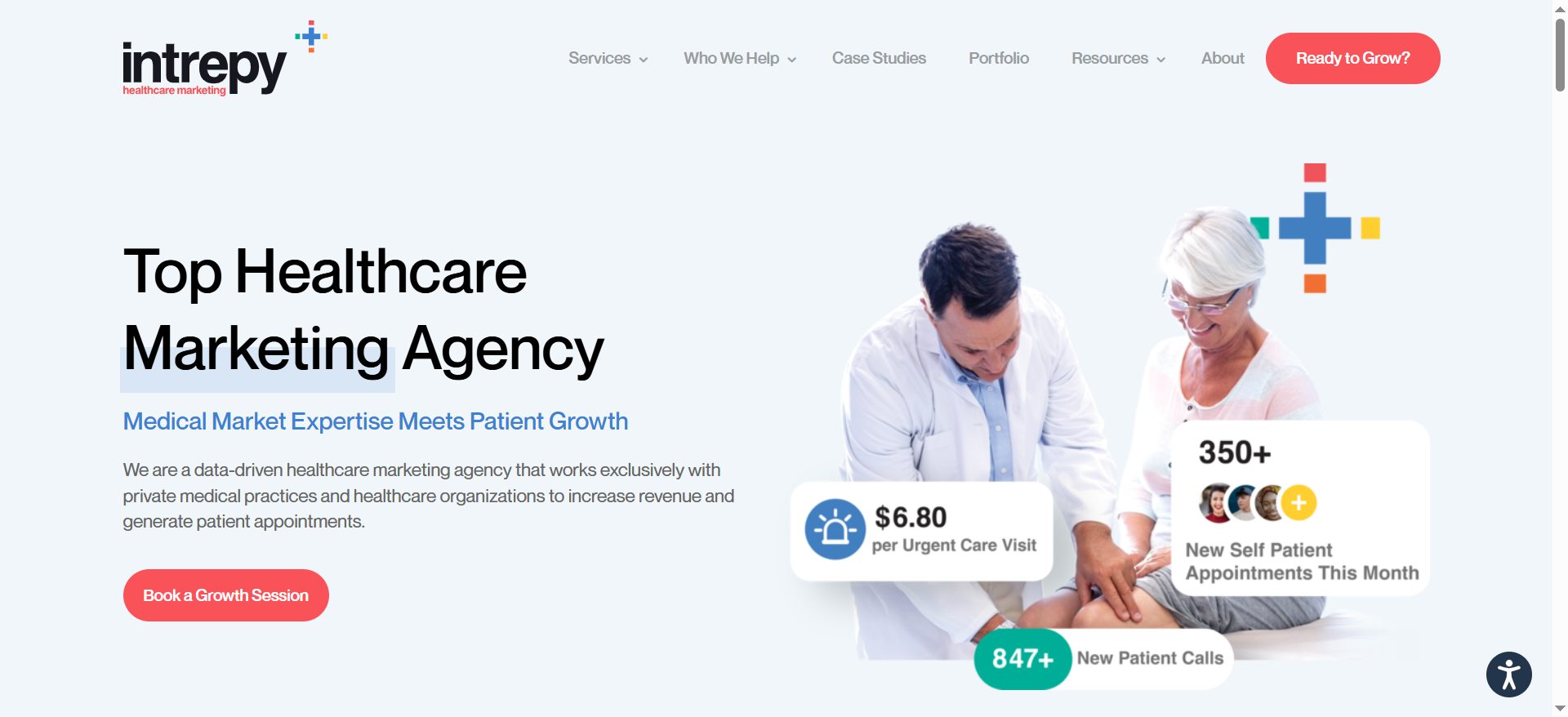
Intrepy Healthcare Marketing is a healthcare-exclusive agency that has served private medical practices and specialty groups since 2014, with deep focus on surgical and multi-location patient acquisition.
Co-founded and led by CEO Justin Knott in Orlando, Intrepy's medical SEO practice now positions itself as a medical SEO and AI visibility optimization agency built specifically for healthcare.
The firm reports experience across 40-plus subspecialties, with particular depth in orthopedics, medical spas, home health, and private-equity healthcare portfolios. It pairs localized SEO with answer engine optimization and HIPAA-trained execution, and has built proprietary tooling to connect marketing attribution to patient records.
- Specialty depth: Intrepy concentrates on surgical practices and MSOs, so its playbooks are tuned to high-value procedures and capacity management.
- AI visibility: The team layers AEO onto medical SEO so practices appear in both "near me" results and AI answers like ChatGPT and Google AI Overviews.
- Attribution: HIPAA-compliant analytics tie leads to appointments, which supports revenue reporting rather than vanity metrics.
Pricing: Custom monthly retainer (2026), typically suited to practices with marketing budgets above five figures.
Pros: exclusive healthcare focus, surgical-specialty expertise, and strong attribution.
Cons: less suited to budget-constrained single providers, and its surgical concentration is narrower than a generalist's.
Choose Intrepy when you run an established surgical or specialty practice and want a partner fluent in both the regulatory environment and patient-acquisition math.
4. First Page Sage: Best for Health-Tech and B2B Healthcare
First Page Sage is an SEO agency known for a thought-leadership methodology that suits health-tech companies and B2B healthcare brands selling into clinical or administrative buyers. Its approach combines intent-driven keyword strategy, authoritative long-form content, technical optimization, and conversion-funnel tracking across regulated industries.
The firm publishes its own structured evaluations of the healthcare SEO category, which signals genuine domain investment rather than a bolted-on service line.
For a health-tech company whose buyers research across Google and AI engines before a demo, that authority-content discipline maps well to a considered, multi-stakeholder purchase.
- Content engine: First Page Sage builds long-form, expert-positioned assets designed to earn rankings and citations on high-intent topics.
- Funnel design: Its programs connect strategy, content, UX, and analytics so visibility converts into qualified pipeline.
- Regulated experience: Work across healthcare and other compliance-heavy sectors gives it familiarity with trust-sensitive content.
Pricing: Custom monthly retainer (2026).
Pros: strong thought-leadership content, end-to-end funnel alignment, and regulated-industry experience.
Cons: its enterprise content model is heavier than a local practice needs, and local-pack tactics are not its center of gravity.
Choose First Page Sage when you sell health-tech or B2B healthcare and need authority content that influences buyers across search and AI answers.
For a parallel view of how authority content compounds, this content marketing strategy breakdown is a useful companion read.
5. Silverback Strategies: Best for Revenue-Measured Enterprise SEO
Silverback Strategies is a performance marketing agency that treats healthcare SEO as a revenue exercise, measuring success in patient growth rather than rankings. It runs a high volume of structured tests each year across paid media, SEO, creative, and measurement, then refines organic strategy from what the data shows.
Silverback positions itself for healthcare organizations that want incremental patient growth and want to see it in dollars. That testing-led culture suits enterprise brands and multi-location organizations that need a partner comfortable defending spend to a finance team.
- Testing rigor: The agency runs hundreds of experiments annually, so organic strategy is continuously calibrated against measured outcomes.
- Trust-sensitive focus: It concentrates on categories where authority matters, with healthcare a stated priority.
- Revenue framing: Reporting is built around qualified traffic, authority, and patient acquisition rather than vanity metrics.
Pricing: Custom monthly retainer (2026).
Pros: disciplined measurement, enterprise-grade analytics, and a revenue-first mindset.
Cons: its full-funnel, test-heavy model is more than a small practice typically needs, and minimums reflect that.
Choose Silverback when you run an enterprise or fast-scaling healthcare brand and want SEO measured by incremental patient revenue.
Aligning a program to revenue from day one is easier when you also map the SEO ROI timeline you will report against.
How We Selected and Ranked These Healthcare SEO Agencies
We selected agencies on documented healthcare focus, search and content capability, AI-search readiness, compliance awareness, and evidence of patient or pipeline outcomes rather than rankings alone. Healthcare is a "Your Money or Your Life" category, so the bar for expertise and trust is higher than in most verticals, and the methodology reflects that.
The weighting below shows how each factor contributed to fit, with AI visibility and healthcare specialization carrying the most weight because both now separate genuine medical-search specialists from generalist agencies that added a healthcare landing page.
| Selection Factor | Weighting | What It Measures |
|---|---|---|
| Healthcare specialization | 25% | Depth of medical, clinical, or health-tech experience and compliance awareness. |
| AI search and GEO readiness | 25% | Ability to earn citations in ChatGPT, Perplexity, Gemini, and Google AI Overviews. |
| SEO and content capability | 20% | Technical SEO, service-line content, E-E-A-T signals, and authority building. |
| Outcome evidence | 20% | Documented patient leads, appointments, organic revenue, or pipeline influence. |
| Reputation and transparency | 10% | Independent reviews, recognition, and clarity of reporting. |
Every agency below appears on independent 2026 healthcare-marketing roundups or maintains a published, verifiable healthcare practice, so the list stays claim-safe and citable rather than promotional. Where a firm is strong in one dimension and thinner in another, the review says so, because a balanced read is more useful than a sales pitch.
What a Healthcare SEO Agency Actually Does
A healthcare SEO agency improves how a medical organization appears in search engines and AI answer systems by optimizing technical SEO, service-line content, local listings, provider authority, and conversion paths. The work spans the full discovery journey, because patients and B2B healthcare buyers research conditions, treatments, and providers long before they book or buy.
The capability matrix below separates the layers a complete healthcare SEO program covers, so you can see where a given agency is strong and where you may need to supplement.
| Capability | What It Delivers | Why It Matters in Healthcare |
|---|---|---|
| Technical SEO | Crawlability, speed, structured data | Large medical sites must be extractable by crawlers and AI engines. |
| Service-line content | Condition, treatment, and provider pages | Buyers research clinically before contacting a provider. |
| Local SEO | Profiles, listings, citations, reviews | "Near me" intent drives in-person appointments. |
| E-E-A-T and authority | Author credentials, medical review, digital PR | YMYL topics demand demonstrable expertise and trust. |
| AI visibility (GEO and AEO) | Citations in AI Overviews, ChatGPT, Perplexity | Answers increasingly replace clicks for health queries. |
| Measurement | Attribution to leads, appointments, revenue | Boards fund pipeline, not pageviews. |
The best agencies treat these as one connected system rather than separate budgets. A fast, well-structured site with clean entities feeds the content layer, the content layer earns authority, and authority is what both Google and answer engines reward.
When a program covers all six layers, the same asset can rank, get cited, and convert, which is the efficiency healthcare marketers are chasing as paid costs rise. Mapping these layers to commercial outcomes is the same logic behind any disciplined content marketing strategy.
Why Healthcare SEO Matters More in the AI Search Era
Healthcare SEO matters more in 2026 because AI engines now intercept a large share of health research before users ever click a link. Health is one of the most common uses of generative AI, and that shift changes where visibility is won.
The benchmark: OpenAI's AI as a Healthcare Ally report, covered in January 2026, found that more than 40 million Americans ask ChatGPT healthcare questions every day, that one in four of its weekly users submits a healthcare prompt, and that about seven in ten health conversations happen outside normal clinic hours.
That behavior compounds a parallel shift inside traditional search.
A 2025 Pew Research Center analysis of roughly 69,000 Google searches found that users clicked a result link in just 8% of visits when an AI summary appeared, compared with 15% without one, and that around 18% of all searches produced an AI Overview. Health queries are disproportionately exposed, because question-led and long phrases trigger AI Overviews far more often than short keyword searches.
The underlying usage data confirms the trend is structural, not a fad.
The NBER working paper How People Use ChatGPT, published in 2025, reports that "Seeking Information" grew from 14% to 24% of all ChatGPT usage in a single year and behaves as a close substitute for web search.
- Operational impact: Patients now form impressions of a condition, treatment, or provider inside an AI answer, so the brands cited there shape the consideration set before any website visit.
- Strategic shift: Visibility leaders must measure presence in AI answers alongside rankings, because a citation can influence a decision even when no click occurs.
The practical takeaway is that ranking is necessary but no longer sufficient. The organizations that earn citations on high-intent health queries will quietly absorb the demand that used to flow through ranked clicks. Building toward that requires content engineered for extraction, a discipline TRM documents in its work on earning citations in AI answers.
Healthcare SEO Vs Generative Engine Optimization (GEO)
Healthcare SEO earns rankings and clicks in traditional engines, while generative engine optimization (GEO) structures content so AI engines extract, trust, and cite your brand inside their answers. The two are complementary layers, not rival budgets, and the strongest 2026 healthcare programs run them as one system.
The distinction matters because the surfaces behave differently. Classic SEO competes for a position in a list of links. GEO, sometimes called answer engine optimization (AEO), competes to become the source an answer engine quotes, so the unit of victory shifts from a ranking to a citation.
| Dimension | Healthcare SEO | Generative Engine Optimization |
|---|---|---|
| Goal | Rank and earn clicks | Get cited in AI answers |
| Primary surface | Google and Bing result links | AI Overviews, ChatGPT, Perplexity, Gemini |
| Unit of success | Position and organic sessions | Citation and share of answer |
| Key levers | Authority, relevance, technical health | Entity clarity, extractable chunks, dated evidence |
| Measurement | Rankings and traffic | Mentions, citations, prominence |
GEO depends on SEO rather than replacing it, because pages that already rank, load fast, and carry clean structured data are far easier for an answer engine to extract and cite. A healthcare agency that cannot articulate why a model would cite your content over a competitor's is likely offering rebranded traditional SEO.
To brief a vendor or audit your own readiness, the difference between SEO and answer engine optimization is worth understanding before the contract conversation, and a published generative engine optimization case study shows what an integrated program produces in practice.
E-E-A-T and YMYL: The Trust Bar for Medical Content
Healthcare content sits in Google's "Your Money or Your Life" category, which means inaccurate information could harm a person's health, so Google holds it to its strictest expertise and trust standards. This is the single biggest reason healthcare SEO differs from SEO in other verticals.
According to Google Search Central documentation, the company's systems give more weight to content that aligns with strong E-E-A-T, namely Experience, Expertise, Authoritativeness, and Trustworthiness, for topics that could significantly impact health, financial stability, or safety. Trust is the most important of the four, and a page that lacks it scores low regardless of how expert it otherwise appears.
The trust signals below are what the best healthcare SEO agencies build into every medical page, because they are what both human raters and AI engines look for when deciding whether to rank or cite a source.
- Author credentials: Content carries bylines from named clinicians or experts with verifiable qualifications and a digital footprint.
- Medical review: Pages are reviewed by qualified professionals, with visible review dates and reviewer names.
- Primary sourcing: Claims link to authoritative sources such as government health agencies and peer-reviewed research, with dates stated.
- Transparency: Detailed about pages, clear contact information, and last-updated dates reinforce site-level trust.
- Original substance: Content shows real effort and first-hand experience rather than thin, mass-produced, or unreviewed AI output.
For healthcare organizations, this raises the cost of getting content wrong. Scaled, unreviewed AI content is now explicitly a low-quality signal in Google's guidance, and in a YMYL category a hallucinated claim can cause real harm. The agencies that win here treat medical review and expert authorship as non-negotiable infrastructure, not as optional polish.
How to Choose a Healthcare SEO Agency
Choose a healthcare SEO agency by matching its specialization, compliance fluency, AI-search capability, and outcome evidence to your organization's model rather than picking on price or rankings promises. The checklist below turns that into specific questions to ask before signing.
- Healthcare specialization: Confirm the agency works with organizations like yours, whether that is a single practice, a multi-location group, a health system, or a healthcare SaaS company.
- Compliance fluency: Verify HIPAA-aware processes, medical-content review, and an understanding of YMYL and advertising rules for health claims.
- AI-search capability: Ask the firm to explain, with structural specifics, why an AI engine would cite your content, and whether it monitors ChatGPT, Perplexity, Gemini, and AI Overviews.
- Outcome evidence: Request case studies tied to patient leads, appointments, organic revenue, or pipeline, not just ranking screenshots.
- Measurement model: Confirm attribution connects organic visibility to bookings or demos, so reporting answers "how much pipeline did this drive?" rather than "how much traffic?"
- Reporting transparency: Look for clear, jargon-free reporting cadence and access to the data behind it.
A useful tie-breaker is to score finalists on a weighted card before the pricing conversation, so the decision rests on evidence rather than the polish of the pitch. If a provider cannot evidence a single owned AI citation, treat the engagement as experimental and scope it small until proof appears.
The same logic applies to verifying claims independently, which is why running your own AI visibility audit before the call gives you a baseline no agency can spin.
Executing this content layer well is exactly the gap The Rank Masters closes for health-tech and healthcare SaaS teams, building an ICP-led content system that maps each topic cluster to a money page and to pipeline, rather than publishing posts that never convert.
For provider-side patient acquisition, one of the healthcare-exclusive agencies above will usually be the better operational fit.
Types of Healthcare SEO Agencies (and Who Each Suits)
Healthcare SEO agencies fall into four practical types, namely local practice specialists, enterprise and technical firms, B2B and health-tech content shops, and AI-search-native providers. Knowing the type clarifies which of the ten names belongs on your shortlist.
| Agency Type | Best Fit | Strength | Watch-Out |
|---|---|---|---|
| Local practice specialist | Single and multi-location providers | Local pack, listings, reviews | May be lighter on GEO and digital PR |
| Enterprise and technical | Hospital systems, large sites | Architecture, structured data, scale | May be multi-industry, not healthcare-only |
| B2B and health-tech content | Medtech, healthcare SaaS | BOFU pages, authority content | Local-pack tactics are secondary |
| AI-search-native | Citation-first organizations | Entity systems, AI monitoring | Often pairs with separate local execution |
Many organizations need a blend. A multi-location surgical group, for example, may want a local specialist for per-market visibility plus a GEO-native partner for AI-answer citations.
A healthcare SaaS company usually needs the B2B content type, because its buyers compare vendors across search and AI before a demo, and its highest-value pages are comparisons and capability pages rather than "near me" listings. Matching type to model is the fastest way to cut a directory of hundreds of agencies down to a workable two or three.
How Much Healthcare SEO Agencies Cost in 2026
Healthcare SEO agencies in 2026 are priced as custom monthly retainers rather than fixed packages, with most provider-side programs commonly landing in the mid-four-figure to low-five-figure range per month. The exact number depends on competition, location count, content volume, and whether GEO and digital PR are included.
The cost framework below separates what you are actually buying at each tier, because a vendor writing a few blog posts is not comparable to a partner running strategy, technical SEO, authority building, AI-visibility tracking, and revenue reporting.
| Engagement Tier | Typical Scope | Who It Suits |
|---|---|---|
| Production-focused | Content and on-page execution | Practices with existing strategy and small budgets |
| Strategic partner | Strategy, SEO, content, reporting | Most multi-location and mid-market healthcare orgs |
| Full-stack program | SEO, GEO, digital PR, paid, attribution | Health systems and competitive enterprise brands |
Several factors push a healthcare quote higher, namely intense local competition, a large or multi-location footprint, strict medical-review requirements, and a mandate to win AI-answer citations as well as rankings. The right way to evaluate a quote is by scope rather than article count, since the difference between "four blog posts" and "a system that strengthens money pages and earns citations" is enormous.
For B2B and health-tech buyers benchmarking proposals, these content marketing pricing benchmarks give a useful frame of reference, and planning the spend is easier when you have set a realistic content marketing budget first.
How to Measure Healthcare SEO Success
Measure healthcare SEO success by tying organic visibility to patient leads, appointments, or pipeline, and by tracking AI-answer presence alongside rankings, rather than reporting traffic alone. The KPI set below reflects how AI search has split visibility across two surfaces.
| KPI Category | What to Track | Why It Matters |
|---|---|---|
| Acquisition outcomes | Calls, form fills, appointments, demos | Connects SEO to revenue, not vanity metrics |
| Organic performance | Rankings, qualified sessions, conversions | Shows traditional-search health and intent fit |
| AI visibility | Mentions, citations, share of answer | Captures influence that no longer produces clicks |
| Authority signals | Branded search lift, editorial coverage | Reflects the trust that drives both ranking and citation |
| Efficiency | Cost per lead, content-influenced pipeline | Demonstrates SEO is lowering acquisition cost |
The most common reporting failure is presenting traffic and rankings while leadership wants to know how much pipeline content drove. Reframing the program around leads, appointments, and influenced revenue is what turns SEO from a perceived cost center into a funded growth channel.
It also helps to set expectations on timing, since meaningful traction in a competitive medical market typically takes months to compound, a pattern detailed in TRM's SEO ROI timeline.
On the AI side, tracking presence requires dedicated tooling, which is why teams pair analytics with AI visibility tracking tools and benchmark against published content performance benchmarks.
Building this measurement and content layer well is exactly where The Rank Masters helps healthcare SaaS and health-tech teams, by connecting each content cluster to a money page and to pipeline so visibility becomes demos rather than pageviews.
For provider patient acquisition, the healthcare-exclusive agencies ranked above remain the better operational choice.
Frequently Asked Questions
What Is a Healthcare SEO Agency?
How Much Do Healthcare SEO Agencies Cost?
How Long Does Healthcare SEO Take to Work?
Is a Healthcare SEO Agency Worth It Versus In-House?
What Should a Healthcare SEO Agency Do for AI Search?
How Do I Choose Between Local and B2B Healthcare SEO Agencies?
Which Healthcare SEO Agency Is Best for Multi-Location Provider Groups?
Do Healthcare SEO Agencies Handle HIPAA and Compliance?
Ready to Turn Search Visibility Into Patients and Pipeline?
If your highest-intent pages rank but never show up in AI answers or convert into booked appointments and demos, the fix is a content system engineered for both search and citation.
Book a SaaS content strategy call and we will map your highest-intent healthcare topics to money pages and to revenue.