

Organic search drives 43% of all ecommerce traffic and converts at 2.8% on average, making it the single highest-performing acquisition channel for online stores, according to a 2026 ecommerce SEO analysis by Ringly.io.
Shopify now powers over 5.6 million active stores worldwide and commands roughly 29% of the U.S. ecommerce platform market, per Brenton Way's 2026 Shopify marketing statistics report. That scale creates a visibility problem.
Every one of those stores competes for the same product, collection, and category keywords, and Shopify's platform-level constraints, namely rigid URL structures, duplicate canonical paths, app-driven page-speed bloat, and limited robots.txt control, mean that ranking well requires specialized SEO execution, not a generic playbook.
The best Shopify SEO companies combine deep platform knowledge with ecommerce revenue strategy. They understand that Shopify generates two canonical paths for every product, that each installed app adds JavaScript to the storefront, and that collection pages are often the highest-value ranking targets for commercial-intent queries.
The wrong agency treats Shopify like any other CMS. The right one treats it like a revenue engine with specific mechanical constraints.
This guide ranks and evaluates the strongest Shopify SEO agencies operating in 2026, covering their service scope, pricing, ideal client fit, and verified results. Whether you run a small DTC brand or a high-volume Shopify Plus operation, the comparison below will help you shortlist the right partner based on your store's stage, catalog complexity, and growth goals.
▶️ If your ranked pages are not showing up in AI answers and you want a content system that fixes that, book a SaaS content strategy call.
Shopify SEO Companies Comparison Table
| Agency | Best For | Core Shopify SEO Services | Pricing Range (2026) | Notable Result |
|---|---|---|---|---|
| Netalico Commerce | Shopify Plus brands needing technical depth | Technical SEO, content strategy, structured data, site speed | Mid-to-high retainer | 300+ stores launched, 5.0 Clutch rating |
| Siege Media | Content-led organic growth at scale | Content engineering, digital PR, link building | $10,000+/mo | $7.2M monthly traffic value for a client |
| SmartSites | Mid-market merchants wanting full-service ROI | Technical SEO, content marketing, link building, PPC | $1,500 to $5,000/mo | Inc. 5000 for nine consecutive years |
| OuterBox | Enterprise Shopify Plus and complex migrations | Revenue-first SEO, technical audits, migration support | $5,000+/mo | 250-person in-house team |
| Coalition Technologies | Multi-channel ecommerce brands | Technical audits, on-page optimization, content, links | $2,500 to $7,500/mo | 250+ team across LA, Seattle, and globally |
1. Netalico Commerce: Best for Shopify Plus Technical SEO
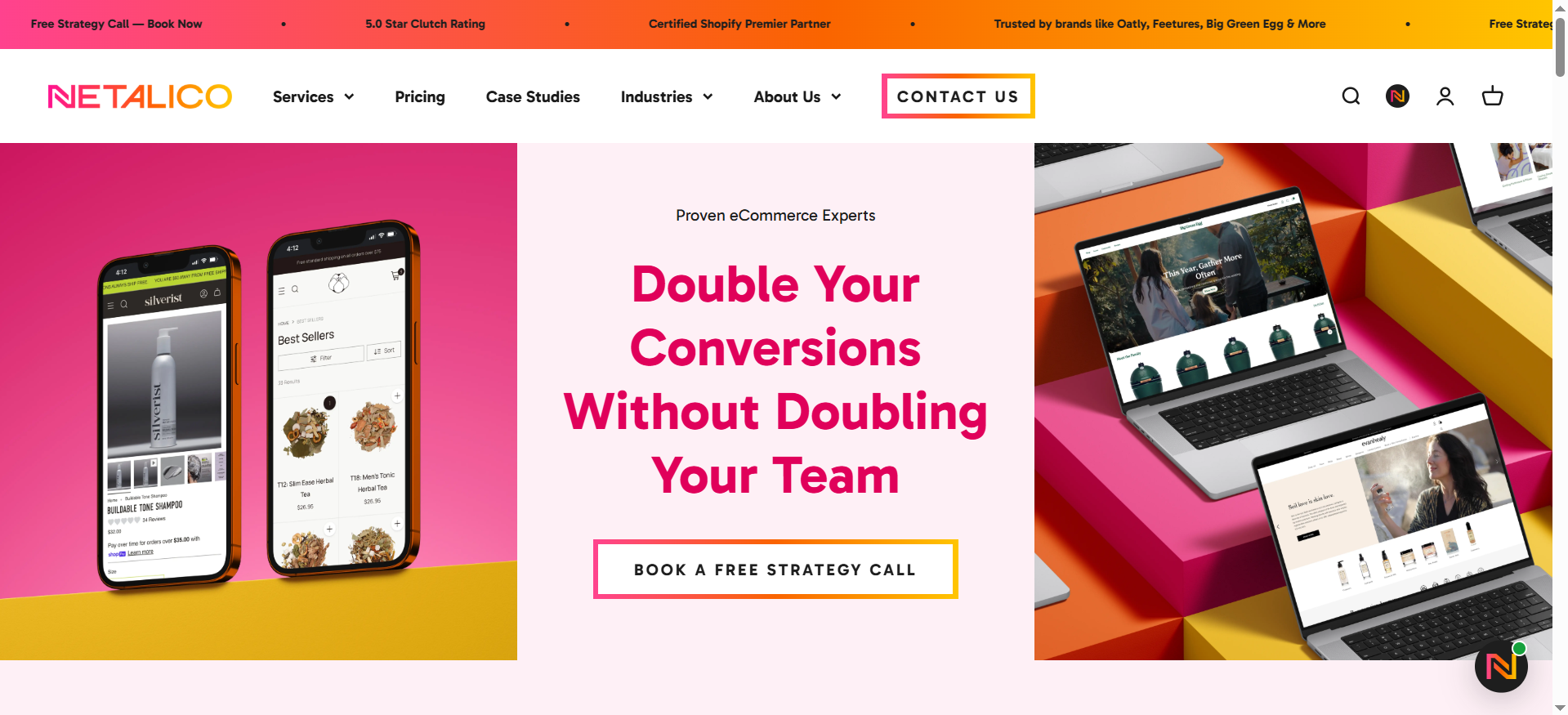
Netalico Commerce is the strongest choice for Shopify Plus merchants who need deep technical SEO execution paired with ongoing platform maintenance. As a certified Shopify Plus partner with over 100 Shopify Plus projects and 300+ stores launched, Netalico combines the development expertise to implement SEO fixes at the code level with a strategic layer covering content and structured data.
Best for: Shopify Plus brands that need technical foundations built and maintained long-term.
Netalico's SEO program operates across three interconnected pillars, namely technical SEO, content strategy, and structured data implementation. On the technical side, they handle Shopify-specific problems including canonical tag management, crawl budget optimization, site speed improvements, and schema markup for rich results. Their content strategy targets high-intent keywords that drive qualified traffic rather than vanity rankings.
| Feature | Detail |
|---|---|
| Shopify Partner Status | Certified Shopify Plus Partner |
| Projects Completed | 100+ Shopify Plus projects, 300+ total stores |
| Client Rating | 5.0 on Clutch |
| Core Services | Technical SEO, content strategy, structured data, ongoing maintenance |
| Notable Clients | Oatly, Feetures, Big Green Egg |
What sets Netalico apart is the connection between their SEO work and their ongoing Shopify maintenance services. Technical SEO on Shopify is not a one-time fix. It requires continuous monitoring as the platform evolves, apps are added, and product catalogs grow. Their retainers protect ranking gains over time, preventing the common scenario where SEO improvements slowly erode as the store changes.
- Strength: Development and SEO under one roof, so technical recommendations actually get implemented
- Limitation: Not the lowest-cost option, and onboarding takes a few weeks
- Choose Netalico when: Your store runs on Shopify Plus and you want a single partner for development, technical SEO, and ongoing optimization
2. Siege Media: Best for Content-Led Shopify SEO at Scale
Siege Media is the top pick for Shopify brands that want to use editorial content as their primary organic growth lever. Their team builds large-scale content programs that earn both search rankings and high-quality backlinks through data-driven keyword research and strong editorial production.
Best for: Shopify brands in saturated transactional categories that need content to differentiate.
Siege Media's proprietary strategy tool, BlueprintIQ, identifies exact content gaps where a brand can outpace competitors and forecasts ROI before a single piece is written. Their DataFlywheel system automates the identification and updating of top-converting pages, keeping content fresh in an environment where both Google and AI engines penalize stagnation.
| Feature | Detail |
|---|---|
| Specialization | Content-led SEO and digital PR |
| Proprietary Tools | BlueprintIQ (content gap analysis), DataFlywheel (content freshness) |
| GEO Capability | Active generative engine optimization program |
| Team Structure | In-house content, design, and outreach |
| Notable Achievement | $7.2M monthly traffic value for a major client |
Siege also offers generative engine optimization, addressing the growing importance of AI search visibility. Their approach goes beyond traditional page-one rankings to ensure client content surfaces in AI-generated answers from ChatGPT, Perplexity, and Google AI Overviews.
- Strength: Content engineering at scale with measurable ROI forecasting
- Limitation: Less focused on technical Shopify platform issues; primarily a content and PR shop
- Choose Siege Media when: Your technical foundation is solid and you want to invest heavily in content-driven organic growth and backlink acquisition
3. SmartSites: Best for Mid-Market Shopify Stores Needing Full-Service SEO
SmartSites delivers the strongest balance of performance, breadth, and pricing for mid-market Shopify merchants who want technical SEO, content, and paid media coordinated under one roof. Recognized on the Inc. 5000 list for nine consecutive years, SmartSites brings a consistent track record of measurable results.
Best for: Mid-market Shopify merchants seeking integrated organic and paid growth.
SmartSites covers technical optimization, content marketing, and link building for Shopify stores, with consistently strong client reviews for communication and responsiveness. Their team also supports AI search visibility alongside traditional rankings, positioning them for the evolving search landscape.
| Feature | Detail |
|---|---|
| Inc. 5000 Recognition | Nine consecutive years |
| Client Reviews | Nearly 1,000 verified reviews |
| Core Services | Shopify SEO, enterprise SEO, audits, technical SEO, link building |
| Additional Channels | Google Ads, Facebook Ads, LinkedIn campaigns |
| Pricing Model | Flexible engagements, competitive pricing |
- Strength: Full-service digital marketing with strong Shopify SEO foundation
- Limitation: Broader agency that handles many verticals, so Shopify-specific depth may vary
- Choose SmartSites when: You want a single agency for SEO plus paid media at competitive pricing with proven results
4. OuterBox: Best for Enterprise Shopify Plus and Complex Migrations
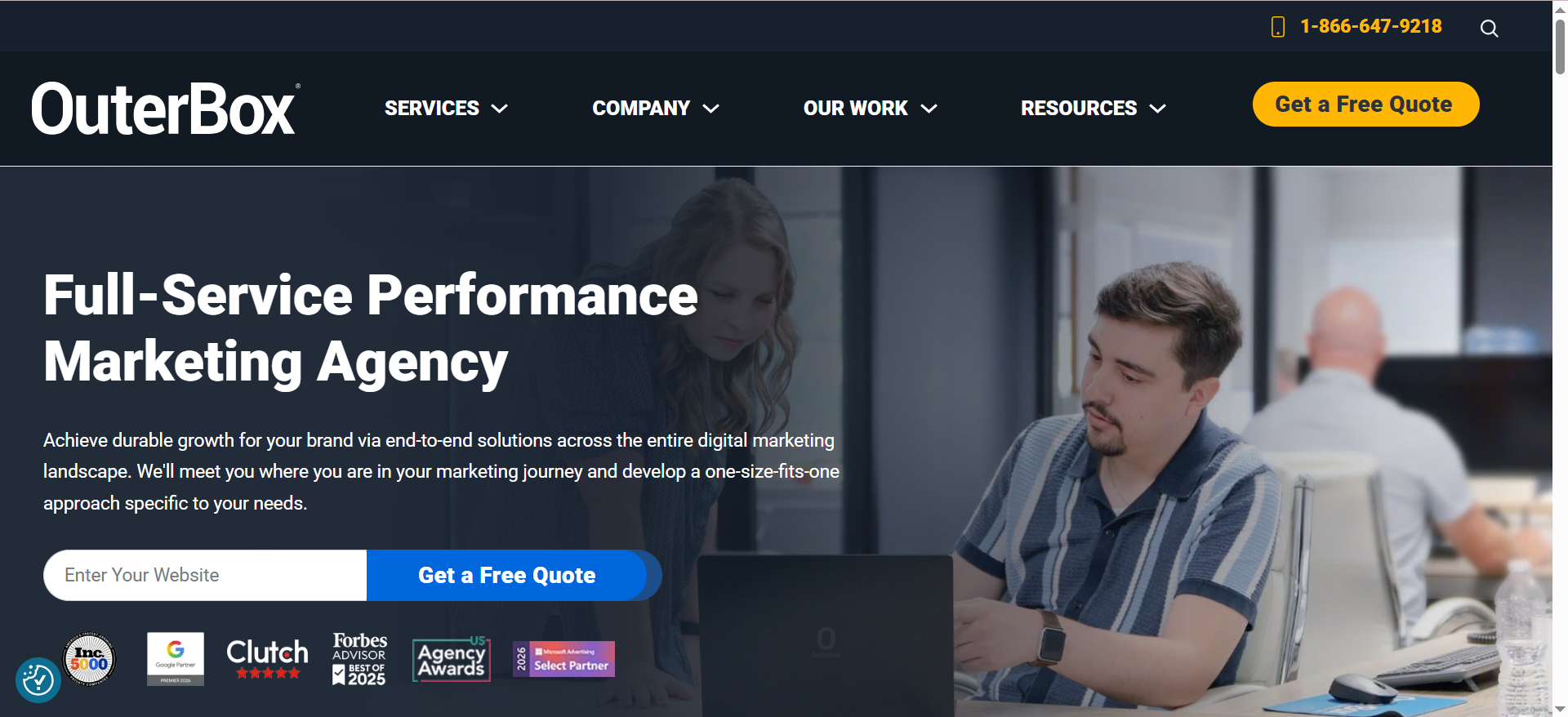
OuterBox specializes in revenue-first SEO strategies for high-volume Shopify Plus merchants. Their 250-person in-house team handles both strategy and implementation, making them a strong fit for enterprise-level stores that need scale and consistency.
Best for: Enterprise Shopify Plus brands and stores undergoing complex platform migrations.
OuterBox's primary advantage is team depth. They can simultaneously run technical audits, produce content at volume, build links, and manage conversion optimization without relying on subcontractors. For merchants migrating from Magento, WooCommerce, or BigCommerce, OuterBox provides structured migration support that preserves SEO equity through careful redirect mapping and metadata mirroring.
| Feature | Detail |
|---|---|
| Team Size | 250+ in-house |
| Specialization | Revenue-first ecommerce SEO |
| Migration Support | Full redirect mapping, metadata preservation, schema migration |
| Engagement Model | Retainer-based, enterprise-tier pricing |
| Client Base | High-volume Shopify Plus merchants |
- Strength: Enterprise-scale execution with everything handled in-house
- Limitation: Pricing and team size are built for larger budgets, not ideal for small stores
- Choose OuterBox when: You run a high-volume Shopify Plus store or need SEO-safe platform migration support
5. Coalition Technologies: Best for Multi-Channel Ecommerce Optimization
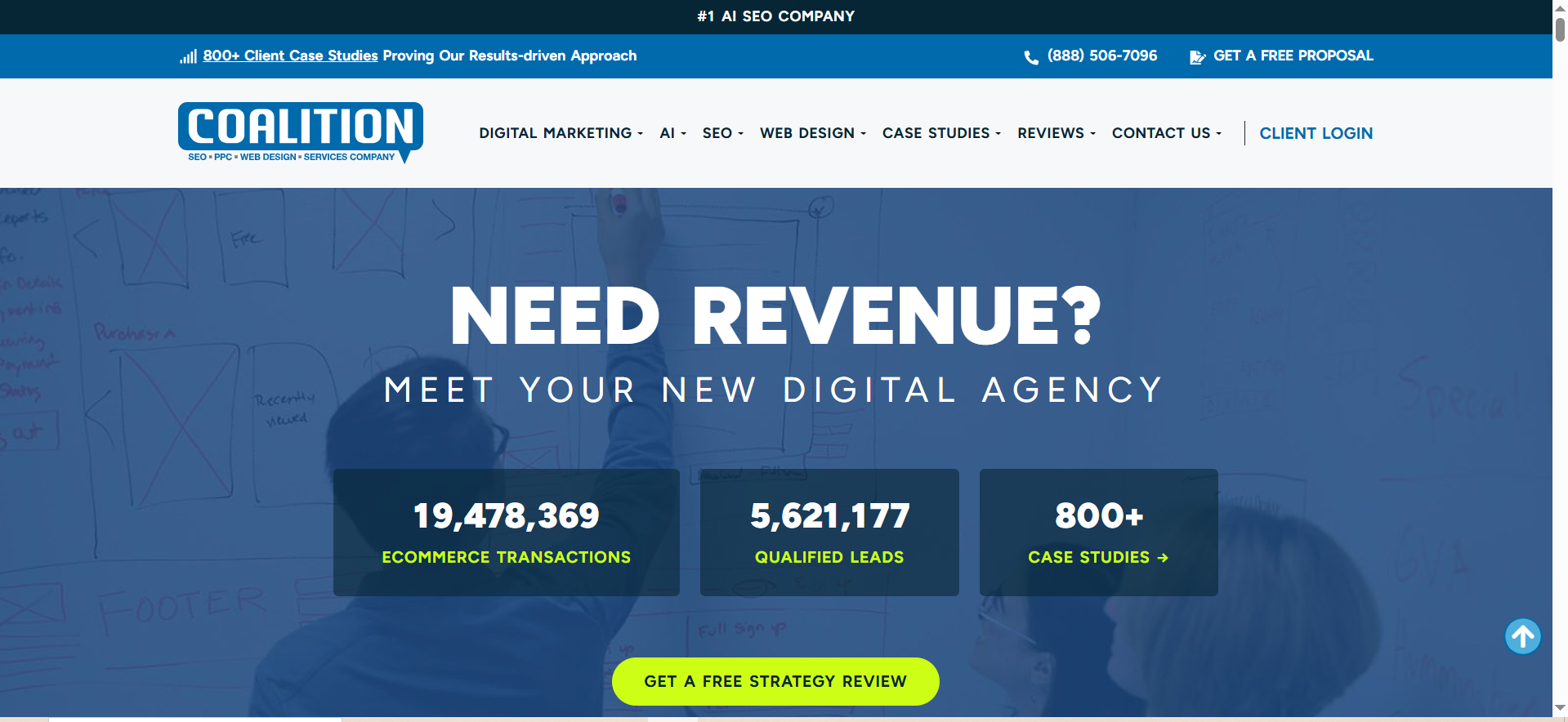
Coalition Technologies is a Los Angeles-based Shopify Partner offering design, development, and SEO under one roof. With a 250+ person team operating across Los Angeles, Seattle, and globally, the agency handles complex Shopify and Shopify Plus builds alongside ongoing organic growth programs.
Best for: Multi-channel ecommerce brands that need development and SEO coordinated.
Coalition's approach integrates technical audits, on-page optimization, content development, and link building with a deep understanding of Shopify's product page, collection page, and blog content nuances that generalist agencies often miss.
| Feature | 250+ globally |
|---|---|
| Team Size | Design, development, SEO, content, link building |
| Core Services | Design, development, SEO, content, link building |
| Platform Focus | Shopify and Shopify Plus |
| Approach | Revenue-tied KPIs, integrated development and SEO |
| Locations | Los Angeles, Seattle, global |
- Strength: Design, development, and SEO all coordinated under one agency
- Limitation: Large agency that serves many verticals, so Shopify specialization may not be as narrow as boutique shops
- Choose Coalition Technologies when: You need a single partner for store design, development, and SEO at scale
How to Choose the Right Shopify SEO Company for Your Store
The best Shopify SEO agency for your business depends on your growth stage, catalog size, and internal capabilities. A startup with 50 products has different needs than a Shopify Plus store processing thousands of orders per month.
According to Clutch's 2026 Shopify SEO data, monthly retainers for Shopify SEO range from $2,500 to $15,000, with hourly rates generally sitting between $75 and $150. Enterprise engagements or multilingual stores can exceed $25,000 per month.
| Store Stage | Budget Range (Monthly) | Recommended Agency Profile | Priority Services |
|---|---|---|---|
| Startup (under 100 products) | $1,000 to $2,500 | Boutique or freelancer with Shopify focus | Technical audit, on-page, collection page optimization |
| Growth (100 to 1,000 products) | $2,500 to $7,500 | Mid-market agency with documented Shopify results | Technical SEO, content strategy, link building |
| Enterprise (Shopify Plus) | $7,500 to $25,000+ | Full-service agency with Shopify Plus partnership | Full-stack SEO, CRO, migration support, AI visibility |
Before signing with any agency, ask these five questions to separate specialists from generalists.
- How have you improved organic revenue, not just traffic, for other Shopify stores?
- Which apps or custom code changes do you implement for SEO?
- What is your approach to fixing duplicate content caused by Shopify's URL structure?
- How do you measure success, and do you report on revenue or just rankings?
- Will I retain ownership of all content, data, and backlinks created?
Executing this well is exactly the gap The Rank Masters closes for B2B SaaS teams, building an ICP-led content system that maps each topic cluster to a money page and to pipeline, rather than publishing posts that never convert. If your Shopify store sells to businesses and you need content that ranks in both Google and AI search engines, a SaaS content marketing strategy built around buyer intent will outperform generic SEO retainers.
How We Selected and Ranked These Shopify SEO Agencies
Every agency on this list was evaluated against five criteria designed to surface Shopify-specific capability rather than generic SEO credentials.
| Selection Criterion | What We Verified |
|---|---|
| Shopify platform expertise | Shopify Partner status, Liquid proficiency, case studies on Shopify-specific issues |
| Documented revenue outcomes | Published client results tied to organic revenue, not just traffic or rankings |
| Service breadth | Coverage of technical SEO, content strategy, link building, and CRO for Shopify |
| Client reviews and reputation | Verified ratings on Clutch, G2, or Google, with specific Shopify feedback |
| Pricing transparency | Published pricing ranges or willingness to share retainer structures |
This list is unranked unless stated otherwise. The best agency for your store depends on catalog size, growth stage, budget, and whether you need a full-service partner or a specialist in one discipline. We recommend reading each profile and mapping it to your own operational needs before reaching out.
Shopify SEO Pricing: What Agencies Charge in 2026
Shopify SEO pricing varies widely based on engagement type, catalog complexity, and whether you need ongoing optimization or a one-time fix. According to a 2026 Shopify SEO cost guide by ShopExperts, the realistic ranges break down by service tier.
| Engagement Type | Price Range (2026) | What It Covers |
|---|---|---|
| One-time technical audit | $500 to $2,500 | Crawl analysis, meta tag review, speed assessment, schema check |
| Audit plus implementation | $2,000 to $8,000 | Audit findings plus executed fixes |
| Small monthly retainer | $1,000 to $2,500/mo | Basic ongoing optimization, reporting, minor content |
| Mid-market retainer | $2,500 to $7,500/mo | Technical SEO, on-page, content strategy, reporting |
| Aggressive growth retainer | $7,500 to $15,000/mo | Full-stack SEO, CRO, link building, content at volume |
| Enterprise SEO | $15,000 to $50,000+/mo | Multi-market, multilingual, Shopify Plus complexity |
| Content production | $100 to $2,000 per article | Blog posts, collection page copy, buying guides |
| Link building | $200 to $1,500 per link | Quality backlink acquisition through outreach and PR |
AI-powered tools have compressed costs for routine SEO tasks by 20% to 30%, according to Digital Applied's 2026 SEO pricing report. Content briefs, technical audits, keyword research, and reporting that previously consumed 15 to 20 hours per month can now be completed in 5 to 8 hours with AI assistance. Agencies that have adopted AI workflows pass some savings to clients, but strategic and creative work remains labor-intensive.
The critical calculation is not "how much does it cost" but "what does it return." A Shopify store doing $50,000 per month in revenue with a 1.5% conversion rate is leaving significant money on the table. Moving from 1.5% to 2.0% conversion represents roughly $16,000 per year in additional revenue. If the SEO and CRO work that drives that improvement costs $3,500, the payback period is under three months.
Shopify SEO vs General Ecommerce SEO: Key Differences
Shopify SEO is a subset of ecommerce SEO with platform-specific constraints that require specialized execution. General ecommerce SEO knowledge does not automatically translate to Shopify, because the platform handles URL routing, canonical tags, page rendering, and site architecture differently from self-hosted solutions.
According to Shopify's own 2026 SEO challenges guide, five core challenges dominate ecommerce SEO today: algorithm volatility, securing long-term buy-in, zero-click AI search, intense competition, and the shift from keywords to comprehensive topic coverage. On Shopify specifically, these challenges compound with platform-level limitations.
| SEO Dimension | Self-Hosted (WooCommerce, Magento) | Shopify |
|---|---|---|
| URL structure control | Full control over all URL paths | Cannot remove /collections/ or /products/ prefixes |
| Robots.txt editing | Complete file access | Limited template-based access |
| Canonical tag management | Full manual control | Auto-generated, requires Liquid-level overrides |
| Page speed optimization | Server-level control, CDN choice | Dependent on Shopify CDN and app overhead |
| Category hierarchy | Full parent-child nesting | Flat collection structure, no native subcategories |
| Server-side rendering | Configurable per framework | Shopify-managed rendering pipeline |
For readers exploring how AI search engines factor into ecommerce visibility, a deeper look at SEO strategies for AI visibility covers the practical steps for earning citations in ChatGPT, Perplexity, and Google AI Overviews.
What Services the Best Shopify SEO Agencies Offer
A credible Shopify SEO agency operates across multiple service layers that work together to drive organic revenue. The most effective programs combine technical fixes, content development, authority building, and conversion optimization into a coordinated growth system.
| Service Layer | What It Includes | Why It Matters for Shopify |
|---|---|---|
| Technical SEO | Crawl optimization, canonical fixes, schema markup, Core Web Vitals | Fixes Shopify's structural SEO limitations |
| Content strategy | Keyword research, blog content, collection page optimization, buying guides | Drives qualified organic traffic to high-intent pages |
| Link building and digital PR | Outreach, guest content, PR campaigns, broken link reclamation | Builds domain authority that Shopify's flat structure needs |
| Conversion rate optimization | A/B testing, checkout flow optimization, trust signal placement | Ensures traffic from SEO actually converts to revenue |
| AI search optimization | Structured data, FAQ schema, answer-engine content formatting | Positions store content for AI Overviews and chatbot citations |
According to a 2025 ecommerce SEO statistics analysis, AI Overviews now appear in over 13% of all Google queries, and only 0.3% of those overviews currently include ecommerce sources. This gap represents a major opportunity for Shopify stores that invest in structured content and schema markup before competitors catch up.
Teams evaluating their existing tool stack can cross-reference with a breakdown of the best tools for SEO to ensure their agency uses platforms that deliver actionable data rather than vanity metrics. For technical audits specifically, an overview of the best AI tools for technical SEO audits covers the crawl and analysis platforms that top agencies deploy.
Shopify SEO Results: How Long Before You See ROI
Most Shopify SEO campaigns begin generating positive returns within six to twelve months. According to Shopify's own ROI guidance, ecommerce SEO often breaks even in about nine months and then compounds to fivefold ROI or more by year three.
The timeline depends on three variables: the store's existing technical health, the competitive intensity of target keywords, and the catalog size. A store with clean technical foundations that targets long-tail commercial keywords will see results faster than a store in a saturated category with significant technical debt.
| Timeline | What to Expect | Key Metrics to Watch |
|---|---|---|
| Months 1 to 3 | Technical audit, fixes, keyword mapping, content planning | Indexed pages, crawl errors resolved, site speed improvements |
| Months 4 to 6 | Content publishing, initial ranking movement, link building starts | Impressions, keyword position changes, new pages indexed |
| Months 7 to 9 | Rankings consolidate, organic traffic grows, early revenue attribution | Organic sessions, organic revenue, conversion rate by landing page |
| Months 10 to 12 | Compounding returns, content library driving consistent traffic | ROI calculation, customer acquisition cost from organic, repeat traffic |
| Year 2 and beyond | SEO becomes a self-reinforcing growth channel | Revenue per organic session, lifetime value from organic customers |
SeoProfy's 2026 ROI statistics report found that the median SEO ROI across industries is approximately 748%, meaning roughly $7.48 back for every $1 spent. Ecommerce specifically delivers a 317% ROI, with the lower percentage offset by the higher absolute revenue at scale.
For brands tracking whether their existing content is aging well or losing rankings, understanding B2B SaaS content benchmarks provides the baseline metrics for evaluating content performance over time.
Red Flags When Hiring a Shopify SEO Agency
Not every agency that claims Shopify SEO expertise can back it up. According to Clutch's agency vetting data, the most reliable warning signs include the following.
- Guarantees of specific rankings within a set timeframe, because no agency controls Google's algorithm
- Inability to explain how their tactics map to Shopify's specific ecosystem, including Liquid templates and app conflicts
- Generic SEO playbooks applied without auditing the store's current technical state
- Reporting focused on traffic and keyword counts rather than organic revenue and conversion rates
- Cold outreach emails claiming your site has critical SEO errors, which are almost always from low-quality providers
- Long-term contracts with no performance benchmarks or exit clauses
A strong Shopify SEO partner will ask about your organic revenue goals before discussing deliverables, demonstrate familiarity with Shopify-specific constraints like duplicate URL paths and app-driven speed issues, and provide case studies with verifiable traffic and revenue data.
For teams comparing SEO tools for small businesses, the same principle applies. The tool, like the agency, should tie its value to business outcomes, not vanity metrics.
Frequently Asked Questions
What Is a Shopify SEO Company and What Do They Do?
How Much Does Shopify SEO Cost per Month in 2026?
Is It Worth Hiring a Shopify-Specific SEO Agency Over a Generalist?
How Long Does Shopify SEO Take to Show Results?
Can Shopify Stores Rank Well Without an SEO Agency?
What Should I Look for in a Shopify SEO Agency's Case Studies?
Do Shopify SEO Companies Also Handle AI Search Optimization?
How Do I Know If My Current Shopify SEO Agency Is Underperforming?
Why Shopify Stores Need a Specialized SEO Agency
Generalist SEO agencies miss the platform-specific problems that make or break Shopify rankings. Shopify auto-generates tag pages that dilute crawl budget, creates duplicate product URLs when items sit in multiple collections, and restricts direct access to the robots.txt file, limiting how store owners control what search engines crawl. According to a 2026 technical SEO analysis by Blubolt, these structural quirks represent the most common ranking barriers Shopify merchants face.
A specialized Shopify SEO agency solves problems that a platform-agnostic provider will not recognize. These include canonical tag conflicts between /products/ and /collections/ URL paths, JavaScript bloat from third-party apps that pushes Largest Contentful Paint beyond the 2.5-second threshold Google uses for ranking, and shallow breadcrumb navigation that weakens internal linking signals.
| Shopify SEO Challenge | Why It Hurts Rankings | What a Specialist Fixes |
|---|---|---|
| Duplicate product URLs | Splits link equity across collection-based paths | Canonical consolidation to /products/ slug |
| Tag page indexation | Creates thin, crawlable pages with no unique content | Noindex directives or tag-page consolidation |
| App-driven page speed issues | Every app adds JavaScript, increasing LCP | Quarterly app audit, script deferral, lazy loading |
| Rigid URL structure | Cannot remove /collections/ or /products/ prefixes | Descriptive slugs, strong internal linking, schema |
| Limited robots.txt control | Cannot fine-tune crawl behavior for large catalogs | Template-level workarounds, crawl budget optimization |
| Shallow category hierarchy | No parent-child collection relationships | Smart internal linking, breadcrumb schema markup |
The financial case for specialization is clear. First Page Sage's 2025 ecommerce SEO ROI report, analyzing 80 ecommerce clients across five verticals, found that ecommerce SEO delivers a 317% ROI with a nine-month break-even window.
Stores that invest in platform-specific optimization capture that return faster because they avoid the months of wasted effort that generalist agencies spend learning Shopify's constraints.
If thin BOFU coverage is costing you pipeline, book a SaaS content strategy call and we will map your highest-intent topics to revenue.