

If you want the fastest path to publishable topic clusters, start with Semrush (broad discovery + clustering workflows), validate depth and difficulty with Ahrefs, and use Keyword Insights when you need clean, intent-labeled clusters you can turn into briefs at scale. For finding “easy wins,” LowFruits helps you spot lower-competition SERPs, and AlsoAsked is perfect for turning clusters into human-first (and AI-friendly) question maps.
📋 Get Listed / Advertisement
We update this guide monthly. Want your tool featured? Contact: [email protected].
Best AI Tools for Keyword Research & Topic Clustering (Quick Comparison)
| Tool | Best for | Standout capability | Typical workflow |
|---|---|---|---|
| Semrush | End-to-end discovery + planning | Large keyword databases + topic planning features | Discover → expand → group → plan hub/spoke pages |
| Ahrefs | Validation + competitive research | Deep backlink + SERP intelligence for cluster validation | Validate demand/competition → pick winners → map content |
| Keyword Insights | Clean clustering + intent labeling | AI clustering + intent classification built for content teams | Upload/export keywords → cluster → label intent → write briefs |
| LowFruits | Low-competition opportunities | Highlights weaker SERPs + long-tail patterns | Find long tails → validate SERPs → build small clusters |
| AlsoAsked | Question-based clustering | “People also ask” style question relationships | Build question tree → turn into outline + FAQs + subtopics |
📋 Get Listed / Advertisement
We update this guide monthly. Want your tool featured? Contact: [email protected].
▶️ Explore
1. Semrush
What it does
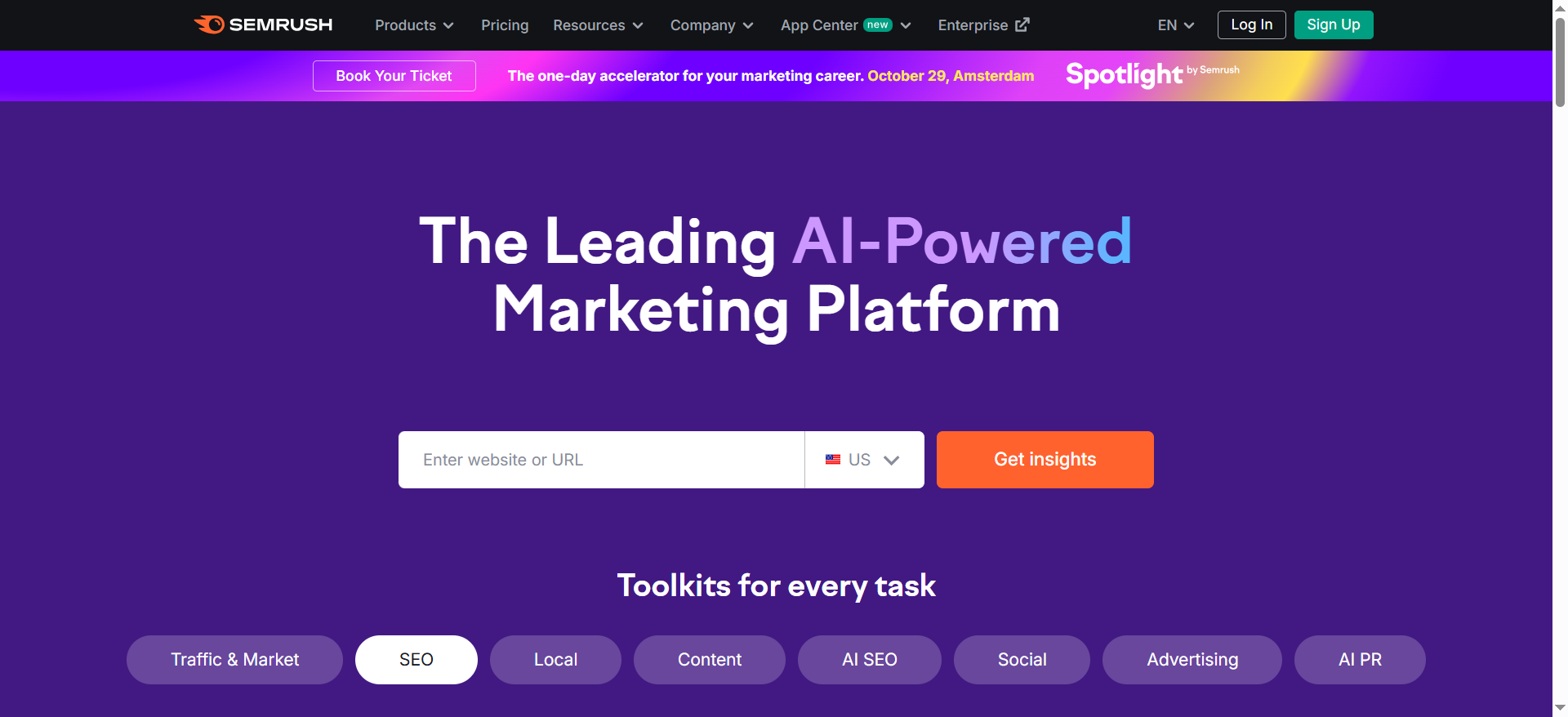
Semrush is a broad SEO platform that supports keyword discovery, competitive research, content planning, and (depending on the workflow you use) topic grouping and cluster planning.
Why teams use it
Because it’s often the fastest way to go from “we need a content plan for this category” to “here’s a prioritized map of pages we can publish.” It’s also useful when you need to align clusters with business outcomes (commercial pages, comparison pages, and supporting educational content).
What it’s good for
- High-volume keyword discovery (seed expansion, variants, modifiers)
- Early-stage cluster planning and identifying subtopics you’d otherwise miss
- Competitive “gap” thinking: what topics do competitors cover that you don’t?
- Building a repeatable workflow for content ops
When it’s a good fit
- You need an all-in-one tool for research + planning
- Your team publishes consistently and needs scalable processes
- You want to tie clusters to topical authority (not random posts)
When it’s not a good fit
- You only need lightweight clustering (you may prefer a specialist tool)
- You want highly customized clustering rules and labels without extra steps
- You’re extremely price-sensitive and only need one narrow capability
How to use it for topic clusters
- Start with a money-page seed: a product category, integration keyword, or pain-point query.
- Expand into modifiers: “best,” “alternative,” “for [industry],” “vs,” “pricing,” “template,” “tool,” etc.
- Split into intent buckets (commercial vs informational).
- Group by meaning, not just stems: “ai keyword research” and “keyword clustering tools” can belong in the same hub, while “keyword research template” might be a separate spoke.
- Export your grouped list into a cluster sheet (template later in this guide).
Key capabilities
- Keyword expansion and variations
- SERP previews and intent signals
- Competitive research to identify missing subtopics
- Content planning workflows that support hub/spoke thinking
Pricing
Semrush’s SEO Toolkit pricing starts at $139.95/month (Pro plan).
Free tier?
Semrush offers a free account with limited access, and it also offers a 7-day free trial for most toolkits.
Downsides / limitations
- “Clustering” may require manual shaping if you want editorial-grade clusters
- Some teams over-collect keywords and under-ship pages (tool doesn’t fix that)
- You still need a framework to turn exports into publishable hubs
2. Ahrefs
What it does
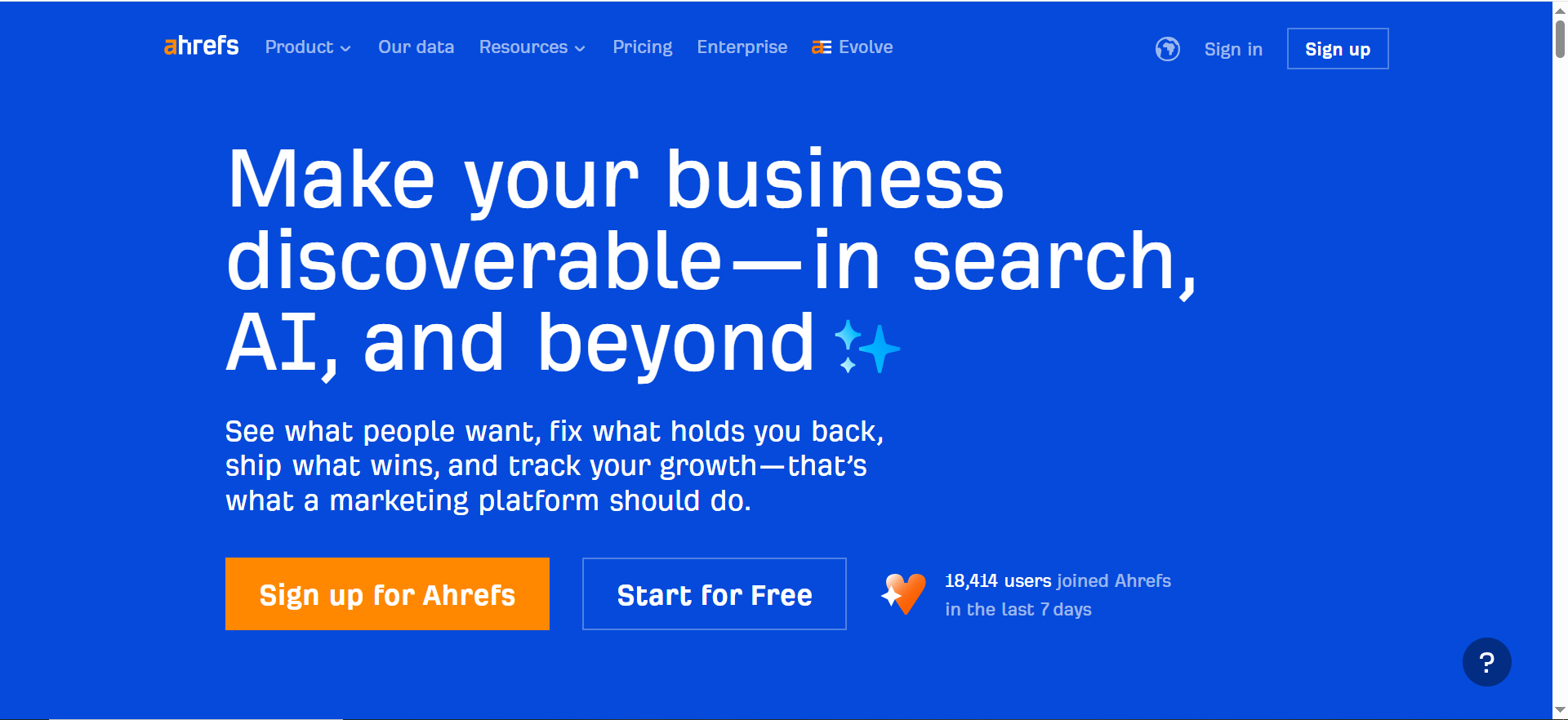
Ahrefs is a powerful SEO suite known for competitive research, backlink intelligence, and SERP-level analysis, excellent for validating which clusters are worth building.
Why teams use it
Because keyword clustering isn’t just grouping, it’s choosing what to publish. Ahrefs helps you validate:
- Is there real demand?
- Is the SERP dominated by giants?
- Are there weak results you can outmatch?
- Which pages (and links) keep competitors on top?
What it’s good for
- Confirming cluster viability and competitiveness
- Finding competitor pages to reverse-engineer structure and entities
- Identifying link requirements for cluster hubs (especially BOFU)
- Discovering adjacent topics via competitor and SERP research
When it’s a good fit
- You have a shortlist of clusters and want to pick winners
- You care about link-driven competitiveness
- You publish comparison/integration pages and need SERP realism
When it’s not a good fit
- You primarily want automated clustering and intent labels out of the box
- You need question mapping (you’ll likely pair it with AlsoAsked)
How to use it for clusters
- Take your draft cluster and pull the top ranking pages.
- Note SERP diversity: is it informational, commercial, mixed?
- Extract entity coverage: what subtopics appear across top pages?
- Check backlinks: if every top result has heavy authority, adjust scope or pick a different angle.
- Decide your “hub” keyword: the one that matches the SERP intent and can support internal links from spokes.
Key capabilities
- SERP analysis for intent validation
- Competitive research to uncover “missing” pages
- Backlink intelligence to estimate effort required
- Keyword expansion that’s especially useful for long-tail variants
Pricing
Ahrefs’ pricing starts at $29/month (Starter plan).
Free tier?
Ahrefs doesn’t offer a free trial, but it does offer Ahrefs Webmaster Tools, a free plan with limited access to Site Explorer and Site Audit.
Downsides / limitations
- Clustering may be more “do it yourself” unless paired with a clustering specialist
- Easy to get lost in analysis if you don’t enforce a publish-first cadence
3. Keyword Insights
What it does
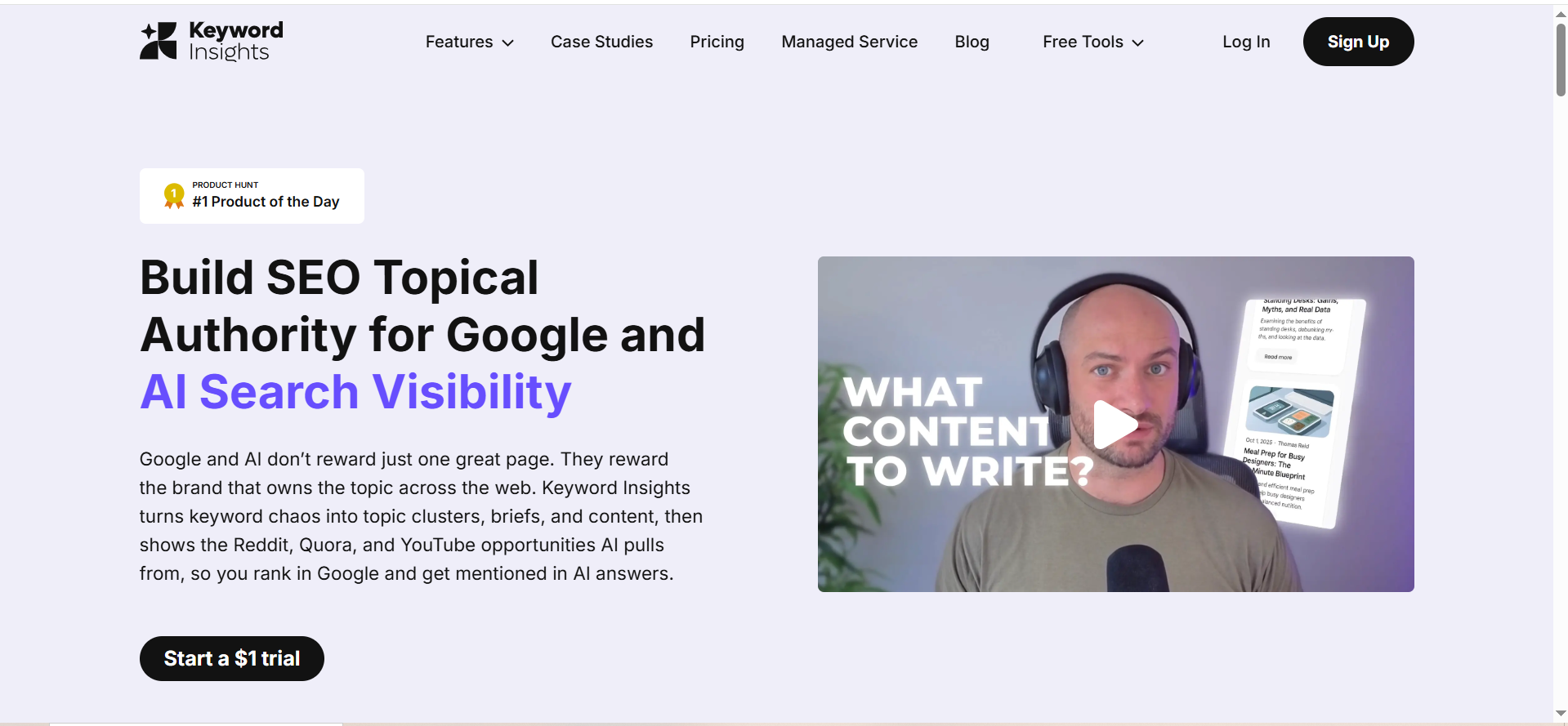
Keyword Insights is built specifically for turning keyword lists into usable topic clusters, often with AI-assisted grouping and intent labeling that content teams can act on.
Why teams use it
Because the painful part isn’t finding keywords, it’s turning 5,000 keywords into:
- 40 clusters
- 40 briefs
- a clear hub/spoke model
- and a publishing plan your team can follow
What it’s good for
- Automated clustering that you can refine editorially
- Intent labeling (helpful for planning “hub vs spoke vs BOFU”)
- Turning exports from Semrush/Ahrefs into content-ready structure
- Reducing cannibalization by clarifying which keywords belong on the same page
When it’s a good fit
- You already have keyword sources but need structure
- You want clusters that map to outlines and briefs
- You’re building topical authority in a category and need consistency
When it’s not a good fit
- You only need lightweight research for a handful of pages
- Your process is heavily bespoke and you prefer manual editorial clustering
How to use it
- Export a keyword universe from Semrush/Ahrefs.
- Import into Keyword Insights and run clustering.
- Review clusters and rename them based on page intent (not just the biggest keyword).
- Add intent labels: Informational / Commercial / Comparison / Template / Use-case.
- Generate (or manually write) a brief: target angle, entities to cover, internal links, and CTA placement.
Key capabilities
- AI clustering + cluster refinement
- Intent classification support
- Workflow designed for content ops (not just SEO analysts)
Pricing
Keyword Insights’ pricing starts at $58/month (Basic plan).
Free tier?
Keyword Insights doesn’t offer a free tier, but it does offer a $1 trial for 7 days.
Downsides / limitations
- You still need a strategy for “what clusters become money pages”
- Requires clean inputs (garbage-in = garbage-out)
- Teams may accept clusters blindly without SERP validation, don’t
4. LowFruits
What it does
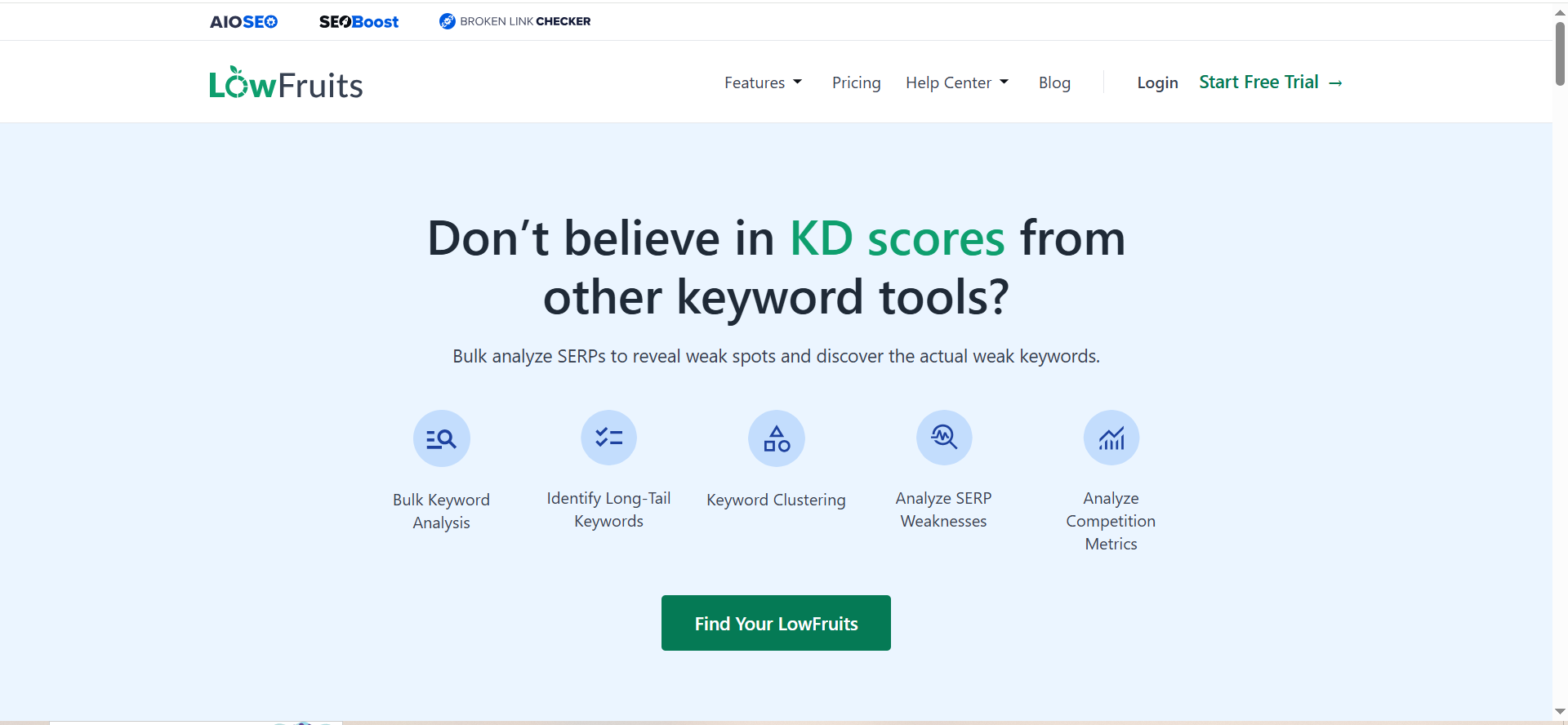
LowFruits focuses on identifying lower-competition keyword opportunities, especially long-tail queries where SERPs show signs of weakness.
Why teams use it
Because sometimes the fastest growth comes from small clusters you can win quickly, then internally link into bigger hubs.
What it’s good for
- Long-tail keyword discovery
- Spotting clusters where the SERP is dominated by weaker pages
- Building “support rings” around money pages with faster-to-rank content
- Finding topic pockets competitors ignore
When it’s a good fit
- You’re building authority from a smaller domain
- You want faster ranking wins to support bigger hub plays
- You want to feed a clustering tool with “winnable” candidates
When it’s not a good fit
- You need enterprise-grade competitive research and reporting
- You want full end-to-end planning inside one platform
How to use it
- Start with a commercial seed (product category or pain point).
- Use LowFruits to surface long-tail variants.
- Group into micro-clusters (5–20 keywords) that belong on one page.
- Publish support content first, then link into your larger hub.
Key capabilities
- Long-tail discovery
- SERP weakness signals for prioritization
- Helpful for avoiding “wishful thinking” clusters
Pricing
LowFruits’ subscriptions start at $20.75/month billed annually (or $29.90/month billed monthly).
Free tier?
LowFruits doesn’t offer a full free tier, but it does include 3 free keyword searches every 7 days on its pay-as-you-go flow.
Downsides / limitations
- Not a full clustering suite by itself for large keyword universes
- Needs pairing with a hub strategy so “quick wins” build toward authority
5. AlsoAsked
What it does
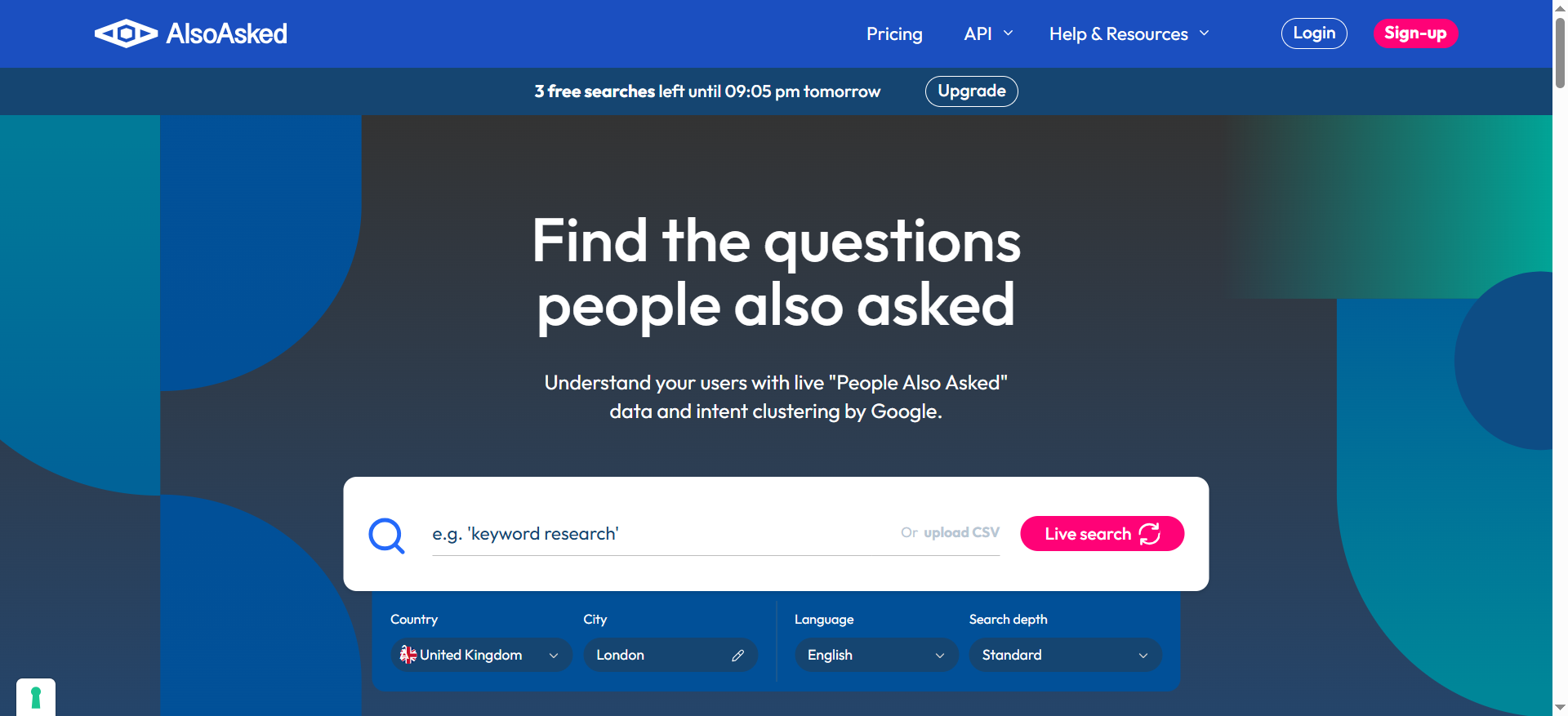
AlsoAsked visualizes question relationships (similar to “People Also Ask” style structures), making it great for topic clustering by questions and for building outlines and FAQ sections that match real user curiosity.
Why teams use it
Because AI search and AI Overviews often pull from pages that answer clear questions with clean structure. AlsoAsked helps you find the question graph behind a topic and translate it into headings that both humans and LLMs can follow.
What it’s good for
- Question-based clustering
- Building semantic outlines for hubs and spokes
- Improving “extractability” (clear headings, direct answers)
- Creating FAQs and subtopics that align with real searches
When it’s a good fit
- You want to strengthen hubs with better subtopic coverage
- You need better outlines and FAQ depth
- You’re optimizing content for AI visibility, not just blue links
When it’s not a good fit
- You need full competitive research, link analysis, or large-scale keyword exports
- You need automated clustering of thousands of keywords (use it as a companion)
How to use it
- Enter your hub topic.
- Export question branches.
- Turn each branch into an H2/H3 outline.
- Assign questions to either:
- the hub page (core questions), or
- a spoke page (deep-dive questions)
Key capabilities
- Visual question maps
- Easy-to-turn-into-outline exports
- Perfect for FAQ generation and semantic completeness
Pricing
AlsoAsked’s pricing starts at $12/month (Basic plan).
Free tier?
AlsoAsked does offer a free tier, which includes 3 free searches per day.
Downsides / limitations
- Not a standalone keyword database
- Needs pairing with a discovery tool (Semrush/Ahrefs) for full planning
What “AI keyword research + topic clustering” actually means in 2026
Most teams think clustering is a spreadsheet exercise: group similar keywords, assign a page, publish. That was already hard. Now it’s harder, because you’re not only trying to win Google rankings.
You’re also trying to be understood and cited by AI systems.
Keyword discovery vs. intent mapping vs. clustering
These are different steps, and mixing them up is why content plans fail.
- Keyword discovery = ‘What do people search for?’ (volume, variants, modifiers)
- Intent mapping = “What does the searcher want to do?” (learn, compare, buy, implement)
- Clustering = “Which keywords belong on the same page vs. different pages?” (avoid cannibalization, build hubs)
A strong stack supports all three:
- Semrush/Ahrefs for discovery and validation
- Keyword Insights for operational clustering
- LowFruits for quick wins
- AlsoAsked for question and outline depth
“Clusters built for humans + AI answers” (the real goal)
A cluster isn’t “50 keywords that share a stem.”
A cluster is:
- one publishable page with a clear job to do
- supporting subpages that deepen coverage
- internal links that make the relationship obvious
- headings that answer questions directly
- entity coverage that matches what top-ranking (and cited) pages include
If your cluster can’t be explained in one sentence; “This page helps [ICP] decide/learn/implement X”, it’s not a cluster yet. It’s a pile.
The Cluster-to-Revenue Page Framework
Here’s the shift: stop treating clusters as outputs. Treat them as inputs to revenue pages.
A typical “SEO clustering” output is:
- a spreadsheet of keywords
- a cluster name
- maybe a suggested URL
A revenue-ready cluster output is:
- a hub page that matches SERP intent
- spokes that strengthen topical authority
- BOFU pages that convert (alternatives, comparisons, integrations, templates)
- a measurement plan (rankings + assisted conversions + AI visibility signals)
Pick the money page, then build the support ring
Start every cluster by deciding which page is the “money” page type:
- Commercial hub (best tools, best software, platforms)
- Comparison page (X vs Y)
- Alternatives page (X alternatives)
- Integration page (X for Y / integrates with Y)
- Use-case landing (for B2B SaaS, industry, role)
Then build support content that makes that page inevitable:
- definitions and “how it works” pages
- implementation guides
- templates and checklists
- troubleshooting and edge cases
- questions and objections
Entity gaps and topical authority
To rank (and to be cited), your hub has to cover the things the topic implies.
For “keyword research + clustering,” those implied entities include:
- search intent
- SERP similarity
- embeddings/topic modeling
- keyword difficulty/competition
- topical maps
- internal linking
- cannibalization
- content briefs
- on-page structure and FAQs
- measurement (rankings + conversions)
If your page skips those, AI systems and readers treat it as shallow, even if it’s long.
Internal linking that LLMs can follow
AI systems don’t “crawl” exactly like Google, but the principle remains: clear relationships win.
Your cluster should make it obvious:
- what the hub is
- what the spokes are
- why each spoke exists
- how to navigate between them
Simple internal linking rules:
- Hub links to every spoke in a “Learn more” or “Related guides” block
- Each spoke links back to hub using consistent anchor text (e.g., “keyword clustering tools”)
- Spokes also cross-link when it’s genuinely helpful (avoid spammy link webs)
Step-by-step workflow: From seed keywords to publishable topic hubs
This is the repeatable process most teams are missing. Use it with any combination of the five tools above.
Step 1: Build a clean seed set
A seed set should be:
- close to your ICP and offer
- connected to a product category, pain point, or job-to-be-done
- capable of spawning multiple intents (learn → compare → buy)
Example seeds for B2B SaaS marketers:
- “keyword clustering”
- “AI keyword research”
- “topic clustering tool”
- “topical authority”
- “content hub strategy”
Step 2: Expand + filter by intent
Use Semrush/Ahrefs to expand, then label by intent:
Informational
- what is keyword clustering
- how to build topic clusters
- topic clustering vs keyword research
- how to prevent keyword cannibalization
Commercial investigation
- best keyword clustering tools
- keyword clustering software
- keyword insights vs [tool]
- semrush keyword clustering
BOFU
- keyword clustering tool pricing
- keyword clustering service
- agency for topic clusters
Don’t aim for perfect labeling on day one. Aim for good enough to assign page types.
Step 3: Cluster using SERP + embeddings (don’t rely on one signal)
The best clustering uses two signals:
- SERP similarity: if two keywords return basically the same top results, they likely belong on one page (see how to pick keywords for zero-click SERPs).
- Semantic similarity (embeddings): if keywords mean the same thing, they likely belong together, even if SERPs vary slightly; this is where understanding LLMs for business growth helps.
Practical rule:
- If SERP intent matches and the keywords are semantically close → same page.
- If SERP intent differs (informational vs commercial) → separate pages even if terms look similar.
Step 4: Assign page types (hub, spoke, BOFU landing)
Once you have clusters, assign each to a page type:
- Hub page: “Best AI Tools for Keyword Research & Topic Clustering”
- Spoke pages:
- “What is keyword clustering (and why does it prevents cannibalization)?”
- “How to build a topical map for B2B SaaS”
- “SERP similarity vs embedding clustering: which is better?”
- BOFU pages:
- “[Tool] alternatives for keyword clustering”
- “Keyword clustering service vs in-house tools”
This is where clusters become a publish plan, not a spreadsheet.
Step 5: Write briefs that win in Google + AI Overviews
Your brief should include:
- the primary query and intent
- 5–10 secondary questions to answer
- the entity checklist (what must be mentioned)
- internal links (hub ↔ spokes)
- a “direct answer” section near the top
- examples, tables, and definitions
AI visibility tip: Write at least one section where you answer the question in 2–4 sentences with zero fluff, this improves extractability for AI systems.
Step 6: Publish in rings
A simple publishing sequence that works:
- Publish 2–4 “easy win” spokes (use LowFruits to find them).
- Publish the hub page (your “best tools” guide).
- Publish 1–2 BOFU pages that convert.
- Refresh hub monthly (new tools, updated comparisons, improved FAQs).
This builds momentum and internal links before you bet on the biggest page.
How to choose the right tool
Use these decision questions:
1) Do you need discovery, clustering, or both?
- Discovery + broad planning: Semrush
- Validation + competitive reality: Ahrefs
- Operational clustering + briefs: Keyword Insights
2) Are you building topical authority from a weaker domain?
Pair:
- LowFruits (quick wins) + Semrush/Ahrefs (strategic plan)
3) Do you struggle more with outlines than keywords?
Add:
- AlsoAsked for question graphs, outlines, and FAQs
4) Do you need clusters that map directly to revenue pages?
Prioritize tools and workflows that support:
- intent mapping
- hub/spoke relationships
- BOFU page creation
- refresh cycles
(That last part is the difference between “SEO activity” and “SEO pipeline.”)
Common mistakes (and how to avoid them)
Mistake #1: Clustering by word stems instead of intent
Fix: Always check SERP intent for the hub keyword (especially as AISO vs SEO, AEO, GEO keeps changing how “intent” shows up). Mixed intent = separate pages.
Mistake #2: Building clusters that can’t be explained
Fix: Every cluster should have a one-sentence job: “This page helps [role] do [job] so they can [outcome].”
Mistake #3: Publishing spokes without a hub
Fix: Create the hub early (even if you’ll improve it). Spokes need a “home” to consolidate authority.
Mistake #4: Treating FAQs as filler
Fix: FAQs should be fan-out queries and objections (a good checklist is in content optimization tools). Answer directly in 2–5 sentences.
Mistake #5: Measuring only rankings
Fix: Track:
- rankings for hub + spokes
- internal link clicks
- assisted conversions (demo/contact)
- mentions/citations in AI surfaces (where possible)
Best AI tools for keyword clustering
If you want clustering that’s actually useful for publishing (not just grouping in a spreadsheet), the “best” tool depends on what part of the workflow you’re trying to optimize:
- Best all-in-one research + planning: Semrush
- Best when you need discovery, competitive context, and a practical way to move from seed → plan. Use it to build the keyword universe and early topic map.
- Best for SERP + competition validation: Ahrefs
- Best when you need to confirm whether a cluster is winnable, what kind of pages rank, and what authority/backlinks competitors have.
- Best for clean clustering + intent labeling: Keyword Insights
- Best when you already have keyword exports and need them grouped into editorial-grade clusters with intent labels you can turn into briefs.
- Best for finding quick-win long-tail clusters: LowFruits
- Best for surfacing lower-competition opportunities and building “support clusters” that help you rank faster and feed authority into bigger hubs.
- Best for question-based clustering: AlsoAsked
- Best for turning a topic into an outline and FAQ set (excellent for AI visibility because it pushes you toward clear Q → A structure).
Best-stack recommendation (most teams):
Use Semrush (discovery) → Keyword Insights (clustering + intent labels) → Ahrefs (validate the top clusters) → AlsoAsked (outline + FAQs) → LowFruits (quick wins to publish first).
How to do keyword research for AI Overviews / AI search
Keyword research for AI Overviews (and AI-assisted search) isn’t just “find volume.” It's to find questions and tasks that AI systems summarize, then create the page that becomes the best source to quote, especially if you’re targeting AI Overviews for BOFU pages.
Step 1: Start with outcomes, not keywords
Pick a category where you can credibly be the “best answer.” For B2B SaaS, that’s usually:
- “best tools for X”
- “X vs Y”
- “X alternatives”
- “how to do X”
- “X template / checklist”
Step 2: Capture question intent explicitly
AI answers are often question-driven in AI search engines. Build a query set that includes:
- Definitions: “what is…”
- How-to: “how to…”
- Comparisons: “X vs Y”
- Objections: “is X worth it,” “pros/cons”
- Edge cases: “for [industry],” “for [role]”
Tools: AlsoAsked + PAA-style questions + SERP “People also ask” (useful for spotting zero-click query patterns.
Step 3: Map each keyword to a “page job”
Every target should have one clear job:
- Teach (informational)
- Help decide (commercial investigation)
- Help implement (tactical)
- Help buy (BOFU)
AI Overviews tend to cite pages that are structured, direct, and complete on the job they’re doing.
Step 4: Build for “extractability”
When writing, include:
- A 2–4 sentence direct answer near the top
- Clear H2/H3 headings phrased as questions
- Short paragraphs and lists
- Definitions and examples
- A tight FAQ section with real fan-out questions
Step 5: Validate with SERP reality
If the SERP is dominated by:
- product pages → you need a commercial page
- guides → you need a guide
- mixed intent → split into separate pages (don’t force one page)
Practical rule: If you can’t summarize the user intent in one sentence, your target keyword is too broad or mixed.
How to build topic clusters for topical authority
Topical authority is built by coverage + consistency + internal structure (use B2B SaaS content benchmarks to sanity-check what “good” looks like). Clusters are the operational way to do that.
Step 1: Choose your “topical territory”
Pick a topic where you can credibly own multiple subtopics. Example: “keyword research” is huge; “AI keyword research & clustering for B2B SaaS” is ownable.
Step 2: Pick the hub
Your hub is usually:
- “Best X tools”
- “Complete guide to X”
- “X for [role/industry]”
The hub must match SERP intent and be internally linkable, exactly what strong SEO strategies for AI visibility reinforce.
Step 3: Build spokes that cover subtopics and objections
Great spokes include:
- Definitions (what it is / why it matters)
- How-to workflows
- Templates/checklists
- Mistakes + fixes
- Use cases
- Comparisons/alternatives
Step 4: Build a linking system, not random links
- Hub links to every spoke (and updates as spokes grow)
- Every spoke links back to hub using consistent anchor text
- Spokes cross-link only when it improves comprehension
Step 5: Publish in rings
- Ring 1: quick wins + foundational definitions
- Ring 2: deeper tactical content
- Ring 3: BOFU pages (alternatives, comparisons, integrations)
This sequence accelerates authority because the hub isn’t “standing alone.”
How to find entity gaps for a topic
Entity gaps are the missing “things” your page should mention to be considered complete. This matters for both Google and AI systems because it improves semantic coverage.
Step-by-step method
- Collect the top 5–10 ranking pages for your hub keyword.
- Extract recurring concepts (entities) across those pages:
- tools, methods, metrics, frameworks
- subtopics, steps, constraints, examples
- Compare that to your draft outline:
- What do competitors mention that you don’t?
- What questions are left unanswered?
- Add missing entities as:
- new sections (H2/H3)
- examples
- mini-definitions
- FAQs
Entity gap checklist
For most SEO clustering topics, check whether you cover:
- intent types (info/commercial/BOFU)
- SERP similarity vs semantic similarity
- cannibalization prevention
- internal linking rules
- how to validate a cluster
- how to turn clusters into briefs
- prioritization (winnable vs aspirational)
Quick litmus test: If a reader asks “yes, but how do I actually do it?” and your page can’t answer in a sequence of steps, you likely have entity gaps.
How to turn keyword clusters into content briefs
A cluster becomes a brief when you translate “keywords” into:
- one page job
- one audience
- one intent
- one outline that satisfies that intent
Brief template (what to include)
1) Page objective (one sentence)
Example: “Help B2B SaaS SEO managers choose a keyword clustering tool and understand a practical workflow.”
2) Primary keyword + intent
- Primary: “best AI tools for keyword clustering”
- Intent: commercial investigation
3) Secondary keywords (10–20 max)
Pick the strongest close variants and subtopics.
4) Questions to answer (fan-out list)
Add 8–12 questions that should become H2/H3s.
5) Entity coverage checklist
List must-include entities (methods, metrics, tools, frameworks).
6) Differentiation angle
Why your page is better:
- clearer tool comparison criteria
- step-by-step workflow
- templates and checklists
- real pitfalls + fixes
- updated tool landscape
7) Internal links
- Link to hub/spokes you want to strengthen
- Add required anchors (consistent phrasing)
8) CTA placement
Top CTA (light), mid CTA (contextual), end CTA (primary conversion).
9) “Extractable answer” requirement
Include at least one direct answer block near the top and 5–8 FAQ answers in 2–5 sentences each.
How many keywords per cluster is “normal”
There’s no magic number because the real unit is intent, not keyword count.
That said, practical ranges help:
- Micro cluster (5–15 keywords):Best for long-tail pages where many variants mean the same thing.
- Standard cluster (15–50 keywords):Most “one page can cover this” clusters land here if intent is consistent.
- Large cluster (50–200+ keywords):Only safe when the intent is clearly unified and the page format supports breadth (e.g., a strong hub guide). Otherwise, it becomes a cannibalization risk.
When to split a cluster
Split if:
- keywords imply different page types (guide vs tool list vs comparison)
- SERP intent changes across variations
- your outline becomes two different articles glued together
- you can’t write one clean intro that fits all keywords
Rule of thumb: If two keywords require different “best answer formats,” they’re not the same cluster.
How to validate a cluster before writing
Validation prevents wasted content. Do it before you invest in writing.
The 7-point validation checklist
- SERP intent alignment
- Do the top results match the page type you plan to publish?
- SERP overlap test (same page or different?)
- If two keywords have mostly the same top 10 results, they likely belong together.
- Content depth reality
- Are the top pages thin? If yes, you can win with depth and clarity.
- Authority requirements
- If every top page is a mega-domain with heavy backlinks, narrow scope or pick a more specific angle first.
- Entity coverage
- List entities the top pages cover. Can you match and improve?
- Differentiation
- What will your page do better? (examples, templates, clearer framework, fresher updates)
- Internal link support
- Do you have (or can you publish) spokes that will link into this page?
If you fail #1 or #2, fix the cluster before writing. If you fail #7, adjust your publishing order.
How to prevent cannibalization with clusters
Cannibalization happens when multiple pages compete for the same intent and Google/AI systems can’t tell which is the primary answer.
Practical anti-cannibalization system
1) One intent = one primary page
Create a single “home” page for each intent:
- definition page
- tool list page
- comparison page
- how-to page
2) Use “page roles”
Define the role of every page in the cluster:
- hub (broad)
- spoke (deep)
- BOFU landing (conversion)
3) Build consistent internal linking
- spokes link back to hub with consistent anchor text
- hub links out to spokes
- don’t create two hubs for the same intent
4) Avoid duplicate intros and headings
If two pages start the same way and cover the same H2s, they’ll cannibalize.
5) Merge or differentiate quickly
If two pages overlap:
- merge them, or
- differentiate by angle (industry/role/use-case) and update titles, intros, and section structure.
6) Canonicals only when necessary
Don’t use technical fixes as a strategy. Fix the content structure first.
Cannibalization warning signs
- Pages swap positions constantly
- One page ranks for the other page’s target keyword
- CTR drops despite content updates
- Google can’t decide which URL to show
FAQs
What is topic clustering in SEO?
What’s the difference between keyword clustering and topic modeling?
How many keywords should be in one cluster?
Do I need a clustering tool if I already have Semrush or Ahrefs?
How do topic clusters help with AI search visibility?
What’s the best “budget” approach to clustering?
How do I prevent cannibalization when building clusters?
How often should I refresh a “best tools” cluster page?
📋 Get Listed / Advertisement
We update this guide monthly. Want your tool featured? Contact: [email protected].