

If you want “AIO monitoring like rank tracking”, repeatable checks, history, and change alerts, the best starting shortlist is: OtterlyAI (fastest self-serve AIO monitoring + clear pricing), Promptmonitor (broad model coverage with prompt workflows), Profound (enterprise-grade AIO analysis and governance), Akii (quick audits + multi-engine visibility trends), and Conductor (enterprise SEO suite adding AI visibility and AIO research).
📋 Get Listed / Advertisement
We update this guide monthly. Want your tool featured? Contact: [email protected]
Best AI Visibility Tools for Google AI Overviews Tracking (Quick Comparison)
| Tool | Best for | AIO strengths | Notable limitations |
|---|---|---|---|
| OtterlyAI | SMB + growth teams | Explicit AIO monitoring + citations/mentions across AI platforms | Prompt-volume pricing can jump at higher tiers |
| Promptmonitor | Prompt workflows + broad model coverage | Tracks Google AI Overview/AI Mode plus major models | Pricing details vary by source; validate on sales call |
| Profound | Enterprise brands | Purpose-built AI visibility analytics + AIO support announcement | Enterprise-only pricing (custom) |
| Akii | Quick audits + trend baselines | Track mentions/citations across Google AI + others; “start tracking free” | Some pricing info relies on listings; confirm plan fit |
| Conductor | Teams already on enterprise SEO suites | AIO research + AI search positioning narrative | Enterprise suite complexity; may be more than you need |
📋 Get Listed / Advertisement
We update this guide monthly. Want your tool featured? Contact: [email protected].
1. OtterlyAI
What it does
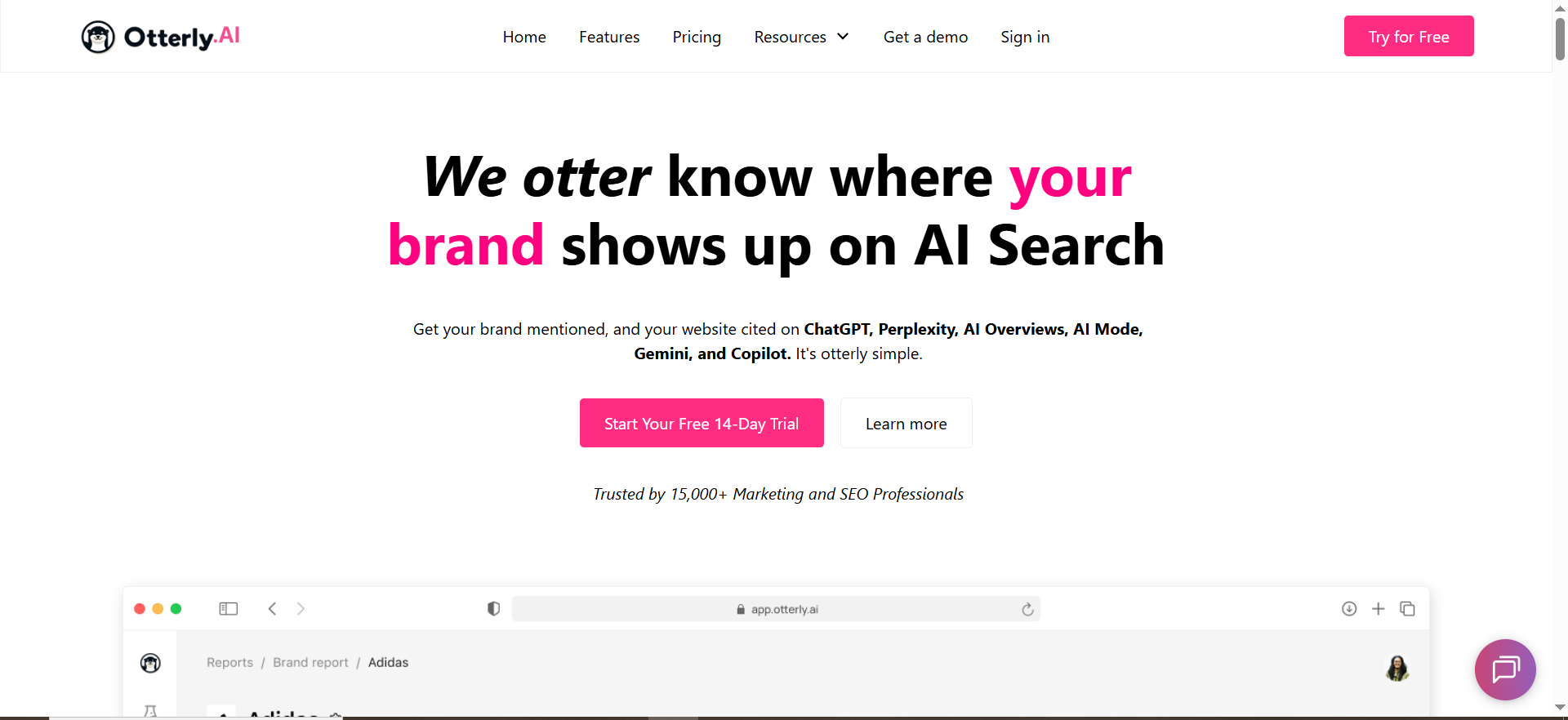
OtterlyAI positions itself as an AI search monitoring product that tracks brand mentions and website citations across surfaces including Google AI Overviews.
Why teams use it
Most teams adopt OtterlyAI when they want a self-serve way to operationalize monitoring quickly, the “set it up and get a dashboard” experience, without committing to an enterprise platform. It’s also appealing when you need to show leadership clear outputs (mentions/citations per prompt) without building internal scraping or UI-capture systems.
What it’s good for
- AIO detection at the query level: Identify which of your tracked queries trigger AI Overviews frequently (and how often).
- Citations tracking: Monitor whether your domain (or key URLs) appear as cited sources in AIO.
- Change monitoring (lightweight): Use daily tracking to spot changes (e.g., your citation disappears, a competitor replaces you).
- Stakeholder reporting: “Here are the prompts that matter and what AIO is doing this week.”
When it’s a good fit
- You’re a B2B SaaS or growth team that needs a repeatable AIO monitoring cadence (daily/weekly) and a straightforward prompt list.
- You want transparent entry pricing and the ability to scale prompts over time.
When it’s not a good fit
- You need enterprise governance (SSO/SAML, strict compliance controls) and global rollouts with heavy permissions.
- You need advanced research workflows, large-scale keyword sets, or deep integration into an enterprise SEO stack. (Otterly can still work, but you’ll likely outgrow it.)
How to use it for AIO tracking
- Build a “money prompts” list (more on this later): unbranded category prompts + comparison prompts + pain-point prompts.
- Track daily for the first 2 weeks to establish a baseline and separate “noise” from “real changes,” using a simple brand visibility audit to confirm what’s actually shifting.
- Create a weekly AIO report: (a) prompts that show AIO, (b) prompts where you’re cited, (c) prompts where you lost citations, (d) competitor domains that gained, then roll it into your existing SEO reporting software.
- Turn losses into actions: update the cited page(s), improve entity coverage, and add supporting sections that match AIO intent (definitions, steps, tables) by following a clear AEO content structure. Google’s Search Central guidance for AI features emphasizes making content accessible and useful; your goal is to become the cleanest “source candidate” for the overview.
Key capabilities for AIO
- Prompt tracking and history (daily runs)
- Mentions vs citations separation (a mention without a link is still brand perception)
- Export/reporting and segmentation (persona, market, funnel stage)
Pricing
OtterlyAI’s pricing starts at $29/month, with higher tiers based on how many search prompts you track.
Free tier / trial
OtterlyAI doesn’t offer a free tier, but it does offer a free trial.
Downsides / limitations
- Prompt-volume economics: Some teams find the jumps between tiers steep as monitoring scales.
- AIO is volatile by nature: Don’t treat a single-day drop as failure, use baselines and rolling averages (explained below).
2. Promptmonitor
What it does
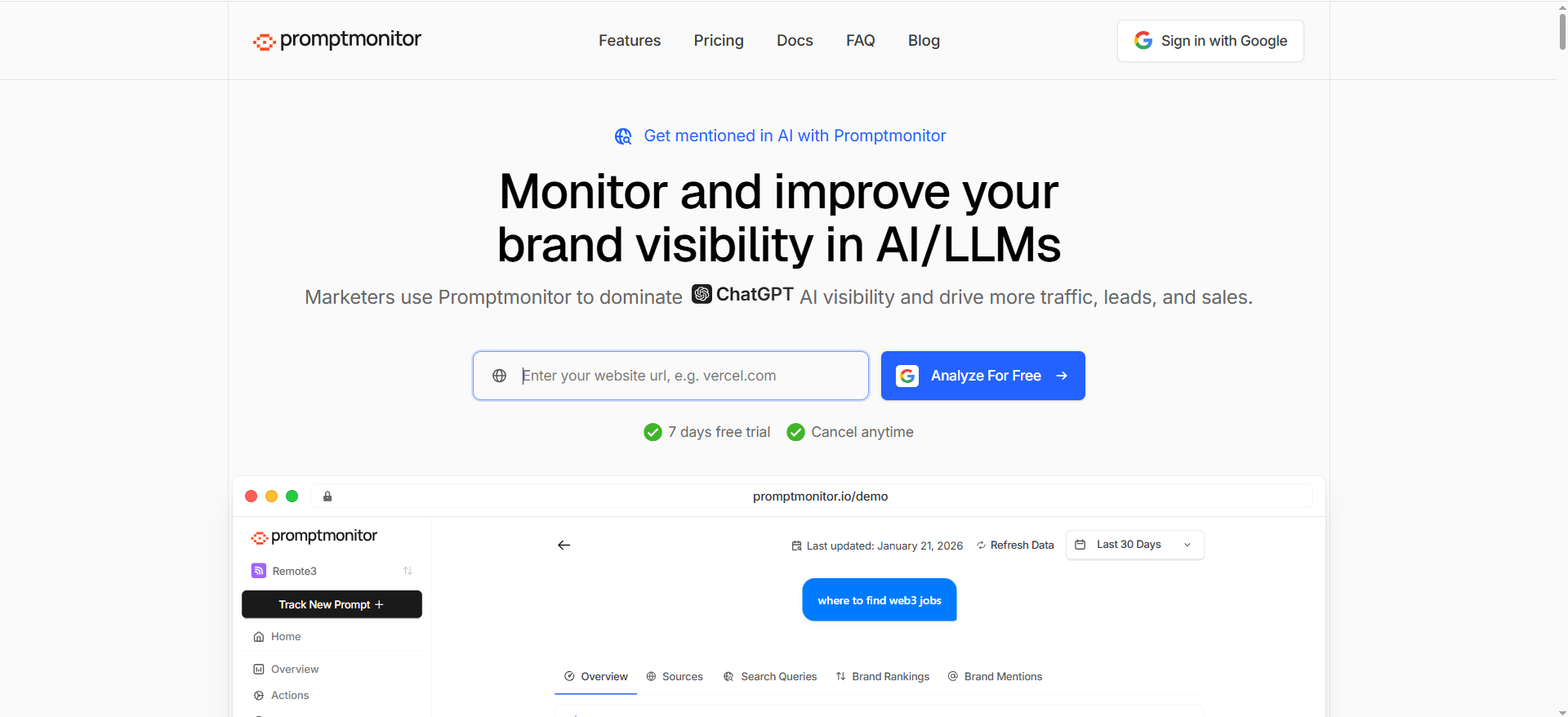
PromptMonitor markets itself as an AI visibility / GEO tool that tracks major models and explicitly includes Google AI Overview and AI Mode in its engine coverage list.
Why teams use it
PromptMonitor is usually chosen when teams want broad model coverage plus a prompt-first workflow, especially if you’re monitoring beyond Google (ChatGPT, Perplexity, Gemini, etc.) while still keeping AIO in the same reporting system.
What it’s good for
- Unified visibility dashboards across multiple answer engines, helpful when leadership asks, “Are we showing up in AI?” and they don’t mean only Google.
- Prompt organization (by product line, persona, or funnel intent) so AIO tracking becomes a program, not a one-off check, this is the core of a durable AI search visibility strategy.
- Competitive benchmarking: measuring how often your brand appears vs others for the same prompt set.
When it’s a good fit
- You need one system to track AIO plus other AI engines.
- You already have a prompt strategy and want repeatability: same prompts, same cadence, better trend confidence.
When it’s not a good fit
- You want public, crystal-clear pricing and packaging without talking to anyone.
- You need deep enterprise governance and compliance controls (it may still work, validate requirements).
How to use it for AIO tracking
A practical approach is to treat Promptmonitor like a “prompt rank tracker” for AIO:
- Build prompt sets by intent (awareness vs comparison vs purchase readiness).
- Run prompts on a fixed cadence (daily early on; weekly once stable).
- Capture: (1) whether AIO appears, (2) which sources appear, (3) whether your brand is named, (4) whether you’re recommended or simply listed.
Key capabilities for AIO
- Stated coverage of Google AI Overview/AI Mode
- Prompt workflows for segmentation and consistent re-runs
- Output capture (answer text + change deltas)
Pricing
Promptmonitor’s pricing starts at $29/month.
Free tier?
Promptmonitor doesn’t offer a free tier, but it does offer a 7-day free trial.
Downsides / limitations
- Validation required: Because pricing/packaging details can differ by source, make “confirm pricing + retention + AIO capture method” part of your trial checklist.
- Volatility management: As with all tools, quality depends on how well you define prompts and segments.
3. Profound
What it does
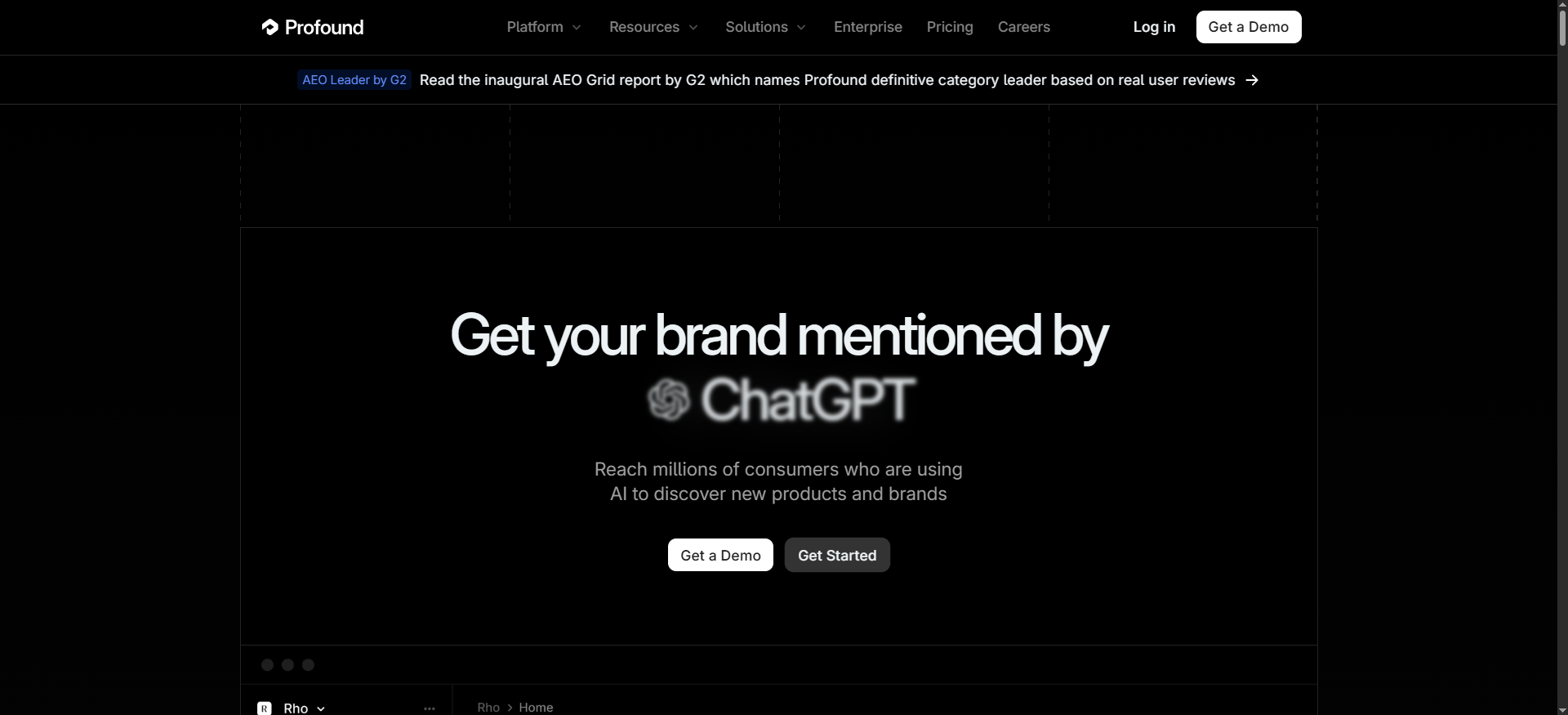
Profound is positioned as an enterprise platform to measure and optimize visibility in AI-generated answers, including content performance tracking (which pages are referenced in AI responses).
Why teams use it
Profound is typically selected when AI visibility becomes a board-level or brand-risk topic, and teams need:
- centralized analytics,
- repeatable monitoring, and
- enterprise-grade controls and support.
Profound publicly announced support for analyzing Google AI Overviews, which is a strong signal that AIO is a first-class use case for the platform.
What it’s good for
- Enterprise AIO analysis: Tracking brand appearances across major AI platforms, including Google AIO.
- Page-level performance tracking: Seeing which pages are referenced in AI-generated responses (useful when you need to map citations to URLs).
- Governance + security posture: Profound highlights enterprise readiness (e.g., SOC 2 Type II, SSO) for teams that need compliance alignment.
When it’s a good fit
- You’re an enterprise brand with multiple lines of business and need global monitoring plus governance.
- You want a platform built around AI visibility as a core problem, not an add-on.
When it’s not a good fit
- You’re early-stage and just need a lightweight AIO tracker with a small prompt set.
- You don’t have the operational maturity to act on the insights (enterprise tools amplify good ops; they don’t replace them).
How to use it for AIO tracking
An enterprise-friendly workflow:
- Create prompt sets by business unit and region (NA, EMEA, APAC).
- Identify the “critical AIO prompts” tied to revenue pages (pricing, comparisons, integrations).
- Establish baseline share-of-citation and share-of-mention for each segment as part of your broader AI visibility toolkit.
- Define escalation rules: e.g., if citations drop for a core segment, trigger content/PR review.
Why this matters: AI Overviews can be highly influential and can cite sources that aren’t always what you’d expect, some analyses have raised concerns about citation quality in certain query classes, which makes auditing and monitoring more important, not less.
Key capabilities for AIO
- AIO analysis support (announced)
- Content/page mapping to AI references
- Enterprise security posture
Pricing
Pricing starts at $99 per month.
Free tier?
Profound doesn’t offer a free tier, but it does offer a demo.
Downsides / limitations
- Not SMB-priced: It’s designed for enterprise footprints.
- You still need methodology: Without a clear cadence, prompt set strategy, and reporting plan, enterprise tooling can turn into expensive dashboards.
4. Akii
What it does
Akii positions itself as an AI search optimization platform that lets you monitor how often AI models mention, recommend, or cite your brand across Google AI and other engines. It also has an “AI Search Tracker” page describing continuous tracking across AI search engines.
Why teams use it
Akii tends to be used for fast audits and quick baselines: “How visible are we in AI answers right now?” That makes it useful when you need an early signal before building a more complex monitoring program.
What it’s good for
- Baseline visibility trendlines: How often your brand appears in AI answers over time (directional signal).
- Cross-engine comparison: If your team cares about AIO and also ChatGPT/Perplexity visibility, you can keep it together.
- Getting started quickly: Akii promotes quick start tracking and “start tracking free” messaging.
When it’s a good fit
- You want an audit + trend baseline quickly.
- You’re building the business case for AI visibility work and need “before/after” visibility snapshots for leadership.
When it’s not a good fit
- You need deep enterprise SEO workflow integration (ticketing, publishing pipelines, large-scale keyword ops).
- You need the most conservative sourcing for pricing/package details (always confirm in-product or with sales).
How to use it for AIO tracking
Use Akii like an “early-warning trend layer” while you build a more robust prompt program:
- Start with 25–50 prompts: top category questions + top comparison questions.
- Track weekly for 4 weeks to find stable patterns.
- Choose 10 prompts that are both high-intent and volatile; track those more frequently.
- Pair AIO tracking with a simple “citation target list” (domains and page types that repeatedly show up in AIO).
Key capabilities for AIO
- Track mentions/citations across Google AI and others
- Visibility metrics and exports (varies by plan)
Pricing
Akii’s pricing starts at $49/month, with higher tiers for larger credit volumes and teams.
Free tier?
Akii doesn’t offer a free tier, but it does offer a 14-day free trial.
Downsides / limitations
- Plan clarity: If your procurement requires firm packaging definitions, validate in a live demo and document it.
- Program maturity: Baselines are helpful, but to win citations you’ll still need a content and technical response plan.
5. Conductor
What it does
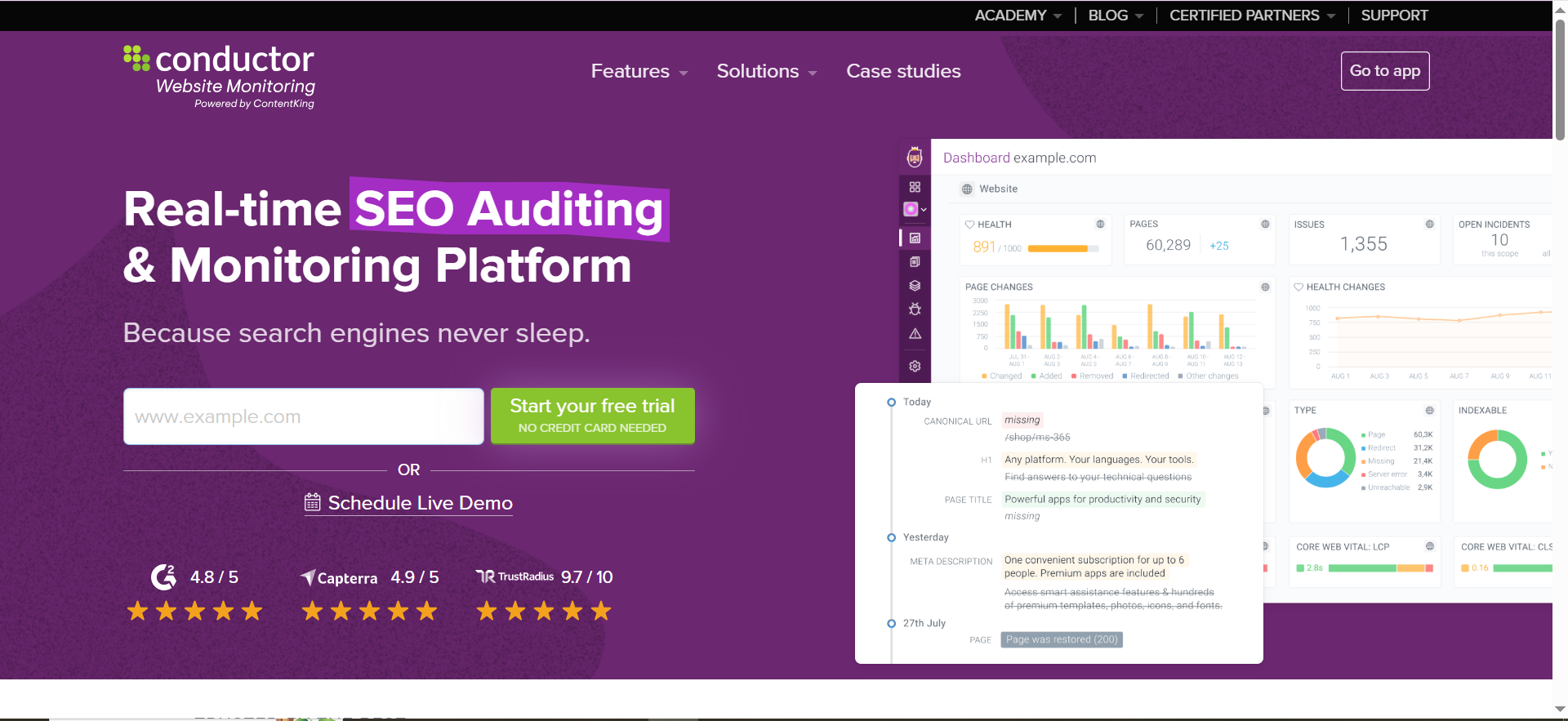
Conductor is an enterprise SEO platform positioning itself to help brands “get found in AI search,” combining SEO intelligence and AI-era workflows. It also publishes ongoing AI Overview research (e.g., large-scale analyses) and educational content on AI prompt tracking and readiness.
Why teams use it
Conductor is often chosen by enterprises that want one system for classic SEO plus AI-era measurement. If your org already runs Conductor, adding AI visibility components can be more practical than introducing a separate vendor.
What it’s good for
- Research + benchmarks: Conductor publishes ongoing analysis of AI Overviews at scale (useful for “how big is the impact?” narratives).
- AI prompt tracking best practices: Conductor’s academy content covers how to set up prompt tracking and how to measure readiness.
- Enterprise workflows: Reviews and feature listings highlight AI mention tracking and AI search ranking insights as part of the platform’s capabilities.
When it’s a good fit
- You need a platform that supports enterprise SEO operations and you want AI visibility as an extension of that program.
- You value vendor research, education, and support as part of adoption.
When it’s not a good fit
- You only need a lightweight AIO tracker for a few prompts.
- You don’t have the budget or operational need for an enterprise SEO suite.
How to use it for AIO tracking
A Conductor-friendly approach:
- Start with Conductor’s AI Overviews research to set context: where AIO appears and what categories are impacted.
- Build a prompt program for priority topics and map them to your content clusters.
- Tie monitoring to actions: technical readiness checks, content refresh cycles, and governance reviews.
Key capabilities for AIO
- AI visibility tracking mentions/rank insights (per reviews/features listings)
- AI Overviews research and education
Pricing
Pricing is not publicly listed; Conductor provides pricing by quote based on plan and configuration.
Free tier?
Conductor doesn’t offer a free tier, but it does offer a free trial (3 weeks) and a demo.
Downsides / limitations
- Complexity: Great for mature SEO orgs; overkill for small teams.
- Tool sprawl risk: If you add Conductor plus other AIO tools, define which system is the source of truth for AIO reporting.
What “Google AI Overviews tracking” actually means (and what it doesn’t)
Google AI Overviews are designed to summarize information and provide links so users can explore the web further.That matters because AIO tracking is fundamentally about visibility in a summarized answer, not “ranking #1.”
A practical definition of AIO tracking includes four layers:
- AIO Presence (SERP feature detection): Does an AI Overview appear for the query set you care about?
- Brand presence: Are you mentioned, recommended, compared, or excluded? (Mentions matter even without links.)
- Citation/source presence: Are you cited? Which competitors are cited? Which domains show up repeatedly?
- Change over time: Did the answer, citations, or presentation change week-over-week?
What it doesn’t mean:
- A single universal “AIO rank” metric that’s as stable as classic keyword positions. AIO outputs can vary by location, language, and query interpretation, so your tracking must be built around baselines and segments.
The AIO “rank tracking” model: Metrics, cadence, and reporting (a practical playbook)
Your spreadsheet’s angle is exactly right: treat AIO like rank tracking, but adapt the metrics to the reality of AI answers (mentions, citations, volatility, and history).
Step 1: Build your prompt set like a portfolio
Split prompts into 4 buckets:
- Category definitions: “What is [category]?” “Best [category] tools for [use case]?”
- Comparison intent: “[You] vs [competitor]”, “Best alternative to [competitor]”
- Problem intent: “How do I solve [pain]?” “How do I track [metric]?”
- Buyer intent: “Pricing,” “implementation,” “security,” “integrations,” “SOC 2,” “SSO”
Why: AI Overviews are designed to help users get the gist of complex topics. Prompts that imply complexity (tradeoffs, steps, “best for”) are often where AIO shows up and where citations matter most.
Step 2: Use metrics that match AIO realities
Here are the core KPIs teams actually understand:
AIO Trigger Rate
- % of tracked prompts where an AI Overview appears (by segment).
Share of Citation (SoC)
- Among prompts with AIO, how often your domain is cited.
Share of Mention (SoM)
- Among prompts with AIO, how often your brand is mentioned (linked or not).
Citation Quality Score (simple rubric)
- Is your citation:
- primary (first 1–2 citations),
- mid-pack, or
- buried/expanded?This mirrors the idea that “visibility” is not binary, prominence changes outcomes.
Volatility / Change Rate
- Week-over-week change in (a) AIO presence, (b) citations, (c) answer framing.
Why volatility matters: independent reporting and studies have raised concerns that AIO citations can sometimes be surprising or inconsistent in certain areas. Even outside of health queries, volatility is a business risk because it destabilizes predictable acquisition.
Step 3: Choose a cadence that reduces noise
- Weeks 1–2: Daily runs (baseline building)
- Weeks 3–6: 2–3x/week (trend confidence)
- After stabilization: Weekly for most prompts; keep a “hot set” daily (your highest-revenue prompts)
Conductor’s prompt tracking guidance emphasizes cadence over ad hoc checks so you can detect real trends instead of artificial swings.
Step 4: Build a stakeholder report that drives action
A simple 1-page report that works:
- Executive summary: “AIO appeared on X% of prompts; our citation share is Y%; change WoW is +/– Z.”
- Wins: prompts where you gained citations/mentions; note which page is cited.
- Losses: prompts where you lost; list the competitor domains that replaced you.
- Actions: 3–5 fixes for the next sprint (content, internal linking, schema, page consolidation).
- Risks: segments with rising volatility or high AIO trigger rate but low citation share.
How to choose the right tool (decision checklist + common buyer mistakes)
The decision checklist (use this on demos)
Data capture
- Does it capture the AIO output via real UI or via API/approximation? (Ask and document.
- Does it store history and allow comparisons/diffs?
AIO coverage
- Does it explicitly support Google AI Overviews (and ideally AI Mode)?
- Can it segment by country/language/device?
Citations & attribution
- Does it extract citations reliably and map them to URLs/pages?
Workflow
- Can you tag prompts by persona/funnel stage?
- Can you export to dashboards (CSV/Sheets/BI)?
Governance
- SSO, permissions, audit logs (especially enterprise).
Common buyer mistakes
- Tracking too many prompts too soon (you drown in noise and never act).
- Reporting the wrong KPI (e.g., only “mentions” when leadership cares about citations and revenue pages).
- No change management (you detect losses but don’t have an update/playbook to respond).
- Not validating “what counts as AIO” (SERP layouts change; your tool should define detection clearly).
What are Google AI Overviews and when do they show?
Google AI Overviews (AIO) are Google Search’s AI-generated summaries that appear at the top of some results pages. They’re meant to give a quick “snapshot” answer and then point users to the web with links/citations so they can explore further.
What an AI Overview includes (what you should track)
- The AI summary text (the answer itself)
- Cited sources/links (which domains and which URLs Google chose)
- Follow-up expansion behaviors (some experiences allow follow-up questions, which can change what gets shown next)
When AI Overviews tend to appear (practical “pattern recognition”)
Google doesn’t publish a single rule like “AIO shows for X keywords,” but in practice, AIO is most likely to show when the query implies complexity: which is why teams use tools to identify zero-click queries when building prompt sets.
- Complexity: multi-step explanations, comparisons, “best,” “how to,” “vs,” “alternatives”
- Ambiguity: where users might need synthesis rather than a single factual snippet
- Exploration: broad topics where people want a quick overview before clicking deeper
Google also notes AI Overviews are available across many countries/languages (availability depends on market and rollout).
What “when do they show” means operationally
For tracking, “when they show” is not a philosophical question, it’s a metric:
AIO Trigger Rate = (# of tracked queries that show AIO) / (total tracked queries), and improving that starts with the right AI visibility SEO strategy.
Track it by:
- country / language
- branded vs unbranded
- funnel stage (awareness vs comparison vs purchase intent)
That’s how you convert “AIO is happening” into a measurable program.
How can I tell if AIO is impacting my organic clicks?
There are two realities you need to hold at once:
- AIO can reduce click-through behavior overall (users often get what they need without clicking).
- Citations can still drive clicks, but the distribution changes and may concentrate into fewer winners.
Pew Research found that when an AI summary appears, users were less likely to click traditional results, and clicks on links inside the summary were rare in their dataset.
Industry analyses also discuss how AIO can reshape click distribution, especially for top organic positions.
How do I track citations/links inside AI Overviews over time?
Because AI Overviews are designed to include links to sources, citation tracking is the heart of AIO monitoring.
What you should track
For every tracked query and each run, store:
- query
- date/time, location/language/device
- AIO present? (yes/no)
- cited domains (list)
- cited URLs (list)
- Is your brand cited? (yes/no)
- your brand mentioned? (yes/no)
The 3 best ways to track citations over time
1) Use an AI visibility tool with AIO capture + history
Most teams choose a tool because doing this manually is painful at scale. The key capability is retention + diffs: you need to see what changed (your URL swapped out, competitor added, citation count increased, etc.).
2) Lightweight manual tracking (for tiny prompt sets)
If you’re tracking 10–20 queries early on:
- run each query in an incognito-like environment
- log citations in a sheet weekly
- screenshot the AIO for record-keeping
This is slow, but it’s useful for validating tool accuracy.
3) Hybrid: tool for monitoring + manual audit for high-stakes queries
This is the sweet spot:
- Tool runs daily/weekly across your portfolio
- Manual review happens only when there’s a major change (e.g., losing citations on your “money prompts”)
Metrics to report from citation tracking
- Share of Citation (SoC): % of AIO-present prompts where your domain is cited
- Top cited competitor domains: who appears most often
- Citation concentration: do a few domains dominate, or is it fragmented?
- URL-level winners: which pages are getting cited (and for which query themes)
The insight most teams miss: “citation eligibility”
Some analyses suggest AIO tends to cite specific passages that answer parts of the question clearly, not just “the best overall page.” That means structuring content into clean answer blocks can increase your “citation surface area.”
How do I monitor AIO changes (answer text, cited sources, layouts)?
AIO changes matter because they affect:
- whether users trust the summary
- which sources get credit
- whether your brand is framed positively, negatively, or not at all
The 4 change types you should monitor
1) Answer text changes
Track:
- new claims added/removed
- whether your category is defined differently
- whether recommendations shift (e.g., “best tools include…” changes list order)
Why it matters: AIO can become a “default narrative” users accept. If the narrative shifts away from your positioning, that’s a marketing risk.
2) Citation/source changes
Track:
- new domains added
- your domain removed
- URL swapped (same domain, different page)
- “prominence” shifts (from top citations to buried)
Why it matters: Citation changes are often where traffic and authority shifts show up first.
3) Layout / SERP presentation changes
Track:
- whether AIO is collapsed/expanded by default
- whether follow-up prompts appear (and what they ask)
- where citations appear (top vs bottom, inline vs list)
Google has continued evolving the AIO experience (including more conversational follow-ups in some contexts), so UI changes can alter user behavior even if the text doesn’t change.
4) Volatility patterns
Track “how often it changes,” not just “what changed,” so you can spot volatility patterns
- daily volatility score
- week-over-week change rate
- stability by query class (definitions vs comparisons)
Practical monitoring setup (what “good” looks like)
- Daily: your 10–20 “money prompts” (highest revenue impact)
- Weekly: the rest of your prompt portfolio
- Alerting: notify when:
- you lose a citation on money prompts
- a competitor gains multiple citations in your core segment
- AIO begins triggering for a set that used to be stable
What’s the minimum viable stack for AIO monitoring in 2026?
A minimum viable stack (MVS) is about one thing: turning AIO visibility into consistent measurement + action without tool sprawl.
Layer 1: AIO detection + capture (the “collection” layer)
You need a way to answer:
- Does AIO appear?
- What does it say?
- Who does it cite?
This can be:
- an AIO-capable AI visibility tool (preferred), or
- manual tracking for a tiny set (temporary)
Layer 2: Organic impact measurement (the “analytics” layer)
You need to connect AIO presence to performance outcomes:
- Google Search Console for clicks/CTR trends
- (optional) your analytics platform for landing page engagement
Pew’s research suggests click behavior changes when AI summaries appear, which makes website traffic analysis non-negotiable if you need to explain performance shifts.
Layer 3: A reporting surface (the “stakeholder” layer)
A simple dashboard or weekly report that includes:
- AIO trigger rate
- share of citation (SoC)
- share of mention (SoM)
- top competitor domains cited
- money prompts gained/lost
This can be as simple as:
- Google Sheets + a weekly templateor:
- Looker Studio / BI tool if you need automation
Layer 4: An action loop (the “ops” layer)
This is what makes monitoring valuable:
- content refresh queue (“citation target pages”)
- ownership (who fixes what)
- SLA for investigating losses on money prompts
The true “minimum viable” list (if you want it ultra-lean)
- AIO tool (or manual + screenshots)
- Google Search Console
- One reporting doc (sheet/dashboard)
- Weekly ops cadence (30–45 minutes)
If you want, I can also rewrite these sections to match your exact house style (more conversational vs more technical) and add internal cross-links to the tool reviews above.
FAQs
Are Google AI Overviews available everywhere?
What should I track first: mentions or citations?
How many prompts do I need for a useful AIO program?
Which tool is best for a small team that wants self-serve pricing?
Which tool is best for enterprise governance and security requirements?
Can I rely on one week of data to make decisions?
Do AI Overviews always cite the most authoritative sources?
📋 Get Listed / Advertisement
We update this guide monthly. Want your tool featured? Contact: [email protected].