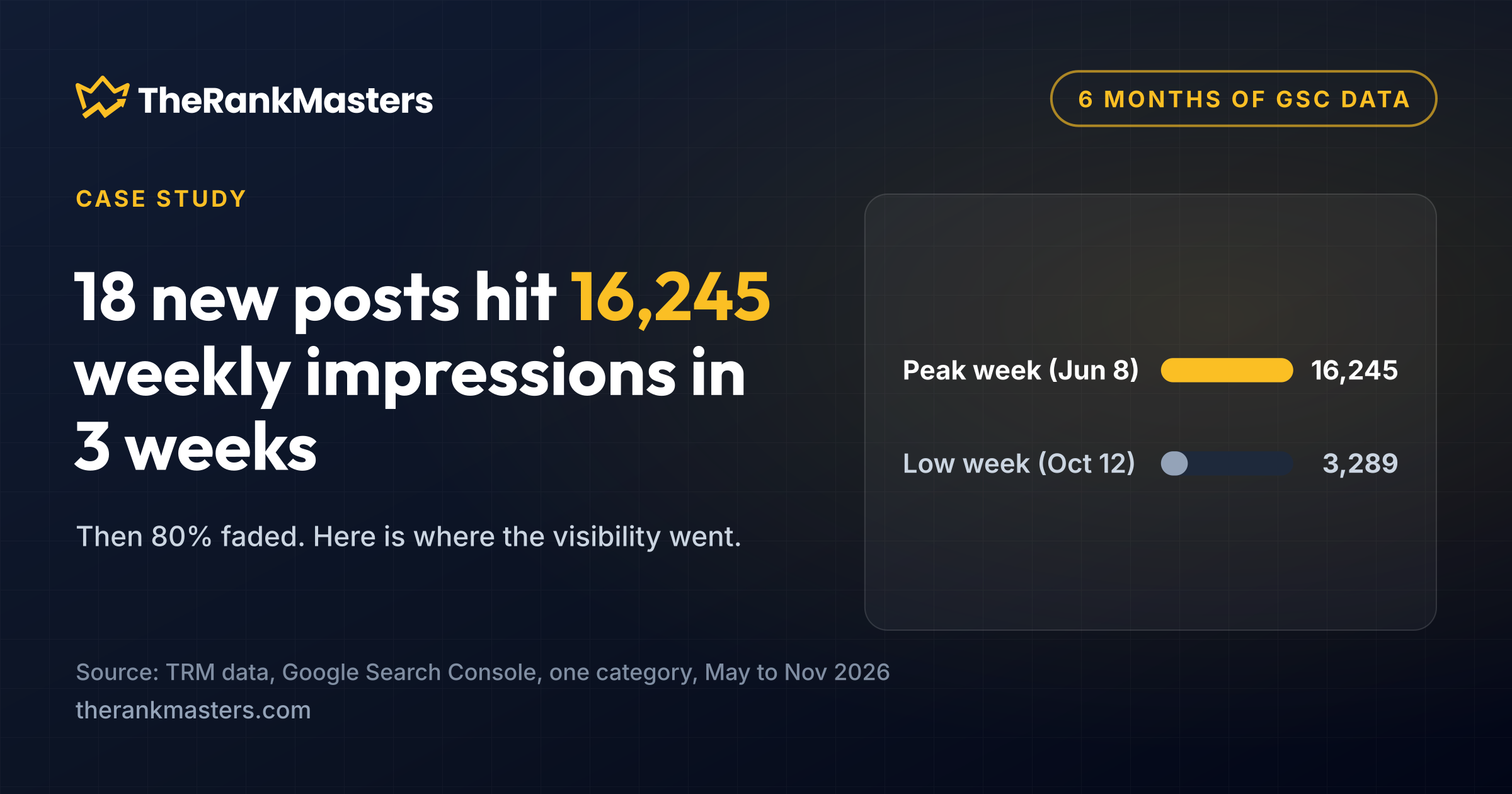
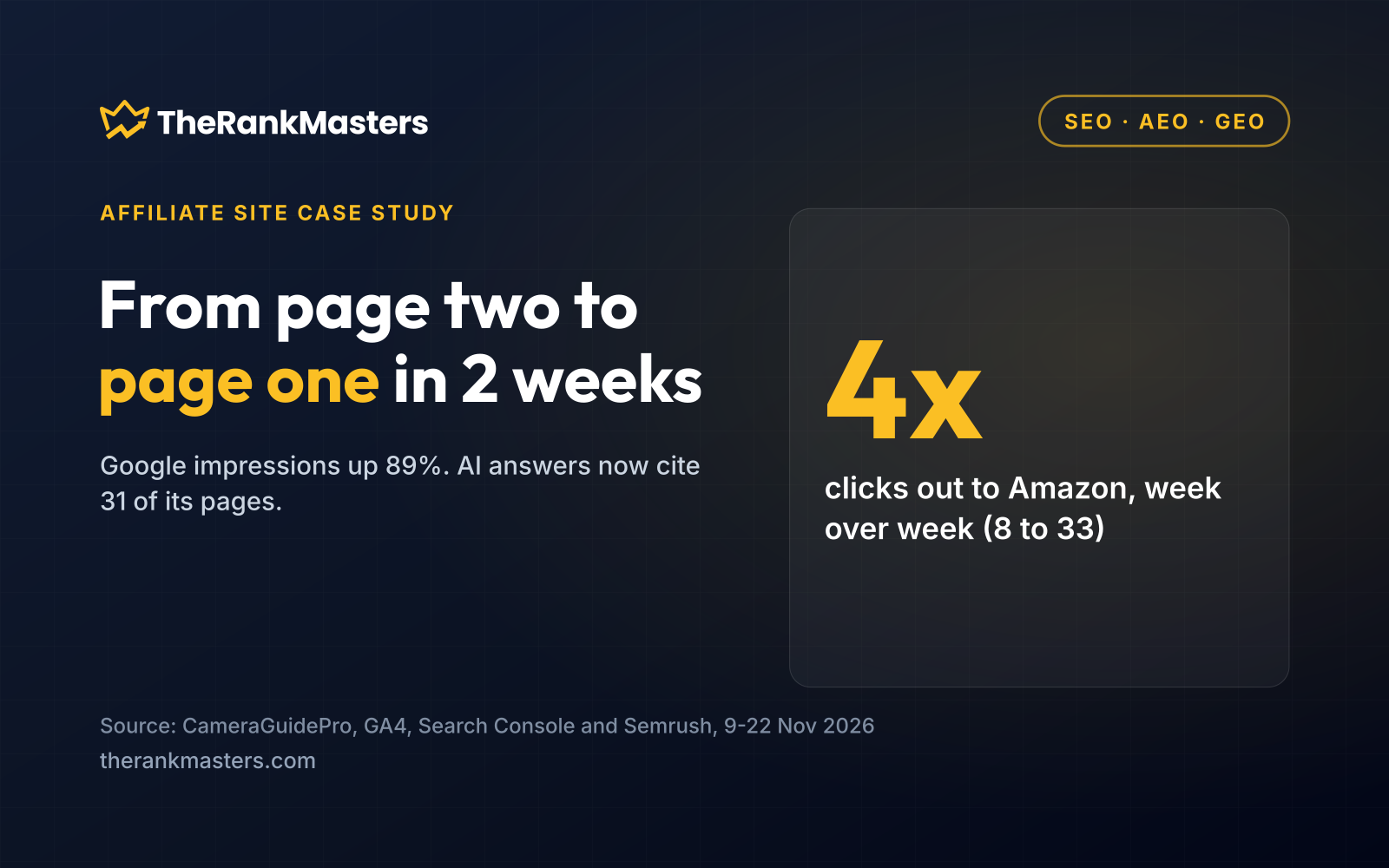
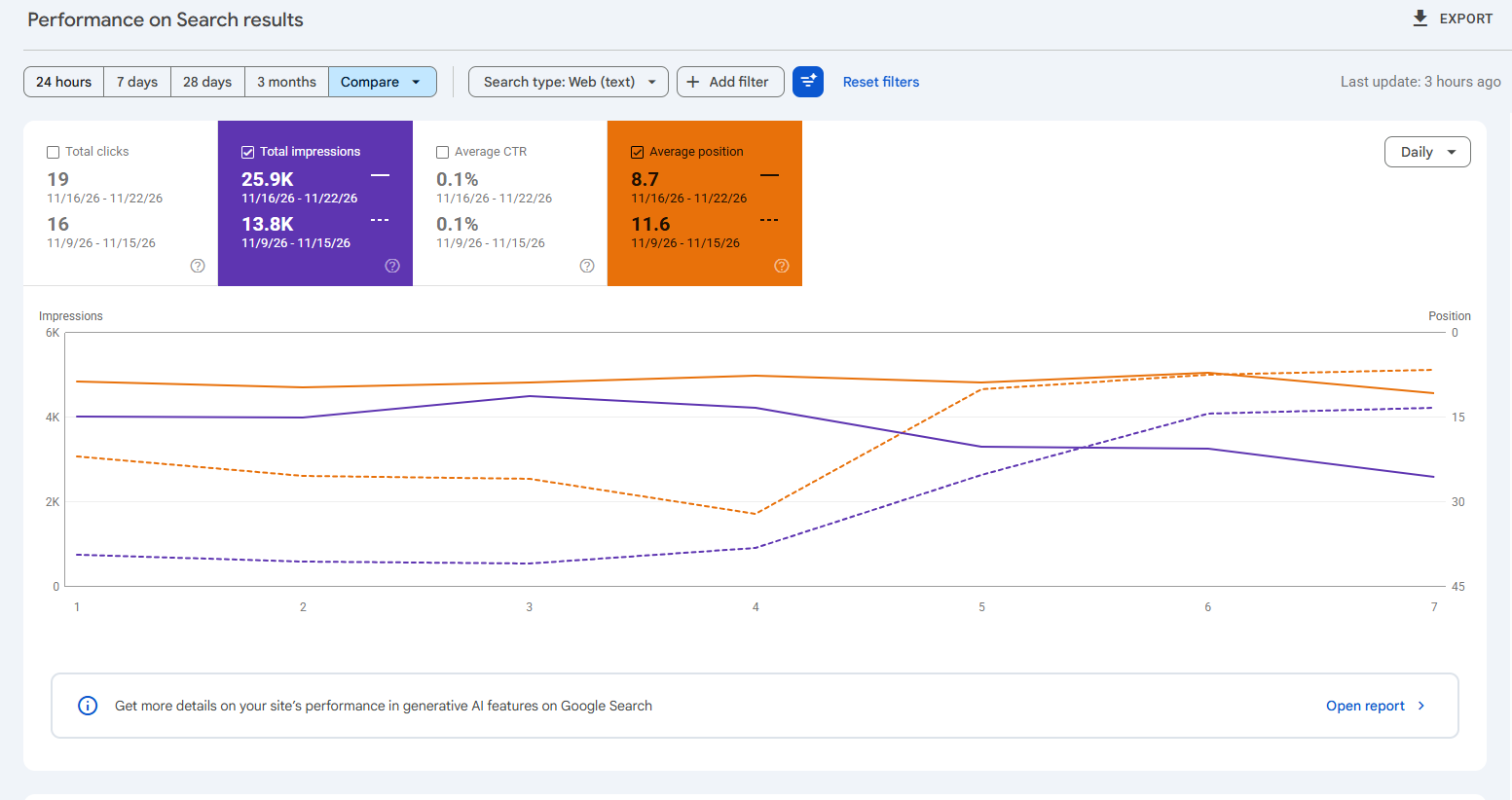
CameraGuidePro went from 8 clicks out to Amazon in a week to 33, two weeks after we switched on an automated SEO, AEO and GEO content engine. Over the same week, Google impressions rose 89%, visits from Google search rose 90%, and the average Google position moved from 11.6 to 8.7. That is page two to page one.
The numbers are small, because the site is small. The pattern is what matters. Pages chosen by data, rewritten so search engines and AI assistants can lift a clean answer, and kept in stock every day, started earning within a fortnight.
Sitting on a library of posts that rank on page two? A data-led content refresh is usually the fastest place to start.
Results At A Glance
CameraGuidePro is an Amazon-affiliate review site covering cameras, gimbals and accessories. These are its numbers for the latest week (16-22 Nov 2026) against the week before (9-15 Nov 2026).
| Metric | Week before | Latest week | Change |
|---|---|---|---|
| Clicks out to Amazon | 8 | 33 | +313% (4.1x) |
| People who clicked to Amazon | 4 | 10 | +150% |
| Visits from Google search | 41 | 78 | +90% |
| Engagement rate of Google visitors | 41.5% | 64.1% | +22.6 points |
| Engaged sessions from Google | 17 | 50 | +194% |
| Engagement time per Google visit | 1m 14s | 1m 32s | +23% |
| Google impressions | 13,769 | 26,013 | +89% |
| Average Google position | 11.6 | 8.7 | 2.9 places higher |
| Pages cited in AI answers | Not tracked | 31 pages in 44 prompts | Gemini, ChatGPT, Google AI Mode |
The short version: In two weeks the site moved from page two of Google to page one on average, nearly doubled its search visitors and quadrupled the clicks that earn affiliate revenue. AI assistants were already citing 31 of its pages.

Source: GA4 Traffic acquisition, Organic Search, 16-22 Nov vs 9-15 Nov 2026.
The Challenge
CameraGuidePro had a large library of buying guides, and Google was showing them. It just wasn’t sending readers on to buy. When we started, the site had four problems:
- Rankings stuck on page two and three: From 1 to 12 November, the average Google position was 24.9. Many guides sat at positions 10 to 25 for queries like “best camera for soccer” and “best 35mm film camera for beginners”, where almost nobody clicks.
- Stale product picks: Gear pages go out of date fast. Recommended products had sold out or been replaced by newer models, so readers who did click often found nothing to buy.
- Traffic that didn’t convert: Only 41.5% of Google visitors engaged with a page. In the week before the sprint, 41 search visits produced 8 clicks to Amazon.
- No plan for AI answers: Shoppers now ask ChatGPT, Gemini and Google’s AI Mode which gimbal or camera to buy. The site had no plan for being the source those engines cite.
The brief was simple. Get more of the right visitors, and get more of them to click through to the product, without a content team.
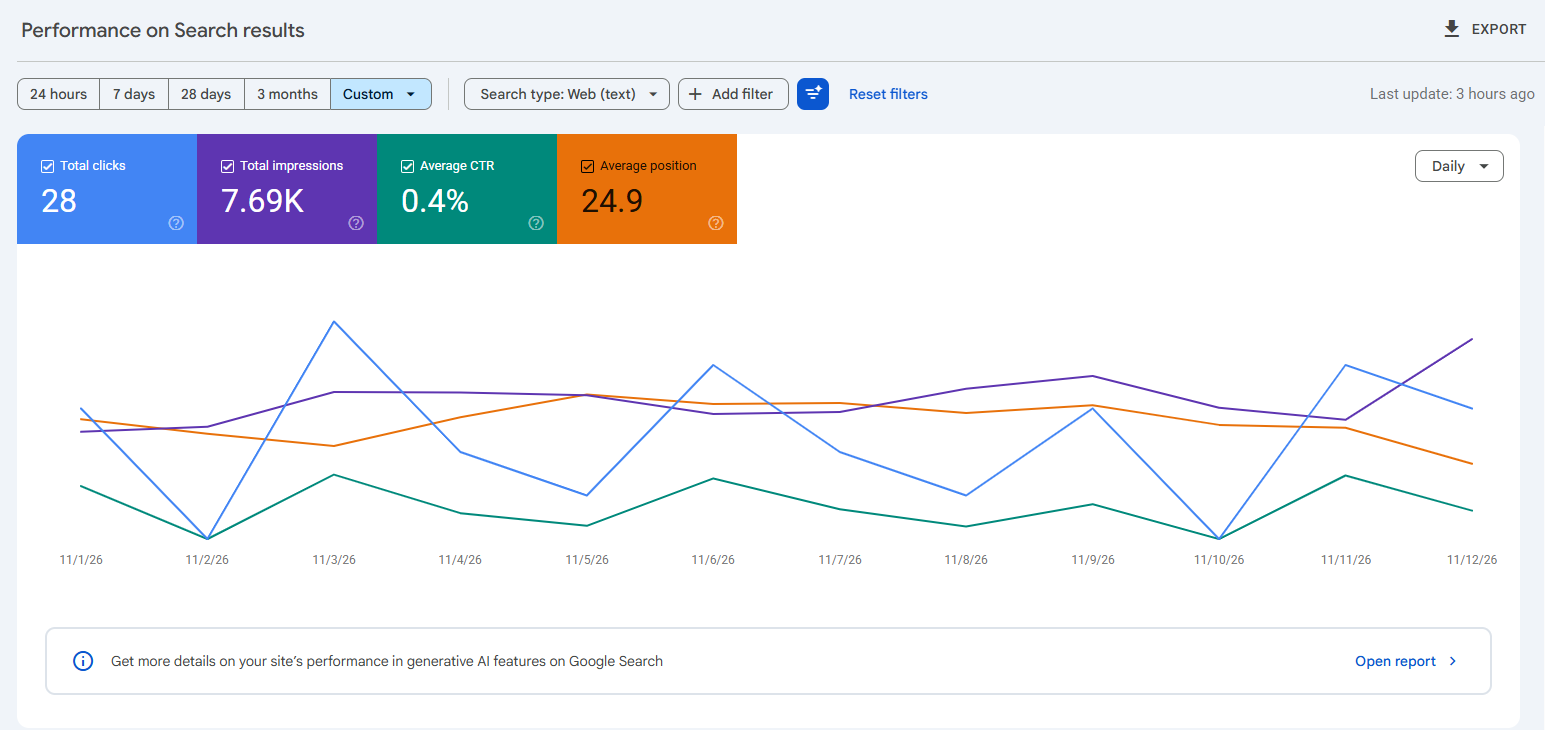
Source: Google Search Console, 1-12 Nov 2026. 7.69K impressions, 28 clicks, average position 24.9.
Our Approach: One Engine For SEO, AEO And GEO
We didn’t run search, answer engines and generative AI as three projects. We built one weekly loop that serves all three, and automated everything that didn’t need judgement.
1. Let The Data Pick The Work (SEO)
Every Monday the engine pulls 28 days of Search Console and GA4 data and ranks every page. It looks at four things:
- Money pages first: Pages that already earn Amazon clicks, especially if their position or impressions are slipping.
- Striking distance: Pages at positions 5 to 20 for buying queries, where a refresh can move them onto page one.
- Decliners: Pages whose impressions fell 30% or more.
- Gaps and launches: Buying queries where the site ranks below 15 or has no page at all, plus cameras and gimbals released in the last 60 days.
Every new topic also has to pass a commercial gate. It must be a buying search, have at least three in-stock products, not overlap an existing post, and be a query a real camera buyer would type. The output is a plan of 4 refreshes and 3 new posts a day.
2. Write For The Answer, Not Just The Ranking (AEO)
Every page is rebuilt so an answer engine can lift a clean answer from it. This is the core of answer engine optimization, and each page gets the same parts:
- An answer-first intro that names the top pick and who it suits in the first few lines.
- A comparison table of the picks with the same attributes on every row.
- Product sections with “best for”, pros, cons and real use cases.
- A buying guide built around the decisions shoppers actually face.
- An FAQ block with schema markup, written to the follow-up questions people ask.
3. Become The Source AI Cites (GEO)
Generative engines cite pages that are specific, current and consistent. So the engine does four things:
- Specs from the maker: Specs come only from the maker’s own product page, never from memory or other review sites.
- Live stock checks: Every product is checked against live Amazon data before it is recommended. Anything sold out or replaced by a newer model is swapped.
- Exact models: Pages name exact models, mounts and camera compatibility, so an AI engine can match a page to a precise question such as “best gimbal for the Sony ZV-E10”.
- Clusters around earners: A new “best gimbal for the Canon 6D” post links to its parent guide, and the parent links back.
4. Automate The Mechanics, Keep A Quality Gate
Claude researches and writes each article. An n8n workflow does everything mechanical, which means affiliate links, product images, daily stock checks and publishing. Nothing goes live until it passes an automated gate that checks for placeholders, untagged links, prices, word count, stock and keyword overlap. Anything that fails is held back with the reason written on its card.
What We Shipped And When
The engine took about a week to build and two weeks to show results. This is the timeline:
| When | What happened |
|---|---|
| Around 5 Nov | Engine built. Data pulls, planning rules, writer guide, quality gate and publishing automation. |
| 6-9 Nov | First refreshes drafted on pages that already earned Amazon clicks. |
| 13 Nov | Google impressions start climbing, from about 900 a day to 2,600 and then over 4,000. |
| 16-19 Nov | Daily runs continue. Refreshes plus new supporting posts, all gated before going live. |
| 20-22 Nov | Weekend sprint. 9 new posts and 12 refreshes in three days. |
| 22 Nov | A stock check flags a gimbal guide whose top picks sold out. The engine swaps in in-stock products and republishes the same day. |
- New posts in the sprint: All supporting or launch topics, each linked into a cluster. Pocket 3 and Pocket 4 accessories, kayak camera mounts, lenses for bird photography, wireless mics for iPhone, action cameras for motorcycles, lenses for the Sony a6400, GoPro HERO13 Black accessories, Nikon ZR accessories and SD cards for GoPro.
- Refreshes in the sprint: Striking-distance and earning pages. Kayaking cameras, compact cameras under $500, indoor cameras for the elderly, monitors for photo editing, gimbals for social-media creators, smartphone tripods, travel and video cameras, action cameras under $100, boat and car gimbals, affordable film cameras and DSLRs for filmmaking.
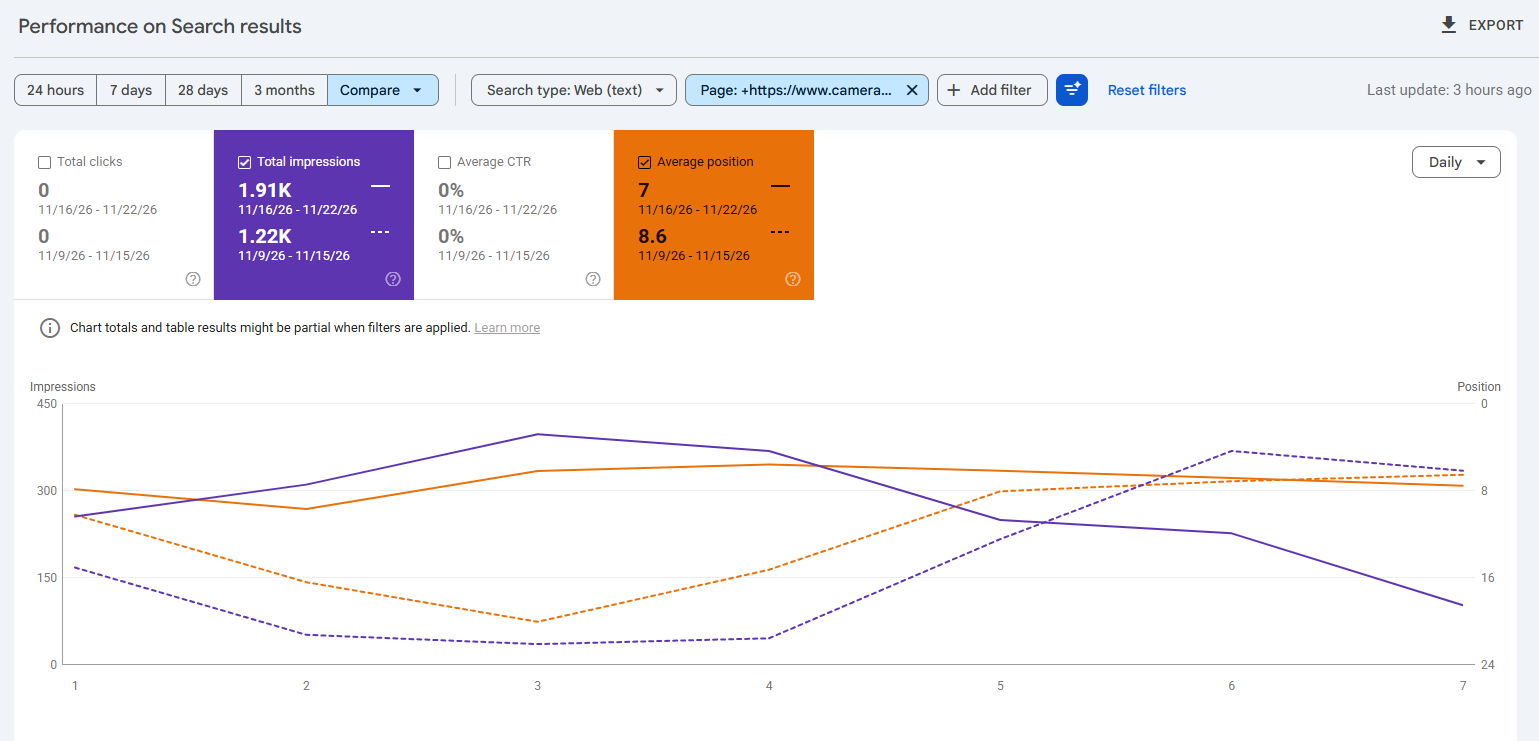
Source: Google Search Console, Best Compact Camera Under $500 page (refreshed 20 Nov), 16-22 Nov vs 9-15 Nov 2026. Impressions rose from 1.22K to 1.91K and average position moved from 8.6 to 7.0.
Result 1: Google Moved The Site Onto Page One
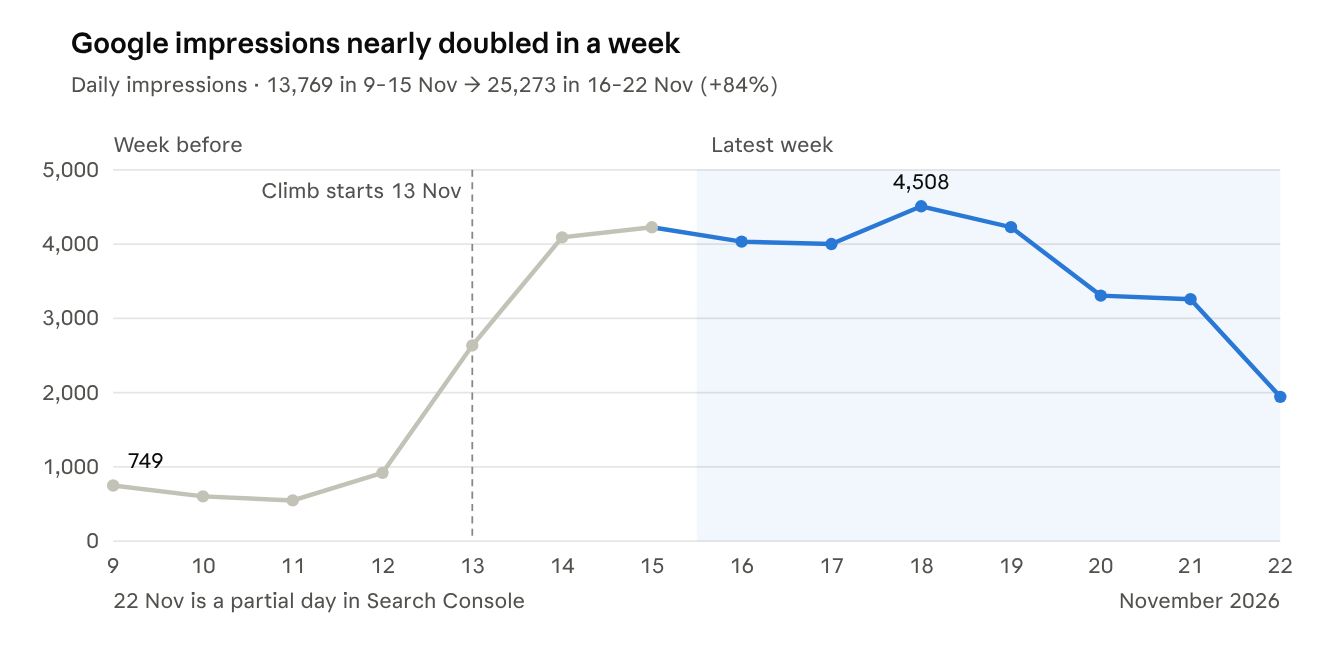
Source: Google Search Console, sc-domain:cameraguidepro.com, daily impressions, 9-22 Nov 2026.
Impressions began climbing on 13 Nov, before the weekend sprint. That is when Google had re-crawled the first refreshes from 6-9 Nov and the new supporting posts. Since then it has averaged about 3,700 impressions a day, close to six times the early-November average of about 640.
Average position followed the same path. It was 24.9 from 1 to 12 November, 11.6 in the week of 9 to 15 November as the climb began, and 8.7 in the latest week.
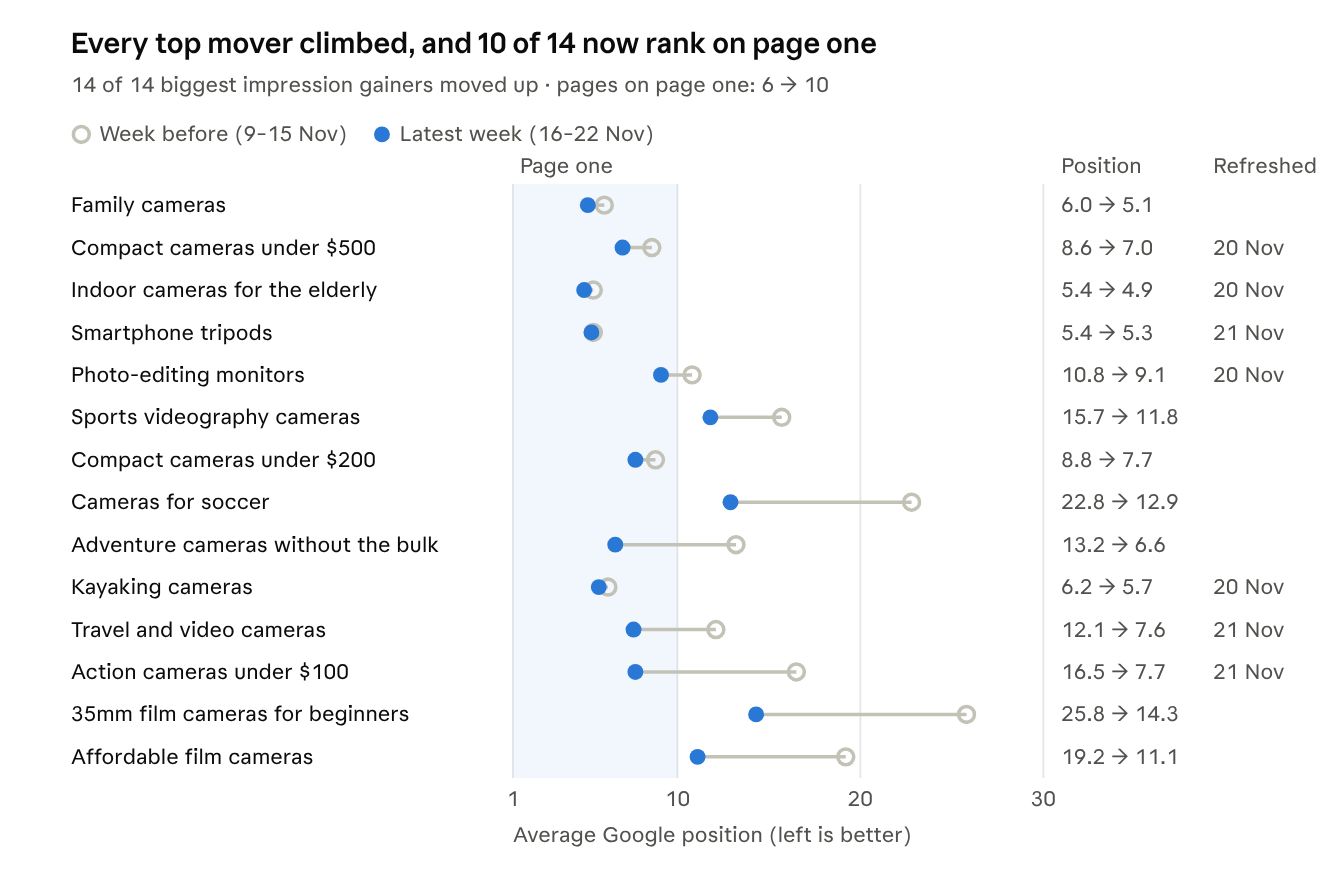
Source: Google Search Console, the 14 pages with the largest impression gains, average position 9-15 Nov vs 16-22 Nov 2026.
The gains weren’t confined to the pages we touched. Untouched guides in the same clusters rose too. Soccer cameras went from 22.8 to 12.4, and Canon lenses for cinematic footage from 25.0 to 16.8. That is what happens when a site’s topical coverage, internal linking and freshness improve together. Google rewards the whole cluster, not only the edited page.
Source: Google Search Console, 16-22 Nov vs 9-15 Nov 2026.
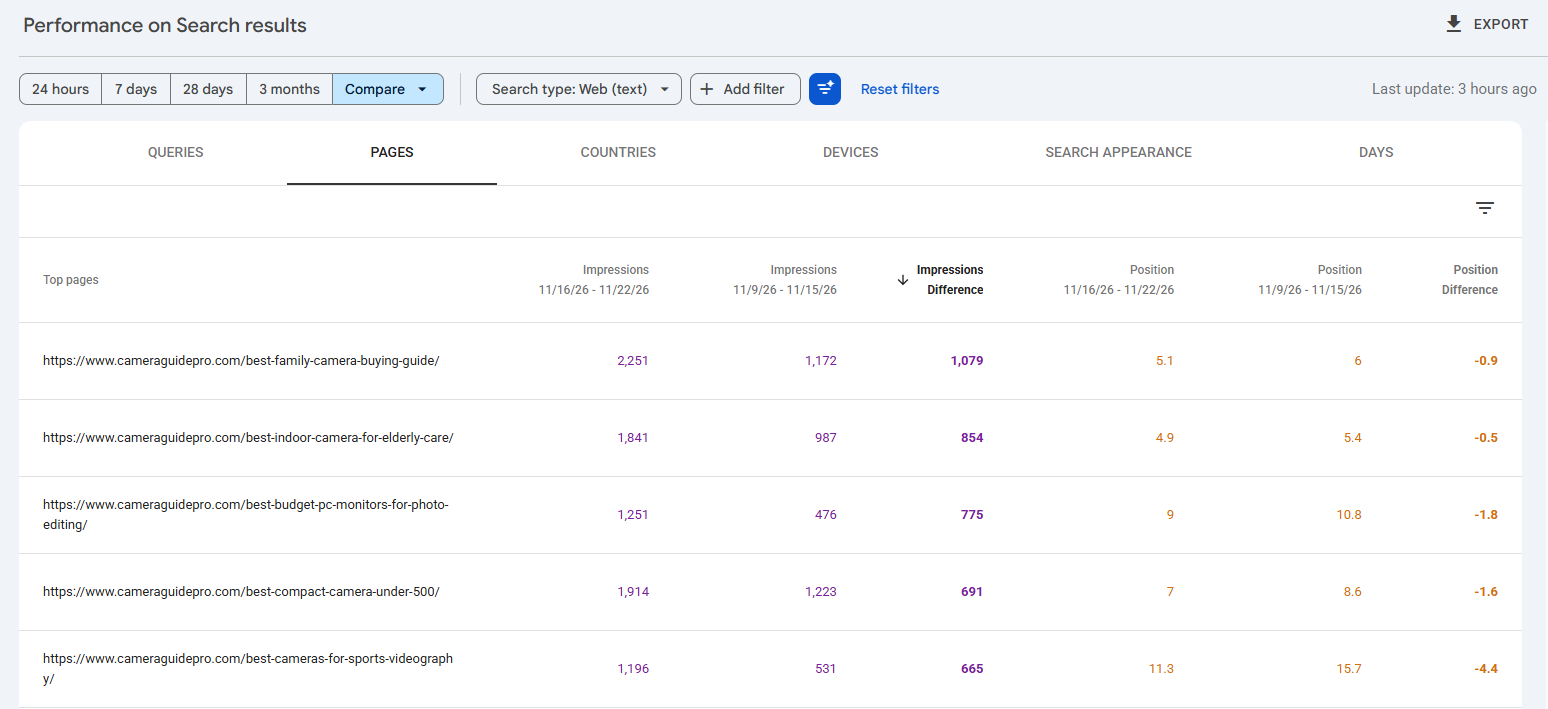
Source: Google Search Console Pages report, sorted by impressions difference.
Result 2: Four Times The Clicks That Earn Revenue
Rankings are a means. For an affiliate site, the number that pays is the click through to the product.
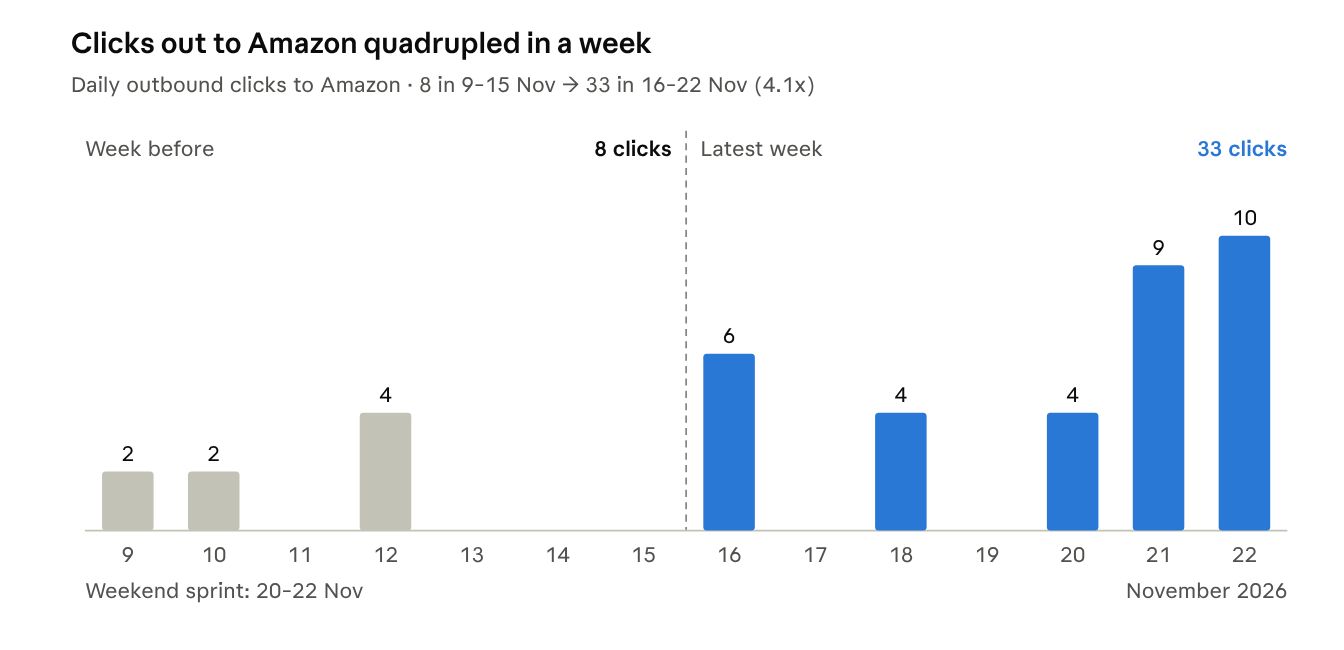
Source: Google Analytics 4, click events to amazon.com and amzn.to links, 9-22 Nov 2026.
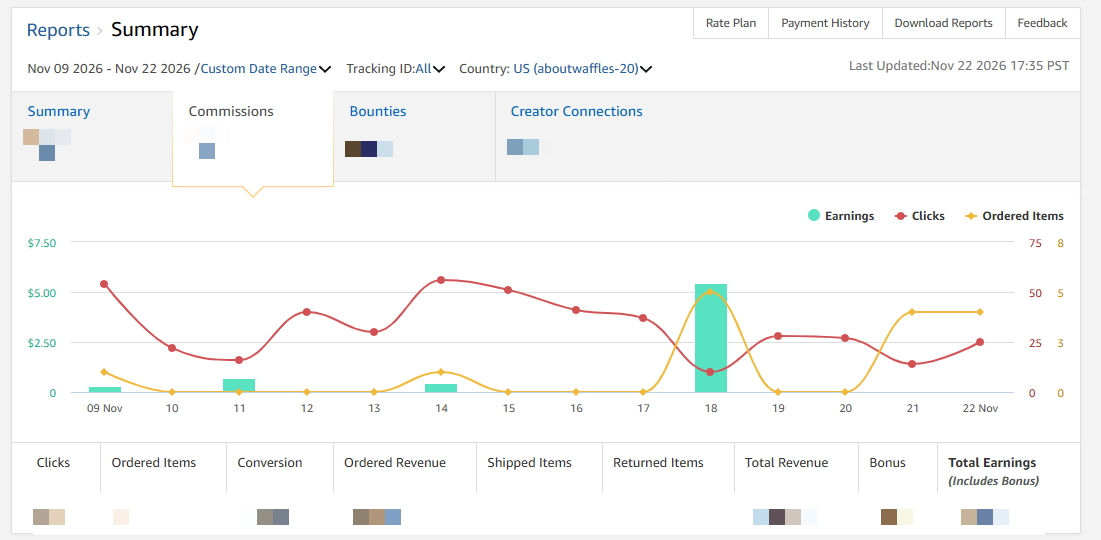
The weekend sprint produced the two best days of the period, with 9 clicks on 21 Nov and 10 on 22 Nov. The bigger story is where the clicks came from. In the week before, four pages earned 2 clicks each. In the latest week, seven different pages sent readers to Amazon, and none of them had earned a click the week before:
- Gimbals for the Sony ZV-1: 9 clicks
- Gimbals for social-media creators (refreshed 21 Nov): 8 clicks
- Bridge cameras for birding: 4 clicks
- Gimbals for the Canon 6D: 4 clicks
- DJI Pocket 3 vs Creator Combo: 4 clicks
- Auto-tracking cameras for basketball: 2 clicks
- Canon lenses for real-estate photography: 2 clicks
The quality of search traffic rose too. The share of Google visitors who engaged with a page went from 41.5% to 64.1%. Engaged sessions from Google nearly tripled, from 17 to 50, and the average visit grew from 1m 14s to 1m 32s. People were landing on pages that answered their question, with in-stock products they could act on. That is the job revenue content is built to do.

Source: GA4 Explore, click events to Amazon links, 16-22 Nov vs 9-15 Nov 2026.
Result 3: AI Assistants Cite The Site By Name
Shoppers now ask AI assistants which gear to buy. Semrush’s AI Visibility Toolkit tracks which pages Gemini, ChatGPT and Google’s AI Mode cite when they answer. Its latest export for CameraGuidePro shows:
- Buyer prompts: 44 prompts where an AI answer cites cameraguidepro.com as a source.
- Pages cited: 31 unique pages. Semrush’s Cited Pages report lists 36, because it counts a page once for each country where it was cited.
- AI engines: Gemini (35 prompts), ChatGPT (7) and Google AI Mode (2).
- Countries: 17, from the US, India and the Netherlands to Brazil, Japan and Qatar.
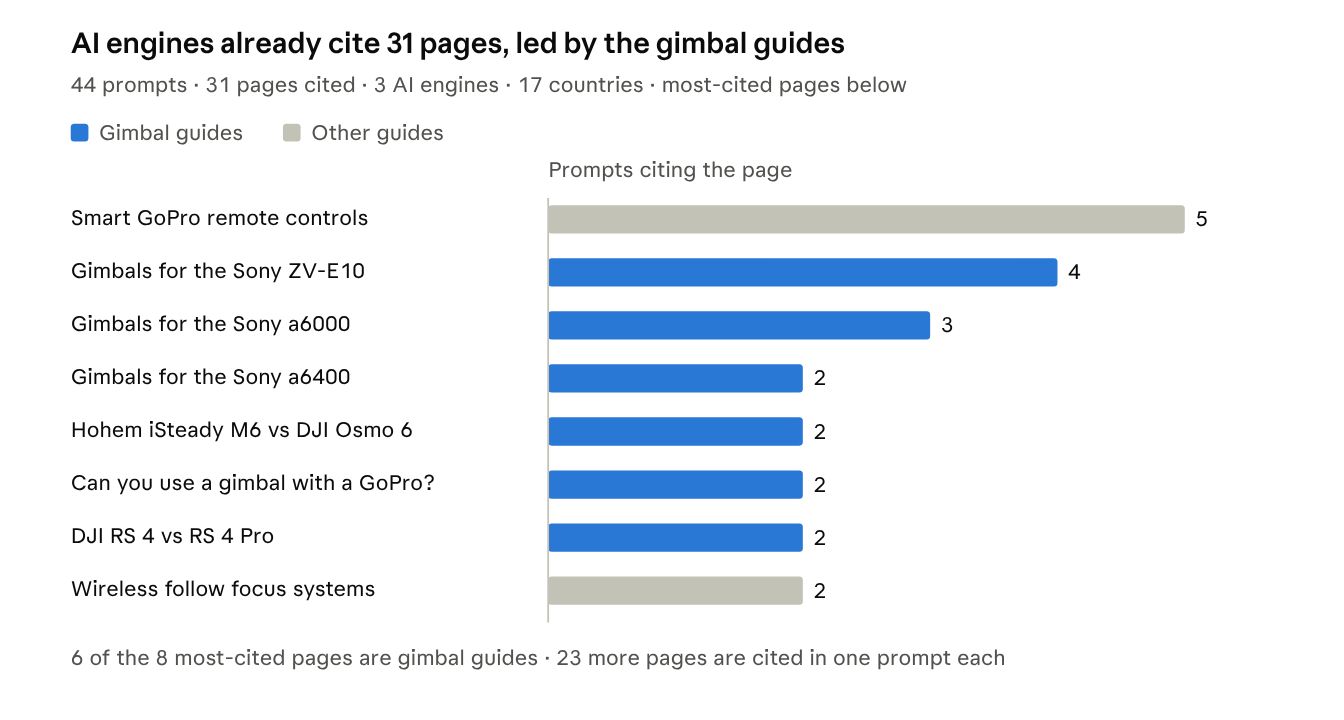
Source: Semrush AI Visibility Toolkit, cameraguidepro.com, worldwide, sources and prompts exports, 23 Nov 2026.
The prompts are buying questions, the same intent the engine targets in search. “Best gimbal for smooth video with the Sony ZV-E10.” “How do DJI gimbals compare to other brands.” “What accessories are essential for the DJI RS 3 Mini.” Semrush groups them into topics led by soccer cameras and tracking devices, DJI RS 4 gimbals and DJI Ronin RS 3 gimbals, with a combined Semrush topic volume of over 114,000 across the exported topics.
This is where SEO and GEO meet. The pages AI engines cite are built the way the engine builds every page, with an exact model in the title, specs from the maker, a clear comparison and a direct answer. The gimbal cluster is the densest on the site, and it dominates the citations. If you want to see how this works on a SaaS site, our PSOhub AEO and SEO case study shows the same approach earning AI citations in 90 days.
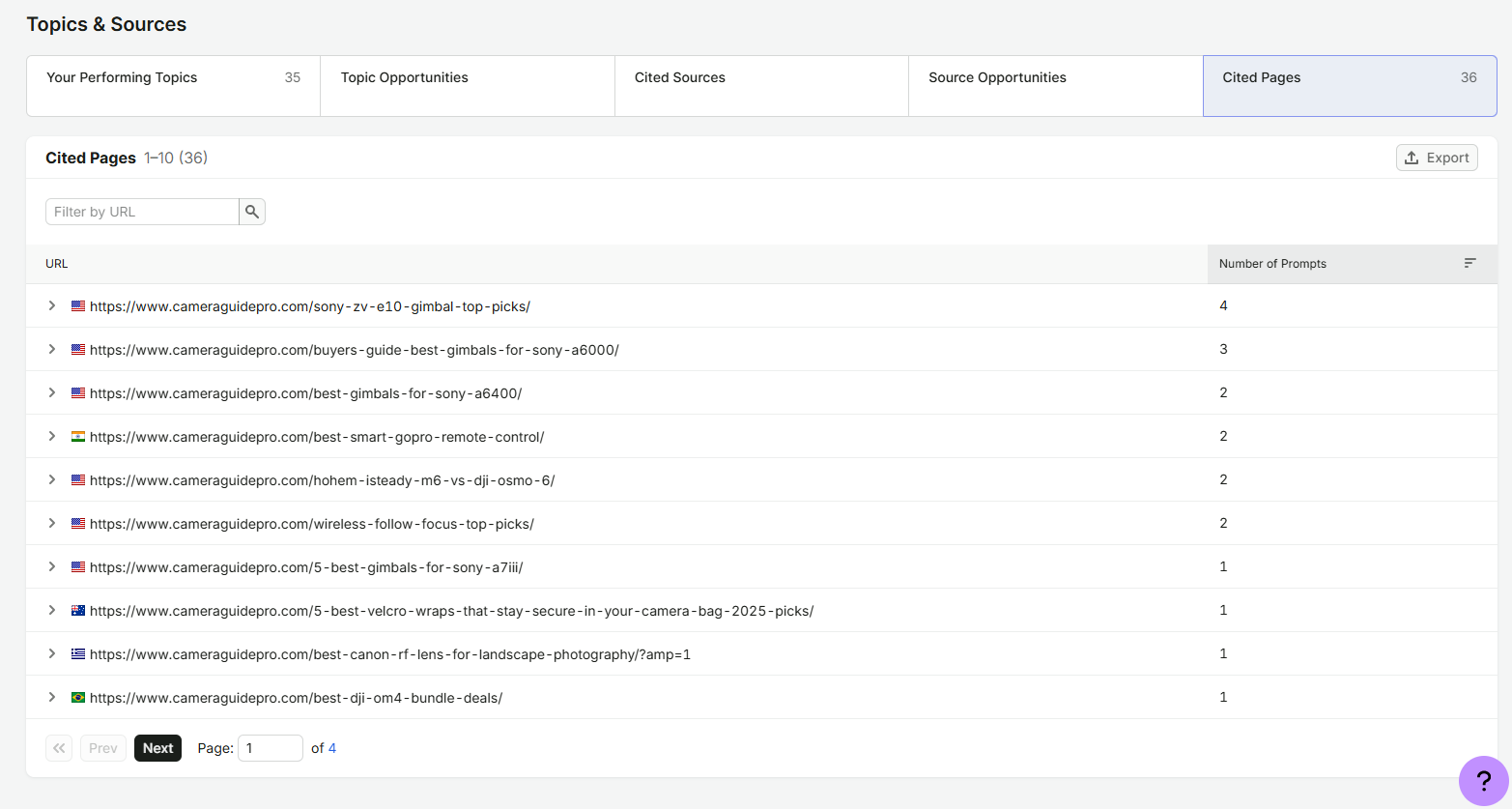
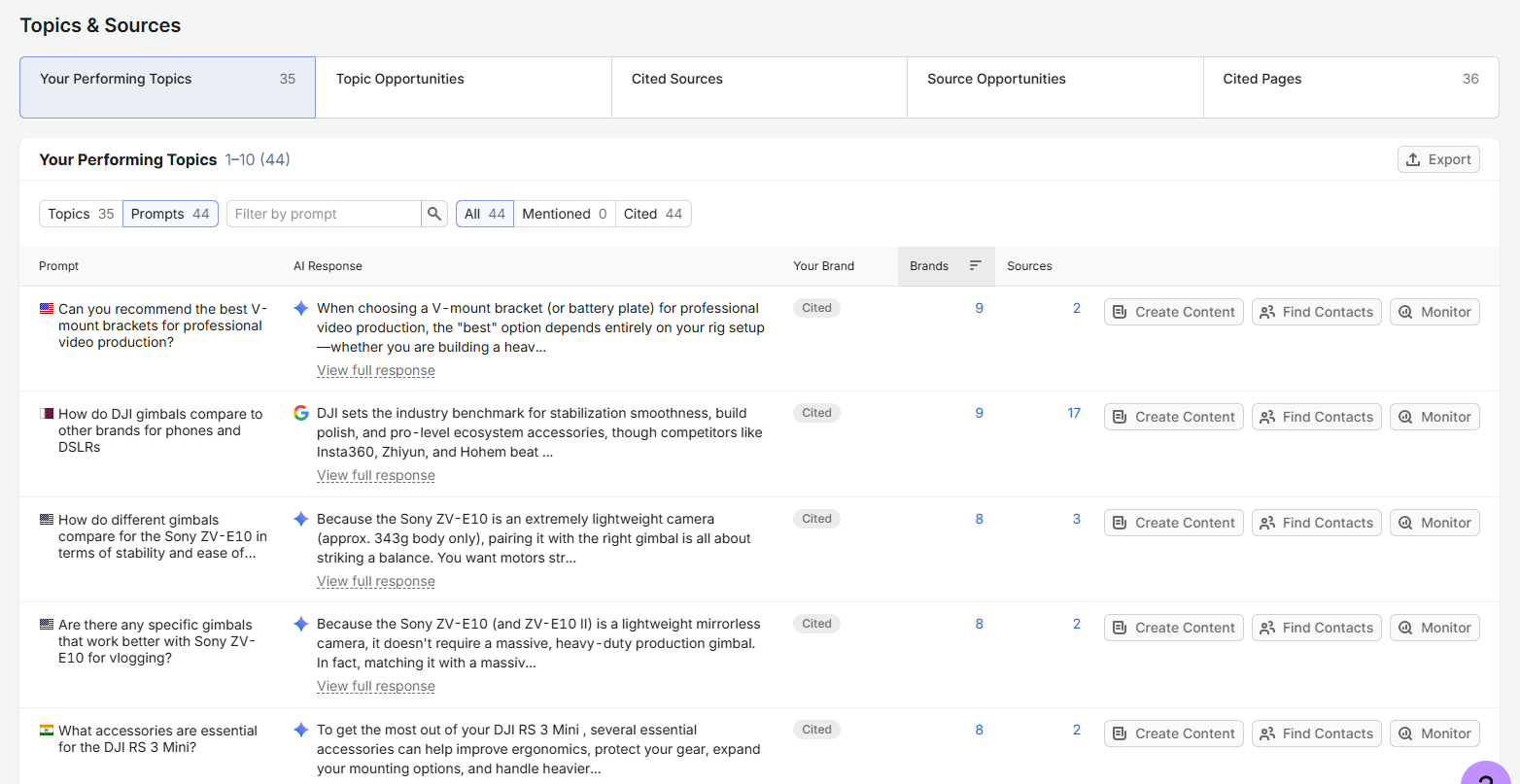
Source: Semrush AI Visibility Toolkit, cameraguidepro.com, worldwide, 23 Nov 2026.
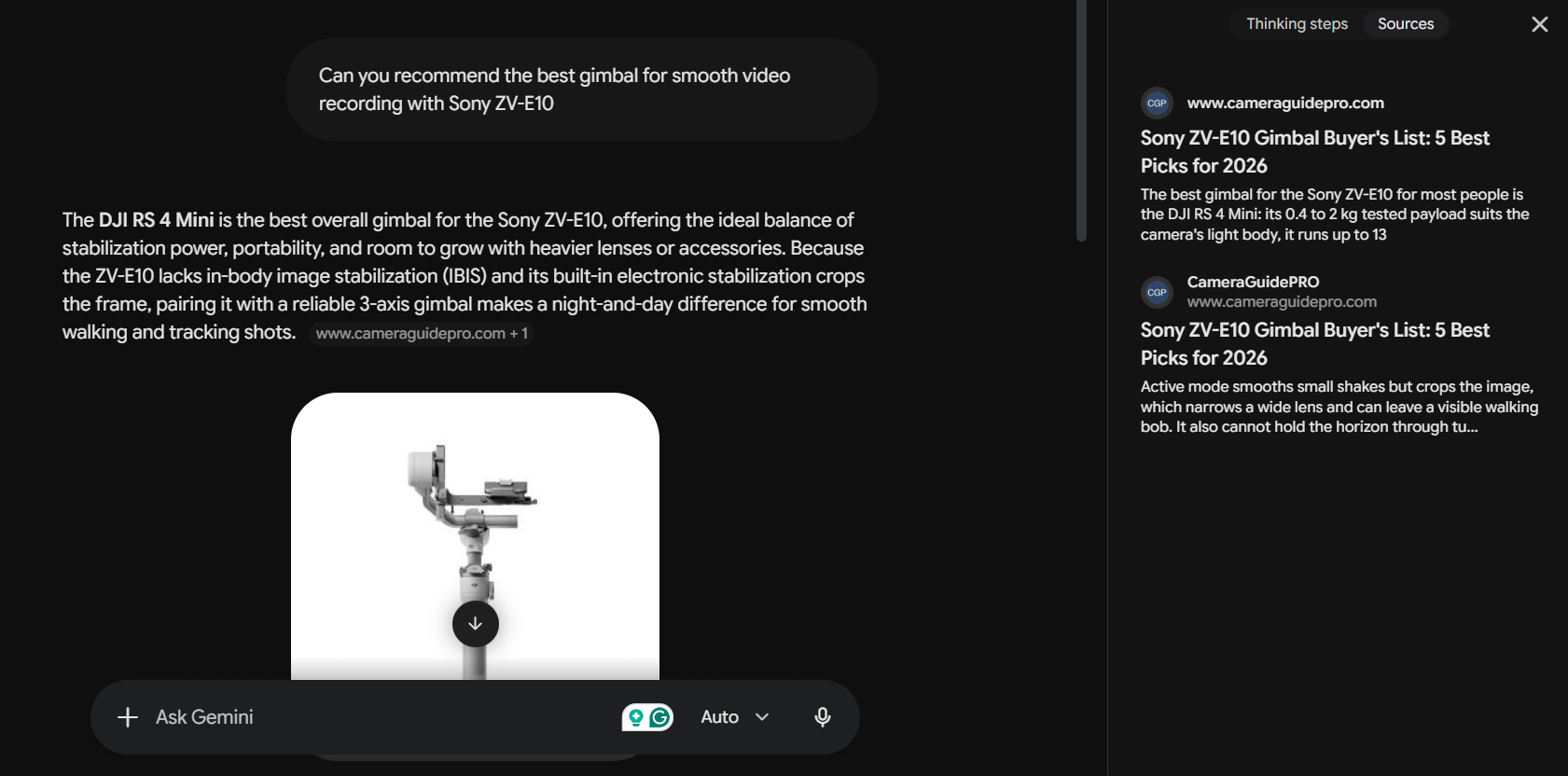
Source: Gemini, asked “Can you recommend the best gimbal for smooth video recording with Sony ZV-E10”.
Want to know which AI answers already cite you, and which cite your competitors instead? Our AI search visibility work starts with exactly that map.
What Made The Difference
None of these tactics is new. The results came from running them together, every day, on the pages the data said mattered.
- Data decides, not opinion: Every refresh and every new post had a reason written on its card, whether Amazon clicks, impressions, a striking-distance position or a rising query. Nothing was written because it seemed like a good idea.
- Clusters over one-offs: New posts were built around pages that already earned, such as Canon 6D gimbals, Pocket 3 accessories and Sony a6400 lenses, and linked both ways. Google and AI engines both reward a site that covers a topic in depth.
- Sold-out picks lose the sale: A guide that recommends unavailable gear loses the click even when it ranks. A daily stock check flags broken picks, and the engine replaces them, usually the same day.
- Write for extraction: Answer-first intros, consistent comparison tables, “best for” labels and FAQ schema make it easy for Google’s snippets and for AI assistants to quote a page accurately.
- Speed with a safety net: Seven articles a day is only safe with an automated quality gate. Nothing broken, untagged or out of stock reaches a reader.
Try It On Your Site: The 7-Day Starter Plan
You don’t need the full engine to start. This is the same loop, done by hand in one week:
| Day | Do this |
|---|---|
| 1 | Export 28 days of Search Console pages and queries. List pages at positions 5-20 for buying queries. |
| 2 | In GA4, find which pages already send clicks to your money pages or partners. These are your refresh priorities. |
| 3 | Refresh the top three with an answer-first intro, a comparison table, current picks and an FAQ with schema. |
| 4 | For each refreshed page, plan two supporting posts (accessories, X vs Y, best X for a model) and link them both ways. |
| 5 | Check every product or offer you recommend is still available, and replace anything that isn’t. |
| 6 | Run your top buying questions through ChatGPT, Gemini and Perplexity. Note which sites they cite and what those pages do that yours don’t. |
| 7 | Compare this week with last in Search Console and GA4. Then make it a weekly loop. |
Doing this every week, across hundreds of pages, is where the work gets heavy. That is what our GEO and SEO Growth Programme runs for you.
Frequently Asked Questions
What Is The Difference Between SEO, AEO And GEO?
How Long Did It Take To See Results?
Were The Results Caused By The Weekend Sprint?
Why Did Pages That Were Not Refreshed Also Climb?
How Do You Measure AI Visibility?
Does Keeping Products In Stock Really Matter For SEO?
Can This Approach Work For A SaaS Or Service Business?
What Tools Does The Engine Use?
Want the same engine pointed at your site? Book a free 30-minute call and we’ll show you where your fastest wins are. Not ready to talk yet? Start with a free AI Visibility Report.